Showing posts with label Black Lives Matter. Show all posts

Thursday, June 18, 2026

A lesson for us all

Last Sunday in church I had an unexpected experience. At the end of the service, the musician launched into a stirring rendition of James Weldon Johnson's hymn, "Lift Every Voice and Sing" -- otherwise known since the early 20th century as the "Black (or Negro) national anthem." 
 
In the sort of overwhelmingly white churches I attend, the hymn has become a commonplace. There was an era when a gay community whose men were dying in droves during the worst of HIV/AIDS took it up enthusiastically. That made a certain emotional sense; the lyric speaks the joy of the dismissed and discarded.
 
Yet I have been uncomfortable. The practice smacked of cultural appropriation; what right did a bunch of historically illiterate white Americans have to Black Americans' hymn of liberty?
 
Now the Trump administration has sought to erase the federal holiday that marks Juneteenth, the day of liberation from chattel slavery for four million Americans. No more free admission to National Parks to mark Black liberation under the MAGA regime!
 
Civil War historian Kevin M. Levin discusses why it feels so much more plausible and honest for us all to celebrate Juneteenth in this awful year when Donald's decrepitude tries to overrun us all.
Juneteenth Is Not Someone Else's Story 
Emancipation didn't just free four million people. It rebuilt the country the rest of us still live in.
 
... Juneteenth is a federal holiday now. It belongs to the country, which I understand to mean that it belongs to all of us, and not in some abstract, ceremonial sense. Emancipation did not simply liberate four million enslaved people and leave everyone else untouched. It rewrote the Constitution, redefined citizenship, and forced a reckoning over federal power that still shapes our politics. It launched a fight over Reconstruction whose outcome determined who could vote and who counted as a full citizen, a fight whose unfinished business runs through Jim Crow, through the civil rights movement, and into our own disputes over voting rights and equal protection.
 
... None of us, whatever our ancestry, lives outside the world that emancipation built. 
I am not ceding anything. This is part of my history too, not because I share an ancestral claim to bondage or liberation, but because I am an American living inside the consequences of that rupture and the story of how four million people moved from slavery to freedom is the central drama of this nation’s history.
 
... Black Americans inherited Juneteenth as lived memory, as family history, as a chain of testimony passed down with a weight and intimacy I will never replicate. Nor do I have any interest in attempting to do so.
 
... Nobody should cede this story. Juneteenth is the only national holiday that celebrates the freedom of over four million people, in a nation that has long claimed to be ‘exceptional’ in advancing freedom. We should all be reaching for it, from wherever we stand, both as historians and students of history. Because a nation that only half remembers its emancipation has not yet finished becoming free.

This Juneteenth, it behooves us to celebrate emancipation and refuse to cede our aspirations for more perfect freedom.

Lift every voice and sing,
'Til earth and heaven ring,
Ring with the harmonies of Liberty;
Let our rejoicing rise
High as the list'ning skies,
Let it resound loud as the rolling sea.
Sing a song full of the faith that the dark past has taught us,
Sing a song full of the hope that the present has brought us;
Facing the rising sun of our new day begun,
Let us march on 'til victory is won."
 

Sunday, September 14, 2025

Target's broken promises to Black community spur boycott

When an economic actor is already on the skids, that's the moment to push harder, not to compromise. 

Under intense competition from the likes of Walmart and Amazon online, Target -- the huge mid-American retailer -- has plenty to worry about. Consumers are complaining of messy stores and poorly stocked shelves. 

The number of Americans who say they regularly shop at Target has gone down 19% since 2021, according to GWI, a behavioral attitudinal data provider. The number of Americans who say they do not shop at Target has risen 17%. 

Further, Target is backing out of promises made to the African American community.

... the company had heavily touted a commitment to DEI back in 2020 after protests erupted across the nation over the murder of George Floyd. That year, Target announced it would increase representation of Black staff by 20% over three years and invest $10 million in social justice organizations. In 2021, the company pledged to dedicate more than $2 billion toward Black-owned businesses before the end of 2025.

In January, however, Target said it would conclude the hiring and advancement goals it had set. 

Then the company contributed $1 million to Donald Trump's inauguration fund ...

African American leaders think the retailer owes respect to its customers' community, not to a billionaire President.

Pastor leading Target boycott on its impact and the retailer's response
Target is reeling as sales have stalled and its stock price has plunged. The company faced backlash after a rollback of its DEI initiatives prompted a boycott that slowed store traffic nationwide, one of the factors that pushed CEO Brian Cornell to step down. Now, Target is scrambling to reset its image. Geoff Bennett discussed more with Pastor Jamal Bryant, who spearheaded the Target boycott.

Interviewer Geoff Bennett: ... Why single out Target when this appears to be a broader corporate retreat? 

Pastor Jamal Bryant, senior pastor of New Birth Missionary Baptist Church in Georgia: After the inauguration of Trump, 23 corporations backed away from inclusion and we thought it prudent to just go after one at the time. The African American community spends upwards of 12 million dollars a day at Target. We thought that the one that was the most trafficked should be the focus of our media attention. 

Bennett: ... it's striking that Target hasn't reinstated its DEI program even as it struggles with declining sales, sluggish foot traffic. ...

Pastor Bryant: I think that diversity is in as much danger as democracy is. The president of Target as well as of Amazon and Walmart met with the President [Trump] back in February. I think they have held on to his admonishment more than what the consumers are clamoring to say. 

Bennett: ... [Target] highlights a $2 billion investment in Black-owned businesses, more than doubling the number of Black-owned brands on its shelves, supporting more than 500 entrepreneurs, completing a more than $100 million investment in Black-led community organizations. Why do you see those efforts as insufficient?

Pastor Bryant: ... they produce no receipts. $2 billion but they have not been forthcoming as to what entities are the recipients of it. ... We'd love to put a ribbon on it, but if Black companies or Black banks were the recipients, they would be clamoring to announce it and yet we're in the silence of the lambs. ...

... [Target] is one of the lead employers of African Americans. They are the beneficiaries of African American consumption.

... When George Floyd died, they made the pledge of $2 billion and then it stalemated. It was supposed to be turned over to us on July 31. And we still are not seeing anything. We are reasonable and amenable... but none of those requests have been responded to.

Bennett: What's the end game if Target does not meet your requests?

Pastor Bryant: Then they will continue to hemorrhage. ... with 9.7 percent of foot traffic being slowed down, online sales being slowed down, the stock continuing to plummet ... I think it is time of for the share holders to make their voice clear ...

The Montgomery bus boycott went for a year and a day. This is just our fifth month. ...

Bennet: How do you see yourself leveraging this kind of power on other issues?

Pastor Bryant: ... this is the first real organizing power of Black economic strength in 70 years and a lot of  corporations are waiting to see what will be the outcome ... this generation needs a victory, that our collective works are not in vain ...

This boycott is the real thing -- not just performative hand waving. Like the Tesla Takedown, the boycott takes aim at a corporation which counts on the good reputation of its brand and which is fouling that brand through association with the Trump regime. And it hurts Target. Market researchers report

Since last year, the number of regular Target shoppers who identify as Democrat has declined 13%. Inversely, the number of Republican customers has risen 13%. It's not clear if that is due to Target’s $1 million donation to Trump's inauguration or some other factors. 

The boycott is spreading beyond its founding base in Black churches. Over Labor Day, the American Federation of Teachers joined the movement, hoping to cut into Target's Back to School business.  

AFT President Randi Weingarten explained: 

This movement comes at a crucial moment—when American workers find themselves at the whim of billionaires and board rooms that are more invested in money over people. We want this resolution—and the full weight of our nearly 2 million members—to be a reminder to Target that there are consequences to dismissing the will of the American worker and that, until they do right, our members will be spending their money in places they feel respected and recognized. 

Boycott Target! This is yet another way to assert there's more to this country than MAGA!  

Wednesday, March 05, 2025

The war over our history

Did you know that one of Donald Trump's golf courses included a Civil War battlefield? Neither did I, but the Orange Toddler wants you to believe it did. 

 
He's not picking sides ... he's not yet saying he'd be all for the Confederate cause of preserving slavery. But we can guess. 
 
Much more from Kevin M. Kruse on the Trump/Hegseth zeal to rename military bases which lost their Confederate names during the necessary historical reassessment triggered by the Black Lives Matter movement.

Monday, April 01, 2024

Department of strange bedfellows

When you are up against the threat of fascism, you have to be willing to inhabit, always uncomfortably, a big tent. 

So these days, I find myself listening to and cheering on Never Trump folks at The Bulwark and elsewhere. They are stalwart at working to defeat Trump and MAGA and they have suffered for their determination. They have lost their tribe; that is a terrible human injury.

Yet they believe so many things I find appalling ... They think Ronald Reagan was a hero of human freedom; I think he was the butcher of Central American aspirations for justice and democracy. They think it's somehow morally wrong to forgive student debt; I think this policy is simply making whole people who've been victims of a con. They applaud Joe Biden's support for Israel's war on Palestinians; I think he's lost the moral thread.

And perhaps most counter-factually in my view, they think the racial reckoning sparked by George Floyd's murder-by-cop was mass violence unleashed. That's just hooey. According to the international Armed Conflict Location & Event Data Project (ACLED), researchers concluded that these events, largely inspired by the Black Lives Matter movement, were "overwhelmingly peaceful."

The vast majority of demonstration events associated with the BLM movement are non-violent. In more than 93% of all demonstrations connected to the movement, demonstrators have not engaged in violence or destructive activity. Peaceful protests are reported in over 2,400 distinct locations around the country. Violent demonstrations, meanwhile, have been limited to fewer than 220 locations under 10% of the areas that experienced peaceful protests. In many urban areas like Portland, Oregon, for example, which has seen sustained unrest since Floyd’s killing, violent demonstrations are largely confined to specific blocks, rather than dispersed throughout the city.

Sure, there were a few places where there was considerable violence -- in addition to a few blocks of Portland, Kenosha comes to mind. 

And there were quite a few locations where polices forces, angry at seeing their free use of excessive force challenged, reacted to protesters with violence of their own. Remember Martin Gugino, the 76-year-old white protester who had his skull cracked by Buffalo police? After video of the incident went viral, two officers were suspended, but eventually returned to duties as if nothing had happened. 

Via El Tecolote
All this is preface for a bit of unfinished business that's become current business here in the Mission. 

A hilltop San Francisco intersection will soon bear the name of Sean Monterrosa to honor the legacy and contributions of the 22-year-old man killed in 2020 by a Vallejo police officer. 

On Tuesday, the San Francisco Board of Supervisors adopted a resolution to honor Monterrosa with a commemorative street name at Park Street and Holly Park Circle in the Bernal Heights neighborhood where he grew up. Several neighbors and residents wrote to the board to express their support. 

“Sean Monterrosa had a bright, beautiful, and limitless life ahead of him,” said Supervisor Hillary Ronen, a co-sponsor of the resolution. “The passing of this item will help the community heal, serve as a positive beacon for Black and brown youth for whom Sean was a mentor, and remind our city of his great contributions.” 

Monterrosa was killed in a Walgreens parking lot in Vallejo on June 2, 2020, by Det. Jarrett Tonn, who fired five rounds from a Colt M4 Commando rifle from the backseat of an unmarked police truck, records show. A single bullet struck Monterrosa in the back of the head. Tonn told investigators that he mistook a hammer in Monterrosa’s sweatshirt for a gun.

The Vallejo police fired Tonn; he was later reinstated. No charges were filed against Tonn; evidence surrounding the killing did not survive handling by Vallejo Police Department.

That this killing happened in Vallejo should be little surprise according to KQED

Between 2010 and late 2020, Vallejo police officers killed 19 people, the second-highest rate among America’s 100 largest police forces.

Can I be excused for knowing with certainty that most of the violence of the summer of 2020 was not done by the supporters of Black Lives Matter? 

Can I work on the same team with people who've imbibed a completely different reality in which mobs trashed America? Faced with the danger to us all, I have to.

Sunday, March 24, 2024

Palm Sunday

Cole Arthur Riley explains how this book came to be:

I was twenty-three when I walked into an Episcopal church with an overwhelming desire to die. The service began with a hymn. Two dozen elderly choir members hovered above us from the loft, singing words I couldn’t make out, which has its own way of making you feel alone. But then all around me people began to speak the liturgy aloud. Blessed be God. And blessed be God’s kingdom, now and for ever. ...

... Ritual, when coupled with beauty, makes for a very adequate mooring. It won’t carry you to shore, but it will keep you close enough that hope can swim out to visit you regularly. ...

... The Sunday after George Floyd’s murder was Pentecost Sunday. While still in the height of the pandemic, I logged into an Episcopal church service online and waited for some manner of belief to return to me. I lay in the same position I had been for days prior, a cluster of grapes and a bag of hot Cheetos on the pillow next to me. And I waited, knowing what I’ve always known: that there are days when it is particularly difficult to pray words written by a white man. ...

And so I began Black Liturgies. Mostly out of rage. I cannot say how much of my rage was holy and how much was hatred, but I hope it contained more of the former. I was desperate for a liturgical space that could center Black emotion, Black literature, and the Black body unapologetically. ...

The resulting book is hardcover, bound like a Book of Common Prayer.

It contains prayer sequences -- wisdom from elders living and dead, petitions, breath exercises -- for the emotions she found appropriate and needed in the COVID summer after George Floyd's cinematically recorded murder by cop. It also includes prayers for religious seasons.

I'm not the intended audience, but I get a lot out of dipping in. Here's a seasonal taste:

PALM SUNDAY

Jesus found a young donkey and sat on it; As it is written:
‘Do not be afraid, daughter of Zion. Look, your king is coming, sitting on a donkey’s colt!’ —John 12:14–15 (NRSVA)

There is miracle in belonging to a God who rejects the image of a gloried hero and instead comes to us on a donkey, centering the plight of those who suffer.

Liberation begins with this: Do not be afraid....

Blessed be.

Wednesday, February 08, 2023

We can't let myths take over

In October 2022, in an article in the Atlantic which skewered the hypocrisy of Trump-enamored evangelical Christians, David French wrote:

A partisan mindset is a dangerous thing. It can make you keenly aware of every unfair critique from the other side and oblivious to your own side’s misdeeds. I was indignant about attacks against Romney, for example, while brushing off years of birther conspiracies against President Barack Obama as “fringe” or “irrelevant.”

Then, of course, Republicans nominated Trump, the birther in chief, and the scales fell from my partisan eyes.

French is a former staff writer for the National Review. That is, he's a conservative guy. He hold views on abortion that privilege a zygote over a living, breathing adult potential mother. But he's also a morally serious member of the never-Trump center right who will argue that the contemporary Republican Party is a danger to majoritarian democracy. He knows his Christian comrades on the right and I find his explorations of that world thoughtful.

This excellent background has now earned French an opinion writing slot at the New York Times. I will read him with some interest, especially if his new digs don't cut him off from the grassroots Republican evangelicals I find so inexplicable. He seems genuinely interested in overcoming partisan strife.

But his introductory column includes a casual affirmation of a right-wing myth that no serious commentator should be peddling. He writes of "the riots of summer 2020" in reference to the Black Lives Matter protests over the police murder of George Floyd -- and of so many other victims. 

The notion that the protests of that summer were somehow widespread eruptions of deliberate mob violence -- on a par with Trump supporters' attack on Constitutional process on January 6 -- is propagandistic nonsense.  

93% of Black Lives Matter Protests Have Been Peaceful, New Report Finds

The Armed Conflict Location & Event Data Project (ACLED) analyzed more than 7,750 Black Lives Matter demonstrations in all 50 states and Washington D.C. that took place in the wake of George Floyd’s death between May 26 and August 22.

Their report states that more than 2,400 locations reported peaceful protests, while fewer than 220 reported “violent demonstrations.” The authors define violent demonstrations as including “acts targeting other individuals, property, businesses, other rioting groups or armed actors.” Their definition includes anything from “fighting back against police” to vandalism, property destruction looting, road-blocking using barricades, burning tires or other materials. In cities where protests did turn violent—these demonstrations are “largely confined to specific blocks,” the report says.

Sure -- there were a few locations where protests turned into violent chaos -- Portland and Kenosha come to mind. But mostly folks marched and demonstrated peacefully in cities and towns across the country. Getting the rage and grief out in the open threatened some people but engaged millions of others carefully and thoughtfully.

This small, mostly white, gathering on Martha's Vineyard was probably quite typical.
In the same issue where Mr. French's new column appeared, the paper is still following up on the New York's Civilian Complaint Review Board's report on the 750 complaints against the police that came out of the 2020 protests. Even this quite toothless body reckoned that, in some instances, police had used pepper spray indiscriminately and beaten protesters with batons while covering up their identifying badges. The Police Union is predictably wroth that any blame for violent episodes might be placed on the cops. I'm sure protesting New Yorkers think the report is a whitewash.

It's hard to credit writers who casually repeat partisan myths. We all have to be conscious of our partisan blinders.

Monday, January 17, 2022

Shards from the Embattled Republic

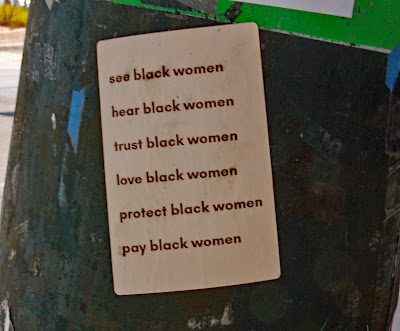
An occasional list of links to provoking commentary. Some annotated by me. Let's listen to some Black women.

 
Simone Biles: "I have a theory that if someone were to try and account for the exact amount of labor Black women have forcefully and freely contributed to the U.S. economy and culture, if America had to match us cent for sweat drop, it would be a number so great it would bankrupt all of this country’s resources." And she's not just talking about her sport ...

Roxanne Gay: "A great many Americans are only concerned with fairness when they think someone else might get something they won’t get. And they are seething with resentment as they imagine a country in which we help one another." Makes for a hell of a pandemic ...

Chakyya Harrison: "People are struggling because you all made the world this way.” How the federal pandemic stimulus failed her family ...

Nikki Giovanni: "If Earth survives — there’s a good chance we’ll blow ourselves up — gender and race are going to go." Gotta think big ...

Nathalie Baptiste: "Black conservatism is a sort of thwarted Black nationalism, all bleakness and bootstraps."

Christine Emba: "Objections to Critical Race Theory are an emotional defense against unwanted change, not an intellectual disagreement. Conservatives were never debating the facts. ..." When it comes to CRT, they weren't debating, they were just howling grievance against the teaching of truths.

Toni Morrison: "There is no time for despair, no place for self-pity, no need for silence, no room for fear. We speak, we write, we do language. That is how civilizations heal. I know the world is bruised and bleeding, and though it is important not to ignore its pain, it is also critical to refuse to succumb to its malevolence. Like failure, chaos contains information that can lead to knowledge—even wisdom. Like art."

'Nuff said.

Saturday, September 18, 2021

Saturday scenes: Black Lives Matter on Martha's Vineyard

Every Sunday at 10:30am, a small group gathers at Beetlebung Corners to kneel for 9 minutes and 20 seconds, remembering George Floyd and so many other victims of wanton police violence. 

 
This past week, about 25 folks listened to an account of the killing of Terrence Coleman by Boston police officers Garrett Boyle and Kevin Finn on October 30, 2016; the cops were intervening in his mother's effort to get an ambulance for the unarmed man.

After the kneeling, the group listened to reports of activism to reduce the danger of police violence during mental health calls on the island.

Perseverance furthers.

Tuesday, June 15, 2021

Eyewitness testimony

I'm not sure the world is well served by jumping back into the details of that disgusting episode last June during which non-violent Black Lives Matter protesters were clubbed and teargassed, apparently to facilitate a Trump photo-op holding a Bible in front of a D.C. church. A new inspector general's report wants us to believe that -- oh no, this wasn't a foul publicity stunt; this was a pre-scheduled move to erect a security fence outside the White House.

Police officers wearing riot gear push back demonstrators next to St. John's Episcopal Church just north of Lafayette Square and the White House, June 1, 2020 in Washington D.C. (Jose Luis Magana / AFP / Getty)

But one of the priests of the church used as Trump's prop, the Rev. Gini Gerbasi, is still outraged and wants to us all to remember what she saw. It seems worthwhile to reproduce part of her passionate denunciation of the effort to conceal what she lived.

I’m one of the people who went to Lafayette Square last June in support of #BLM, & was driven away by riot police with teargas, & flash grenades. I saw the report finding no link between the clearing of the park & the photo op. Initially I was not going to respond...

“Stay in your lane!” is what some people say when clergy weigh in on political issues. But I’m an Episcopal priest; my LANE is truth-telling in service of love. My LANE is to call out sin when I see it. And that report – and the culture that gave rise to it – is full of it.

I'm not talking about the man who signed it. I’m talking about a sinful CULTURE that lies, hides the truth, lusts for power, glorifies violence, & rewards self-serving ignorance. That pernicious culture will keep spreading unless we call it out and refuse to accept it.

Last June 1st, 30 min. before curfew, I heard explosions. The air filled with smoke. In an INSTANT, police charged protestors, shoving & swinging clubs. People ran for cover, screaming. Police fired rubber bullets into the crowd; I saw a man who had been hit all over his chest.

The idea that this level of violence – unleashed in a single moment – was about clearing the space for a fence is absurd. This was not, “Hey folks, we need you to move so we can build a fence!” This was police in riot gear using weapons of war.

You saw it on TV – the sudden burst of violence, the President’s speech, and then that walk across the street, the smoke still clearing as he held that Bible. Trying to convince us that we did not see what we saw is gaslighting – it’s a lie. It’s also a distraction.

Would police have been justified in using this level of violence against innocent people if it WAS about a fence? Of course not. Violence against innocent people is wrong, period – wrong for a photo op, wrong for a fence.

The word Apocalypse means to uncover what was already there, but not clearly seen. That we were there on June 1st to protest the use of violence against innocent POC uncovered AGAIN our country's sin of racism, with its roots in the past but its chokehold firmly in the present.  ...

On June 1, 2020, the air was thick with smoke, but I could see clearly that what was happening was wrong. This report is another attempt at distracting and intimidating people with a smokescreen. I can see clearly through this one as well.

As she goes on to point out, there wasn't that sort of treatment meted out to the white crowd invading the Capitol on January 6. There's more. You can read it all here.

Tuesday, May 25, 2021

On the anniversary of a murder by cop ...

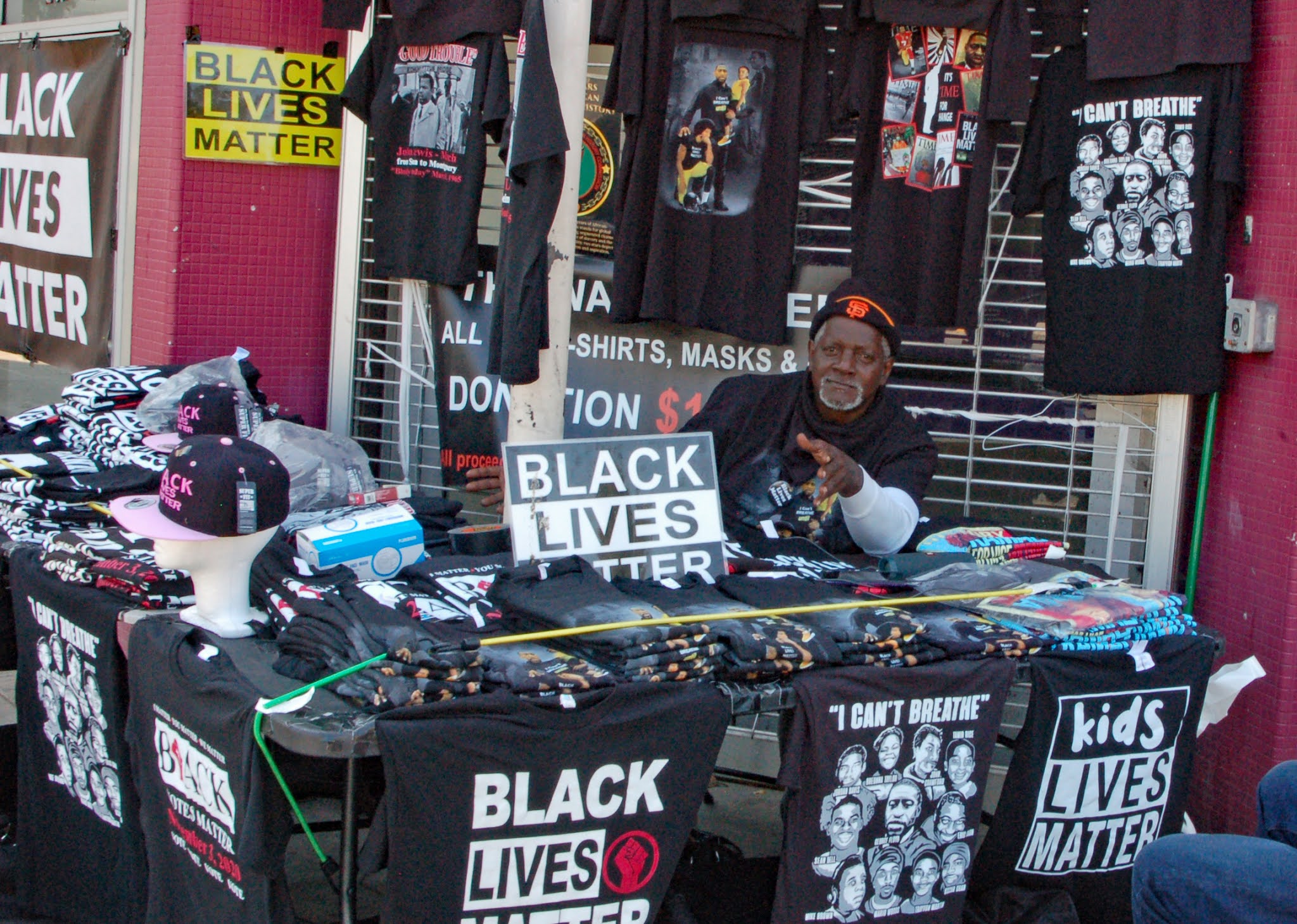
In the year since George Floyd gasped his last breaths, I've walked and photographed 73 out of the 596 precincts in the city. The photos demonstrate that sheltering-in-place San Franciscans, in every corner of the city, have posted an amazing variety of messages in support of the demand for greater racial justice, expressing their foundational recognition that Black Lives Matter.

 
Some present a complex array of worthy demands.
 
Some blend with their surroundings.
 
A few offer practical support. 
 
Some recall other historic popular struggles.
 
Some support the neighbors.
 
Some are art.
 
Some take advantage of natural features.
 
Some manifestations provide small commercial opportunities.
 
Some aim to raise the banal to something more enduring.
 
Some rocks will not be moved.

I have friends who dismiss all this San Franciscan signage as performative virtue signaling.  They are not all wrong. What concrete good does displaying BLM messages do? 

But on the other hand, isn't some level of consciousness that something has to be done a prerequisite to more justice? I think so. Every sign seems to me a momentary, possibly fleeting, blow against apathy and inertia. It's up to all of us to make these manifestations more.

Saturday, April 10, 2021

A toughened skin and a softened heart

Alicia Garza's The Purpose of Power: How We Come Together When We Fall Apart is an engaging and wise account of organizing and movement building. These two activism currents are not the same thing; it's rare to find them both described and appreciated in one volume. It's even more rare (perhaps because these topics are usually the terrain of men?) to find them melded with "a story about [Garza's] personal journey."

There's so much to learn and savor here.

Garza is nationally known as one of the three founders/inspirers of Black Lives Matter. In the Bay community where I live, she's known as one of the most committed, diligent, and often put-upon local organizers around. She comes by her high repute because she has done the work.

Because my long time engagement has been in injecting electoral expertise into community organizing and coalitions, I read with great interest her description of how corporate developers crushed a 2008 proposition sponsored by the community organization where she worked. (I was out of San Francisco for all of this campaign, I realized to my surprise.) POWER sought to curb gentrification in San Francisco's Bayview district, the last bastion of Black community here in Techvillage. Money and developers' inside track with more established, less community-based activist players overwhelmed the POWER effort -- and POWER also found they had not put down deep enough roots in the affected community.
I thought long and hard about what we could have done differently ... My organization, POWER, had always appealed to me because of its unapologetically radical politics and vision -- and yet it wasn't our radical politics that could have won the campaign, given the deep-seated beliefs community members had about how change happened and what kind of change was possible. ... If we'd had more partnerships to draw from, we might have been able to access more of the resources we needed to win ... We came close to winning by agreeing to build with organizations that we didn't consider to be radical and some that we didn't even consider to be progressive. We brought the campaign to those we did not believe would join us, and we allowed ourselves to be surprised -- and we often were. 
Building broad support did not mean we had to water down our politics. It didn't mean we had to be less radical. It meant that being radical and having radical politics were not a litmus test for whether or not one could join our movement. It meant that we created within our campaign an opportunity for more people to be part of the fight to save what was left of Black San Francisco and to see the fight as their own. 
Organizing in the Bayview forever shifted my orientation toward politics. It's where I came to understand that winning is about more than being right -- it is also about how you invite others to be part of a change they may not have even realized they needed. ...
We got all lucky. Garza came out of POWER several years later ready to build for Black freedom and ultimately all of our freedom -- at scale. The little localized organizations that incubate in the foundation-funded nonprofit industrial complex don't easily grow and intersect with genuine passions among unorganized people -- that is, with where most people live. Elections come closest to activating broad swathes of us, but usually organizing in that context is superficial, sacrificing deepening engagement for breadth of contact. It's good to win elections, but it takes an enduring, persistent movement to make much of those victories.

The second half of the book explores movement building out of her experience in Black Lives Matter. Garza discusses unity and solidarity, leadership, being a woman among male organizers, social media, political education and common sense, popular fronts for particular issues, united fronts which share strategy and a vision of power -- and much more. She'd be the first to say it's all a work in progress -- she's still learning.  She enunciates principles:
In a society were anti-Blackness is the fulcrum around which white supremacy functions, building multiracial organizations and movements without disrupting anti-Blackness in all its forms is about as good for a movement as a bicycle is for a fish. 
My feminism is Black, it is queer, and it includes men, masculinity, and manhood that is sustainable and does not depend on the subjugation of women to exist. Until we get there, I continue to expect men in general to sexualize me with or without my consent, will refuse to take me seriously, and take credit and be given credit for that to which they've made very little contribution. I expect them to have a propensity toward violence against me, even those men who claim to love me. And I work hard for the day when men who fight the racialized patriarchy are not the exception to the rule and, more than that, are not merely in solidarity with women. I work for the day when men understand that another masculinity is possible -- but not under the racialized patriarchy.
Her work with the Black Futures Lab has given her hope:
What we've learned through this endeavor is that the conditions for building effective and responsive social movements not only exist but are in their prime at this very moment. ... The most common response we hear from people who have been touched by our project is that they have never been asked what they want their future to look like ... We have launched a policy institute ... We've also created political vehicles that can contend for power inside the political arena. ... We don't believe in supporting leaders who are Black simply because they are Black ... we support Black leaders who have a transformative vision.... 
We do this work because we believe that Black communities deserve to be powerful in every aspect of our lives, and politics should be no exception. ... We are but a small part of the infrastructure that must be built in America to change the conditions that Black communities experience. ...
And Garza has shared a book that every progressive person in this country can learn from. What a gift!

Thursday, October 29, 2020

Organizer and visionary

My friend Alicia Garza has a new book. Here she talks about her vision with Trevor Noah on the Daily Social Distancing Show. Alicia has been organizing in the Bay Area for a couple of decades; she is one of the three co-founders of the Black Lives Matter movement.  

Being an organizer, she knows it is not all about taking to the streets to shout our feelings. She's about building institutions that ensure that Black lives really do matter.
  • "There's something that transforms in us when we become part of a movement, that transforms it into love."
  • "It's not that I want to have Joe Biden over for dinner. The point of [voting for Joe Biden] is to get the kind of terrain where you can get the things you need more easily and more accessibly. That's what we're organizing around now."

The book is The Purpose of Power: How We Come Together When We Fall Apart. I'm not going to get around to reading the copy I bought until after this desperate election sprint. Too much work on the phones to finish. But afterward ...

Wednesday, October 14, 2020

Joyce Louis-Jean spells it out for you ...

Those of us who live in the Southwest may not know all this. But we could. Watch Joyce Louis Jean explain.

  • Black immigrants are damn near erased from the conversation about immigration in our country ...
  • ... cops transfer Black immigrants to ICE and there is no evidence that Black immigrants commit any more crimes than any other immigrant population.
  • ... the longest ICE detentions on record are all for Black immigrants
  • ... ICE can even make something like deportation even worse for Black immigrants

Thursday, October 08, 2020

Dana tells how the Black Lives Matter movement came to Chilmark, Mass.

This post is a treat ... at least so it seems to me.

Chilmark is a rural town on Martha's Vineyard Island, known throughout the east coast as a summer vacation destination. Its larger towns have long had a more visible Black presence than most resort areas. But Chilmark is the white boondocks. (E.P. has a long history there and she takes me along.) My friend Dana's is one of the few Black faces in town. I've always found her awesome, but this is special.

In this podcast, Dana Nunes shares her story of a movement moment. Give it 28 minutes of your time. You'll be glad you did. 

Photo stolen from the Martha's Vineyard Times. Dana is wearing the black t-shirt.

Friday, August 28, 2020

Passing the torch

Jonathan Capehart of the Washington Post passes along a letter from some of the surviving luminaries of the 1963 March on Washington to the leaders of today's Get Your Knee Off My Neck March on the capitol mall. Here's a long excerpt:

We in the Black Freedom Movement of the 1950s and 1960s held countless mass meetings in churches and community halls in Black communities throughout the Jim Crow South. On August 28, 1963, for the first and only time, we gathered before the Lincoln Memorial for a mass meeting on a national scale, joined and witnessed by the entire country. We called this mass meeting “The March on Washington for Jobs and Freedom”. 
We feel obligated to accurately recall the true story of our nonviolent movement to transform our country. We affirm the direct lineage from the Black Freedom Movement of the 20th century, in which we were immersed, and the Black Lives Matter Movement and renewed Poor People’s Campaign of the 21st century which we profoundly admire, and wholeheartedly endorse and support. 
For decades America portrayed the 1963 March on Washington as a symbolic apotheosis of peaceful social change, racial harmony and reconciliation. Yes, the March was a uniquely powerful demonstration of the struggle for racial justice. But this struggle continues, as systemic racial injustice persists 
... On August 28, 1963, we marched to demand enforcement of the 14th Amendment to the Constitution by reducing congressional representation from States that disenfranchise citizens. We renew the demand that our Constitution be enforced in the face of widespread voter suppression today. ... 
... Before Dr. King shared his dream of the future, John Lewis demanded that we wake up to the national nightmare of the present. “We must say: ‘Wake up America!'" 
... We applaud and support the urgent work of next generation voting rights defenders and organizers including the M4BL Electoral Justice Project, the Black Voters Matter Fund, and the student activists of the Andrew Goodman Foundation. Together these young leaders are fighting to secure our Constitutional rights and mobilize the vote in Black and other communities of color throughout the United States. We honor them, support them, and follow them. ... 
Today, in 2020, the killings of Tanisha Anderson, Ahmaud Arbery, Philando Castile, Dominique Clayton, George Floyd, Eric Garner, Botham Jean, Atatiana Jefferson, Eric Reason, Breonna Taylor and countless others demonstrate the tragic reality that Black Americans remain the victim of unspeakable horrors of police brutality. When will it stop? 
... Even at the height of the coronavirus pandemic, young BLM leaders achieved results far beyond what Dr. King and the civil rights movement of the 1960s were able to accomplish: bringing somewhere between 15 million to 26 million Americans of all races and generations into the streets for the largest nonviolent protest movement in the history of the United States. 
With admiration and gratitude, we pass [Reverend Martin Luther King's] torch to the activist youth in the Black Lives Matter, March for our Lives, and climate justice movements. 
We know that their marvelous new nonviolent militancy will lead us to the Promised Land. 
Our obligation on this day is to follow their leadership. 
We urge all Americans to join our courageous nonviolent young activists in the hard work of building a just and free society in which we shall overcome.

In this strange year in which a couple of old white men compete for the presidency (and who wins matters desperately), would that all of us from these elder's generation could find it in our hearts to look for leadership in our movement successors. Who could not be thrilled by the intellectual and physical audacity of today's leaders? It's their time.


Sunday, July 05, 2020

Tough choice


I feel as if I'd written this post before -- and I more or less did -- during the primary race which left Los Angeles County with the choice of either reelecting incumbent District Attorney Jackie Lacey or replacing her with George Gascón, a former San Francisco D.A. But it keeps happening: well-known national and Southern Californian progressives like Bernie Sanders and Maxine Waters, Dolores Huerta and Jackie Goldberg, even usually less knee-jerk partisan commentators like Ezra Klein, even San Francisco's new progressive D.A. Chesa Boudin, keep telling me that Gascón is part of the new wave of progressive prosecutors who are bringing less punishment and more justice to criminal law enforcement.

As someone active for years in trying to bring to some measure of justice to bear against trigger-happy cops who killed Alex Nieto, Amicar Perez Lopez, Luis Gongora Pat, and Mario Woods in 2014-15, I find the fulsome endorsements of Gascón disorienting. Gascón was AWOL in the context of these police killings, refusing to charge police officers in any of them.

Not that Gascón's current endorsers are "wrong," because elections are binary events from which you can't always get what you want. When voting, you have try to get what you can. But let's apply some nuance here.

I understand that Jackie Lacey, though the first woman and the first African-American in the D.A. role in Los Angeles, is not a progressive choice. She too has failed to charge cops who kill and is notable as one of the few D.A.s in the state still bringing special enhanced murder charges that carry the death penalty. The California death penalty system is totally dysfunctional and our current governor has made clear that no death sentences will be carried out on his watch. She's just wasting money and legal angst by continuing to bring these charges. In the context of the current racial reckoning, the Black Future Project is picketing her house, demanding she resign!

But George Gascón is not a simple alternative. On formal, high profile, declared policies -- he's been a valuable voice among a law enforcement community hooked on punishment. He has supported bail reform, ending the war on drugs, clearing old marijuana conviction records, and alternatives to incarceration for juveniles.

But on charging decisions, his record looks highly political in the bad sense of trying to avert criticism from powerful detractors. Though he backed a "Blue Ribbon" study of police malpractice (and its indictment of police practices is quite incendiary,) somehow no cops who killed on his watch in San Francisco had to face a jury. He may have rightly judged that under the law as then written it would have been hard to convict, but the community was left feeling hung out to dry. Did the lives of these men matter?

Yet when powerful establishment forces line up to push him, he'll overcharge and posture on a bad case. I'm thinking of the high-profile shooting of Kate Steinle by a dumb and dazed undocumented immigrant. This tragedy was clearly a murderous accident, but Donald Trump and all our national Know-Nothings were screaming for blood. Gascón's charges against the shooter all demanded a finding of malevolent intent to reach a guilty verdict; the jury wouldn't and couldn't convict. Gascón demonstrated he can be pushed around; L.A. progressives, take note.

If I lived in L.A., would I vote for Gascón? I guess so. It would be hard, but I believe in making tactical choices with open eyes. And if this guy manages to win, folks better stay ready to get after him ...

Saturday, July 04, 2020

This is beyond beautiful

Five descendants of Frederick Douglass read and respond to excerpts of his famous speech, "What to the Slave is the Fourth of July?" which asks all of us to consider America's long history of denying equal rights to Black Americans.

FEATURING (alphabetically)
Douglass Washington Morris II, 20 (he/him)
Isidore Dharma Douglass Skinner, 15 (they/their)
Zoë Douglass Skinner, 12 (she/her)
Alexa Anne Watson, 19 (she/her)
Haley Rose Watson, 17 (she/her)

Friday, July 03, 2020

Fourth of July is upon us


For the national holiday, give a listen to Erudite Partner being interviewed by Bill Moyers. For all the horror of the omni-crisis -- white supremacy, coronavirus, apparent economic Depression, Trump and the GOPers -- neither of them is disheartened.

This is what my students have said over and over again is, “We don’t want to go back to normal. We don’t want the country to go back to the way it was before. This is a time when we need to rethink everything.” And I think that we are at a time when the combination of the pandemic and what’s looking to be a very, very deep recession and the Black Lives Matter movement. Those three taken together create an opportunity to talk about, what would it look like to do things genuinely differently?

And, of course, it’s not gonna be perfect and it may turn out to be incremental and it may not be what one would hope for. But I feel like this is the first time in a very long time that you see people, you know, serious journalists asking about, you know, “Couldn’t things be genuinely, radically different?”

... BILL MOYERS: How are you gonna advise [your students] to celebrate the Fourth of July?

REBECCA GORDON: I might tell them to read Frederick Douglass’s famous address about the Fourth of July in which he argues that this is nothing for him and his people to celebrate.

What I am trying to do is educate people to believe that it is important to be citizens. Citizens of the country they live in, but also citizens of the world. And that if they want to spend their Fourth of July thinking about, “What does it mean to me to be a citizen? What do I have to think about? How do I have to act?” I think that’s a great way to celebrate the Fourth of July.

Let the celebrations begin -- without crowds or probably fireworks.

Thursday, July 02, 2020

Bull-bleep on behalf of cops and other stirrings


Dan Walters is what I think of as a classic curmudgeonly columnist. He's been writing in newspapers about California politics nearly forever -- since 1960 in fact. He's a smart old white guy who knows where a lot of bodies are buried, and he has a sharp eye for how power has worked. At this point he's also deeply cynical and out of tune with the hopeful, multi-racial, loosely left, California that is emerging. So, naturally, he gives voice to police unions' propaganda about why it would be terrible if racial justice reform chipped away at the cops' power.

It's not that Walters doesn't see a problem with policing: he calls out
... the cozy relationship between police unions and politicians and the laws and policies that protect violence-prone officers from consequences for their acts.

The unions get what they want from local and state officials, not only legal protections but generous salaries and pension benefits. The politicians also get what they want, campaign funds and union endorsements testifying to their crime-fighting credentials.
But right on cue, he insists that police unions are just like other public employee unions.
... the political clout that police unions have wielded in California for decades is no different from what other public employee unions have done. Universally, they seek more job security and increases in pay and fringe benefits for their members, and do so by supporting politicians who will deliver the goods, regardless of how it impacts the larger public.

If, therefore, we condemn the unhealthy relationship between police unions and politicians, we should subject other public employee unions to the same critical scrutiny.

Police unions have often blocked accountability for violent acts. Education unions flex their muscle to stifle competition and avoid accountability for how schools treat their neediest pupils. The outcomes of both damage the larger society.
Why, in Walters' view, cops are just like teachers!

Here he's equating organized teachers' fight to prevent private charter schools from sucking up public school funding with cops' demand for a protected right to beat, gas, and shoot persons they consider scary or uppity. Usually Black or Latinx persons. And to get paid well for this.

Walter's sleight of hand makes a false equivalence between a policy difference over how to achieve a socially agreed common good -- educating kids -- with perpetuating a license to harm without effective legal limits.

That is, he's spewing bull shit for the cops.

Many of us have long called out corrupt police unions defending indefensible behavior by some of their members. I certainly have. Too often these unions serve as toxic reservoirs of white (and usually male) resentment in a changing society. The labor movement at large is going to have to decide whether it can advance the interests of a multi-ethnic working class while treating police work as just another type of work for wages.

This is not a new dilemma. Because throughout the 19th century, police in the U.S. north had served as violent strikebreakers for bosses, the 1886 American Federation of Labor wanted nothing to do with organizing cops. (In the Jim Crow South, policing in that era meant local white sheriffs whose job was to maintain the racial hierarchy by force.) Labor journalist Steven Greenhouse explains that police officers only won the right to collective bargaining in the 1960s as part of a general expansion of labor organization among public employees. Once governments agreed to bargain with their police, a poisonous dynamic played out.
Initially, newly established unions focused on winning better wages and benefits. A major recession in the early eighties and the anti-tax fervor of the Reagan era caused budget crunches in many cities. Local leaders told police unions and other public-sector unions that they had little money for raises. In turn, the police demanded increased protections for officers facing disciplinary proceedings.

Since the eighties, police contracts in New York and many other cities have added one protection after another that have made it harder to hold officers accountable for improper use of force or other misconduct. Such protections included keeping an officer’s disciplinary record secret, erasing an officer’s disciplinary record after a few years, or delaying any questioning of officers for twenty-four or forty-eight hours after an incident such as a police shooting.
This is how you get a killer officer like Derek Chauvin still on the Minneapolis police force and training newcomers after 17 previous complaints.

Progressive unions within the laboring movement are edging up to the problem of how to deal with affiliates which act as bullies for white supremacy. SEIU President Mary Kay Haney has been willing to talk about expelling police groups. Though national union leadership, including AFL-CIO President Richard Trumka and Randi Weingarten, president of the American Federation of Teachers, are flinching from a fight over police, plenty of progressive parts of the labor movement such as United Teachers Los Angeles, the second largest teachers organization in the country, want the police out.

One of the accomplishments of the Black Lives Matter movement has been to force organized labor to re-examine its allegiances -- to decide whose side it is on.

Tuesday, June 30, 2020

Falling down -- and getting up again

Trust Erudite Partner to find the material meaning behind a scary label. In her latest opus for Tom Dispatch, she asks "Can making Black Lives Matter rescue a failing state?"

Sure as can be, rescue by all of us together is needed as the many plagues of the omni-crisis -- white supremacy, Trump and his GOPers, the coronavirus, and a crashed economy -- grind on. Against every possible obstacle for 400 years, Black citizens have dreamed and enfleshed visions of justice and freedom. What a time!