Showing posts with label Spain. Show all posts

Sunday, November 18, 2018

Reality check: this is what climate action looks like

We think the advent of fleets of driverless cars in US cities would be radical. Spian's got a much more far reaching idea. Here's what a democratic socialist government is proposing:

Spanish government planning to ban sale of gasoline, diesel cars from 2040
... Transportation in Spain – and in most of the European Union – is the straggler when it comes to the fight against climate change. While the use of renewable energy continues to grow in the power sector – with a realistic target of 100% of electricity coming from clean sources in the future – road transportation is not progressing at the same speed in the fight against climate change.

Just over a quarter of all greenhouse gases emitted in Spain are from the transportation sector, and most of those come from the roads. Forecasts from the government suggest that if measures are not taken, these emissions will grow 15% from here to 2030.

In the draft text presented on Tuesday, the 2040 ban on “passenger and light commercial vehicles with direct emissions of carbon dioxide” would also mean an end to the sale of hybrids, which also burn gasoline or diesel. This kind of veto has already been announced in other EU countries, such as the United Kingdom and France, which have also set a target date of 2040, and Denmark, Ireland, Germany and the Netherlands, which have set a date of 2030.

El Pais, 11/13/18

The new plan would also ban fracking and end licenses for exploiting carbon fuels (oil and coal) by 2040. The aim is to expand current wind and solar energy production to provide 100 percent of the country's electricity needs by 2050.

Spain's government is a cobbled together coalition in which socialists are dependent on anti-austerity and left populist parties. It's almost certainly fragile. But it seems noteworthy that there is enough social consensus that climate change is a vital emergency that the governing party believes a serious de-carbonization plan can be negotiated.

Sunday, November 19, 2017

Choosing to forget injuries, at least for awhile

A few weeks ago I found myself in a discussion of how the Catalan independence movement was roiling Spain, a country where I'd just spent a delightful month. I quickly realized that I didn't know my ass from my elbow about contemporary Spanish politics. The historical reading I'd done on the country tended not to extend forward beyond the end of the Civil War in 1939 or perhaps the death of the dictator Francisco Franco in 1975. That was a long time ago; how did contemporary Spain come to be and how did the country work? After all, the place is not just a glorious historical artifact.

Tellingly, the only hint I got from a Madrid friend felt cryptic: "Nobody talks about it."

Seeking answers, I went looking for my preferred source of information -- a book, preferably in English since I'm linguistically challenged. Somewhere I happened on Democracy Without Justice in Spain: The Politics of Forgetting by Omar G. Encarnación. The author, a professor at Bard College, is actually writing within a discussion among political scientists about what makes for a successful transition from authoritarian rule to democracy, but along the way he provides an accessible narrative of the modern Spanish political developments which are the backdrop of the current impasse.

The Franco regime won power in the 1930s and cemented its long rule through brutal repression of any hint of opposition. It might have been natural, as international circumstances changed, the dictator died, and Spain tried to emerge from being an European fascist throwback and pariah, for opponents to respond to any hint of that regime crumbling by seeking revenge. In fact, in the mid-1970s, the political classes did the opposite. They chose fully conscious "forgetting."

Spain suggests that in some cases a political solution that abridges, circumvents, and delays justice against the old regime might be preferable. This hard truth gets us to the question of why forgetting flourished in Spain in the first place. In Spain, the question about what to do about the past was approached not as an ethical or legal challenge, as the transitional justice movement is prone to do, but rather as a political dilemma. This entailed doing what was possible rather than what was right.

Franco's designated successor was the nominal monarch, but King Juan Carlos knew that royal absolutism wasn't going to fly. A politically nimble politician of the old regime, Adolfo Suárez, offered Spain's repressed Socialists and Communists democratic rights -- freer speech, elections, a written constitution (1978) -- in return for a broad agreement not to relitigate the Civil War. According to Encarnación, the opposition was almost as willing to keep silence as the former Francoists.

... the Pact of Forgetting aimed at arriving at something of a consensus about Spanish history, especially the Civil War. Although the memory of the Civil War remained polarized, for the main actors of the democratic transition the conflict came to be understood as a guerra de locos (war of collective madness) that produced no winners and losers, only victims. In this problematic formulation, both sides bore equal responsibility for the Civil War, which made it redundant to ascribe blame to any particular group in society. The important thing was to ensure that a similar conflict would never happen again, and the best way to achieve that result was to forget and to look to the future.

Both left and right simply wanted to go on -- to transform Spain into a "normal" European state. When the Socialists won power through election in 1982 (and the right allowed a peaceful transition of power), rejoining Europe, modernizing Spain in the eyes of the continent, remained their priority.

Throughout Spain's democratic transition, regional separatisms erupted around the transition's edges. Basque separatists blew up Franco's designated successor, Prime Minister Admiral Luis Carrero Blanco, in 1973 while the old dictator still lived, a deed which certainly impacted the transition. But, though Carrero Blanco may not have been missed, ETA's bombings did not create broad support for regional separation. And ETA rejected what the rest of Spain was doing:

... like other revolutionary movements of the period, ETA members chose to distance themselves from the democratization process in Madrid in protest against what they perceived as an illegitimate transition to democracy, since neither the right nor the left approved of the principle of regional self-determination. Herri Batasuna, ETA’s political branch, branded the democratic transition “the pure continuity of Francoism”.

Majorities of Spaniards simply wanted an end to political violence.

Between 1979 and 1980, a period that coincided with the negotiation and ratification of the Basque autonomy statute, ETA killed 242 persons—one third of all those killed since the beginning of the transition

... the political class sought to solve the conundrum posed by the demands for self-governance by Spain’s separatist-nationalist communities. The failure to deal successfully with these demands in the 1931 constitution was widely seen in 1977 as having contributed to the failure of the Second Republic. ... The solution arrived in the form of a highly contradictory constitutional compromise that stresses the “indissoluble unity of the Spanish nation,” effectively eliminating the possibility for self-determination, alongside the recognition of a variety of “nationalities” in the Spanish territory and the right of any region to self-governance. This compromise opened the way for the creation of las autonomías, a system of regional self-governance distinguished by its asymmetry, with the “historic” autonomous regions (Catalonia, the Basque Country, and Galicia) enjoying more autonomy than the rest. As such, the system remains closer to “regionalism” than to “federalism,” a term studiously avoided in the 1978 constitution ...

It is the residue of these compromises, and subsequent economic, political, and attitudinal twists and turns, that set up the Catalonia impasse today.

It was not until 2007 that the Spanish parliament passed the "Law of Historical Memory" which reckoned more openly with the painful past, apologized to Franco's victims, and led to removal of many Francoist monuments. This was at least partially enabled by the judge Baltasar Garzón's decision in 1998 that the Chilean dictator Augusto Pinochet could be held legally accountable for his crimes in his country. Spain's movement away from "forgetting" and toward openly engaging with its past involved a sort of positive blow-back from Latin American struggles for democracy. Encarnación quotes Carlos Castresana, the lead prosecutor in the Pinochet case, and latter head of the International Commission against Organized Crime in Guatemala:

"The truth about the past is the compensation that we owe those who made the miracle of our transition possible with the sacrifice of their silence. "

I'm sure there are better histories of this complex progression, but I was glad to find Democracy Without Justice in Spain to cast light on some of my questions. This was only possible because of access to academic libraries through my Erudite Partner; the book is beyond expensive which probably means it is less read than it might be.

Saturday, October 28, 2017

When nations come apart ...

Despite having traveled for a month in Spain this fall, I don't have any very clear idea what I think about Catalan independence.

My friends in Spain, good lefties who live in Madrid and despise the corrupt right-wing government of premier Mariano Rajoy, nonetheless dismiss Catalan separatism as petulant and unrealistic. What do I know? I've learned to look at the English version of El Pais, a social-democratic paper that is the country's top selling daily. El Pais tilts hard against Catalan secession, treating the effort as anti-democratic and nativist.

With this background, I found Washington Post correspondent Ishaan Tharoor making points that seem highly relevant:

Catalan aspirations are deep-seated, anchored in the region's distinct history and cultural identity. But the momentum for independence catalyzed only in the wake of the 2008 financial crisis, as Catalans saw their robust region being dragged down by a cratering Spanish economy. Catalan officials say the region still pays about $12 billion more in taxes each year to Madrid than it gets back.

These frustrations are not exclusive to Catalonia. A number of fledgling secessionist or autonomy movements in other parts of Europe, from Lombardy in Italy to Flanders in Belgium to Scotland or even London in Britain, are grounded in the belief that their regional interests are not being served by the national politicians who call the shots. Over the past year, we've tended to think of nationalism in the West in the context of angry, right-wing populist movements, fueled by disaffection with elites and hostility to immigrants.

But another trend to watch ought to be the impatient regionalism of more metropolitan parts of Europe, frustrated by the backward politics of their nation-states.

Tharoor points to a Guardian column by Paul Mason which makes a thought-provoking argument:

... the positive factor driving progressive nationalisms, from Scotland to Catalonia, is technological change. Information-rich societies reward the development of human capital; so the ability to study in your first language, to participate in a rich national culture, to create unique local selling points for incoming foreign investment is more important than ever. If the regions, peoples and nations currently demanding more freedom seem to be driven by “cultural nationalism”, that in turn is driven by technological change plus global competition.

The second impact of these forces is the emergence of successful big cities and devastated small towns. In large cities with dense networks of information and culture, you can survive globalisation. In small towns it is harder. So the logical economic strategy is to create a “region” or small nation focused on one big city, and develop the suburban and rural economy in synergy with that city, not the bigger unitary state. If Barcelona were not a massive global success story, the impetus behind Catalan nationalism would be smaller.

This should not seem foreign to us in the United States. One of the most mind-boggling aspects of last year's presidential election, according to Mark Muro and Sifan Liu was that:

The less-than-500 counties that Hillary Clinton carried nationwide encompassed a massive 64 percent of America’s economic activity as measured by total output in 2015. By contrast, the more-than-2,600 counties that Donald Trump won generated just 36 percent of the country’s output—just a little more than one-third of the nation’s economic activity.

... with the exceptions of the Phoenix and Fort Worth areas and a big chunk of Long Island, Clinton won every large-sized county economy in the country.

Another way of saying this is that California (Los Angeles and San Francisco metro areas), New York (the city and environs), and Illinois (Chicago metro area) are thriving; meanwhile vast areas of the United States are accumulating grievances that Republicans exploit. Historically, more prosperous regions have been the tail that wagged the dog. It seems unlikely that the converse will endure for long.

Technology, globalization and cosmopolitanism, and mass migration aren't going to stop (however much the Trumpies want to stop the world so they can jump off). These forces are re-making our society; rote application of leftwing dichotomies derived from a different economy don't adequately capture contemporary conflicts. Eugene Robinson tries to name what this means for Democrats trying to assemble a majority:

Today’s key fault lines may be between metropolitan areas and the exurbs and small towns strung along the interstates; between those who have gone to college and those who have not; between families who have benefited from the globalized economy and those who have not; and between an anxious, shrinking white majority and the minority groups that within a couple of decades will constitute more than half the population.

He thinks Democrats need to convincingly project themselves as the "opportunity" party. That's sounds a bit over-technocratic to me; wasn't that what Hillary Clinton was offering? Winning Democrats will inspire hope that all of us, together, can enjoy the better future that prosperous areas glimpse even now.

Sunday, October 22, 2017

A suspicion confirmed

In Santiago de Compostela we marked completing our pilgrimage by taking a tour of the roof of the Cathedral of St. James. We noticed that several of the towers looked like this one, a 15th century improvement on a Romanesque original. This did not seem to accord with the usual architectural style of the period; where might the Spanish architect have gotten his inspiration? Our guide suggested he might have been influenced by Spain's new world conquests in Mesoamerica.

At the Teotihuacan: City of Water, City of Fire exposition at the DeYoung Museum in San Francisco, we encountered this artifact. The similarity of decorative form leaps out to me.

Tuesday, October 17, 2017

Dangerous trees

Northern California isn't the only region experiencing perilous wildfires in this season of weather disasters. Four people have died in scattered forest fires in Galicia and Asturias in Spain in the last few days. (That's where we walked on pilgrimage during September.) Thirty-five more people are reported killed further south in Portugal. Persistent drought fueled the outbreak. Politicians want to blame arsonists. But might there be an additional factor?


While walking through this region we made a surprising observation: where farmers had until recently grown pines in wood lots meant for paper and pulp production, they are now planting eucalyptus trees. They explained that these exotics would mature in 25 years while pines required 50.

Importing eucalyptus was evidently controversial. The Australian native species can be a hazard waiting to ignite as Californians have discovered.

... eucalyptus trees can exacerbate deadly fires. Their sap is flammable, and so is their bark, which flies off when burned, igniting new fires up to 100 yards away.

L.A. Times

In Spain we saw signs of vocal opposition to imports:
These trees may be more a part of the problem than part of a solution to rural areas' economic stagnation.

Wednesday, October 04, 2017

Some Spanish windmills

As we walked the Camino de Santiago in Asturias and Galicia, we often found ourselves repeating a line we'd read in somebody's blog: "More windmills? Guess that means we have to climb another big hill ..."

Indeed there are a lot of windmills in Spain, especially in this part of Spain. In 2015, Spain was the fifth largest generator of wind power in the world. On a few blustery days, wind power makes up more than 50 percent of the power the country uses. Wind power even enables the province of Galicia to produce more renewable energy than its own power needs demand. Spain has promised the European Union to achieve 20 percent of all its energy needs by 2020.

The country seemed well on the way to this target a decade ago, through a combination of wind, solar and hydroelectric production. However, since the conservative government of Mariano Rajoy’s Popular Party took power in 2011, green power production has plateaued. Subsidies for clean energy were cut; the government introduced a "sun tax" which penalizes individual private installations of solar panels which might reduce demand for the output sold by commercial power companies.

Under the new rules, these self-reliant consumers will not be able to use products such as the Powerwall battery recently launched by American automotive and energy-storage company Tesla, and will additionally be penalized for the storage systems that come included with the latest generation of solar panels.

... The Spanish government’s attitude is in contrast to other countries, such as Germany, which is encouraging the use of solar panels with batteries.

Government solicitude for the stranded costs of legacy power companies acts as an impediment to clean energy all over the world. David Roberts has recently explored why cheaper batteries are going to blow away the old monopoly electric company profit model despite their political power in the U.S. -- and as soon as 2020.

Rooftop solar can be staved off temporarily with fees and rate tweaks, but as batteries get cheaper, those strategies will stop working. More and customers are going to generate, store, and manage more and more of their own power.

Utilities have got to find other ways to make money, other services to provide, other roles to play in the power system of the future. They have no other choice.

Yet another hill to climb ...

Monday, October 02, 2017

Spain's mad knight may still have a message for our times

Plaza de España
The Spanish philosopher Miguel de Unamuno (1864-1936) responded to the last crumbling of Spain's colonial empire (that would the seizure by the United States in 1898 of Cuba, Puerto Rico, and the Philippines) with the
realization that, in hopeless times, quixotic lunacy could save people from the paralysis that often accompanies defeatism.
According to Mariana Alessandri, embracing the "madness" of the fictional Don Quixote de la Mancha who tilted at windmills and "dreamed impossible dreams," undergirded Unamuno's principled denunciation of Spanish fascism at the end of his life, a story I've recounted previously. The philosopher's thinking seems highly relevant amidst political inertia, lies, corruption, and folly.
... Unamuno urged his fellow Spaniards to practice quixotism, which meant adopting the moral courage necessary to fight for lost causes without caring what the world thinks. ...

Quixote didn’t charge the windmill because he thought he would defeat it, but because he concluded it was the right thing to do. Likewise, if we want to be legitimate actors in the world, Unamuno would say that we must be willing to lose the fight. If we abandon the common-sense belief that deems only winnable fights worth fighting, we can adopt Unamuno’s “moral courage” and become quixotic pessimists: pessimists because we recognize our odds of losing are quite high, and quixotic because we fight anyway. Quixotic pessimism is thus marked by a refusal to let the odds of my success determine the value of my fight.

... Warning: quixotic pessimism will not go over well in public. If you choose this life, Unamuno says you will face disbelief, judgment and ridicule. He writes that moral courage “confronts, not bodily injury, or loss of fortune, or the discredit of one’s honor but rather ridicule: one’s being taken for a madman or a fool.” In a real-life context, quixotic pessimism will look like constantly face-planting in public, and we will need moral courage to accept it. People will laugh at us as they do at Quixote. ...
In our time, some windmill tilting seems to have its moments. Who thought that the horror of unified Republican control of government would end up exposing that a substantial majority of us actually believe that it is the government's job to ensure access to medical care for all? Apparently we collectively are not afraid of "socialized medicine" any more. Let's see what other longstanding truisms a determined resistance can knock over ...
Bilbao

Sunday, October 01, 2017

The Catalan independence vote

Banners supporting Catalan and Basque separatism on a political party building in Bilbao
During the entire month we were walking in Spain, the impending October 1 regional referendum on Catalan secession dominated news media. Whenever we caught a glimpse of a newspaper or a few minutes of TV news in a bar, the separatist effort in the Barcelona region overwhelmed all other topics. (Even Trump. That was sort of restful.)

The situation is very complex, arising from centuries of historic grievances complicated by contemporary differences between a conservative federal government in Madrid and a pro-independence regional government. The national government has outlawed the referendum; it is not at all clear whether any of this is going to reveal the desires of a majority of Catalans.

Some of the apparently most complex coverage, sympathetic but honest, I've seen of the Catalan situation in English has been in the Guardian. Perhaps a British newspaper, with experience with Scottish and other regional independence movements, is better at this than U.S. media. In any case, for more substantive information, read them, not me. I know little.

But I can share an observation from our walk on the Camino that may cast a weak light. In the north of Spain, the home language of many or even most people is not what we think of as "Spanish." In Spain, "Spanish" means Castilian and that is what people call it. Catalan is the co-official language the Mediterranean coast, of Catalonia. In the Basque country, people and their street signs, use Euskara. As we walked west, signs changed languages. In Asturias, though the language is not officially co-equal, Asturian is the mother tongue. And in Galicia, the province's official language is Galician, which speakers of the majority Castilian Spanish think of as akin to Portuguese. This map shows the language distribution; like so much in Spain's rich diverse fabric, it's complicated.

Saturday, September 30, 2017

Saturday scenery: Toledo, city of concurrent and successive faiths

The Spanish city of medieval Toledo is a well preserved treasury of multi-faith historical religious edifices. A schematic history of the city: the Jews came along with the Roman Empire's legions; most Ibero-Romans eventually adopted Christianity as did the northern European "barbarians" who conquered this rich land; these kingdoms were pushed to the peninsula's margins by Muslim invaders bringing a rich pan-Mediterranean civilization; and the Muslims in turn were eventually expelled by Spanish Christian monarchs in the Reconquista ending in 1492, along with the remaining Jews who became the Sephardim of the Diaspora. It's a bloody, tangled story and Toledo proudly displays the cross-fertilized remnants.

Today the Sephardic Museum occupies the Synagogue of El Transito, a worship space built by the merchant Samuel ha-Levi in 1356 by permission of the Christian king Peter of Castille.


The synagogue's intricate artistry suggests comparison with the contemporary Moorish palace of the Alhambra in Granada.

Incongruously the Jewish worship space thought to be the oldest synagogue building in Europe is now maintained by the Roman Catholic Church as "Saint Mary the White." (Yes, Catholic Spain also boasts black madonnas, black representations of the mother of Jesus, but not that we saw in Toledo.)


Far more than El Transito, despite the cross belatedly hung over the main open space, this building is infused with a feeling of its historic sacred use. The only religious edifice I've ever experienced to equal this holy feeling is the Ummayad Mosque in Damascus.

Far more incongruous is this interior from what is called the Mosque of Cristo de la Luz. The small square Islamic structure surrounded by fountains and a garden was built in 999. The Muslim city of old Toledo was conquered by King Alfonso VI in 1085 and the mosque converted into a Christian chapel in 1186.

Today Toledo throngs with gawking tourists staring at this religious melange. Do we hunger for a glimpse of religions co-existing? I certainly do.

Monday, September 25, 2017

Goodbye Spain

Hello ordinary responsibilities. Ready to go, whether ready or not. Such is life.

Sunday, September 24, 2017

Basque Country welcomes refugees

In keeping with the generally sophisticated design consciousness in Bilbao and environs, Euskara-speaking activists have redesigned the familiar fleeing family on these banners. The image hangs on private houses and some public buildings. The ongoing tragedy of refugee drownings in the Mediterranean feels very close here. 

Saturday, September 23, 2017

Stubborn for earth and sustainability


The mountainous hills and valleys north of Burgos where Spain's long river Ebros arises are breathtakingly lovely.  

The people who live there want to keep it that way.  

Friday, September 22, 2017

The bear and the madrone

The heraldic emblem of the city of Madrid as it appears on manhole covers throughout the city. 

The city's bear as created out of aluminum foil by a cheerful Metro artist. He gave it to EP in response to her interest.

Tuesday, September 19, 2017

Hints of civilization


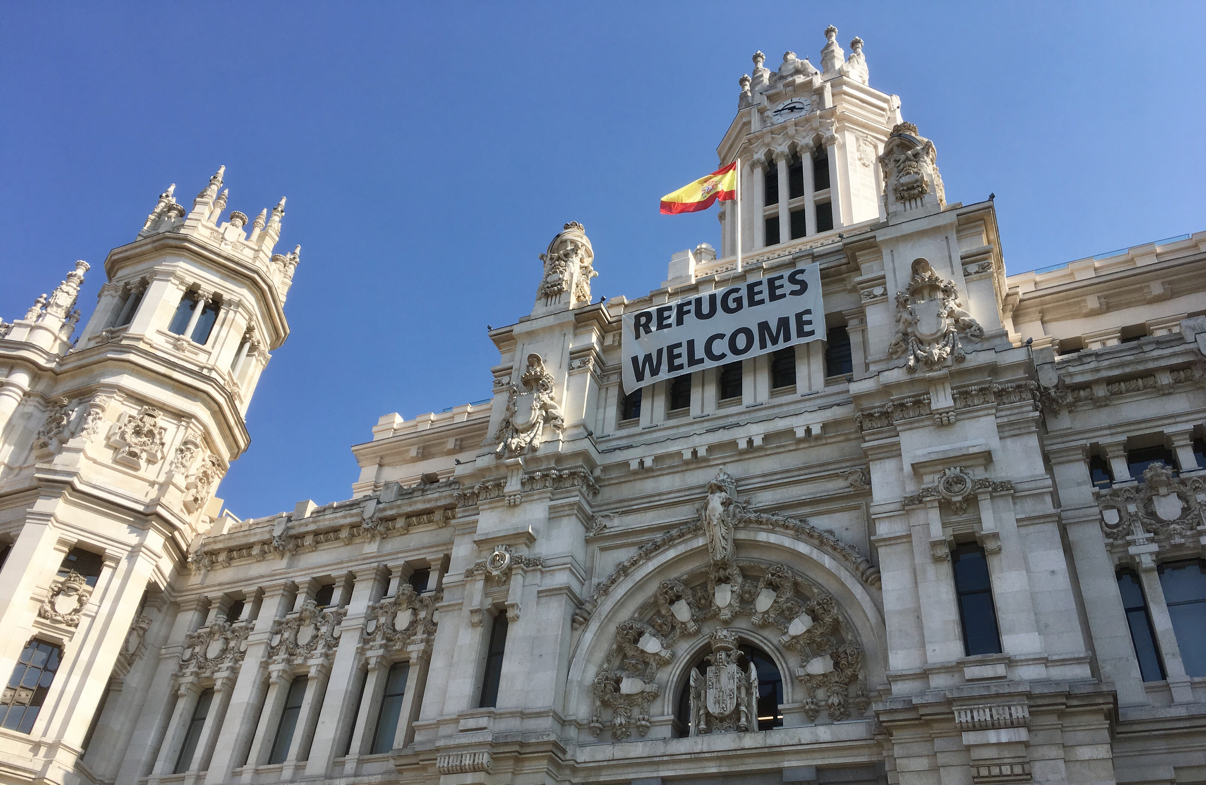
The Palacio de Cibeles is the seat of the City Council of Madrid.

Within, the better part of one floor was devoted to an exhibit about the history of LGBT struggle in Spain. That struggle has been part of the wider movement to restore democracy after the end of the Franco dictatorship in 1975 and has achieved a remarkable turnaround in social attitudes in a conservative country. 

All very heartening on a day when a U.S. president blustered before the world, threatening to annihilate a country of 25 million people ...

Saturday, September 16, 2017

Repurposed signage


The image on this banner in Santiago might seem familiar to some Californians. The fleeing family used to appear on freeway signs near San Diego, warning drivers not to run over unauthorized immigrants. 

Here it reads "Welcome Refugees" in the Galician language. Somebody has a heart. 

Tuesday, August 22, 2017

A Spanish legacy


The U.S. is not the only country with a problem about what to do with statues that honor people and events we subsequently condemn. This picture shows what Spain has done about monuments to the dictator Francisco Franco who ruled brutally from 1936 to 1975. I ran across a description in a Washington Post round up of what other countries do about ugly but contested parts of their history:

In Spain, authorities have set about renaming streets that commemorate Francisco Franco. In 2006, the Spanish parliament passed a law requiring every province in the country to remove Franco statues. (Most were already gone.) But the dictator's body is still housed in a shrine called the Valley of the Fallen; critics say the prominent placement serves only to glorify his reign.

It's hard for democratic countries to win the argument against fascists definitively.

Like many good late 20th century lefties, the Spanish Civil War (1936-1939) in which the right wing General Franco successfully overthrew a weak elected Republic served as a sort of political touchstone for me. Hitler and Mussolini played a huge role in Franco's successful rebellion/coup -- might the horrors of the European war been avoided if people of good will had stood up against fascist barbarism in Spain? That's not a question with an easy answer, but there were people who had done exactly that among us, elders in our communities who were veterans of the Abraham Lincoln Brigade. I've written about books on this period on this blog here and here.

So when I saw that our pilgrimage began in Oviedo, the capital of the Asturias region of Spain, faint bells went off. Wasn't this the site of one of the earliest atrocities committed by troops led by Franco? Yes, it was. Before the generals revolted against the Republic, Franco commanded a professional army which had honed its craft through torture and mass murder in Spain's African colonies. In 1934, the weak Republican government was more frightened of striking miners in Asturias than of the generals, so called in Franco to lead the repression of their own citizens. According to Franco's New York Times obituary:

He exhibited [his] methodical cruelty in 1934 when he imported legionnaires and Moors to crush an Asturian miners' uprising. At least 2,000 miners were rounded up and executed, many of them in the Oviedo bullring. Some officers reportedly sought to halt the slaughter, but Franco sent word that the officers must continue or face execution themselves.

As I wrote in my previous foray into Spanish history, we are about to travel in a "very contradictory country." I doubt this massacre is much commemorated in Oviedo today, at least on the pilgrim trail. We may find out by the end of this week. But this too happened here. Spain's story includes so much cruelty, so much beauty, so much passion, so much wisdom. I guess Spaniards are human.

Monday, August 21, 2017

We sought out some Spanish history ...

While walking in preparation for our pilgrimage on the Camino de Santiago, we've listened to The History of Spain: Land on a Crossroad. These 24 lectures by historian Joyce E. Salisbury survey the enduring lineage of passing peoples -- their tribes and ethnicities, their religious affections, and how they earned and/or seized their livelihoods -- though what our maps render a minor corner of Europe but which at many periods was where the wide human world met. Salisbury loves Spain. She offers an extremely accessible, enthusiastic, and rich account of the country's oscillation between episodes of relatively peaceful creative diversity of cultures interspersed with eruptions of conflict, cruelty, and terror. There's lots to think about here. I highly recommend this course.

On topics on which I've done some prior study and so am willing to offer an opinion, I was impressed by Salisbury's short background descriptions of early post-Roman Empire Christian conflicts over doctrine, of the history and diffusion of Islam, and of the creative centuries of Jewish-Christian-Muslim coexistence in Al-Andalus. These were so convincing that I was very open to her effort to explain the peculiar features of Spanish Catholicism about which I know so little and which I find culturally very foreign. Apparently the small number of Spaniards attracted to Reformation Christianity in the 16th century were rapidly extirpated -- literally, by both monarchs and the Inquisition. Spanish rulers were just completing a religious war -- the Reconquista -- which ended with expulsions and forced conversions of Jews and Muslims. Reformation Christianity heralded an individualistic Bible-reading faith; the victorious Spanish empire was ripe for a triumphal, sacramental, and collective religiosity that upheld the institutional power of church and state. But in the northern Europe, Reformation unleashed personal religious passion that re-invigorated Christianity. How to compete? Salisbury attributes the baroque artistic expressions of Spanish church building architecture and of Spanish piety as a reaction. No wonder more Protestant-influenced northerners like me find it a little off-putting. Tridentine Roman Catholicism needed to give popular enthusiastic piety an outlet. I will walk among the buildings, shrines, and statuary with this in mind. Perhaps I'll appreciate more than I might have?

I don't have a text to quote from here, so I'll just pass along some impressions particularly relevant to the Camino that I derived from listening.
  • St. James, the "Santiago" which the pilgrimage seeks, was by held by tradition to have been martyred in Jerusalem shortly after Jesus was executed. In the ninth century, Alfonso II the Chaste, king of Asturias and Galicia, accepted a claim that his bones had been discovered and moved them to the cathedral in the town now named Santiago de Compostela.
  • Religious strife was not foreign to early medieval Spain; this lecturer suggests that the revered bones may have actually been those of an Arian heretic bishop who had a local following. Neither story rests on "evidence" in the modern sense. But the shrine quickly became the most prominent of medieval European Christian pilgrimage destinations.
  • The shrine served as a rallying focus for the small, backward northwestern Christian kingdoms that survived on the peninsula in an era when Islamic kingdoms thrived in the rest of what is now Spain and Portugal. The pilgrimage brought a lucrative "tourist trade" which helped pay for the Reconquista.
  • Pilgrimage, then as now, led to cross-cultural mingling of ideas and people. Salisbury suggests northern pilgrims brought a more vigorous anti-Semitism to Asturias and Galicia, while taking home Spanish Catholicism's particular sort of fear of Muslims. St. James -- Santiago -- became the patron of the Reconquista, acquiring the moniker Matamoros, killer of Moors (Muslims). This figure of James remains the patron saint of Spain today.
  • Yet according to Salisbury, St. Teresa of Avila -- a Carmelite nun, a mystic and one of the few women ever recognized as a Doctor of the Church -- gave St. James a close competition during the 16th century for who should be recognized as this contradictory nation's patron.
We're going to a very contradictory country. So much to learn and I know I'll only scratch the surface. No wonder I loved it the last time we visited and so much want to experience it more.

Sunday, August 20, 2017

Going on pilgrimage ...

This coming week, Erudite Partner (EP) and I are joining up with Wise Friend (WF) to walk the Camino Primitivo, the "original" way across Asturias and Galicia in northern Spain. Pilgrimage to Santiago de Compostela, the legendary burial site of the remains of St. James (the "son of Zebedee" James), has been undertaken by Christians and other wanderers since the 9th century. Two hundred seventy-seven thousand pilgrims made the trek one way or another last year.
Most of these contemporary pilgrims did not walk the Primitivo, the route we've chosen, a more rugged, hillier, somewhat shorter, and less developed 225 mile track instead of the more frequented Camino Frances. We wanted less crowds, more solitude. Let's just hope we don't also get more aching muscles and blistered feet.

So why do we go on pilgrimage? At root, just as with most things, we go because we can (afford this both in time and treasure) and because we want to (for the experience whatever that may prove to be.)

Thich Nhat Hanh suggests a mantra for walking:
"I have arrived. I am home. In the here. In the now. I am solid. I am free. In the ultimate I dwell." Four lines guiding us in our practice of walking meditation. ... Let us flow like a river, generating peace with every step we make.
That seems about right. Once underway, we'll walk (usually 25 or more kilometers a day), wash clothes (essential when you only carry 2 sets on your back), eat (food is fuel ...) and sleep (soundly I expect). And then get up and do it again. For something like three weeks. What we'll learn, we'll learn.

During this past awful week of Charlottesville and Trump, in the Jesuit magazine America, Father Jim McDermott offered a spiritual exercise for the overwhelmed and exhausted which seems pertinent both to surviving the present tumult -- and to our pilgrimage.
... if we are not going to turn away, overwhelmed and exhausted, how are we to sort through this constant barrage of information and raw emotion? How do you continue to “bear witness” when every three or four days there is another crisis?

Faced with upheaval in U.S. society, with leaders who enable violence and oppression while others stand by silent, an invitation to prayer might sound like the spiritual version of palliative care—an attempt to address the pain but not the disease. But though the news cycle and each new outrage demand constant attention, to see what is really going on and to offer a thoughtful response we need not only to be able to enter in but to step back.

O God, I ask as I sit before CNN, Fox or my newsfeed: Where are you today? What do you want me to notice? What do you want me to see?
Oh God, I hope to ask as I walk across Spain, "Where are you today? What do you want me to notice? What do you want me to see?" That would be more than enough. Doing is for another time, for later ...

I don't know how much connectivity I'll have or want while on pilgrimage. Expect occasional photos but little else here.

Sunday, July 17, 2016

Heroism and horrors

Adam Hochschild's big new book, Spain in Our Hearts: Americans in the Spanish Civil War, 1936-1939 is just what the subtitle advertises -- the story of U.S. citizens who participated in that confusing, emotionally charged struggle.

Of necessity, that means Hochschild has to provide a narrative of a conflict that unfolded very differently than anything in the experience of most of us. In this one, it was the democratically elected government, the "Republic," which was fighting against the "Nationalists," rebelling colonial army officers whose assumed that label to proclaim themselves the only authentic Spaniards. But that elected government contained liberals, socialists, Moscow-aligned Communists -- and was functionally dependent during its early resistance to the military coup on anarchists who fought for no government at all. Francisco Franco and the other generals were enthusiastic fascists, dependent on feudal estate holders, the Catholic Church, and Hitler and Mussolini. The government won only suspicion from Europe's democracies, England and France, and isolationism from Franklin Roosevelt's United States, so became quickly dependent on the Soviet Union. There were atrocities in this very intimate war committed by both belligerents, though of far greater scale by the Nationalists. (Historian Paul Preston has presented in English the very thorough archival data about these horrors unearthed by Spanish scholars in The Spanish Holocaust.) Franco and the Nationalists triumphed; the Generalissimo became Spain's vicious dictator until his death in 1974.

The Spanish Civil War was an immensely complicated, dramatic, horrible, apparently morally simple but actually multi-layered, mess. Hochschild does a graceful job of presenting enough of this backstory to make some sense of the experiences of U.S. participants. (For a more general history in which U.S. citizens are the bit players they were, I'd suggest Antony Beevor's The Battle for Spain.) He naturally depends on the available written materials from a few of the approximately 3000 U.S. volunteer combatants, the writings of U.S. journalists who covered the war (often on the front pages) for U.S. newspapers, and the records of the Texaco oil magnate who made sure Franco and later Hitler had all the oil they needed. The whole makes a good story.

Unlike U.S. contemporaries, Hochschild makes his readers vitally aware of the social revolution -- the rising of workers and peasants against their class oppressors -- that the Republican government wished it could keep under wraps. Anarchism was a developed ideological current in early 20th century Spain whose adherents were quite capable of holding and experimenting with running the highly developed province of Catalonia. Their trams ran on time and the mail was delivered -- unless there was a political rally or an "essential" point of principle to be argued out.

... idealists had dreamed of a world where wealth would be shared, where workers would own factories and peasants land, and where democracy, in yet-to-be-defined ways, would be far more direct. For some months this had actually happened, above all in Barcelona ....

The bourgeois Republican government and its Communist supporters wanted these bumptious anarchists out of sight, at best. These leaders had a mechanized, industrial war to fight which required foreign equipment and and tight order. Enthusiasm and elected officers were no match for heavy artillery, tanks, and Moorish economic conscripts under Franco. The democracies would never supply an anarchist army and neither would the Communist Soviet Union, the only practical source of weaponry. The anarchists were duly crushed by the Republic.

Hochschild's most acerbic criticism, in a what is a gentle book about horrors, is directed at the war correspondents who sought to make names for themselves in Spain, but missed the anarchists' social experiments. Whether celebrities or sloggers, their reporting stayed within the "Authorized Version of the Spanish Civil War ... [an] easy to understand heroes v. villains narrative ..." which usually contained a heavy dose of romanticized machismo.

The fact that a utopian social revolution might have been an impractical and romantic dream even in peacetime and was surely an impossible one when fighting a terrible war, made it no less worth reporting. Of the many hundreds of correspondents from abroad who passed through Spain during the war, not one showed much interest in the revolution that for months surrounded them ... [even] those like Virginia Cowles. She noted, at least, that the Hotel Florida itself "was in the hands of elevator boys, doormen and clerks, with the restaurant where I ate managed jointly by a group of waiters." ... Not a single one bothered to spend a few days in a Spanish factory or business or estate taken over by its workers, to examine just how the utopian dream was faring in practice. ... Has history ever seen a case where such a huge array of talented reporters ignored such a big story right in front of them?

I'm not sure they (we) do any better today. After all, who ever cares about the workers upon whose labor writers and scholars depend?

The bulk of the book is about the men and the few women who comprised the Abraham Lincoln Brigade. Fully twenty percent of these volunteer soldiers never returned from Spain. Most were Communists, many urban workers. The Republic could seldom keep them supplied with arms, not to mention clothed and fed. In general, they had hardly any military training; they learned as they fought. They were often used as shock troops. As the war progressed, they were exposed to near constant artillery and air bombardment for which they had no answer. They were sometimes poorly led; some officers were doctrinaire Communist martinets. If captured, they could expect to be summarily executed as "Reds."

Few American volunteers doubted that they were fighting the first battle of a world war to come ...There seemed a moral clarity about the crisis in Spain. Rapidly advancing fascism cried out for defiance; if not here, where?

Surely Spaniards were right to resist a coup backed by Hitler and Mussolini. But did the Republic become doomed by its entanglement with the Soviet Union, whose government was at least as murderous as the Franco regime? Defenders of the Republic were, in short, fighting for one of the finest of causes beside one of the nastiest of allies .

The "Lincolns" were indeed heroic in a cause they believed in. And if that motivation frayed, they struggled on for their comrades in arms, like all armies. They had little idea what was going on politically behind the lines or internationally, though they knew fascism was an evil to be fought. Their story is still thrilling, even, or perhaps because, we know how it ended.

Hochschild makes clear that he does not share the left orthodoxy of that time -- the idea that, if the democracies had just armed the Republic and Franco been defeated, the catastrophe we call the Second World War could have been averted. Hitler's drive for continental and world domination had to be defeated in its own right, not by proxy.

In the introduction, he does raise a very pertinent question for contemporary U.S. progressives:

For more than half a century now, many members of my own political generation have been strongly opposed to war, and especially to American intervention in the civil wars or internal affairs of other countries, whether in Vietnam, Nicaragua, El Salvador, Iraq, or almost anywhere else. Yet most of us have long thought the world would have been better off if our government had not stood aside from the Spanish Civil War. We've regarded as heroes an earlier generation of Americans who went off to fight in it. This raises the question: are there times when military involvement in a distant conflict is justified?

The book does not return to this question. I belong to the same generation as this author (and have run across him when we were both agitating against the U.S. war on Sandinista Nicaragua). I do have an answer for this: the U.S. since 1945 has been the world's top empire; U.S. interventions have almost exclusively empowered the rich few against the poor majority, and ignorantly and arrogantly trampled upon others' societies and cultures. No, our distant conflicts in my lifetime have done far more harm than good, bringing death and destruction to millions. I find that judgment all too easy. And while our rulers continue to aim for world hegemony, that's not going to change.

Monday, April 25, 2016

Spain: carnage, confusion and courage

It is a truism that the victors get to write the history. In The Battle for Spain: The Spanish Civil War 1936-1939, Antony Beevor points out that the story of Republican Spain upends this pattern, presumably because General Franco's victorious Nationalists were functionally a branch of the Nazi/Fascist axis utterly destroyed in the European phase of World War II. The Generalisimo held on to power until 1975, but his dictatorship was a tainted relic of ugly memories.

Beevor's history is largely an account of military campaigns whose details are not gripping to most foreign readers; the larger history seems worth recounting, if only because, for those who didn't live through it, it might seem tangled beyond comprehension. The contemporary analogy is probably Syria's terrible civil war with its mix of domestic and international belligerents and deathly incompatible ideologies.

Franco's revolt against the democratically elected Spanish Republic was based in the imperial army in the African colonies, re-enforced by a collection of traditional monarchists, a feudal and obscurantist Roman Catholic church, Spain's own quasi-populist fascist movement, and industrialists and landowners determined to resume unchecked power. Though this was not a simple coalition to manage, the Generalisimo rapidly emerged as the unchallengeable leader commanding a coherent and ruthless military force in service of national dictatorship.

The Republic was a political mess, composed of ineffectual bourgeois democratic liberals, anarchist trade unions and cooperatives, and communists more loyal to Stalin's Russia than to Spanish liberty, all pulling and hauling for advantage. Not surprisingly, Republican forces were never effectively organized or properly led against the Nationalists and were crushed with enormous loss of life both in battle and through decades of reprisals. Modern estimates calculate that the Fascists were responsible for 3 to 5 times the number of political massacres committed by the left, with 150,000 to 200,000 victims.

That brief summary elides that this struggle was as much a proxy war among European states as a civil war. Hitler's Germany and Mussolini's Italy armed and equipped Franco's forces, tested their most modern aircraft and tanks in Spain, and sent "advisors" and even units of regular troops. The Soviet Union armed the Republicans much less generously, managed to extract Spain's gold reserves in return, and meddled in favor of the communists within the Republic's domestic political fracas. Britain and France dithered, unsure whether they feared fascism or communism more. The United States Congress passed a law forbidding supplying both belligerents, but our capitalists found ways to assist their kind. The internationalist left, mostly communists, raised brigades of foreign fighters to support the Republican cause. (I've bought Adam Hochschild's Spain in Our Hearts about the US contingent and will write it up soon.)

Beevor tells this story deeply, I think fairly, with empathy and sometimes disgust. If you want to know about Spain, this is a good book. Apparently it was a best seller in Spain on its release in 2006.
***
Reading Beevor, I learned about an episode of courageous integrity at the outset of Franco's brutal regime which I am sure is legendary among those who know it, but of which I had been ignorant. It seems worth sharing here. For simplicity's sake, I am taking this from a Wikipedia article which tracks other accounts.

In 1936, Miguel de Unamuno y Jugo was an author, poet, philosopher, one of Spain's most celebrated intellectuals, and rector of the University of Salamanca.
On 12 October 1936 the celebration of Columbus Day had brought together a politically diverse crowd at the University of Salamanca, including Enrique Pla y Deniel, the Archbishop of Salamanca, and Carmen Polo Martínez-Valdés, the wife of Franco, Falangist General José Millán Astray and Unamuno himself. According to the British historian Hugh Thomas in his magnum opus The Spanish Civil War (1961), the evening began with an impassioned speech by the Falangist writer José María Pemán. After this, Professor Francisco Maldonado decried Catalonia and the Basque Country as "cancers on the body of the nation," adding that "Fascism, the healer of Spain, will know how to exterminate them, cutting into the live flesh, like a determined surgeon free from false sentimentalism."

From somewhere in the auditorium, someone cried out the motto "¡Viva la Muerte!" (Long live death!). As was his habit, Millán Astray responded with "¡España!" (Spain!); the crowd replied with "¡Una!" (One!). He repeated "¡España!"; the crowd then replied "¡Grande!" (Great!). A third time, Millán Astray shouted "¡España!"; the crowd responded "Libre!" (Free!) This -- Spain, one, great and free -- was a common Falangist cheer and would become a Francoist motto thereafter. Later, a group of uniformed Falangists entered, saluting the portrait of Franco that hung on the wall.

Unamuno, who was presiding over the meeting, rose up slowly and addressed the crowd: "You are waiting for my words. You know me well, and know I cannot remain silent for long. Sometimes, to remain silent is to lie, since silence can be interpreted as assent. I want to comment on the so-called speech of Professor Maldonado, who is with us here. I will ignore the personal offence to the Basques and Catalonians. I myself, as you know, was born in Bilbao. The Bishop," Unamuno gestured to the Archbishop of Salamanca, "whether you like it or not, is Catalan, born in Barcelona."

"But now I have heard this insensible and necrophilous oath, "¡Viva la Muerte!", and I, having spent my life writing paradoxes that have provoked the ire of those who do not understand what I have written, and being an expert in this matter, find this ridiculous paradox repellent. General Millán Astray is a cripple. There is no need for us to say this with whispered tones. He is war cripple. So was Cervantes. But unfortunately, Spain today has too many cripples. And, if God does not help us, soon it will have very many more. It torments me to think that General Millán Astray could dictate the norms of the psychology of the masses. A cripple, who lacks the spiritual greatness of Cervantes, hopes to find relief by adding to the number of cripples around him."


Millán Astray responded: "¡Muera la inteligencia! ¡Viva la Muerte!" ("Death to intelligence! Long live death!"), provoking applause from the Falangists. Pemán, in an effort to calm the crowd, exclaimed "¡No! ¡Viva la inteligencia! ¡Mueran los malos intelectuales!" ("No! Long live intelligence! Death to the bad intellectuals!")

Unamuno continued: "This is the temple of intelligence, and I am its high priest. [Éste es el templo del intelecto, y yo soy su gran sacerdote.] You are profaning its sacred domain. You will win [venceréis], because you have enough brute force. But you will not convince [pero no convenceréis]. In order to convince it is necessary to persuade, and to persuade you will need something that you lack: reason and right in the struggle. I see it is useless to ask you to think of Spain. I have spoken."

... Unamuno was removed from his position of rector of the University of Salamanca by Franco and placed under house arrest. He died of natural causes before the year ended.
We all like to think we'd be courageous if confronted by political atrocity. But would we? The old man was.
Unamuno was escorted from the hall surrounded by howling, saluting fascists. Photo source.