Showing posts with label citizenship. Show all posts

Sunday, July 12, 2026

Credit where due

I try to know as much history as I can study, but Kevin M. Levin has just taught me there's a lot I've missed about how the Union won the Civil War. 

By Committee of Ladies of Philadelphia via Wikipedia
Roughly 75 percent of free born African American men of military age in the North volunteered to serve in the Union army during the Civil War. No other demographic group in American history has mobilized for war at anything close to that rate.

These men enlisted knowing they would receive unequal pay until Congress relented in 1864, that they would serve under white officers and be denied commissions, and that capture might mean enslavement or execution rather than a prison camp. Finally, they served not knowing whether that service would translate into citizenship.

Roughly 180,000 Black men ultimately served in the United States Colored Troops, nearly a tenth of the Union army by the war’s end. They were joined by hundreds of thousands of enslaved men and women who fled to Union lines and forced emancipation onto the war’s agenda before Washington had decided what the war was about.

Frederick Douglass understood precisely what this service meant, which is why he threw himself into recruitment. “Once let the black man get upon his person the brass letters U.S.,” he declared in 1863, “let him get an eagle on his button, and a musket on his shoulder, and bullets in his pocket, and there is no power on the earth or under the earth which can deny that he has earned the right of citizenship in the United States.” 

Apparently civilians in Union cities knew who was defending them. I feel pretty certain that Donald Trump and his merry band of vandals who are busily trying to cover up what we should learn in US history doesn't know this. And they'd only work harder to push lies if they were taught it. But we can do better.

Thursday, April 22, 2021

The House votes ...

... on to the Senate. 

[D.C. non-voting delegate Eleanor Holmes] Norton said this year’s vote felt even more significant than last year’s, because awareness of the District’s plight seems to be growing.“It’s now begun to excite the country,” she said in an interview earlier this week.

Erudite Partner grew up in D.C. sixty plus years ago, always aware that Congress was disenfranchising the people of her very Black city. 

The District is no longer so preponderantly Black. That's a complex development, neither all good or all bad. 

But it has always been wrong that 690,000 people don't enjoy full citizenship.

And the rest of us have begun to understand that.

Monday, January 11, 2021

America's mayor or America's next governor?

The headline reads "Bowser tells Americans to stay home for the inauguration." Good for District of Columbia Mayor Muriel Bowser. If enough potential visitors listen, as seems likely, it will make it easier to separate the white supremacist militia boys planning another riot from the rest.

Locals may differ; they almost always do. (Don't expect me to applaud my mayor's coronavirus response, despite her national rep.) But from afar,  it seems Bowser's a done decent job in an impossible position and year, both in affirming Black Lives Matter and trying to bring order to a city abandoned by Donald Trump's federal government which controls most of the levers of power.

Certainly she supplants for the title that delusional conman from New York who had one good afternoon 20 years ago and now awaits a much needed pardon from his criminal client and overlord.

Bowser's legal inability to extract assistance from the feds and to command her own National Guard add to the case for DC statehood. I don't know if the Dems have enough votes to deliver; all it would take is a majority vote and presidential signature. But one or two lawmakers and the President himself could gum up the works, again.

Some facts about DC statehood: the new jurisdiction would immediately become the most Black state with currently something like a 46 percent Black population. Though that's a high proportion, it's nothing like the "chocolate" Washington that Erudite Partner grew up in during the 1960s -- truly an overwhelmingly Black city. 

DC's population is larger than that of Vermont and Wyoming.

Because DC is entirely an urban city center, the new state's GDP would be 1st per capita in the nation, and 1st by median household income. That doesn't mean everyone is Washington is rich. Poor residents (essential workers, perhaps?) have been pushed east across the Anacostia River where, in 2016, the poverty rate was 33 percent.

Residents of the District are U.S. citizens; they have long deserved their own state government.

Thursday, October 15, 2020

Indian Americans are down with Biden-Harris

The Carnegie Endowment for International Peace has done the polling. Here's what they learned.  

Indian Americans [we're talking here about U.S. citizens with origins in the South Asian colossus] are unexpectedly in the spotlight thanks to their growing affluence and influence in political circles and Democratic candidate Joe Biden’s selection of Kamala Harris (who is of partial Indian origin) as his running mate.

... The data show that Indian Americans continue to be strongly attached to the Democratic Party ... In addition, Indian Americans view U.S.-India relations as a low priority issue in this electoral cycle, emphasizing instead nationally salient issues such as healthcare and the economy.

... Between 2000 and 2018, the Indian American population grew by nearly 150 percent, making it the second-largest immigrant group in America today. The community’s elevated levels of educational attainment and household income render its members valuable campaign contributors and potential mobilizers. And in select swing states, the Indian American population is larger than the margin of victory that separated Hillary Clinton and Trump in the closely contested 2016 presidential race.

Take that Donald Trump. Playing buddy-buddy with India's increasingly dictatorial nationalist ruler, Prime Minister Narendra Modi, will not win you the affections of these Americans.

° ° °

Yes, content will sometimes be a little thin here through November 3. I'll try to share interesting thoughts and factoids I come across here. But this is a time for working for a huge, peaceful Biden sweep and a Democratic Senate, not for commentary. Let's win this thing and dissect it after we know where we come out.

Wednesday, October 07, 2020

Represent!

There are many ways to turn out the vote. Here's a pure delight from one of my friends whose people came here from one of those Asian countries that U.S. citizens of other origins lump together as "Asian."

Enjoy.

Saturday, July 04, 2020

The democratic impulse is resilient

On this day celebrating national freedom, there are material signs that enthusiasm for egalitarian democracy is surging after a season of seeming decline.

Just take a look at a new poll of thousands of young citizens from Tisch College at Tufts University.
Here are some summaries of findings:

Youth ready to seize their power. Young people see 2020 as a time to exercise their potential power. Overall, 83% of those surveyed believe young people have the power to change the country, 60% say they feel they are part of a movement that will vote to express its views, and 79% of young people say the COVID-19 pandemic has helped them realize that politics impact their everyday lives.

Youth take to the streets. Young people report that they are protesting at more than five times the rate of 2016. 27% of youth (ages 18-24) say they have attended a march or demonstration in 2020, a remarkable increase from the 2016 (5%) and 2018 elections (16%).
 

Young people reaching out. Along with political activism, peer-to-peer voter outreach is increasing to even greater rates than in 2018, which saw a surge in youth participation. After the 2018 election, 33% of youth reported trying to convince their peers to vote, and 11% said they had registered new voters. Those numbers have skyrocketed: Today, months before the election, 50% of youth say they’ve already tried to convince others to vote, and 25% say they have helped register voters.

Democracy is possible when people are willing, even eager, to participate in the decisions that determine their life chances. Dire times seem to have produced a generation which has decided its their time to jump into the fray.

This may seem to come out of nowhere, but it didn't. The Black Lives Matter wave of activism has been building since the murder of Trayvon Martin in 2013 (if not since 1619). Willingness to take to the streets among white people has been on the rise since Trump's surprise election.

According to a poll from The Washington Post and the Kaiser Family Foundation, one in five Americans said that they had participated in a protest since the start of the Trump administration, and 19 percent said they were new to protesting.

... “It looks, for all the world, like these protests are achieving what very few do: setting in motion a period of significant, sustained, and widespread social, political change,” Professor McAdam said. “We appear to be experiencing a social change tipping point — that is as rare in society as it is potentially consequential.”

New York Times, July 3, 2020

This protesting stuff -- whether against the Muslim ban, locking immigrant children in cages, the sexual entitlement of powerful men, or police violence -- is learned behavior and we have a generation that has learned well.
...
Meanwhile, older folks are wising up. Here's a pretty amazing story about some mostly white Florida elders who have come to believe that their lives may depend on a change of administration.
These people aren't about to make a revolution, but they aren't standing in the way either. Once again, the citizens of this nation are called to struggle for "a new birth of freedom, and that government of the people, by the people, for the people, shall not perish from the earth."

Thursday, December 26, 2019

A proposal for a qualification requirement for pundits

Ezra Klein is depressed. His impeachment podcast went looking for a new angle on the unhappy process in the House of Representatives. They came up with partnering with a survey research group (a pollster) to listen to a group of "undecided voters mainly" in New Cumberland, Pennsylvania about these events.

The experience had a similar effect on him to what so often seems to happen to the consumers of focus group research (like, say an earnest campaign committee): he found his neighbors astonishing, inarticulate, and inhabitants of another planet from the one on which he lives. Overwhelmingly, they can't stand conflict, yet conflict is the stuff of our polarized politics and a weaponized instrument wielded by the current Republcan Party.

My reaction to Klein's reaction was all too familiar. I wanted to tear my hair. These pundits should all have to spend a few weeks knocking on doors and talking with voters before they are allowed to pontificate. The experience would give them far more understanding of, and appreciation for, their fellow citizens.

I was so annoyed by listening to this that I got myself a transcript -- quotes here are from that, slightly smoothed because people don't talk in complete sentences and the translating algorithm still finds our patterns of speech confusing.

Here's my take, derived from years of knocking on doors. These are decidedly not undecided voters. I suspect that, although many are probably registered whatever variant of "no party preference" Pennsylvania offers, most of these people vote for Democrats most of the time. They don't want to throw down with a party team; Washington is "similar to a Patriots fan defending Spygate." But they are open to Democrats.

If, and this is a big if, Democratic activists search out and create ongoing contact with this sort of people (as so many extra-party organizations did in 2018), they'll be there for whoever the Dems get around to nominating. If neglected, they may not vote.

Why am I so sure? Because the leanings and values expressed by these nice, mostly lower middle class workers (of the sort who shower before, not after, work) are so overwhelmingly ethical in a secular frame. They think of themselves as citizens and want to do the right thing. They find the political fray hard to grasp, but they want to be good within it. Some examples:

  • ... I am not paying much attention to it. I'm exhausted. ...
  • ... I work for the government, but I've always believed in process and things happening according to a procedure ...
  • ... this is unethical behavior or illegal behavior if he did what they're saying that he did
  • ... I just want a smooth transition of power no matter what ... I have stopped thinking about the minutiae. I'm just worried about like not dying...
  • ... I just think about my kid. I only have one now I have but one on the way. It is scary, it's a scary world, you know...
  • ... I want people to have acceptable behavior. ... Where my kids go to school, there is a big focus on kindness ...

As any responsible pollster always reminds the consumer of a focus group, this is just one tiny group of people who may or may not be representative of anything. But years on the doors have shown me that there are a lot of these good, ethical, somewhat detached, citizens waiting to experience personal contact with someone who will listen and gently explain. That's the job in 2020: we must go find them.

Thursday, October 31, 2019

Black votes matter more and more

This guy loves his data. I find his enthusiasm contagious.

Yet we have to remember that political power is about so much more than presidential contests every four years. People getting together and learning in their bones that a combination of agitation and organized participation (all that politics stuff) is what dredges out wins for communities.

Jenna Johnson offers a smart profile of the work that Black Leaders Organizing for Communities (BLOC) are doing on the ground in Milwaukee. They are focused in Black neighborhoods where turnout was down in 2016. A Republican state government had put a lot of obstacles in the way of poor, Black, and brown urban citizens. But it doesn't have to be that way. Here's the key:

Increasing voter turnout requires helping people believe that their votes will make a difference and that it does matter who gets elected.

When everybody votes, people-oriented policies become more possible -- locally and nationally -- and hope wins.

Tuesday, October 29, 2019

Talk about burying the lede: success in life depends on where people settle

Why do journalists do this sort of thing? Emily Badger at The Upshot reports on a working paper from a team of economic historians at Princeton, Stanford and the University of California, Davis. They found that in every generation since the 1880s, children of poor immigrants (actually they say "sons") have been more economically successful than children of "similarly poor fathers born in the United States." That is, once immigrant families become established, many prove adept at getting ahead.

The adult children of poor Mexican and Dominican immigrants in the country legally today achieve about the same relative economic success as children of poor immigrants from Finland or Scotland did a century ago. All of them, in their respective eras, have fared better than the children of poor native-born Americans. If the American dream is to give the next generation a better life, it appears that poor immigrants have more reliably achieved that dream than native-born Americans have.

It would seem to me that the phenomenon that needs more study here is what's keeping poor native-born families from doing as well -- but that's not what this study is about.

The researchers examined whether their findings merely showed that first generation immigrants, learning a new language and culture, simply could not make much money, so the successes of their children stood out in contrast to the fathers. And they looked at whether second generation immigrants looked successful because the U.S.-born poor cohort to which they were compared included a lot of African Americans who suffer from the historic wealth gap arising from their family history of being enslaved and subjected to discrimination. But the apparent advantages of immigrant children still appear in the data when Black peers are left out of the comparisons.

So what's going on? Way at the end of Badger's article she explains: new immigrants tend to settle or move to places in the United States where the economy is strong and opportunity is greater.

So what else might explain this pattern that is so consistent through history and across diverse immigrant groups? The researchers point to one other factor that we know influences a child’s economic mobility — where he lives. Both documented and undocumented immigrants have tended to cluster in common international ports of entry, in major cities, in communities where jobs are easier to find. The places they have moved to have frequently been the same places that have offered better economic mobility to everyone.

In their data, when the researchers compare the sons of immigrants with the sons of native-born fathers who grew up in the same county, the difference in their mobility rates largely vanishes. This suggests that what separates these immigrant and native-born groups isn’t necessarily some quality inherent in their culture or work ethic, but rather their decisions on where to live.

Looked at another way, immigrants embody the upward mobility more native-born families in poverty might experience if they were more able or willing to move. In this way, immigrants have one significant advantage U.S.-born families don’t. They’re not bound by generations of family ties or by the feeling they can’t leave a particular place, whether things are going well there or not.

My emphasis. Immigrants do what residents of this rich land have always done if they could. They go where the getting is good; they "head out for the territory." Movement of people for a better life has always been how this country worked.

Like a lot of privileged white people, I can say I did this myself, trading in declining Buffalo, New York roots for mid-20th century California.

What needs sympathetic study is why some people can't, don't, or won't participate in the great national ebb and flow for better lives.
...

Meet a second generation immigrant who has found her niche -- and should be able to keep it, despite Trump's ugly attempt to expel her.

Monday, May 06, 2019

Practicing citizenship

It starts young -- perhaps before imagination and delight have been knocked out of us.

H/t Ronni Bennett.

Monday, May 21, 2018

Never again

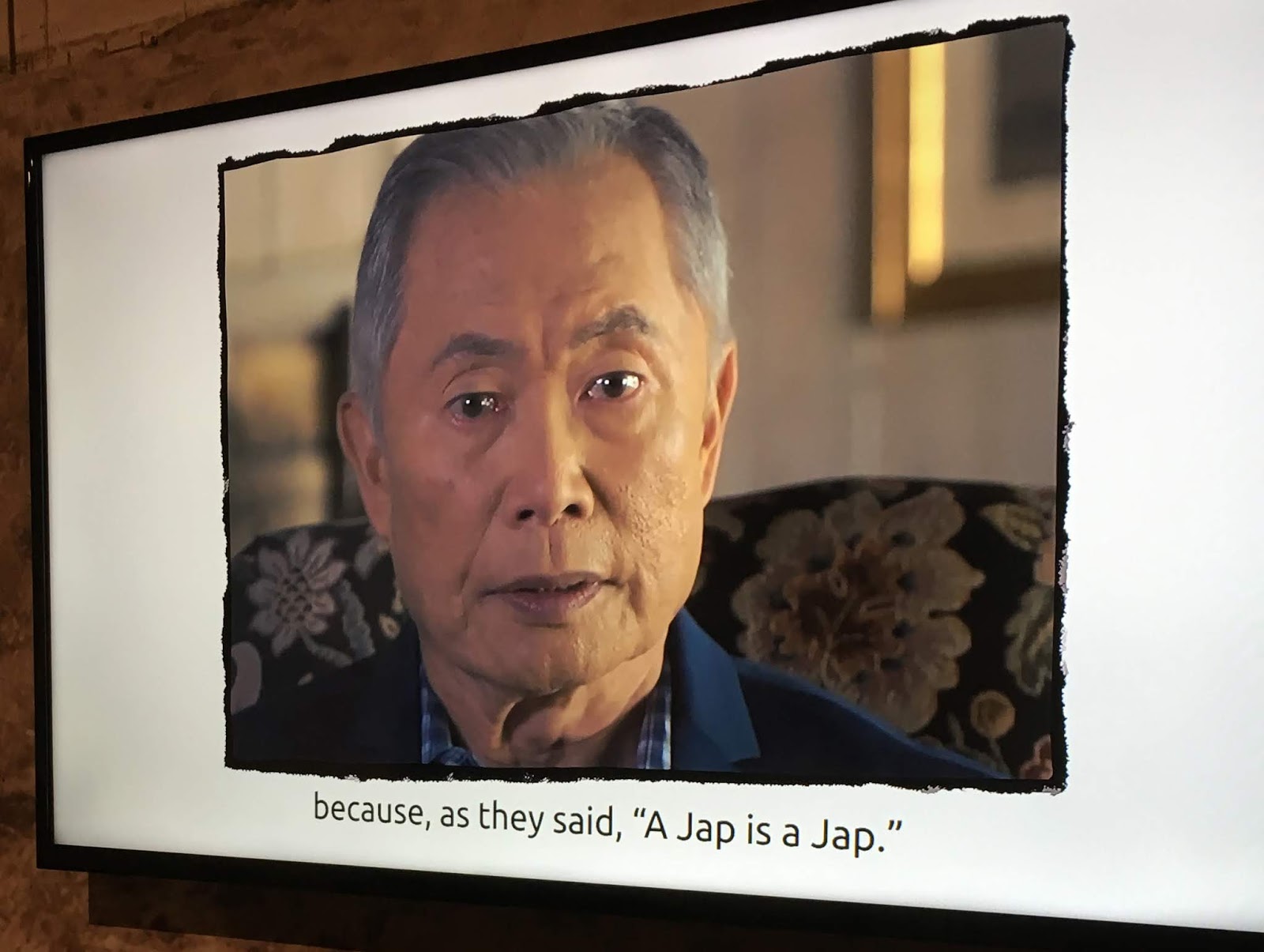
The California Museum in Sacramento includes a powerful permanent exhibit -- UPROOTED: Japanese Americans during WWII. Seventy-six years ago, Japanese Americans in California were swept up and sent away to internment camps. Old people recount their memories of childhoods ripped apart.

"My grandmother was looking at her roses and she said 'I don't think I'm ever going to see this again.'"

These people were no threat to this country as cooler heads understood even then. But fear and racial panic overwhelmed common sense and human decency. Somebody had to suffer for the Japanese empire's attack on Pearl Harbor. (Ironically, Japanese Americans in Hawaii were not locked away. The U.S. Army welcomed their labor for the war effort.)

The actor George Takei of Star Trek fame was one of those children sent to the camps. He explains in a looping video at the entrance to the exhibit how travesty came to pass.

Here's more from Takei on the internment from a PBS documentary.
Finding this exhibit in a state facility just a block from the capitol building reminds me how glad I am to be a Californian. We are far from perfect, but we still think we can make our state kinder, smarter, and better.

Sunday, May 13, 2018

Remembering my mother

Here she is with her squirmy toddler, circa 1948.

I feel a bit discordant posting this as she despised Mother's Day: "it's just something invented by the florists!"

I was very lucky in my relationship with my mother; few of my peers seem to have had it so easy. She simply unequivocally supported and loved me, even when I evolved into someone whose life and beliefs were unexpected. I loved her.

I think she would have said that raising me was her most significant accomplishment. Knowing that makes me a little wistful -- she was smart, competent, informed. In a time with different opportunities for women, she might well have had other, or additional, achievements.

I think too, if someone had asked her what else she was proud of in her life, she might have answered having been an active citizen of a country that defeated Hitler. (She wouldn't have instinctively given the Russian people the credit for this that I do, though I remember her explaining to me that she first had hope during World War II when the Nazis made the mistake of invading the USSR.) Most everyone of her generation felt they'd made a contribution to the war effort; she participated in aircraft monitoring in fields around Western New York. Though a person of the conventional right and no admirer of FDR, she left notebooks from the 1930s full of horror at what was rising up in Germany. She knew personally refugees from fascism. She had no truck with the America Firsters -- the domestic faction soft on fascism in her day -- who wanted to let Hitler conquer all of Europe rather than go to war.

She believed in engaged citizenship. I do too.

Monday, March 26, 2018

The other video that made me cry this weekend

Emma Gonzalez' evocation of her fallen friends was not the only message that had me in tears this weekend. This, from basketball team owner Vivek Ranadive speaking after protests against the police shooting of Stephon Clark had delayed a scheduled game for 19 minutes, also reduced me to tears.
Those old Greek philosophers, Plato and Aristotle, held that a good polity was only possible when citizens practiced "civic virtue." In this country, the founders thought that such good character -- balancing individual freedom with responsibility to community -- would be the foundation for their novel republic without a king. Under late capitalism, it is vanishingly rare to see a rich businessman display civic virtue, but Mr. Ranadive has it down here.

The team members are impressive too.
When civic virtue at the top is so obviously lacking as in the current White House and Republican Congress, citizens must look to other role models. Fortunately, these arise again and again from the people of this vast, complicated country.

Wednesday, March 21, 2018

On informing citizens

Linda Greenhouse, the long-serving New York Times Supreme Court reporter who has been contributing sporadic opinion columns since retirement in 2008, has turned several lectures she gave at Harvard into a pleasant little book: Just a Journalist: On the Press, Life, and the Spaces Between.

In her view, journalistic professionalism has, in the craft's most exalted reaches such as the paper she worked for, been interpreted to require the muzzling of the reporter as a citizen. Anyone who read her reporting would know that Greenhouse believes women should have a legal right to abortion and that torture inherently violates national and international law. Yet when she said as much aloud, casually, in speeches on other topics, she met with intense criticism from media critics. Being a tough woman, she simply pushed on and did her job as she understood it. She was good enough at it that she got away with this uncompromising steadfastness.

The crisis of journalism's business model and the Trump ascendency have forced elite institutions to reexamine their goals and standards. We're in a new day when the "paper of record" announces forthrightly that the President is a liar. "Objectivity" -- he said, she said reporting -- has been fully unmasked as "a management tool to control the behavior of the newspaper's employees." Careful balancing of unequal "facts" both fails the reader and won't deflect criticism anyway. Unexamined stenography of the emissions of those with the most potent microphones serves no one (except maybe the loudmouths). She envisions more fruitful use of journalistic energy.

Arthur Hayes Sulzberger, publisher of the Times from 1935 to 1961 captured the newspaper's credo of impartiality with a saying: "We tell the public which way the cat is jumping. The public will take care of the cat." Maybe that attitude was adequate in Sulzberger's day. Maybe it still is for sophisticated New York Times readers who take the time to sort through the cacophony of media voices retailing mutually exclusive versions of the truth. But surely we know now, in what has come to be called the post-truth age, that simply reporting which way the cat is jumping falls short if the goal of journalism is to empower readers to sort through the noise and come to their own informed conclusions. For that, they need context: not just what happened a minute ago, but what led up to that minute, why it happened, and what might come next.

That sounds obvious enough, but I was well into my three decades of covering the Supreme Court before I thought consciously of this kind of reader empowerment as a goal -- in fact the highest goal -- of journalism. ...

Today the internet provides access to raw information to anyone who will do the digging; the best of reporting, fair and accurate but without false "objectivity," can help us understand what to make of it all.

This graceful short book is well worth a couple of hours to read and ponder.