Showing posts with label sexism. Show all posts

Thursday, November 13, 2025

The fury to come

 
Even the complicated, partial release of the Epstein files has revealed and confirmed enough to make decent women (and men) see red -- and should help push our mad king off his phony pedestal.

I don't know how this plays out in younger age groups, but casual sexual exploitation of very young women is all too recognizable to most women in my age group. These guys, these powerful men, just assumed that women's bodies existed for their pleasure. (In their eyes, we had no souls.) Least culpably, some merely leered without remorse at young women; many of the richest and most powerful felt entitled to molest.

Some women can only deal with our dehumanization by men by denying it happens. A small number aid the perpetrators. In my generation, a lot of us gave up on men, even those men who were not personally guilty, but who couldn't see the burden women carry under the male gaze. Most women just soldiered on, living on a hurtful battlefield that is barely recognized by their male peers, even the men they love. 

And, if the good women and men with any power have the strength to pursue the Epstein revelations and implications, the nation faces a protracted release of stifled fury and agonizing confusion, necessary but terribly painful. Thanks Donald.

Cartoon via The Guardian. 

Wednesday, January 25, 2023

Can we just grow up?

It's the most banned book in the country so naturally I asked my public library for a copy. Happily, the San Francisco Public Library obliged within a week.

Gender Queer: A Memoir by Maia Kobabe, a graphic novel, is a sweet, relentlessly positive young adult account of trying to figure out sex and gender. It currently has many homophobes and misogynists in a tizzy.

Considering the book has been around almost 10 years, it's a little surprising that Governor Ron DeSantis's Florida should have gone ballistic about it last year, condemning it as a danger to kids.

Oh well, young people will find out what they need to find out regardless of adult anxieties. Adults can make this easier or harder. The availability of books like Maia's may make it easier for some.

A couple of comments on this highly recommended volume:
• Maia describes parents, family, and a community that seems amazingly supportive of e's exploration of a non-conforming identity. We can hope that such an environment is available to many people -- and I certainly see more of this around me. But most gender non-conforming people are still certainly not so lucky. Those of us who feel stable in where our gender identities have landed owe it to the searchers to provide as much support and acceptance as we can.

• Maia defaults to approving the (to my mind) pseudo-scientific view that felt gender and sexual identities are genetically determined. That is: "We're born this way." It's a convenient notion while struggling for social acceptance. And I'm sure this is true for some; but I am also profoundly aware that social and power dynamics influence how people can express their inner felt identities and that, in different social circumstances, people have and will make different accommodations. Often this is and has been literally about survival.
Finally, here's a panel from this book -- juvenile Maia's reaction to discovering that eir Mom thinks e can't swim without a bathing suit top. It captures the naive truth about gender norms that I wish we could all preserve:

Saturday, October 06, 2018

Polling miscellany

What with my intense work on the campaign to make Nevada blue, I haven't had my usual amount of time to surf about in random polls. But in addition to the election, there are some interesting findings floating about.
For all the Trump base's hostility to gender non-conformity, a Harris poll finds support for trans people's rights in the workplace is increasing at least marginally. Seven in ten people support a law "to protect LGBTQ people from bias in employment, public accommodations, housing and credit." Nice to see when the Trump administration is gratuitously jerking around about visas for partners of foreign diplomats who happen to be gay.
Latino Decisions finds that adding a question about citizenship to the 2020 census arouses sharp suspicions that the Trump administration would use the answers against Latinx families. Not hard to understand where that fear comes from ... Latinx leaders have worked hard to encourage full community participation in the census to ensure their constituents are noticed in social policy. That effort will be in trouble if the Trump administration gets its way and adds that frightening question.

PRRI (Public Religion Research Institute) polled issues related to abortion, gender, sexual harassment, and women's power in the context of Brett Kavanaugh's confirmation and the midterms. The linked article explores numerous findings, most of which merely confirm what a divided country we live in.
Actually I'm a little surprised by how far we've come in converting Democratic men to advocates for women ... good for these guys. We're gaining, but it sure feels too slow and too painful.

Interestingly, PRRI found that in this fraught moment, abortion was more important to Democrats than to Republicans. That's a change. Just wait to until Justice Kavanaugh and the other four black-robed men decide to restrict abortions further.

More happily, generic (unnamed, hypothetical) Democratic candidates lead among registered voters who claim to be certain they will vote. But additionally, among those not quite so certain they'll vote, the partisan gulf in strength of intent to vote turns into a chasm. That's why we're doing all this work to find infrequent voters who will support Democrats at the top of the ticket here in Reno. Once we find them, we'll hound them until they get to the polls. Why not? voting for Jacky Rosen and Steve Sisolak is what they claimed to want to do. Campaigns help them realize their intent.

Thursday, September 13, 2018

Justice delayed


It's good news that, at long last, San Francisco police officers whose racist and sexist text messages have been public knowledge since 2015 can face discipline. But I have to highlight one sentence from the Chronicle report on the decision.

The state Supreme Court cleared the way Wednesday for San Francisco to seek disciplinary action against a group of police officers who exchanged racist, sexist and homophobic text messages in 2011 and 2012 — calling African Americans “monkeys” and encouraging the killing of “half-breeds,” among other slurs.

The texts, which surfaced publicly in 2015, prompted the district attorney’s office to re-examine thousands of criminal cases the officers have handled. As many as nine officers, who have been on paid leave since December 2015, could be fired if the Police Commission finds serious misconduct.

We've been paying these guys not to work for three years because a combination of the power of the police union (POA) and politicians' weakness have made the SFPD unaccountable to the public. Individual cops have a right to fair hearings, but the people have a right to speedy resolution of complaints and removal of wrongdoers on the force.

Mayor Breed, State legislators, County supervisors, and Police Commission: take back our city from rogue cops! This is your job!

Sunday, November 26, 2017

These men just don't get it

Guest post from my friend Michele:

NPR had an “ad” for the book Sleeping Beauties [by Stephen King and Owen King] and the tag line was basically: “Imagine waking up in a world without women.” That sentence tells us the root of the sexism in our society. Who is listening to the tag line? Men and women. Who will wake up in a world without women? Men. It didn't occur to the writer, or to the people who approved the message, or anyone else who had veto power before the line was read on the air, that it was for the ears of men only.

Imagine waking up in a world without women? We apparently already live in one.

BTW, I read the book and it’s not very good.

YMMV. I'm unlikely to read this one.

Wednesday, November 15, 2017

Rethinking Bill Clinton: never a defensible guy in my book

There have been a cascade of articles in the last few days about how the Weinstein-Wieseltier-Moore revelations about powerful men using their positions to coerce sex from women should lead all of us on the progressive side of things to rethink Bill Clinton's sexual behavior, most especially the highly plausible rape allegations from Juanita Broaddrick. Here's the excellent Michelle Goldberg in the New York Times. Here's Dylan Matthews at Vox. Here's Caitlin Flanigan at the Atlantic. After all, didn't we stick up for a guy who several women charged with sexual misconduct and who we knew had a pattern of apparently thinking with his dick?

I don't feel any need to join the self-flagellation. I never was a Bill Clinton fan. The Lewinsky episode disgusted me; a president taking advantage of a misguided intern always seemed to me an unpardonable abuse of power. He was an adult; he had no business diddling a kid. A president even more than a movie mogul or a business tycoon ought to practice self-control over his appetites. He should have resigned for that alone.

And Clinton's misconduct involving Lewinsky contained another trespass. Millions of Democrats hadn't elected the guy to enable him to play with his pecker. We needed him to conserve his authority so as to govern for the people who put him in office. On election night in 1992, I found myself in a crowd of gay men whose community Republicans had allowed to die from HIV infections over the previous 12 years; they were now singing "Ding, dong the witch is dead!" This was just one subset among the constituencies -- communities of color, LGBT people, women, poor people -- that needed Bill Clinton to do the work of correcting some of the damage Reagan and Bush I had inflicted on the country's social health. It would be a fight. It always is.

Instead, Clinton weakened his presidency by playing sex games and ended up going along with one regressive GOPer measure after another: "don't ask, don't tell"; the "welfare reform" which killed federal support to poor women with children; a "crime bill" that led to mass incarceration of Black men. (Yes, there were other impediments to the Clinton agenda -- like Newt Gingrich and the GOPers -- but the guy increased his vulnerability to them with his sexual indiscipline.)

The other sexual accusations against Clinton (Jones, Willey, Broaddrick, Flowers) came from women who were promoted by his political enemies, the same people who were trying to convince us without the slightest evidence that the power couple in the White House were murderers and drug dealers. I didn't until the last few days remember even the names of the other accusers: too much right wing noise covered up the possibility these women's charges might be truthful. That's what happens when a blanket of fog spewed for partisan advantage covers the landscape. I can go along with the current assessment that we should have taken them more seriously, but their right wing sponsors, whose nonsense seemed an atmospheric pollutant hanging over the decade, were what made them invisible and inaudible to me.

At Politico, Jeff Greenfield offers a thoughtful take on Clinton and his progressive supporters.

... the center-left argued that the removal of Clinton was not just anti-democratic (overturning an election), but would be a victory for the forces of reaction. ... It also represented a complete reversal of a central feminist argument that “the personal is political,” that the behavior of men, and not just their pronouncements and policies, had to be taken into account. The new version was, “the personal is political unless the person in question embraces my politics.”

Clinton himself raised this argument when he told his cabinet in August of 1998 that his earlier assurances of innocence in the Lewinsky affair were false. His Health and Human Services Secretary Donna Shalala, upbraided him for his conduct, and noted that had he been a professor at the university she once ran, he would have been bounced for such conduct.

To which Clinton replied, according to the Washington Post, “that if her logic had prevailed in 1960, Richard M. Nixon would have been elected president instead of John F. Kennedy.”

This is, you may recognize, the mirror image of the argument Trump’s supporters made to skeptics, and what Moore’s supporters are making even as their man takes serious incoming fire. The political defense of Moore goes like this: “If Moore loses, that’s one less vote for tax cuts, conservative judges, traditional values. (Well, they might want to shelve that one). We can’t let our problems with personal conduct override the enormous political stakes.”

... For many of us, it is easy to look at of Weinstein, Trump and Moore as case studies in pathological behavior. Looking closer to home is a lot more painful; it is also compulsory. Unless and until partisans across the board stop justifying unconscionable behavior out of political self-interest, the more likely it is that the pervasive cynicism about the process, and everyone involved in it, will fester and grow.

More focus on what government is for and what political efforts we are trying to win through it, coupled with more women in positions of power (though we aren't immune to the temptations of misbehavior), might help.

Wednesday, October 18, 2017

Rage in two kinds

It's not hard to find descriptions of the rage of Donald Trump's "base" -- those white, often rural, older, and predominantly male citizens whose disaffection stuck the rest of us with this vicious, blustering idiot. Here's an articulate sample from the National Review (via Kevin Drum):

Trump is stoking a particularly destructive form of rage — and his followers don’t just allow themselves to be stoked, they attack Trump’s targets with glee. Contrary to the stereotype of journalists who live in the Beltway and spend their nights at those allegedly omnipresent “cocktail parties,” I live in rural Tennessee, deep in the heart of Trump country. My travels mainly take me to other parts of Trump country, where I engage with Trump voters all the time.

If I live in a bubble, it’s the Trump bubble. I know it intimately. And I have never in my adult life seen such anger. There is a near-universal hatred of the media. There is a near-universal hatred of the so-called “elite.” If a person finds out that I didn’t support Trump, I’ll often watch their face transform into a mask of rage. Partisans are so primed to fight — and they so clearly define whom they’re fighting against — that they often don’t care whom or what they’re fighting for. It’s as if millions of Christians have forgotten a basic biblical admonition: “Be angry and do not sin.” ...

The Harvey Weinstein story ("revelations" only to those not placed to look or to see) is a unleashing a righteous rage just as deep, more wide, though not nearly so empowered. Here's Lindy West:

When [Woody] Allen and other men warn of “a witch hunt atmosphere, a Salem atmosphere” what they mean is an atmosphere in which they’re expected to comport themselves with the care, consideration and fear of consequences that the rest of us call basic professionalism and respect for shared humanity. On some level, to some men — and you can call me a hysteric but I am done mincing words on this — there is no injustice quite so unnaturally, viscerally grotesque as a white man being fired.

Donald Trump, our predator in chief, seems to view the election of Barack Obama as a white man being fired. He and his supporters are willing to burn the world in revenge. This whole catastrophic cultural moment was born of that same entitlement, of Trump’s paws and Weinstein’s unbelted bathrobe, of the ancient cycles of abuse that ghostwrote the Trump campaign’s real slogan: If I can’t have you, no one will.

Setting aside the gendered power differential inherent in real historical witch hunts (pretty sure it wasn’t all the rape victims in Salem getting together to burn the mayor), and the pathetic gall of men feeling hunted after millenniums of treating women like prey, I will let you guys have this one. Sure, if you insist, it’s a witch hunt. I’m a witch, and I’m hunting you. ...

West is certainly not alone; anyone who has looked at a Facebook feed full of "me too" over the last few days knows that.

The moment feels much akin to the heady times in the 1960s and 70s when 20th century U.S. feminism lurched awkwardly out of the lineage of previous freedom struggles. Only this time, the witches may indeed represent a broader swath of humanity (one that even includes a lot of well-raised men!) Time will tell; we women are good at endurance. The slogan from the South African freedom struggle seems on point.

Thursday, April 06, 2017

This woman nails it

Democrats: take a look around and see who the "working class" really is these days. Then you can think through a strategy. Otherwise, phooey ...
Click through the slide show or read in a more conventional form here.

If this grabs you, you might also like: Against the Rich and Racist: Democrats can win over working-class voters fed up with the wealthy white nationalists in Trump's administration.

Sunday, December 04, 2016

Lessons from a survivor

Patricia Bell-Scott's The Firebrand and the First Lady -- Portrait of a Friendship: Pauli Murray, Eleanor Roosevelt, and the Struggle for Social Justice was a good book to read in the days following the election. However bleak our times may seem, it's worth staying aware of the brave and terrible struggles that have won us whatever is good in our country.

Pauli Murray, an obscure young Black activist, improbably forced her way into the patrician First Lady's affections, writing letter after letter alternately upbraiding, cajoling, congratulating, and demanding more equitable treatment for her people. The president's wife was 26 years older, both privileged and constrained by her husband's political career, insulated by her class from direct experience of the privations of Depression, yet determined to be on the side of "the people," a group that gradually, more and more, came to include Black people.

Murray is the vivid presence and center of this book, despite its organization around the two women's unlikely friendship; think of it as Murray's biography.

The label "firebrand" was ER's description of Murray. And no wonder. Murray's first letter in 1938 complained that President Franklin Roosevelt had lauded the University of North Carolina as a progressive institution at just the moment it was refusing her admission on the ground of her race. Two years later, Murray was back in touch with ER after being arrested for refusing to move to the back of a segregated interstate bus in Virginia. Not long after that, Murray became the field secretary for the Workers Defense League's campaign on behalf of Odell Waller, a Black sharecropper facing execution for killing a white landlord in self-defense. Murray, in tandem with Waller's mother, mobilized thousands of supporters, white and Black, to demand a reduced sentence. Roosevelt was persuaded to approach the Governor of Virginia and to try to push her very reluctant husband to intervene in the case. Their efforts failed; Waller was executed on July 2, 1943.

The struggle to save Waller led Murray go to law school at Howard University where she overcame discouragement from male professors and led student sit-ins to integrate lunch counters in the District of Columbia. Mrs. Roosevelt invited her "firebrand" friend to tea at the White House at this time. Also at this time, Murray's tortured struggle to come to terms with her attachments to female friends caused emotional breakdowns and even landed her in a mental institution. Homosexuality was considered a perverted "mental disorder." A concept of healthy homosexuality would not be invented for another 30 years. Bell-Scott quotes a painful letter Murray wrote to an aunt:

This little 'boy-girl' personality as you jokingly call it sometimes gets me into trouble. And to try to live by society's standards always causes me such inner conflict that at times it's almost unbearable. I don't know whether I'm right or whether society (or some medical authority) is right -- I only know how I feel and what makes me happy. The conflict rises up to knock me down at every apex in my career and because the laws of society do not protect me, I'm exposed to any enemy or person who may or may not want to hurt me.

In that last fear she was correct. Despite graduating from Howard with high honors, she was excluded from further legal study at Harvard for being both Black and a woman. She earned an additional law degree at Boalt Hall at Berkeley, but despite her accomplishments couldn't get a government job in the McCarthy-ite 1950s. Suspicions about her sexual orientation were an added strike against her on top of her work for racial justice. At one point, even Thurgood Marshall at the NAACP wouldn't hire her because of such rumors. Through all this Eleanor Roosevelt remained a solicitous correspondent whose friendship strengthened Murray. By then, also, Murray had established a stable, accepting relationship with Renee Barlow with whom she had worked at a law office.

By the beginning of the 1960s, Murray had added another justice struggle to her plate:

She had spent the first half of her life fighting for equal rights as an African-American, only to discover she would have to spend the second half fighting for equal rights as a woman ...

ER died in 1962; in 1966, Murray became one of the founders of the National Organization for Women; worked to keep sex discrimination as an element in the Civil Rights Act; and so influenced future Justice Ruth Bader Ginsberg that Ginsberg credited Murray with co-authorship of the brief that established sex discrimination as unconstitutional.

And then -- having taken on race, sex, and gender struggles, Murray felt called to break one more barrier, enrolling at General Theological Seminary in 1973 and taking a place among the first cohort of women to be ordained as priests in the Episcopal Church.

"My ordination as a Negro woman priest comes some 172 years after the first Afro-American male priest was ordained ...The Holy Spirit in our Church moves slowly at times, but it does move."

In 2012, twenty-seven years after her death, the Episcopal Church added Murray to its calendar of Holy Men, Holy Women who are held up as worthy examples of godly lives.

I'll give the last word to Murray here:

“If anyone should ask a Negro woman what is her greatest achievement, her honest answer would be, ‘I survived.’ ”

Thursday, August 25, 2016

On being a certain sort of woman


Maybe it is something about having a woman on the verge of winning the presidency, but I find myself encountering bold discussions of the realities of women's lives with a frequency not prominent for awhile. Or maybe I'm just paying more attention ...

Kristi Coulter offers up a message that is the antithesis of the battered bumpersticker above. Recently having got sober, she calls it as she has lived it as an accomplished young professional.

... And there’s no easy way to be a woman, because, as you may have noticed, there’s no acceptable way to be a woman. And if there’s no acceptable way to be the thing you are, then maybe you drink a little. Or a lot.

... A woman with a single-malt scotch is bold and discerning and might fire you from her life if you fuck with her. A woman with a PBR is a Cool Girl who will not be shamed for belching. A woman drinking MommyJuice wine is saying she’s more than the unpaid labor she gave birth to. The things women drink are signifiers for free time and self-care and conversation — you know, luxuries we can’t afford.

... Is it really that hard, being a First World woman? Is it really so tough to have the career and the spouse and the pets and the herb garden and the core strengthening and the oh-I-just-woke-up-like-this makeup and the face injections and the Uber driver who might possibly be a rapist? Is it so hard to work 10 hours for your rightful 77 percent of a salary, walk home past a drunk who invites you to suck his cock, and turn on the TV to hear the men who run this country talk about protecting you from abortion regret by forcing you to grow children inside your body?

... Maybe women are so busy faking it — to be more like a man at work, more like a porn star in bed, more like 30 at 50 — that we don’t trust our natural responses anymore. Maybe all that wine is an Instagram filter for our own lives, so we don’t see how sallow and cracked they’ve become.

This is absolutely go-read-the-whole-thing writing.

Thursday, August 11, 2016

Perenial Olympic rehash

At the Guardian, Lindy West offers a solid explainer: How to talk about female Olympians without being a regressive creep.

As ever, this year’s Olympics – an international bacchanal of physical perfection and triumphant will swaddled in human rights abuses and environmental catastrophe – are providing fuel for public delight and scorn in abundance. Making a strong showing in the “scorn” category already is the press, which, less than a week in, has managed to insult, demean and erase female athletes in a cornucopia of bungles.

... The Olympics offer up women’s bodies for public scrutiny on a massive scale, but to surprisingly constructive effect, relatively speaking: It’s one of the only hit TV shows that celebrates female strength, skill and excellence without sexualising female existence. ...

... I’ve put together a quick and easy template for your basic reporting needs (cribbed and adapted from a piece I wrote about coverage of female politicians in 2014, because you could basically have this conversation about any industry, and I do):

NEWS REPORT: [Female Athlete] did [sports] today. [Describe sports.] THE END. Sportswriting accomplished!

Solid advice that.

Meanwhile, via Grist, there's this cheery item. Enjoy.

For all the controversy over the Games’ hefty price tag, past Olympics have brought some marked improvement to cities’ transit and livability — and some downsides, too.

I recall seeing the result on the waterfront in Barcelona. Let's hope Rio benefits as well, though you probably need at least a center-left government, if not urban communists, to avoid the worst.

Wednesday, August 10, 2016

Is it really this bad? Perhaps.

When a book completely reinforces all my preconceptions, I have to wonder whether, just perhaps, the author has missed something. Is there some other way to look at this material?

That's how I felt when I read Peggy Orenstein's Girls & Sex: Navigating the Complicated New Landscape. As her daughter came into adolescence, this feminist writer decided to find out what sex meant to her generation. She interviewed some 70 young women between the ages of 15 and 20 and reports what they said.

What they told her reads for me as if very little has changed since the mid-60s when it comes to young women feeling empowered and happy about their sexual desires. Oh, there are obvious differences: porn in many guises is everywhere and the poor things think they have to shave their pubic hair to be attractive. But the underlying dynamic seem to work just as it did when I was young: girls believe they must put out in order to get or keep the attention of young males -- and young males think they have a natural right to have girls provide them with sexual pleasure. Neither partner much gives a damn about, or even expects, girls' pleasure.

Some snippets from this book:

So what, I asked [a young woman named] Sam, was today's version of 'the bases'?

..."Well, first base would be kissing, ... second base would be a hand job for a guy and fingering the girl... And third base would be oral."

"Both ways?" I asked.

Sam laughed ... "For the guy ... Girls don't get oral sex ... For us, oral sex is not a big deal. Everyone does it."

Orenstein points out that giving blow jobs can and does pass around STDs among teens, leading to rising rates of gonorrhea and herpes.

Boys, incidentally, far and away, said the number one reason they engaged in oral sex was for physical pleasure.

... particularly for girls, giving oral sex was also seen as a path to popularity. Intercourse could bring stigma, turn you into a "slut"; fellatio, at least under certain circumstances, conferred the right sort of reputation. "Oral sex is like money or some kind of currency," Sam explained. "it's how you make friends with popular guys ..."

[A college freshman named Anna elucidated:] "Sometimes a girl will give a guy a blow job at the end of a night because she doesn't want to have sex with him and he expects to be satisfied. So if I want him to leave and I don't want anything to happen ..."

Orenstein does report that under some circumstances, giving oral sex offers young women a feeling of power.

"I guess I like that feeling of 'Ha! You can't get this from anyone else. I am in control here!' You knew they really, really wanted it and you could be like, 'No! No!' and they'd be like, 'Please! Please!' Because they were so desperate. That part's kind of fun. But it's definitely not the physical side of it, because that's so gross and it really hurts my throat. I mean, it's sort of fun getting in the rhythm of it. But it is never fun fun."

Well at least she gets one sort of sexual pleasure. I would wish she were able to enjoy sex a little more whole-heartedly.

These are young women who have grown up expecting equality with boys. They often excel as much or more than their male peers in school and intend to undertake difficult career paths. So Orenstein challenged them:

What if, rather that blow jobs, guys were expecting girls to, say, fetch them lattes from Starbucks? Would the girls be so compliant?

Sam laughed when I asked her that. "Well, a latte costs money..."

"Okay," I said. "Pretend it was free. Let's say guys expected you to keep getting them cups of water from the kitchen whenever you were alone. Would you be so willing? And would you mind that they never offered to bring you one in return?"

Sam laughed again. "Well, if you put it that way ..."

Obviously these young women aren't "putting it that way."

Orenstein theorizes that, like generations past, these girls have internalized a sense that their genitals are "icky". Most don't masturbate, so they know little more about their bodies than the boys do. For some, "absence of pain" is about all they expect from a boyfriend.

The book ends with an indictment of most sex education. Orenstein asks: can't we just teach both sexes that sex is for their pleasure and to enable intimacy between equal partners? The Dutch apparently do, according to her research.

But in the land of the religious right, "abstinence-only," and prurient sexist adults, that's apparently not yet possible.

Or is there more to this story? This childless old lesbian can't claim to know.

Saturday, April 30, 2011

A visual rant about the status of women

How come we're still a problem?

Often I look around and think, well -- the rich may have ripped off my country and succeeded in making the "little people" (thank you Leona Helmsley for naming us) pay the price in daily suffering for the empire's decline -- but at least in my lifetime women and queers seem on the way to equal opportunity participation in the general morass.

I'm not talking about the big battles, like the Republican war on women's health as expressed by denying funds to Planned Parenthood. Control of our plumbing remains contested.

But whenever I think I'm surrounded by little improvements that have moved the terrain, I run across reminders that women's equality is still problematic. Here are three examples for a quiet Saturday.

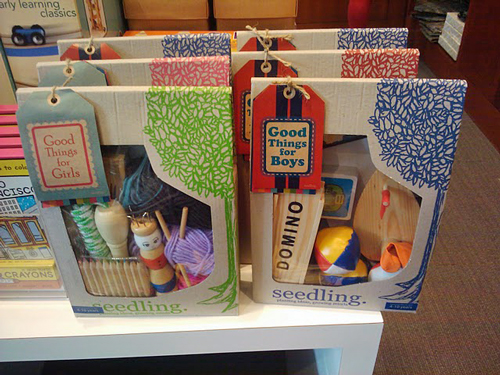
sexis-toys-legion-of-honor.jpg
A friend noticed these packages at the gift shop in San Francisco's tony Legion of Honor museum. Now I guess we can imagine that some tourists may be too overwhelmed by the facility's splendors to figure out what souvenir to buy for young relatives -- but do they really need gender labels on their gifts? My friend tried to complain to a mystified clerk.

libyan-women-guns.jpg
Walking through the Mission District (yes, photographing cats in windows), I ran across this odd example of pseudo-revolutionary porn. What was the artist thinking? I have no idea whether Libyan women have guns, but I'm pretty certain that most of them are hunkering down, hoping to keep their menfolk alive, and wondering whether their families will survive the fighting around them. Sure, they may have political opinions, hopes and fears -- but there's nothing pretty or attractive about living through a chaotic war among testosterone-poisoned guys with guns.

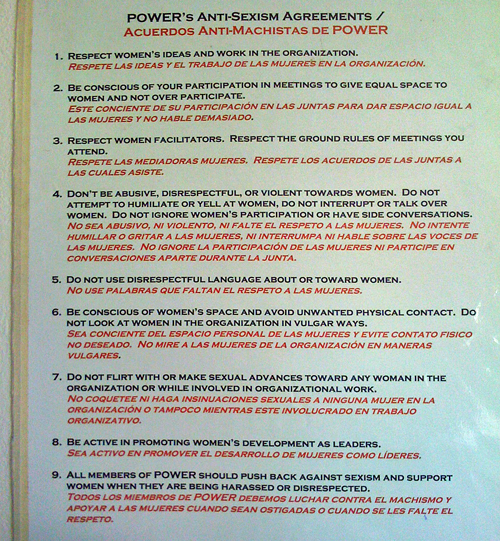
POWER-anti-sexism-agreements.jpg
This poster hangs on the wall of the conference room in one of our city's more effective neighborhood community organizing outfits. Yes, it feels a bit simpleminded and rigid, but following rules of behavior may be what we need to learn to get along. We become what we practice. The poster probably fades from members' consciousness, just another wall hanging in a familiar room. But the rules set a baseline. As in most such organizations, women outnumber men in the membership here and they sure aren't about to keep quiet or take any shit.

Thursday, July 08, 2010

This goes for racism too ...


Here’s an easy rule for any manager to live by: If you haven’t considered the societal forces and ingrained prejudices that may contribute to gender disparities in your hiring practices, your hiring practices are probably sexist.

And if you respond to suggestions that your hiring practices may be sexist with a letter signed by all the women on your staff dismissing these claims out of hand, then your hiring practices are almost certainly sexist. That, or men are just better than women.

Substitute "race" for "gender," "racist" for "sexist" and "blacks" for "women" -- and you can notice you are asserting that white (men) are just better than black and brown people. It happens -- a lot.

The quote is from an Amanda Hess column in the Washington City Paper explicating the flap over whether Jon Stewart's employment practices at The Daily Show are sexist.

Tuesday, February 16, 2010

Winter Olympics: Women still deserve wider opportunities

The figure skating is not my favorite part of the Winter games.

I'm not fond of any judged sports. It seems to me better to let competitors, within the rules of their discipline, do their thing in head to head competition and the one who could best the others on that day wins. Naturally I prefer watching events like the cross country races or the downhill skiing to judged skating. Moguls was an interesting mix of judged and straight competition -- an under-informed viewer could be a little mystified to see that the fastest competitor to arrive at the bottom of the hill still standing didn't necessarily prevail.

In the judged sports like figure skating (and gymnastics in the Summer games), the aim becomes to measure how closely a competitor can match his/her arduously honed gifts to whatever ideal image is lodged in the judges' heads. This needn't be completely arbitrary, but it is also not necessarily as athletically interesting as what these extraordinary talents might come up with if their creativity weren't so constrained by their discipline's conventions.

Elvis Stojko, a Canadian three-time world champion during the 90s, has riled some folks by insisting that skating's conventions leads to "effeminate" programs. As reported in Salon:

People tiptoe around the topic, and I was like, "You know, I'm just going to say it: Effeminate men's skating is not my style of skating. In men’s skating I like to see power and strength."

... It's not the skaters' fault. It's the way the system has been rewarding them. You have to have a program that’s dynamic. If it's the same from beginning to end, and it's soft and doesn’t have dynamic strength and power and quickness, the routines become very much the same, and it becomes very boring.

...It doesn’t have anything to do with gayness.... It's the way you carry yourself. There’s a certain strength to it when a masculine skater steps onto the ice and attacks a program. With the feminine skaters, the use of the hands becomes very soft, down to the fingertips. There's a lot of little details, but essentially you can pick up on it in the first few movements. ..As a male skater I don't want to be considered a beautiful skater. I want to be a strong skater.

Okay, I could easily decide this guy just doesn't like women and doesn't want to be identified with us.

But, you see, I share his wish to see power and strength on the ice: from the women skaters! Why are they constrained to be soft, feathery, weepy? They are obviously remarkable athletes, possessed of extraordinary agility and balance -- and rock strong in order to skate these long programs. But the latter quality is something they are required to hide.

The twosome pictured didn't come close to winning the pairs; they placed 8th. But I loved their short program. Ukrainians Tatiana Andreëvna Volosozhar and Stanislav Morozov skated in what looked like Star Trek uniforms (she got to wear pants!) with power and zeal. That suited this viewer fine. I'd love to see what a solo woman skater who added visible power to grace could do in the solo competition. But we all know the sport's conventions would never allow that.
***
Then there's women's ski jumping. Or rather, there isn't women's ski jumping in the Olympics. San Francisco sports columnist Gwen Knapp hazards a guess at why this exclusion remains:

At the start of these Winter Olympics, American Lindsey Van held the record for the longest jump at the so-called normal hill (the smaller one) at the Whistler venue. Not the record for women, but for anyone, male or female.

At the time, no elite men's event had been held there. In the first round of the Olympic normal-hill competition, the maximum jump was 105 meters, half a meter less than Van's distance. In the final round, the longest jump broke Van's record, at 108 meters. The bronze medalist had the second-longest at 106.5 meters.

Ski-jumping results combine distance and judges' style scores, so Van's 105.5 meters don't translate to guaranteed success among the men. But low body weight allows extra loft, to the extent that the men have developed eating disorders and the sport has regulated their weight as if they were jockeys, adjusting ski lengths according to body mass. The physical advantages most men have over women, particularly upper-body strength, don't play a big role here.

To modern thinkers, the prospect that a woman might be able to outperform a male medalist in the Olympic Games seems pretty fascinating. To stodgy IOC members, the thought must be terrifying.

As Knapp points out, the women jumpers don't actually want to jump against men; they want their own event in which to compete with each other. Knapp hopes that the Olympic Committee can correct this injustice by 2014.

I also hope so; I have a 16-year old friend who would be just about ready to make that team ... You can read about women's jumping and this aspiring athlete in this article from the Rutland Vermont Herald.

Saturday, June 14, 2008

A 1950s Father's Day

Thanks to my deceased father, I have no trouble with being a Father's Day skeptic. Mine suspected that the day was designed to sell something and he wanted none of it!

I suspect he had a point. A friend remembers celebrating the day in the 1950s by giving this item to her dad:


What's this?


Oh, a stand for reading the morning paper...


or shutting out the little wife, perhaps?

Some humor doesn't wear well.