Showing posts with label youth. Show all posts

Thursday, March 26, 2026

On the infrastructure of young lives

This week two different US courts found two monster social media platforms -- Meta (Facebook and Instagram) and Google (YouTube) -- liable for encouraging social media addictions in young people. This should shake up these companies which have operated with so much impunity for the consequences of their products. About that, we'll see.

John Della Volpe has been polling young Americans for over 20 years about what shapes their lives. He has explored with them what they think about social media. 

... According to our polling, 71% of young Americans use Instagram, 64% use TikTok, and 54% use Facebook. ... nearly 1 in 3 young Americans blame platforms directly for spreading false information. And when asked what would rebuild trust, 50% say holding both platforms and individuals accountable — the exact legal theory that just prevailed in court. ... 

Platforms have become infrastructure — useful, embedded, but not believed. And the implications extend far beyond tech. ... Gen Z depends on systems they believe are unreliable, run by institutions they believe are unaccountable. That’s not a user problem. That’s a legitimacy problem. ...

The consequences of growing up in, of being natives within, a system they can't believe in are scary and deep They adapt to their environment which is simply the world where they live, but which they cannot trust.

    •    They cross-check everything.
    •    They trust peers over institutions.
    •    They build their own internal filters for what’s real and what isn’t. 
That’s rational behavior in a low-trust system. But at scale, it creates a country where there is no shared baseline — only parallel realities, loosely connected, constantly contested. And that’s where democracy starts to strain..

... They don’t leave the platforms. They can’t. 

... Trust doesn’t disappear all at once. Platforms still work. People still log on. The business model still holds. But something underneath starts to shift.

When people stop believing what institutions say, they respond to authority differently. They question more. They verify more. They rely on each other instead of the system itself. ...

... Platforms can survive without trust. Democracies can’t. 

 • • •

Talking with a parent of teens recently, he observed that his young people weren't very interested in social media as far as he knew -- and they vehemently rejected AI-infused content when they encountered it. Maybe we'll see a generation more discerning than their elders about this stuff? That would be the normal human reaction to a novel technological reality.

Wednesday, October 29, 2025

Alone in public amid randomness and isolation

John Della Volpe introduces himself: 

For more than two decades, I’ve been embedded in the land of young Americans. First millennials, and now Gen Z with an eye on Gen Alpha. From my perch since 2000 as polling director at Harvard Kennedy School’s Institute of Politics, at SocialSphere, and as the dad of a few Zoomers and one Zillennial — I spend most of my time talking with, surveying, and thinking about young Americans. 

In the context of New Yorker's mayoral election, he's been talking with young citizens of that city. He reports: After Everything, They Still Want In. You can read it all at the link. 

Twelve young New Yorkers — disillusioned with both parties, abandoned by institutions, and living under daily pressure — still believe in something better. ...

All under 30. Some were born there, some were not. All living in the tension between loving New York and questioning whether it loves them back.

“We love it here,” one said. “But it doesn’t always love us back.”

The conversation didn’t spiral. Everyone stayed grounded. They were proud to live in the “greatest city in the world” — but honest about how much it costs them, in every sense.

He covers ten points; I found myself reflecting on this one:

#7: Fear is everywhere. So is numbness.

Almost every participant described feeling physically unsafe at some point in the last month.

“You’re always calculating... Should I step in? Should I run? Am I going to get hurt just trying to help someone?”

“They’re not there to protect people. They’re there to write tickets.”

The problem wasn’t just crime. It was the feeling of being left alone with it.

I tried to think how this was the same and different from what I felt when I lived for awhile, a long time ago, in the great city. So I raised the question to Della Volpe and he responded: 

janinsanfranCan you expand on what the fear is about? I know New Yorkers who feel that NYC feels safer than it ever has. 

Lived there myself as a very young person in the 70s -- very sporadically, but not uniformly, seemed unsafe then, in what was then thought a very unsafe area. 

These folks feel what they feel and we must honor that -- but that conclusion seems something that could be expanded on. 

Della VolpeYou’re right — the fear young New Yorkers describe isn’t the same one older generations remember. It’s not about crime rates; it’s about randomness, isolation, and trust.

They’re afraid that anything can happen anywhere — a shove on the platform, a stranger following them — and no one will step in. It’s the sense of being alone in public that feels new.

And even when they know the data shows record-low crime, they don’t feel it. The fear now is less about danger itself, and more about whether anyone — the police, the city, other people — will show up when it happens.

In that gap between statistics and experience, you can feel how much trust has frayed.

Let's hope the experience of the Mamdani campaign is breaking through this isolation. Effectual campaigns can do that. If Mamdani's mayoral term can deliver on some of its promise, that would help too.

Tuesday, September 26, 2023

Credit where credit is due

Here's a postscript to the blog about youth election engagement posted here yesterday.

David Hogg came to national notice in a terrible way: he's one of the survivors of the Marjory Stoneman Douglas High School shooting massacre. With many of his comrades and others, he became one of the organizers of the national March for Our Lives

Then he went off to and completed college.

These days he is launching what looks like a movement-oriented youth electoral politics shop which they call Leaders We Deserve, aiming to "build the EMILYs List for young people"  More power to them; needs to be done.


But I wanted to share here Hogg's thoughtful assessment (from Xitter @davidhogg111) of where we've come to in the last four years and of our incumbent and candidate president.

Young people voted for Biden in record numbers here’s the result so far:
• Billions in student debt forgiveness

 • First gun safety bill in 30 years

• Most Climate spending in US history
• Office of gun violence prevention
• Climate Corps

More progress on all the above issues in three years than the past 30. This is not simply because Biden cares about young people it’s because our generation has real power. Biden knows he can’t win without the youth vote- especially young people of color. While he’s limited with a divided congress and a corrupt Supreme Court he’s managed to get more done than any president in decades with razor thin margins.

It can be hard to imagine but Biden was once a young person he was elected to the senate when he was 29. He has over 50 years of experience. When voting what I want most is someone who can deliver and Biden has.
This because he’s done a remarkable job integrating progressives into leadership. When we match the passion of the progressive movement with his experience it’s a recipe for success.
When he was first elected I was very doubtful of how much could really happen I am happy to be proven wrong. If he was doing a bad job, as someone who does not shy away from publicly criticizing the party or president I would tell you. But honestly Biden and especially his incredible staff [have] made it work.
March for Our Lives and many others demanded action, protested and Biden has listened, we aren’t going away but i wanted to give credit where it is due.

Clearly, Hogg is wrestling with the permanent conundrum for honest advocates for major change in a democracy: how do you keep your vision clear and your coalition together while striving for tangible accomplishments on your agenda. Wrestle away! May the force be with you.

Monday, September 25, 2023

The Times They Are A-Changin

John Della Volpe writes "for more than two decades, I’ve been embedded in the land of young Americans. First millennials, and now Gen Z with an eye on Gen Alpha. From my perch since 2000 as polling director at Harvard Kennedy School’s Institute of Politics, at SocialSphere, and as the dad of a few Zoomers and one Zillennial — I spend most of my time talking with, surveying, and thinking about young Americans. ..."

He concludes, based on long running CBS News polling, that younger Americans are approaching the looming 2024 election and our general prospects with a lot more hope than their elders. 

#1: Younger Americans are the most optimistic Americans
    •    Younger Americans have dealt with more chaos more quickly than most Americans — indeed, before most reached adulthood;
    •    Yet, they’re not turning away from their country; they are leaning in with a generous and tenacious spirit.
Gen Zers and millennials are significantly more likely than older generations to indicate that things in the country are going “very” (13%) or “somewhat well” (31%).
And unlike their elders, they think well of Vice President Harris. Her presence along with Joe Biden increases their confidence in the ticket.

#2: VP Harris is polling solidly with younger voters who see her as an asset to President Biden and the 2024 ticket

Although the GOP presidential candidates are attempting to downplay Vice President Harris’s role in the administration and her potential impact on the 2024 Democratic ticket, this poll indicates that younger voters remain undeterred and supportive.

The Vice President’s approval ratings are trending ahead of most national figures and are particularly strong across the younger cohorts. (55%: among the 18-29 age group)

On a fraught subject, a majority think Joe Biden is getting U.S. support right for a free Ukraine.

#3: Gen Z and millennials are more in favor of U.S. engagement in Ukraine than older generations

For as many adults over 30 who believe that the Biden administration is generally handling things the right way in Ukraine, about the same number think the U.S. should be pulling back and doing less. The pattern reverses, though, with younger Americans. ...those under 30 are between seven and ten points more likely to support greater U.S. support for Ukraine.

Additionally, young adults are also more supportive than older generations of sending aid and supplies (76%), weapons (57%), and troops (48%) to Ukraine.

Though I agree about the justice of Ukraine's cause, I marvel at the reversal from past wars which younger people questioned more readily than did their elders.

• • •


Los Angeles Times writer David Lauter took up the question of who among us might spark hope in the years ahead. He found an answer in the paper's reporting: 

The optimism of President Obama’s “Yes we can” and President Reagan’s “shining city on a hill” seem like increasingly quaint relics....

... a campaign for reform is not an impossible idea. In the early 20th century, a national debate and calls for systemic change led to the direct election of senators, widespread adoption of ballot initiatives and women’s suffrage. In the 1960s, another wave of reform enfranchised Black Americans and swept away legally enforced racial segregation.
Could that happen again? The optimism about the future that our Times/KFF poll of immigrants found and the deep discontent the Pew survey documented among younger Americans point to a possible way the current era of stalemate could end.
... Both immigrants and young people vote at much lower levels than the rest of the population. Many immigrants aren’t citizens, and even those who do have citizenship often aren’t plugged into U.S. politics. Young people often aren’t habitual voters and need a cause to motivate them.
But both groups are poised to play a larger role. Millennial and Gen Z Americans are forecast to become a majority of voters by the end of this decade. And the number of immigrant voters will grow as well, as more achieve citizenship. Both groups want more than the current system offers and could push it out of its rut.

• • •

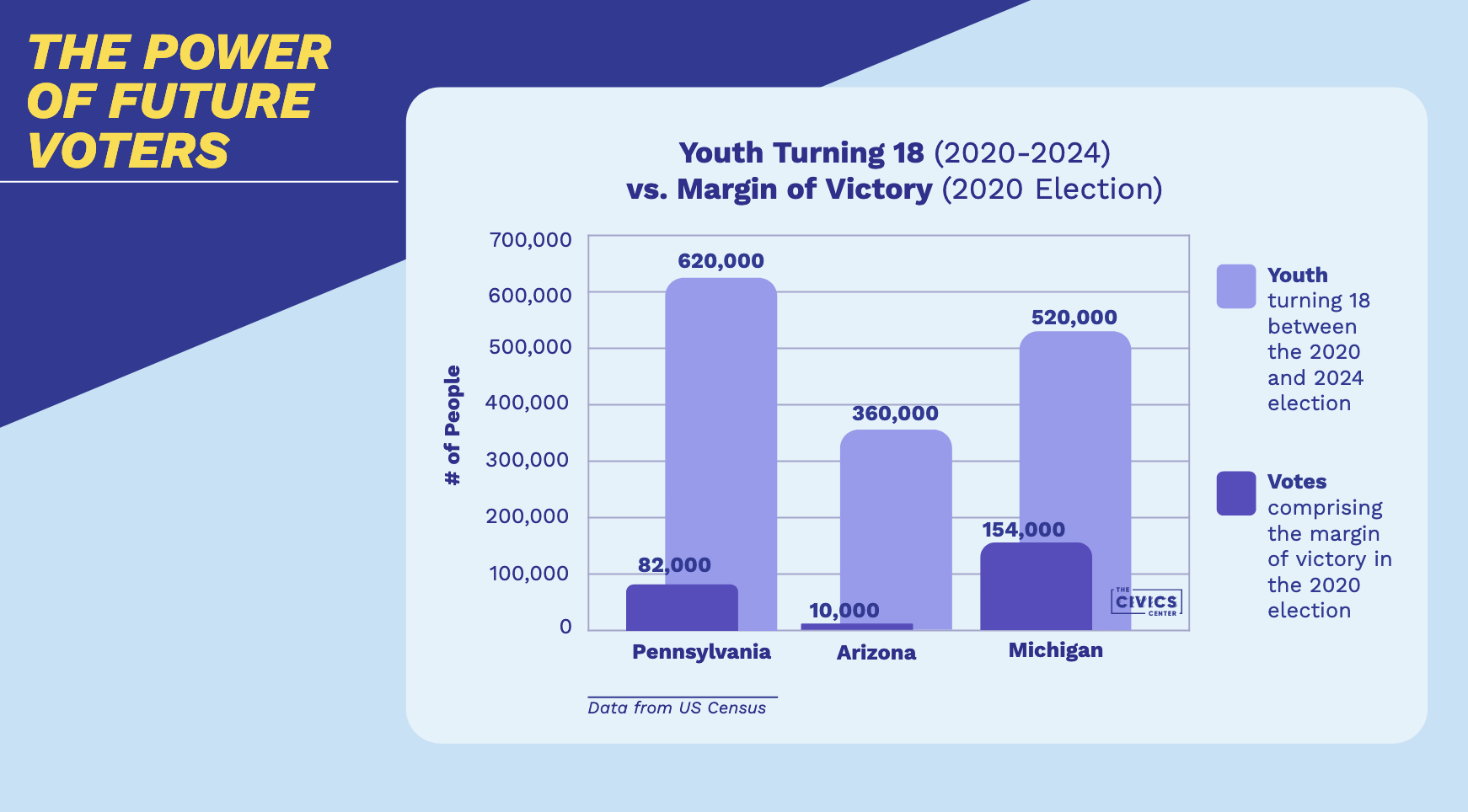
The Civics Center works to get young people registered as soon as they turn 18, mostly while still in high school. That early start on encouraging engagement with politics is important. Once they leave high school, spread out, start college or a job, often elections can seem one thing too many in a challenging time of life. It becomes hard to catch them to ensure they are registered -- but they will vote once they are already registered. 


And the number of young new registrants can make all the difference to outcomes.

If this inspires, check out The Civics Center. They've got a program to get the job done.