Monday, February 20, 2006

Flight Security

Well, I may, or may not, still be on the no fly list, but I was not too surprised to find the document that follows when I opened my suitcase after flying into town last night.
TSA-Notice001
I suppose this kind of surveillance might detect a bomb, though I tend to suspect that, like the no fly list, this is really just the Theater of Fear. There was no evidence that anything in the suitcase was disturbed. I don't lock, so they didn't have to break in. I hope they found my dirty underwear and socks fascinating.

It may have been a good thing that I threw the book I'm currently reading, When Victims Become Killers by Mahmood Mamdani, in my carry-on.

Sunday, February 19, 2006

Historians against the war
Panel highlights

Over the past weekend, my partner and I attended "Empire, Resistance and the War in Iraq," a conference put on by Historians against the War, at the University of Texas at Austin. The well-attended three-day event featured four keynoters, Andrea Smith, Howard Zinn, Irene Gendzier and Rashid Khalidi. I may write more about the conference and their presentations in the future.

In this post I'm just going to share a few highlights from some of the more thought provoking panelists. These are based on my notes and I may have erred in interpreting what I heard. You are reading here what I took away which I can only hope accurately portrays what the speakers said.

Alan Dawley, College of New Jersey. In U.S. history, three elements that have brought U.S. imperial wars to an end (short of annihilation of the "natives"); none of these factors have been sufficient to end wars, but all three taken together have ended our imperial adventures. They are:
  • 1)a favorable balance of power internationally, meaning real opposition from countries with some power;
  • 2) significant resistance within country attacked;
  • 3) rising US domestic resistance to the war.
As all these factors are present in relation to the Iraq war, he is mildly hopeful about ending the current adventure, though optimism is no reason for the U.S. antiwar movement to reduce its efforts. Nor does the failure of our regime's Iraq war preclude other imperial follies.

Magnus Bernhardsson, Williams College. After 2000 years, the U.S. invasion may have managed to kill off Iraqi Christianity. One of the oldest Christianities on earth, the faith community had survived isolation from both Rome and Constantinople (Eastern Orthodoxy), Islamic rule, the Ottoman empire, European colonialism, Ba'ath rule, and the xenophobia that the Israeli-Palestinian war has excited in the Arab world. But since the Bush administration's incursion, the Christian community is simply fleeing the insecurity that is contemporary Iraq.

Rahul Mahajan, New York University. In the 1980s the US stopped cementing its domination of weaker countries by imposing plutocratic dictators and turned instead to imposing "democracy." This democracy is a debased polity named by the scholar William Robinson "poliarchy." In poliarchy, democratic forms become a sort of play acting rather than an exercise of political power. Elites rule, enlisting the masses of people only as extras in their dramas. The U.S. is rapidly being reduced to a poliarchy itself. Because the people responsible for Bush's policies really believe they can (and should) implant this debased "democracy," they are genuinely surprised when its forms yield unexpected results such as an Islamic fundamentalist government in Iraq and a Hamas majority in Palestine.
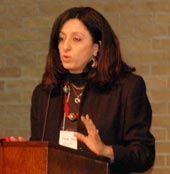
Nada Shabout, an art historian, explored how "liberation" by the U.S. occupation is disconnecting Iraqis from their historical experiences. Though an exile herself from Saddam Hussein's tyranny, she is worried and angered that the ongoing project to destroy all monuments from the Ba'ath leader's era is tearing up vital historical memories for many families who lost children in the conscript armies that fought the Iran-Iraq and Gulf wars. She speaks up for preserving some of the many cast bronze heads of Saddam that were such a feature of pre-invasion Iraq; "after all the Roman emperors were tyrants, but we are glad to have sculptures of their heads."
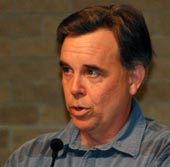
Walter Hixson, University of Akron. "There is no United States. Over and over the country has had to have its identity reaffirmed and recreated by wars. The U.S. historically has affirmed itself by naming some people the Other and killing them. Without our wars, we have no history." Within the country, war creates and maintains hierarchies; successive wars preclude reforms. "The nation state has got to go. The nation state is incompatible with a future."

Friday, February 17, 2006

On elections far and near


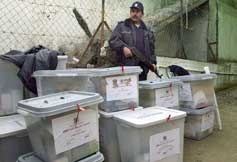
A Palestinian policeman protects ballot boxes at an election commission center. Photo: AP MOHAMMED BALLAS

Helena Cobban has just written the most cogent discussion of elections on the contemporary international scene that I could imagine. Read it: How to deal with an uncomfortable vote.

Cobban concludes "God help the peoples of Haiti, Palestine, and Iraq." I'd add the United States.

Thursday, February 16, 2006

In flight


Flying away today to Empire, Resistance, and the War in Iraq: A Conference for Historians and Activists.

Blogging will be either very light or very heavy for the next few days.

Wednesday, February 15, 2006

Three years ago today...


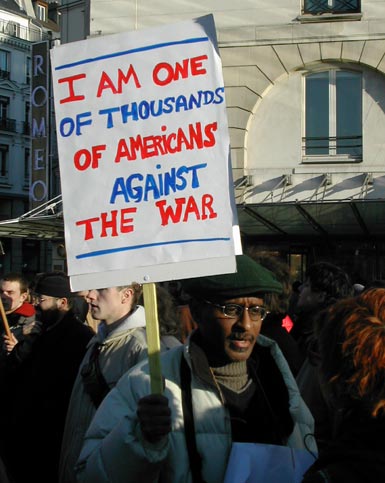
An American in Paris: Gerald Lenoir carries a message on February 15, 2003.

Hard as it may be to remember now, on this day only three years ago, 10 to 15 million people worldwide marched to try to prevent the U.S. invasion of Iraq. Out of the meetings of the World Social Forum in Porto Alegre, Brazil, in December 2002, came a call for a worldwide protest against U.S. plans. Email networks helped facilitate what became demonstrations in 800 cities worldwide. Just a few of the locations and numbers (where two figures appear, the first is what the police said, the second what the organizers claimed):
  • London: 750,000 people (police) to 2 million (organizers)
  • Paris: 100,000 or 200,000
  • Berlin: 300,000 or 500,000
  • Barcelona: 1.3 million
  • Madrid: 660,000
  • Other European cities: Oslo, Copenhagen, Stockholm, Brussels, Amsterdam, Vienna, Oviedo, Bern, Zagreb, Prague, Budapest, Warsaw, Istanbul, Athens
  • Canada: Montreal, Toronto, Vancouver, Ottawa
  • South America: Buenos Aires, Havana, Santiago, Rio de Janeiro, Caracas
  • Africa: Lagos, Nairobi, Kigali, Johannesburg, Cape Town
  • Asia: Tokyo, Kuala Lumpur, Calcutta, Seoul
  • the "Middle East": Tel Aviv, Ramallah, Damascus, and of course Baghdad
Oh yeah, and we didn't stop the war. The world said NO and GWB said yes.

Three years ago, at least 63 percent of the U.S. people felt threatened enough by Iraq to believe an attack was justified. Just about no one else in the world believed that. A BBC poll showed that the population of nearly all countries opposed a war without UN mandate, and most viewed George W. Bush and the United State as a danger to world peace. Currently a USA Today/CNN/Gallup Poll finds the U.S. public is getting it about the Iraq war.

A 55% majority say the war in Iraq was a mistake. Just 31%, a record low since the question has been asked, say the United States and its allies are winning there.

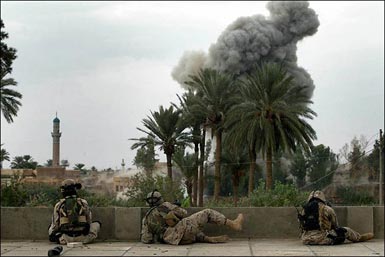
I guess that's progress, 2300 dead U.S. troops, about 200 dead other "coalition" troops, and uncounted -- maybe 100,000 or more -- dead Iraqis later.

It is worth remembering that the worldwide anti-war movement is the largest popular movement in history. Able to field the February 15 demonstrations with only a few months lead time, it has grown since and dwarfs the international anti-Vietnam war movement that grew up over a decade.

Probably its most concrete accomplishment was preventing democratic governments from jumping on the U.S. band wagon (Canada) and making it impossible for those who went along initially to stay on board (Spain and gradually several Eastern European states). Additionally, like all genuinely popular movements, it has also showed a quasi-anarchic creativity, continually generating new forms in order push aside the dams those in power set up to block popular expression. Three years ago, we'd never heard of Code Pink, Christian Peacemaker Teams in Iraq, Cindy Sheehan's demand that George W. Bush tell her why her son had to die, After Downing Street, and thousands of other actions and organizations that work to end the war.

And of course, the work of the anti-war movement is not over. Demonstrations are planned in London, Rome and other European cities on March 18, the anniversary of the Iraq invasion.

For a list of local March 18 events, mostly in the United States, visit United for Peace and Justice.

Tuesday, February 14, 2006

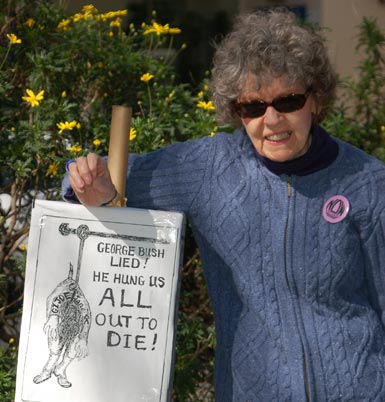
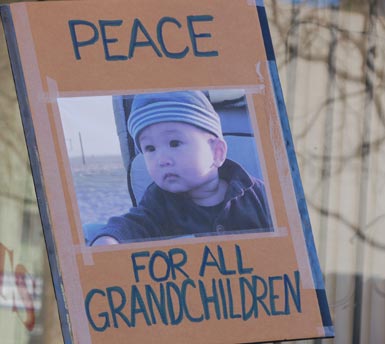
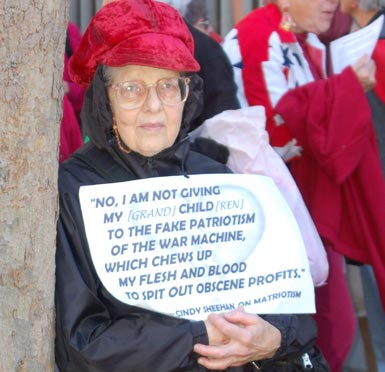
Grandmothers protest war, part 2


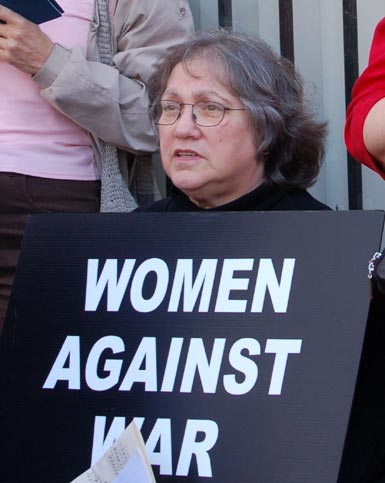
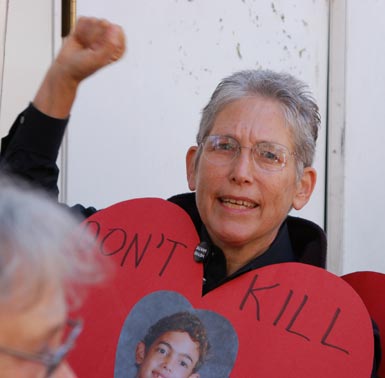
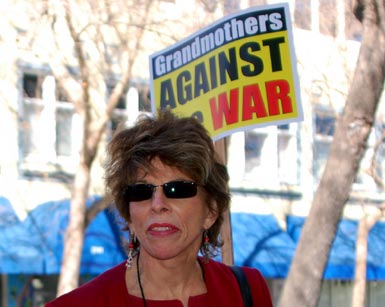
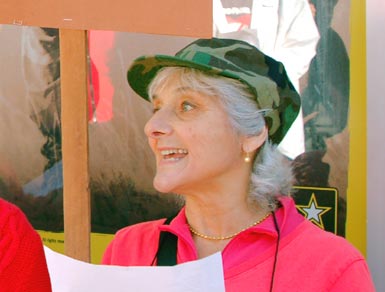
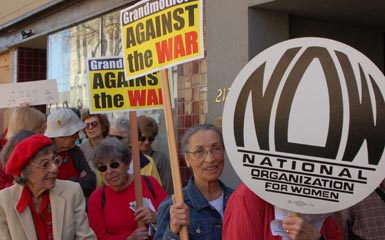
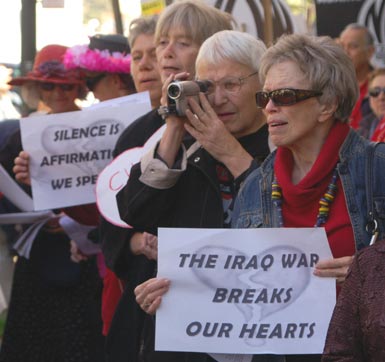
As I was photographing the protest in part 1, I realized that the event presented an extraordinary opportunity. In general, women "of a certain age" avoid the camera. I know; I am one. But by putting on their own event in their very own style, the grandmothers and friends at the Oakland recruiting station were volunteering to be looked at and captured by the camera.

I think we are beautiful. Here are some of us who were out there today.


Valentine's Day:
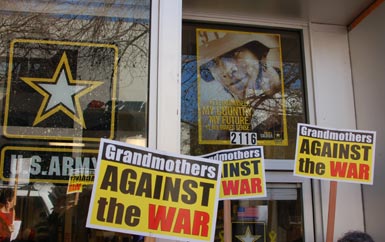
Grandmothers say "take us instead"


The "Armed Forces Career Center" (aka the Army recruiting office) in Oakland, California was closed today. In a Valentine's Day themed protest, Grandmothers against the War offered themselves to replace young folks as cannon fodder.

"...we are demonstrating our love for this country and its young people by enlisting in the U.S. military....This is not a show of support for our military action in Iraq....Rather, it is a Valentine's Day gift to our children and grandchildren.

"We grandmothers have had long, full lives. Our young men and women deserve the same. We are prepared to take their place and by that action to help bring an end to this destructive occupation. We want our brave young people home -- alive and whole."
Army recruiters had enough sense to hightail it for greener pastures when about 200 determined women showed up on their doorstep.


On the march.


Huge puppets stood in for grieving Iraqi mothers.


Now there's a sign for many of us. It seems to be available here. No endorsement of seller implied.


Second post to follows here with more pictures from this inspiring event.

Monday, February 13, 2006

Ethics and conscience said no way!

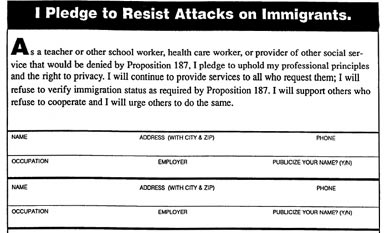
pledge
Do we have to start this up again? The text above reads in part:

I pledge to uphold my professional principles and the right to privacy. I will continue to provide services to all who request them; I will refuse to verify immigration status. ... I will support others who refuse to cooperate and I will urge others to do the same.

The Immigrant Rights Action Pledge (IRAP) was a response to the passage by California voters of Proposition 187 in 1994. That measure, never put into effect because of a series of legal challenges, would have required educators, doctors and social service workers deny help to undocumented persons. That's right: the people who work with them were supposed to rat on kids, sick patients, and desperate people.

IRAP wasn't the only or perhaps even a very important part of the broad push back inspired by that recent episode of xenophobia, but it mobilized an important source of resistance: people whose professional code of ethics mandated that they resist discrimination and criminalization of the innocent. The consciences of service workers were outraged. Thousands signed on to say a loud "no." They supported immigrants, advocates, and the attorneys who eventually squashed that measure. Along with religious people whose faith traditions locate holiness in welcoming the stranger, these professionals are the most likely source of citizen resistance to current anti-immigrant efforts.
HR 4437, passed by the House last fall, included a provision that makes it a crime for anyone to assist undocumented immigrants to "come or remain" in the United States. The bill makes 'soliciting, aiding, abetting, counseling, commanding and procuring' undocumented workers an aggravated felony, according to a recent Pacific News service article. Any number of humanitarian organizations that try to meet the needs of poor people and low-wage workers could find their work has been turned into an offense.
Migra Matters has a good discussion of the bill. The law has yet to clear the Senate and some of the most horrible provisions may be stripped out. But some kind of immigration "reform" that creates additional obstacles to migrants hoping to become members of our communities with full legal protections is almost certain to be passed this year.

Meanwhile, people trying to save lives along the Mexican border already find themselves at legal risk. Two aid workers with No More Deaths; No Mas Muertes, Shanti Sellz and Daniel Strauss, face felony charges of transporting "illegal aliens" for the crime of medically evacuating 3 people in critical condition from the 105-degree Arizona desert in July 2005. Amnesty International, religious leaders, the local AFL-CIO, and the antional NAACP have all come out in support of the accused. Recently former Arizona Supreme Court Justice Stanley Feldman joined the defense team. No trial date seems to have been set.

Facing rising U.S. xenophobia, teachers, medical workers and social service providers should be badgering their professional organizations to take a lead against what amount to outlawing their professional ethical obligations. Panicked attacks on immigrants have been a staple of U.S. history; repeatedly, people of goodwill (abetted by the labor needs of employers) have overcome the fears of exclusionists. Can we do so once again in the 21st century?

Sunday, February 12, 2006

Torture is a moral issue


The National Religious Campaign against Torture writes:

Torture violates the basic dignity of the human person that all religions hold dear. It degrades everyone involved --policy-makers, perpetrators and victims. ...

The President's signing statement, which he issued when he signed the McCain Amendment into law, implies that the President does not believe he is bound by the amendment in his role as commander in chief. ...

Furthermore, in a troubling development, for the first time in our nation's history, legislation has now been signed into law that effectively permits evidence obtained by torture to be used in a court of law. The military tribunals that are trying some terrorist suspects are now expressly permitted to consider information obtained under coercive interrogation techniques, including degrading and inhumane techniques and torture. ...

Nothing less is at stake in the torture abuse crisis than the soul of our nation. What does it signify if torture is condemned in word but allowed in deed?

Follow the link and join up now.

Saturday, February 11, 2006

Pill pushers will have to try harder


This couldn't be happening to a nicer group of folks: An Los Angeles Times story about increased seizures of prescription drug parcels sent from Canada to U.S. seniors hides its most interesting aspect at the very end.

Yes, it looks like the Feds are trying to prop up enrollment in their preposterous Medicare drug scam by harassing those who could get cheaper drugs by importing them.

And yes, apparently Canadian shippers view replacing seized shipments for free as a necessary cost of keeping their U.S. market.

And yes, big U.S. drug companies want to suppress any competition to their overpriced products.

But most fascinatingly, globalization is working to blunt pharmaceutical companies' ability to get their way by using the U.S. government:

Canadian pharmacies, which are able to purchase brand-name drugs at low wholesale prices negotiated with the purchasing power of the Canadian government, already had been adapting to increasing political and market pressure.

When major drug makers began curbing sales to Canadian pharmacies that shipped to the U.S., many began ordering in bulk from drug factories in Europe, India and Israel.

There may be a few benefits to individuals as the empire discovers it is simply another deadbeat debtor in a big world full of a lot of smarter, more realistic players.

Culture of life

Damn I love my city! I ran out to the store yesterday to get supplies for a potluck. Went by a busy intersection and vaguely noticed a poster on a bus shelter. The city sells advertising space on them; naturally no one looks at them. The intersection is one of the city's main transit stops in a rundown, mostly Latino neighorhood.

And then I did a double take. Here's what I saw:


If you can't quite read the writing, go visit Condoms4Life.

Somehow I don't think the hierarchy is quite as happy with this campaign as I was.

UPDATE:
There's also a whole country to celebrate:

The Brazilian government will distribute 25 million free condoms to promote safe sex during the country's Carnival holidays, the Health Ministry said on Monday....

"It's that time of year when we boost distribution because of the increase in demand," an official from the Health Ministry's anti-AIDS program said....

The Roman Catholic Church in Brazil -- the world's largest Catholic country -- routinely denounces such programs as encouraging sex and contravening its stand against contraception.

Thursday, February 09, 2006

Time for some laughs

The other day Reddhedd at firedoglake asked how we could "effectively cut through that pee-your-pants fear that Rove and company have been stoking in this country since 9/11." Right question.

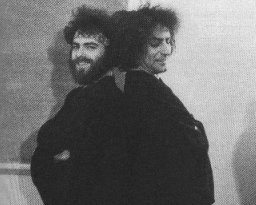
Actually, we know one of the answers -- when the sky is falling, laugh a little. A previous generation of activists took this to brave lengths. The two guys below, Jerry Rubin and Abbie Hoffman, were on trial in 1970 for conspiracy and inciting to riot, facing serious prison time. So they came to court dressed in judicial robes. Abbie blew kisses at the judge and offered to set him up with a good LSD dealer. Jerry tried to run a pig for President (some ideas are timeless.) On a serious plane, their antics helped delegitimize the culture of fear that supported the anti-Communist rationale for the Vietnam war.


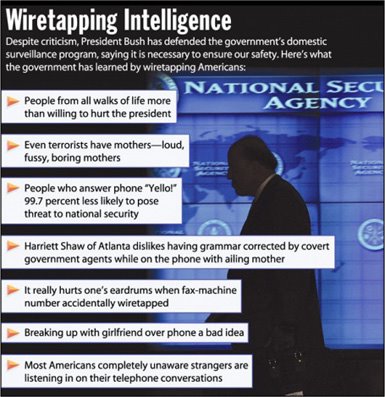
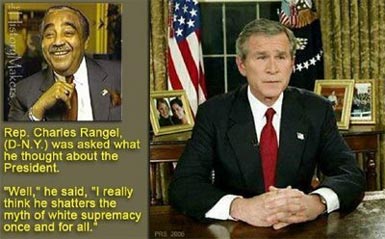
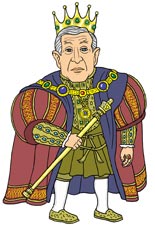
Confronted with our current wannabe King, we need all the laughs we can get. Fortunately, Photoshop and the web have made satire a lot easier to circulate than it was 35 years ago. Some borrowed gems:

From the Onion, via War and Piece.


From The BEAST blog.


From everywhere -- with thanks to Rep. Rangel.

Wednesday, February 08, 2006

Facing the gaggle:
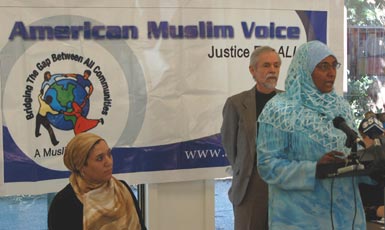
U.S. Muslims and those cartoons


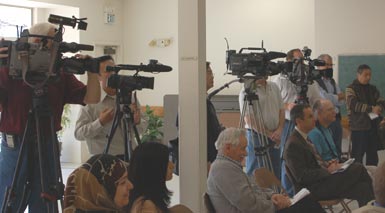
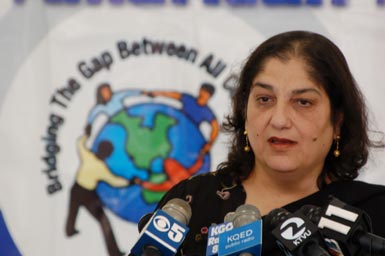
American Muslim Voice, the Council on American-Islamic Relations--SF Bay Area, and friends met the press this morning in a Congregational Church in Fremont, providing a local angle on the raging controversy over the Danish drawings of the Prophet. To no one's surprise, speakers condemned publication of the offensive cartoons, repudiated violent demonstrations against those who published them, and urged us all to realize that Islam is a religion of peace. The Oroville Mercury Register provides a thorough account.

While photographing the speakers, I found myself mulling the ritualistic quality of the event. How many times since 9/11 have U.S. Muslims and friends had to go over similar ground? Journalists kept asking whether they believed in free speech; the Muslims, all women, kept repeating that they practiced respect for others and deserved respect in their turn.


Samina F. Sundas of AMS shared one of the many hate mails they have received since the present fuss started; it proclaims "If you do not like my country, please leave." But this is Sundas' country.


Safaa Ibrahim, executive director of local CAIR, vented her frustration: "I think there is an 'us versus them' mentality. I'd rather not be on the defensive. I'd rather just educate people about our faith."


Interfaith allies duly spoke up for sanity. Pictured here are Chris Shriner, a Unitarian Universalist minister, and Fr. John Butcher, an Episcopal priest.

Does this ritual do anyone any good? In the end, I think yes, it does.

On the world stage, Muslims have real grievances. We, the U.S. and friends, run our economies on their oil, overrun their lands by force when we wish to, support authoritarian governments that repress them, and, above all, usually treat their way of living as inferior. The cartoon flap is a natural result; Eugene Robinson got it right in the Washington Post:

People don't normally burn down embassies over a few cartoons in a newspaper they've never even heard of, much less ever read. The widespread hair-trigger outrage, I think, grows out of a sense that the world of Islam has been used and abused for many years by a powerful and evil entity called "the West" -- and that this mistreatment is getting worse, not better.

But our local Muslims aren't part of that nasty stew. Their plaint is that they too are Americans -- why can't the rest of us understand that?

When spokespeople from the Muslim communities talk to the press, they are getting us accustomed to their presence. They are here. They aren't terrorists; they are simply people. They probably value freedom of religion more than some of our homegrown Christian theocrats; they have need of it. We rub against each other; we all change a little. That's just the way this country works, so long as we don't give in to the haters in our midst.

Tuesday, February 07, 2006

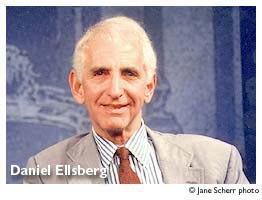
Daniel Ellsberg muses about Bush and God


I have no idea whether Daniel Ellsberg is religious. The former Defense Department analyst who leaked the Pentagon Papers during the Vietnam War exposing any number of government lies and misdeeds is plenty upset about our present war. SusanG reported these observations on the President's religious megalomania in Part 6 of a series of interviews with Ellsberg:

How reliable is [Bush's] channel to God? A God, by the way, who made George Bush our president. (What would that say, to the rest of us, about God?)

He has said on more than one occasion that God told me to attack Saddam Hussein and I did. And I've said to audiences, he was wrong. He was mistaken. That was not God. I feel very sure about this.

I've discovered that I do have some theological preconceptions, more than I would have thought. That's one of them. When you hear a voice you take to be God that tells you to invade a country that has not attacked and is no threat to us, get a second opinion.

The whole Ellsberg interview is worth reading -- long and scary. I'll just report that he says

I think we'll see from tens of thousands to hundreds of thousands - and I mean plural, hundreds of thousands - of Middle Easterners, Muslims and sympathizers, some non-Muslim dissenters but mostly young Muslim males, in camps or deported. And that will happen without a whole lot of resistance by the public after another 9/11.

Unfortunately, it doesn't require the experience of an Ellsberg to believe that prediction.

Monday, February 06, 2006

Can the SFPD be reformed?


The San Francisco Chronicle is doing a huge service to the people of the city with its current series, "Use of Force," documenting and describing the pattern of brutal behavior by a some of officers of the San Francisco Police Department.

The Chron has done what the city government ought to have done a long time ago: using public records, they have complied a data base of use of force reports, citizen complaints against police, and settlements payments by the city to injured citizens. The picture isn't pretty:

San Jose's department, about 60 percent San Francisco's size, studied its citizen-filed force complaints at The Chronicle's request and found that from 1996 through 2003 the officer with the most complaints had four, while nine officers had three. Seventy officers had two complaints, and 566 officers had one.

In San Francisco during the same period, the officer with the most unnecessary-force complaints had 26. Another had 20; one had 18, 4 had 15 and 3 had 13 the Office of Citizen Complaints records show.

While San Jose reveals only a few incidents, the SFPD keeps and promotes officers who use force improperly. There can be no other conclusion.

Nothing in "Use of Force" is much of a surprise to residents of the poorer, blacker and browner neighborhoods of the city or to political activists. A few memorable incidents in a long catalogue of SFPD misconduct include
  • the 1989 Castro Street Sweep in which 200 San Francisco police officers swept through the Castro and broke up a peaceful march by gay and lesbian activists protesting the federal government's neglect of people with AIDS;...only one police officer was disciplined, but the city paid out $250,000 to settle lawsuits brought by victims.
  • the fatal shooting of 17 year old Sheila Detoy by cops who were trying to arrest a drug dealer. Community activists spent years trying to get the shooter disciplined, while the city paid out a wrongful death settlement of $505,000 to her family.
What will be telling is whether the Chronicle uses its series to push for any remedies with bite. Some of what is needed is obvious:

1) Put in place a system of reporting that forces the SFPD to acknowledge that a few cops cause most of the complaints.

2) Fix or fire those officers, pronto. Simply doing those two things would be incredibly cost effective -- whatever a new computer reporting system and the training to use it would cost, it has to be less than the city pays in settlements to police misconduct victims.

So why won't the obvious get done? Here's where things get rough.

3) The police brass is riddled with officers who are willing to look the other way when cops use excessive force. It may have seemed a little over the top a few years ago when D.A. Terrance Hallinan indicted the whole command structure of the department over the chief's son beating up a bartender. Hallinan didn't have the evidence to make the charges stick. Nonetheless, the clubby chain of command where bad apples rise in rank makes reform nearly impossible.

4) Unhappily, the Police Officers Association (POA) is part of the problem. The current head of the union, Gary Delagnes, wracked up over 100 complaints of misconduct himself before rising to his current job.

5) And this points to the final, possibly fatal, obstacle to police reform: the city's political ruling class apparently doesn't mind seeing the SFPD out of control in its treatment of brown, black and uppity citizens. And so successive mayors have appointed chiefs acceptable to the existing command and the union. Willie Brown changed the race of the police brass, but did nothing to rock the boat. Gavin Newsom appointed a Chinese American woman chief, but so far has not used his clout to stop misconduct. It remains to be seen whether he'll act after this Chronicle series, since the POA has long been a political supporter.

On the front page of today's Chron, next to the "Use of Force" story, a headline reads "Push to open up mayor's races in S.F." In recent years, deluges of corporate and developer money of dubious legality have flooded San Francisco mayoral contests. The current mayor spent $5.7 million to win the office against a more progressive opponent who spent less than a million and still got 47 percent of the vote. The two previous mayoral elections were dominated by Willie Brown's ability to leverage vast funds to bury progressive challengers.

Gavin Newsom is probably guaranteed another term (he is popular) but the public financing plan now before the city council might change the electoral terrain after he leaves office. A more equitably financed electoral system might enable a future mayor to confront the culture of police brutality that has long festered in corners of the SFPD. Without political change, the SFPD will continue to get away with periodically beating people up and the city will go on paying settlements.

Saturday, February 04, 2006

What rule of law?


As we know, the Bush Administration is out to do away with the quaint notion that we live under a government of laws, not men. Just so it doesn't go by unmarked, let's look at a current instance. The WaPo reports that the U.S. military arrested a U.S. citizen in Baghdad in October, 2004 and has held him without charge ever since. Shawqi Omar, whose parents live in North Carolina, talked on the phone repeatedly with his wife who is in Jordon.

He has not been charged with any crime. When U.S. based lawyers filed papers arguing that Omar should either be charged or released,

Ned White of the Justice Department sent an e-mail to [Susan] Burke, Omar's [U.S.-based] attorney. "Mr. Omar is currently in the custody of Multinational Force-Iraq and a determination was previously made to refer his case to the Central Criminal Court of Iraq," White wrote. "Please be advised that, whenever scheduled, we would not be able to disclose to you the date of any hearing for security reasons."

Burke asserted in court papers filed this week that the government's actions were intended to subvert Omar's rights and that they placed him -- as a Sunni Muslim in a Shiite-dominated security apparatus -- in clear danger.

"The government's attempt at a middle-of-the-night transfer," the defense wrote, "to a foreign government that the United States has publicly stated engages in torture in an effort to avoid judicial review is conduct that shocks the conscience."

A federal judge ordered the government to argue a rationale for its actions on this coming Tuesday. We'll see if they just spirit Omar away in the night. (For what it is worth, this Shawqi Omar has the same name as an individual tied to Zarqawi in a Jordanian court indictment, but presumably someone who moved to the U.S. twenty five years ago, only returning to Iraq after the war, is not the same guy -- and if he were, we'd have given him to the Jordanians by now.)

UPDATE, 2/7/06: Newsweek reported today that the Shawqi Omar held in Baghdad is the same one wanted in Jordan. He is charged by U.S. authorities with connections to the Zarqawi network. Omar is a naturalized U.S. citizen who served in the National Guard in the 1980s. His family denies he is a terrorist; his attorneys are asking that he be charged and tried if the government has evidence against him.

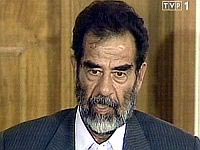
Also on the rule of law front, Christopher Allbritton is back in Baghdad and reporting on his observations as a pool reporter at the Saddam Hussein trial. He is surprisingly impassioned in stating his opinion:

It’s not right to say the trial is fair; it’s not transparent and the tribunal’s legality is murky, considering the illegal origins of the war that brought the current government to power. ...

[I]n terms of setting up a tribunal and establishing a legal precedent for trying heads of state for alleged war crimes, the legality of the war is very much an issue. Precedent matters in the realm of law, and the institutional structures built by an occupation and its progeny had better be well-constructed indeed.

However, and this is a big “however,”: Saddam absolutely must be tried. He must be tried, judged and sentenced. He was — and likely still is — a horrible man, responsible for the deaths of thousands. If he committed the acts he’s accused of, he deserves the punishment meted out, and whether he was America’s bestest buddy in the region during the 1980s is beside the point.... Which is why he must be tried in an international tribunal.

Go read all of Allbritton's views and the responses.

Friday, February 03, 2006

Impeachment update

A few weeks ago I put the "Impeach Bush" banner on this blog. Why? Because impeachment is the remedy provided by the Constitution for unlawful acts by a President. It seems completely clear that the President is asserting a right in his Presidential office to override statutory law in relation to warrantless wiretaps and probably any number of other acts that haven't leaked out yet. And since the problem is the overriding of Constitutional boundaries, the proper appeal is to application of law rather than political containment (though that wouldn't be a bad idea either.)

So though it seems a little crazy, IMPEACH is the word.

Clicking on the banner takes you to the Impeach Bush Coalition, a blog that reports on impeachment developments.

The obvious problem with impeachment is that, to get it going, the House of Representatives has to vote out a set of charges. And we all know what a set of corrupt rightwing non-entities the Republican members are. So that seems unlikely. But it turns out that the legislature of any state may transmit impeachment charges to the House. (That doesn't mean the House will affirm them, but they'd probably have to vote on them.)

And, in the great state of Vermont 104 members of the legislature, a majority, have already called on their Governor to

"assert that all searches and surveillance of American citizens be conducted according to the rule of law, and we ask you to publicly call on the powers that be in Washington to cease such unconstitutional activity in Vermont at once."

There is definite potential in state campaigns to push Congress.

Some unexpected voices have called for impeachment. For example, Thomas Donlan wrote an editorial in Barron's:

Putting the president above the Congress is an invitation to tyranny. The president has no powers except those specified in the Constitution and those enacted by law....

Willful disregard of a law is potentially an impeachable offense. It is at least as impeachable as having a sexual escapade under the Oval Office desk and lying about it later. The members of the House Judiciary Committee who staged the impeachment of President Clinton ought to be as outraged at this situation. They ought to investigate it, consider it carefully and report either a bill that would change the wiretap laws to suit the president or a bill of impeachment.

Strong stuff for a business magazine.

Meanwhile, in Washington, more Democrats are pushing on toward impeachment. Rep. John Conyers's H. Res. 635 now counts 17 supporters. Additionally, in December, California Senator Barbara Boxer asked legal scholars to analyze grounds for impeachment.

None of this is enough to get impeachment done, but it is something of a start. The Senate starts hearings on the warrantless wiretap program next week. Kagro X at The Next Hurrah is flogging impeachment with intelligence and passion. Stay tuned.

Super Bowl Pick: Go Steelers!


Since my team dropped out before the season opened (somebody please buy the Niners from the pennypinching Yorks), my Super Bowl allegiance was up for grabs -- until I saw this article:

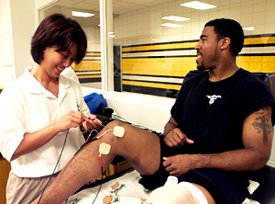
Plenty of NFL careers end because of torn anterior cruciate knee ligaments. Ariko Iso may be the first person to make it to the league because of one.

When she was an aspiring basketball player in Tokyo, a ripped-up knee set back her athletic career but got Iso interested in the field of sports medicine.

Two U.S. college degrees and nine years of athletic training later, the 31-year-old Iso has made the career move that, to the other women in her profession, is the groundbreaking step they often envisioned but feared might never come.

Finally, 82 years after the NFL was founded, the Pittsburgh Steelers have hired Iso as a full-time trainer -- the first woman who will treat the injuries, soothe the nerves and calm the fears of the league's millionaire players.
...
Her parents, who still live in Tokyo, are happy for her success but, she said, "They don't understand this is a fairly big thing for our profession."

It certainly is. Nearly half of the estimated 20,000 registered athletic trainers in the United States are women, and a woman, Julie Max, is president of the National Athletic Trainers Association. But Iso is the only full-time female trainer in the NFL, NHL or major league baseball. The NBA's Houston Rockets have had a female assistant trainer, Michelle Leget, since 1997.

Now there's a reason to support the Steelers.

Interestingly, one of their best players is also of Asian ancestry. Hines Ward credits his mother's demonstration of courage in the face of adversity as a poor Korean immigrant to teaching him how to make it.

"My mom is why I'm here today," Ward said Monday, shortly after the Steelers arrived in Detroit. "My mom worked her tail off for me. She taught me how important it is to work hard. I'm not here if it's not for my mom." Even if, Ward said, smiling, "She's a nervous wreck this week."

I'm enough of a sentimentalist to give the benefit of the doubt to a football star who credits his mother.

Hat tip to angry asian man for both these stories.

Thursday, February 02, 2006

Do something about the Medicare Part D nightmare

We asked for prescription drug coverage and our Congresspeople, led by the Republican majority, gave us a bonanza for drug profiteers.

Consumers Union asks your support for HR 752, a bill that would help simplify Medicare for seniors, and save taxpayers significant amounts of money by allowing Medicare to negotiate the best possible drug prices for seniors. Click here and scroll down to the item about Medicare.

Iraq war still rages


Drew Brown of Knight Ridder provides a statistical profile of change in Iraq since last year.

Some highlights:

The first number is as of Jan. 31, 2005, and the second is as of Jan. 31, 2006:

  • U.S. military deaths: 1,415; 2,242
  • U.S. military wounded: 10,622; 16,606
  • Number of daily insurgent attacks: 61; 75
  • Estimated number of insurgents: 18,000; 15,000-20,000
  • Crude oil production (millions of barrels per day): 2.1; 1.78
  • Estimated unemployment rate: 27-40 percent; 25-40 percent
  • Percentage of Iraqis who believe country is headed in right direction (through Dec. 2005): 49 percent; 49 percent

Will these numbers be worse in 2007?

United for Peace and Justice along with Rainbow/PUSH Coalition, National Organization for Women, Friends of the Earth, U.S. Labor Against the War, Climate Crisis Coalition, Peoples' Hurricane Relief Fund, and the National Youth and Student Peace Coalition has called for

a MOBILIZATION FOR PEACE, JUSTICE AND DEMOCRACY
in New York City on Saturday, April 29.

Sure, this mobilizing stuff gets old, but NYC in April is the place to be.

Wednesday, February 01, 2006

Winning as outsiders


How did they build it? By bootstrapping?

This week many in the blogosphere were lamenting our inability to instill passion or install spines in Senate Democrats opposing the elevation of Justice Alito. More than once I dropped something like this on a comment thread:

Folks are going to have to get really used to understanding that we are outsiders. That isn't the end of the world. When the country was founded, a majority were outsiders -- not white, male property owners. The outsiders have progressively forced their way inside. The current Right wants to shove a lot of us back out. So we have to organize like outsiders, expecting very little from the Democrats except when we make them behave.

Sure, it is awful. But there really is no choice.

Guy Kawasaki was one of the "evangelists" who sold the creative, antic appeal of the original Macintosh to a world that had believed computers were for geeks or bean counters. He is now a venture capitalist whose blog Let the Good Times Roll serves as an amusing marketing experiment for his current ventures. Recently he put up a post aimed at start-up entrepreneurs about what he calls The Art of Bootstrapping. I find it interesting to think about what Kawasaki's advice to fledgling businesses might mean to outsider advocacy or candidate campaigns. In the following material, Kawasaki's advice is in italics.

1) Focus on cash flow, not profitability. The theory is that profits are the key to survival. If you could pay the bills with theories, this would be fine. The reality is that you pay bills with cash, so focus on cash flow. For outsiders this means: don't plan on raising the money you need from the big guys, at least at first. Don't make your campaign plan on the assumption that you'll get the big grant or hit with the big donor. Instead, try to project simply how you can make payroll. As long as you can do that, you can move forward and create the momentum that might lead to bigger money.

2) Forecast from the bottom up. Because big media, especially TV, have big impact, it is easy to get fixated on what you could do if you could buy enough gross rating points to saturate your intended market with your message. But that route to influence is not for outsiders. Instead you need to multiply the number of ways you deliver message rather than trying first to overwhelm your audience. On a city size campaign, this can imply that given the choice of one really glossy, classy brochure or 15 literature tables in popular locations for a weekend with ugly but serviceable paper flyers, go for those tables.

3) Ship, then test. Outsiders get their propaganda out the door, then refine the message based on the feedback. Because we are outsiders, we really don't know what will work when we try it out. We write letters, set up and frequent blogs, make flyers, put up stickers and hammer at our points. In a political campaign, the perfect is often the enemy of the good.

4) Forget the "proven" team. Proven teams are over-rated -- especially when most people define proven teams as people who worked for a billion dollar company for the past ten years. These folks are accustomed to a certain lifestyle, and it's not the bootstrapping lifestyle. Hire young, cheap, and hungry people. You don't need the most experienced political consultant or pollster. In fact, because the ones with reputations have usually gotten to be insiders and organize like insiders, you don't want them even if you could get them. And you can't. You need people who care about your issue or candidate, who will work, and learn.

5) Start as a service business. Build a base by giving the people you want to recruit something they want. For a great story about working this way, read Suburban Sweatshops: The Fight for Immigrant Rights by Jennifer Gordon. Advocates offered legal assistance to exploited immigrant workers by training them about their legal rights and eventually won major wage raises and a domestic workers bill of rights from New York State legislators. With imagination, most campaigns can use this advice. For those trying to replace incumbents, think candidate training workshops!

6) Focus on function, not form. Design great stuff, but buy cheap stuff. Outsiders don't need the best of everything, just good enough. Used copiers and borrowed office space is okay. (Don't apply this advice to databases or accounting though.)

7) Bootstrappers pick their battles. They don't fight on all fronts because they cannot afford to fight on all fronts. Yes, you have lots of battles. For political outsiders, this means that you have to look around for people who are already in the field who might be your friends. This can be made difficult by the fact that advocacy financing and political office are finite competitive resources, so there will be pressure on you to go it alone, to pretend you have the only solution to the problem you are working on. Try not to do this if you can help it. Work with others as much as you can, even if they resist your presence in the field.

8) Understaff. Self-exploitation is the only way to get started without money. Accept this and recruit others who can live with it.

9) Go direct. The optimal number of mouths (or hands) between a bootstrapper and her customer is zero. In a campaign, your best and cheapest resource is the candidate's time. An outsider candidate has to be open to grotesque, non-stop, self-exploitation for the duration -- that means being willing to go to every meeting, meet every voter, shake every hand, answer every question, over and over. In an advocacy campaign, this means, though you try to play well with others, being at every possible event with your own materials, never depending on friendly organizations to get the nuts and bolts organizing done, never thinking organizational or celebrity endorsements will carry the day without your shoe leather.

10) Position against the leader. Don't have the money to explain your story starting from scratch? Then don't try. Instead position against the leader. This bit of business advice is about how to break into a Microsoft world. Political outsiders are trying to break into a Republicrat world. I don't mean to imply we need a third party; I'm writing for outsiders who aim to move the Democrats. You need to promise through your actions and propaganda that you recognize how establishment Dems do it -- and promise to fill the niche for those who want it done better. You can. Their results are not that good these days.

11) Take the "red pill." This refers to the choice that Neo made in The Matrix. The red pill led to learning the whole truth. The blue pill meant waking up wondering if you had a bad dream. Bootstrappers don't have the luxury to take the blue pill. They take the red pill -- everyday -- to find out how deep the rabbit hole really is. Stay real. The beginning of political wisdom is understanding what forces you have and what you can really do. As you have a few minor successes (and a lot of failures), don't believe your own endorsement interviews or grant applications. Hang on to your vision -- and know what force you really have. Use it. Build it. Win.