Monday, June 12, 2006

Ring that bell!


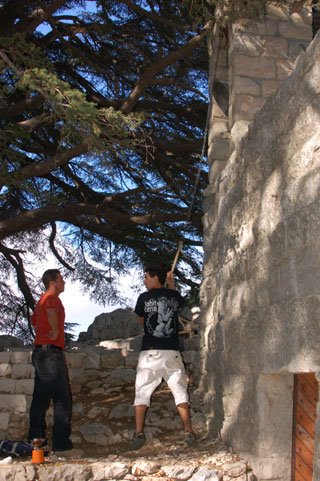
Above the village of Jaj in Lebanon, high on the side of the mountain, a hearty grove of the famous cedars pushes upward among the rocks.


A hiking path leads to a small stone church, empty of furnishings.


A cross and bell tower top the tiny shrine.


At this distant place we came upon two young local hikers who were considering whether they could make the church bell toll. One clearly had some experience with the bell and was eager to show off for his friend and foreign tourists with cameras. I didn't have to understand Arabic to know what he was saying:


Here's how you do it.


You have to pull all the way down.


Then the bell pulls you back up.


It lifts you all the way off your feet! Clang, clang, clang....

Saturday, June 10, 2006

A visit to South Lebanon

(Disclaimer: I write from a country where I have never been before, where I do not speak the language; what I share may tell more about me, than the place I am lucky enough to visit.)

This is the part of the country that suffered longest from the Israeli invasion (begun 1982) and subsequent occupation (not ended until 2000). The land, a maze of rocky hills and fertile green valleys, is beautiful.


You don't wander off the beaten track here. The hills are still littered with land mines placed by the Israelis and by the resistance fighters who expelled them.


Most of the people are Shiites although there are mixed villages where the Christian church sits adjacent to the mosque, as pictured here. While we were taking this picture, a woman came by, smiling broadly, gesturing with her hands, as if to explain to us: "yes, show that we live side by side!" So I have.


The land is dominated by a windswept outpost that carries the Crusader name, Chateau de Beaufort. It has always been the high point occupied whoever sought to hold the land: Ottomans, nationalist insurgents, Palestinians driven north by Israelis, then the Israelis during their invasion.


Today, the permanent residents are mostly lizards that have evolved over generations to blend with the stones.


The Israelis were so sure they would never be forced to leave this bit of southern Lebanon that they build this settlement below the castle.


But Israeli occupation did not last forever. The Lebanese village of Arnun on the north side of the keep has rebuilt.


Today the pennants of the forces that led the resistance to the Israelis, Hezbollah and Amal, fly above the pinnacle.

Wednesday, June 07, 2006

Beirut: a stroll on the Corniche


It has been hot in Beirut, not just according to weather wimps from the States, but also the locals. So when a breeze came up in early evening, everyone turned out to walk along the sea on the grand promenade, the Corniche.


Some exercised by running. The promendade is marked in half kilometers as part of the course of the Beirut Marathon.


More walked, briskly.


Even Gamel Abdel-Nasser, the Egyptian president and architect of Pan-Arab socialism (1918-1970) strides on his obelisk -- in the direction of one of the universal icons of globalization.


Some just watch the world go by.


A lone man casts for fish in the sea.


And shortly, the equatorial sun will plunge into the Mediterranean.

Tuesday, June 06, 2006

The model and the real thing


The archetypal cedar of Lebanon...


now flying over parliament house in Beirut.

Monday, June 05, 2006

A visit to the shrine of Our Lady of Lebanon at Harissa

(I write from a country where I have never been before, where I do not speak the language; what I share may tell more about me than the place I am lucky enough to visit.)

This is not an expedition for those with a fear of heights. But it is a great chance to share a special place with all sorts of Lebanese on a Saturday afternoon outing.


The cable car jumps off from the sea front town of Jounieh, sailing next to and over somewhat shabby high-rise apartment buildings.


On the other hand, many of the buildings on the adjacent hillside look quite posh.


At first glance, the postings on the gate of the shrine seem a little fierce: "This is a holy place dedicated to the Virgin meant to be used for prayer, silent meditation and reflection." "It is forbidden to come into this holy place 1. wearing indecent clothing, showing too much skin, in mini-skirts... 2. or to engage in immoral behavior. 3. or to eat, drink or smoke."


And many pilgrims look as one might expect at a sacred Christian shrine.


A few obey the injunction to cover up by wearing a sort of drape. This seems enough to bring a woman into compliance.


Clearly for some couples, the shrine is a destination for a kind of chaste date.


Or perhaps a pleasant, holy curiosity.


A visit is capped, literally, by a climb up the tower to the statue of the Virgin.


For a few, the climb is a fulfillment of a pious promise, though most trudge up happily in their shoes.


And there she is, looming above, the queen of heaven and of the Lebanese.


After the climb, it is time to enjoy the shrine grounds, perhaps snap a few pictures.


Some visitors have as yet no notion of decorum or self-restraint, just joyous exuberance.

Friday, June 02, 2006

A walk around Beirut

(Disclaimer: I write from a country where I have never been before, where I do not speak the language. Anything I describe is only what eyes' clouded by ignorance can observe. I look, I listen to what I am told, I seek to understand, I share photos here; what I share may tell more about me than the place I am lucky enough to visit.)

The last two days our kind host has walked us around her city.


We passed this lovely garden in the central city; most of Beirut is far less manicured.

Between 1976 and 1992, Lebanon was wracked by war among its own religious communities (many different sorts of Christians and Muslims), invaded and partially occupied by Israel and Syria, and subjected to rapacious struggles fueled by armed warlords. For the last decade and a half, Lebanese have been relearning how to live with each other and rebuilding their country.


About the only time most people in the United States have been aware of Lebanon over the last few years was when the politician and Donald Trump-like wheeler dealer Rafiq Hariri was blown up by a car bomb. The U.S. blames Syria; some Lebanese whisper about rough business deals gone bad. Hariri's assassination provided the spur to a movement of Lebanese demanding the Syrian forces leave the country. Hariri images (here with his son, now a major political figure himself) are everywhere.


Hariri enabled this appropriation of a bit of sea front by a private club. Correction:I'm told it was a different bit of beach front that Hariri appropriated.


Ordinary people enjoy tea and a chat in the sun.


We walked in the neighborhood adjacent to the old "Green Line" -- the dividing line between Christian East Beirut and Muslim West Beirut during the war. Our host described the house in the center as once occupied by Muslims who were killed or driven out by sniper fire.


War damaged buildings in the neighborhoods still stand empty, often next to shining new construction.


In the Christian neighborhood where our host grew up, a small mosque had once co-existed happily before the war. Plastered on its wall are posters of a progressive Sunni sheik who as assassinated in 1989 -- and a small shrine of the Christian Virgin.


In the narrow neighborhood streets, much renovation is underway. The sign in Arabic on the right side of this photo warns passers-by of falling stones from the crumbling balcony above.


Incongruously, what was once a quiet Catholic residential neighborhood has become a center of bars and nightlight. Che co-exists with Catholic education on the same building.


Meanwhile construction goes on everywhere.


These ancient ruins were uncovered by one downtown building project.


A fashionable Maronite Christian Church abuts a grand new mosque built by the assassinated Hariri.

Thursday, June 01, 2006

Friday Cat Blogging:
The cats of American University of Beirut

The American University of Beirut is not only a thriving educational institution and one of this Lebanese city's larger employers, it is also a haven to huge numbers of feral cats. They apparently own the place.


Mostly they don't even both to move when you approach them.


Some look quite well fed.


Who are you? This is my place.