Showing posts with label Lebanon. Show all posts

Monday, June 01, 2026

Bibi boasts over Beaufort

Mainstream media have been sharing the news that Israeli forces have seized Beaufort Castle, a Crusader-era high point and fortification on the southern border of Lebanon in a region which is home turf to Israel's foe, Hezbollah. 

The Israelis seem very proud of this conquest, though in modern terms, the ancient "castle" is just some rock piles. Here's the story from Le Monde

Israeli Prime Minister Benjamin Netanyahu vowed to push deeper into Lebanon after his military took over the medieval castle of Beaufort on Sunday, May 31, calling it a "dramatic shift" in Israel's campaign against Hezbollah in Lebanon.

The Iran-backed militant group, meanwhile, said it targeted Israeli forces near the fortress as well as army positions and infrastructure in Shlomi and Nahariya in northern Israel, while air raid sirens blared in the Acre area. Israeli forces used the Beaufort castle, also known as Qalaat al-Chakif, as a base during their previous two-decade occupation of southern Lebanon that ended in 2000.

"We have returned united, determined and stronger than ever," Netanyahu said in a video statement released after the military took Beaufort. "Now my directive is to deepen and expand our hold in places that were under Hezbollah's control. The capture of Beaufort is a dramatic stage and a dramatic shift in the policy we are leading."

Erudite Partner and I had the chance, thanks to a Lebanese friend, to walk about this eerie spot in 2006, just weeks before that year's Israeli assault on the proud and battered country.

The yellow banner of Hezbollah flew defiantly from the castle's pinnacle then. We didn't see any fighters, though there were rumors that they had tunneled somewhere underneath.

Looking south, across the deep ravine cut by the Litani River, we were looking into Israel where a neat modern settlement had been built.

 
Looking the other way, we could see the Lebanese village of Arnoun. It appeared prosperous in its own way that spring, but very much an organic growth on the hillside, not any kind of planned community.
The contrast between the two towns seemed to exemplify two civilizations. Meanwhile the Crusader castle endured, in between. 
 
I wonder if Beaufort will survive its latest occupants. 
 
I am quite certain that the adjoining Lebanese village is by now destroyed and depopulated. Poor Lebanon, fated to try to survive next to its belligerent neighbor.

Thursday, April 09, 2026

"The strikes were everywhere, all at once."

The Guardian's soft spoken reporter Will Christou spells out the shock in the Lebanese capital when Israel bombed central Beirut, killing at least 250 yesterday. This ten minute clip is much longer than what I usually post here, but I would urge readers to take the time to watch. It's not gory; instead, it is morally devastating.

The leaders of Israel are ethical monsters, as are our own US rulers. As, of course also, are the Iranian rulers and the princelings of the Gulf States. 

Saturday, March 21, 2026

Israel is pulverizing Lebanon again -- and plans to stick around

Of course the US/Israeli war on Iran is getting most of our focus in this country. Thanks to the Orange Toddler's folly, we'll all be paying higher gas and more widely inflated prices on everything -- and if that's the worst blowback, we'll be lucky. Nothing about Trump's war gives me any confidence.

Meanwhile, Israel is taking the opportunity to try to kill off its Hezbollah enemies and a lot of other people in Lebanon. Over 1,000 have died in Lebanon since beginning of March, with more than 2,700 injured, according to Lebanese health officials. Over one million Lebanese have been driven from their homes -- that's in a country of slightly less than six million, 16 percent of the population.
 
As the reporter in the news clip explains, Israel plans for its invading troops to occupy much of southern Lebanon.
 
Lebanon's national government, of which Hezbollah represents a faction within a divided civil society, is seeking a ceasefire with Israel. Lebanese government authorities want negotiations if possible.
[The prime minister of Lebanon] Nawaf Salam told CNN World in an exclusive interview [published March 19] that he sought a ceasefire “yesterday, not tomorrow,” as the death toll from Israel’s onslaught against the Lebanese militant group Hezbollah reached 1,000. More than 100 of the dead are children, according to Lebanese officials.
 
... The prospect of a negotiated end to the conflict in Lebanon, which began 17 days ago when Hezbollah fired projectiles into Israel to avenge the death of Iranian Supreme Leader Ali Khamenei, has dissipated over the past 48 hours as Israel’s military campaign has focused on a wider ground invasion. France has suggested some ideas for a settlement, Salam said, and there are contacts with US officials. Yet he shied away from suggesting actual talks have begun. ...
 
... One of the likely sticking points will be that Lebanon does not recognize the state of Israel. ... 
 
...  [Salam] rejected any involvement by foreign troops and insisted that Lebanese territorial integrity was central to a peace deal.

Israel has pushed farther into Lebanon in the past week, and concerns are mounting it seeks to create a deeper “buffer zone” along the border. Israeli forces are occupying the land south of the Litani River, an area it has called on Lebanese to evacuate.

“We cannot accept any buffer zone, security zone, any infringement on our sovereignty,” Salam said. “We cannot negotiate any form of treaty, deal or arrangement with Israel (before our) sovereignty is fully restored.”

To repurpose a dictum attributed to the Mexican dictator Porfirio Diaz: "“Poor Mexico, so far from God, so close to the US.” Poor Lebanon: so close to God, so close to the state of Israel.

Thursday, March 12, 2026

We knew he was a crook. The latest Trump heist comes for us all.

The United States is not only failing to "win" but also actively losing Donald Trump's glorious new iteration of a Middle East war. 

Journalist and historian Garrett Graff explains:

... The Pentagon is telling Congress today an initial, partial tally of the monetary cost of the war (the cost in human lives, instability, and reputation is of course much higher): The first week of the war cost about $11.3 billion — an enormous number that is hard to even tally. To put that in context: It’s a number larger than the annual state budget of some 16 states, including Iowa or New Mexico and represents roughly the entire annual state budget of Nebraska, Oklahoma, or Alabama.

More than that, though, is how we as a nation spend money on war and “immigration enforcement” as if it’s endless, while skimping on all the expenses that actually help our fellow humans. We have already added this past year $150 billion to the defense budget — while destroying and dismantling the $35 billion we spent on the US Agency for International Development. 

As I wrote and investigated a couple weeks ago, the $52 billion construction and procurement budget for Customs and Border Protection is so large that it represents more than the defense budgets of Hungary, Austria, the Czech Republic, Switzerland, Finland, Greece, Belgium, Romania, Denmark, and Norway combined.

The remaining money to spend this year that CBP has to spend equals the entire GDP of Estonia. 

I think a lot in moments like this of the 1953 speech by Dwight Eisenhower about the cost of war versus peace. 

 “Every gun that is made, every warship launched, every rocket fired signifies, in the final sense, a theft from those who hunger and are not fed, those who are cold and are not clothed,” [President Dwight] Eisenhower told a group of newspaper editors. “This world in arms is not spending money alone. It is spending the sweat of its laborers, the genius of its scientists, the hopes of its children. The cost of one modern heavy bomber is this: a modern brick school in more than 30 cities. It is two electric power plants, each serving a town of 60,000 population. It is two fine, fully equipped hospitals. It is some fifty miles of concrete pavement. We pay for a single fighter with a half-million bushels of wheat. We pay for a single destroyer with new homes that could have housed more than 8,000 people.” 

What could $11.3 billion have bought us if we spent it here at home? A few data points: We spent in the 2020-2021 school year a total of about $21 billion to feed near universal school lunches and breakfast across the country during the pandemic — a life-changing educational investment for children. Or today: $11.3 billion would cover putting 1.4 million on Medicaid or into affordable housing — that’s the entire population of New Hampshire or Maine. 

Remember all of this the next time you hear a politician tell you there’s not enough money for this social safety program or that one. ...

I am confident we the people didn't make this grifting moron the president in the hope he'd crash our economic well-being. But here we are.

Saturday, August 10, 2024

Lebanon on my mind ...

The Post reports:

The exodus from Lebanon began last week after back-to-back assassinations targeted a Hezbollah commander near Beirut and Hamas leader Ismail Haniyeh in Tehran.

... Vacations cut short, hurried goodbyes and last-minute flights at exorbitant fares — residents and tourists, heeding warnings of an impending war, are scrambling to leave summertime Lebanon as tensions build between Israel and Hezbollah, Iran’s Lebanese ally.

Britain has ordered its citizens to “leave Lebanon now,” while Paris is urging French nationals to depart “as soon as possible.” The U.S. Embassy in Beirut, in an alert over the weekend, instructed Americans who wish to leave to “book any ticket available to them.”

At the Beirut airport, passengers waited for delayed flights or for seats to open up, tired children resting against luggage carts piled high with suitcases, their parents sipping coffee out of paper cups. As airlines such as Lufthansa, Air France and Royal Jordanian cancel flights to and from the country, ticket prices have skyrocketed, putting them out of reach for many Lebanese grappling with the effects of an economic crisis, including soaring inflation and a currency that has lost much of its value. ...

Once again, Beirutis have reason to fear their small country is about to devastated by an Israeli attack on Hezbollah. Western media always neglects to mention that Hezbollah, though certainly the most heavily armed faction in this divided country, is also a legitimate part of what passes for government in Lebanon.

We visited in 2006, just prior to the last time Israel blasted the Beirut airport and much of the city to bits. So much has come to pass since then.

This picture of an advertising balloon over the city could not be taken today. Several years later an explosion in the port blew out the windows to the balcony from which I took this shot -- that apartment was no longer habitable.

That was an accident of sorts. But this would be war and retribution, largely striking people who have had no choice but to be in the firing line.

Saturday, December 23, 2023

An unwelcome blast from the past

The headline reads: U.S.-Brokered Talks Seek to Ease Tensions on Israel-Lebanon Border. I have no idea whether this is a meaningful development or not. I tend to doubt that the U.S. is a useful interlocutor in talks which, of necessity, must involve dealing with Hezbollah, the Lebanese force which we have designated a "terrorist organization" and a hostile Iranian proxy. Many, but not all, Lebanese think differently, recognizing Hezbollah as one legitimate force among many in a divided country. I claim no expertise.

The immediate focus of the discussions has been to prevent cross-border skirmishes between Israel and Hezbollah — fueled by Israel’s war against Hamas in Gaza — from escalating into an all-out conflict, said the officials, who spoke on condition of anonymity to discuss the sensitive deliberations.

... In addition to its efforts to contain the immediate risk of escalation, the Biden administration has been discussing with the parties the parameters of a longer-term agreement to increase stability along the border so that tens of thousands of displaced civilians in northern Israel and southern Lebanon feel safe enough to return to their homes after the war in Gaza ends.

... According to participants in the talks, Israeli officials have sent mixed messages about the distance Hezbollah fighters would have to move north of the border to allow Israeli civilians to return to their communities in northern Israel. One Israeli proposal called for Hezbollah forces to move at least five kilometers, or about three miles, north of the Israeli-Lebanese border — to reduce the chances that the group could follow Hamas’s example and send large numbers of fighters into Israel to kill and kidnap Israeli civilians. Another called for them to move eight kilometers.

The discussion -- the sort of matter about which I tend to believe nothing until something concrete occurs -- reminds me that I had the privilege of being driven through that border area in an ostensibly peaceful interlude in 2006. Such beauty, so much history.

 
The remains of a Crusader castle, Beaufort Chateau, sat on a ridge.
 
Yes, that is the Hezbollah flag flying proudly.
 
On the Lebanese side of the ridge, the village of Arnoun.
 
To the south, an Israeli settlement.

I have no idea how much of what is pictured is still there. Less than a month after I took these pictures, the 2006 Israel/Hezbollah War washed over this border area. Israel also bombed civilian infrastructure throughout Lebanon. Hezbollah survived, was able to use Iranian contributions to rebuild southern towns, and matured into a party within the Lebanese government, though remaining a non-state military force apart from the Lebanese Armed Forces.

Hezbollah and Israel have continued to lob missiles at each other sporadically ever since.

Let us hope Israel's Gaza retaliation for 10/7 doesn't not spread to Lebanon.

Wednesday, January 08, 2020

Why U.S. elites are suckers for war with Iran

The U.S. policy elite, usually of both parties, hates Iran with a recurrent, near-maniacal, fury that is not shared by most of us.

I thought about this when I read that one response to the assassination of Iranian General Qassim Suleimani was a rush of queries to Google about a military draft. Are we being drafted into yet another war in the far off place we call "Middle East"? Seems so.

I've probably written this summary before but it seems worth repeating. What explains the endless elite animosity toward a country about which few of us think very often? I see three streams that intermingle.

Historic guilt
Persia -- modern Iran -- is unlike most of the countries we use and abuse in the so-called Middle East. Its boundaries are not some accidental affliction inherited from European colonial conniving after World War I as is true for most of the Arabic-speaking countries. Persia, an ancient Farsi-speaking Shiite Muslim land, was and is more or less what it has always been: a rich and diverse nation that is conscious of its history as the center of the civilized world when Europe was a feudal backwater.

In the aftermath of World War II, Iran was on its way to becoming a modern parliamentary democracy. British oil companies combined with a cowboy C.I.A. agent, Kermit Roosevelt, to overthrow its elected Prime Minister in 1953 and stick the unhappy Iranians with several decades of repressive, authoritarian rule led by the oil companies.

In 1979, Iranians -- left, right, and center -- rose up to take back their nation. Such eruptions are not neat and orderly and Iranians ended up with the Shiite Islamic rulers who still run the place. (Repressively, we should understand.) Along the way, nationalists seized the U.S. Embassy, grossly mistreated U.S. diplomats, and crowed over their dramatic escapade. Protection of diplomats is a real imperative of any international law-based system, but it's understandable that many Iranians didn't much credit the U.S. commitment to good behavior. The ensuing 444 day hostage crisis became a domestic political football in the U.S. and helped bring down Democratic President Jimmy Carter who looked ineffectual while Ronald Reagan wandered around beating his chest. (He was, after all, a celluloid cowboy.) For a slice of the U.S. elite, of which our current president is an exemplar,

If it’s always 1979, it’s always 1979.

David Graham

Iran remained hostile the U.S. while the U.S. remained hostile to Iran. During the entire 1980s, we encouraged and funded Iraq's Saddam Hussein in his war on the Islamic state, a murderous conflict that killed at least half a million combatants.

Iran didn't take U.S. hostility sitting down. In 1983 Iran almost certainly was responsible for helping Hezobollah, its allied Lebanese Shiite militia, carry out Beirut suicide truck bomb attacks which killed 241 U.S. military personnel, 58 French military personnel and 6 civilians. For a somewhat younger slice of the U.S. foreign policy elite, this was the opening act of a war with Iran they've never given up on. It's little remembered today, but that era's pseudo-cowboy president knew better than to be drawn into overt hostilities: Reagan quickly withdrew U.S. troops from Lebanon.

In the years since, Iran and the U.S. have warred covertly with a few episodes breaking into public consciousness as when we shot down an Iranian civilian airliner and they supported and trained Shiite Iraqis fightings against the U.S occupation after 2003. Then again, sometimes these enemies have been temporarily on the same side as when Iran, in operations led by the assassinated General Soleimani, helped the U.S. find al-Qaeda terrorists after the 9/11 attacks. Iran, too, wanted ISIS eradicated. This is a complicated part of the world -- a little much for monochrome U.S. thinking.

Our sick relationship with the state of Israel
In the U.S., relations with Israel are about domestic politics. Given the (more and more inaccurate) assumption that the route to the (tiny) Jewish vote runs through fealty to Israeli political aims, U.S. politicians have more often than not been onboard with Israeli demands we stand in for them in containing Iran. Israel does have something to worry about. Unlike their venal and repressive Sunni Arab neighbor states, Iran is a modern country of 80 million people, scientifically educated and capable of making a real threat if it came to hostilities. The Obama-era "Iran deal" was meant to walk back the threat of Iran advancing toward nuclear capability.

This wasn't good enough either for Israeli right wingers or our right wingers. They didn't want Iran constrained. They wanted the country obliterated. Trump did their bidding by violating the nuclear deal and thus pushing the region toward hot war.

And then there are our rapture-seeking evangelical Christian whack doodles ...
Apparently Secretary of State Pompeo is one of these, as is Vice President Pence. These nutcases believe that the Persians are tools of Satan and fighting them will bring on the battle of Armageddon, bringing back their weird version of a Messiah. Or some such. If they manage to start a war with Iran, they are just helping fulfill Biblical prophecies.

I cry: "Heaven preserve us!"

Sunday, April 15, 2018

Albert is no more

This past week I was shocked to learn that my friend Albert Naccache (pictured above enjoying his boat on the Mediterranean) had died in his home city of Beirut. As another friend wrote of him "... [he was] such a generous, gentle, sweet soul, and so smart."

Albert was a linguist and historian, a UCBerkeley Interdisciplinary PhD. determined to study his own Lebanese/Arabic roots, inventing his field if necessary. Some of his scholarly writings are accessible on the web in English, including Beirut Memorycide: Hear no Evil, See no Evil. In that article, he argued that Lebanon had missed a chance to develop a unifying understanding of its own history when, after the destruction left by the Civil War (1975-1990), it allowed reconstruction that bulldozed archeological treasures in the central city.
Mass psychosis waxes and wanes, and the sobering effect of the rubble might not last long. This is why it was important to take advantage of the rubble of Beirut’s Downtown to start a program of concerted archaeological research designed to uncover as much as possible about the history of this major Lebanese site. The proper archaeological study of Beirut would have been a first step towards the writing of the much sought-after “Unified Lebanese History Book.” Unfortunately, the needed “research framework or set of objectives and priorities for the archaeological work” ... was never elaborated. ...

... The aborted archaeological program has denied the Lebanese an opportunity to acquire a common ancestor, i.e. to have a common history. Because the loss of the archaeological wealth of Beirut has been the result of conscious and obstinate policies, and since it amounted to a loss of a shared, albeit “forgotten” memory, we are entitled to describe it as a memorycide. And we can but fear the consequence of this memorycide on the future of Lebanon.
Bath site uncovered in Downtown Beirut
Albert Naccache ¡Presente!

Sunday, August 16, 2015

Letter from Lebanon: August 13, 14, 15

Reproduced with permission from the writer: Tina from Beirut.

Dear Friends,

On August 13, it was the first anniversary of the killing of Yazidis in Iraq, I went at the screening of a documentary on this massacre, done by a Lebanese journalist who was the first Lebanese to make it there. I cried.

On August 14, it was the 9th anniversary of the defeat of the Zionists in Lebanon. I am sure you remember what happened then and how the Zionists destroyed large parts of the infrastructure of our country from North to South. And during those 33 days, what happened was a total support [by] the majority of Maronites for the million Shiaa who left their homes in the South and moved North. Many, many homes were destroyed and when leaving, the Israelis left behind more than 100,000 cluster bombs. And of course you recall that without the support of the [U.S.] Empire, all this would not have happened.

Yesterday, there was a very moving ceremony organized by Hezballah in a valley in the South, the place were the Mirkava tanks were attacked and destroyed, after which the Zionist soldiers just ran away, it was on August 14.

Today, we, in my part of the world, we are still in a war zone created by the Empire and its allies, be it the Zionists or the Saudis or the Qataris or the Europeans. This war zone includes Lebanon, Syria, Iraq and Yemen.

I am well aware that you are not anymore the activists who can move things in the US, like I am not in my country either; but you are still people involved in politics and you will be voting or maybe even working on campaigns for presidential candidates. Please, please, look at what is a candidate's stand on my part of the world before getting excited for her/him. Really, really, until now who ever was your president, he took part in the destruction of my part of the world and in the destruction of my country in particular.

Do you know that it is your government who is stopping the election of the strongest Christian/Maronite in Lebanon, Michel Aoun, because he is not under the control of anyone and because he is an ally of Hezballah? Do you know that your ambassador gets involved even in stopping a specific general to head the Lebanese Army? This to give you just small details.

August 15, it is the "our lady's holy day" Mary is considered the protector of Lebanon, she is the replacement of Ashtarut (Ashtar) the goddess who was the goddess of our mountains.

I am not a believer, but Mariam is our goddess. I love it, especially that she is loved by both Muslim and Christians. Yes yes I am a non-believer, but my name on my ID is Christiane Maria and any Takfirist will recognize me as a Christian and would kill me ...

One day, the Empire will disappear. I doubt this will happen in our lifetime. Hopefully it will disappear before destroying totally my part of the world.

With my love ...

If you've forgotten the Israeli assault on Lebanon in 2006, this Seymour Hersh article from the New Yorker tells the sordid story.

Friday, September 30, 2011

Monday, February 23, 2009

Don't try beating up on queens!

A Lebanese friend points to this first ever gay rights demonstration in Beirut.

Check out the video [ad may play first; 1:38]:


Nice to see the feminists were there. When things are tough, we sometimes know we have to stick together.

H/t Queer Arabs Blog.

Friday, October 03, 2008

Oh that's what he meant...

Joe Biden, while effectively crushing the tiresome Ms. Palin last night, had one really odd moment that left me jaw dropped. He seemed to be saying the United States had driven Hizbollah out of Lebanon. How the hell would that happen? Hizbollah is a group of Lebanese.

Time's Joe Klein explains:

Joe Biden, by contrast, demonstrated a real knowledge of the issues in question. He made several verbal fumbles -- it was Syria, not Hizballah, that left Lebanon...

Oh, that's what he meant. I couldn't call that demonstrating real knowledge. In general, most of the world does better when our politicians think about their countries less.

Monday, June 09, 2008

Rainbow flag flies in Beirut


The Babylon & Beyond blog at the Los Angeles Times passes on this picture along with news that Helem, a Lebanese organization dedicated to the protection and empowerment of lesbian, gay, bisexual and transgendered individuals, had pulled off a successful celebration of the International Day Against Homophobia.

LGBT folks told their stories, displayed their art, and asserted their pride in their community.

My friend who pointed me to the story reports that around 200 people attended.

Tuesday, April 17, 2007

Of Iraqi refugees and Israeli cluster bombs


Refugees shopping in an almost all-Iraqi area of downtown Amman, Jordan. Photo: Jon Elmer 2005.

Last summer when we had just returned from visiting Lebanon, Jordan, and Syria, I wrote a lot about two topics that had become more immediate to me from having been in the region. Today, a couple of timely updates:
  • A major United Nations meeting in Geneva today is taking up the situation of the 4 million Iraqis displaced in the wake of the U.S. attack on and occupation of their country. Emma Batha on an Alertnet blog reports that

    We're now seeing a "migration crisis of epic proportions", according to the International Rescue Committee, a relief agency which works with refugees.

    Around half those who have left their homes are living in Syria and Jordan, which are struggling with the burden - the issue is particularly sensitive in Jordan where Iraqis now make up a fifth of the population. (You can't help wondering how a European country might act in a similar situation.)

    ... For many years Afghanistan has been the world's biggest source of refugees, but experts believe it could very soon be overtaken by Iraq.

    Read the comments on this blog entry to get a sense of how the refugee Iraqis are destabilizing life in Syria, much as we heard last summer.
  • Meanwhile, international pressure is building on Israel to pay for cleanup of cluster bombs it fired into southern Lebanon in the last days of last summer's war.

    Belgium's Defense Minister said last week that he would act to extract payment from Israel for the removal of cluster bomb fragments that the Israel Defense Forces fired into Lebanese territory during the Second Lebanon War.

    During a meeting with representatives of Medical Aid for the Third World (MATW), an international medical organization, Defense Minister Andre Flahaut said the weapon was "the resort of cowards and a violation of international law."

    ... The MATW did not address the issue of how the funds would be collected from Israel.

    "We left that up to the Belgian government, as the removal is performed at its expense by the Belgian contingent to the United Nations Interim Force in Lebanon," [Dr. Bert] De Belder [of MATW] said.

    Haaretz, April 16, 2007

Seems like a reasonable request, but the world will see if anything comes of it.

Sunday, February 25, 2007

We are so screwed...


Great. If Seymour Hersh is right, and he usually has been, it will come out after the next Al-Qaeda attack in the U.S. that it was planned and prepared with U.S. government funds. No, he is not saying that our rulers think a nice massacre on U.S. soil would keep us in line (though they may think so). He claims, having reduced Iraq to rubble, they are trying to build a Sunni rampart against Iran by funding whoever will attack Hezbollah in Lebanon, Bashar Assad in Syria and Iran itself. That turns out to be Sunni jihadis of the Muslim Brotherhood/Al-Qaeda sort. Lovely.

Most improbable of all, he reports that John Negroponte left his Intelligence czar post to become a Deputy Secretary of State because he didn't want to repeat the off-the-books, amateur spy antics of the Iran-Contra affair in which he played an ugly bit part as U.S. proconsul in Honduras.

Wednesday, February 21, 2007

Talking sense:
Maybe it has to be your neighborhood...


Lebanese journalist Rami Khouri wants to know:

The North Korean precedent is very relevant to the Middle East because the United States is involved in a direct, perhaps escalating, confrontation with several important players in this region, namely Iran, Syria, Hizbullah, Hamas and a series of other Islamist movements that reflect huge segments of public opinion. These are unsavory characters in Washington’s view, and should not be approached other than with ultimatums, threats, sanctions, military moves and the like.

Yet the policy of confrontation, encirclement and attack that the United States has pursued in much of the Middle East seems only to have made this region a more violent and unstable place. ...

Why is the United States capable of rational compromises and large doses of healthy humility in a situation like North Korea, but not in the Middle East? No single issue can explain this. It is probably due to several factors, including powerful Israeli influences on US policy, oil and energy issues, the centrality of American-induced transformation of the Middle East in the neo-conservative agenda that drives Washington -- as well as continued reactions to the trauma of 9/11 and persistent terror fears.

The irony, it would seem, is that the United States could achieve meaningful, lasting progress on all these fronts, and a few others that interest it, if it used an approach similar to the one that has achieved a breakthrough with North Korea. It has nothing to lose, and much to gain. So why does it not do so?

Read all of it.

The horrid likelihood is that our rulers don't want peace; they see peace as a defeat. Peace would be a defeat for their contractor cronies and their militarist fantasies. Only people would benefit.

Monday, December 18, 2006

Rumors of wars:
A tale of two countries


Photo from Raising Yousuf,

This cogent comparison of U.S. policies toward the Occupied Palestinian Territories and Lebanon was offered by an anonymous commenter at Raising Yousuf, Laila El-Haddad's informative blog from Gaza. It undoubtedly springs from its own biases, but nonetheless is worth thinking about.

  • the US does not deal with the president in Lebanon, and only deals with the president in Palestine;
  • the US says that the [Siniora] government is democratically elected and should be supported, but opposes the democratically elected government in Palestine and calls for its punishment;
  • the US is opposed to unarmed demonstrations in Lebanon but supports armed demonstrations by Dahlan gangs in Palestine;
  • the US calls for disarming of militias in Lebanon, but arms and finances militias in Palestine;
  • the US is opposed to early elections in Lebanon, but supports early elections in Palestine;
  • the US is opposed to a national unity government in Lebanon and also opposes one in Palestine--the idea of national unity bothers the US it seems;
  • the US calls for Syria to not intervene in Lebanon but wants Syria to intervene in Palestine to support US/Israeli puppets;
  • the US wants to punish assassins in Lebanon, but the US supports Israeli and Dahlan assassinations in Palestine, and the assassins there receive US financial and military support.
(Mohammed Dahlan is a Gazan Palestinian legislator long involved with armed Palestinian factions and a member of a younger generation of Palestinian leadership not coming out of Hamas, the Islamist faction that won the last elections.)

Even the New York Times seems to admit that by pushing Palestinian president Mahmoud Abbas to call early elections of dubious legality to oust Hamas, the U.S. is playing with unknown fires.

Polls show that support for Hamas has been slipping because of the economic crisis facing the Palestinians, worsened by the cutoff of Western direct aid to the Hamas-run Palestinian Authority, and the security chaos in Gaza and large parts of the West Bank.

But Hamas could win new elections and also defeat Mr. Abbas for the presidency, which could put an end for some time to the idea of a two-state solution, with an independent Palestine next to Israel. Hamas recognizes Israel as a fact, but does not accept its right to exist permanently on what it considers Islamic land.

A poll released Sunday placed Mr. Haniya and Mr. Abbas in a dead heat in a presidential race and suggested that Fatah is six percentage points ahead of Hamas, 42 to 36, in a parliamentary election. But the poll, conducted by the independent Palestinian Center for Policy and Survey Research, has a margin of sampling error of plus or minus three percentage points, meaning that the two factions could be tied. Mr. Abbas also faces problems because he has done little to reform Fatah or to fire old cronies, who are popularly considered corrupt and out of touch with the lives of ordinary Palestinians.

Oh yeah, there are also ordinary living, breathing people involved, as well as grand imperial strategies and men with guns.

Sunday, December 10, 2006

Changing media tune on Beirut protests


Demonstrator holds poster of showing speaker of parliament Nabi Berri of the Amal Party, Christian General Michel Aoun, and Hezbollah leader Hassan Nasrallah -- together.

After a week of reports demonizing and minimizing the protests, today the BBC seems to be taking a slightly different slant on anti-government demonstrations in Beirut:

Hundreds of thousands of Lebanese are taking part in the latest protest to press the government to cede more power to the opposition or step down.

Led by Hezbollah and its pro-Syrian allies, the rally is possibly the largest demonstration Beirut has seen. ...

Fully-veiled Shia women, Christian students wearing t-shirts and fathers hoisting children on their shoulders were among crowds who cheered a series of opposition speakers urging the government's resignation, the AFP news agency reported.

My Lebanese friends have been furious with BBC reporting. (See their account of Lebanon's crisis of political legitimacy here.)

The snippet above still promotes what my friends contend is the BBC's (and the Americans') central lie: that the anti-government demonstrations are simply "pro-Syrian" manifestations cooked up by the "terrorist" Hezbollah. But it also admits the size and breadth of protests -- and highlights the unity of Christians with Shia and other Lebanese nationalist groups. On Friday, the BBC even admitted that a Sunni cleric "led thousands of Sunni and Shia anti-government protesters in a show of unity during Friday prayers." A broader picture is breaking through Western denial.

More pictures from the demonstrations:

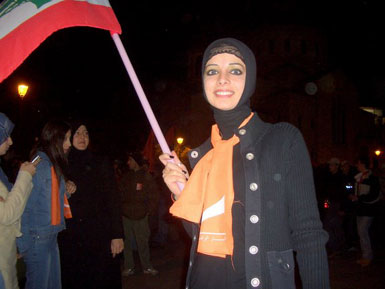
A Shia protester wears the orange scarf of the Aoun movement while waving the Lebanese national flag.


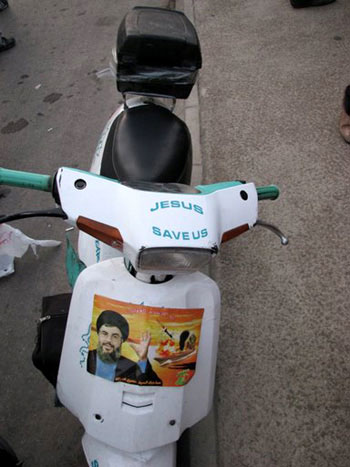
This Vespa promotes enthusiasms that belie the central theme of Western reporting. We may not be able to imagine that Hezbollah leader Hassan Nasrullah and Christianity can coexist and cooperate, but apparently many Lebanese do think so.

See also this site for more on the Lebanon crisis.

Sunday, December 03, 2006

Opposition demonstrations in Beirut


(bintlouisa writes from her country, giving a view of the background of ongoing opposition demonstrations very different from that in the U.S. and British media. The demonstrators believe the Lebanese government of Prime Minister Fouad Siniora is not legitimate and are demanding a more representative alternative. Here's why, along with some information on who the parties are and the author's account of being among these huge crowds of protesters.)

The "Siniora" government lost its constitutionality several weeks ago with the resignation of all its Shia ministers, from both parties, Amal and Hezbullah. Under the Lebanese constitution, all the main religious communities must be represented in government -- around 40 percent of Lebanese are Shias, so there can't be a government without them.

The "Siniora" government has done many illegal/unconstitutional things. For example, it impaired the constitutional court to prevent it from looking into requests for annulment of election results for eleven parliament seats that would have made it lose its parliamentary majority. This impairment has also hampered the whole judicial system. Also, the minister of interior resigned 10 months ago, and an interim was nominated. Then suddenly after the departure of the Shia ministers, the ex-minister was brought back and we learned that he had been receiving his salary during those 10 months. According to a high-ranking judge, this makes all the decisions of the interim minister invalid or at least questionable. This could only be settled by the still frozen constitutional court.

The parliamentary majority that gives today's government its credentials is the product of a gerrymandered electoral law imposed by the Syrians in 2000. The same law was used in the 2005 voting although the Syrian army had withdrawn from Lebanon. One of the effects of this law is that 35 of the 64 Christian parliamentarians were elected, not by Christian voters, but by voters from other communities: some, in the South and part of the Beqaa, were put in office by Shia votes; the others were put in through [assassinated former Prime Minister] Hariri's money machine in alliance with Jumblatt's Druze votes. [The Hariris are Sunni Muslims; the Druze are neither Christian nor Muslim.] The Christian ministers in today's government come from the later group. All in all the gerrymandering led to the following distorted results:
  • the Hariri group, now in power, received 400,000 votes that gave it 71 seats;
  • the Shia parties, Amal and Hezbullah, received 460,000 votes that gave them 35 seats;
  • opposition Christian leader Michel Aoun and his allies received 405,000 votes that gave them 21 seats.
What the opposition has been asking, and Michel Aoun was the first to do so, is the following: formation of a government of national unity, which will change the electoral law so all citizens as well as communities are more fairly represented, new parliamentary elections, and after that the new parliament elects a new president of the republic and brings in a new government.

The current government doesn't want to hear about new elections, but wants today's parliament to unseat the current president in office and elect a new one for the next 6 years. The president in office had his six-year term extended for three extra years under Syrian pressure.

The opposition is not only Hezbullah, Amal and Aoun; it includes local leaders from all communities. There are no neutral leaders today although a handful who are in the opposition do not support the street demonstrations. However the street protest of the last three days shows that the opposition enjoys a large, almost overwhelming, popular support.

As far as I can judge the government has very limited support in the country. But the government has total support from the governments of the U.S., Europe, Israel, and their stooges like Saudi Arabia and Egypt. It seems as if Siniora has no freedom to resign; the Americans want him to stay.

The country is at a standstill. Economically this is a disaster, coming not only after the summer war but also after 1.5 years of disastrous financial mismanagement. Imagine this: neither in 2005, nor in 2006 was this government now in power able to come up with a budget! All this follows fifteen years during which the Hariri governments --with Siniora as Finance Minister -- and in collusion with the occupying Syrians -- plundered the country, accumulating $40 billion public debt while spending only $4 billion for reconstruction and public works.

The opposition protesting in the streets is led by two highly persistent groups: one [led by Aoun] fought the Syrian occupation for 17 years, the other [led by Amal and Hezbullah] the Israeli occupation for 18 years. The existing government cannot yield to the demand for a national unity government because the Americans do not want it. The Lebanese national army is keeping the peace and is not divided as it was in 1975 at the onset of the civil war. In addition the army is supported by the opposition.

What can happen next after several days of huge popular demonstrations? Will the Americans who are propping up the government bow to the pressure of the people in the streets? I have no idea.

For months now, the government has been saying: Hezbullah and Aoun are followers of Syria and Iran. It is ludicrous to say this about Aoun -- in 1989-1990, he led a war to push the Syrians out of Lebanon and ended up in exile for 15 years during which the movement he inspired kept on peacefully fighting the Syrians in Lebanon and paid a heavy price for it.

Now it is true that Hezbullah has been supported by both Iran and Syria. However Hezbullah follows a Lebanese agenda. The liberation of the South from the Israeli occupation was a Lebanese agenda, not an imposed Syrian or Iranian agenda, no matter what the American administration or the Israeli government say. Already in 1989, Michel Aoun, in a broadcast speech and in the midst of the war against the Syrian army, supported the resistance to the Israeli occupation.


The protests have been peaceful, even joyful. I have been going down to the demonstrations and the sit-ins. The atmosphere is like being at a fairground. There are parents with their children carrying Lebanese flags, women wearing headscarves and around the neck the orange scarf of the Free Patriotic Movement [the Michel Aoun party]. It is wonderful to be in a mix of all Lebanese communities.

I am a little worried inside. I am not afraid that the opposition will turn the protest violent; I am afraid of provocateurs. Let's hope it all stays peaceful!

Tuesday, October 24, 2006

Under bombs ...


When I was a child in the late 1950s I attended a summer camp deep in the New England woods. The people who ran this oasis of privilege were descendants of Protestant missionaries who had carried their Gospel far and wide to people they probably called "heathen" and whom we might call "citizens of the less developed world." Happily, that experience of life outside the United States, instead of teaching them to feel superior, actually made them unusually aware that we, here, had much to learn from people who lived in other countries. The camp leadership always made sure there were foreign campers and counselors in residence.

One year we had a Japanese counselor, a shy and barely English speaking woman. She was a good friend to some of the shy campers. We also had the usual collection of home grown counselors, many of them boisterous college students enjoying a summer break. One of the latter got a surprise visit from her boyfriend -- an aspiring pilot, he buzzed the camp in a small plane.

As the biplane swung past, campers squealed in delight -- but then we heard screams of a different sort, cries of a kind of terror none of us had known. Our Japanese friend ran from her tent and plunged under the nearest building, out of her mind with fear. She lay there, white and shaking, refusing to come out for hours.

What did we know about growing up under bombs, under incendiary raids?

It is not major news in U.S. media, but Israeli jets are still buzzing the Lebanese towns upon which they rained bombs last summer. According to the Israeli newspaper Haaretz,

The planes conducted mock raids over much of southern Lebanon, Reuters reported, and residents saw them flying low over the capital Beirut, but neither Hezbollah nor the Lebanese army fired anti-aircraft rounds at them as they have done in previous years.

Israeli jets have routinely flown over Lebanon since the 34-day war.... The Lebanese government and the UN say the overflights, which Israel had continued to conduct after it ended its 22-year presence in south Lebanon in 2000, violate both the latest truce and the terms of Israel's earlier pullout.

It has also come out in the last few days that Israel used white phosphorous weapons during the war.

White phosphorous is a translucent wax-like substance with a pungent smell that, once ignited, creates intense heat and smoke. ...

In addition to the toxicity of the smoke, burning fragments can stick to the skin and clothing to cause severe burns, and fragments of phosphorous can become buried in wounds.

Of course, the use of such weapons is not news to those upon whom they fall. It is the rest of us who are kept in the dark about what our militaries are doing. Israel is not alone in using this vicious substance; the U.S. also used it in Iraq.