Friday, December 23, 2005

Has public disclosure of government actions become inevitable?


Commenting on the Administration practice of trying to buy favorable news coverage in Iraqi media, Abu Aardvark observes

Any policy which does not take into account the inevitability of early public exposure is by definition a flawed policy. That applies to extraordinary renditions, torture, domestic spying, and Iraqi payola schemes alike. This should be a key concept for all policy making today…

If true, this is important and perhaps a genuine change from previous eras.

As recently as 60 years ago, it really was possible to keep hidden from Hitler just where and when enormous Allied armies were going to land on the European coast. Fifteen years after that, it was possible (with the connivance of establishment media) to hide the Bay of Pigs invasion of Cuba from Castro. In 1972, it was possible to hide the activities of Nixon's rogue operatives for nearly a year, but then the bureaucracy sprung repeated leaks. In the 1980s, the Reagan Administration policy of selling of arms to Iran in trade for U.S. hostages held in Lebanon stayed hidden only a few months before its exposure in a Lebanese newspaper led to the unraveling of the Iran-Contra scandal. Though the nightmare of Bush's misbegotten global war on a noun feels as if it had been with us forever, in fact we've only been trapped in Iraq for less than 3 years and already a litany of "secrets" have come to light.

It does seem as if the secrets of the powerful are emerging from the shadows at a greater and greater rate. And in the present state of internet communications, anything known to anyone very quickly becomes known to all who care. It still helps to know what to look for and where to look for it -- it always has: "covert" wars were no surprise to Laotians in the 70s or Nicaraguans in the 80s, merely to U.S. taxpayers who made them possible.

More and more, Abu Aardvark is probably right that all policy happens in sight. This implies that in the nominally democratic parts of the world, governments can only carry out their policies, good, bad and indifferent, if they can either distract a majority from them, attract a majority to them, or impose their will by force on their populations. Getting by under the radar is no longer a realistic option. That's new and I don't think we quite know what it means yet.

Friday Cat Blogging: Whiskers at Home


This is my place and I like to check out what is going on.


I can pretend to survey the house indifferently...


... but you can take a lot of liberties if you treat me right.

Thursday, December 22, 2005

Good Grief!

The Washington Post online has a Politics Trivia poll this morning asking:

"As of Dec. 21, how many governors had opted for more traditional Christmas greetings, such as 'Merry Christmas,' instead of generic 'Happy Holidays' greetings in their annual greeting cards?

I don't think I've ever gotten a Christmas card from a Governor; I guess that is not surprising as I don't much truck with Governors. My mother used to get cards from Ronald Reagan; she put them on the mantle (and sometimes I covered Ron and Nancy with other cards.)

Two points:
  • If they send the things at this season, they are participating the great Amurrican consumption holiday which is called "Christmas," no matter what words they use on the cards. People from non-Christian faiths or no faith have a right to feel erased in the frenzy.
  • Whatever the cards may say, they have little to do with Christmas as a pointer to the life of Jesus. Read this.
Oh yeah, the answer to the Wapo's quiz (sorry, can't figure out how to link to the question rather than the results): "An in-depth Stateline.org survey concluded that 37 of the nation's 50 governors chose the more generic "holidays" formula, nine went for the more traditional Christmas greetings and four haven't sent official cards at all."

Wednesday, December 21, 2005

We can but watch and wait and pray…


Christian Peacemakers hold vigil with Iraqis in a destroyed house in Abu Sifu. Photo: CPT

For those who are Christians, Advent is the season of waiting in joyful hope for the Christ child. For those who are moved by the nonviolent witness of the members of the Christian Peacemaker Team (CPT) in Iraq, this December is a time of waiting in anxious hope for news to the four members kidnapped in Baghdad on November 26.

The four men, Tom Fox, Jim Loney, Hameet Sooden, and Norman Kemper, were taken as they were leaving a mosque where they had discussed what could be done to free Iraqis detained by U.S. and/or Iraqi government. There has been no known contact with their kidnappers, who call themselves the Swords of Righteousness Brigade, since December 8. Thousands of people, from all over the world, Christians, Muslims and others, have signed a petition, held vigils, and, as a step toward reducing violence in Iraq, called for an end to the occupation.

In this time of waiting, those so much closer to the situation have much to share.

Peggy Gish has served on CPT's Iraq team since before the multinational forces invaded in 2003. She is currently doing support work for the Iraq team based in Amman, Jordan from where she wrote this reflection:

It is hard for the missing CPTers' families. It is hard for us not knowing where our four colleagues are, how they are holding up during this time, or when they will be released. We pray; we cry; we wake up in the night feeling tense with worry. We ask God for more faith and trust as we call for their release and work to share the stories of who these men are, of the work of CPT in Iraq and other places of conflict and injustice. We care about these four men, yet we also feel the same urgency for all Iraqis and their families who are suffering fear and pain because their family members have disappeared or been killed or imprisoned.

Sheila Provencher works with CPT in Baghdad. She tells us:

Lately I feel so tired. There’s always a part of me that wants just to sleep; sleep and make all of THIS – the war, my government’s policies and actions, the counter-violence of the insurgency, all the greed and sin in the world – just go away for awhile. I can identify with the apathy of citizens who give in to violence: yes, just make the evil go away, press the button, fire the missile, send the young ones off to war. Take any way out.

There is no way out. But there is a way through. I tasted it the other day, when I was tired and wanted to hide, but instead went down the street to visit an Iraqi family who are going through a troubled time. On the way, I met little Huda in the street. I gave her a kiss; she gave me a piece of candy. Simple relationships, simple human connections – that’s the way through.

Brian Conley points out on Alive in Baghdad:

It is important to remember that kidnapping is a much larger problem for Iraqis than for Foreigners. ... A report by my friend Greg Rollins (also a Peacemaker) quoted an Iraqi Policeman in Baghdad suggesting that as many as 300 kidnappings of Iraqis had occurred in 2005 in his district alone! This 300 kidnappings in one police district accounts only for those kidnappings that were reported.

Simon Barrow both catalogues media commentary on the CPT hostage taking and reflects:

Amidst the agony of waiting and hoping, one of the interesting issues that has arisen from the CPT hostage situation in Iraq is the contrast between how different sections of media (and the communities behind them) have responded to the story. Even though Christian Peacemaker Teams were on to prisoner abuse and Abu Ghraib before anyone else, the mainstream continues to ignore such groups, except when a crisis erupts.

Here in the UK, Christianity is most often only good for a story when it is being silly, when it is declining, when it is fretting about sex, or when its hierarchs are being obnoxious or clueless. The routinely extraordinary things done by groups like CPT are simply "not news" -- even when they clearly are. They just don't fit "the script".

The church media isn't much better. Indeed it is often confused and baffled by people who think that Christian faith is about life transformation rather than churchianity or my-personal-Saviour. A deep commitment to the way of Christ that involves a refusal of violence, the embracing (rather than the haughty rejection) of 'the other', and so on, is for an eccentric minority.

He has a lot more to say; check it out.

Finally, Gene Stoltzfus, who was director of the CPT from its beginnings until 2004, brings a special, experiential wisdom to peacemaking. On his blog Peace Talk he draws a word picture of what a meeting between CPT members and the sheik of a Baghdad mosque might have been like, takes up the implications of the hostage-takers' claim that the CPT folks are "spies," and tries to help the people of the U.S. understand why the rest of the world might think of them as purveyors of terror. In Who Did It? he gently explains:

In my travels I have noticed people do not immediately distinguish between state supported terror and terror that may grow out of groups remotely affiliated with state power or clearly independent. The use of terror in the support of military objectives has been associated with war for 5000 years. Roman legions, Genghis Khan and their predecessors including Alexander the Great resorted to wanton destruction of property, rape, and pillaging of civilian populations in their campaigns to conquer and subdue the enemy. …

In the so called Christian west there are modern efforts to bring boundaries to war by enlightenment internationalists and the inheritors of just war thinking. Various covenants and protocols are in place that prescribe treatment of detainees and guidelines on the treatment of civilians for armies of occupation. In the wake of this growing body of international law and the recovery of enemy loving teachings among Christians, governments have resorted to two track war making.

The public face of war making are the uniformed soldiers with their attendant weapons of modern warfare including all kinds of high tech equipment often justified as being inherently less destructive. The other track, the shadow side, contains war making at much more vicious level that can be regarded as the application of terror on enemy populations including civilians. Many of us choose to see the visible expressions of the security state, the uniformed soldier, but are mystified by or choose not to believe that "civilized" nations Christian, Muslim or Jewish, practice assassination, torture, destruction of whole cities with dimly lit underworld programs.

Despite the fact that thoughtful military historians report that these expressions of terror rarely achieve the desired ends of national security, planners and politicians continue to use these means.

Read the rest of it; it is worth the effort.

And so this Advent, we wait and pray for the CPT hostages and their captors, hoping that somehow our very broken world might find the joy that is also hidden among us.

Tuesday, December 20, 2005

Governor Arnold's woman problem


Sacramento Bee columnist Dan Walters is writing an interesting ten part series on how Governor Schwarzenegger managed to fall from being the conquering action hero of the recall election in 2003 to the goat of his own special election in 2005. The whole series is current available through this link.

Today's installment was called "Schwarzenegger's clashes with women haunted his ballot drive." According to Walters,

Arnold Schwarzenegger has a problem with women, and it has been a major factor in derailing his governorship.

No doubt about it; the Governor holds women in contempt and we sense it.

In the week before the recall election, the LA Times broke the story, long floating just below the threshold of respectable "news," that Arnold had been a serial groper of women working in the bodybuilding and movie world. The revelations were not enough to derail his momentum, but he won only 44 percent of the women's vote as compared to 52 percent of men. And a residue of slime stuck, just waiting for further evidence that the guy was no gentleman.

As Walters repeatedly suggests, a more polished politician would have worked harder to avoid triggering women's latent distrust. Arnold did the opposite. He made a promise about levels of school funding to the teachers' union -- and broke it. Not smart.

When fighting with the legislature, his idea of how to put his opponents down was to call them "girlie men." If that is an insult, it is one rooted in woman hatred, further wrapped in homophobia. Call your opponents "obstructionists," "incompetents," whatever, but don't think you can score on them by calling them female.

At a conference of the state's women, he patronized nurses who wanted him to guarantee adequate staffing in state hospitals:

An obviously irritated Schwarzenegger urged the crowd to "pay no attention to those voices over there," and added, "They are the special interests. Special interests in Sacramento don't like me because I am always kicking their butts. That is why they don't like me. And I love them anyway."

Yeah, he loves women like all the abusers love women -- it gets these guys off to kick us around.

And, so over the last year, the leading institutions of working women in California, the Teacher's Association and the Nurse's Association, cut the Gropinator down to size. I hope he understands it was those girls who did it; I suspect he does.

The night of the 2003 recall I was at a party also attended one of the founders of Code Pink, the women's anti-war group. We actually had something to celebrate as in the same election in which the voters put Arnold in, they also defeated a racial information ban. (Mixed bags, California elections.) I remember assuring her that eventually Arnold's woman hatred would come back to bite him. Even at my optimistic best, I never thought it would happen so rapidly or so clearly as it did this past November.

The word

IMPEACH

Read this. Don't let this happen.

Sunday, December 18, 2005

Bush Imperator


Photo: Manuel Balce Ceneta / AP

"The president does not get to pick and choose which laws he wants to follow. He is a president, not a king," said Senator Russell D. Feingold (D-Wis).

A confession: I was very much a radical activist in the 1970s, the last time U.S. intelligence services were revealed to be spying on U.S. citizens who were not charged with any crime. And I paid no attention at the time to the reforms that led to the rules and procedures, the warrants and the F.I.S.A. court, that President GWB apparently has illegally trashed.

You see, I didn't believe that laws would restrain the behavior of the FBI or other government agencies, regardless of what statutes and courts might dictate. In my short experience, local Red Squads routinely infiltrated activist groups and Chicago police had brazenly executed sleeping members of the Black Panthers (Fred Hampton, 1969). Extrajudicial repression was a fact of life for activists of color and sporadic, but real, for white leftists. The authorities could pretty much do whatever they wanted to Commies and other uppity people and there was very little recourse.

Despite the 1970s reforms, extrajudicial spying was very much a part of the U.S. government response to the citizen movements in the 1980s that supported the various peoples' struggles in Central America. Christian activists offered sanctuary to victims of the U.S. supported governments in El Salvador and Guatemala; their offices were repeatedly broken into, files stolen and meetings infiltrated. It eventually came out that the Reagan Administration had avoided Congressional oversight of their secret war on Nicaragua by selling arms to their enemies in Iran and using the proceeds to arm their proxies.

Given the long history of U.S. government lawbreaking, what makes current revelations that Bush simply trashed the laws governing spying on U.S. citizens so shocking? We're living the difference between furtive lawbreaking and a fundamental disdain for law. The LA Times asked law professor William C. Banks, director of Syracuse University's Institute for National Security and Counterterrorism, whether Bush's assurances that his lawyers reviewed the warrantless wiretaps was reassuring:

"That review is nice. But what are the standards? What are they measuring against? Some concept of executive power not written down anywhere? Not endorsed by any court? It is what you want it to be" Banks answered.

What Bush wants it to be.

Juan Cole laments:

It was a good run, this United States of America with its Constitution and its Bill of Rights. How sad that a gang of unscrupulous criminals has been allowed to subvert its basic values altogether. …And why? Because of a single attack by a few hijackers from a small terrorist organization?

After ignoring and doubting those old documents for so much of my life, it feels strange to realize that now I have to struggle to re-establish their authority. But I am not ready crown a king.

Saturday, December 17, 2005

Urban [wild]life:
Is this why we have possums?


Photo by Valerie at at Garden Bits

I live in the inner city. I mean it. Friends sometimes don't want to visit here because it is a "bad neighborhood" -- not to mention a place with about 120 percent more cars than parking places. We find drunks keeled over on the sidewalks and see more drug dealing in corners than anyone wants to see.

We also have other local residents. One night last June we heard what sounded like several people running repeatedly across our roof. We called 911. Unexpectedly, two uniformed cops turned up within minutes. They shined their powerful lights on the roof and bright eyes peered back. A huge raccoon, weighing thirty five pounds at least, looked down balefully and disappeared. The officers were very nice about being called for a coon; "it happens." We saw the beast several more nights before it lumbered off.

Lately there have been roof noises again. One early evening, the woman who lives in the back went out to look up and found two (different) cops. She asked weren't they worried that a surprised, frightened, and armed homeowner might come out blasting? No answer -- someone on the block had complained of roof noises again.

About a week after that the latest source of the running sounds above became visible: we now have a family of large opossums, furry critters about twice the size of a large rat with pointed faces and long hairless pinkish tails. They are noisy too.

Why all this wildlife? I have a new theory. Across the street we have a middle school. And that middle school tries, amid the concrete, to give its students a tiny taste of cultivated greenery:

The other day for the first time, I stopped by the school's garden to read the "mission statement." (Since when did a garden need a mission statement?)

Among other worthy ends they hope to restore some balance to the neighborhood by "encouraging the return of small indigenous animals..." Can they really be attracting native critters? Or, perhaps, the coons and possums are better adapted than we imagine to inner San Francisco.

Gender roles quiz

Androgynous
You scored 83 masculinity and 60 femininity!

You scored high on both masculinity and femininity. You have a strong personality exhibiting characteristics of both traditional sex roles.


My test tracked 2 variables How you compared to other people your age and gender:
free online datingfree online dating
You scored higher than 70% on masculinity
free online datingfree online dating
You scored higher than 45% on femininity
Link: The Bem Sex Role Inventory Test written by weirdscience on Ok Cupid.

Hmmm...
Seems about right for a tall, physically competent dyke born in 1947. Those of us who came of age in the liberation movements of the 60s and fought our way to feminist consciousness in the 70s quite commonly seem to have cultivated this mix of characteristics based on available gender roles. Those who came both before and after us tend to label us "butch." Many of us just think of ourselves as women who like ourselves.

Thanks to Republic of T.

Friday, December 16, 2005

Does it matter when we do what we say we don't do?


I may be naïve, but I sure hope it matters. Today the Senate, via Senator Lindsay Graham's legal dodge and good dose of obfuscation seems likely to pass a gutted version of the McCain amendment that will put the U.S. on record as "not doing torture" while in fact preventing persons tortured by the U.S. from going to court to complain about it. There's a Catch 22.

For weeks we've been treated to the Prez and Condi telling all and sundry "we do not torture." And concurrently we have the drip, drip, drip revelations that the U.S. both turns over unlucky "rendered" prisoners to others to torture and practices "harsh interrogation" tactics that sometimes leave dead bodies lying around. And many of us with longer memories know the U.S. trained thousands of Latin American torturers at the "School of the Americas" in the 80s (that military outfit is still on mission today, renamed the "Western Hemisphere Institute for Security Cooperation.")

We live with a strange, divided consciousness. On the one hand, anyone listening at all knows that our government is violating international norms and laws. Concurrently, the torturing authorities still need to lie about it, volubly, and even go through complicated charades like the current McCain amendment shenanigans to backstop the lies and give legal cover for continuing to torture.

Why bother with the lies? Why not just come out and nakedly assert: "We can and we will. Fuck you." While I am sure this is closer to GWB's preferred style (and is the style his U.N. enforcer John Bolton), they apparently can't quite do that.

I guess they do still need some international cooperation. Other governments may envy the U.S.'s freedom to act lawlessly, but at least the European ones can't afford to admit that to their own populations.

And they are hampered by a surprisingly strong residue of respect for rights and laws among people who work for the U.S. government. Today's report that the President, on his say-so, threw out the constitutional requirement for warrants to wiretap U.S. citizens betrays that many high ranking officials had reservations. They talked to each other. They leaked. The new conduct bothered them; they were accustomed to feel governed and sustained by law; they also feared they might someday suffer consequences for trashing the law.

A senior government official recalled that he was taken aback when he first learned of the operation. "My first reaction was, 'We're doing what?' " he said. … Some agency officials wanted nothing to do with the program, apparently fearful of participating in an illegal operation, a former senior Bush administration official said. Before the 2004 election, the official said, some N.S.A. personnel worried that the program might come under scrutiny by Congressional or criminal investigators if Senator John Kerry, the Democratic nominee, was elected president.

Nobody is talking high principle here, but at least there seems to have been a habit of deference to law.

I think the strength of that deference is part of why they need to torture and imprison lawlessly. It is not just the bodies of the captives that are on the line, but also the whole edifice of moral and legal constraint on the guys with the most war toys. They want that broken, definitively.

Even as the U.S. sinks more and more deeply into the authoritarian pit, I find it hard to believe that lawlessness will completely win out.

One of the mysteries of twentieth century history is that vicious, murdering governments again and again held the bodies of their most effective enemies in their control -- and didn't kill them. Nicaragua's Anastasio Somoza was a brutal dictator who responded to popular unrest by bombing his own cities. But though he tortured and imprisoned his enemies, the Sandinistas leadership survived to overthrow him. (And be "destabilized" in turn by the U.S.) The apartheid government of South Africa tortured Steve Biko and many others to death. They imprisoned Nelson Mandela for 27 years, but he lived to negotiate a relatively peaceful transition to democratic rule by the majority. Some vestige of legal constraint limited even these brutes.

Slowly, unevenly, a majority of this dangerous species of ours seems to have learned that some limits on our murderous tendencies are needed for survival. And so, prudentially, we begin to codify limits. International law gets enunciated, even if it is mostly ignored.

After storms of lawlessness, those once all powerful may be surprised to find themselves reviled -- think Pinochet. And though it may be hard for people in the U.S. to see, Eurocentrics that we are, even the loathsome Taliban were originally hailed in Afghanistan as the restorers of law; it looks likely the young Sadr may get to play that role in Iraq once the U.S. retreats.

The drive toward some rule of law seems to be universal. (What form of law remains to be struggled over, of course.) So our lawless government has to lie about torture and tries to get as many as possible to participate in the falsehood. Though not yet challenged, they know some kind of guilt, some sense of crossing a necessary line. The rest of us are left to build from that weak, but real, foundation.

Thursday, December 15, 2005

In honor of defenders of the Bill of Rights


December 15 is Bill of Rights Day. President Franklin Delano Roosevelt proclaimed it, in 1941, just a week after the country was thrust into a terrible war by the surprise Japanese attack on Pearl Harbor.

A couple of years ago, when I was giving a talk in Tacoma about my lawsuit to find out why I was on the no fly list, I met a retired military man. He had sat down one day and read the Bill of Rights -- and ever since he has devoted himself to activism to preserve these liberties. In honor of Tim Smith's work I'll list those rights here:
  • Freedom of speech, press, religion, peaceable assembly, and to petition the government.
  • Right to keep and bear arms.
  • Protection from having to house troops.
  • Protection from unreasonable search and seizure.
  • Due process, double jeopardy, self-incrimination, private property.
  • Trial by jury and other rights of the accused.
  • Civil trial by jury.
  • Prohibition of excessive bail, as well as cruel or unusual punishment.
  • Protection of rights not specifically enumerated in the Bill of Rights.
  • Reservation of powers of states and people.
Roosevelt's U.S. honored its freedoms as much in the breach (think Japanese internment) as in fact. We're probably doing worse.
  • Today the Washington Post tells us that the Pentagon is building a wide ranging database that names nonviolent protesters as military threats;
  • the U.S. continues to lock up several Uighers (a Chinese minority) in the Guantanamo prison camp, even though even the U.S. military says they have committed no offense and are no threat to the country;
  • Meanwhile Cobb County, Georgia went to appeals court today asking to be allowed to place anti-evolution stickers in high school science textbooks, something a lower court found would introduce a religious position into the curriculum;
  • and yesterday the U.S. House of Representatives passed an extension of the USA PATRIOT Act (signed 46 days after the 9/11 attack). Civil libertarians in the Senate led by Russ Feinguld (D-WI) plan to filibuster.
It hasn't been a good week, or a good couple of years, for rights and liberties.

In honor of the day, it seems right to hear from some of the men who wrote the Bill of Rights.

"The spirit of resistance to government is so valuable on certain occasions, that I wish it to be always kept alive. It will often be exercised when wrong, but better so than not to be exercised at all. I like a little rebellion now and then. It is like a storm in the atmosphere." Thomas Jefferson, letter to Abigail Adams, February 22, 1787

And, perhaps even more subversively

"Liberty, when it begins to take root, is a plant of rapid growth." George Washington

The plant needs some cultivating.

Wednesday, December 14, 2005

Death and life


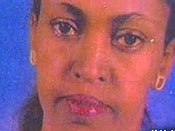
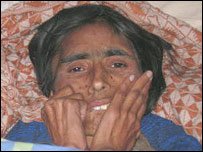
Left: Tirhas Habtegiris; Right: Naqsha Bibi

First, death: A Dallas TV station reports that a Plano hospital gave the family of a patient an ultimatum: find other care for her in 10 days or have her respirator disconnected.

Tirhas Habtegiris was an East African immigrant and only 27 when she died Monday afternoon.

She'd been on a respirator at Baylor Regional Medical Center at Plano for 25 days. …

[H]er brother Daniel Salvi was stunned to get [a] hand-delivered notice invoking a complicated and rarely used Texas law where a doctor is "not obligated to continue" medical treatment "medically inappropriate" when care is not beneficial. ... [O]n the 11th day, Tirhas Habtegiris was taken off the respirator and died.

Even though her body was being ravaged by cancer, this family says Tirhas still responded and was conscious. She was waiting one person.

"She wanted to get her mom over here or to get to her mom so she could die in her mom's arms," says her cousin Meri Tesfay. Ten days was not enough time, [family members] say, to get a mother from Africa to America.

"A fund issue is what I understand. Because she is not insured and that was the major reason the way I understood it," Salvi said.

George W. Bush signed the law that made this denial of care legal, so it is tempting to blame him and/or the peculiar barbarism of freewheeling Texan capitalism. However I would not be surprised if many U.S. states have similar laws.

Life: According to the BBC Naqsha Bibi was recovered from under the rubble of her home in Kashmir on December 10. She had survived since the October earthquake crushed into a tiny space in what had been her kitchen. Apparently a trickle of water kept her alive, though she weighed less than 75 pounds when pulled out. She was found by accident.

"We started clearing the debris of her house on 10 December, mainly to pull the iron sheets off the collapsed roof to build ourselves a shelter," says Faiz Din. … "We first thought she was dead but she opened her eyes as we were pulling her out."

Although her muscles remain frozen in a fetal crouch, doctors in Muzaffarabad believe that with liquid feeding and physical therapy, she will be able to recover.

Dr Abdul Hamid was one of the doctors treating Naqsha. When asked how someone could possibly survive for such a long time, he said, "medical science may struggle to accept it but there are miracles in this world, you know."

Tuesday, December 13, 2005

Changes in the 'hood


Before

After

Somehow I don't think this transformation is going to make much difference.

For the last couple of months, major renovations have been going on inside the dive down the street from my house. The old El Zarape had been on this corner for at least as long as I have been here -- well over 10 years. I don't remember ever seeing more than two tables occupied out of eighteen or so. If fact, I often wondered if the place were some kind of money-laundering front.

The "now open" Velvet Cantena appears designed to appeal to a similar prospective clientele: members of the Latino business class making a night out. I just don't think there is much of a market for such a restaurant in this neighborhood.

Despite encroaching gentrification accompanied by rising property values and higher rents, this part of the San Francisco Mission District is still heavily Latino. But Spanish speakers here are mostly new immigrants, Mexican men who shape up on the sidewalks and Central American families crowded into rooming houses. Prosperous Latinos, often business owners, move their families to the inner suburbs where the schools are better and the living more secure. They may still work in the neighborhood, but they don't live here and I doubt if they'll play here.

For one thing, the Velvet Cantena can't provide parking.

It will be interesting to see whether this place endures or the new operators sell out to restaurateurs who will cater to the young white Mission crowd that travels by public transportation and eats out frequently. That's who one sees in restaurants around here.

Bearing witness:
Guantanamo fasters and the CPT 4


Marchers break bread at liturgy outside Guantanamo gate
Published by Witness Against Torture. Photo by Scott Langley.


This post is an update on two sets of people who have stretched the boundaries of activism for peace -- people whose bravery has to be a challenge to all of us arm chair critics.

In Cuba, outside the U.S. base at Guantanamo: Twenty two mostly Christian activists continue a water-only fast at a Cuban military checkpoint outside the base today. The Witness Against Torture website explains:

They have completed their 5 day, 50 mile march and are now waiting for permission to enter the US base. They hope to be allowed to visit the prisoners, something that should be a simple act and one that is rooted in their religious tradition. In the Gospel of Matthew, 25:36, Christians are charged to perform the Works of Mercy. Among these works is the visitation of prisoners.

NewsDay reports that "Stacey Byington, a civilian spokeswoman for U.S. Naval Station Guantanamo Bay, told The Associated Press in an e-mail message that access to the base is limited to those with official or authorized business."

The marchers have not indicated how long they will remain outside the gates, bringing further attention to this U.S. prison in which nearly 500 men are held outside the reach of any internationally recognized legal procedures. Detainees released from Guantanamo have repeatedly claimed they were tortured. Thirty-two prisoners are on hunger strike to protest what they say is cruel and inhumane treatment. Twenty-five of those prisoners are being fed through tubes.

In Iraq: nothing has been heard for several days from the kidnappers of the four members of the Christian Peacemaker Team. The Toronto Globe and Mail reports somewhat morbidly:

The Swords of Righteousness Brigade said it would kill Canadians James Loney, 41, and Harmeet Sooden, 32, as well as long-time British peace activist Norman Kember, 74, and American Tom Fox, 54, unless all 16,000 Iraqi prisoners held in British and American military prisons are released. The first deadline was last Thursday -- 12 days after the four were abducted at gunpoint from the streets of Baghdad. The deadline was then extended until Saturday. The captors then broke off all communication --another standard tactic, which puts families through agony and places the governments of the captives' countries in a precarious position.

Many of those held hostage in Iraq are never heard from again.

The article goes on to point out that the kidnappers have gone out of their way to show the Canadian members of the foursome with free hands and able to speak, while the U.S. and British men are chained in orange jumpsuits.

In Canada:The Canadian press has been much more diligent in following this story than U.S. media. In particular, it has recounted the impression Jim Loney made on the First Nation communities in Kenora, Ontario:

Kenora activist Bobby Herrington praised Mr. Loney's inner strength. "He's right up there with a small number of native elders -- he always has that presence, that aura about him, that things can be okay."

Loney's hometown paper from Sault Ste. Marie published a friend's Advent meditation on the kidnapping:

Advent is a sacred space set aside to plumb the depth and breadth of what it means to wait and pray for peace, for reconciliation – no matter how frightening, how painful the Birth. Waiting in a Nazi cell, the Jesuit priest Alfred Delp confronts his fears and asks, "Are these hours of waiting preparation for an extraordinary Advent?"

For us, Jim's community of friends, it has already been an extraordinary Advent.

We stay awake with Jim and the others. …

Neither Jim nor Christian Peacemaker Teams is waiting for false freedom.

Neither Jim nor Christian Peacemaker Teams is waiting for some empire's shock and awe to deliver them.

Both Jim and CPT believe, as Oscar Romero put it, that "we live by that power that even death cannot overcome."

Monday, December 12, 2005

From the human garbage heap:
San Francisco Municipal Court

This morning in San Francisco Municipal Court, I watched an acquaintance (I'll call him JPW) receive a sentence of 16 months in state prison for a felony burglary conviction. Between credit for time served and the good behavior he usually manages when he is inside, this will probably mean that he'll spend six month in San Quentin prison.

Afterward he'll be on the street, broke, homeless and on parole. If he goes by back to drugs, which is likely, he'll wind up inside again; since the current rap is a felony, he is now one third of the way to "out," a mandatory sentence of twenty years to life.

From what I could see, JPW was treated reasonably well. He was represented by a concerned Public Defender (we have very good ones here). He seemed to understand what was happening. JPW is a smart guy with a bad meth habit who has burned everyone he knows. As far as I have seen, he is not aggressive or violent, though beligerant when high. The judicial and prison system is becoming his home.

Municipal Court is the lowest rung of that system, the garbage dump of society. Everyone looks rumpled and frayed, not just the defendants, but also the judge, the lawyers, bailiffs, and spectators. Some observations, not necessarily meaningful:
  • The courtroom itself is dilapidated. Over in the State Building the seal of California is brightly colored; here it is dull gray. Some seats are broken; signs admonish spectators not to talk, eat, drink or chew gum during the proceedings. No one paid any attention to these rules until the judge shouted at one point "I can't hear!"
  • The court processes daily an enormous flood of arraignments, appearances, bail requests, and scheduling difficulties -- all briskly, but with some attention to individual particulars.
  • This judge was not at all hesitant about overruling the very young representative of the District Attorney's office; at one point, she responded to a request for $75,000 bail for a guy who had failed to appear 3 times saying "that's not enough; I'll make it $125,000." On the other hand, she casually looked over a felony charge the DA proposed and reduced it to a misdemeanor.
  • Most of the defendants on the calendar this morning were in custody, brought to court from the jail in handcuffs and orange pajama suits.
  • Translation is provided for defendants who don't speak English, but it looked really doubtful that putting the words into their own languages was doing anything to enable them to understand what was happening.
  • Folks who end up before the bottom rung of the courts don't manifest high levels of ability to play the games society demands. A couple of guys charged with low level gang related offenses turned up not only with their mother, but also with their buddy who sported a t-shirt saying "Stop Snitching."
  • Almost all the defendants were men of color who must have felt they had wandered into a wonderland presided over by aliens: the judge, lead sheriff, DAs and most of the Public Defenders were white women, several appearing to be lesbians.
All of this was something most of us never see, yet there are whole populations of folks like JPW who live here. Is this okay? Even if we had the will, is there anything we could do about it?

Sunday, December 11, 2005

Fun with Google


This silly exercise has been floating around the blogosphere. I'm ready to bite. You enter your first name and word "needs" in Google -- in my case "jan needs." Then you capture the first ten items (more or less) and list them on your blog. Here goes not much:

1. Jan needs a man. Like hell I do. What would I do with one of those?

2. Jan needs to be seen today. I seldom want to be seen; after all, being seen usually leads to interacting which leads to stress. And, nonetheless, most everything worth living for.

3. Jan needs to get a lot of new things for my new home. I don't need any more damn things; I have too many things now in a nice old home.

4. Jan needs a new desktop computer. Nope, I'm a laptop kind of gal.

5. Jan needs to go to bed sooner on weeknights. True. This blogging thing tempts me to act like a college sophomore with a late paper.

6. Jan needs critics. Absolutely. How else do I figure out what I'm doing? Not that I promise to like criticism, but I have spent a lifetime trying to learn how to sit still and listen.

7. Jan needs cancer databases. Not that I know of, thank goodness.

8. Jan needs help. Often. Jan also needs help accepting help.

9. Jan needs to be on order confirmation pages. Huh? I am not a business form.

10. Jan needs replacing. Hope not, though some days I could use some spare parts. Do they make replacement plantar fascias?

Thanks to SarahLaughed for the meme.

Cross border medicine


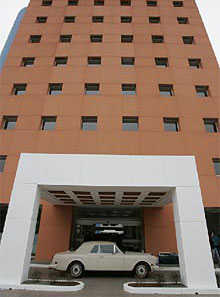
The comprehensive private care facility's opening this week in Tijuana drew VIPs, some of whom arrived in this Rolls-Royce. Photo: Jim Baird, San Diego Union-Tribune

You got to hand it to rampant capitalist entrepreneurship -- it is creative. Smart MBAs figured out they could send U.S. customer service jobs more cheaply to India. Huge success. Big pharmaceutical companies managed to keep drug prices uncompetitively high in the U.S., so Canadian pharmacies discovered they could make money selling the same drugs to U.S. consumers. Great business model. Health care costs are out of control in the U.S.; a Mexican private hospital chain thinks it can prosper by building a new facility in Tijuana and attracting U.S. patients.

The hospitals' operators are counting on drawing a significant portion of their patients – as much as 25 percent – from Southern California. They are offering care at lower cost, they say, but at standards similar to those north of the border. Hospital administrators say their services will cost about 40 percent less than comparative care at a San Diego hospital. …

"We really welcome that they come," said [Dr. Patricia] Aubanel, a heart surgeon who has worked on both sides of the border and founded a cardiovascular center in 2002 at Hospital del Prado. "It's good for the city. It puts us at another level of competition, which is always good."

Growing numbers of patients from across the United States reportedly have been going to Mexico in search of elective procedures such as gastric bypass operations and plastic surgery offered at a fraction of U.S. prices.

There have long been clinics of dubious quality in Tijuana. Maybe this outfit can give the town a better medical reputation.

Sounds to me like a new incentive for linguistically challenged Amuuricans to learn Spanish.

Saturday, December 10, 2005

March against U.S. torture


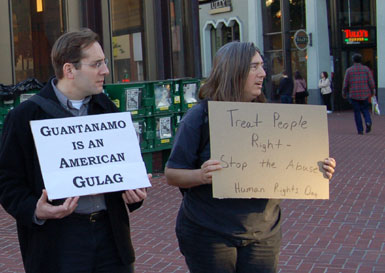
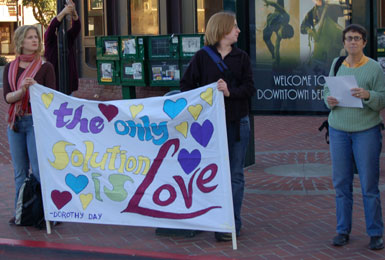
Twenty-five Christians in the nonviolent tradition of Dorothy Day and the Catholic Worker movement have been marching for four days from Santiago, Cuba to the U.S. prison at Guantanamo Bay, a distance of 50 miles. Today they arrived at Guantanamo City, the Cuban town outside the detention camp. Tomorrow they will attempt to visit the prisoners. If denied entry to the base, they have said they will fast and pray for the abolition of torture by all nations.

Catholic Worker Matthew Daloisio explained: "We want our fellow Americans to see the shameful acts of torture and abuse taking place in this and other illegal prisons hidden across the globe. We pray that others will join us in urging our government to allow us to perform this act of Christian faith."

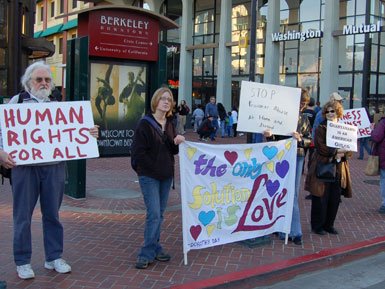
This afternoon, a small but determined group of Catholic Workers, Quakers, members of Jewish Voice for Peace, and assorted agitators and friends held a support vigil in downtown Berkeley. They also marked International Human Rights Day. U.N. Secretary General Kofi Annan proclaimed that day this way:

"Let us be clear: torture can never be an instrument to fight terror, for torture is an instrument of terror."

Some pictures from the Berkeley vigil follow:


Migrants -- dispensable cogs or human beings?


That question is really what is being argued when Republican politicians attack 'birthright citizenship.' Birthright citizenship is the legal determination, enshrined in the 14th Amendment that outlawed slavery, that if you are born in the U.S., you are a citizen. About 90 House Republicans want to throw out that principle. And they are not just blowing smoke; a Rasmussen poll in November found that 49% of those asked want to end automatic citizenship for children of "illegal" residents, while only 41% support retaining it.

Meanwhile, Latino and other immigrant leaders are appalled:

"This is about attempting to deal with a serious policy problem by going after people's babies…." said Cecilia Muñoz, vice president for policy of the National Council of La Raza.

Many strands are embedded in this discussion
  • the hunger that drives people to come where the jobs are regardless of legalities,
  • the pragmatic interests of employers who want cheap labor,
  • and the fears of those already here.
Opponents of "illegal" migration fixate on "law breaking." Considering that these folks seem to be among those of our citizens who are otherwise proudly distrustful of government, this seems odd. It is hard to escape the suspicion that employers of cheap labor are manipulating fearful people to get themselves a compliant migrant workforce.

Repealing birthright citizenship would create a class of persons who were not quite the same as the rest of us. Children of the "illegal" might well be stateless with no government to serve as their advocate. Their parents would have it ratified that they are "less equal" humans than the native born.

We are already on that path in other arenas. The President has declared his right to imprison Jose Padilla, a U.S. citizen, without trial, because he says so. There's healthy friction in the legal system about that assertion and some chance that some version of the rule of law will prevail. But in the eyes of our current rulers some are clearly "less equal."

The history of the U.S. is the record of the struggle to understand and enshrine in law the full equality of all. Women, those who are not Christian, those who are not white, gays -- we all were less than human once. Will we allow employers of cheap labor to drive the country backward?

Friday, December 09, 2005

The eyes have it
Friday cat blogging


Billie is an enthusiastic youngster.


Griveny is grizzled old guy.

Both beauties; both their own cats.