Monday, December 10, 2007

Corruption


If power corrupts, weakness in the seat of power, with its constant necessity of deals and bribes and compromising arrangements, corrupts even more.

Historian Barbara Tuchman

The quotation is most likely from March of Folly: From Troy to Vietnam, her Vietnam book. In a conversation today on Daily Kos, a commenter offered it to explain the behavior of Congressional Democrats who once again apparently intend to give Bush funding for the Iraq war with no strings or conditions. Seems very descriptive of the current leadership of the Dem party. Could Democrats behave otherwise? Possibly, if we make them.

Sunday, December 09, 2007

Another "homeless crisis" -- where's the plan?


Perhaps this guy served his country once upon a time.

Since last week I bashed the SF Chronicle's C.V. Nevius about his columns bashing the homeless, I should mention that he wrote a more realistic column today about the next "homeless emergency" we can anticipate.

Bobby Rosenthal, regional manager for homeless programs at the Department of Veterans Affairs, estimates that one third of the more than 6,000 homeless people - about 2,100 - in San Francisco are veterans. [Homeless advocates would say those numbers were a gross undercount.]

And no wonder the number is so high. California leads the nation in homeless veterans by a mile, according to the National Coalition for Homeless Veterans. The 2006 numbers showed 49,724 homeless vets in California. The next nearest state was New York with 21,147.

Now here's the scary part. Compared with what's coming, that's nothing. ...

Yup, the Iraq vets who'll end up on the streets are on the way, juiced up on meth, disoriented, traumatized -- and swept out of sight by the government that shipped them off to fight an unnecessary war.

"You know what scares me?" asks [Swords to Ploughshares counselor Tyrone Boyd.] "I haven't heard a plan (from the federal government) about what they are going to do when the troops come home. What's the plan?"

Now why would he think there would be a plan? There wasn't a plan for Iraq when they conquered it -- why would they care about the broken human lives they spit out from this adventure or the cities that will absorb them?

Pelosi signed off on torture

So my Congresswoman was among the scared Democratic rabbits briefed by our spooks in 2002 on their torture plans. No wonder she can't make any real effort to rein them in.

In September 2002, four members of Congress met in secret for a first look at a unique CIA program designed to wring vital information from reticent terrorism suspects in U.S. custody. For more than an hour, the bipartisan group, which included current House Speaker Nancy Pelosi (D-Calif.), was given a virtual tour of the CIA's overseas detention sites and the harsh techniques interrogators had devised to try to make their prisoners talk.

Among the techniques described, said two officials present, was waterboarding, a practice that years later would be condemned as torture by Democrats and some Republicans on Capitol Hill. ... With one known exception, no formal objections were raised by the lawmakers briefed about the harsh methods during the two years in which waterboarding was employed, from 2002 to 2003, said Democrats and Republicans with direct knowledge of the matter.

... [Representative Jane] Harman [who later wrote a letter objecting] said she had been prevented from publicly discussing the letter or the CIA's program because of strict rules of secrecy.

"When you serve on intelligence committee you sign a second oath -- one of secrecy," she said. "I was briefed, but the information was closely held to just the Gang of Four. I was not free to disclose anything."

Washington Post,
December 9, 2007

It should be noted that Harman famously doesn't like Pelosi and vice versa, so there may be more to this story.

Of course there is a bit of 20/20 hindsight in thinking these wimps should have protested shaming their country. They were not only scared of the muscular men of spookland and GWB's faux-macho, they also thought dangerous Saudi and Taliban fundies might be hiding under beds. Still, the revelation is disgusting.

Not going along with the unthinkable requires thinking about it in advance and training oneself to recognize what lines should never be crossed. These practices are not much part of rising in politics. Apparently Nancy Pelosi's much ballyhooed Catholic education by Notre Dame nuns and Trinity College did not serve her when push came to shove.

Saturday, December 08, 2007

Warnings


Recently these signs have been turning up along one of my regular running routes adjacent to San Francisco's beachfront. I have to admit, I figured they were some kind of bureaucratic ass-covering. Along most of the ocean perimeter, a 20 to 30 foot mound carries the four-lane Great Highway and hides the city's sewer system. The houses of the Sunset District sit behind that barrier. Since I've run the path hundreds of times over the years, I admit I sometimes day dream about how far a tsunami would carry into that pleasant, but somewhat landmark-free, neighborhood. It find it hard to imagine a wave carrying far after it cleared the berm.


Apparently I was wrong to be so confident that a tsunami striking the coast would not get far onto the land. On March 27, 1964, an earthquake off Alaska set off a wave that not only caused massive damage in the far north, but also killed in Crescent City in northern California. Story here. After the 2004 Asian tsunami, some scientists who studied it claimed that a West Coast earthquake might produce "waves that send water surging up the coast to much greater heights than previously anticipated..."

In 2005, the California Seismic Safety Commission warned that we should consider ourselves vulnerable.

There have been 80 tsunamis in California during the past 150 years, and geological records show previous waves reached heights of 60 feet or more.

The indications are simple, said Lucy Jones, scientist-in-charge for the U.S. Geological Survey in Southern California -- a long earthquake after which the water recedes.

Jones says beachgoers seeing the water recede should run far inland and stay away from the beach for at least 12 hours, since tsunamis are actually a series of waves that can last for hours.

"You need to know that if you have a five-minute earthquake, there will be a tsunami," Jones told the Times. "That's inevitable.... The really terror scenario is that it's a summer day and there's a million people on the beach."

Maybe those proliferating blue tsunami signs really will help us be more aware of a threat that could become reality any day. If the siren ever goes off when I'm down there, I'm not going to hang around looking for a wave.

Thursday, December 06, 2007

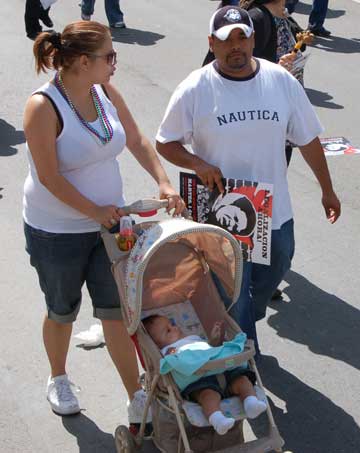
Latinos move toward Dems

family.jpg
According to the Pew Hispanic Center, Republicans are losing whatever success Texan George W. once had drawing Latinos to his party.

After spending the first part of this decade loosening their historic ties to the Democratic Party, Hispanic voters have reversed course in the past year, a new nationwide survey of Latinos by the Pew Hispanic Center has found.

Some 57 percent of Hispanic registered voters now call themselves Democrats or say they lean to the Democratic Party, while just 23 percent align with the Republican Party – meaning there is now a 34 percentage point gap in partisan affiliation among Latinos. In July, 2006, the same gap was just 21 percentage points – whereas back in 1999, it had been 33 percentage points.

Well duh -- when Republican candidates use televised debates to call your uncle or your child or your brother bad names, you probably won't cozy up to them. Democrats may not be perfect, but their leaders are usually not obviously vicious.

What our Republican nativists don't understand is that hardly any family in our low-wage, newcomer work force is all on the above-board citizenship track or entirely undocumented. The reality is usually a mix of people in a mix of statuses -- and nobody takes kindly to having their relatives dissed by a bunch of dumb old white men who never did a lick of dirty work in their lives. And more and more Latinos can vote, so it is getting to be pay back time for Republican racists.

A choice we make for others


One of my neighbors, asleep.

Way at the end of yet another column painting Mayor Newsom as God's gift to the homeless and the people who actually work with people on the streets -- or are the people on the streets -- as pessimistic losers, San Francisco Chronicle columnist CV Nevius reports this exchange:

As I left the Homeless Connect event, I encountered a young man squatting on the sidewalk. I asked him if he'd gone inside. He had, he said, and it was very valuable, lots of services and referrals. He thought it was great.

And then he had a question for me.

"Spare change?"

That just about encapsulates homeless situation in San Francisco. The homeless will get housed when they get two things we as a society cannot or will not provide them:
  • Money.
  • Housing they can afford.
Yeah, some people on the streets are nuts or drugged up. Wouldn't you be if you had to be studied and talked about and patronized and serviced by a very comfortable bureaucracy -- but not housed? If they weren't crazy or addicted when they started, homeless people can hardly be blamed deteriorating until they fit our stereotypes.

None of us can take care of them individually, but if this were a country that cared, we certainly are wealthy enough to provide for them collectively. Guess we don't want to.

Tuesday, December 04, 2007

Much ado about not much:
California's convenience voters


Chris Phan photo.

Last week just about every newspaper in the state and some online media reported on a Field Research profile of convenience voters in California -- that is, a study of folks long designated "permanent absentees" who will soon be called "vote-by-mail" voters in accordance with a new state law. Guess what? These folks are not just like to the other people who go to the polls.

While Democrats outnumber Republicans 42 percent to 34 percent among all California voters, the GOP holds a 41 percent to 40 percent edge with permanent mail voters.

While Bay Area counties have 21 percent of California's voters, they have 29 percent of permanent mail voters....[ Election officials in Los Angeles County, concerned that a flood of mailed-in ballots could overwhelm the system, have been reluctant to encourage people to sign up for permanent mail status.]

Nearly a third of the permanent mail voters are age 65 or older, far more than the 19 percent among all California voters. Three-quarters of the mail voters are non-Hispanic whites, compared with 66 percent overall.

Homeowners make up 75 percent of the permanent mail voters and 68 percent of the overall electorate. While women outnumber men 53 percent to 47 percent among all registered voters, the gap widens to 56 percent to 44 percent among permanent mail voters.

San Francisco Chronicle,
November 30, 2007

***

What does the typical absentee voter look like?

She's a white, well-to-do, educated woman who is older than 65 living in the Bay Area in a home that she owns.

Stockton Record,
November 30, 2007

No one who works in campaigns will be surprised by these findings -- for a political junkie's jaded reaction see this short item by Brian Leubitz.

So, does it matter that convenience voting attracts an electorate so skewed away from demographic pattern of the general voting public? Perhaps. Let's tease it out.

The state of Oregon chose to go to all mail balloting through an initiative passed in 1998. In Washington State, 34 of the state's 34 counties use vote-by-mail. They provide some experience to look at. On the positive side of the ledger, voters who vote by mail by and large say they like it. Once the kinks get worked out, voting by mail seems to be at the very least "fraud-resistant" -- it certainly leaves an auditable paper trail, unlike computer polling systems that reputable researchers fear are vulnerable to hacking. Mail voting is cheaper to run than polling place voting, although the Oregon version does still provide some physical drop off points.

On the other hand, political scientists are largely convinced that convenience voting does not increase turnout among unlikely or infrequent voters. (Research discussed here.) The Field study adds data supporting that conclusion -- those old white Republicans are already likely voters.

In his contribution to the frenzy of commentary last week, venerable Sacramento Bee columnist Dan Walters sought to remind his readers that expanding convenience voting may not work out entirely as they expect:

It used to be quite difficult in California for someone to vote via mail, rather than in person at the polls, but about 30 years ago, a Democratic Legislature and a Democratic governor decided to loosen up on what was called "absentee voting."

The Democrats believed that it, along with easier voter registration, would counteract Republicans' edge in voter turnout.

The maneuver backfired big time in 1982 when Republicans mounted a strong -- albeit somewhat stealthy -- drive to increase absentee voting among party loyalists and help their candidate for governor, George Deukmejian, in what shaped up as a close contest with Democrat Tom Bradley. ... Bradley won among Election Day voters, as exit polls accurately confirmed. ... As the mailed ballots were tallied, however, the tide began to turn. It soon became apparent that Deukmejian had won the governorship.

... going to all-mail elections... would alter political dynamics even more in ways -- as demonstrated a quarter-century ago -- that could not be easily foreseen.

He's not going to go out on a limb with a prediction about how vote by mail would play out -- but he's sharp enough to flag the question.

What irks me about this discussion is the tendency of progressives to assume that getting more people to vote by mail will somehow automatically benefit our causes. This is magical thinking of the same sort as San Francisco's embrace of rank choice voting. Too many of us get seduced by the happy idea: "change the mechanics and that will give us different [better] outcomes."

Last fall when the label for California convenience voting was changed from "permanent absentee voting" to "vote by mail", Steven J. Ybarra , of Hispanic Vista.com provided a sample of the kind of magical thinking that doesn't help.

I am beginning a campaign to change every Latino voter to VBM!

It is about political power. It is about ending the control of the media vampires. Now we need a real 58 county strategy in California now that every voter does really count!

California needs Ybarra's campaign, but we aren't going to get it through a mechanical fix. Bringing Latinos into the electorate will take the laborious person-to-person organizing that community groups and unions have done for decades. There is no magic fix.

The Field study actually demonstrates that voluntarily adopted convenience voting skews the electorate away from the people who form the progressive base: away from Democrats, the young, renters, inexperienced voters, non-whites. The state may eventually decide to conduct elections by mail. If we do, progressives need to think creatively about how to neutralize the present inclination in our constituencies to avoid this method of casting their ballots. If we don't work on this, we aren't going to be happy with the results.

Bully nips back


Michael Savage, like many bullies, can't take it when the people he kicks stand up and talk back. The Muslim civil rights organization CAIR has been encouraging the hate radio host's advertisers to pay attention to what's being said with their money. Quite a few don't like the racial and religious slurs they've been hearing and have canceled their sponsorships.

Now Savage is suing CAIR for publicizing recordings of his on-air attacks on the Quran and Muslims. Hey buddy -- the name for the thing you do is broadcasting. You say it; you are stuck with it. That's how broadcasting works.

CAIR responds more judiciously, calling Savage's law suit

"bizarre, sloppy and baseless."

"We expect to prevail based on the facts, the law and the Constitution," Amina Rubin said.

Associated Press.


Monday, December 03, 2007

Privatization's benefits


Citizenship ceremony, Los Angeles. Rick Friedman photo from the New York Times.

File this one under "strategic incompetence"* -- seemingly everyday corruption and maladministration that has, for our rulers, the happy by-product of impeding popular participation in elections and the legal system that protects employees.

Workers who help process millions of visa and citizenship applications for a federal immigration agency are getting pay reductions just as the agency is facing an enormous surge in those applications....

Immigration officials said the agency granted a contract to Stanley [Inc.], after competitive bidding last year, to manage mailroom and data entry work at the two centers, in an effort to speed handling of the vast paperwork of the applications. ...

Officials at the immigration agency said last week that they received 2.5 million applications for visas and for naturalization in July and August, more than double the applications in the same period last year. Many immigrants rushed to file applications before large fee increases took effect July 30, officials said. ...

[Employee Jeremy Murray] said he had worked at the Vermont center for more than six years sorting incoming applications, making $14.54 an hour. Starting Monday, he said, he will make $12.84 an hour and will no longer be able to work overtime. He will lose as much as $400 a month. ...

Mr. Murray said some of the guidelines for procedures he performed were 40 pages long. If applications are misfiled, he said, errors can take months or longer to fix.

New York Times,
December 2, 2007

No reason why clerical drones should be paid a living wage. And if (mostly) brown people can't get through the citizenship maze, they will remain in legal limbo with second class rights -- and they won't be voting. That's okay, they mostly become Democrats anyway.

*I first heard the term "strategic incompetence" from Salvadoran activists who were dealing with the failure of their right wing authorities to register large parts of the population prior to a general election.

Sunday, December 02, 2007

"War fatigue" and the peace movement


The term "war fatigue" comes from a superb Nation magazine article, quoted repeatedly in this post, by Ari Berman about the Iowa primary campaigns. The accompanying photos come from recent discussion sessions hosted by War Times/Tiempo de Guerras about why the antiwar movement seems stalled.


Numerous polls agree that a majority in the U.S. want the troops home from Iraq. And even though U.S. casualties are down the last couple of months and many believe the current anti-insurgency campaign is "working," the same majority wants the troops out as felt that way in February 2007 when the war was very obviously a complete disaster. (Pew Center poll.) So why hasn't the antiwar movement gathered enough force to end the war or even produce a serious antiwar candidate in the Democratic primaries? (Sorry, that perennial loser Dennis Kucinich doesn't count.)

"They marched, wrote letters, elected a Democratic Congress and now Congress is funding the war -- and Hillary is giving the President the authority to go into Iran!" says Nicholas Johnson, a University of Iowa law professor and former FCC commissioner who leans toward Richardson. "What's a voter to do?"

I'm not going to claim I have answers, but here are some thoughts, many arising from our recent War Times forums.

Iraq is very far away; its language, religion, and culture are very remote from most of us. It was interesting to realize that we held a couple of fairly well-attended, thoughtful, public meetings in the very diverse San Francisco Bay Area and there was no one that I was aware of who attended either who came from Iraq or from anywhere in the current arc of imperial wars from Egypt through Afghanistan. There were not even any U.S.-origin Muslims eager to talk about ending Bush's "crusade." The closest any of us in the rooms had been to Iraq (again as far as I know) was to Jordan and Syria.

This would not have been the case during the 1980s when a very similar set of people mobilized to oppose U.S. interventions in Nicaragua and El Salvador. Central Americans lived in U.S. cities; many North Americans had seen the effects of U.S. domination themselves.

It has been very hard for antiwar activists to focus public attention on the human devastation caused by the U.S. war. Because that reality is so physically and intellectually distant (except among the vets who have become a vibrant antiwar sector), we end up discussing the machinations of our rulers when we need to keep Iraqi suffering at the front of our consciousness.

If we understood more viscerally what a sophisticated civilization the U.S. is crashing around in, we might be able to cut off sterile debates about what we think ought to happen in Iraq when the U.S. leaves, realizing that the Iraqis will work out their solutions on their own terms. Our work is in this country.


A Wellstone Democratic Renewal Club activist speaks up.

The war is playing out in domestic U.S. politics in ways that are hard for the antiwar movement to influence. Old timers from era of the Vietnam war tend not to trust the Democratic party as the vehicle for antiwar agitation -- Vietnam was LBJ's war for far too long. As a consequence of that imperial defeat, the Democratic party and many individual Democrats have become more cautious about imperial adventures since. And as Ari Berman explains

Like Hurricane Katrina, the war is a metaphor for all that has gone wrong under George W. Bush.

Because the combination of Bush's tainted 2000 victory with 9/11 gave a partisan Republican executive almost unchallenged power, Iraq has been "a Republican war." In fact, a majority of Democratic Congresscritters voted against the authorizing legislation in 2002. So the war is generally understood in partisan terms and in the two-party system, people jump to the conclusion that the counter to a Republican war should be a revived Democratic party.

Many of the most practical efforts to counter the anti-democratic, crony capitalist project of which the Iraq war is a part have gone into critiquing and propping up a better Democratic opposition. The Dean campaign in 2004, vibrant Democratic online activism, and extensive efforts to create new messaging and new media have mostly operated within a Democratic party politics frame, alongside, but not particularly in sync with, antiwar agitation. If the Republicans were the problem, Democrats had to be the solution.

If, as seems possible and even likely, Democrats elect a President and more Congress members in 2008 and the war still drags on, the antiwar movement needs to help people understand the new configuration of forces. Elites within the Democratic party will not easily behave as much differently from the Bush regime as we would like. They all share the assumption of the innocent rightness of U.S. world power.

But we may be more able to exert some influence on Democrats in power. The project for the antiwar movement will then be to work more closely with progressive Democratic activists who are likely to find themselves pushed to the margins of the party they've been building. These folks will face a choice (actually they already do) between limited access to the real powers and their principles. Many will share in the antiwar effort to force the party in power to cut U.S. losses in Iraq. After all, many got into Democratic activism for that purpose. It is very important that antiwar activists understand that this "they" is part of "us". The antiwar movement will only benefit from closer cooperation with the practical organizing sophistication of a lot of people who have been very focused for the last few years on reinventing the Democratic party. And if the antiwar movement is serious about democracy (small "d") we will have to find a way to use the Democratic party put our principles into action.


Just because the dominant crony capitalism of Wall Street operates on a time horizon that don't reach beyond six months, that doesn't mean that the peace movement has to. In fact, we're going to have to understand our work for peace as a long-term struggle. The U.S. lurches into imperial wars to maintain its hegemony; to secure resources for an economy of unsustainable though, unequally distributed, wealth; and ultimately because the regime in power can get away with it. Though in historic terms we live in a rather young empire, this one has clearly reached its zenith. The struggle for peace is a struggle to manage imperial decline with the minimum pain to folks in the rest of the world and at home. It is not going to be quick or easy.

Getting the U.S. out of Iraq may take years -- restraining imperial ambitions will take even longer. But there aren't any alternatives that point to a democratic society or a sustainable planet. We're in for a long haul.

"Sometimes I think a lot of people forget about the war," [an Iowa activist] admits. "But then they see a pin, or a sticker, or a sign, and it brings it all back."

We will simply have to keep bringing it back until we get the U.S. out of Iraq and out of the empire business.

Friday, November 30, 2007

War is not healthy for children and other living beings


Photo of Iraqi children at play by way of the Situationist.

Hussein, with McClatchy News, writes from Baghdad:

Yesterday noon, an American squad from the United State Army (about ten to twelve) broke in Al-Mansour preparatory school for one reason or another. We don't have the right to ask them why they came to the school. The soldiers spread in different spots of the school walking towards the back yard which is used as a soccer field. Most of the students were in their classes when the squad came, but still there were many students in the yard who were terrified to see the American soldiers with their guns. One of the students was upset to see the soldiers and he threw a stone and hit one of them. Three soldiers surrounded him kicking him with their boots for some minutes on different parts of his body.

Later, a teacher of English said that the captain of the squad told him "next time if students throw stones, we will use our machine guns not the boots". I really hated myself hearing that news as I am a teacher myself. What shall I do if I were there? ... What excuses will I give for that incident? My brain stops thinking from now on.

Some U.S. commenters on the blog are indignant that the actions of U.S. soldiers should be presented in such a light -- others express sympathy with the rational, if misplaced, fear the soldiers must have been feeling.

Last spring Washington Post reporter Sudarsan Raghavan investigated the question: what is this war doing to Iraq's children?

... Abdul Muhsin started to focus on children only last year. Like many of the estimated 60 psychiatrists who remain in Iraq, he treated only adults before the invasion. Back then, he said, children with psychological problems were a rarity.

Inside his bare office at Ibn Rushed Psychiatric Hospital, where armed guards frisk patients at the entrance, he flipped through a thick ledger of patients. In the past six months, he has treated 280 children and teenagers for psychological problems, most ranging in age from 6 to 16. In his private clinic, he has seen more than 650 patients in the past year.

In a World Health Organization survey of 600 children ages 3 to 10 in Baghdad last year, 47 percent said they had been exposed to a major traumatic event over the past two years. Of this group, 14 percent showed symptoms of post-traumatic stress disorder. In a second study of 1,090 adolescents in the northern city of Mosul, 30 percent showed symptoms of the disorder....

Many of the children Abdul Muhsin treats have witnessed killings. They have anxiety problems and suffer from depression. Some have recurring nightmares and wet their beds. Others have problems learning in school. ...

He and other child specialists say as many as 80 percent of traumatized children are never treated because of the stigma attached to such ailments.

"Our society refuses to go to psychiatrists," said Abdul Sattar Sahib, a pediatrician at Sadr General Hospital in Sadr City.

The Iraqi doctors fear that the violence the children have experienced will pervade Iraqi society for decades to come.

We know already that U.S. soldiers bring the mental agony of war home with them.

Veterans aged 20 through 24 ... had the highest suicide rate among all veterans, estimated between two and four times higher than civilians the same age. (The suicide rate for non-veterans is 8.3 per 100,000, while the rate for veterans was found to be between 22.9 and 31.9 per 100,000.)

CBS News,
November 13, 2007


Wondering ...


This woman was methodically circling the Polo Fields in Golden Gate Park today, checking each rubbish bin for recyclable bottles that can be exchanged for tiny amounts of cash.

Was I seeing grinding poverty? Or was I seeing a person who makes a valued contribution to her family's welfare? Someone whose activity is a product of desperate need? Or a worker who pulls her weight to the best of her ability?

I have no way of knowing.

Thursday, November 29, 2007

Christmas novelty

In honor of the International Day of Solidarity with the Palestinian People, it seems appropriate to mention to this innovative Christmas gift item. The olive wood nativity scene, complete with separation wall, is available from the Amos Trust. They explain

A nativity set with a difference - this year the wise men won't get to the stable. ...poignant, ironic and made in Bethlehem.

The Amos Trust is a U.K.-based organization that describes itself as working for "justice and hope for the forgotten."

Why not to vote for Obama


They can't attack him as unqualified to be President because he's black. That wouldn't fly in contemporary U.S. political discourse. So they make him deny he's a Muslim.

Tuesday, November 27, 2007

A speak out against commercial hate


Members of the "Hate Hurts America" interfaith coalition held a press conference this morning outside Talk Radio KNEW 910. KNEW is the San Francisco home of hate radio host Michael Savage. Not surprisingly KNEW is an outlet of Clear Channel, the megaconglomerate that claims 110 million listeners to its radio stations.


Savage's program claims 8 million listeners. He has quite a history of vicious statements about Muslims. For example Media Matters reports this:

"[W]hen I see [Muslim extremists] hanging from lampposts, with their guts hanging out, then I'll believe that there's a difference between radical Islam and the rest of Islam over there. But if I don't see that -- if I don't see the massive uprising against them, I can only assume that they're the shock troops of all of Islam in the Middle East."

He doesn't much like lesbians, Democrats or Hillary Clinton either. Recently he took off on the Quran:

"What kind of religion is this? What kind of world are you living in when you let them in here with that throwback document in their hand, which is a book of hate. Don't tell me I need reeducation. They need deportation. I don't need reeducation. Deportation, not reeducation. ..."

That is, he's a jerk who peddles prejudice and fear for profit.

Hate Hurts America points out to advertisers that they may not want to be complicit in the hate business. Some big companies, including Office Max, JC Penney and Autozone, have responded, dropping ads on Savage's program.

Today's press conference organized by the Muslin civil rights organization CAIR, promoted an interfaith petition asking other advertisers to get out of hate mongering. Speakers included lots of San Francisco's activists, including representatives of the Lt. Watada Support Committee, the American Friends Service Committee and Gerardo Sandoval representing the city supervisors.


But by far the most interesting speaker was Rabbi Harry Manhoff of the San Francisco Board of Rabbis who took as his text the famous statement of the German pastor Martin Niemoller -- "They came for the Communists, and I didn't object - For I wasn't a Communist; ... They came for the Jews, and I didn't object - For I wasn't a Jew; Then they came for me - And there was no one left to object." He explained [my paraphrase] that he had begun to worry -- though he had preached against the Bush Administration's Iraq invasion and suspension of habeas corpus within his own congregation, he hadn't really stepped out into the public eye with his criticisms. He was afraid taking too strong a presence would be used to criticize "my beloved Israel." But the kind of venom encouraged by Savage had convinced him he must speak out and reach across expected chasms.

In the words of the petition:

Hate-filled words can and do lead to violent actions.


Monday, November 26, 2007

Big Coal -- and us


Georgia Power’s Plant Scherer, near Macon, is the largest single point source of carbon dioxide emissions in the United States. Photo by Jeff Goodell. Natural History Magazine.

Do you suspect you ought to know more about how the United States contributes to the planet overheating? Reporter Jeff Goodell offers a heaping serving of understandable, if not palatable, explanation in Big Coal: The Dirty Secret Behind America's Energy Future.

The author is a magazine feature writer and it shows. In the first sections of the book he puts a human face on the people who dig coal and who live with mining's byproducts, the people who transport the black rock, and the industry that profits from coal extraction and burning.

But this book is about more than explicating the problem -- and yes, our addiction to the energy provided by coal is a big problem. Goodell wrestles with a fundamental question: can a global capitalist society decide that the common good must prevail over the very engines of its wealth: individual greed and short-term profits?

On one level, he's confident it can be done. He proclaims:

We don't need to destroy our world, just reinvent it.

He finds hope for reinvention in what to U.S. sensibilities is an unlikely place -- among polluted China's rural developers. In that society, where living standards are on the rise despite labor and ecological horrors, he finds a "can do" spirit which encourages hope. (This tracks with the polling reported here.) And he's a hopeful guy because of his own background; having grown up in Northern California during the energy crunch and "malaise" of the late 1970s, he saw the rise of Silicon Valley as proof that the new futures could be imagined just when progress seemed to be hitting a wall.

But for all that, Big Coal emphasizes the entrenched power that coal interests and resource extraction barons wield to constrain our choices. He does not underestimate the obstacles to meaningful change, coming to this realization:

We hear it all the time: if we pass laws that limit CO2 emissions, the price of electricity will skyrocket and the economy will collapse! If we clean up dirty coal plants, the price of electricity will skyrocket and the economy will collapse! ...This is nothing new in America. ... the writer Ian Frazier observed, "Lincoln's great moment was saying 'I don't care if it is destructive. Slavery is wrong. 'You start with, 'Is it right or wrong?' Then you act on that judgment. You don't say, 'I'm not going to say it's wrong because it would be too impractical to undo.'"

Burning coal may not be the moral equivalent of slavery, but it is a moral question nevertheless.

One could quibble about whether Lincoln really treated slavery as the unequivocal moral evil we now so easily declare it to be. But it is worth noting that to imagine a solution to the climate crisis we face, Goodell has to shift the terrain of the discussion to a moral realm that the economic system in which we live explicitly and intentionally excludes from our social and scientific understanding of the world.

James Surowiecki who writes "The Financial Page" column in the New Yorker, similarly turned to a non-economic explanation of human behavior recently when writing about the writers' strike. He seems bemused:

Readiness to pay a price in order to enforce an idea of what is right is part of what keeps sides [in the labor dispute] from settling.... in labor relations, the bottom line isn't always the bottom line.

It takes a considerable mental shift to get that statement out of a conventional economist.

Goodell is almost certainly right that "goods" that can't be entirely calculated within capitalist economics will have to be the end of measures to preserve a livable planet. Tinkering at the edges of current practices with "cap and trade" emissions control markets isn't going to cut it. Big Coal loses if the planet wins. Can we, like the emerging Chinese, even imagine that we could demand and enforce an end to current destructive energy addictions?
Are we able to make the fight to get there?

Seeing is believing


Fires of hell? No. A factory in India where New York City manhole covers are made on contract for Consolidated Edison.

We don't usually get to see the labor on which our well-being rests. Kudos to J. Adam Huggins for this picture from today's New York Times.

Sunday, November 25, 2007

Candidacies


Yesterday I met with a prospective local candidate. He's a good guy and would be wonderful to have in government. I was encouraging and even donated to his campaign. And I said to him what I say to all of them: to win office, you have to run with all your being -- and you have to understand that the qualities that make a good candidate are completely different than the qualities that make for a good officeholder.

I've previously described the quality candidates need as benign megalomania.

This morning I see that Mark Halperin. a senior political analyst for Time magazine and former ABC News Political Director, is saying something similar about our aspiring presidents:

Our two most recent presidents, both of whom I covered while they were governors seeking the White House. Bill Clinton and George W. Bush are wildly talented politicians. Both claimed two presidential victories, in all four cases arguably as underdogs. Both could skillfully serve as the chief strategist for a presidential campaign.

But their success came not because they convinced the news media (and much of the public) that they would be the best president, but because they dominated the campaign narrative that portrayed them as the best candidate in a world-class political competition. In the end, both men were better presidential candidates than they were presidents.

Halperin is criticizing the news media, his own profession, himself, for practicing the horserace journalism that values political dexterity over policy substance. He might as well criticize our capitalist culture that has assured most of us that candidates are just marketable commodities and that holds campaigns to no higher ethical standards than it holds prescription drug commercials.

...These side effects may kill you, but isn't the background scenery lovely ... soft music fades...

Saturday, November 24, 2007

Time to unsubscribe


Warning: This film shows a performance artist undergoing, for real, interrogation techniques permitted in the CIA handbook.

You won't like it.

You are being asked to sign on for Amnesty International UK's "unsubscribe" campaign:

We did not sign up. We do not approve. We unsubscribe.

Unite against terrorism. Unite against human rights abuses in the 'war on terror'.

Go ahead; do it. It is not a lot, but it is something.