Showing posts with label curiousities. Show all posts

Sunday, March 10, 2013

Out of place ... or not?

The New Yorker is pretty much the only (non-entertainment) print magazine I get around to looking at. Sorry, Progressive; sorry, Nation … I let you lapse. Web offerings suffice to keep me informed, I hope. But I can't yet do without The New Yorker.

So, perusing the current profile article on Justice Ginsberg, I was stunned to see this right there alongside perfume ads, TV show promos, and Microsoft:
Now that takes me back. Insurrectionary images for sale at a New York gallery auction? Evidently so.

A little internet research reveals that the artist, Emory Douglas, is still around and still kicking. In fact, unknowingly, I recently photographed one of his contemporary agitprop posters on the wall at a community meeting:

Yes -- the SF8 had their charges dismissed.

In 2009, Douglas was interviewed at length about joining the Black Panther Party, creating its images, and the Black liberation movement's legacy. This YouTube is a fascinating account of people that the government tried hard to exterminate in the late '60s -- well worth 10 minutes of your time.
I sure hope Douglas is getting the benefit of that swank New York art auction. He apparently also sells images through this website.

Saturday, December 29, 2012

Saturday scenes and scenery: behind the fence

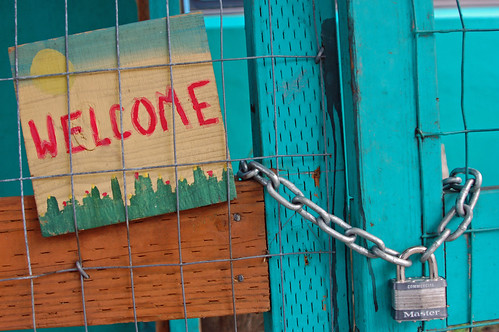
welcome padlocked copy.jpg
Sometimes it's (sort of) obvious that the fence is there you keep you out ...

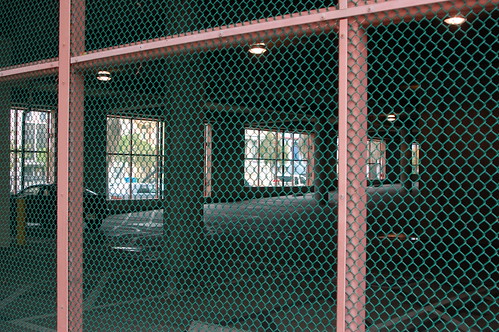
behind the pink and green fence copy 2.JPG
But it can be interesting to look through a fence.

!secret garden copy.jpg
Not much to see through this fence ... unless you step back 10 feet from your screen. Go ahead ... try it.

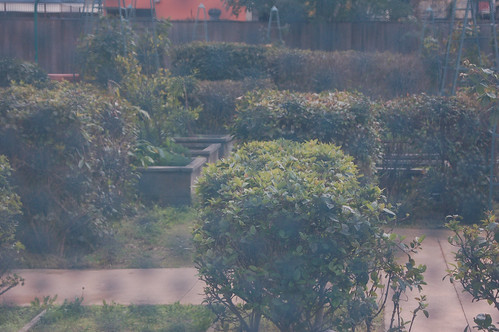
secret garden revealed copy.jpg
Sure I can photographed the garden, but isn't the previous image more interesting?

Friday, March 09, 2012

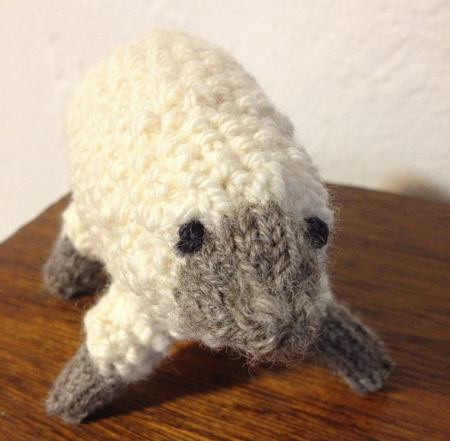
Friday critter blogging: meet Nuzzle

When you live with a spinning and knitting fanatic, creatures like this may turn up in your home.
nuzzle.jpg
I'm told she is named "Nuzzle."

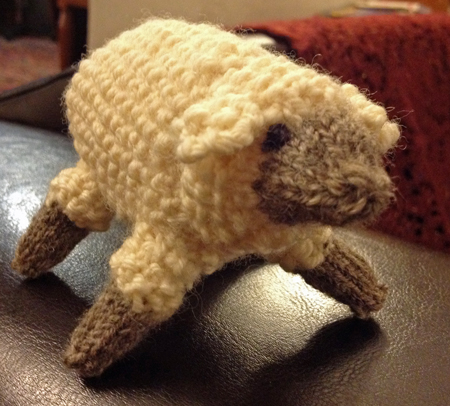
nuzzle2.jpg
I think she looks better after acquiring ears, don't you?

Saturday, January 21, 2012

Bathrooms are where our evolutionary ancestry shows

This clip starts slowly, but it is worth watching.


It's a big privilege if you never have to think about the bathroom.

I'm nearly 65 years old -- and white -- and it still happens to me.

We seem driven to instantly categorize the gender of people we meet. I guess that once had a sort of evolutionary value, having the question "can I make babies with this one?" at the top of our consciousness. And for women, it also had (sometimes has) safety implications -- unknown males are more likely to be dangerous than other females.

Please, if you are a woman and perceive a person whose gender seems in doubt in a women's bathroom, look again before you shriek. You might simply be seeing a person whose way of presenting herself is different from your expectations.

Saturday, January 14, 2012

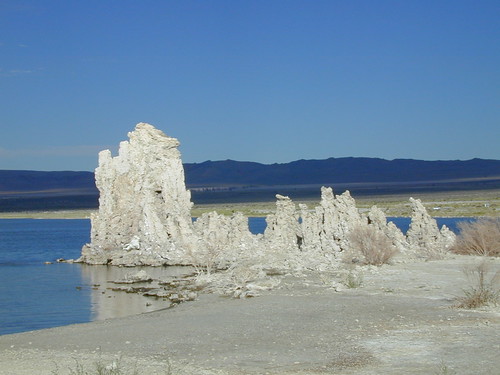
Saturday scenes and scenery: Mono Lake park saved

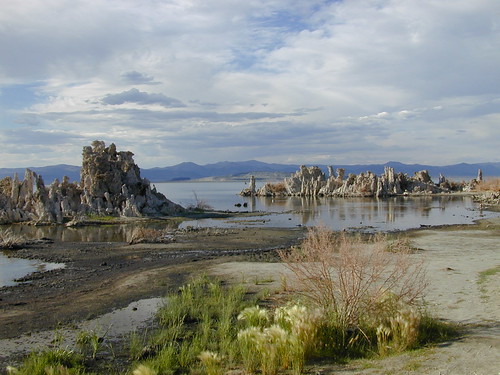
tufas and sky2!
Sometimes good things happen. I've written previously about the folly and shame of chipping away at California's tax shortfall by closing state parks.

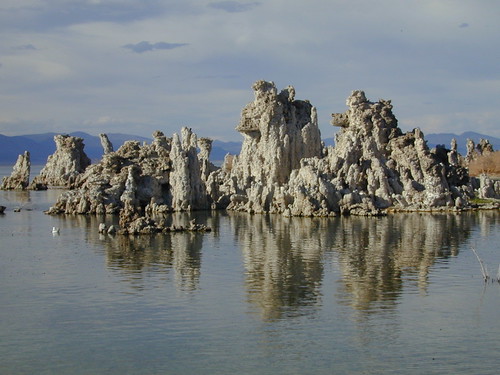
tufa reflctions
In December, the Mono Lake Tufa State Nature Reserve received a reprieve. Mono Lake is a vast volcanic basin east of the Sierras whose alkaline waters "grow" the strange calcium-carbonate castles named "tufas."

tufa in dusk!
Seeing them makes you wonder if you've landed on the moon. Good for California and the lake's local champions for stopping the drive to close the park and let this unique environment decay.

Thursday, January 05, 2012

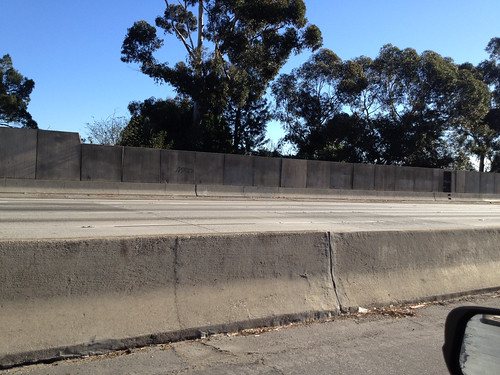
L A is a great big freeway ...

wide view.jpg

But at 9:30 am today, an accident had blocked the north bound lanes of the 5 and slowed the south bound lanes to a crawl.

narrow view.jpg
The result was novel emptiness.

Wednesday, December 28, 2011

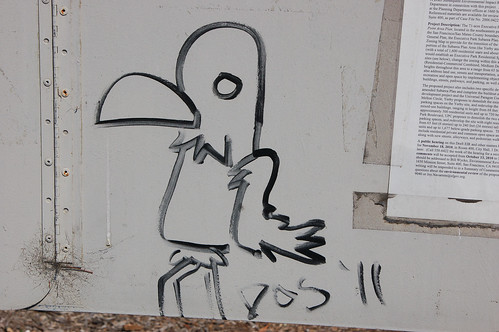
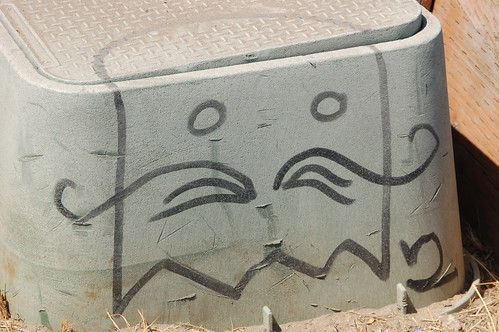
Line drawings in the 'hood

strutting line bird.jpg
He struts about, taking the space.

line man with mustache.jpg
He pokes his head up to take a look around.

Who is he? I don't know, but the city is more interesting for the adornment.

Monday, August 29, 2011

A puzzle

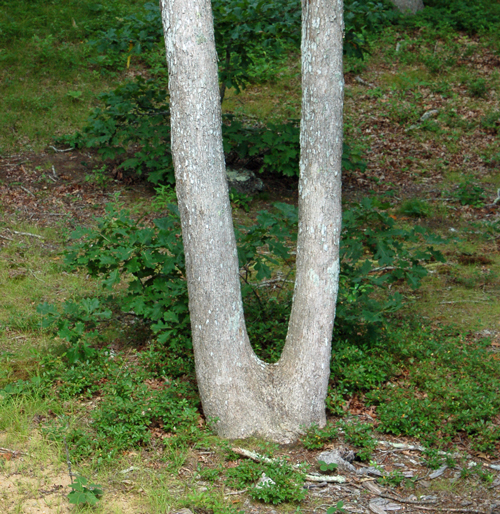
split-tree-web.jpg
Have you ever let your mind wander, wondering what happened to a tree early in its life, with the result that it grew like this?

I have.

Tuesday, July 19, 2011

Is the internet changing your brain?


The shelves are multiplying in the lobby at my branch library. First there was a small bookcase in one corner. Then the shelves were extended along the wall. Now, rolling carts have occupied much of the floor space.

Why? Because the way many of us use the library has changed. Instead of consulting a catalog at the branch, whether in wooden drawers or at a computer, we select our books from the online catalog at home and put in an automated request. If the book is anywhere in the library system, they get it and deliver it to the local branch. The person making a request gets an email and the book goes on the lobby shelves awaiting pickup. You have 10 days to go get it.

"We can barely find enough space for all the requests," says the librarian at the desk

Aside from young people studying after school and homeless/poor people using the computers, the great hall where the permanent collection lives is no longer the central focus of the building. I haven't been up there in years. I haven't browsed the stacks in years.

Does this new way of "doing library" change my interaction with books? I don't know; I do know I like the convenience.
***
Dr. Betsy Sparrow of Columbia University says that the internet is changing how we use our capacity to remember things. Google has won. We count on it and adjust how we interact with information accordingly.

Sparrow devised experiments to test whether the expectation of internet access changed what we remembered. It did.

The subjects were significantly more likely to remember information if they thought they would not be able to find it later. “Participants did not make the effort to remember when they thought they could later look up the trivia statement they had read,” the authors write.

A second experiment was aimed at determining whether computer accessibility affects precisely what we remember. “If asked the question whether there are any countries with only one color in their flag, for example,” the researchers wrote, “do we think about flags — or immediately think to go online to find out?”

In [another] case, participants were asked to remember both the trivia statement itself and which of five computer folders it was saved in. The researchers were surprised to find that people seemed better able to recall the folder.

“That kind of blew my mind,” Dr. Sparrow said in an interview.

She concluded:

...“Human memory,” she said, “is adapting to new communications technology.”

I have no doubt she's right. Is this a good thing or a bad thing? Obviously many of us would be in deep doo-doo if we tried to perform some data-intensive task without internet access. But does this adaptation change or impair our experience of things that require something other than the internet -- such as trail running or listening to a familiar piece of music? The Tubes may make these pleasure easier to access (through route-finding or downloading), but the pleasure still resides elsewhere. The same goes for pains -- suppose I sprain my ankle on that trail. I still need to stagger home and in time do my physical therapy exercises, even if I can look up the condition online.

There are still physical limits to the alterations our technology can lead us into -- but for how long? I do wonder.

Saturday, July 09, 2011

Saturday scenes and scenery: Oregon road trip curiosities

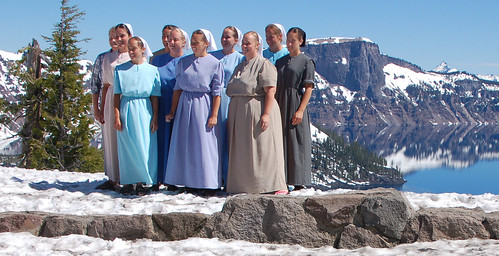
1amish women at crater lake.jpg
When we arrived at Crater Lake on one of the most beautiful days I've ever seen, this group of young Amish women was getting a picture taken. They seemed to be on a kind of wanderjahr, a van trip around the country after which they'd presumably be better able to make the decision whether to return to their community as adult members. They were clearly having a wonderful time. It was a pleasure to be near them.

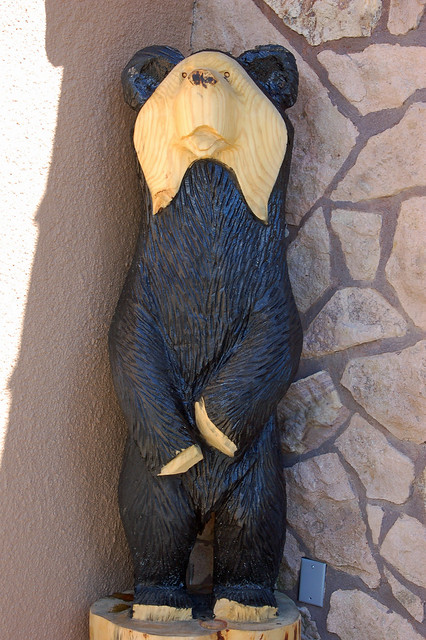
2modest bear at Black Bear Diner.jpg
This very modest bear is a representative specimen of the decor at a Black Bear Diner, a handy small chain restaurant in that part of the world, a step up from Denny's.

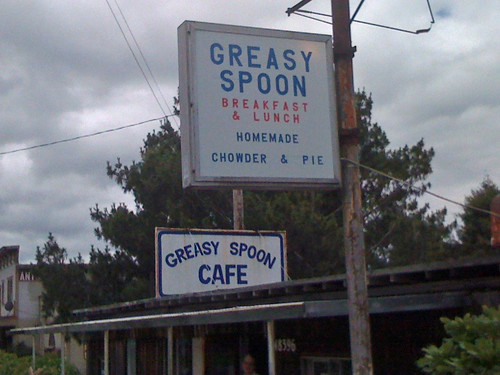
4greasy spoon in langlois, or.jpg
This dive in coastal Langlois is definitely one of a kind. We ate breakfast there and appreciated the simple, no-nonsense food.

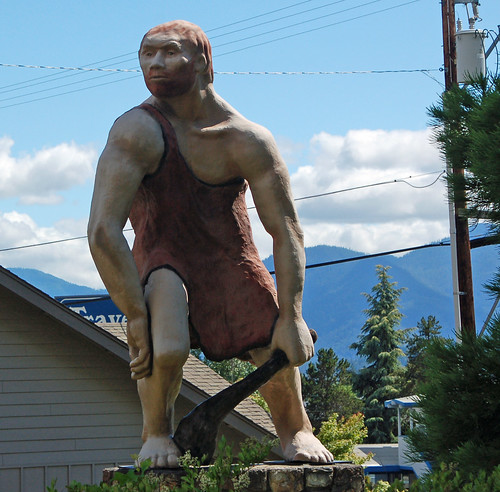
3grants pass caveman.jpg
This ten-foot high gentleman dominates the north entrance to the town of Grants Pass. He turns out to be the totem of a city booster club. A sign explains:

The Cavemen, dressed in animal skins, wearing horsehair wigs, buck teeth and "big horns" run rampant in parades and gatherings of the public ... Their main purpose is to publicize Grants Pass ...

Whatever. We enjoyed the road; you never know what you'll come upon next.

Sunday, June 12, 2011

Warning

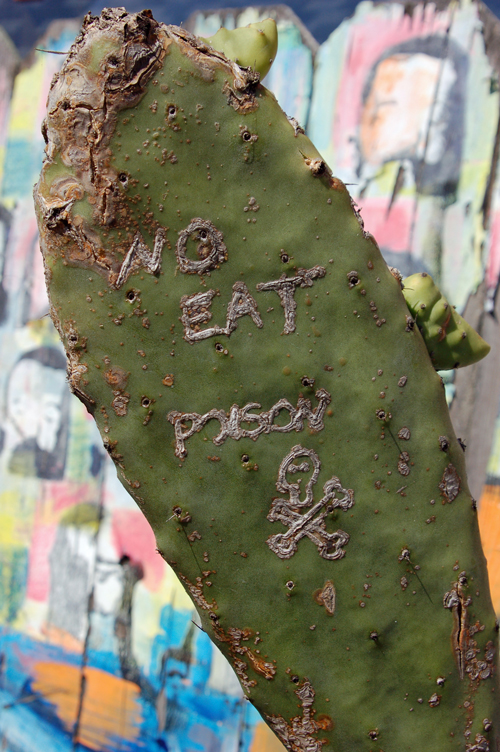
no-eat-poison.jpg
I wouldn't think of it. You don't exactly look appetizing.

Saturday, May 28, 2011

View out my window

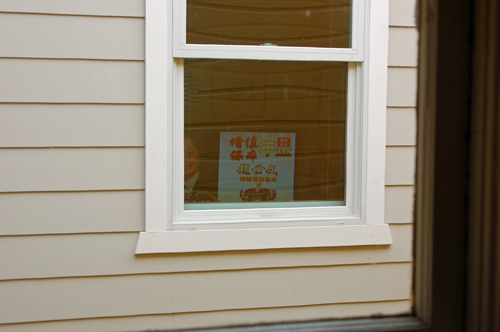
neighbors'-new-TV.jpg
The neighbors have a new TV. A LARGE TV.

I wonder, who will get a curtain first? Not us, I don't think. Maybe no one.

Saturday, May 21, 2011

Still here, so far

May-21-Day-of-Judgment.jpg

Has judgment been postponed? Or are we living it?

Monday, May 16, 2011

Department of Discrimination Defense is on the move!

This might just be the dumbest ad I've ever seen.


If you live in New York State, contact Marriage Equality New York to learn how you can help turn back the discrimination offensive.

H/t Susan Russell.

Monday, March 28, 2011

Isolation correlations


I picked up this interesting graphic from Paul Krugman who picked it up from Richard Florida. It certainly confirms most of my prejudices: states with lower numbers of people who are equipped to venture out of the United States do run to Republicanism and other variants of Know-Nothingism. They also, mostly, have smaller proportions of in-migrants, immigrants.

The only slight surprises to me on the map are New Mexico and Michigan. Border states are places, nowadays, where we NEED passports. Neither of these are places where the adjacent country seems truly in the category of "foreign."

There was a time when I didn't have a passport. In those days, you didn't need one to go to Canada or Mexico and I did. These days, we think borders are VERY important. Odd, since information from and about other places, including visual information, is so much more accessible than in that earlier time.

It's a big world and I'm glad to have traveled a little of it.

Sunday, November 14, 2010

The web as nursery for naivete ...

Did you know that when you use Google to search the net, you get results based on that engine's guess at what you want to see, taking off from your past internet activity? Last year, Gizmodo explained this "feature."

The next time you Google something, if the search results seem a little too good, a little too personal, it's because they are. While Google's always delivered customized search results to people logged into their Google account -- that is, search results tailored to you, based on your web history (yes, even outside of Google...), past searches and previous results you've clicked on -- it's now going to be doing that for everybody.

Google does offer a page explaining how to disable their customization, but naturally they make it cumbersome since the practice maximizes the effectiveness and price of their ads.

While the reality that numerous commercial and probably other entities track our activity on the net has awful implications for our privacy, I get almost equally concerned that the net's ability to give us what we want locks us away in little information niches of our own making. Google searches aren't, easily anyway, going to lead us to sites and people that challenge our prejudices.

One small example -- I'm not interested in getting my sexual kicks from the web, so I NEVER see anything that suggests that the web is largest pornography mart in the world. But it is.

More seriously, as I range about the net, I also very seldom see the festering swamps of hate and bigotry that many of my fellow citizens inhabit. And consequently, I'm inadequately aware of much that is going on around me.

With that in mind, I share this exchange that I ran across on a Yahoo forum by chance the other day.


I admit to being shocked at the casual smugness of the racism, though I shouldn't be. It doesn't do us any good not to know.

Sunday, November 07, 2010

Falling back


Today we dutifully "fell back" an hour with the end of Daylight Saving Time -- and I noticed that a change had crept up on me. We no longer fall back by resetting clocks -- the Mac, the iPhone, and my watch all do it themselves, without my intervention. My goodness, those chips are getting smart (though, curiously, the iPhone and the computer are 2 minutes apart ... oh well.)

I probably want to remember to reset the microwave. But essentially, switching times is now something our appliances take care of without our intervention.

Saturday, September 25, 2010

Saturday scenes and scenery:
Orange Alley murals, part two

2old-wooden-cross.jpg
Last week I highlighted the murals between 25th and 26th Streets. But there's more if you wander on down toward 24th Street -- it's just in a different vein.

graffiti-jesus.jpg
Bethel Christian Church, a non-denominational megachurch incongruously plopped in the heart of the Mission, apparently let its youth group loose on its rear walls. Though I'm sure many of those who worship there are perfectly pleasant people, I have trouble warming to a church whose website lists professional homophobe James Dobson and his Family Resource Council as resources.

following-the-star.jpg
I'm afraid I just don't share this aesthetic.

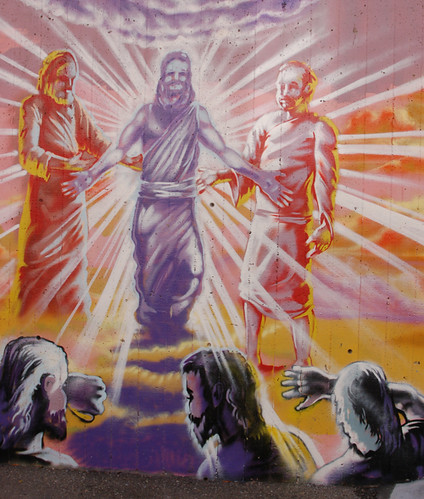
transfiguration.jpg
I assume this is a rendering of the Biblical account of the "Transfiguration" -- a revelatory moment when some of Jesus' followers saw his face shine with the glory of God and figures of older prophets appeared alongside of him.

Though long celebrated in Eastern Christianity,Western (Roman Catholic) Christianity took up annual observances of this story on August 6 only about 500 years ago.

Some historical themes recur. The catalyst for the adoption of the western Transfiguration feast was apparently the victory of Catholic Hungary over Muslim Ottomans in 1456. Fear of Muslim invaders is part of the DNA of much of Europe. It's a new development, and an unhappy one, in this country.

Tuesday, September 07, 2010

Sociopathic individuals and societies that favor sociopathy

Probably I would not have picked up The Sociopath Next Door by Martha Stout if I hadn't just read about the meaning-free massacre at Columbine. How do people who can do horrible things experience the world? Stout's book tries to tell us.

Her subtitle is "the ruthless versus the rest of us." Her point is that some people are irretrievable sociopaths -- people who simply live without the restraint of ever feeling guilt.

About one in twenty-five individuals are sociopathic, meaning, essentially, that they do not have a conscience. It is not that this group fails to grasp the difference between good and bad; it is that the distinction fails to limit their behavior. ... Without the slightest blip of guilt or remorse, one in twenty-five people can do anything at all. ...

What differentiates a sociopath who lives off the labors of others from one who occasionally robs convenience stores, or from one who is a contemporary robber baron -- or what makes the difference be;ween an ordinary bully and a sociopathic murderer -- is nothing more than social status, drive, intellect, blood lust, or simple opportunity. What distinguishes all of these people from the rest of us is an utterly empty hole in the psyche, where there should be the most evolved of all humanizing functions. ...

Stout is a practicing psychologist. She works with survivors of psychological trauma, often of abuse inflicted by the sociopathic among us whom they've had the misfortune to run up against. She wants to give those of us who do experience conscience, who are able to grasp and anticipate empathetically what our behavior might mean for others, some tools for identifying the dangerous sociopaths among us. The tip off, she says, is "the pity play." Sociopaths are people who have learned to get their way by encouraging others to make up sympathetic excuses for behavior for which they would otherwise be condemned and shunned.

For something like 96 percent of us, conscience is so fundamental that we seldom even think about it. ... And so, naturally, when someone makes a truly conscienceless choice, all we can produce are explanations that come nowhere near the truth: She forgot to give lunch money to her child. That person's coworker must have misplaced her briefcase. That person's spouse must have been impossible to live with. ...

When scientists use brain imaging to measure the reactions of people who psychiatrists diagnose as sociopaths to emotionally laden cues -- like the words "kill" or "kiss -- they have discovered that the subjects' brains simply don't respond. However, these people do have to get by in the world, so they learn to act.

Clinicians and researchers have remarked that where the higher emotions are concerned, sociopaths can "know the words but not the music." They must learn to appear emotional as you and I would learn a second language, which is to say, by observation, imitation, and practice. And just as you or I, with practice, might become fluent in another language, so an intelligent sociopath may become convincingly fluent in "conversational emotion."

But they never really "get" loving connections between people; they can't.

All societies seem to have some frequency of sociopathy, but Stout produces some evidence that some cultures embrace norms that reduce the disorder's expression. While she maintains that 4 in every 100 of us in the United States are conscience-less, in Japan and China, the prevalence seems closer to 1 in 100. She muses:

...how is it that some societies have a positive impact on incipient sociopaths, who are born with an inability to process interpersonal emotions in the usual way? I would like to suggest that the overriding belief systems of certain cultures encourage born sociopaths to compensate cognitively for what they are missing emotionally. In contrast with our extreme emphasis on individualism and personal control, certain cultures, many in East Asia, dwell theologically on the interrelatedness of all living things. Interestingly, this value is also the basis of conscience, which is an intervening sense of obligation rooted in a sense of connectedness. If an individual does not, or if neurologically he cannot, experience his connection to others in an emotional way, perhaps a culture that insists. on connectedness as a matter of belief can instill a strictly cognitive understanding of interpersonal obligation.

Stout wrote this book in the close aftermath of 9/11, a time when she saw a vengeful lust for violence, a willingness to mindlessly maim and torture "the enemy," enjoying a distressing level of approval among many of her fellow citizens. She is clearly wrestling with the problem not only of individuals born without human empathy but also with whether entire countries can lose empathy. She's more than a little freaked by what she sees and hears around her -- something I have no trouble empathizing with.

This is not a tightly argued book. It is full of descriptive vignettes that create a picture of what a sociopath is and of suggestive tidbits that tweak the imagination. It's not definitive science; it's very smart, thoughtful, intriguing journalism. I'd recommend it to anyone wanting to know what is wrong with some of us that enables us to do very bad things. And I'd take it all with many grains of salt.
***
My personal quibble here is with the assertion that 4 percent of people in the United States are sociopaths. For Stout, sociopathy is a binary condition: you either are one, or you are not. In my work life, I've known hundreds of people, actually probably thousands. And I can only identify perhaps one, or maybe two of them, who fully fit the description of a person acting without conscience.

Oh sure, I've known lots of people who acted without conscience some of the time. And I've definitely known people who had to learn how to pretend to experience the conventional emotions, just as Stout describes. But among the latter, what I've observed is that a life of pretending to consideration for the (incomprehensible) feelings of others sometimes leads to acquiring some of the habits of conscience almost despite the intent of the individual doing the pretending. Maybe that accords with Stout's evidence about East Asian societies.

I've also seen people who had no discernible conscience, over time, begin to act as if they did comprehend the emotions of people around them. And then, sometimes, even respond appropriately to those emotions. It looked a herky-jerky process, but sometimes, when someone, firmly and compassionately, loved the loveless one, something that looked like healing happened. It is a dangerous business for the person(s) doing the loving, but it sure looks to me as if sometimes love can move the empty shell of a person that is a sociopathicly inclined individual into full humanity.

Maybe I'm just a sucker, but I think I've seen it happen and I am very glad that I cannot reject that possibility. I'm also very glad that the few times I've run across sociopathic people in full bloom, my gut instinct has been to run away, quickly.

Saturday, September 04, 2010

Saturday scenes and scenery:
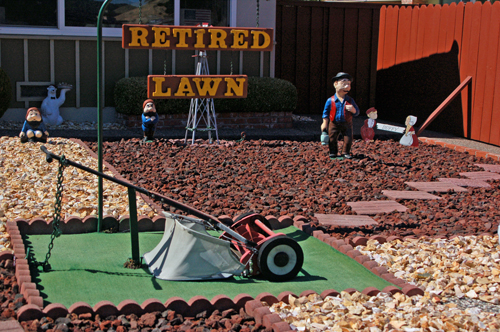
Retired lawn

retired-lawn.jpg
I ran across this in a northern California suburb this week. It's a scene alright.

But seriously, retiring our lawns (and some golf courses, perhaps) is one of the responses most of us probably will be forced to make to global warming. California mountains will get less snow; we just won't be able to continue to surround every house with a patch of lush green grass.

A 2006 report from the Public Policy Institute of California spelled out the problem.

Landscaping currently accounts for at least half of all residential water demand, according to the report. Without new conservation efforts, the amount of water going to outdoor landscaping is predicted to rise by 1.2 million acre feet a year [by 2030] -- enough to serve roughly 4.8 million people. ...

... future shortages could be exacerbated by the dominance of single-family homes on relatively large lots in the state's fast growing interior -- particularly the greater Sacramento region, the San Joaquin Valley and the Inland Empire in Southern California -- where much of the future projected growth is expected. ...

Bob Drobny, manager of Zamora Sod Farm in Chico, which sells sod from Yuba City to the Oregon border, said his company has been doing strong business as the inland population has boomed. "You almost can't buy a house that isn't landscaped in the front and back with grass being an integral part of it," Drobny said.

Sometime down the line, we're going to have to retire some of those lawns. The mini-gnomes will remain optional, I certainly hope.