Tuesday, February 07, 2012
Lesson to go along with the mail
The fellow who seems to run the rented mail drop where our postal mail goes stopped me as I loaded today's haul into a cloth bag. "Are you the people who are working to end death sentences?"
"Yes. All this stuff that comes here is petitions collected by volunteers who are working to get the initiative on the ballot. We'll be getting 1000s more next week as we approach our deadline …"
"Well I want to sign that petition," he replied.
I'd never asked him. I'd never even thought about asking him. Aside from whoever owns of these grubby, crowded private depots, the work here look like minimum wage drudgery, punctuated by irritated and demanding customers. I've tried to be polite, even when I have thought the employees weren't taking particularly good care of our voluminous and valuable incoming mail. We get enough mis-delivered mail that I've wondered how competent some employees were at reading English.
But these too are voters -- at least this guy is. He'll get his chance to sign on tomorrow when I carry a petition in.
Monday, February 06, 2012
On losing our sense of direction
My co-workers all announced they "have no sense of direction." I do have a sense of direction. Though I knew we were going astray, I also didn't want to interfere with the others perfectly adequate form of route finding, so I stayed out of the discussion. I would not have been able to explain why I had a different perception of where we were.
In the New York Times, Julia Frankenstein explored some scientists' conclusion that the availability of GPS is changing how we create mental patterns, mental spacial maps.
She says the remedy for what we are losing is that same as in most forms of physical activity: "practice."… in my opinion, it is likely that the more we rely on technology to find our way, the less we build up our cognitive maps. Unlike a city map, a GPS device normally provides bare-bones route information, without the spatial context of the whole area. We see the way from A to Z, but we don’t see the landmarks along the way. Developing a cognitive map from this reduced information is a bit like trying to get an entire musical piece from a few notes.
Our brains act economically: they try to decrease the amount of information to be stored (e.g., by relating new thoughts to already known content) and avoid storing unnecessary information. That may be the unconscious appeal of a GPS, but it means we’re not pushing our brains to work harder.
And a GPS device may even contradict your mental map by telling you to go left (e.g., for a faster highway) while your target is actually to the right. All of this leads us to use our mental maps even less. ...
And there is more: The psychologist Eleanor A. Maguire and her colleagues at University College London found that spatial experience actually changes brain structures. As taxi drivers learned the spatial layout of London, the gray matter in their hippocampal areas — that is, the areas of the brain integrating spatial memories — increased. But if the taxi drivers’ internal GPS grew stronger with use, it stands to reason that the process is reversible after disuse. You may degrade your spatial abilities when not training them, as with someone who learned a musical instrument and stopped playing.
Navigating, keeping track of one’s position and building up a mental map by experience, is a very challenging process for our brains, involving memory (remembering landmarks, for instance) as well as complex cognitive processes (like calculating distances, rotating angles, approximating spatial relations). Stop doing these things, and it’ll be harder to pick them back up later.
I suspect that the reason I have a highly developed "sense of direction" is that I thrive on practice. I've been known to drive around unfamiliar cities simply collecting a sense of how the place is ordered, for the fun of it. For whatever reason, this is one of my delights.
For many people, mental mapping may be becoming an obsolete exercise. I'd be sad to lose this pleasure, but it may seem less valuable to those who've never developed it. This is a reminder from daily life that we are changed by our technology and environment, changed more rapidly and more significantly than we might imagine.
Sunday, February 05, 2012
Juan Cole's back-of-an-envelope calculation of the costs of war on Iran
Heck, maybe our military has become so good at "precision" warfare that Iran would not be as "expensive" as Iraq. After all, they are supposed to have learned something in the last fiasco. Let's cut the damage by a third:What is striking to me is the glibness with which the Right wing speaks of an attack on Iran. The UN Security Council has not authorized the use of force against Iran, and Tehran has not attacked any other country. A strike on Iran is therefore a war crime, more especially since it would release radioactive toxins on the people of Isfahan and of the Middle East more generally.
Besides, proponents never say how they would pay for such a war. Iran is three times as populous and geographically much larger than Iraq. So multiply everything in that war by three to get the cost
.
Immediate cost: $3 trillion
Long term cost, including veteran care: $9 trillion
US troops killed: 15,000
US troops fairly seriously wounded: 100,000
Iranian dead: 1 – 3 million
Iranian displaced: 12 million
Anyone who advocates such a thing is a sort of monster, in my view.
Still monstrous and criminal.Immediate cost: $2 trillion
Long term cost, including veteran care: $6 trillion
US troops killed: 10,000
US troops fairly seriously wounded: 60,000
Iranian dead: 1 – 2 million
Iranian displaced: 8 million
Obligatory Super Bowl post: rooting for Giants' clothes
When your team comes close but doesn't make the finals, it's easier to recognize what a trivial game these addictive rivalries are. This, from Steven Pinker's The Better Angels of Our Nature seems exactly right:
So this Super Bowl Sunday, I'm throwing down for the New York Giants' clothes.Loyalty to groups in competition, such as sports teams or political parties, encourages us to play out our instinct for dominance vicariously. Jerry Seinfeld once remarked that today's athletes churn through the rosters of sports teams so rapidly that a fan can no longer support a group of players. He is reduced to rooting for their team logo and uniforms. "You are standing and cheering and yelling for your clothes to beat the clothes from another city." But stand and cheer we do: the mood of a sports fan rises and falls with the fortunes of his team.
Even sports millionaires know which side they belong on.WASHINGTON—As NFL players, we know our success on the field comes from working together as a team. We’re not just a team of football players—we’re also the fans at games and at home, the employees who work the concession stands and the kids who wear the jerseys of our favorite football heroes. NFL players know what it means to fight for workers’ rights, better pensions and health and safety in the workplace.
To win, we have to work together and look out for one another. Today, even as the city of Indianapolis is exemplifying that teamwork in preparing to host the Super Bowl, politicians are looking to destroy it trying to ram through so-called “right-to-work” legislation. {Republicans did.]
“Right-to-work” is a political ploy designed to destroy basic workers’ rights. It’s not about jobs or rights, and it’s the wrong priority for Indiana.
The facts are clear—according to a January 2012 Economic Policy Institute briefing report (“Working Hard to Make Indiana Look Bad”), “right-to-work” will lower wages for a worker in Indiana by $1,500 a year because it weakens the ability of working families to work together, and it will make it less likely that working people will get health care and pensions.
Saturday, February 04, 2012
The business of competing in "minor" sports
A friend of mine is an aspiring Olympic biathlete. What's that? She skis between targets, then must calm herself to shoot bulls eyes either prone or standing. Once upon a time, the sport trained the Norwegian army. Now it's practitioners practice without much notice from the world except in Winter Olympic years.
It's not cheap. My friend is supported by small businesses in her Connecticut River Valley home in Vermont. The video is local TV at its best, supporting the home folks. Only two minutes with a short commercial lead-in. Enjoy.
Friday, February 03, 2012
What's wrong with Iran developing a nuclear bomb?
If we're going to go to war with Iran, something we seem to be edging toward, I think that as a citizen, I've got a right to an answer. Why it is worth spilling anyone's blood over Iran acquiring a nuclear weapon?
After all there are nine states currently armed with nukes -- the U.S., the U.K., France, Russia, China, India, Pakistan, North Korea and Israel. Not all of those are anywhere I'd like to live, but so far no country except the United States has ever used the Bomb. So far, nuclear weapons' destructive horror has created a taboo that we can all hope will never be broken. Four states formerly possessed nukes (Belarus, Kazakhstan, Ukraine, and South Africa) but voluntarily gave them up. It's not as if the science underlying nuclear weaponry is a deep dark secret. Making a bomb requires sophisticated technology and some wealth, but the principles are in the public domain.
So why should anyone die to prevent Iran from getting the bomb? The most succinct rationale I was able to find came from Thomas Buonomo, a former intelligence officer in the U.S. Army.
Let's take that apart a bit.Israelis view a nuclear‐armed Iran as an existential threat and U.S. officials are rightly concerned that nuclear weapons would give Iran coercive power over Iraq and its Arab Gulf neighbors, which are critical energy suppliers to the U.S. and its allies.
Israelis view a nuclear‐armed Iran as an existential threat. Yes, and what's that got to do with us? I mean seriously, why is it in the interest of the United States to care enough to risk war? Israel acts like a nasty tribal entity that oppresses the people it has conquered and can''t get along with its neighbors. It's not some pathetic refugee camp for escapees from Hitler; it is a successful state with its own ample supply of nukes should it face any actual threat. It doesn't need the United States to protect it; the people of Israel need to come to terms with the realities of neighborhood where they are located and figure out how to make a peace. The United States has sunk vast sums into supporting Israel; there's such a thing as knowing when to cut your losses.
U.S. officials are rightly concerned that nuclear weapons would give Iran coercive power over Iraq and its Arab Gulf neighbors, which are critical energy suppliers to the U.S. and its allies. Short translation: it's our oil, we stole it fair and square; and we intend to hang on to it. A nuclear armed Iran might upset our apple cart and the equilibrium of some regional allies and we don't like that. Point taken. The thing is, nukes are expensive. For all we know, a nuclear armed Iran would have to sell more oil on the world market to pay for their fancy new weapon. And we need to get over our addiction to carbon-based sources of energy anyway.
How about the fact that the Iranian regime is a nasty theocracy that oppresses many of its people? Yeah -- and so's our buddy the king of Bahrain, but we turn a blind eye when he shoots protesters and brutally attacks medical personnel. I would hope that the Iraq fiasco and the ongoing Afghanistan debacle would have convinced our rulers not to go to war to try to replace other people's governing institutions. Besides, if Egypt's Mubarak can be brought down by his own citizens, the unexpected collapse of governments that have lost their legitimacy should never be ruled out, even though we worry we won't like the results.
Then there's the reality that Iranians and U.S. citizens have spent decades learning to distrust each other. Older people in the U.S. remember the then-new Islamic Republic holding our diplomats hostage in 1979. Few Iranians alive today lived through the CIA coup in 1953 that overthrew a democratically elected prime minister and replaced him with the Shah's monarchy but the memory of humiliation and frustration still festers. Are we really going to allow ourselves to be led into a war because of decades old irritants?
Actually I can think of only one intellectually respectable reason why Iran should not have a nuclear weapon: NO country should have nuclear weapons. The obstacles to achieving that look to be more in Tel Aviv and Washington than in Tehran.
I'd call that hope "the Iraq war dividend" and a paltry thing it is. I am not convinced the war proponents will be required to meet that test. We seem to be blundering toward another horrible end.The burden of proof rests, in any event, with those who would urge war.
Thursday, February 02, 2012
Redistricting San Francisco: hyper-local politics
The Bay Guardian alternative newsweekly sponsored a meeting last week designed to educate progressive activists about how the process will work to draw local Supervisor's districts and what new maps could mean. The local Redistricting Task Force charged with drawing new boundaries is already working on new maps, holding public hearings. According to the Guardian (and I concur):
While it's difficult to draw 11 bad districts in San Francisco, it's entirely possible to shift the lines to make it more difficult to elect progressives -- something many groups out there are anxious to do.

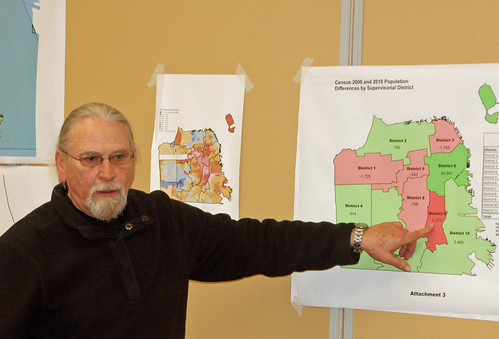
Community activist Calvin Welsh points to a map of the current districts. Those in red and pink have lost people in the last ten years, while the center-city District 6 has seen massive development and population gains.
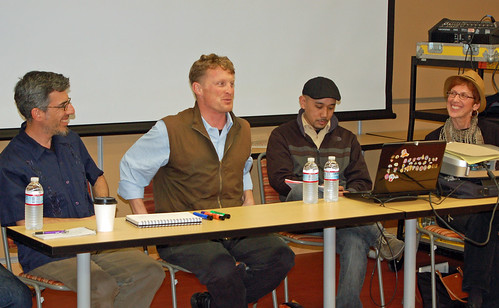
The Guardian's meeting sounded a warning that if people don't involve themselves, the prospects for progressive governance might be seriously hurt. A panel included Fernando Marti, who has worked on a draft progressive map; Quentin Mecke, who served on the last redistricting committee; Terry Valen from the Filipino Community Center; and Eileen Hansen, a former Supervisor candidate who later served on the city's Ethics Commission (that's where campaign regulations are enforced.)

This week, the Guardian has posted a link to a proposed progressive community-drawn map. You can see it here.
Having been involved in the last round of this, I'm glad to see community groups trying to engage with the process, although if we have been a little slow to get going. The district boundaries set in the last round helped progressives contest the board of supervisors for most of the decade, balancing citywide administrations that were more friendly to (and funded by) developers and big business interests. Boundaries that corral most of the city's most progressive voters in a few districts would enforce a political balance in which the interests of the very rich sweep aside those of everyone else.
But I was struck by what the two Supervisors who dropped in, John Avalos and David Campos, had to say about the process. Each repeated some version of the statement "we can run in whatever lines they come up with."
Now that's not strictly true; neither man would get far with the voters of Pacific Heights. But the sentiment has to be part of the mindset of progressives who want to influence city politics. We have to present a vision of what life might be like in this city that attracts a majority across its divisions. That's tough in a city where the middle class is being priced out, leaving the rich, the menial workers who serve them, and a sprinkling of short term residents -- young artists, techies and slackers.
Yes, we lose citywide elections because our candidates get buried under an avalanche of cash. But we also lose because we have a hard time projecting a vision that attracts a majority across economic, racial and identity lines. Favorable supervisorial boundaries can to some extent mask a weakness. And the progressive boards elected in the 00s certainly had great accomplishments -- I think particularly of the local universal health plan, Healthy San Francisco. But in addition to good boundaries, we also need that vision thing and the community institutional capacity to spread it.
Wednesday, February 01, 2012
Unexpected ... but not necessarily unwarranted

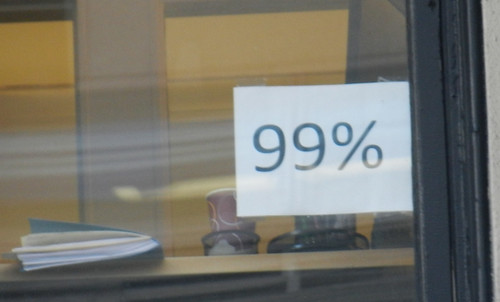
Even amid the granite canyons of San Francisco's financial district, alongside the pseudo-Doric capitals, there it is ...

an almost wistful claim that here, too, are the 99 percent.
Warming Wednesdays: A windy future
In the Anthropocene, even renewable technologies may have unsettling climate effects. That's what happens when we use our human technological capacity to alter the planet's balance -- something we are doing and will continue to do whether we want to or not, barring a massive human die-off.
Think adoption of wind power couldn't possibly mess with the climate? Not so according to New Scientist.
Go read it all.In 2010, Somnath Baidya Roy at the University of Illinois in Urbana-Champaign reported that wind farms affect their local climate. Long-term data from a wind farm at San Gorgonio, California, confirmed his earlier model predictions: surface temperatures behind the wind turbines were higher than in front during the night, but as much as 4 °C lower by day.
Roy thinks the turbulence created by the turbines sucks air down from above. During the day, when the hottest air is usually near the surface, this has a cooling effect. At night, when the air near the ground may be colder than that above, it can have a warming effect.
These effects could be minimised by placing wind farms in areas where there's already a lot of turbulence. But we might not want to minimise them. "Some of these effects are actually welcome for agricultural reasons," says Cristina Archer at the University of Delaware in Newark, who studies wind power. Strategically placed wind farms might keep crops cool in summer and reduce the risk of frost in other seasons. Farmers in California and Florida already use wind machines to fight frost by pulling down warmer air.
Do offshore wind farms affect sea surface temperatures and evaporation rates? Could these local effects add up to produce significant regional or even global effects? Perhaps. Winds obviously play a major role in climate. Slowing or altering wind patterns will alter the movement of heat and water around the planet, and thus temperature and rainfall.
It might seem inconceivable that humans could have a significant effect on the wind, but we may already be doing so. While wind speeds over the oceans are increasing, surface winds over Europe, Asia and North America have slowed by up to 15 per cent on average since 1979.
Tuesday, January 31, 2012
An autobiographical argument for the rule of law
Soufan is an Arab American born in Lebanon who applied to become an FBI agent on a bet with college friends. None of them imagined the Bureau would want a foreign born native Arabic speaker. But in the mid-1990s, it did and the new special agent was assigned to the New York office. Like many immigrants, he especially valued our historic freedoms:
He also was fascinated by exotic figures he had learned about from reading Arabic language newspapers; while still in college he made a sort of hobby following the activities of a Saudi millionaire named Osama bin Laden. While still an FBI trainee he wrote a memo about bin Laden's declaration of war against the United States and was transferred into the New York taskforce that had worked on the 1993 bombing in the World Trade Center underground garage. When al-Qaeda bombed U.S. embassies in Nigeria and Tanzania in 1998, he was among the New York team that digested the work of on-the-ground investigators. Later he was sent to Yemen to investigate the 2000 bombing of the U.S. destroyer Cole. That investigation led to the FBI becoming aware that a clandestine meeting had taken place in Malaysia involving only partially known persons and possible plots. Despite repeated requests, they were unable to get the CIA to share what they knew of this; in hindsight Souffan claims that if bureaucratic rivalries and suspicions had been overcome, the 9/11 plot probably would have been foiled. When he first learned, while still in Yemen, of the 9/11 attacks, his reaction was to sit in the lavatory and vomit, so sure was he that if information had been shared, all those people would have lived.While the Constitution and the Pledge of Allegiance may perhaps seem largely symbolic to many Americans, to those of us who have have lived with alternatives, they are filled with meaning. I know that the protections offered therein are very necessary.
After 9/ll, as one of the U.S. government's few Arabic speakers, an experienced interrogator, and an expert on al-Qaeda, Souffan was a busy guy indeed, debriefing the numerous men seized in Afghanistan and elsewhere in the hunt for terrorist plotters. Because he understood the intricacies of their organization and could imagine the mindset of those prisoners who turned out to be members of the group (many were just innocents who had been in the wrong place at the wrong time), Souffan reports he repeatedly won admissions and genuine information. He always sought practical intelligence that would enable the U.S. government to foil any plans and also built legally viable cases again conspirators that could be used to convict them in court.
This kind of legal case-building rapidly came to be treated as foot-dragging by the higher ups in the Bush administration who became enamored of crack-pot ideas spun by contract psychologists of breaking the captives through coercion. Holding suspects in freezing cold rooms, led to locking them in stress positions while bombarding them with noise, led to water-boarding -- and the prisoners stopped providing any meaningful information, no matter how much they jabbered. Souffan maintains that al-Qaeda prepared its adherents to expect truly grotesque tortures from Middle Eastern dictatorships: rape by dogs for example. No wonder the modulated torments so favored by Dick Cheney and Donald Rumsfeld only led them to lie and/or clam up. And the torture "techniques" rapidly spread from Guantanamo to Iraq and Abu Ghraib, helping to ensure the failure of our rulers' Mesopotamian adventure. Souffan and the bureau eventually walked out, refusing to adopt the new torture practices, and thus depriving the anti-terrorism effort of the people who had the most knowledge of and experience with actual threats. The book makes it abundantly clear that some in the CIA and the Bush Administration hated Souffan for blowing the whistle on intelligence failures -- and for having been better at protecting U.S. citizens than they were.
The story of all this drama as Souffan tells it is actually pretty dry. It's easy to get overwhelmed by the volume of unfamiliar names and their complex connections. He's building a case here in this book and that object determines its structure, even when he shares memories of the anger and frustration he felt over his own government's many missteps and misdeeds.
As the book was ready to go to press, already cleared of classified and confidential information by the FBI, the CIA weighed in with demands for Souffan to excise additional material. Rather than hold up publication, his publisher went ahead and released the book with the contested bits printed but blacked out. Souffan claims that the material the CIA forbade is either already in the public domain, unclassified, or improperly classified to prevent Agency embarrassment. Some of the redactions are transparently absurd. For example, they made him black out one sentence of a nationally televised exchange with Senator Lindsay Graham. If complaints through FBI channels don't relieve him of these CIA requirements, he knows his preferred remedy.
Once again Souffan is painstakingly building his case, placing his faith in the law.…if they fail in their duty, I plan to compel disclosure of the redacted information through legal means.
This book is not light or even gripping reading. Rather it is a very dry, detailed, and workmanlike narrative of one man's experience in the United States' shameful lost decade post 9/11. That's probably what we should hope for from a law enforcement officer, not bombast, speculation, or posturing.
Monday, January 30, 2012
Upside down goose on the loose?
Here's a slow motion video of such a flight:
Ain't reality grand?During flight, geese can twist their necks to flip their bodies upside down, while keeping their heads upright.
Now amateur videographers Hans de Koning and Lodewijk van Eekhout have captured the first slow-mo video of the manoeuvre, winning a prize in a competition organised by the Flight Artists group at Wageningen University. Known as whiffling, the move is often performed before landing as a means of braking. Upside down wings generate more drag causing a goose to slow down quickly, just like what happens when a plane is inverted during flight.
Sunday, January 29, 2012
Is this any way to run an empire?
Under George W. Bush, the prison at Bagram was a central node in the network of "black sites" where U.S. intelligence personnel held suspected terrorists. Obama came into office calling for closure of such secret prisons where both the local Afghan authorities and the International Committee of the Red Cross were excluded -- and where abuse, murder and torture have been documented. NATO allies with forces in Afghanistan also called for the closing of Bagram. And Afghans demanded that they should take over the prisoners. But the Afghan prison system is notoriously corrupt and also itself a site of torture. So U.S. hold on the Bagram prison and the prisoners continues.
The Obama administration did proscribe a procedure -- it can hardly be called a hearing or a court-- for determining which prisoners should remain locked away.
Candace Rondeaux of the International Crisis Group described actual workings of this legal mirage recently.
That's not satisfactory to the U.S. Therefore our military won't hand over many of the prisoners to the Afghans. Therefore Bagram must remain a U.S.-run prison for the foreseeable future. Therefore the war must go on. And therefore proud Afghans fume and individual prisoners are denied any resolution of their status.As part of its new detainee policy, the Obama administration launched a process in which a review board of three military officers hears evidence to determine whether a Bagram detainee is a supporter or member of the Taliban, al Qaeda, or another insurgent group. Detainees are allowed to attend unclassified portions of their hearings. They are also assigned personal representatives, U.S. military officials who are responsible for assisting detainees with presenting their cases.
When I visited Bagram last November, Colonel Peter Masciola, head of the legal operations directorate there, described this to me as a “meaningful opportunity to counter claims in an administrative procedure.” The hearings, however, fall far short of international legal standards. Detainees are still barred from reviewing classified evidence or from listening to classified testimony in their cases, which largely consists of hearsay evidence of the detainee’s alleged terrorist connections. Personal representatives assigned to detainees are allowed to see the classified evidence but not share it, and since these representatives are not lawyers, there is no way for detainees to challenge their inability to review classified evidence. This is a clear violation of international law on fair trial standards. But by providing a hearing that mimics a regular court procedure, the White House has been able to airbrush these concerns out of the picture.
In the classification-obsessed culture of the U.S. military, the simplest details about a detainee’s capture are often classified. Since the U.S. military also limits the information it shares with the Afghan government, Afghan judges and prosecutors are also barred from reviewing all the evidence in cases that are transferred to them under the Bagram transition agreement.
[The military] has generally solved this problem by either delaying the transfer of detainee cases or, sometimes, by handing over virtually empty case files to Afghan authorities. As a result, Afghan judges have thrown out dozens of cases because of a lack of evidence.
Is this any way to run an empire?
Saturday, January 28, 2012
Saturday scenes and scenery: from the SAFE California campaign
These pictures show some of the people I have the privilege to work with. Many are from the Dr. Martin Luther King day holiday when volunteers attended over 30 events statewide and collected thousands of signatures to qualify our measure.
Californians: we need help, lots of it. Visit SAFE California today and sign up.
Friday, January 27, 2012
Seen in the 'hood ... a laughing matter

At the Bomb Truck website, I found this:
Our comparative equanimity is not universal.Organic Vegan Handmade Pops. We are like the Willy Wonkas of gourmet pops. Inspired by mom and pop shops,hole in the walls, neighborhood ice cream trucks, and childhood memories.
And a federal court still thinks is within the law for security authorities to order a citizen locked up as an "enemy combatant," drive the guy crazy, and only then put him into the federal court system on vague charges. That would be Jose Padilla. Padilla's lawyer, Ben Wizner, said of the decisionA FedEx driver was delivering a package to an Army base in Utah when someone asked what it was. The driver replied it was probably a bomb. Military police evacuated more than 2,200 people, and prosecutors have charged the driver with making a threat of terrorism.
Appropriately, there's not a lot of humor in that conclusion.the appeals court “handed the government a blank check to commit any abuse in the name of national security, even the brutal torture of a U.S. citizen on U.S. soil.
“This immunity is not only anathema to a democracy governed by laws, but contrary to history’s lesson that in times of fear our values are a strength, not a hindrance,” said Wizner, litigation director for the American Civil Liberties Union’s National Security Project.
Not their grandmothers' electorate
It's not surprising that the essential futility of these guys comes out in Florida over immigration issues. The Republican party has had a good long run since Richard Nixon at being the bastion of frustrated white resentment, but their country is not the country we live in, in many places today and everywhere going forward. The country is changing.
Florida is one of the places where demographic shift is happening fast. According to the 2010 census, Florida's is about 58 percent white, 22 percent Hispanic/Latino of any race, and 16 percent Black. Unlike any other group of Latinos in the United States, Florida's Cuban immigrants tend to be Republicans, but these days they are more and more balanced out by Democratic-leaning Puerto Ricans, Mexican Americans and others from countries to the south.
Contemporary Republicans have nothing much to say to Latinos, aside from anti-Castro Cubans. Their white base won't let them deal sensibly with the fact of 11 million people who live here without papers. So we get the kind of nonsense Mitt and Newt traded tonight.

Today Markos Moulitas of Daily Kos, himself of Greek-Salvadoran ancestry and so quintessentially a modern citizen of the U.S., mocked the idea that Republicans were going to pick up Latino votes.Alabama, Arizona, Georgia, Mississippi, and other states have recently enacted measures calling for stricter enforcement of existing immigration laws. Some of these measures even aim to deny birthright citizenship to U.S.-born children of illegal immigrants. These initiatives, overwhelmingly supported by Republicans, drive Hispanics to vote increasingly for the Democratic Party.
… Most of the demographic change in the American electorate today comes not from waves of new immigration but from the echoes of past immigration: the children of immigrants and their children. Nationwide roughly 21 percent of white citizens are under eighteen years old, compared to 44 percent of Hispanic citizens. Over the coming decade, aging alone will increase the number of Hispanics who are eligible to vote by 25 percent.
Hispanic voters will continue to emerge in Texas, California, and other states where Hispanics have long been gaining in numbers. But the tide of Hispanic citizens is rising in some surprising places as well. The states with the highest percentage of Hispanic citizens under eighteen years old are North Carolina, Georgia, Alabama, Tennessee, Arkansas, and South Carolina.
And closing the borders will not appreciably affect the increasing numbers of Hispanics and Hispanic voters in the United States for a simple reason: the Hispanic population is already sizable and has a much higher birth rate than the white population. The policies that the parties pursue now on immigration, education, and other matters that particularly affect Hispanics will define electoral politics for generations to come.
Note to discouraged white progressives: people of color have a lot of experience with making disheartening lesser evil choices. For most of U.S. history, that's all that was on offer -- none of the available politicians really represented them. Grown ups make the best of bad choices -- and then know that political participation doesn't end when the election is over. Why sometimes, people have to go on to Occupy ...Latinos may be disappointed in the lack of progress on immigration reform the last few years. But they saw who voted against the DREAM Act in Congress, and they see who is still campaigning against the DREAM Act. They see who is demagoguing Mexico and kowtowing to the notorious Latino-hating Arizona Sheriff Joe Arpaio, and they see who is passing anti-immigrant laws in places like Arizona and Alabama. They know that Romney wants to make things so miserable for undocumented immigrants that they "self-deport."
There may be disappointment in Obama and the Democratic Party among Latinos, but … there is zero opening for Republicans with this key, growing, demographic.
Thursday, January 26, 2012
Gay marriage is coming to Washington State
LGBT people haven't done so well at winning these kind of state ballot measures; in both Maine and California, marriage victories were overturned by voters. But I wouldn't be surprised if Washington voters turn back marriage opponents in a November vote; among other strengths, they can count major state businesses like Starbucks and Microsoft in the pro-marriage equality camp. And the northwest has an honorable history of winning electoral fights over gay rights"It's not done. In fact, it's just started," said Joseph Backholm, executive director of the Family Policy Institute of Washington, vowing that legalization of same-sex marriage would end in a referendum challenge.
A Washington vote to uphold a gay marriage law would repeat one of the great early successes of the LGBT rights movement. Thanks to the movie Milk, there's some historical memory of the 1978 defeat of a California initiative that would have fired out lesbian and gay teachers and silenced their supporters. But the same year, Seattle voters rejected an attempt to repeal their local ordinance that protected lesbians and gays against employment and housing discrimination. History Link tells the story.
Good friends of mine lived through the campaign adhering to "more radical" opposing positions; in fact two poured donated blood on the office of proponents and served local jail time for this act of uncivil though nonviolent disobedience.On November 7, 1978, Seattle voters rejected Initiative 13 decisively, by nearly two to one. Initiative 13 would have repealed city ordinances protecting employment and housing rights for gays and lesbians. Also, it would have dissolved the City of Seattle's Office of Women's Rights.
The initiative was sponsored by Save Our Moral Ethics (SOME) and by Seattle Police Officers Dennis Falk and David Estes. Opposition was led by the Committee to Retain Fair Employment (CRFE) chaired by Charles Brydon and directed by Jill Shropp. Other groups opposed the measure as well.
Seattle was one of the first large American cities to enact specific civil rights protections prohibiting discrimination on the basis of sexual orientation. Employment rights of sexual minorities were affirmed in 1973, and the City broadened its housing laws in 1975. [The reforms] ... generated little controversy at the time of their adoption.
…CRFE was organized as a broad coalition of civil rights groups, religious moderates, and political liberals. Initiative 13 was also vocally opposed by more radical gay and lesbian groups, but CRFE raised the largest war chest and was able to broadcast radio and television messages. Its campaign focused on the theme "Your Privacy is at Stake," arguing that Initiative 13 exposed all citizens, straight and otherwise, to intrusive background checks by employers and landlords.
Early, unofficial vote counts showed Initiative 13 defeated, with a vote of 59,797 (37 percent) in favor to 101,809 (63 percent) opposed. Also on November 8, 1978, California voters rejected the "Briggs Initiative," which sought to curtail the civil rights of gays and lesbians in that state. …
As a political campaigner, I'm interested in lessons collected in oral histories of the victory. The Seattle Committee Against Thirteen and Women against Thirteen (SCAT/WAT) was a "more radical" group that wanted to talk about a lot more than generic privacy rights. Jan Denali explained
In the struggle for full gay rights, there simply is no doubt that repeated exposure to the humanity of ordinary gay people -- those face to face meetings that may begin in ignorance and prejudice but lead to mutual tolerance -- are what has turned the tide in our favor. We are everywhere and the end of the world (or of the family or heterosexual marriage or whatever) hasn't come. That approach worked on a citywide basis (alongside a more conventional electoral effort) as far back as 1978. It obviously works better in smaller settings and when the heat behind the issue hasn't been driven up too high by demagoguery. It probably takes a mix of campaign styles to win, but I have little doubt that victories that push back bigotry that are won with a strong component of public education are durable, in fact likely to be permanent. That 1978 campaign, super-heated and fraught as it was, laid the groundwork for marriage equality in Washington State this year.What I was mostly involved with was the canvassing project, which was a joint project of SCAT/WAT. ... That was the door-to-door stuff. We were big on education. ... We prioritized the city by precinct, you know, going for the swing precincts: who do you have a prayer of convincing? And running amazing orientation sessions to go out and canvass the city on the issue and being very educational about it. So that was what I did. ...
To be addressing the issue straightforward ... to be able to stand there in front of somebody and have a conversation ... and we had all this stuff about de-briefing and teamwork because you’d get icky stuff too and how to deflect that, and it was all just so completely empowering.
Wednesday, January 25, 2012
Warming Wednesdays: How about that State of the Union speech?
A search on "climate" reveals that Obama did mention it.
I guess saying that gridlock rules is better than saying nothing. But I think I've got a right to be disappointed in the people who rule us and in the ordinary people (too many of us) who put them in office.The differences in this chamber may be too deep right now to pass a comprehensive plan to fight climate change.
Every year around the time of these speeches, pundits bloviate about whether what a president comes up with matters. This year it has been fashionable to say the President Obama was delivering the long form of his re-election stump speech or that nothing ever changed because of what was in a presidential speech. Presidential jawboning runs into the checks and balances in the system and we shouldn't expect anything to come of it ...
But did anything ever change because of what was not in a presidential speech? If our more rational political figures never speak honestly about human-induced global warming and our less rational ones denounce the concept and scientific understanding itself, is it any wonder that a huge fraction of the U.S. population denies climate change is happening?
The most intriguing bit of pre-speech punditry I ran across was from Steve Benen:
Really? Only time will tell.… if you want to know what Obama’s prepared to fight for, look no further than what he has to say tonight.
Tuesday, January 24, 2012
Culture of death on the way out?
This assumption is exactly the sort of thinking professor Steven Pinker tries to dispel in The Better Angels of Our Nature: Why Violence Has Declined. The data say we emphatically do not live in a culture of death, says Pinker. In fact, all over the world, people are expanding our solicitude for lives that would once have been socially discounted.We live in a culture of death," said [Ryan] Phillips, a high school senior who says he has attended the march 10 years in a row. "We'd like that to end."
Meanwhile, people more fixated on the flourishing of living women and families than on the fetus point out hard facts about abortion in the United States today. This video clip is unusually straight forward in explaining why some women continue to need legal abortion and how society could affirm women's humanity and autonomy, if we really wanted living women and children to thrive.Many opponents of legalized abortion predicted that acceptance of the practice would cheapen human life and put society on a slippery slope toward infanticide, euthanasia of the handicapped, a devaluation of the lives of children, and eventually widespread murder and genocide. Today we can say with confidence that that has not happened. Though abortion has been available in most of the Northern Hemisphere for decades, no country has allowed the deadline for abortions during pregnancy to creep steadily forward into legal infanticide, nor has the availability of abortion prepared the ground for euthanasia of disabled children. Between the time when abortion was made widely available and today, the rate of every category of violence has gone down, and, as we shall see, the valuation of the lives of children has shot up.
Opponents of abortion may see the decline in every form of violence but the killing of fetuses as a stunning case of moral hypocrisy. But there is another explanation for the discrepancy. Modern sensibilities have increasingly conceived moral worth in terms of consciousness, particularly the ability to suffer and flourish, and have identified consciousness with the activity of the brain. ... The change is a part of the turning away from religion and custom and toward science and secular philosophy as a source of moral illumination. ... The vast majority of abortions are carried out well before the milestone of having a functioning brain, and thus are safely conceptualized, according to this understanding of the worth of human life, as fundamentally different from infanticide and other forms of violence.
At the same time, we might expect a general distaste for the destruction of any kind of living thing to turn people away from abortion even when they don't equate it with murder. And that indeed has happened. It's a little-known fact that rates of abortion are falling throughout the world. ...abortions have also become less common in China, the United States, and the Asian and Islamic countries in which they are legal. Only in India and Western Europe did abortion rates fail to decline, and those are the regions where the rates were lowest to begin with.
Well worth watching.