Saturday, July 11, 2015

It's World Population Day, says the U.N.


The theme this year is "Vulnerable Populations in Emergencies," particularly women and girls.

There are more and more people involuntarily on the move. A recent report concluded that the number displaced by wars grew from 51 million in 2013 to almost 60 million in 2014.
If this were the population of a country, says UNHCR, it would be the world’s 24th largest.

“We are witnessing a paradigm change, an unchecked slide into an era in which the scale of global forced displacement as well as the response required is now clearly dwarfing anything seen before,” UN High Commissioner for Refugees António Guterres declared in a press release issued earlier today and marking the report's release.

“It is terrifying that on the one hand there is more and more impunity for those starting conflicts, and on the other there is seeming utter inability of the international community to work together to stop wars and build and preserve peace,” he added. ...

  • In Africa, the outbursts of hostilities, many of which are sectarian in nature, have consumed eight countries, including Côte d'Ivoire, the Central African Republic, Libya, Mali, northeastern Nigeria, the Democratic Republic of the Congo, South Sudan and, more recently, Burundi. ...
  • In the Middle East, Syria, Iraq and Yemen remain ablaze ...
  • in Europe, Ukraine has spawned a displacement crisis subsuming more than more than 1.3 million people, mostly across the country's eastern provinces of Dinetsk, Luhansk, and Kharkivska. ...
  • In Asia, meanwhile, the unresolved tensions in Kyrgyzstan and in several areas of Myanmar and Pakistan, [as well as fighting in Afghanistan,] continue to force people across the countries' borders.
And the worst of displacement often falls on women.
UNFPA said women and adolescent girls who are caught up in humanitarian emergencies also face much greater risk of abuse, sexual exploitation, violence and forced marriage during conflicts and natural disasters.

In addition, many women who survive a crisis become heads of household, with the sole responsibility of caring for their children.

They often have to overcome immense obstacles to provide health and care for children, the sick, the injured and the elderly, and bear the heaviest burden of relief and reconstruction. As a result, they may neglect their own needs as they care for others, UNFPA said.
I have a neighbor who walked across Cambodia with children to escape the famine and murders of the Cambodian Khmer Rouge in the 1970s. She and her family made it. People are remarkably resilient. But our memories are shaped by the survivors' existence. Many, often most, don't make it.

Friday, July 10, 2015

What can we do to stop the train?

Last week, Bree Newsome's heroism in pulling down the Confederate battle flag (before the the South Carolina legislature got around to it) inspired a little conversation here about solitary acts of resistance. Usually what looks lonely is the fruit of a movement of many.

In 1987, Vietnam veteran turned peace activist Brian Willson's act of resistance, lying in the path of a munitions train in Concord, California, cost him is legs. This was most emphatically not a solitary act. A small, noisy community of people had planted themselves near the tracks determined to let the world know that death and destruction in Nicaragua began right there. Good friends were part of that community. Within days after Brian was maimed, thousands from the Bay Area flocked to a rally at the site; the Rev. Jesse Jackson likened the tracks' purpose to the trains to Nazi death camps; and we pulled up several hundred feet of rails with picks and crowbars. By coincidence, the San Francisco Symphony was on strike that week and a little band of musicians played "I've been working on the railroad" while we dug.

Willson has trudged on, on artificial legs, raising opposition to U.S. imperial wars. There is currently a fund raising push to raise the last $35,000 for Paying the Price for Peace whose trailer is posted here. It tells the story of Willson and other U.S. vets who have sought to impede wars. We should not forget.

Friday cat blogging

I think that is what you call a "baleful glance." Encountered while walking for 596 Precincts.

Thursday, July 09, 2015

Parking in San Francisco

Yesterday I had several hours to kill between appointments. It might have made sense to drive near to the distant upcoming event and while away some time in a cafe, a pleasant prospect. But I didn't do this. Why? Parking!

Parking in San Francisco is a very fraught subject. My car was parked in a space in my neighborhood for which I have a sticker that allows long term occupation. I wasn't about to surrender this and go somewhere else where I might have had to practice my parking juggling skills. This kind of consideration probably supports neighborhood businesses, but it also has the interesting effect of segmenting us into local enclaves or promoting resignation to the inefficiencies of (fairly good) public transit.

For the moment, my scope is quite wide. I'm willing to walk about 1.5 miles to get somewhere I want to go, if public transportation isn't convenient and I have the time. But I can't assume I'll always be able to be so mobile.

If driving were not an option, I would never have made an appointment for a class across town at 5:30 pm. But driving is an option, so I did.

More fraught parking does reduce some the frequency with which I choose to drive, probably a good development for sustainability. This isn't a bad thing, but it is an ever-present reality in this booming San Francisco.

The boom is driving the parking shortage, as it is much else. Since 2010, San Francisco has added some 50,000 residents. That's a lot of cars as well as people. Also, Uber (without taking its competitors into account) has signed up 15,000 drivers in the city. From the look of the cars Uber drivers use, these aren't the beaters their families count on. These are new or newish vehicles. All those cars have to go somewhere.

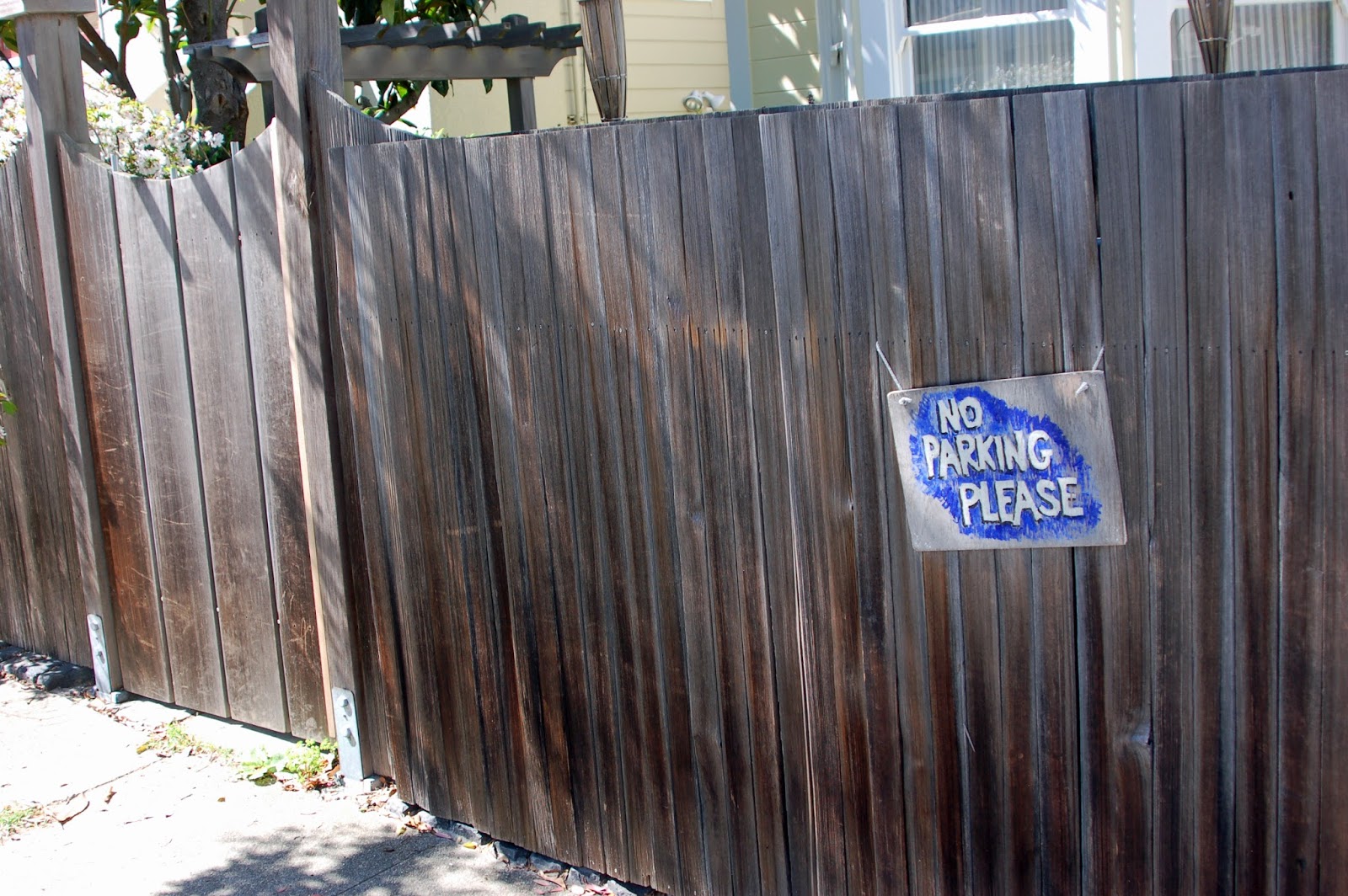
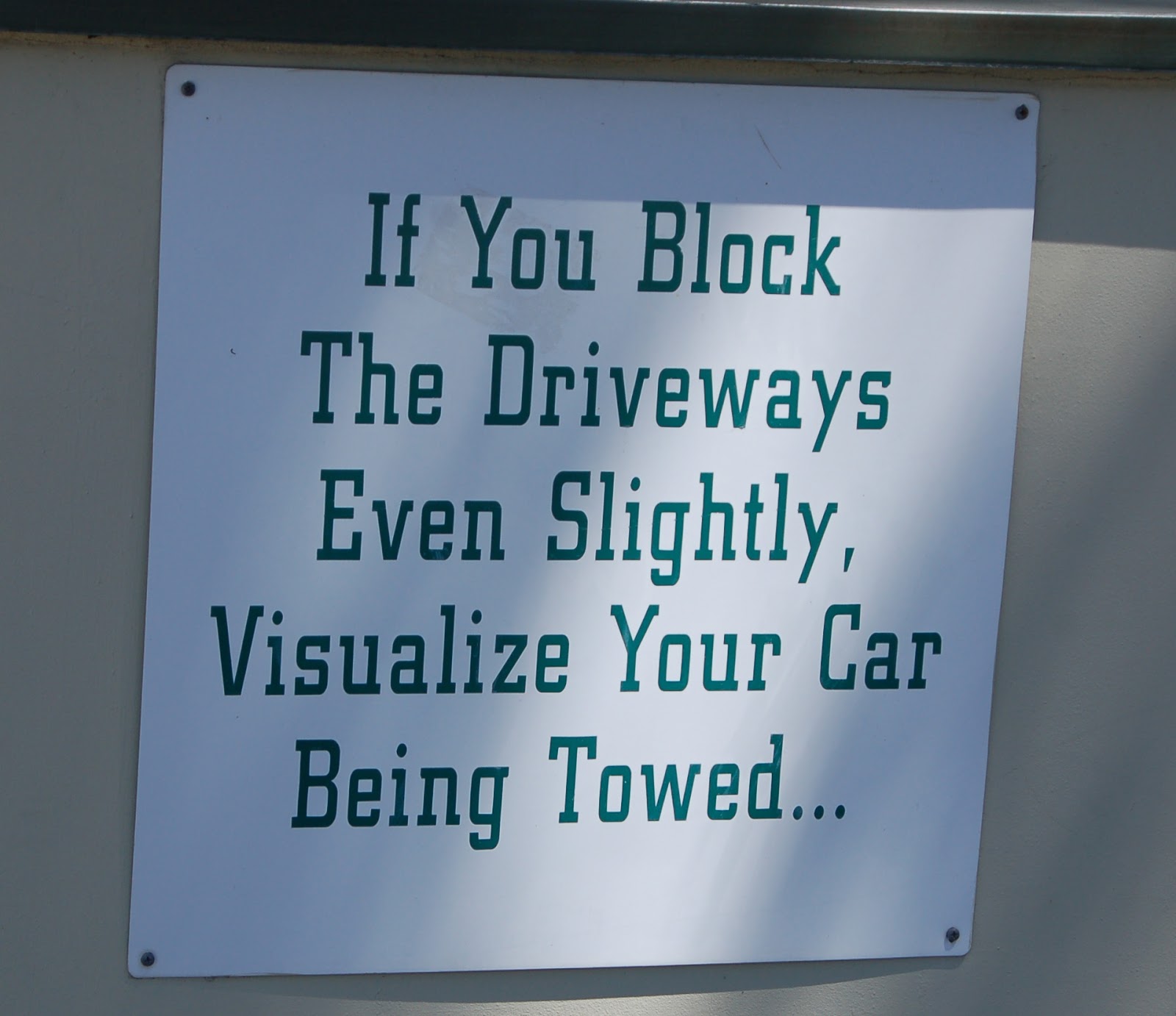
San Franciscans think a lot about parking. And we express ourselves. These examples were collected while walking 596 Precincts.

Maybe we'll someday get to this.

Wednesday, July 08, 2015

A Republican nightmare is here

A headline from NPR tells the story: Census Data Confirms: Hispanics Outnumber Whites In California.

Anglos, as non-Hispanic whites are known here, now number 14.9 million, and Latinos have edged them out with a population of 15 million.

[Roberto Suro of the University of Southern California]: Immigration brings in young adults. Young adults are at the peak of their fertility, and the white population has been aging. So baby boomers produced a lot of babies in the 1980s, bringing us the millennial generation, but since the 1990s, boomers have mostly been beyond childbearing. ... The white population is actually - in terms of natural increase in the United States, it's shrinking.

... Right now, because of the earlier waves of immigration and the earlier fertility, there are lots of Latino young people who are coming online every year - native-born citizens who are turning 18 and moving into the electorate.

... In California, there are 4.8 million Latinos under 18. There are 2.4 million whites under the age of 18, so there are twice as many Latino young people as there are white young people. That is enormous demographic power because that means 10 years from now, there will be twice as many Latinos of childbearing age as there are whites of childbearing age ...

A recent Pew poll makes it abundantly clear that Republican horror about the newcomers is not limited to people who arrived here without legal papers. They just plain don't want any immigrants.

They aren't going to have their druthers. If they are lucky, very likely the people who care for them in frail old age will come from this immigrant stream. And thinking that there's a way to stop the demographic change is like Canute trying to hold back the tides. They need to get used to world that is and meet the neighbors!

Tuesday, July 07, 2015

Puzzling conversations

Carla Power is a U.S. journalist, a former Newsweek correspondent who now writes for Time. She enjoyed a curious and lucky upbringing in a series of Islamic countries in less conflicted times. This book, If the Oceans Were Ink: An Unlikely Friendship and a Journey to the Heart of the Quran, is a pondering on a year's conversations with Sheikh Mohammad Akram Nadwi, a longtime friend and colleague from a shared Oxford academic project.

The Sheikh, educated in madrassas and at university in his native India, is a deeply immersed scholar of his tradition who also serves as a day-to-day religious leader to many British Muslims. He lectures and answers questions from students that range from theological puzzles to whether it is licit to use hair dye. To a Western observer, he seems an exotic figure because he has recovered the stories of thousands of Muslim women who historically played the roles of jurists and interpreters of belief. His teaching about Muslim women separates out what he considers cultural accretions to Islamic practice from a core system of belief that he finds in the Quran. But he is not some kind of modern re-interpreter of the faith -- he's a traditionalist.

Power often finds the gulf between the way she thinks and what the Sheikh teaches wide -- possibly unbridgeable. She writes about hearing the Sheikh provide counseling to the parents of a young girl who had become pregnant without marriage. His whole concern was for helping the girl and the family find practical ways to go forward together, despite allowing no slack for such loose morals. Power explains:

In my creed, sex, drugs and rock and roll, and any number of other explorations were fine, so long as nobody got hurt. Such tolerance derived from the assumption that this life is all we have and that every individual has freedom. Akram's tolerance came from a belief in just the opposite: in a God-centered universe, nobody has freedom and nobody has the right to judge others. That is God's job.

The impression that I have long had of Islam is that, more than European Christianity, it demands communal solidarity and equity among all the people (at least those within the faith circle.) No unjust judges here! Thus I was interested in this exchange:

I [Power] had always been taught that justice was the cornerstone virtue of Islam, occupying much the same position that love does in Christianity. Prophets were sent to bring justice to the people through their messages. Polygamists are counseled to be just with their wives, and merchants to make fair deals in the marketplace. "A just leader," the Prophet Muhammad is reported to have said, will be "the most beloved of people to God," while the "most hated" would surely be a tyrant. ...

I called the Sheikh to ask about justice. "It's the basic tenet of Islam, right?" I asked.

A pause.

There was justice, ultimately, he said, but it would not necessarily arrive in this life. Allah would provide it in the Hereafter.

Sheikh Akram is a quietist. His religion is all about living in submission to God, to Allah, come what may. That is, after all, what the Arabic word islam means. He projects simplicity and calm.

Yet to Power -- and to me -- the contradictions held inside his lived belief remain unfathomable. This book left me reflecting on whether perhaps I find that true of single minded practitioners of any religious tradition. We live these things rather than think them ... yet there are scholars and counselors and prophets and holy fools. This was a book to read slowly and allow to seep inside. It stirs more questions than answers. They seem gentle, healthy questions -- something of a rarity in our noisy lives.

Sharing the 'hood

Down my Mission district street, there's a wide set of stairs where a group of young men sometimes congregates. They sit and talk and smoke -- and never seem any kind of threat to me, though I'm instinctively wary of groups of young men.

The residents of the building have apparently decided to set up some ground rules. These seem quite reasonable and the sign has stayed up for nearly a month, so I guess co-existence is working.

Monday, July 06, 2015

Greeks vote a resounding NO


This is a story about democracy breaking through. We've had dramatic political events in the U.S. recently -- it's not likely that many of us have been paying much attention to what has been going on in Greece and the European Monetary Union. But Sunday's 61 percent vote against further economic measures that would immiserate ordinary Greeks in order to placate northern European bankers should invigorate everyone who prefers democracy to plutocracy.

Sure, Greek governments in the '00s ran up some huge debts, debts the country was never likely to repay. Note the lenders were probably smart enough to know that, but they trusted the European Union project to save their speculating asses.

Comes the 2008 recession and by 2010, Greece can't pay up. So in that year, the European Central Bank, European Commission and the International Monetary Fund (the Troika) sent enough cash to Greece to enable the private creditors (mostly French and German banks) to escape their losses. In return Greece has had to cut government services, raised taxes and slashed pensions. This sent the Greek economy into a tailspin -- twenty-five percent unemployment and collapsing small businesses sent some people to picking through garbage for food. Meanwhile, all this pain is doing no more than pay interest to the Troika. Greece is never going to pay off the principle on the original loans. Repayment was probably always impossible; with a trashed economy, default is a certainty.

Meanwhile, the Greek people decided they couldn't forever let technocrats and Northern European elites decide what their lives would be like -- or if they'd even survive. In January of this year, exhausted Greek voters turned to the party of the Coalition of the Left, Syriza. Syriza promised to negotiate a better deal with the Troika. Over several months, led by German Chancellor Angela Merkel, the Troika said the bankerly equivalent of "screw you and we will take your mother as well as your money." Greek Prime Minister Alexis Tsipras finally said we'll just put that "offer" of yours up to a vote of the people. That is what happened Sunday. Greeks thumbed their noses in return.

Economist Paul Krugman says this is a good thing and he knows a lot more about it than I do.

... we have just witnessed Greece stand up to a truly vile campaign of bullying and intimidation, an attempt to scare the Greek public, not just into accepting creditor demands, but into getting rid of their government. It was a shameful moment in modern European history, and would have set a truly ugly precedent if it had succeeded.

But it didn’t. You don’t have to love Syriza, or believe that they know what they’re doing — it’s not clear that they do, although the troika has been even worse — to believe that European institutions have just been saved from their own worst instincts. ... democracy matters more than any currency arrangement.

Just maybe, Greece will now have to leave the Euro, the common currency used by most of the states of the continent. This may be economically painful, but it is not clear that fate will be worse than being dictated to by (mostly) German plutocrats. And people insisting on self-determination against bankers is almost always inspiring.

Sunday, July 05, 2015

Rebuild the Churches

It does my heart good to see that my little Episcopal parish is on the list to raise money for the Rebuild the Churches Fund. It looks like many churches will collect a significant sum for Black churches burned in the backlash against national revulsion at the Charleston massacre.

It's one thing we can do. Our neighbors are hurting. Some of the fires may not be arson. But I warm to concrete actions more than "conversations." The cause is good.

At St. John's, we have community memories of being recipients of this sort of effort. When our congregation's building was dynamited to make a fire break after the 1906 San Francisco earthquake, donations from the generous Episcopalians of the East Coast financed the current Perpendicular Gothic edifice. It's visually impressive -- and a struggle to maintain.

Saturday, July 04, 2015

Saturday scenes and scenery: from the trails

I had thought to write a serious post for Independence Day about "what's a country for?" Maybe someday I will. But today I need a bit of a break, so instead I'll offer a little of what I love most about this place, the scenes I encounter while running outside.


Here's the view over the Bay from the ridge off of San Bruno Mountain. The crow and I were entranced.


This road runs up into the Gerbode Valley in the Marin headlands.


Despite (or perhaps because of) the drought, there were lovely wild flowers in that area this spring.


The drought brings terror of fires. This fire road is above Lake Chabot near Castro Valley.


Below San Andreas Lake on the Peninsula, deer come out in the open to munch on the well-watered grass.


I don't even have to leave the city to find trails. In Golden Gate Park, I get to share hidden ways with mounted patrol cops and their mounts who look to be enjoying the day.

Friday, July 03, 2015

A drunk, an addict, a father and a journalist

David Carr's media column for the Times only became a regular stop for my browsing shortly before his death last February. As journalism struggles to find a way to pay for significant reporting, he tried to keep it real. The columns at the link are still worth reading: informative, tough, and compassionate.

I knew he had written a memoir of his years as an addict and drunk. I didn't want to read it. I've never been much interested in white, straight, mid-Western boozer males.

But after he died -- in journalistic harness, collapsing at his desk -- I decided to give the book a chance. It is titled The Night of the Gun: A reporter investigates the darkest story of his life. His own. As far as Carr's life story goes, I was right to avoid it; descent to the bottom is not interesting except to the participants.

But there's more going on here. Carr really did give his memories of multiple foggy episodes the full fact-checking treatment. The title derives from his discovery that his memory of his best friend pulling a gun on him during a particularly extreme binge was completely false. He was the one who had brought the gun into their quarrel. There's chapter on chapter of that sort of thing, including some woman beating and a lot of crack cocaine.

Still, why might anyone want to read this painful book? Perhaps because it is both wise and possibly truthful, or at least it expands a reader's apprehension of the categories of human truth.

Regular people, people who are not drunks or addicts, will drink too much, get a horrible hangover, and decide not to do it again. And then they don't. An addict decides there is something wrong with his technique ...

Somehow, twin daughters who needed him and a stalwart (second) wife helped Carr pull out of the pit he dug himself. Journalistic talent clearly helped too. Woes await the recovering drunk who isn't employable ...

And even Carr's description of his bottoms has its endearing moments. During one crazed moment, he describes himself alone, talking to his dog, Barley, a Corgi mix.

... I'd ask her random questions. Barley didn't talk back per se, but I saw the answers by staring into her large brown eyes.

Am I a lunatic? Yes. When am I going to cut this shit out? Apparently never. Does God see me right now? Yes. God sees everything.

Sobriety didn't come for a long, long time, but when it came, Carr relished being "normal." He concluded:

You are always told to recover for yourself, but the only way I got my head out of my own ass was to remember there were other asses to consider.

I now inhabit a life I don't deserve, but we all walk the earth feeling we are frauds.

***
I read this book by ear -- and I do not recommend that version. When I borrowed the hard copy from the library, I was delighted to discover it was full of pictures of people, police reports and newspaper clips that are not to be missed.

Friday cat blogging


I think Morty likes the heat from the lamp.

Thursday, July 02, 2015

Love can grow larger


Newly elected Episcopal Church Presiding Bishop the Rt. Rev. Michael Curry makes a point.

Yesterday the General Convention of The Episcopal Church -- bishops, clergy and laity making like a legislature -- brought our marriage ceremonies and definitions into line with the expansive expression of love that is sweeping the land. Good for them.

According to a friends I count on to know a thing or two, the new PB explained at his press conference:

"It's marriage. It's not gay marriage. It's not straight marriage. It's marriage."

That's done, thanks to decades of patient, urgent struggle, much pain and some joy. Now can my church gets its mind and heart around other justice agendas?

Wednesday, July 01, 2015

Greece; Iran; terrorism; doors opening, maybe

Things I think that I think about the situation we're in ... some, guardedly, hopeful. While other events wrung me out over the last few days, I can't let pass three developments foreign and one domestic.

Tourist photo from Athens
1. Does it seem to anyone else that the German government and European banking elites are treating Greeks much as rural state legislators treat cities where people of color are the majorities -- as stupid, incompetent, foolish, lazy and incapable of self government? In Europe, are Greeks the blacks?

Nobel winning economist Joseph Stiglitz might concur:
We should be clear: almost none of the huge amount of money loaned to Greece has actually gone there. It has gone to pay out private-sector creditors – including German and French banks. Greece has gotten but a pittance, but it has paid a high price to preserve these countries’ banking systems. The IMF and the other “official” creditors do not need the money that is being demanded. Under a business-as-usual scenario, the money received would most likely just be lent out again to Greece.

But, again, it’s not about the money. It’s about using “deadlines” to force Greece to knuckle under, and to accept the unacceptable – not only austerity measures, but other regressive and punitive policies.
2. Sometime in the next ten days, the U.S. and its partners in nuclear negotiations with Iran will or will not come up with a deal to prevent further bomb making for some period of time. If there is a deal, there'll be war in the U.S. Congress between the administration and the fully bought and paid for representatives of the Israel Lobby in both U.S. parties. Oil industry friends of the Saudis will be doing their best to scuttle the deal as well. It's going to be one of those times when people who care about peace will have to push for spine transplants for our legislators.

It is worthwhile remembering a little of the backstory of U.S./Iran relations. In addition to using the C.I.A. to impose the Shah's dictatorship over Iranians in the 1950s, the U.S. supported chemical war by Iraq against the revolutionary Iranian people during the 1980s. Robin Wright in the New Yorker explains:
Officially, the United States was neutral. But Washington did not want Iran to win, so U.S. intelligence provided satellite imagery of Iranian positions to Iraq, along with military options. With American and other foreign guidance, the Iraqis constructed a replica of Faw for practice runs.

Iraq also used U.S. intelligence to unleash chemical weapons against the Iranians in Faw. U.N. weapons inspectors documented Iraq’s repeated use of both mustard gas and nerve agents between 1983 and 1988. Washington opted to ignore it. At Faw, thousands of Iranians died. Syringes were littered next to bodies, a U.S. intelligence source told me; Iranian forces had tried to inject themselves with antidotes. The battle lasted only thirty-six hours; it was Iraq’s biggest gain in more than seven years. The war ended four months later, when Iran agreed to a cease-fire.

... U.S. intelligence estimated, at the time, that Iran suffered more than fifty thousand casualties—deaths and injuries–from Iraq’s use of nerve agents and toxic gases. A senior Reagan Administration official told me that he was ashamed of the covert U.S. role at Faw and during the final period of the war.
No wonder we're not buddies with Iran.

3. Last Friday, militants linked plausibly with ISIS killed scores of people in Tunisia, Kuwait, and France. Probably fortunately, most U.S. media where too preoccupied to notice. U.S. media have lately pointed out that, since 9/11, nearly twice as many people in this country have been killed by right-wing (racist) extremists as by Islam-tinged nutcases.

And 4, here at home: Some recognition that our legal system of mass incarceration and brutal punishment is off the rails seems to be infiltrating the rarefied precincts of the Supremes. And it is the "centrists" who are talking. First, out of the blue, Justice Kennedy questioned the constitutionality of unbounded solitary confinement in prisons. Then Justice Breyer raised the likelihood that application of the death penalty, in the words of former Justice Potter Stewart, is as random as being struck by lightening.
The problem, Breyer suggests, may be irresolvable. We can have executions without long delays, or we can have the procedural review necessary to avoid unfair executions, but we can’t have both. If the Constitution requires both, the death penalty may well be unconstitutional.
It's a start.

Tuesday, June 30, 2015

Can solo acts spark social movements?

The other day at Lawyers, Guns & Money, Erik Loomis, who I usually consider a sharp observer of popular organizing, wrote a post with a strange premise about Bree Newsome's wonderful direct action in pulling down the Confederate flag at the South Carolina capital.

The Role of a Single Activist
... This fantastic episode of direct action ramps up the pressure on South Carolina to get rid of the flag and continues placing the anti-flag movement in the public eye where it has been since the attack on the Charleston church last week. ...

What’s also interesting about this to me is the outsized role single activists can sometimes have in moving conversations forward, setting off new movements, and exposing the power structure that oppresses people. Most of us are simply not going to climb that flag pole. But we probably should. ...

It had not occurred for me for a minute to think of Newsome as a "single activist." Her brave step seems so obviously to arise out of organized demands, out of the wonderful eruption of justice energy that is the Black Lives Matter movement. She was undoubtedly aware of a community of sisters and brothers who would have her back. That posse would leverage the resources to support her. Her life matters.

Now Loomis is of course right that lonely acts can sometimes prompt vast movements. But lonely acts will often -- usually -- sink without a ripple. What's hard is to predict which actions will make enduring waves. What Newsome did certainly amplified a cresting tide already in motion. She's won an honored place in the long river of resistance -- but she is certainly not alone.
***
All that was introduction to this video which struck me as presenting a worthy, semi-solitary, effort to advance a movement. Walking for justice has many precedents. The guy has a big union at this back. Somehow I doubt his pilgrimage will fan many sparks that aren't already smoldering along his route. But of course I could be wrong. And when what you need is movement, you need as many solo actors as possible, hoping that one will raise a conflagration.

Enjoy.

Monday, June 29, 2015

Pride pushing forward

For many gay people of my generation, the annual LGBT Pride bash evokes mixed emotions, if we even attend. We remember terrifying times. We remember so many causalities among our age group who dared to flaunt forbidden love when such conduct required heedless optimism -- and who are dead. A few were gay-bashed. Sometimes the drug and alcohol abuse which can be the refuge of outcasts did them in. In this city, HIV/AIDS killed a generation. We never imagined we'd see a majority of our fellow citizens affirm that our love could be just as good as theirs. The Supreme Court's marriage decision, even though the more politically attuned among us were confident it was coming, leaves us slightly stunned. Happy, yes. But still a little disoriented.

Lots of older people carried these muddled feelings to the San Francisco city streets today, mingling with crowds -- gay, lesbian, trans, straight and whatever -- whose celebration is not complicated by such tangled memories. It was a grand day.

On the BART train home from the gargantuan civic party, I noticed this tableau and ad. There's a pill called PrEP these days that protects uninfected people from the HIV virus, if they take it every day. Since that kind of rigorous health regimen is hard to sustain -- who does anything every day? -- the San Francisco Health Department via a program called Bridge HIV is looking for additional reliable methods to deliver the drug to protect sexually active people. Where better to recruit pharmacological volunteers than on the Bay's transit system?

One of the enduring consequences of the AIDS crisis that so decimated our community is that this appeal to ordinary people for help with expanding the science is now a more conventional practice.

Here's a good Center for Disease Control video about the PrEP drug. Knowledge is still power.

What is PrEP? from Pre-Exposure Prophylaxis on Vimeo.

Sunday, June 28, 2015

Choices

This has been a week of such grief and such joy, I'm just about wrung out. Both images in this post are true. We have a choice which is most potent.
Black church burned in Charlotte, NC

Saturday, June 27, 2015

Supreme Court gets it right


Nobody gets to vote on anyone's marriage any longer!

It's sad to see the Republican presidential scrum defaulting to the position that marriage equality should have been decided state by state. There's a history to that sort of appeal:
  • When the more populous and prosperous section of the nation turned against slavery in the 1840s and '50s, Southern slave interests turned to state nullification and then secession preserve their property in human beings.
  • Having lost their war for slavery, the same forces claimed "states' rights" for their imposition of segregation and disempowerment on their Black populations.
  • When the Black civil rights movement rose up against continuing repression in the 1950s and '60s, Southern governors claimed "states' rights" to exempt their region from providing equal opportunity and justice under law.
"States' rights" has been the last recourse of those who reject the full inclusion of all of us in the national experiment.

We might imagine and even hope that federalism could be something other than a shield that protects privilege and inequality. But that is not how our history has worked.

Friday, June 26, 2015

Yeah! Obamacare is here to stay


... at least if the next President is a Democrat.

“In America health care is not a privilege for a few but a right for all,’’ Mr. Obama declared in the Rose Garden after the Supreme Court decision.

It was nice to hear the Prez make the moral case for providing health care to all, in addition to the prudential and economic cases. It would also be nice if health care were available to all -- but the ACA is step in that direction.

The health policy wonks are chattering about a study of a naturally occurring experiment: Oregon lacked the funds to extend Medicaid to an entire group that would have been eligible, so it assigned the small number of available slots by lottery. Health economists thus could study the difference in health outcomes between the winners and the much larger population of losers. Guess what? The winners were not (over a short period) any healthier now that they could see doctors. But they were happier and more financially secure. Well duh ...

Ezra Klein points out the limits of this study clearly:

... the paper can't answer whether there are gains from giving people actual Medicaid insurance rather than leaving them to whatever patchwork, uncertain system of care they're using now. That is to say, it doesn't even try to estimate how much it's worth to be able to see a doctor when you need one, as opposed to when the situation is so dire you simply rush to the ER; it doesn't know how to value the long-term health benefits of stable care or the differences in the kind of care that the insured and the uninsured get; it has no formula for weighing what it means for John to be able to get treatment without begging his brother to lend him cash.

Second, there is real cost — in anxiety and terror, as well as in money — to families scrambling to come up with the money to pay for heart medication or chemotherapy. There's real cost to parents who need to beg their local church group to help pay for their child's medicine. How do we value the relief a family gets — both emotional and financial — of knowing a child can get the medical care he or she needs? This study can't measure that.

Third, the study can't test the value we, as a society, place on everyone being able to go to the doctor when they need medical care. As an example, Social Security offsets a certain amount of support children used to provide for their parents. So a dollar in Social Security is not worth a full dollar to Social Security's beneficiaries, because it partially replaces support they would have gotten anyway. But as a society, we've decided it's really, really important for the elderly to have guaranteed income, and we are willing to pay the cost of that guarantee.

And there's another potential benefit from Obamacare's survival that I've written about here -- and about which I have not found much research. Before the ACA passed, a student of health economics who has made it his business to understand these things assured me that having health insurance was close to a complete predictor of being registered to vote. He didn't know why, but he'd seen the figures.

Well, millions more citizens now have and will have insurance. Might this not lead to increased voter registration? Certainly most people who can manage to sign up for a policy online are demonstrating the contemporary skills that might suggest they can navigate the various registration mazes set up by the states. Under the National Voter Registration Act of 1993 (NVRA), the exchanges should be pointing their users toward whatever state facilities exist for registration. Just maybe, they'll use them.

Nobody could object to that ... except possibly Republicans who can't compete if everyone is included.

Friday cat blogging


I thought I was going to sit down to work -- but there was an obstacle.