Thursday, July 14, 2016

Some insights into the crisis of the European Union as revealed by Brexit

Traveling briefly in Croatia and Montenegro last year led me to think more than I had formerly about "Europe." The former country is part of the European Union; the latter is not and eagerly wanted into the club. And now the English want out while the Scots are horrified. A mess indeed.

Following promptings from friends, I've been trying to educate myself.

Tony Judt, a British historian who taught at NYU, first dragged an awareness of central and eastern Europe into my consciousness; like many in the U.S. who came up during the Iron Curtain era, that Europe was a blank in my mind. Then I read his epic Postwar: A History of Europe since 1945 and felt as if I'd had blinders removed.

In 1996 Judt focused his sharp gaze on the European Union, offering A Grand Illusion?: An Essay on Europe. He very much wanted to see this venture succeed:

I am enthusiastically European; no informed person could seriously wish to return to the embattled, mutually antagonistic circle of suspicious and introverted nations that was the European continent in the quite recent past. Whatever moves us away from that Europe is good, and the further the better. But it is one thing to think an outcome desirable, quite another to suppose it possible.

He worried about the "losers" -- people and regions who would be hurt by unmediated application of free markets' "creative destruction" to old economic modes, by what would feel like a tsunami of cultural changes and unfamiliar people, by seeing some of their local democratic autonomy subsumed into the larger whole. Had he lived until 2016, he would have foreseen Brexit and the xenophobia it has unleashed:

... however desirable in principle, an ever-closer bonding of the nations of Europe is impossible in practice, and it is therefore perhaps imprudent to promise it. In arguing for a more modest assessment of Europrospects, and for a continuing recognition of the proper place of the traditional state, I don’t wish to suggest that there is something inherently superior about national institutions over others. But we should recognize the reality of nations and states, and note the risk that, when neglected, they become an electoral resource of virulent nationalists. It may also be true that the old-fashioned nation-state is a better form in which to secure collective loyalties, protect the disadvantaged, enforce a fairer distribution of resources, and compensate for disruptive transnational economic patterns.

He worried in 1996 that

... we shall discover that it has become little more than the politically correct way to paper over local difficulties, as though the mere invocation of the promise of Europe could substitute for solving problems and crises that really affect the place.

Apparently for a majority of English people, he was prescient.
***
According to the Economist, Dani Rodrik, a Turkish professor at the Kennedy School at Harvard, has named something he calls the "Globalization Trilemna" that sums up discontent with and within the European Union:

In the late 1990s he pointed out that deeper economic integration required harmonisation of laws and regulations across countries. Differences in rules on employment contracts or product-safety requirements, for instance, act as barriers to trade. Indeed, trade agreements like the Trans-Pacific Partnership focus more on “non-tariff barriers” than they do on tariff reduction. But the consequences often run counter to popular preferences: the French might find themselves barred from supporting a French-language film industry, for example.

Deeper integration, Mr Rodrik reckoned, will therefore lead either to an erosion of democracy, as national leaders disregard the will of the public, or will cause the dissolution of the nation state, as authority moves to supranational bodies elected to create harmonised rules for everyone to follow. These trade-offs create a “trilemma”, in Mr Rodrik’s view: societies cannot be globally integrated, completely sovereign and democratic -- they can opt for only two of the three.

To this way of looking at things, the English majority in Britain has opted for democracy and sovereignty over integration. This was a vote about where people's values were located; they chose smaller, but for their own known kind.
***
Thomas Pikety, the French economist whose Capital in the Twenty-First Century meshed so neatly with the Occupy movement's fingering of the One Percent as the source of our increasing inequality, brings a French view to the strains in the European Union. He is even more pessimistic about the Union than Judt, twenty years on.

The legal and political system in which Europe has become ensnared which is ultimately based on the canonisation of free movement and the free market, with no serious counterpart in terms of collective regulation, will lead us straight to a whole series of Brexits.

... if we want to be able to adopt a recovery plan within the Euro zone calmly and democratically, to restructure the debts and adopt a common tax on company profits, etc., then the institutions have to be re-established on a democratic basis. There is a theory that the European institutions reached a state of ultimate perfection with the European constitutional treaty in 2005 (finally adopted in 2008 in the Treaty of Lisbon) and that all would be well if national political leaders and public opinion  finally had a proper understanding of these marvelous institutions and ceased to be foolish Europhobes.

The truth is that the present European institutions are seriously dysfunctional.

What all these authors agree on is that current European (and U.S.) elites are not finding ways to lead their populations through these strains. Quite possibly preserving inward-looking values, democracy, and a globalized capitalist economy is not possible. This is not good for the world. The Europe of the last few decades has been synonymous with civilized society; for it to revert to even petty barbarism would threaten human survival.
***
I'll give the last word in this collection of thoughts to that wise old currency manipulator and democracy activist George Soros who warns:

If disaffected voters in France, Germany, Sweden, Italy, Poland and everywhere else see the EU benefitting their lives, the EU will emerge stronger. If not, it will fall apart faster than leaders and citizens currently realize.

Wednesday, July 13, 2016

Serena crushes it

We could all use some cheer and Serena William served it up after winning her historic 22nd grand slam tennis title at Wimbledon.
She raised a fist in victory, in an echo of Tommie Smith and John Carlos' gesture of Black pride at the 1968 Olympics.

Here's Vann R. Newkirk II reporting on her post match press conference:

“I feel anyone in my color in particular is of concern. I do have nephews that I’m thinking, ‘Do I have to call them and tell them, don’t go outside. If you get in your car, it might be the last time I see you?’” Serena said. “I don’t think that the answer is to continue to shoot our young black men in the United States.”

... [Her] greatness doesn’t only come from what she accomplished inside the lines; it’s also from what she means outside of them. The most enduring image from Wimbledon won’t be of one of her 13 aces or 39 winners, but of her walking off the court, her hair streaming in the wind, as the crowd cheered on. A single fist, raised.

Appropriate local marketing

It's been a little warmer than it was last weekend, but still ... summer in the city.

Tuesday, July 12, 2016

Impediments to Latino voting

Studies and reports from advocacy outfits and think tanks are a dime a dozen. (I know; I used to help churn these out.) Very occasionally, one really does assemble inaccessible information that matters, or ought to matter. The National Association of Latino Elected and Appointed Officials (NALEO) has published such a study on obstacles to Latino voting. The entire document is available online, but I wanted to pull out some bits that particularly struck me.

We know that, because of economic dislocation in Puerto Rico, many islanders are moving to the U.S. to work. This Spanish-speaking group are native born citizens, unequivocally eligible to vote in any state they move to. However, in states which have implemented voter ID requirements to register, they face a particular hurdle:

A Puerto Rican birth certificate would normally constitute proof of its holder’s U.S. citizenship, but in 2009, the Puerto Rican government adopted new standards for official birth certificates, and simultaneously invalidated all Puerto Rican birth certificates issued before 2010. Since the adoption of the new standards, to register to vote in a state with a proof-of-citizenship requirement, all Puerto Rican-born voters must either have a U.S. passport, or must have gone through additional procedures and paid fees to obtain a new birth certificate after July 2010.

This could matter in Florida where many have settled, as could other obstacles:

... Latino voters are more likely than others to be erroneously identified as potential noncitizens as a result of post-registration citizenship verification procedures. ... Any process that targets naturalized citizens is likely to have a disproportionate impact on Latinos, and in one representative instance in Florida, such an effort resulted in creation of a list of suspected noncitizens of whom 87% were people of color, and 58% were Latino, even though Latinos accounted for less than 20% of the state’s eligible voters.

Then we get to language issues. It used to be that under the Voting Rights Act, many jurisdictions had to provide materials in widely used languages, but the Supreme Court tossed out that requirement a couple of years ago. Election administrators are usually underfunded and overburdened. Without federal supervision, language assistance is often the first thing to go, even if there is no malice. But the effect on Latino voting is measurably large.

Where quality language assistance is available, the rate at which eligible Latino and Spanish-speaking voters register and vote tends to improve; registration and turnout are lower where language assistance is not comprehensively available. Professors Michael Jones-Correa and Israel Waismel- Manor found that Latino voter turnout was 11% percent higher in counties covered by Section 203 of the VRA than in uncovered counties that do not provide Spanish language assistance, and Latino registration 15% higher in covered than uncovered counties. Provision of Spanish- language printed materials was associated with a 4% increase in Latino registration rates, and employment of Spanish-speaking staff was associate with a 6% increase in Latino registration.

Election officials too often act stumped by Latino names.

Maria del Carmen Sanchez has a lot in common with other potential Latino voters in her home state of North Carolina. Like more than one-fourth of the state’s Latino electorate, she is a naturalized citizen, born in Cuba. And like many Latinos, she has a name that non-Latino municipal officials sometimes struggle to understand. Ms. Sanchez’s full given name was Maria del Carmen Sanchez Ennes. Maria del Carmen is her first name, and Ennes is her mother’s last name, while Sanchez, her father’s last name, is the last name she went by before her marriage. After marriage, Ms. Sanchez’s North Carolina driver’s license listed her married name, Maria Sanchez Thorpe, but mistakenly denoted “Sanchez” as her middle name. When she first obtained a Social Security Number as a child, moreover, her name was mistakenly recorded with “del” denoted as her middle name, and without any notation of “Carmen” or “Ennes.”

In 2007, when Ms. Sanchez attempted to renew her North Carolina driver’s license, she was initially refused service because employees determined that the married name on her previously-existing driver’s license record did not match the name on her U.S. passport: Maria del Carmen Sanchez. Unbelievably, the solution employees offered her was to obtain a divorce so that her legal name would revert to that reflected on her passport. ...

Her odyssey within a culturally uncomprehending system continued for several additional rounds before she finally managed to register to vote.

Then there are the obstacles to voting created by what Salvadoran leftists taught some of us to call "strategic incompetence."

The costs of inadequate and mismanaged voting resources, and resulting long lines, vary widely across racial, ethnic, and geographic lines. One of the most striking revelations to emerge from the study of voting waiting times is that their negative impact on Latino and African American voters is far greater than it is for white voters. For example, the average wait for all Latino voters nationwide in 2012 was 19 minutes, compared to 12 minutes for white voters.

Although African Americans experienced the longest national-average wait times, at 23 minutes, Latino voters faced the longest waits in Florida, where precincts serving larger proportions of Latino voters closed later than precincts serving mostly white voters.

... Whether or not conscious intention to impair Latino and African American voting is a factor, the individual choices that election administrators have made in equipping polling places have clearly resulted in less opportunity for members of these communities to participate in elections.

The experience of being questioned at the polls in and of itself is an obstacle to citizen participation. Who wants to risk being questioned when you try to exercise a basic right? Not many of us. The report takes up the case of Indiana which has invited partisan poll watchers to question the eligibility of voters.

... Indiana increased the potential negative impact on voters of its ID requirement when the state adopted a provision in 2013 that gives poll watchers appointed by candidates, political parties, and proponents of ballot initiatives the power to demand to see and inspect any voter’s identification. We cannot reliably estimate what percentage of Indiana’s Latino residents eligible to vote are likely to face additional scrutiny of their identification documents at the polls in 2016.

However, where scrutiny is applied and voters increasingly doubt their ability to satisfy new voting requirements, the participation of Latino and other underrepresented voters is likely to suffer the most. Analysis of the 2008 Survey of the Performance of American Elections revealed that 65% of Latino voters nationwide reported being asked for photo ID at the polls, compared to just 51% of white voters. ... The University of Chicago polled young voters aged 18-29 in November 2012, and found that 57% of Latinos were asked for photo ID, compared to just 42.2% of whites.

Thanks to Facing South for pointing to this study.

Monday, July 11, 2016

A history that is not quite a history

Because I'll running long miles on trails these days, I wanted a really long audiobook. And I found one. Susan Wise Bauer's The History of the Medieval World: From the Conversion of Constantine to the First Crusade turned out to have little to recommend it, besides being 22 hours and 45 minutes long in the audio version.

Let's start with her title. Bauer chose, intelligently, to recognize that there was more to the past than Europe. This volume attempts to chronicle kingdoms in China, India, Korea, Japan, Indonesia and even the Americas. Good for her. We and our forebears live in a big world.

But the term "medieval" has a precise English meaning: "middle ages." It derives from the Latin medium aevum and is used by historians exclusively to point to events of the years 500 CE to 1500 CE in Europe. It was first used in 1827 according to the Merriam Webster dictionary. This contrast between the title and areas actually alluded to makes extent of the book's coverage feel like an afterthought.

But further, I question whether what Bauer has written is really "history." Instead, what we have here is a long, fairly artful, stringing together of tales of kings, "great men" and a few women. When I read history, I expect an attempt to tell me at least a little of why we find "the past is a foreign country" -- not just a string of anecdotes and stories. Sure, mastering any deeper knowledge of any of these eras and episodes is a tough job, but that is what worthwhile historical writing attempts.

Still I did read it, by ear. And the stories had their moments. Our rulers might take a lesson from the failure of the northern Chinese ruler Fu Jian to conquer southern China in 382. Despite importing Confucian scholarship and enforcing Chinese norms, he could not win an empire that took root:

... his empire was held together by the sword and each war of conquest strained the existing government a little bit more. "You have had so many wars lately," one of his advisors had warned him before the invasion of the Jin, "that your people are becoming dissatisfied, and hate the very idea of fighting." Once defeated, Fu Jian began to lose territories to rebellion and revolt, one at time. ...

Permanent war and conquest most often only weakens its perpetrators. Take note, Ms. Hillary.

Sunday, July 10, 2016

Toxic times, part 2

There's a lot of nonsense in published reactions to the violence of the last week. A commentator has to be really graceful to say anything helpful. New York Times columnist Charles Blow has accomplished this feat in A Week from Hell. He's both personal and a little olympian.
I feel numb, and anguished and heartbroken, and I fear that I am far from alone.

... Will the people who can see clearly that there is no such thing as selective, discriminatory, exclusionary outrage and grieving when lives are taken, be heard above those who see every tragedy as a plus or minus for a cumulative argument?

Will the people who see both the protests over police killings and the killings of police officers as fundamentally about the value of life rise above those who see political opportunity in this arms race of atrocities?

... The moment any person comes to accept as justifiable an act of violence upon another — whether physical, spiritual or otherwise — that person has already lost the moral battle, even if he is currently winning the somatic one.
It's an excellent column. Charles Blow knows about violence. He's not some ivory tower moralist. The column is totally worth reading.

But can we really think about the violence that permeates our everyday life without mentioning the violence of our perpetual wars on other people's countries? That has to be part of this conversation. We inflict death and destruction on human bodies every day -- "over there," wherever "over there" is at a particular moment.
Tomahawk missile strikes. US Navy photo.

Toxic times

In this season of oh-so-Amerikkan grief and violence, I keep running across internet writers who ask: is this like 1968? No, it isn't. Both the violence and our country's inability to understand what was breaking apart and what was being born were far greater then. I remember.

But I've seen only one internet-era writer (there are certainly others) discuss another comparison.

... This isn’t 1992, when another case of police brutality sparked one of the worst conflagrations ever to strike an American city.

Jamelle Bouie, Slate

He's referring to the filmed beating of Rodney King by the Los Angeles Police Department and the subsequent acquittal of the cops caught on the tape banging away on the prostrate motorist's body. This too was no 1968, but in addition to the raging fires in black LA, there were righteous disturbances in many other cities including San Francisco. I know -- I was out in that one; it was a fine multi-cultural uprising without serious damage except to a few stores.

Over this last Fourth of July weekend, I streamed all 7.5 hours of O.J.: Made In America. The ESPN documentary is worth the time, especially the first episode which explores how a star football player from the projects on San Francisco's Potrero Hill became the celebrity without "race" -- just O.J. -- in a city where the police department was at war against its large African American population.

Somehow I missed most of the subsequent "O.J." part of the story at the time. I mean, the guy was a great runner on two NFL teams that I followed, the Bills and the 49ers. But once he retired and became a "sideline bimbo" (an on-field reporter where too often looks matter), I forgot about him. I've never been able to comprehend the appeal of celebrities, people who are just famous for being famous, which is what he matured into. So I missed the famous chase of the white Bronco carrying O.J. on the freeways. I didn't watch a minute of the nearly year long trial though I must have caught rumors that one of the police witnesses was impeached as an out and out racist. And, though I assumed O.J. killed his wife and her friend, I was not surprised or (properly as I think now) distressed by his acquittal. I just assumed an LA jury made mostly of Black women would seize the chance take a whack at the LAPD.

The documentary makes all this history, and more, horrifyingly immediate. Intentionally slow, it is very well done. About my only substantive criticism is that they fail to thoroughly explore what an offensive location O.J. chose to put himself in by playing at the University of Southern California. In those days, in the heart of Black LA, that wasn't an educational institution; USC was a private four-year frat party for entitled, mediocre, white products of the upper crust. (Not so much so today; it is a different time.) If O.J. had gone to UCLA, he might not have gotten over the same way -- or perhaps he would have. Who knows?

Nobody won in this story. And we're still inside it, as well as beyond it.

Saturday, July 09, 2016

How very San Francisco!

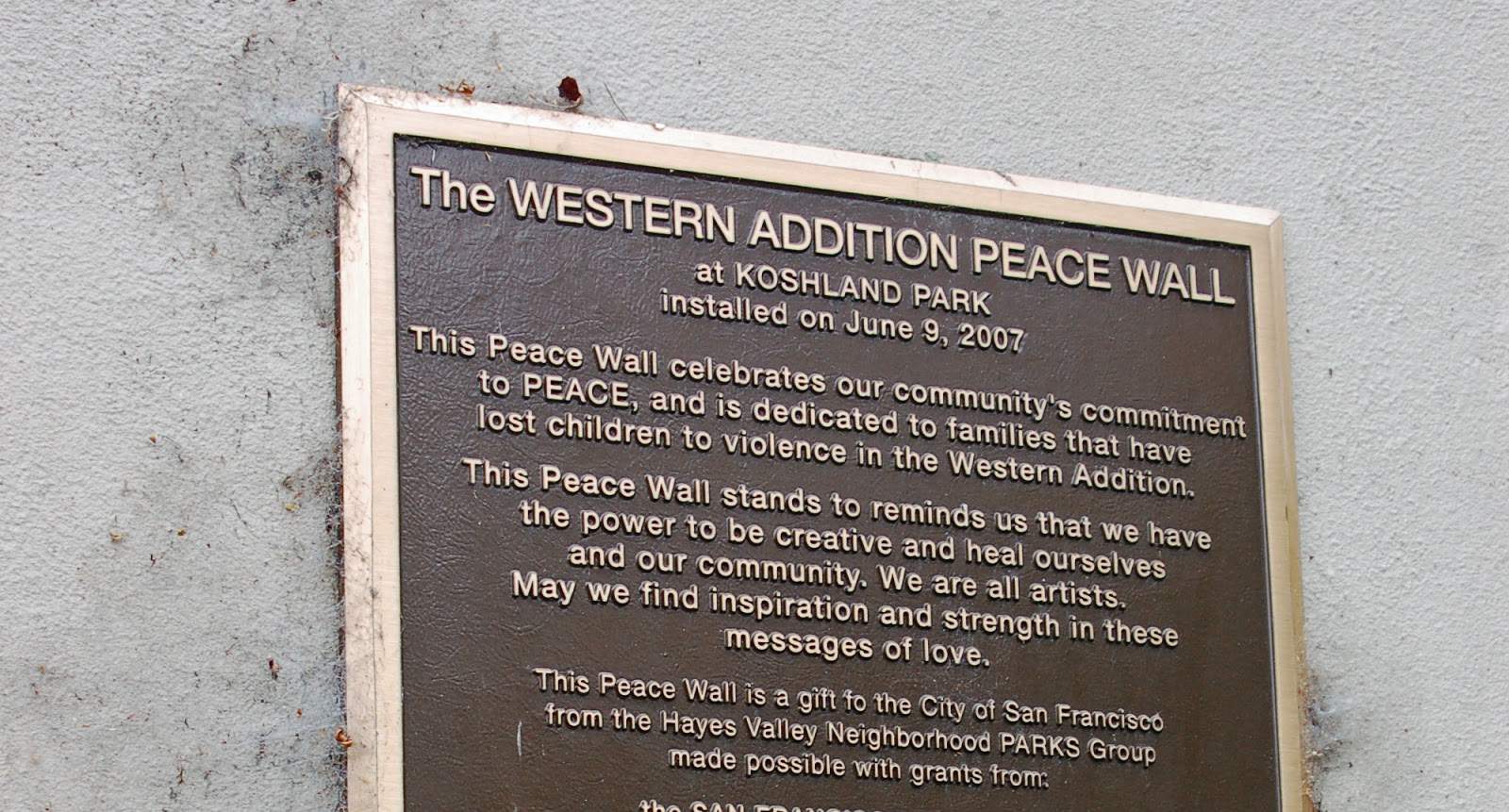
Saturday scenery: Western Addition peace park

After this week that saw the police killings of Alton Sterling in Louisiana and Philando Castile in Minnesota capped by the sniper shootings of five Dallas cops working a peaceful anti-police violence procession, here's how one San Francisco neighborhood responded to local violence in the last decade.

Community residents got grants to design tiles in memory of children lost to violence in this gentrifying enclave next to some of the city's least picturesque public housing.

Some of the resulting "art" seems trite.

But some tiles are challenging ...

... some topical ...

... some childish in the best sense.

Girls Scouts from the Chinese-American school contributed.

Several hundred feet of retaining wall carry the tiles.

There's nothing easy about peace.

All encountered while Walking San Francisco.


Friday, July 08, 2016

Criminals in our midst

A British report -- named after the author Sir John Chilcott -- has told us what we already knew about the U.S. and British war on Iraq: this was an con job perpetrated by elites on their own peoples. They knew or could have known (and if you are the government that's just as bad) that Saddam Hussein was no threat to anyone but his own people. They knew or could have known that they had no plans for what would happen once their armies had crashed into Iraq's cities. They knew or could have known that the country was likely to tear itself apart in sectarian and ethnic rivalries once the dictator was removed. They knew or could have known that thousands of Iraqis who had never wronged them in any way would die and/or be made refugees on their initiative. But they made their war anyway and have paid no penalty for instigating the carnage that continues to this day. They should be defendants on a trial for disturbing the peace of the world, not comfortably retired.

Erudite Partner (Rebecca Gordon) responded to the report at Juan Cole's Informed Comment, always a good source on the interactions between the Muslim world and the West. Her article, Surprise! It was a War Crime, is worth checking out in full. Some highlights:

... members of the Bush administration, including Vice President Dick Cheney and his longtime associate Paul Wolfowitz, actually came into office with an explicit plan ... The ultimate goal would be a realignment of power in the Middle East, with Syria destabilized, a Hashemite king ruling Iraq, and a new regional alliance among Turkey, Jordan, and Israel.

Syria has certainly been “rolled back” in a civil war that has claimed hundreds of thousands of lives and made over half its population either internal or external refugees.The US invasion or Iraq did not cause the Syrian civil war, but it unleashed the shock waves—as Wolfowitz and his co-authors predicted and hoped—that made it possible, as well as creating the conditions for the rise of extremist forces like the Islamic State.

... It’s clear, too, from the Senate torture report and other public records, that U.S. torture in the “war on terror” began because Cheney, Rumsfeld, and Bush needed a reason to invade Iraq. The CIA tortured Abu Zubaydah into saying that Saddam Hussein was in league with al-Qaeda in the 9/11 attacks. They shipped a Libyan named Ibn al-Shaykh al-Libi, who probably had been an al Qaeda trainer, to Egypt. There he was waterboarded until he agreed to the proposition that, as President Bush put it in an October 2002 speech to the nation, “Iraq has trained al Qaeda in bomb-making and poisons and deadly gases.” Donald Rumsfeld wrote his famous memo okaying torture at Guantánamo in hopes that someone there would say the same thing. ...

These men, and their underlings, and their abettors should be in the dock.

Friday cat blogging

Morty can be such a dignified fellow -- you might almost think this was his nature.

Until he does something like leap to the top of a closet door. I don't know what he thinks he'll find up there. Nor, after he gets there, does he seem to remember either. Getting down is usually not so dignified.

Thursday, July 07, 2016

Taking the case to the San Francisco Police Commission ...

Mark Scandrette, Fr. Richard Smith, and La Mesha Izarry

Still no word from the San Francisco District Attorney about charges for the San Francisco Police Department officers who shot Amilcar Perez Lopez six times in the back in February 2016. Neighbors, local clergy and activists took their complaints to the Police Commission Wednesday night, pointing out that the PD removed Amilcar's body from the scene before the D.A.'s office could investigate, violating orders and protocols.

The complaint is just one more avenue to try to move a system that kills black and borwn people with impunity and protects the killers.

Wednesday, July 06, 2016

Happy Birthday to me!

As I turn 69 today, I find myself enjoying a season of unalloyed personal delight as great as any of us are likely to get in a fucked up world.

EP and JA at Portland Marathon, 2000
Why? Because in act of extreme self-indulgence, abetted and enabled by Erudite Partner and my long suffering friends, I've spent the last six months training my aging body to run a 50K trail route at the end of July. This means I have spent endless hours lumbering in the beautiful country around San Francisco, running ten weeks of over 40 miles per week, and 4 of those more than 50 miles. I can do it!

I am a no-talent runner. I never had any speed and I have less at this age than I ever did. I've always been a Clydesdale (a woman runner over 140 pounds), not one of those scrawny, speedy waifs. I enjoy treating my aging body as an interesting, if sometimes frustrating, "experiment of one" as the great running evangelist Dr. George Sheehan suggested that we all do, voluntarily or involuntarily.

Maybe we could blame John F. Kennedy for my passion. The young president came into office in 1960 when I was in eighth grade, bursting with life and advocating physical fitness. Soon we school children were subjected to annual fitness tests -- my favorite part was the half mile run in which I could outlast my agile classmates. But even more, I was attracted to Kennedy's challenge to try a 50 mile hike. The practice became something of craze in 1962-63. I persuaded my parents to let me try. I think I made 16 miles before blisters did me in. But I was hooked on the notion of going far on foot. And I have forged on ever since, on many hiking adventures and a few marathons.

So why stop now? Besides, this year is the 20th anniversary of Californians for Justice, so I'm making my current 50K jaunt a fundraiser I'm calling a Long Run for the Long Haul.

What is Californians for Justice?
Twenty years ago, an initiative seeking to reduce access for young people of color to state-sponsored educational opportunity (Prop. 209) spurred community groups to support the birth of a new organization.

Californians for Justice organized young people and their parents to struggle for racial justice then; Californians for Justice still organizes youth to develop leadership skills and to win improved public education today.

Californians for Justice believes that young people are the leaders our state needs to win the healthy, just and vibrant schools all of our communities deserve. We ensure that students have the opportunity to grow as leaders, and work with them to win campaigns.

When students are part of the decisions that shape the future of California’s schools, students, schools and communities are set up for lasting success. Young people will be able to thrive and achieve no matter where they’re from or where they go on to.

The Long Run has already raised over $1800. Thanks to all who have contributed. We can do more; please chip in if you can for the young people who are the future of California.

Tuesday, July 05, 2016

Digital utopia?

Okay, so our digital economy has transformed the lives of many of us, probably all of us whether we quite know it or not. So how do we make this bounty and its disruptions serve most people instead of making us serfs of entrepreneurial innovators? Throwing Rocks at the Google Bus: How Growth Became the Enemy of Prosperity by Douglas Rushkoff certainly comes with a sympathetic title; I live a block from where several years ago activists blocked the giant white whales of Silicon Valley on their rounds. I see these buses daily and bemoan how the affluent workforce they transport, mostly inadvertently, is reshaping San Francisco to the detriment of our poorer residents and our passionate, quirky culture.

So I'm very open to someone trying to envision how to make something humane of all this invention and profit. Rushkoff is a professor of Media Theory and Digital Economics at CUNY/Queens and media commentator/creator. His project is ambitious; as I read along, I kept thinking of those revolutionary 19th century futurists: Bentham and Mill, Marx and Engels, Kropotkin and Tolstoy -- all big thinkers who tried from their various vantage points to make sense of how industrial capitalism was remaking societies.

Rushkoff wants to influence our understanding of the world on that level. He is propounding a unified theory of the digital economy, situating contemporary innovations in the history of both technology and power relations. According to Rushkoff, Silicon Valley and its progeny including companies, venture capitalists and the technorati have built "digital industrialism" instead of allowing networked peer to peer potential to run to its more humane conclusion. In particular, financial capital has channeled the potential of technologies toward cancerous growth instead of cooperative development at human scale.

And he has concrete prescriptions for a better future (grabbed here from the author's book synopsis):

• Accept that era of extractive growth is over. Rather, businesses must – like eBay and Kickstarter – give people the ability to exchange value and invest in one another.

• Eschew platform monopolies like Uber in favor of distributed, worker-owned co-ops, orchestrated through collective authentication systems like bitcoin and blockchains instead of top-down control.

• Resist the short-term, growth-addicted mindset of publicly traded markets, by delivering dividends instead of share price increases, or opting to stay private or buy back one’s own shares.

• Recognize contributions of land and labor as important as capital, and develop business ecosystems that work more like family companies, investing in the local economies on which they ultimately depend.

Like many futurists, Rushkoff is able to draw a picture of attractive, even plausible, potentialities -- yet never quite gets to that essential step in which we somehow turn a powerful class which holds most of the money away from perpetuating the existing arrangements that have served them so well. I don't have the answer either, but history says this only happens through either social collapse or when the losers in the prevailing economy band together to demand we do things another way.

As I was reading along in this book, I kept having a feeling of deja vu that I couldn't quite place. Where had I encountered thinkers who structured their prescriptions in the way Rushkoff does? Suddenly I realized where: in the Catholic Worker movement whose intellectual leaders, Peter Maurin and Dorothy Day, promoted the "distributism" advocated by 19th century Pope Leo XIII. This was Catholicism's intellectual and moral response to Marxism. It seemed weak tea, but perhaps it has outlived that more muscular revolutionary tradition which degenerated into Soviet-style "actually existing socialism." Rushkoff credits the seemingly bypassed Catholic tradition and finds hope in Pope Francis' writings.

No, we don't need to convert to Catholicism or even approve of Vatican doctrine in order to appreciate the popes' vision of a more distributed economy and to see how it can contribute to our own. ... A form of networked distributism may just be our last best hope for peace in the digital economy today. The conscious application of more distributist principles into the digital economic program could yield an entirely more prosperous and sustainable operating system. Instead of simply amplifying the most dehumanizing and extractive qualities of industrialism, it pushes ahead to something different -- while also retrieving the truly free-market principles long obsolesced by corporatism.

Well maybe -- though I'm unconvinced, I appreciate anyone trying to see their way into a better society.

But I have to ask (and I don't think Rushkoff answers persuasively either question) 1) how do we get to your vision? and 2) who is "we"? who is included?

Monday, July 04, 2016

"Oh! what a lovely war ..."

Homage to past glories on our national day.
Since we're celebrating "rockets' red glare, bombs bursting in air" today, it seems like a good moment to check in on our wars. It's not a pretty picture.

Bombs have sure been bursting in Istanbul, in Dhaka, and in Baghdad.

Our governments (I'll include among that "us"not just U.S. allies, but also governments at the scenes of carnage) blame ISIS. And I don't think ISIS is denying authorship of these horrors.

Peter Beinart points out the killers are not without pretexts for their atrocities, even though there is no excuse for random murder.

The mid-20th century theologian Reinhold Niebuhr once wrote that, “America was menaced as much by its own pretensions to virtue as it was by world disorder.” Niebuhr was no pacifist, nor did he draw a moral equivalence between the U.S. and Hitler’s Germany or Stalin’s USSR. But he urged American leaders to acknowledge that even in just wars, “tyranny [is] defeated with instruments tainted by evil.”

The United States has intervened militarily to prevent ISIS from conquering Iraq and Syria. In that effort, it has carried out more than 10,000 air strikes—strikes that kill many people but go largely unnoticed in the American press. America’s current war may be justified. But America is not innocent. By pretending it is, [Marco] Rubio and other politicians [including Ms. Clinton] mislead Americans about the reasons for ISIS terrorism. And they prevent an honest debate about the costs and benefits of America’s war.

We would rather look away, but we could do with some reminding. The Soufan Group says ISIS is being defeated militarily, but that only points to more suffering and butchery.

Over the past two years, the West has focused on this phenomenon: the persistent and rising threat of attacks such as those in Istanbul, Paris, Tunis, Brussels, San Bernardino, and Orlando, altering policies, laws, and tactics. As the Islamic State enters its third year as a self-proclaimed caliphate, this phenomenon—in which the Islamic State inspires people around the world to act in its name—has completely detached itself from the physical group. This threat to the West will remain, and perhaps grow, as the group suffers increasing losses on the ground. 

But to the millions of Syrians and Iraqis who experience the Islamic State less as a phenomenon and more as a daily existential threat, the announcement of a caliphate was the weary culmination of a long-term corrosion of governance and stability. Life in Raqqa, Mosul, Fallujah, and many other cities and villages was dreadful in the years before the announcement and remains dreadful two years on. Only in the West did the events of June 2014 come as a surprise. 

... As Syria and Iraq mark the second anniversary of the Islamic State, there is reason to hope that a third will not come; however, there is little reason to hope that the group will not re-emerge in some shape or form in the future. The scale of the problem in Iraq—and, even more so in Syria—is beyond comparison and beyond the current capabilities of local, regional, and international actors to resolve. 

Meanwhile, we've got 51 State Department officials calling for deeper U.S. dabbling in the Syrian civil war. Nothing in likely-President Hillary Clinton's past or present pronouncements suggests she knows better. In fact she'd likely embroil us all more deeply. (And yes, we do have to elect her; this is no time for purism.) And then comes word that the Syrian faction allied with al Qaeda has captured the leader of a U.S.-favored "moderate" combatant group -- and presumably all those lovely weapons we've sent him.

Mother Jones blogger Kevin Drum got it right when contemplating our leaders' prescriptions:

This stuff never stops. Everyone wants a miracle cure in the Middle East: the mythical "just right" military response that doesn't involve ground troops; won't get any Americans killed; and doesn't take very long — but that will be magically effective anyway. It's nuts. ... It's snake oil.

Very deadly snake oil, mostly for other people.

Sunday, July 03, 2016

And now for another round of hating homeless people

Sometimes a warm laundromat is the only available place to take a nap.
We do this in San Francisco every few years. Shocked to notice that, yes, as rents soar and old housing burns, there are still people living on the streets, we vote to try to disappear them.

This November, homeless hate will take the form of a ballot measure ordering the police to tear down homeless people's tents, with 24 hour notice and an offer of a shelter bed. Except there aren't any shelter beds for most people on the streets. And we know that they seldom get their seized possessions back. Concurrently, we'll have the chance to push the police to somehow stop car burglaries.

Here's the real story from journalist Tim Redmond:
The key to understanding the two homeless and street crime ballot measures sponsored at the last minute by Sups. Mark Farrell and Scott Wiener is that neither of them has anything to do with homelessness or quality of life crimes.

... Neither measure would do anything that the city can’t already do. It’s already against the law to camp on the sidewalk. It’s already against the law to break into cars or spray paint tags on buildings.

It’s long been the policy of the city that the police first go after serious crimes – murder, rape, assault, arson, robbery, gun violence hate crimes – and that car break-ins, which are almost impossible to solve, aren’t at the top of the list.

... Wiener and Farrell are looking for wedge issues, things that they can use against the progressives. It’s an old tradition among San Francisco candidates who want to cynically use problems like homelessness to advance their careers: Gavin Newsom was elected mayor to a significant extent by running a side campaign called “Care Not Cash,” designed to take money away from homeless people. (And now, in a few years, he may be governor of California.) ... Demonizing the homeless worked for Newsom. Making the cops arrest people for minor crimes while homicides remain unsolved may play well in some neighborhoods. ...
We hold these sham votes over and over. During the last one -- the ballot measure that criminalized sitting or lying on city streets -- I assembled a two part history of these nasty charades, here and here.

It's not like we don't know what homeless people need: they need housing. We choose not to organize ourselves to make it available to them. No, we've made a glittering playpen for tech moguls and their underlings.

Saturday, July 02, 2016

Local media call for Homeless People Vivisection Week

Homeless people live in San Francisco; how can this be? The Chron called on local media to chime in. Some of resulting commentary has been truthful: see Tim Redmond on Why are so many people homeless...? at 48 Hills. Simply put, we've acquiesced in a city and a society which doesn't value providing housing (or any kind of decent life) for everyone. We are not all in this city together; if some people could throw some other people off a convenient cliff, they would. In fact they have.

While Walking San Francisco, I get to see a lot of how we try to drive away unhoused people.

We build barriers to sitting for those without chairs.

No leaning against that planter!

Don't try to grab a nap in a car ...

Or try to rest outside this clinic in the "wrong" hours. Apparently they've given up on suggesting an alternative. You are on your own.

Don't expect to be able to hang on to your property. This neat pile was built up by city workers about to take it away to wherever it is they go with homeless people's belongings. Actually Mission Local investigated: Property of San Francisco Homeless Routinely Disappeared by City.

Sometimes homeless people leave their own mark on the streets:

I'm still homeless. U sick people take and rob, rape, and plunder my nonexistant life. U R false hope.

My transcription and punctuation for clarity.

Friday, July 01, 2016

Friday cat blogging

That's Tokyo doing her fur ball act. She's good at it.

Meanwhile, Morty guards his purple catnip toy on the rug.

Have I mentioned that two cats is a lot more cat than one cat, especially if they are wary of one another?

Thursday, June 30, 2016

Here's what happens when you kick people who could vote ...

They learn to vote. TPM reports:

“The beauty of this country is that we have a voice,” Ehsan Islam began as he looked out onto a room so crowded for Jummah [Friday prayer] that some of the men were on a tarp outside. “We live in a state that is a swing state, that is a very important state, and all the candidates are going to be fighting over this.”

“We can decide the outcome,” he told congregants at the Dar Alnoor Islamic Community Center in suburban Washington, D.C.

There in Virginia, if not across most of the country, he might have a case.

US Muslims are responding to the fear and hatred stirred up against them by the Donald and an industry of Islamophobes just as so many communities have before them: they are organizing themselves to register, to vote, and working to make politicians aware they need to listen up.

According to a New York Times report,

Muslims make up about 1 percent of the United States population. A study conducted by the Institute for Social and Policy Understanding, a nonpartisan think tank, found that only 60 percent of citizens who are Muslim were registered voters, compared with at least 86 percent of Jews, Protestants and Roman Catholics.

“A lot of Muslims didn’t participate in elections because they didn’t see a lot of difference between the parties,” said Emir Sundiata Alrashid of the Lighthouse Mosque in Oakland, where a voter-registration drive was held last month.

The Donald is changing that, big time. And while not amounting to hu-u-ge numbers in most locales, potential Muslim voters are mobilizing.

The Council on American-Islamic Relations (CAIR) offers a toolkit which includes sample questionnaires tailored for local and federal candidates to probe their views on such matters as religious freedom and immigration. The toolkit also includes a "religious pluralism pledge" affirming free exercise of religion which candidates can be asked to sign.

Such tools are the nuts and bolts for getting into the US election game, a game that any community under siege needs as one of many defensive fronts.

Wednesday, June 29, 2016

Still thinking about Brexit

Here in California, we are accustomed to living in a system with a lot of direct democracy, a system where voters can vote on nearly everything, matters vital and trivial. We think it is only normal that we can overrule our representatives in the Legislature and even our Governors. This November, we'll be voting on at least 10 statewide propositions -- and maybe more. That's how we live. By and large, our more successful politicians try to anticipate and conform their actions to policy preferences bubbling among constituents. The ability to meld popular enthusiasms with workable policies is the job of a politician. Otherwise we get terrible law (like the anti-tax rules of 1978's Prop. 13) and many pols lose their jobs.

In Britain, there have only been three all-country referendums since 1975: the first on joining what became the European Union, which passed; the next on adopting something rather like the "instant run-off" voting that we use in San Francisco, which failed; and then the recent vote for Brexit, the vote to leave the EU. Brits don't do this very often.

Compared with what we have in California -- for better or worse -- Brits have a much more attenuated democracy. Without a written constitution, all power resides in Parliament; the party that controls the House rules. Brits have elections for Parliament, but the politicians don't seem to very closely mirror the sentiments of their electors. In the Brexit vote, only 24 percent of the members of Parliament came out for leaving the EU. This suggests that probably more than half of them were out of tune with their constituents. Pointing this out is not to fault them as individuals for failing at some ideal representative function; it is merely to point this is far from unusual in British democracy.

In general elections for Parliament, the regular mode in which British voters express their democratic druthers, it is possible to get quite distorted outcomes that don't look very democratic (small "d") from over here. I've grabbed some charts from the Wikipedia on the 2015 election. Note how little correspondence there is between the percentage of the vote each of the parties won and the number of seats that vote translated into. In particular, the over 12 percent of all voters who picked UKIP (the anti-immigrant party) and got one lousy seat for their pains likely were thoroughly pissed. This can happen in a multi-party system where the victory goes to whoever claws out a plurality within a geographical constituency.

The voters' preference for Brexit seems to have thrown British democracy into a tizzy. Both big parties, Labour and the governing Conservatives, are embroiled in unforeseen leadership struggles; Scotland and Northern Ireland which voted "Remain" are threatening secession; and all this while everyone is trying to absorb the shock of possible major economic and social rearrangements.

E J Dionne in the Washington Post does his pundit thing:

Don’t trash democracy or the voters. Where complicated choices are involved — and Brexit defines complexity — leaders in representative democracies need the guts to make hard calls and submit themselves to voters afterward. They should not use referendums purely to evade responsibility.

[He attributes the Brexit victory to racism.] ... Responsible officials should always be ready to denounce racism. But their job description also requires them to provide realistic policy answers to quell the rage. If center-right and center-left politicians fail to do this, their parties will remain suspect.

That is, in Dionne's view, the kind of not very democratic democracy Britain employs only works if smart leadership is in place to rescue a volatile electorate from itself.

Yet it does seem obvious that if large segments of the electorate felt, accurately, that they were more fairly represented, they might be less volatile, less inclined to throw the system into tipsy gyrations as they just have.

And yes, our electorate here also needs to feel represented, at least in substantial majorities, or our institutions won't work either.