Sunday, May 08, 2016

Media, manifestos and other manipulations

These days one of my favorite podcasts is On the Media. Don't be put off by concern this is just endless criticism of Fox News -- or more exposés of journalist bias. After 15 years doing the program, Brooke Gladstone and Bob Garfield have figured out how to define anything that interests them as within their subject matter. The result is idiosyncratic, eclectic, informative, and often funny.

For example, on the linked home page as I write, there are programs about a 1957 film whose plot has elements of the Trump moment, exploration of the legal battle over access to academic archives that may contain evidence of crimes by the IRA in Belfast, and a dissection of the propaganda battle over a drug that may -- or may not -- treat female sexual dysfunction.

Or, if podcasts aren't your thing, you can read Brooke Gladstone's comic book: The Influencing Machine. Like the show, this is serious reporting and reflection, delightfully presented. Gladstone plays the same role she often adopts in her interviews: she's the endlessly curious innocent who asks all the embarrassingly ignorant questions you wish weren't ordinarily skipped by less secure journalists. Here, she recounts the history of the interaction between technology and media, from ancient Mayan artists through Twitter addicts. She punctures the various pomposities that journalists have adopted in each epoch. She doesn't have a high opinion of many practitioners of her own craft -- or so her character here suggests. (If she really had as low an opinion as she conveys, I don't think she'd be able to attract so many media figures to submit to interviews on her show. From the sound of these, they like and trust her.)

The book includes an observation on U.S. journalism worth remembering. She highlights the pattern through which U.S. governments draw us into wars. Whether it was the first Gulf War, the Spanish-American conquests, World War I, Vietnam, or Iraq II, the pattern is the same.

Whether dead babies, the sinking of the Maine and the Lusitania, the attacks in the Gulf of Tonkin, or Saddam Hussein's weapons of mass destruction, the premises for going to war usually are built on partial or total fabrications. Fundamentally, this is because our government does not trust us to come to the right conclusion -- that is, to go to war.

... Combat reporters focus on the fighting. The reason, our reason for fighting, is lost in the fog of war. And once that's lost, it takes a long, long time to recover.

Yet she is not about to blame our ignorance or distraction entirely on governments.

Once I was confronted by a gaggle of high-ranking Chinese journalists who pointed to several instances in which American news outlets pulled their punches when reporting on the Bush administration and the Iraq war. They said they proved the American media were afraid of the government.

That's ridiculous, I replied. The American media are not afraid of the government. They are afraid of their audiences and advertisers. The media do not control you. They pander to you. ...

Both the podcast and Gladstone's comic are U.S. media at their best: diligently researched, thoughtful, and vastly entertaining.

Saturday, May 07, 2016

Remembering Fr. Daniel Berrigan

The photos that appear here are scanned from a book that seems to have disappeared from historical consciousness, A Spectacle unto the World: The Catholic Worker Movement by psychologist Robert Coles, with photos by Jon Erikson. I am feeding them here into the vast maw of the world wide web that they may not be forgotten.

When Fr. Dan was released from Danbury Federal Prison in 1972 after serving his sentence for burning draft files at Catonsville, he came to the First Street house of the New York Catholic Worker to say mass among the community.

The kitchen table on which meals were prepared served as his altar.

Here Frank Donovan receives the blessed bread.

Jon Erikson was horrified by the poor quality of his publisher's reproduction of these photos; my scans have further degraded them. But they retain some power nonetheless.

Friday, May 06, 2016

Good news for discouraged San Franciscans and other Yanks


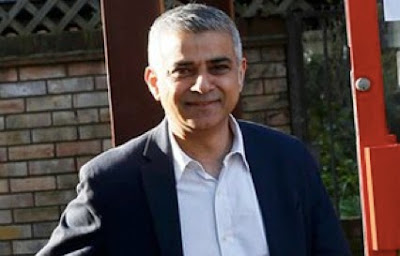
London has elected a new mayor, a Muslim of South Asian origin from the Labour Party. He states his priorities:

[Saddiq] Khan had said he would make solving London’s housing crisis a key priority, and place a freeze on public transport fares for four years.

He said he would set a target that half of all new homes should be “genuinely affordable” and promised to boost landlord licensing, as well as name and shame rogue landlords.

The Conservative campaign against Khan tried to make him out to be a Muslim extremist, unsurprisingly.

Don't know if he can deliver anything, but it is always good to see the voters get tired of the hate.

Four decades of European barbarism

The title of Ian Kershaw's history, To Hell and Back: Europe 1914-1949, got my attention by getting the periodization right. We've achieved enough distance on World War I and World War II to see them as just a single, awful, very long, war -- a convulsion emanating from one continent that engulfed the globe.

When I read a sweeping history written for a popular audience that covers material in which I'm moderately well read, what fascinates me is the historiography, how the author has chosen to structure his story. This British historian of Hitler's Germany is wonderfully clear about the frame in which he is writing: his subject is

four interlocking major elements of comprehensive crisis, unique to these decades: (1) an explosion of ethnic-racist nationalism; (2) bitter and irreconcilable demands for territorial revisionism; (3) acute class conflict -- now given concrete focus through the Bolshevik Revolution in Russia; and (4) a protracted crisis of capitalism (which many observers thought was terminal).

Most European history currently being written in English is bent on correcting an overemphasis on western and northern Europe prevailing during the Cold War when Russia's trauma's and the dramas and horrors of central Europe were ignored "behind the Iron Curtain". If this volume did nothing else, its insistence that Russia, and the Baltic States, and the Balkans and all the other countries of the continent matter along with Britain, France, Germany and the Scandinavians makes a necessary correction to many previous narratives.

Often Kershaw emphasizes continuity as well as change. This is particularly true in reference to violent anti-Semitism whose potency he documents in the societies of Eastern and Central Europe throughout the period, from well before the first "Great War" and into the aftermath of Nazism's unspeakable culmination.

In seeking to understand the Europe that emerged from war's barbarism, Kershaw again identifies four themes that pointed into the next era:

... beneath the surface of Europe's dark age people's lives did continue to be shaped or reshaped in quiet transitions, unbroken if not untouched by the trauma... [These included] economic and social change[s], the role of the Christian Churches, the reaction of intellectuals and the 'culture industry'.

I would not have thought of the churches, since I would have assumed the carnage ended their widespread influence, even hegemony, over social life. Kershaw showed me I was generalizing too much from northern European experience.

This is a very good survey of some awful times and places. My chief complaint is that its broad European focus obscures the role of world wide empire in the war(s). Kershaw's sharp attention to all parts of Europe leaves little room for anything beyond cursory mention of the impacts of that continent's rivalries elsewhere. Sykes/Picot is more mentioned than explicated, as are the seething Indian subcontinent and Indochina. There was a lot of world and a great deal of war that gets short shrift here, as does the agency of non-European peoples.

This volume is the eighth part of a Penguin History of Europe series. Kershaw is to be the author of a subsequent volume bringing European history up the present. It will be interesting to read how he writes of a time when Europe became, though still rich and influential, so much less central to global developments. That's a big shift. And Kershaw is writing it in a moment when the configurations of European stability seem more precarious than in several decades. I look forward to whatever he writes; he's an insightful narrator.

Friday cat blogging

At Erudite Partner's book launch event at the University of San Francisco, her friends gave her a bouquet of tulips. Morty appreciated the digestive aid she'd brought into the house.

Thursday, May 05, 2016

The 'hood reacts to GOP nominee


These went up on bus shelters this morning ... somebody (or several somebodies) have it in for the guy in various idioms. Just in time for Cinco de Mayo ...

Wednesday, May 04, 2016

So this is the Republican nominee

A week ago this man repeated a vicious fairy tale of murder and magic that he maintains exemplifies how he'll deal with the problems of the world.

Go apologize to your Muslim neighbors. You may have trouble holding up your head if you think about it. Dana Milbank has a thorough run down of violent attacks on Muslims apparently arising out of the permission this man is giving his followers.

Then, follow Jamelle Bouie's advice every day through November 8:

Take a breath and say this aloud: Donald Trump will be the Republican Party’s nominee for president of the United States.

Say it again: Donald Trump will be the Republican Party’s nominee for president of the United States.

We will not let him become President.

Tuesday, May 03, 2016

A sustainability miracle

Until about three years ago, I hadn't lived with a dishwasher since college -- over 40 years. We lived in older houses and kitchen improvements mattered less than many other things. Then we finally upgraded the kitchen enough to make it functional, and put in this magic machine:

And now one or the other of us remarks every third day: "I love having a dishwasher!"

But is this wonder appliance good for the planet or bad for the planet? Good for the water supply or bad for the water supply?

Fortunately, that essential environmental publication Grist provides an answer, one I found a little surprising.

Estimate how much time it would take you to wash all of your dishes:

If it’s two minutes or less for the entire batch: Hand wash.

If it’s over two minutes: Use the dishwasher.

The best option: If you have enough plates and cutlery to do so, put your dishes in the dishwasher each night, then run it when it’s completely full. ...

Turns out we've been doing this right and can feel virtuous when using the wonder appliance. It seems that

kitchen sinks spew about two to five gallons of water per minute. If you’re letting your sink run the entire time you’re washing dishes, you’ve already used the same amount of water as a dishwasher after two minutes.

I had no idea; I just thought we'd acquired a serviceable convenience.

Monday, May 02, 2016

To my Hillary-supporting friends ...

You know which ones you are: mostly women, not so young, accomplished, fighters whose lives have been about negotiating a minefield of sexist disrespect and disregard, who see in our likely next president one of your own. You've changed what's possible for women over your lives and you want more. You see in Hillary a champion for the best of the feminism -- that belief in women, in yourselves, that got you through some hard times -- and want it extended to all women. I've worked with you and I profoundly respect your guts and grit.

But what if Hillary in office disappoints? Sure, you're pragmatists, so you expect some of that, but enduring the let down is never simple or easy.

I've got a book suggestion for you. In The Black Presidency: Barack Obama and the Politics of Race in America, a journalist and preacher out of the black church tradition, Michael Eric Dyson, mulls what to make of the experience of electing an unanticipated, almost miraculous, figure who (partially) embodies both your pain and hope -- and how to live with the real world result.

In reading this book, if we're white, we need to understand we're eavesdropping on someone else's conversation; this isn't primarily for us -- except that if Obama's presidency means anything, it means we've ALL been dealing, somehow, with the great national conundrum of white supremacy and race for eight years.

Race is the defining feature of our forty-fourth president's two terms in office. Obama's presidency is a lens to sharpen the details of American ideas about race and democracy. His presidency also raises the question of how much closer the election of a single black man may bring us to a more just and inclusive society. ... What we learn about Obama says a lot about what we learn about ourselves; his racial reality is our racial reality.

Dyson lays out his project:

I have offered principled support for the president in tandem with far more sustained criticism.

In particular, Dyson mourns that being the president of the United States has meant that Obama could not share in the internationalist, anti-imperial vein within black culture.

As the nation flexed its muscles as a global empire, it created an even more complicated situation for black citizens: as they were being eyed suspiciously by white citizens, America's growing global presence inspired black folk to become even more empathetic toward international struggles for human rights. The sense that they were citizens of the world often gave them courage to fight for their rights at home. It also gave blacks moral leverage to highlight the hypocrisy of America's playing moral cop of the world while denying basic human rights to its black citizens.

Holding accountable one of your own in whom you've invested hope is not emotionally simple.

Obama [has been] wedged between the obstructions of the right and and the obsessions of racists ... Some African Americans feared that the obstacles Obama faced would be used as an excuse not to help blacks, lest he appear to pander to his tribe. ... Obama has searched for the best way to talk about race without raising the ire of whites, but here his struggle has been less acute; he has worried little about losing black support.

... Race has gained such artificial importance in this country that one group could hog most of the resources for itself and leave all the other groups gasping for legal and political air. Obama often takes the knowledge of racial division as his undeclared starting point. By not stating it too much, or too loudly, he can rush past the traumatic memory of race to its positive resolutions. ... Obama is willing to underplay evidence of black suffering while promoting a naively optimistic view of the depth and pace of racial progress, as he did in the aftermath of the deaths of Michael Brown in Ferguson in August 2014 and Eric Garner a month earlier in Staten Island. Obama's appeal to his biracial identity as a means of resolving racial conflict has at times only served to heighten anxieties and muffle legitimate concerns ...

... Obama seems to feel he cannot hold white folk's feet to the fire even as he warms up to criticizing black folk explicitly. ...

Yet at the end of his presidency, Dyson concludes that Obama has found a way through the eye of the needle.

In the year following Ferguson ... Obama found a way to be the president of all America while also speaking with special urgency for black Americans. ... It is undeniable that presidential attention to a population and its issues can buttress the belief that democracy is for all Americans. ....

Michael Eric Dyson's The Black Presidency is both fascinating as an assessment of this president completing his term and a gift to all progressives of all races and sexes who have to figure out how we might encounter the likely next one. I "read" this book in an audio version; Dyson narrates it himself. He's a preacher and the result is wonderfully engaging.
***
A Clinton presidency is sure to confront many people who respond to her with enthusiasm with moments of ambivalence. Our first woman president can be trusted to care about matters that were abstract (and perhaps not worth fighting over) to her predecessors -- for example, repealing the Hyde Amendment which prevents government-financed insurance from covering abortion. That's going to take some doing with a Republican forced-pregnancy Congress.

On the other hand, many people who support Clinton, though wanting safety and security, aren't really looking for an endless series of U.S. armed interventions around the world. Clinton seems inclined to muscular military power projection. Obama's sensible "don't do stupid shit" policy (for all his drones, spooks, and his "looking forward not backward") seems likely to give way to American hegemony as usual. Lots of Clinton backers aren't going to like that. How will they negotiate the emotional contradiction of seeing "their" president as war-maker?

Of one conclusion we can be sure: she'll be preferable to Trump!

Sunday, May 01, 2016

To my Bernie-supporting friends ...

While you grieve, please -- please -- take a hard look at what has happened in this primary season and rejoice a little too.

Bernie (who I will vote for in the California primary) has come closer to pulling socialism (or at least social democracy) into the mainstream than any U.S. contender since perhaps Eugene V. Debs.

But Hillary Clinton will be the Democratic nominee because of the choices of the most excluded group in our democracy, African Americans -- especially women -- in the Deep South. If we believe that the Beloved Community -- or the Revolution -- should mean that "the last shall be first," we're seeing it, whether it accords with our druthers or not.

I sometimes think that when the southern states seceded in 1860, the North should have just let that backward region go. In fact, Southern absence from Congress enabled the legislation that laid the foundation for 19th century U.S. prosperity. Never would have happened with the plantation gentry around. Of course letting the South go would have also perpetuated slavery, a grotesquely immoral choice as abolitionists, black and white, noisily insisted at the time.

And I sometimes look at our own time and wish our national politics didn't have to take into account the bitter, biased, and ignorant views too often embodied in southern Republicans. But for Democrats to just back away from the solid white Republican south would be to abandon the most disenfranchised citizens of our country. Southern blacks lose and lose again, out-numbered by white voters who monolithically oppose their interests. (That's if they are allowed to vote at all, not robbed of their ballots by discriminatory laws.)

In this primary, the votes of Democratic Party black people in the South have MATTERED for the first time in a long time. Maybe the first time ever at the national level. If you are a serious progressive or leftist or whatever we're calling ourselves these days, that has to gladden your heart, even as you come to terms with the country's resistance to the nominee you hoped for. Bernie coming up short just means there's more work to do for a more just society. We've been in that hard place for a long time.
***
Part of the background noise of this awful election has been emerging evidence that a lot of white citizens have pretty dismal views of their present condition and prospects -- to the point of rising opiate addiction and suicide rates. (Also enthusiasm for the Donald which seems to me a little suicidal in itself.) Less well advertised is that black citizens are the most optimistic group in society. In specific, blacks even think the economy is doing well.

African-Americans rated the economy as good by a ratio of about four to one, versus about two to one for white Democrats and an even narrower margin for white Democrats without a college degree. A Times/CBS News poll in December found that, relative to two years earlier, roughly three times as many African-Americans said their family’s financial situation was better as said it was worse, while Democrats without a college degree were almost evenly split on this question.

Noam Schieber, New York Times

There are genuine rising expectations going on here.

Yet with those expectations comes a caution based on history. Journalist Farai Chideya commentating at 538 has some suggestions as to why older (and many younger) African Americans think Clinton is a better bet:

... a candidate speaking to the issues that a demographic cares about isn’t enough, no matter your race, and particularly so for black voters. Many black voters could support Sanders’s positions, but if they don’t think he knows how to wrangle Congress, there’s a risk in voting for him. ... one of the roles the president plays is interacting with Congress and pushing (or aiming to block) the passage of legislation. And black and white voters have very different experiences with government when it comes to supporting legislation. [A] University of Chicago study shows how, all other factors aside, black support for legislation means it’s less likely to be passed. If white voters support a bill, it’s much more likely to be passed and adopted. But if black voters support legislation, it’s actually less likely to pass.

That argues that black voters may have a tactical interest in an establishment candidate they think can work behind the scenes in their interest, and there’s a perception that Clinton may be better at insider politics.

Prudential concerns aside, most successful candidates have to prove able to speak to the hearts of at least some fraction of the electorate. We white people may not hear it, but Clinton clearly knows how to signify to many black people that she gets what matters. I was astonished to read this passage in Michael Eric Dyson's The Black Presidency: Barack Obama and the Politics of Race in America. After the Charleston massacre at Emmanuel A.M.E. Church, Obama confined his early comments to putting the murders in the context of other gun slaughters. Dyson thinks Hillary Clinton's response made room for Obama to become "racially unshackled" in his response to Dylann Roof's crime. She

... offered the country a far more comprehensive engagement with the racial politics engulfing Charleston and the nation. Clinton anchored her comments in black history; she acknowledged that African Americans had celebrated, the day before her speech, Juneteenth, "a day of liberation and deliverance" ... Clinton expressed confidence that the black folk in Charleston would draw on their faith and history to see them through: "Just as earlier generations throw off the chains of slavery and then segregation and Jim Crow, this generation will not be shackled by fear and hate."

Clinton argued that "it is tempting to dismiss a tragedy like this as an isolated incident ...." Clinton laid out the facts: blacks are nearly three times more likely than whites to be denied a mortgage; the median income of black families is $11,000, while for whites it is $134,000; nearly half of black families have lived in poor neighborhoods for two generations, compared to just 7 percent for whites; black men are more likely to be stopped and searched by police, charged with crimes, and sentenced to longer prison terms than white men, 10 percent longer than white men for federal crimes; black students suffer the vast re-segregation of American schools; and black children are 500 percent more likely to die from asthma than white children. ...

Clinton's remarkable oration was steeped in black culture and and charged with sophisticated analysis, and was a remarkably honest reckoning, by a major American politician, with both intimate and institutional racism -- racism of the heart, and racism in the systems of society. ...

At a moment of horror, that's a national politician calling out white supremacy. Let's the rest of us white folks try to do at least as well as Hillary Clinton.

Saturday, April 30, 2016

Saturday scenes and scenery: the Panhandle

If I were not Walking San Francisco, I would have never known that the "panhandle" extension of Golden Gate Park was an electoral precinct. I guess it makes a kind of sense. People without houses can register to vote in this city; they are required to furnish a location so the authorities can decide which ballot they qualify for. (They can list a mail drop to receive the ballot.) At times there have been lots of unhoused people who might call the Panhandle home; apparently they have registered here.

It is certainly a pretty place.

And much used by groups of friends at play ...

solitary reading ...

guitar practice ...

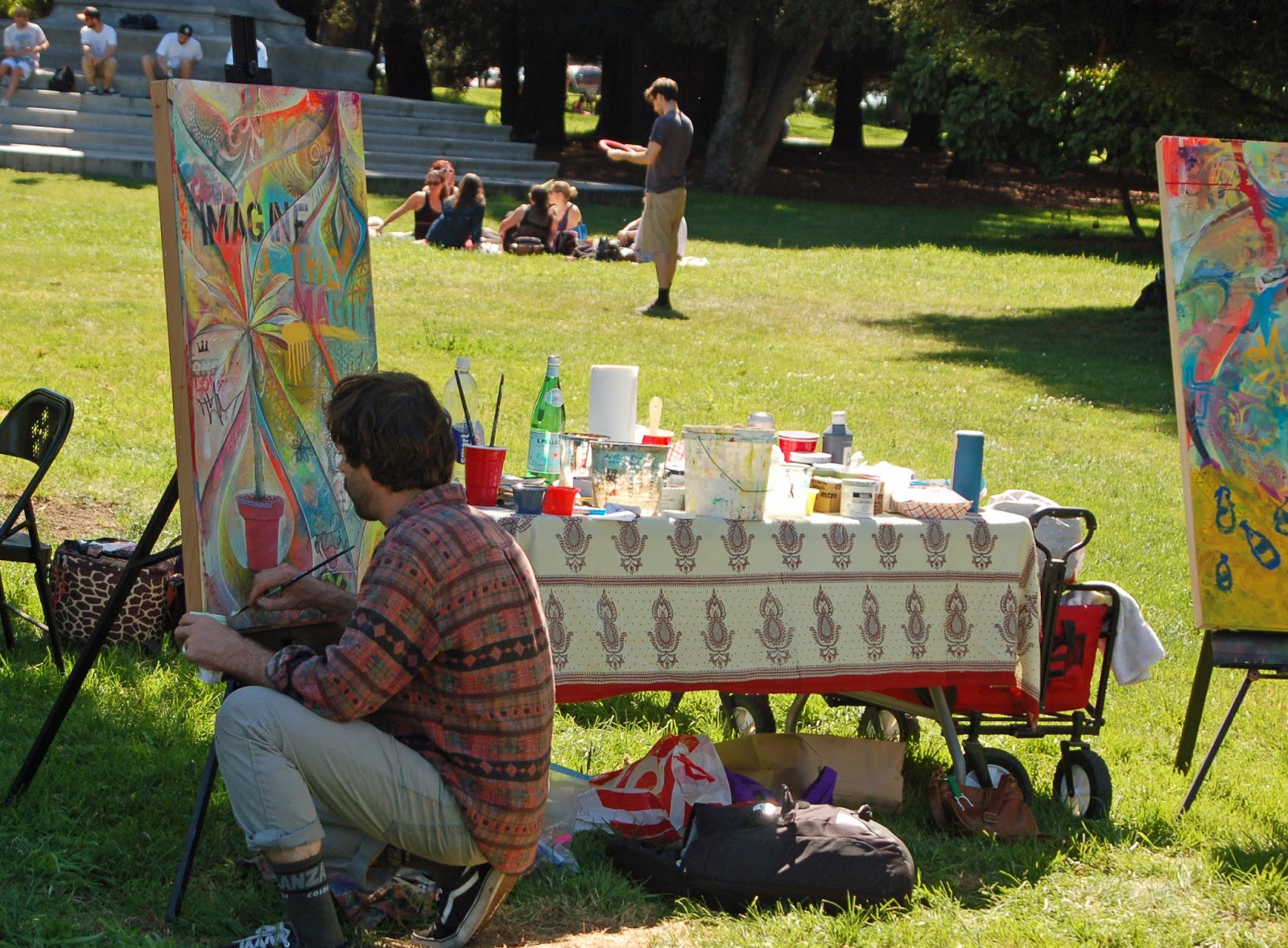
and creativity.

I'm not quite sure what the project is ...

but this set seem to be having fun in the sun.

On the one hand, I see remnants of the old "hippie" Haight-Ashbury of which the Panhandle was an extension. On the other, folks here seem more monochromatically white than I remember from those old days.

Friday, April 29, 2016

When is one thing like another?

The Pentagon has disciplined 16 service members for mistakes that led to the deadly airstrike on a Doctors Without Borders hospital in northern Afghanistan last fall, but no one will face criminal charges, The [Los Angeles] Times has learned.

December 15, 2015: The San Francisco police officers who exchanged racist and homophobic text messages in 2012 will be allowed to keep their jobs and avoid discipline, a Superior Court judge ruled Monday.

Police officials blew past the one-year statute of limitations set by the state’s Peace Officer Bill of Rights for any personnel investigation, Judge Ernest Goldsmith said, and waited too long to take action on the misconduct allegations that raised issues of bias in the department and forced the district attorney’s office to re-evaluate thousands of cases handled by those officers.

Somehow there is always lots of due process for the guys with the most guns. Not so much for the dead.

Book news

Busy days around here at book promotion central.

American Nuremberg has been released in an audio edition, read by the author.

And Erudite Partner has developed one of the themes from the book in The CIA Waterboarded the Wrong Man 83 Times in 1 Month published at The Nation.

She'll be speaking at the KPFA event on the left on June 15 in Berkeley.

Friday cat blogging

Sometimes it's just time for a nap on a warm surface.

Thursday, April 28, 2016

Primary fever is moving this way ...

As we come closer to California's June 7 primary, it's time for this unique voter registration video (featuring many friends). It is not to be missed. If you've moved, or changed your name, or aren't sure you are registered, you can do it all online at this link. Don't wait for the last day.

In fact, according to Capitol Weekly, voter registration in California has been soaring for awhile. That's normal in a presidential year, but this expansion has interesting features.

Overall, registration has skyrocketed in the first months of 2016. There have been over 850,000 registrations in the months between January 1 and March 31. This is twice as much as was registered during the same period in 2012. It even exceeds the total new registrations in the months leading up to the 2008 Primary ...

Each time there has been a big primary somewhere else, thousands have flocked to sign up, predominantly Democrats and Latinos. New registrants always skew young, since so many are just coming of voting age in any year. But look at the pattern.
Registration Growth Jan 1 – Mar 31, 2016 Compared to 2012

There are other changes.

... we see an amazing change in the way that voters can be reached by campaigns or pollsters – only one-in-five of the new registrants have a land-line phone number on the file. Yet, more than 50% have an email address – more than double the rate of voters with emails on the current file

Maybe someday campaigns will stop with the phone calls? I'm not holding my breath.

For all the strides California has made in making it easier for residents to register, I still think the requirement itself is ridiculous in this time of big data. Eleven states allow any resident to walk in to a polling place, show some kind of identification, and be checked online by poll workers, and vote on the spot. Not surprisingly, turnout is higher in these states. California has enacted same day registration, but not yet put it into effect. Maybe next election? More likely next year when this round is over ...

Wednesday, April 27, 2016

SFPD is a disgrace


They are also heavily armed.

More appalling racist and homophobic text messages from a former officer have come to light. The guy is a former officer because he ended up under investigation for rape and somewhere along the line the sort of things he said to his friends, including friends on the force, came to the surface.

"F--- that nig."

"They're like a pack (of) wild animals on the loose."

"Indian ppl are disgusting."

These are actually some of the less inflammatory ones.

Former police chief and present District Attorney George Gascon had a surprisingly perceptive and cogent diagnosis of the department:

"No. 1: There's a substantial number of people within the organization that are racist," Gascon said.

"And No. 2: There's a culture that has allowed those people to thrive and survive and even promote within that environment."

...Gascon likened the leadership of the department's union to police in Alabama and Mississippi in the 1950s. "They would probably feel right at home," he said. "It's a good old boys network that does everything they can to protect the status quo."

Over the last two years, the SFPD has shot and killed four men of color, three Latinos and one African American, in circumstances in which any claim officers were threatened by the dead men is simply preposterous. So far Gascon has not used his authority to charge any of the shooters for the killings.

San Franciscans continue to ask when Gascon is going to bring the force of the law to bear on our outlaw gang in blue.

Tuesday, April 26, 2016

Ease up, sister ... look before you shriek!


It happened to me again yesterday. While running the trails in Golden Gate Park, I stopped in at the public restroom at the Beach Chalet. Whew! -- no line out the door. On weekend afternoons sometimes these facilities are overwhelmed by restaurant and brew pub customers. But not this time ...

I step inside and a small blonde woman pipes up: "You're in the wrong restroom."

"No, I am not!" Fortunately a stall opened up just then and that's the end of it.

Often I'm a little more communicative when I encounter this gender anxiety. But hey, I was running. I was wearing nondescript, non-gendered running clothes. I look like a tall, old lesbian who doesn't give a damn what the world thinks about her appearance when she is trotting about outside. I look that way, because that's who I am, which I think is quite good enough, thank you very much.

All this to say, these stupid, vicious bathroom bills like the one in North Carolina are not only an attack on transpeople, although they are certainly a direct attack on the humanity of transpeople.

These measures are an attempt to shore up crumbling rules about gender presentation which seek to constrain many of us. But human beings are almost infinitely variable. If we were free to notice, most of us would not exactly fit conventional social definitions or what is a "man" or what is a "woman." Gender is a spectrum -- and some people aren't even on it, experiencing themselves as "non-binary." We can get over enforcing gender rules on other people ... or on ourselves.

Monday, April 25, 2016

Spain: carnage, confusion and courage

It is a truism that the victors get to write the history. In The Battle for Spain: The Spanish Civil War 1936-1939, Antony Beevor points out that the story of Republican Spain upends this pattern, presumably because General Franco's victorious Nationalists were functionally a branch of the Nazi/Fascist axis utterly destroyed in the European phase of World War II. The Generalisimo held on to power until 1975, but his dictatorship was a tainted relic of ugly memories.

Beevor's history is largely an account of military campaigns whose details are not gripping to most foreign readers; the larger history seems worth recounting, if only because, for those who didn't live through it, it might seem tangled beyond comprehension. The contemporary analogy is probably Syria's terrible civil war with its mix of domestic and international belligerents and deathly incompatible ideologies.

Franco's revolt against the democratically elected Spanish Republic was based in the imperial army in the African colonies, re-enforced by a collection of traditional monarchists, a feudal and obscurantist Roman Catholic church, Spain's own quasi-populist fascist movement, and industrialists and landowners determined to resume unchecked power. Though this was not a simple coalition to manage, the Generalisimo rapidly emerged as the unchallengeable leader commanding a coherent and ruthless military force in service of national dictatorship.

The Republic was a political mess, composed of ineffectual bourgeois democratic liberals, anarchist trade unions and cooperatives, and communists more loyal to Stalin's Russia than to Spanish liberty, all pulling and hauling for advantage. Not surprisingly, Republican forces were never effectively organized or properly led against the Nationalists and were crushed with enormous loss of life both in battle and through decades of reprisals. Modern estimates calculate that the Fascists were responsible for 3 to 5 times the number of political massacres committed by the left, with 150,000 to 200,000 victims.

That brief summary elides that this struggle was as much a proxy war among European states as a civil war. Hitler's Germany and Mussolini's Italy armed and equipped Franco's forces, tested their most modern aircraft and tanks in Spain, and sent "advisors" and even units of regular troops. The Soviet Union armed the Republicans much less generously, managed to extract Spain's gold reserves in return, and meddled in favor of the communists within the Republic's domestic political fracas. Britain and France dithered, unsure whether they feared fascism or communism more. The United States Congress passed a law forbidding supplying both belligerents, but our capitalists found ways to assist their kind. The internationalist left, mostly communists, raised brigades of foreign fighters to support the Republican cause. (I've bought Adam Hochschild's Spain in Our Hearts about the US contingent and will write it up soon.)

Beevor tells this story deeply, I think fairly, with empathy and sometimes disgust. If you want to know about Spain, this is a good book. Apparently it was a best seller in Spain on its release in 2006.
***
Reading Beevor, I learned about an episode of courageous integrity at the outset of Franco's brutal regime which I am sure is legendary among those who know it, but of which I had been ignorant. It seems worth sharing here. For simplicity's sake, I am taking this from a Wikipedia article which tracks other accounts.

In 1936, Miguel de Unamuno y Jugo was an author, poet, philosopher, one of Spain's most celebrated intellectuals, and rector of the University of Salamanca.
On 12 October 1936 the celebration of Columbus Day had brought together a politically diverse crowd at the University of Salamanca, including Enrique Pla y Deniel, the Archbishop of Salamanca, and Carmen Polo Martínez-Valdés, the wife of Franco, Falangist General José Millán Astray and Unamuno himself. According to the British historian Hugh Thomas in his magnum opus The Spanish Civil War (1961), the evening began with an impassioned speech by the Falangist writer José María Pemán. After this, Professor Francisco Maldonado decried Catalonia and the Basque Country as "cancers on the body of the nation," adding that "Fascism, the healer of Spain, will know how to exterminate them, cutting into the live flesh, like a determined surgeon free from false sentimentalism."

From somewhere in the auditorium, someone cried out the motto "¡Viva la Muerte!" (Long live death!). As was his habit, Millán Astray responded with "¡España!" (Spain!); the crowd replied with "¡Una!" (One!). He repeated "¡España!"; the crowd then replied "¡Grande!" (Great!). A third time, Millán Astray shouted "¡España!"; the crowd responded "Libre!" (Free!) This -- Spain, one, great and free -- was a common Falangist cheer and would become a Francoist motto thereafter. Later, a group of uniformed Falangists entered, saluting the portrait of Franco that hung on the wall.

Unamuno, who was presiding over the meeting, rose up slowly and addressed the crowd: "You are waiting for my words. You know me well, and know I cannot remain silent for long. Sometimes, to remain silent is to lie, since silence can be interpreted as assent. I want to comment on the so-called speech of Professor Maldonado, who is with us here. I will ignore the personal offence to the Basques and Catalonians. I myself, as you know, was born in Bilbao. The Bishop," Unamuno gestured to the Archbishop of Salamanca, "whether you like it or not, is Catalan, born in Barcelona."

"But now I have heard this insensible and necrophilous oath, "¡Viva la Muerte!", and I, having spent my life writing paradoxes that have provoked the ire of those who do not understand what I have written, and being an expert in this matter, find this ridiculous paradox repellent. General Millán Astray is a cripple. There is no need for us to say this with whispered tones. He is war cripple. So was Cervantes. But unfortunately, Spain today has too many cripples. And, if God does not help us, soon it will have very many more. It torments me to think that General Millán Astray could dictate the norms of the psychology of the masses. A cripple, who lacks the spiritual greatness of Cervantes, hopes to find relief by adding to the number of cripples around him."


Millán Astray responded: "¡Muera la inteligencia! ¡Viva la Muerte!" ("Death to intelligence! Long live death!"), provoking applause from the Falangists. Pemán, in an effort to calm the crowd, exclaimed "¡No! ¡Viva la inteligencia! ¡Mueran los malos intelectuales!" ("No! Long live intelligence! Death to the bad intellectuals!")

Unamuno continued: "This is the temple of intelligence, and I am its high priest. [Éste es el templo del intelecto, y yo soy su gran sacerdote.] You are profaning its sacred domain. You will win [venceréis], because you have enough brute force. But you will not convince [pero no convenceréis]. In order to convince it is necessary to persuade, and to persuade you will need something that you lack: reason and right in the struggle. I see it is useless to ask you to think of Spain. I have spoken."

... Unamuno was removed from his position of rector of the University of Salamanca by Franco and placed under house arrest. He died of natural causes before the year ended.
We all like to think we'd be courageous if confronted by political atrocity. But would we? The old man was.
Unamuno was escorted from the hall surrounded by howling, saluting fascists. Photo source.

Sunday, April 24, 2016

Earth Day conundrum

This Earth Day, I might as well share a dirty secret: I've loved living in Northern California during the dreadful drought of the last few years. We've had a little rain this winter (enough to make for this green panorama overlooking the city), but for an urban resident who takes to the hills to run trails, this winter has been dry enough to create no impediment. Mostly we've had day after day of lovely weather. I can't imagine a more pleasant climate for my personal taste than we've enjoyed.

Apparently I am not alone in this. Patrick J. Egan and Megan Mullin share their version of my observation and point out that our comfort with the weather is blocking urgency about rising temperatures.

For a vast majority of Americans, the weather is simply becoming more pleasant.

Our findings are striking: 80 percent of Americans now find themselves living in counties where the weather is more pleasant than it was four decades ago. Although warming during this period has been considerable, it has not been evenly distributed across seasons. Virtually all Americans have experienced a rise in January maximum daily temperatures — an increase of 1.04 degrees Fahrenheit per decade on average — while changes in daily maximum temperatures in July have been much more variable across counties, rising by an average of just 0.13 degrees Fahrenheit per decade over all. Moreover, summer humidity has declined during this period.

In order to more effectively raise awareness and increase public concern about climate change, our research suggests that we need to stop talking so much about rising temperatures. A focus on extreme weather events — which are easily understood by the public and have potentially much greater impact on human health and the economy — may be a better strategy.

And when we do discuss temperatures, we should acknowledge the temporarily pleasant side effects of global warming. But then we should stress that these agreeable conditions will one day vanish — like ice on a warm winter day. ...

Well maybe. Or maybe individual humans are pretty much incapable of generalizing from the minuscule evidence provided by our own experience to something so big, so without precedent in human terms, as the warming of our island home. We either believe the scientists -- who after all have delivered life spans exceeding 80 healthy years, the green revolution, and air conditioning -- or we don't.

Or, as David Roberts points out, we adopt a middle ground. The climate is warming and human beings' carbon pollution is the cause, but the change is not serious ... yet.
We know there is worse to come -- but it sure is a lovely season, isn't it?

We need leaders who take the long view and who listen to the scientists. Fortunately, they seem available if we insist we want them.

Saturday, April 23, 2016

Saturday scenes and scenery: Howard/Langton Community Garden

As I wandered about South of Market with my camera while Walking San Francisco, a friendly local invited me to explore inside the fence.

According to a timely Earth Day article at Hoodline:

It’s hard to believe this space used to be a parking lot. The property was purchased by the city in 1970 and turned into a playground. But over time it came to be known as “Needle Park”—a site where unsavory activities took place. In the late 1980s, Langton Street residents arranged for Friends of the Urban Forest to plant trees in memory of a neighbor who had died of AIDS. Today, the mature flowering fruit trees line the street along the garden. This was the first step towards neighborhood greening.

The area is divided into garden plots, but, as I often am, I was attracted by the garden's idiosyncratic artifacts.

The Buddha is peaceful, but this Guardian less so.

Not all the victims of the SFPD are human.

Someone has hung a hat.

And someone has hung a bat.

In a corner, the inevitable ceramic frog.

You can see for yourself off Howard St. between 7th and 8th.