When, a few months ago, I wrote about a biography of Mitt Romney written by Boston Globe reporters who had followed him since his days as Massachusetts governor, I felt I had to emphasize that I found the book "fair," "not a hit piece."
This video is a hit piece. It's purpose is to share with us what a cold, calculating, empathy-denying specimen of humanity Mitt Romney acted like when confronted by women whose story makes the case for gay people's need for the legal protections of marriage. It is harsh -- and, assuming it is true, Romney's lack of human concern for the women in front of him makes him come off as a sociopath, a robotic, self-interested man without normal feelings for those he meets.
I can't say whether this is fair, but I find it completely believable. Watch and consider.
Showing posts with label 2010 horserace. Show all posts
Showing posts with label 2010 horserace. Show all posts
Wednesday, July 25, 2012


Saturday, June 16, 2012
BHO makes me happy, again
Elections are good for politicians. The need for public approval can get them out of the elite bubble and remind them of their better inclinations. This works especially well when polling says their instincts carry more than 50 percent approval, but hey, it works.
That's my read on President Obama's executive order protecting some 800,000 young people from deportation for the crime of having undocumented parents. The DREAMers were brought to this country as children, raised here, educated here, grew to adulthood as part of the "we" that is "us"-- but were never able to be secure in their country, to work and to study legally.
Obama has always sought (if not very vigorously) a legislative resolution of the conundrum created by millions of people who live and work here without legal status. For decades, employers enjoyed their cheap, exploitable labor; they lived in the shadows without citizenship. Obama's immigration cops have deported over a million people during this administration, demonstrating "toughness" without, as usual, molifying the haters. Meanwhile Congress (mostly the Republicans) refused to pass a comprehensive immigration reform that would provide a legal route to citizenship for those the country attracted and exploited. As Nancy Pelosi tweeted yesterday: "Democratic-led House passed DREAM in 2010. GOP still obstructing."
This executive order not to throw out the successful children of mass immigration for two years is no solution, but it is a start. It's practical: we'd be simply crazy to deport the DREAMers after bringing them up. Of course this country can be dumb sometimes.
I believe Latinos already knew which of two relative evils is a little better. Immigration issues are personal in immigrant communities: it's about tossing out Mother or seeing a nephew shipped to a country where he never lived. When people don't have much power and a lot of pain, they are often very sharp at smelling out the lesser evil and choosing it. But Obama's order certainly will help him turn out Latino voters.
But Obama did right yesterday. And a few weeks ago he did right also, sensing a tipping point on marriage equality and getting on the right side of history. Elections are good for politicians.
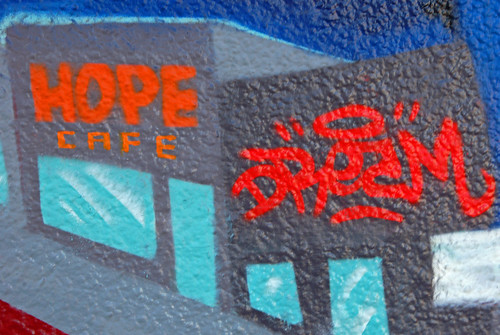
Photo is a detail from a San Francisco mural.
Tuesday, April 17, 2012
A likeable couple in an impossible place
 To my surprise, I greatly enjoyed New York Times reporter Jodi Kantor's The Obamas. This book about the Obama White House and the Obama marriage is my idea of light, enjoyable political reading.
Kantor's male Times colleague called this "chick nonfiction." Okay, it does have a woman's sensibility; what's wrong with that? People in politics are particular humans as well as celebrity creations sculpted by their pollsters and consultants. There's nothing wrong with trying to record the process of brilliant, tough, determined people trying to live into impossible roles. Kantor is just doing the same sort of human reportage that Walter Shapiro provided in One Car Caravan -- that tale is a fine male spiel and this is a fine women's yarn.
As a political history, The Obamas has some major omissions and what I consider errors. It's point of reference simply erases the Democratic Party's left constituencies (except Blacks) -- from this book, you'd never know that masses of people rose up in 2006 and 2008, alienated by President George W. Bush's Iraq war, mishandling of Hurricane Katrina, partisan corruption, and executive overreach. In the Obama-world portrayed by Kantor, Rahm Emmanuel cleverly and single-handedly won Congressional power for the Democrats in 2006 and Obama's campaign was entirely the product of his handlers' brilliance. Thousands of Democratic activists know better.
The only constituency segment that Kantor treats as a real factor in Barack Obama's rise is the Black community. Perhaps this reflects the attitude of the White House intimates? I'm not qualified to judge how accurate an observer Kantor is, but I sense truth in her portrayal of the isolation of African Americans who had achieved such a pinnacle of meritocratic success. No wonder that both Michele and Barack seemed to take awhile to find their selves in that oh-so-White mansion, built by slaves and tended by mostly Black servants.
Yet for all the book's obliviousness to the populist element in the Obamas' story, Kantor provides a telling vignette I've never seen elsewhere. Like many of us who put Obama in office, my greatest disappointment with this president arises from his failure to replace Bush's unconstrained, lawless "security" regime with the constraints of law and due process. She records this story of an Obama meeting with civil liberties lawyers in the spring of 2009:
When push came to shove, reinstating basic civil liberties was a project that Barack Obama couldn't rise to. In another passage, I think echoing how the White House approaches governing, Kantor writes that after Major Nidal Hassan's killing spree at Fort Hood (13 dead; 29 injured)After four months in office, it was becoming clear to him that the visions with which he had inspired millions upon millions of people during the campaign were going to be very difficult to achieve ….Obama had vowed to end Bush·era detention policies and close the Guantanamo prison, which years after the September 11 attacks still held untried terrorist suspects. Contrary to conservatives who argued that the United States could not worry about legal niceties when dealing with dire threats, Obama had declared, even after being sworn in, that there was no conflict between security and liberty. It was a classic Obama statement, following the same theme as his 2004 convention speech about red and blue America: once again, he was promising to resolve what seemed to be irresolvable.
He wasn't saying that anymore. The one-year deadline he had set for closing Guantanamo was still months away, but it was already clear he would not meet it. He had made that promise before administration officials read the classified files on the detainees, which showed that many of the cases would be much harder to resolve than he had anticipated. Congress certainly wasn't cooperating with the initiative to shut down the facility, even voting to deny funds for alternatives; no one wanted suspected terrorists housed in prisons in their states. Meanwhile, on a host of related matters such as releasing photos depicting detainee abuse, the administration seemed to be echoing Bush policies or adopting them with slight revisions. Obama shared little of the left's interest in prosecuting the former officials who had sanctioned policies such as "enhanced interrogation techniques," including methods denounced as torture, because it could criminalize those vital to counterterrorism efforts. …
He shared their constitutional concerns, he said, but Bush had left him a mess. Releasing the wrong detainee could result in new terrorist attacks, he said, and none of his options were comfortable ones. He urged his visitors not to overlook distinctions between Bush's policies and his own-for example, his ban on harsh interrogation techniques and the modifications he made to the military tribunal system set up by the former president.
… His face emotionless, he told his guests that he was considering an indefinite detention policy, allowing authorities to hold certain suspects without charges. It was an "oh my god moment," one guest said later. The legal rule was so basic, everyone knew it: suspects were innocent until proven guilty, entitled to speedy and fair trials. For a Republican president to violate the rule in the wake of a national catastrophe was galling to the guests. But for a Democratic president, a former constitutional law professor who had campaigned on protecting civil liberties, to make it official policy was shocking.
Before the gathering, the visitors had decided not to confront the president, for fear that leveling accusations at him would backfire. But Anthony Romero, the director of the American Civil Liberties Union, was deeply upset by what he heard.
"Mr. President," he began, eyes fixed on Obama, "I am a gay Puerto Rican American from the Bronx. In my entire life, you are the only politician in whom I have placed genuine faith. If you proceed the way you're indicating, I fear you will sacrifice your legacy and disappoint a generation." It was a well-crafted shot, aimed directly at Obama's belief that he was not like other politicians, at the fact that he had been elected because of the faith he inspired in others.
The president reacted viscerally, the attendees recalled. His jaw clenched, and so did the rest of his body. "Tony," he said, even though Romero went by Anthony, and launched into a reply about how he was doing the best he could, adding that ACLU statements comparing his administration to Bush's simply were not helpful. It wasn't the only time Obama snapped back defensively when confronted with supporters' disappointment. … The encounter ran far over its allotted one-hour time period, unusual for the Obama WhiteHouse. The president asked if anyone else had an urgent point to make before the gathering broke up. Romero urged Obama one last time to prosecute a Bush official. "Hunt one head and hunt it famously and bring it down to ensure we don't make the same mistakes again," he said.
"That's one man's perspective," Obama said dismissively, and the meeting was over.
My emphasis. So long as presidents let themselves be held in thrall by the occasional eruptions of mad men, this country hasn't got a chance of turning its attention to our vital problems. A mature country would catch terrorists and jail them, of course, but it would carry on. We need a mature President who can lead us in a grown-up direction. So far, we don't have one.… the nightmare of regular domestic terrorism attacks seemed more and more likely, which sent tremors through the entire West Wing not just its political precincts: there was no higher presidential priority than keeping the United States safe.
Kantor's book vividly describes an inexperienced executive and his uncomfortable spouse growing into their roles. He was unformed and she was uncertain when they moved into the White House. But by now they seem to have figured it out.
Kantor describes Michele as demanding a more disciplined, more strategic and more political approach to the Presidency than her policy-obsessed and oddly apolitical husband instinctively adopted. He sought expert management of a country in economic crisis and partisan division; smart people should be able to work out their differences. Michele, like many of the President's supporters, wanted him to find a better mix of policy and politics, perhaps even show a recognition that smart politics too was part of his project. She wanted him to find a way to transform the country in a more just direction, not just manage a cumbersome ship of state. Or so this author repeatedly asserts.
Kantor closes with an almost wistful anecdote from the dismal end of the failing 2010 midterm campaign. Michele was making a political pitch:
As he fights for re-election, the President is acting like a politician these days, calling out the other guys for coddling the wealthy while making war on women. That's a President who sounds again like the guy who gave us hope in 2008. It is imperative to re-elect him, for all his failings -- the other guy is a conservative plutocrat who has lent himself to the right's project of erasing the 20th century.My husband could not do it alone, she declared, speaking for herself and for them. Like her, the audience had no choice. "Yes, we must," she said, instead of the familiar "yes, we can." "Get to work!" she called into the autumnal darkness by way of good-bye. ..
… In other words, would Obama finally start acting -- in the most necessary and overdue way -- like a politician?
But who will Barack Obama be if he wins a second term? Has he learned to mesh the best impulses of both Obamas with their impossible situation? The Obamas offers some insights, a very mixed bag. This book is far more than a puff piece and a terrific read.
Tuesday, January 10, 2012
New Hampshire time
If it's primary season, it's Red Arrow Diner time in Manchester, NH. In primary season, a stop here is mandatory for the contenders.
It was here, in 2010, that I first understood that President Barack Obama might be in big trouble.
When I had passed through Manchester in the winter of 2008, weeks after the "first in the nation" primary, Hilary Clinton and Barack Obama's smiling mugs were among the many photos of passing politicians on the walls.
By the summer of 2010, there were only Republicans pictured -- uh oh, recession and unemployment were taking their toll. Today, Mitt Romney appears prominently on the clip on the diner's website.
TPM created one of their 100 second video campaign summaries around Republican candidates' visits to New Hampshire diners.
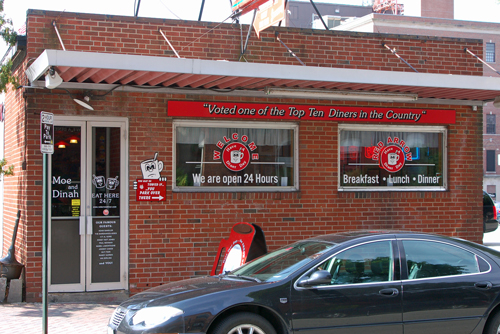
Happily, the Red Arrow actually serves a very tasty and carefully cooked breakfast. This is no greasy spoon. I doubt the candidates have the energy left to enjoy eating by now.
Monday, December 13, 2010
Californians voted ... lots of them

This should be highlighted. As folks undoubtedly know, California bucked the national trend in the 2010 elections. Democrats swept all the statewide offices -- governor, attorney general, treasurer, etc. -- and held on to all the Congressional seats they already occupied. Here's part of the reason:
When more people vote, progressives do better. It's still true, Tea Party or no Tea Party. Campaigns can increase turnout, though that effort is both labor and dollar intensive.Highest Voter Turnout Since 1994: Nearly two out of three voters cast ballots in the gubernatorial election on Nov. 2, the highest participation rate in 16 years, according to ... the California Secretary of State's office.
Thursday, November 04, 2010
Election oddments

There's the big story line -- and then there are the fascinating tidbits around the edges of any national election. Here are a few of the latter that I've run across:
- Remember that back in November 2009 the Democrats "stole" a House seat in rural northern New York that hadn't gone Democratic in 150 years? Sarah Palin and the Teabaggers ganged up on the Republican candidate for not being nuts enough. That woman ended up pulling out; the Teabaggers promoted a Conservative Party kook; and unexpectedly Democrat Bill Owens won in CD-23. Well darned if he didn't win again yesterday. I thought at the time changes might be underway in the area. Maybe so.
- I get to spend a lot of summer time on Martha's Vineyard Island off Massachusetts. It's part of CD-10, a seat opened by a Democratic retirement. The district voted strongly for Republican Scott Brown in the January special election, so it looked vulnerable for a Republican pick up. No way. Democrat Bill Keating is the new Congressman, having dispatched a Republican former police officer who was alleged to have covered up that other officers had illegally strip searched a teenage girl.
- Speaking of criminal behavior, it's good to learn that former Marine Lieutenant Ilario Pantano will not be going to Congress from North Carolina. While on duty in Iraq, Pantano pumped 60 rounds into two unarmed Iraqi prisoners. The military charged him with premeditated murder, then backed off for lack of evidence despite other soldiers' accounts of the incident. Pantano wrote a book about his military exploits and challenged incumbent Democrat Mike McIntyre. McIntyre is no great shakes (he voted against health insurance reform) but nice to see him knock off Pantano.
- Two practicing Muslims were re-elected to Congress and not even the Teabaggers are taking much notice of this.
- There will be four openly gay members in the next Congress. Barney Frank (MA), Tammy Baldwin (WI) and Jared Polis (CO) will be joined by former Providence, R.I. Mayor David Cicilline. All Democrats, not too surprisingly.
- The forced pregnancy crowd tried again to persuade Colorado voters to legislate that a fetus is a person, outlawing abortion. Just as in 2008, this was voted down by over 70 percent. Voters get irritated when they are confronted with the same measures repeatedly and swat them away peremptorily.
Wednesday, November 03, 2010
Suppose they held an election ...

This being a political blog, I suppose I should say something about this election. It will take some time to digest, even though the general contours of what was going to happen have been obvious for awhile. Tonight I'll just throw out some items:
- I have always been skeptical about campaign finance reform laws. Politics is about power and and money is power in our society, so interested money is always going to get into the process, somehow, legally or illegally. But the Citizens United decision of the Supreme Court which allowed corporations massively and secretly to run attacks on candidates they don't like is going to make any politician cringe. This is likely to be especially potent not so much in high profile races like Senate contests, but in Congressional and state races where unexpected outside money can make a big difference. We've seen only the warning shots this time around.
- Self-financed candidates -- McMahon in Connecticut, Whitman and Fiorina in California -- bombed out. This has been a pattern in California -- remember Al Checchi or Michael Huffington? Cash strapped political parties think these people are a cheap date, but this seldom works out. The engagement with others required to raise campaign cash seems to be part of what makes a candidate. Those who evade that chore miss a vital seasoning process. And they never have to demonstrate they have any friends. It takes vast human networks to win elections.
- Race matters. Senate candidate Sharon Angle in Nevada dared people of color to snub her with vicious ads showing threatening dark-skinned hoodlums. They responded. According to exit polls, the Latino fraction of the state's electorate reached a new high of 16 percent and Harry Reid got over two thirds of their votes. He got 7 in 10 votes from people of Asian origin and 8 in 10 Black votes. He survived.
- People still want and need change. One set -- young, Black, Brown and white urban types -- voted for change in 2008; another set -- old, white, and yes, bitter -- voted for change this year. With a different electorate, there was a different outcome.
- This wasn't some kind of repeat of 1994. That Republican wave election was essentially a geographical realignment, the delayed consequence of Democrats throwing down for civil rights and becoming the party of the racially excluded as well as of lower income people. This year was a generational election. Young people under 30 chose Democrats by a 20 percent margin while elders over 65 chose Republicans by the same margin. But the young were just 10 percent of the 2010 electorate, while the old were fully 24 percent. Chait, TNR.
- Republicans can win when most people voting are old and white. That's not sustainable. The current generation of old white people will inevitably die off; the more racially diverse younger cohort will be the core of the electorate as early as 2020 because there are a lot of them, a demographic bulge such as Boomers once were.
- Because the divergence in cultures and interests -- in the changes we want -- is so great, we are likely to see outbreaks of cross-generational bitterness over the next decade. Example tonight from a blog comment: "Generation 'I got mine -- you go die in a ditch!' has gotten what it wants..." Older people (yes, I'm becoming one) would do well to realize that youth always wins!
Tuesday, November 02, 2010
Election day
Somehow I doubt anyone who drops in here is going to fail to vote. But it never hurts any of us to get the word from a genuine hero of the long struggle.
H/t Digby.
Monday, November 01, 2010
Marching against "organized evil"
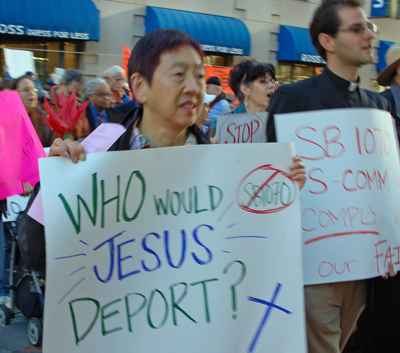
The state of Arizona brought its legal appeal against the federal injunction that prevents the state from implementing its anti-immigrant racial profiling law to San Francisco today.
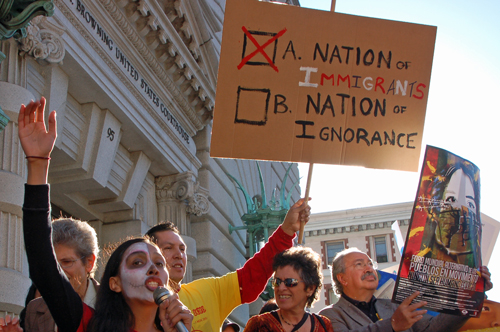
Several hundred religious and community activists, joined along the way by local elected officials, processed to the courthouse to protest immigration policies that penalize willing workers and rip apart families.
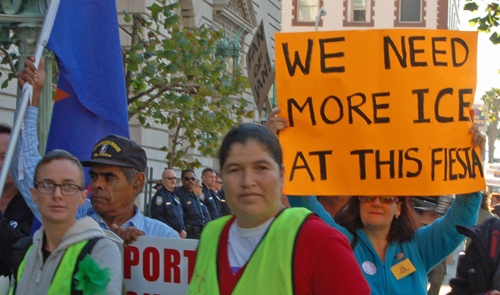
A small contingent of anti-immigrant protesters (apparently from Arizona) met the marchers. Monitors stood between the two groups as San Francisco police looked on. (ICE refers to the federal immigration authorities who carry out deportations.) I saw no scuffles and heard only a little shouting.
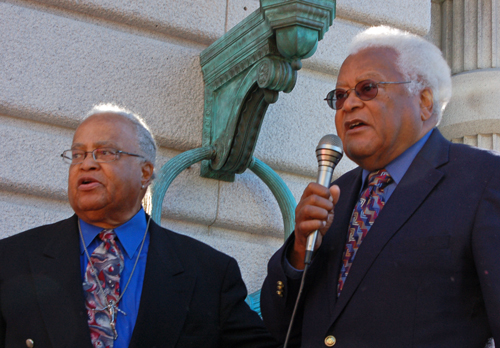
Giants of the civil rights movement addressed the crowd. The Rev. James Lawson (flanked by his brother the Rev. Phil Lawson) worked alongside Dr. Martin Luther King in building the non-violent U.S. civil rights movement of the 1950s and 60s. He exhorted the crowd:
Important admonitions these, from an elder who has seen so much grief and joy, spoken on the eve of an election that may seem yet another sign of hope deferred.Many who want change do not recognize that we are working to change 400 years of organized evil.
To overcome 400 years of evil, we need to keep moving forward; we need a disciplined, organized movement working for truth, for hope, for justice that can speak with one voice.

Latino notables rally for Rep. Jerry McNerney in Stockton
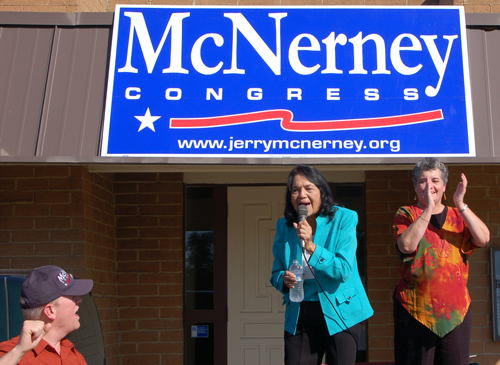
Dolores Huerta led a small crowd of Get-Out-the-Vote volunteers in chants yesterday afternoon, while Democratic Congressman Jerry McNerney (CD-11) cheered along. The 80-year old United Farm Workers Union co-founder was raised in this Central Valley community; though she has been busily working to turn out Latino voters in Las Vegas and Los Angeles, she insisted she couldn't neglect her home town. She urged the crowd not to let up through election day to hold the seat for McNerney.

Richard Chavez (l.), a brother of deceased agricultural labor organizer Cesar Chavez, and Congressman Xavier Becerra (CD-31, Los Angeles) lent their support.
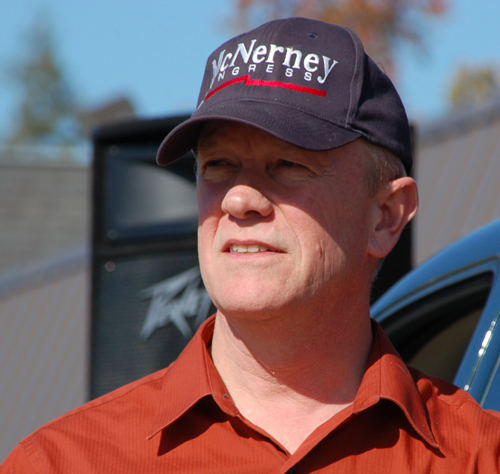
Rep. Jerry McNerney won the seat away from a long-sitting Republican in 2006; this year he is a top target of Republicans for a take-away. Party registration is almost equally divided in the strangely configured district which runs from Stockton and Lodi through Tracy in San Joaquin County, over into the Alameda County suburban towns of Dublin, Pleasanton and San Ramon, and then south to Morgan Hill and parts of Gilroy in Santa Clara County. Latinos are some 25 percent of its population.
The New York Times rates the district a toss up. I worked a little on the election in CD-11 in 2006 and again this year.
Saturday, October 30, 2010
Why we need a rally for sanity in DC ...
... because you might be mad, but they are CRAZY. Lots more here.
Friday, October 29, 2010
Champions for drab times
Here in San Francisco, baseball fans -- and their fair-weather relatives like me -- are having a high old time taking in the World Series. Sometimes literally, as this Texas reporter discovered.
The Giants are an endearing assemblage of little known characters, fresh faces and has-beens, and they are looking very sharp after winning the first two games.
The city's excitement reminds this San Franciscan of the football 49er's glory days in the 1980s. Times were hard for progressives: the odious Ronald Reagan was remaking the country in his lazy, plutocratic way, smashing up little countries around the world that had other ideas, crushing hope for poor and brown people. But we loved our conquering Super Bowl-winning heroes to ease some of the pain.
We love our Giants now, as we approach an election when the country seems all too ready to turn once again toward reaction. But these guys aren't so much in the hero mold; they are more work-a-day journeymen, getting it done. Probably that's more attuned to the time than larger-than-life champions would be. It's in the style of our ever-so cautious, ever-so pragmatic President. Two years of his style have seemed to offer no more than a platter of stasis and further decay, but the story isn't over til the last pitch, so assessments remain premature.
*** Why isn't the rest of the country watching the Giants-Rangers? Here's an explanation that says a lot about the country's discontents, not only as they relate to baseball.
The Giants are an endearing assemblage of little known characters, fresh faces and has-beens, and they are looking very sharp after winning the first two games.
The city's excitement reminds this San Franciscan of the football 49er's glory days in the 1980s. Times were hard for progressives: the odious Ronald Reagan was remaking the country in his lazy, plutocratic way, smashing up little countries around the world that had other ideas, crushing hope for poor and brown people. But we loved our conquering Super Bowl-winning heroes to ease some of the pain.
We love our Giants now, as we approach an election when the country seems all too ready to turn once again toward reaction. But these guys aren't so much in the hero mold; they are more work-a-day journeymen, getting it done. Probably that's more attuned to the time than larger-than-life champions would be. It's in the style of our ever-so cautious, ever-so pragmatic President. Two years of his style have seemed to offer no more than a platter of stasis and further decay, but the story isn't over til the last pitch, so assessments remain premature.
Truth is, the ratings for this Series will be bad. Much of the country will not watch, but it's not America's fault. It's the networks' fault for creating a self-fulfilling prophesy.
They spend all summer ignoring the 25 teams that are not in New York, Boston and Los Angeles, so fans around the country never learn about them. Fans in the Northeast or Midwest or Southern California have have no investment in watching teams they never see. They don't know the players or the storylines. So why would they watch?
Compounding that is the absolute East Coast point of view that flooded the earlier rounds of the playoffs. If you looked on ESPN.com or even listened to the Fox broadcast, the Giants were not up 3-1 after four games of the NLCS. The Phillies were down 3-1. The same was true in the Yankees-Rangers ALCS.
If Fox gets hammered by low ratings in this Series, which will cost them big advertising bucks, it has nobody to blame but itself and its broadcast buddies at TBS and ESPN.
Wednesday, October 27, 2010
Voter suppression and protection season
 Two years ago, according to David Plouffe's delightful rendition of the tale of the Obama campaign, the Democrats were ready for anything.
 Let's hope Democrats are prepared again this year. Many Republicans consider any of the people Plouffe lists as intrinsically ineligible to take part in our governance. So they do everything they can to keep them from voting. Talking Points Memo is chronicling Republican voter suppression activities, ranging from completely scurrilous to the slightly more respectable. Meanwhile, on the ground in Ohio, Kay -- writing at Balloon Juice -- brings a luminous clarity to the conflict between visions of democracy.We also made sure our campaign counsel, led by Bob Bauer, had the most thorough, experienced, and dogged election protection team in place in all the states. A crack staff of hundreds of lawyers, almost all volunteers, would make sure the voters we were counting on -- new registrants, younger voters, and minorities -- were able to participate without facing the same degree of problems and malfeasance that had cropped up in recent presidential elections.
Her second point suggests Plouffe's 2008 work is probably still paying dividends, ensuring that eligible people who don't fit the right wing stereotype of a voter will still be able to cast their ballots.There are two kinds of people who care about the actual voting process. There are conservatives, who look for fraud, and there are liberals, who worry about access. Conservatives believe that one fraudulent vote is one too many. Liberals believe just as strongly that one disenfranchised voter is one too many. There’s no middle ground. It’s adversarial. ... Conservatives simply don’t believe that voting is a right. They consider voting a privilege to be granted, not a right to be protected. There’s no reconciling those two positions.
...Voter protection is something liberals can put in place in every state and build on, because voter protection efforts are cumulative. Once the team is in place for one election, there’s then a pool of trained people who need only a refresher course and an assignment.
Tuesday, October 26, 2010
I've seen this before ...
Sharon Angle's latest racist ad may push her narrow race for the Senate from Nevada over the finish line -- but it's death for a Republican future in Nevada. It's a modern version of the ads that elected Pete Wilson Governor of California in 1994. "They [brown shadows] keep on coming ..."
Those ads touched off a Latino naturalization and registration effort that continues to this day and that has made California a solidly Democratic state. It looks as if Jerry Brown will be able to cruise over Meg Whitman's millions in this awful year for Democrats -- because California was changed by Pete Wilson's racist campaign.
Nevada is not California, but the demographic trends are there for the same transformation. According to the Census, about 55 percent of Nevadans are white but not Latino -- in comparison to the national figure of 65 percent white. Latinos are over 25 percent of the Nevada population.
Now the Nevada electorate doesn't look anything like that. Those Latinos are younger than whites; many are not yet citizens though they are on the way; many are hurting economically. So they aren't voting in proportion to their numbers yet. But the trend is clear. In 2008, for the first time in years, Democrats surpassed Republican registration numbers. Nevada is one of the states with the highest rate of growth of Latino voting. Latinos are going to be more and more influential in Nevada elections -- and Sharon Angle is making the Republican Party poisonous to Latinos.
Blacks are about 9 percent of Nevadans; although there are tensions with Latinos, Blacks have long concluded that Republicans are poisonous to their communities.
Democrat Harry Reid may not squeak through this year, but California shows unequivocally where this is going. Over time, against a demographic wave, the party of white racism hangs itself.
An "only in San Francisco" moment
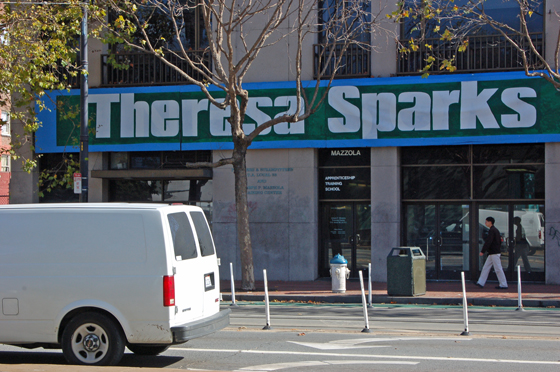
It's not surprising that the building trades unions would have a candidate they are promoting for a local office by spreading a huge sign across the width of their headquarters. And it is not even surprising that this candidate is often described as the "conservative" in what is ostensibly a non-partisan election.
But anywhere but San Francisco, it would probably be surprising that this candidate is a prominent transgendered woman.
If I lived in the district, Ms. Sparks would not be my choice. But I love that her candidacy takes this route in our city.
Monday, October 25, 2010
Time to reverse the Great Schlep
 My friend Ronni Bennett at Time Goes By is calling for what she calls the "The Great Elder Email Schlep." In 2008, comedian Sarah Silverman urged young voters to trek to Miami to encourage their grand parents to turn out for Barack Obama.
This year, older people are more likely to tell pollsters they intend to vote than younger people. So it's time to turn the Great Schlep around.
The people who will suffer worst if large numbers of Republicans win office and refuse to do anything to move the country toward prosperity are mostly not elders. These young people will see their schools cut classes so they can't get the courses they need; they won't be able to find jobs because few are being created; they'll find they have to move back in with their parents, hoping somehow the country turns around.
Most elders are related to these young people -- they had to come from somewhere. Ronni says:
Now we're talking!You don't need to travel to Florida or anywhere else; email and the telephone will work just fine. The idea is to convince your grandchildren, nieces and nephews in that 18 to 29 age range to get out and vote.
Talk to them about the responsibility of citizens in a democracy to vote. Track down online information about contests in their states and send links. Find the polling places for their homes and send the addresses.
...Make a nuisance of yourself for the next week until the election with those young, potential voters. If you have Twitter and Facebook accounts, use them too. Pull out all the stops. Let them know how disappointed grandma or grandpa will be in them if they don't vote.
Wednesday, October 20, 2010
Opinionated survey of California state propositions

Okay -- I voted. It wasn't fun. But I figured out what I thought of the state propositions, all NINE of them. This isn't any way to run a government ... But here goes, if anyone is interested.
Prop. 19: legalize and tax personal use of marijuana for persons over 21. YEAH, sure. I voted for it. This isn't my issue; I stopped smoking the stuff years ago out of disinterest. But nobody should go to jail for wanting to get buzzed if they don't drive while intoxicated or otherwise endanger others ...
Prop. 20: transfer power to draw Congressional districts to a "non-partisan" citizen redistricting commission we created by a 2008 initiative. NO. This is a phony "good government" gimmick that sounds democratic (small "d") but actually makes an ugly reality worse. Redistricting is the unsavory process by which electoral districts are redrawn every 10 years to ensure rough numerical equality. It is also how, instead of voters choosing their politicians, politicians choose their voters. Incumbents can protect themselves from challenge by getting lots of sympathetic voters within the boundaries of their district. (This is called gerrymandering after a Boston politician named Elbridge Gerry who excelled at the practice in the early 1800s. I think he was a distant relative.) The commission would just insulate the politicians by hiding the gerrymandering away amid phony "non-partisan" trappings. Let's keep the redistricting process as honest as we can by keeping it in the light of day where at least we can see which pols did what!
Prop. 21: create a stable revenue stream to fund state parks by adding $18 to the vehicle license fee. YES, INDEED! I hate this kind of proposition. The legislature should be able to handle this kind of thing. The whole body of state voters should not be creating separate revenue streams for our pet projects. But we've broken the ability of the state to tax, so we are stuck with these measures. This one would keep noxious Governors (yes - you Arnold) from snatching park funding when the coffers were low elsewhere and preserve our collective property in beautiful places. Plus drivers with California license plates would get into parks free because they'd already paid as part of the vehicle license fee. Taxes are the price we pay for civilization and this is a worthwhile price. Yes.
Prop. 22: prevent the state from diverting local redevelopment funds. NO. Sounds okay, but this is just exactly the sort of thing that makes the legislature unable to do its job. We can't hold them accountable if we hamstring them. Plus technical measures like this are prone to setting off cascades of unexpected consequences -- we have enough of those in our dysfunctional state government already.
Prop. 23: oil companies want to overturn California's greenhouse gas emissions controls. NO. This one is a total shuck. It would prevent the government from trying to avert climate change until unemployment reached 5 percent -- otherwise known as probably "never." Proponents are Texas oil barons who couldn't win in Sacramento, so they are trying to con the voters with an initiative.
Prop. 24: repeals some business tax loopholes. YES. See Prop. 25 for why we have to vote on this. These giveaways to businesses were the price Republicans made the Democratic legislative majority pay in order to give enough votes to get a budget over the two-thirds requirement. This is blackmail and we can reverse it.
Prop. 25: allows the legislature to pass a budget with a simple majority vote. YES! We'd have a lot less BS on these ballots if we didn't have this crazy system in which majorities cannot do their job because passing a state budget requires a supermajority. Let's let our representatives do their work!
Prop. 26: requires a two-thirds vote to raise various state and local user fees. NO! This is the sort of crap that has given California a dysfunctional state government. We have to pay for the infrastructure and services that make the state work (insofar as it does.) But when we start demanding that two-thirds of us agree to get anything done, we are giving a smallish minority the right to veto all of government and impose the lousy quality of life they prefer on the rest of us. Fifty percent plus one is plenty to ask in any election -- and minor fees should not be something that people have to vote on every time they turn around. Adding all this clutter makes a mockery of democracy.
Prop. 27: eliminate the redistricting commission created by initiative in 2008; throw redistricting back to the legislature. YES. As I said in reference to Prop. 20, you are never going to make this inherently political process into something apolitical or non-partisan. The best you can do it push it out into the open and make sure you know who is doing it. The Legislature already exists to be that body. They should do their job -- no gimmicks!
A dyspeptic survey of San Francisco local ballot measures

The State of California presents nine of these things -- so naturally San Francisco needs FIFTEEN! Asking the voters to opine on that many items isn't democracy; it's evidence of dysfunction.
I plowed through them and voted today. Here's a run down of what I was thinking.
Prop. AA: $10 per car add-on to the Vehicle License Fee to be spend on transit and infrastructure. YES. If we want a livable city, we have to pay for one.
Prop. A: bond to pay for earthquake upgrades in buildings that are affordable housing. YES, reluctantly. If we want owners to rent out, rather than just speculate on, substandard buildings, apparently we have to "help" them. These will be loans.
Prop. B: an attempt to help city finances by take-backs from city employee pensions and health care. NO. You don't get a city that works by bashing the people who work for the city. This is regressive and would hurt the lowest paid workers the most. More here.
Prop. C: make the mayor meet with the Board of Supervisors. YES. We voted for this in 2006. The Mayor ignored our vote. We tried again; Newsom managed to fight off that measure with a well funded campaign. The whole issue is stupid. Of course the city's executive officer should meet publicly with the legislative branch. Refusal is simply childish.
Prop. D: let non-citizens with children in the schools vote in School Board elections. YES.This only seems fair and sensible. More here.
Prop. E: Election day voter registration in municipal races. YES. Our voter registration procedures were developed in the days when we used manual typewriters and carbon paper. Voter registration should be automatic along with moving into a residence. Failing that, it should be easy and available at the polling places. States that allow this, like Minnesota, have the highest participation rates in the country. That's what we should be aiming for.
Prop. F: Health Service Board elections. ?? I give up. I didn't know there was such a board and I certainly don't want to be voting on it.
Prop. G: Bus driver wages and benefits. NO. The transit workers union was uncooperative in negotiations with the financially strapped city during budget discussions this year and this is pay back for not helping out as the other city unions have. The ballot box is no way to negotiate worker contracts. I shouldn't be asked to vote on this.
Prop. H: whether elected city officials can serve on political party committees. NO. This is another piece of junk we're voting on because a politician, in this case Mayor Newsom, got his nose out of joint. The current elected Democratic County Central Committee shows no deference to his desires, so we have to vote on this. It's idiotic.
Prop. I: a privately funded test of Saturday early voting in 2011. YES. I'm almost always for anything that makes voting easier and certainly opening polls on a weekend day might do that. We've tried this before. In the fall of 1994, polling places were opened on Saturdays in a few locations to offer early voting. A polling place in the basement of City Hall opens during every election as soon as the mail ballots go out. These measures are all good, though this particular proposal seems a little incoherent.
Prop. J: raise the hotel tax paid by visitors by about $3 a night and enable collection from internet reservations. YES. Despite what hotel owners say, nobody is going to forgo visiting San Francisco because they are being charged an extra $3 a night (Heck, they are probably being charged an arm and a leg already.) The city needs the money.
Prop. K: this is a poison pill to undercut Prop. J. NO. If this one gets more votes, the hotel tax would not be raised, though the city might capture more tax from people booking on the internet. The hotel owners really don't want the hotel tax raised, so they are paying to run this measure. I wonder if some political consultant is cleaning up on selling this one to the Convention Bureau?
Prop. L: busting people for sitting on sidewalks. NO. This is one of the city's periodic swipes at homeless people for trying to survive in our midst. More here and here.
Prop. M: require police foot patrols. YES. Perhaps a better response in neighborhoods that are freaking out about homeless people, but the Police Department isn't likely to implement this -- takes too much personnel and time.
Prop. N: real estate transfer tax applicable only to properties selling for over $5 million. YES. Damn right we should vote for this. Location in San Francisco is what makes any such parcel that valuable and its owners can contribute to the general welfare!
Monday, October 18, 2010
Cleaning up the record: more on criminalizing homeless people

Last week, I posted about San Francisco's Prop. L, our city's latest opportunity to use the ballot to announce vigorously that we don't like people who live among us who don't have homes. Though I sorted through a lot of archives for that post, I had a gnawing sense that I'd forgotten a few twists and turns in the story. A reader emailed to correct me on events in 1994 and that prompted me to delve a little further into the history.
My correspondent was right: in 1994, we did vote down the sidewalk sitting restrictions that were embedded in unpopular Mayor Frank Jordan's broader Matrix program for dealing with homeless people. Score one for voter compassion and sanity.
However in July of that year, the San Francisco Police Department issued General Order 6.11, instructions to cops on how to deal with people sitting on sidewalks. This order recognized that sections of previous sidewalk sitting laws had been found by courts to be too broad and to allow too much officer discretion, but reinforced that police can act against any person actually blocking others on a sidewalk. This 1994 interpretive framework is still the current law.
Looking into this again tickled a vague memory that San Francisco voters had voted down one of these recurrent measures to attack people who lack a regular street address sometime early in the last decade. I should remember this one: I volunteered help to folks at the Coalition on Homelessness to organize literature distribution against it.
That 2000 ballot measure, Prop. E, was an exercise in civic paternalism. We were voting to treat very poor people as dependent children, taking back the small cash grants they had been receiving and making sure any cash they got was spent as politicians and social workers thought proper. These days, when very poor people are routinely treated as having no rights, it's amazing to think that the city once endorsed the idea that people should be able to use the pittance we spend on them according to their own notion of how to survive. But that had been the case and in 2000, momentarily, we asserted it should be.
Though there were the usual moral arguments in that campaign, I believe Prop. E's rejection should be attributed to another factor.Proposition E, put on the ballot by people convinced that the city's $354 monthly general assistance benefit is often nothing more than a "booze and drugs allowance,'' had stirred a bitter debate. ...
Rabbi Alan Lew of an interfaith coalition against Proposition E saw the initiative in almost-apocalyptic terms. "Our greed has reached such an appalling level that we want to take money away from the poor,'' he said recently.
Prop. E served as the San Francisco liberal establishment's opportunity to give itself a sort of "ethical shower" -- to restore its own good opinion of itself after a season of besmirching its self-esteem. The city had just passed through a vicious mayoral campaign that culminated in December 1999 with the re-election of Willie Brown. Although he enjoyed wide, passionate support, challenger Tom Ammiano (now an accomplished state legislator, but then a far less seasoned Supervisor known to many only as the "gay comic") probably never could have mustered a majority from city voters. But crafty and corrupt old pol Willie Brown demanded that every liberal political figure and organized force in the city must join in grinding the upstart into the ground. Liberal politicians, most of labor, and many community organizations pledged allegiance to the mayor and spent vast sums and their staff time on Brown's campaign. A lot of this was of questionable legality, but King Willie wanted a coronation, a triumphal parade, and he pretty much got one.
The more decent of the people and institutions that were feeling queasy after serving as Brown's shield bearers wanted self-absolution. Led by then-State Senator John Burton, they used the campaign against Prop. E to restore their faith in their own intrinsic liberal goodness. With pretty much all the institutions that signal to voters that good people were speaking in a unified way against Prop. E, it was possible to turn back an attack on homeless people -- for a moment. When attention turned away, bit by bit, the thrust of Prop. E later became Mayor Newsom's current policy for the poor.
The story of that Prop. E campaign has scary implications for this election season. We're not seeing that kind of establishment unity against the racist, selfish, and simply dopey politics of the Teabaggers. We're seeing a lot of Democrats scurrying around trying to distance themselves from directions they once embraced. Defense of a decent society doesn't work that way. When "leaders" won't lead, we get frightening results.
Subscribe to:
Posts (Atom)