Showing posts with label Egypt. Show all posts

Friday, May 03, 2019

Of popular convulsions and would-be kings

Rally in 2011 in San Francisco in support of the Arab Spring
Erudite Partner surveys a tough neighborhood, where, as in this country, only popular resistance offers hope of a better future.
... there has been a new set of popular uprisings in northern Africa, from Algeria to Morocco, to Sudan. Let’s hope they have more lasting success than Egypt’s Arab Spring.
Read it all here.

Monday, May 22, 2017

So much ferment, but stability wins

Rachel Aspden, a newly minted 23 year old aspiring British journalist, wanted to "discover some of the truth," so she arranged to drop herself into Cairo in 2003. She would study Arabic, pick up a low-paid writing job for an English-language news magazine -- and try to figure out what this strange city and country were about. Over the next 12 years, on and off, she achieved something fascinating, becoming simply friends with a diverse group of young Egyptians. This book follows these people through the suffocating stasis coupled with glimpses of consumer modernity that was the Mubarak era, through the exhilarating uprising in Tahrir Square that overthrew that dictator in 2011, and then through the political and religious morass that buried democracy and left Egypt under the thumb of its current military tyrant, Abdel Fattah el-Sisi, friend of our Orange Cheato. Somehow everything changed -- and nothing changed.

All of Aspden's (authentic, even if necessarily disguised) cast of characters survive, though it was a near thing for several Islamist teenage women who took to the barricades in support of the one freely elected leader, the Muslim Brotherhood's Mohammed Morsi. Others among them organized to depose Morsi and cheered their new army boss. Most just tried to keep their heads down and get on with life. This is not about heroics; the best of it is simply about everyday life.

The Cairo that Aspden found herself in, a city of 15 million people, was a place where "the idea of 'privacy' barely existed, while social bonds and social judgments were everything." And, though a foreigner and carrying the stigma combined with privilege of former colonizers, she was a woman.

Because I happened to be female, I was now surrounded by people who wanted to dictate what I could do, say and wear; where I could go, who I could go with and when I could go there; where I could sit in public; how I could travel; what time I could enter and leave my house [a shared apartment] and who I could invite there -- and the finely gauged range of disapproval, harassment and intimidation they could mete out if I crossed these boundaries.

Most of these strictures had little to do with formal Islamic teaching. ... I found that many men assumed that a woman with no male "protection" was an easy source of sex for those with the initiative to take it. ...It was the state that had laid the ground for these sex-crazed citizens -- like their puritanical mirror images ...Sexual harassment and assault were not criminalized, the police dismissed reports of domestic violence and rape -- and were themselves responsible for beating, sexually humiliating and raping detained men and women ...

She did meet a woman -- she calls her Amal -- who had escaped, literally, a strict upbringing in a Nile village, made her way as a teacher and lived on her own in the city, owning her own car. Other Egyptian women were not inspired by Amal's story.

"Why would I want to live apart from my parents, when I love them? Or pay for everything myself? ... Unfortunately, no man will ever agree to marry her," they said.

By the end of the book, Amal has indeed married -- to an Irishman and they are emigrating.

The demands of a patriarchal society also weighed heavily on the young men, with paradoxical results. Aspen describes Abdel Rahman, who entered college with romantic dreams of choosing a perfect mate among the brilliant Egyptian girls he studied alongside. Those dreams were dashed because the father of the object of his hopes pointed out he was still penniless.

Like his friends, he had grown up watching Western porn, first at illicit video parties, then online and he realized the whole world wasn't like Egypt. After he graduated and got a job at a newspaper, he met a string of European girls who smuggled him past suspicious bawabs [doormen] to drink, smoke hash and have sex. ... For a few years, it was fun. But as he neared thirty, it stated to feel empty. He felt guilty and stressed when he thought about the drugs, parties and one-night stands. ...

He realized he had to change. ... Now he began to listen to Quartic recitation as he stop-started through the choking Cairo traffic to and from work every day. It made him feel calm ... He started to pray ... He went to the mosque on Fridays ...

[Soon he explained to Aspden what he wanted in a wife.] "She must be one, beautiful, ... two, religious, three, respectable. ... Men like me, who have done this stuff, think like this more than anyone else ... We know what girls are really like, what they get up to in secret. ... After all my experiences, I've realized that the personality of the Egyptian man tends to stability. Religion is important, marriage is important, who you marry is important ..."

Abdel Rahman turned to his parents to arrange a marriage but the process disgusted him.

"It's like the Camp David negotiations, haggling between the families about money. I'm not a bridegroom, I'm just a walking back account. ... All the burden falls on men. ..."

Abdel Rahman wanted social approval, to make choices that would be endorsed by family and the state. Being a man, that option remained to him. At the book's close, he was still a respectable man about town in Cairo media circles.

Aspden's explorations of her friends' political participation in the Tahrir Square insurrection and in the subsequent flailing and failed democratic project seems less perceptive than her social observations. She came to realize that some friends brought to these events (or learned from them) what she found an unfamiliar source of stability.

[Mazen and Ayman] both hated the old regime and thought of themselves as revolutionaries ...They both had a passionate desire for freedom. But for them, religion was far from a restriction or a burden -- it was a means of liberation.

... Ayman and Mazen's lives were a whirl of instability. Their parents' values could no longer guide them, their country was in upheaval, and their future was uncertain. Islam was their rock in the middle of chaos.

Ayman adopted ultraconservative Salafi Islam for awhile, then turned toward studying comparative religions and writing a novel about how different religions treat women. Mazen landed as a cog in his family's business, cynical and disappointed about all enthusiasms, but conventionally Egyptian in believing that ISIS is a creation of Israel and the US meant as cover for a Western imperial plot to seize oil.

Most of Aspden's people end up disillusioned and frustrated or bent on emigration. Insofar as Aspden's story in Generation Revolution tries to draw any conclusion, it is that for diverse reasons, most Egyptians she knew between 2003 and 2015 came to crave stability above all. Before judging them, I think we need to ask ourselves whether our deepest wishes are any different.

I came away from this intriguing little book unsure whether I'd been exposed to any truthful insight into Egyptian society and events. There are so many social filters between how I understand the world and how Aspden's people do. And she sits in the middle, not always helping much. There are limits to the explanatory power of this kind of participant observation of an unfamiliar society. But this is an interesting attempt to share the realities of people she obviously cares about. It was worth reading, though not for me deeply illuminating. Someone with a less instrumental intelligence might feel differently.

Friday, January 29, 2016

The revolution is dead; long live the revolution


General Abdel Fatah el-Sisi whose coup overthrew Egypt's new government

Five years ago this month, with a rush of joy, Egyptians threw out their oppressive military dictator Hosni Mubarak. Just two years ago, some Egyptians were still proclaiming that their revolution could not be repressed, even as the military reasserted its power to overthrow an elected president.

This month, Helmi Al-Asmar asks Did the 25th January Revolution die under torture?

Speaking on a well-known Egyptian television channel sympathetic to the regime (the opposition has no such access to the media any more), [Egyptian lawyer and human rights activist Negad El-Borai] said that the judgement against two national security officers accused of torturing lawyer Kareem Hamdy to death is an example of how judges show “compassion” towards state officials while ordinary citizens face harsh sentences. ... According to El-Borai, the court has sent a message to the torturers within the interior ministry that, basically, they needn’t worry about what they do ...

“Better than nothing” sums up the story of the revolution, which may have died under torture, or may be clinically dead waiting for someone to wake it from its coma, which may take some time. Egypt is back to square one just five years after the revolution. ...

... Information gathered by international human rights organisations shows that the number of those killed due to torture and medical negligence in Egyptian prisons since the coup on 3 July 2013 is much higher than the official figure of 350; in any case, the statistics do not include those who have simply “disappeared” or whose death has not been recognised. The reasons given for death include electric shock, severed body parts, broken bones and the failure of the authorities to provide medical attention. Sometimes it is claimed that the prisoner has “committed suicide”, as happened on Tuesday when a member of the Muslim Brotherhood detained in Abu Hammad Prison was said to have killed himself. The number of those dying under torture has hit a record high, not only in Egypt, but also around the world.

All or most of those who wrote about Egypt’s 25th January Revolution have admitted, in one way or another, that the country is back to square one. It is as if there was no rebellion; as if Egypt did not hear the chants of “We are all Khaled Saeed” in memory of the young man from Alexandria who died after being tortured by the police. At that time, the interior ministry said that he died as a result of swallowing a bag of hashish. This sparked-off the revolution and inspired the rebels. Today, five years later, the Egyptians do not know whose name to use instead of Khaled Saeed, there are so many candidates who have also died under torture.

I am certain, though, in the midst of such darkness, that nations do not die even if their revolutions are in a coma; there will be a sudden awakening. We do not know when, but the reasons for having a revolution in the first place still exist, on top of which there are even more. The people require a revised and intensified revolution which protects them from oppression and being seized and killed under torture.

Perhaps, but when and how do ordinary people live in the meantime?

Far distant observers cannot pretend to really understand the complex politics within other peoples' countries. But we should not allow the US government to get away with funding this repression either. The Obama administration has shoveled military aid to Egypt's usurping generals for more than a year. These deals with devils never end well.

Do either of the aspiring Democratic presidents have anything to say about this? In the Wapo, David Ignatius is applauding Hillary Clinton for encouraging Obama in 2011 to back half-measures while Egyptians demanded that Mubarak had to go. The Prez opted instead to give Mubarak a verbal push. Hillary does label Egypt's current government "an army dictatorship." Her campaign website says nothing that I could find about policy toward that torturing regime. Neither does Bernie's.

Thursday, February 06, 2014

Egyptian optimism

A few weeks ago I blogged about Egypt and hope. Reading the news since, I've wondered if I was being a Pollyanna. Well, maybe I was.

But I want to raise up this oped by Egyptian novelist Alaa Al Aswany. He was and is there.

He reports that this Facebook message has gone viral in Egypt:

“Fellow revolutionaries, we have been through the three most beautiful and difficult years of our life. We have tried to realize the dream but we now know that it has become impossible. Yet we keep on stating that it was a real dream, no matter how much they try to falsify history. None of us who have lived that dream will ever forget, or regret it, for a moment. As for those who have died in the service of the revolution, we say to you and your families that we apologize because we are not worthy of your sacrifices.”

Further Al Aswany still holds out his own hope:

Is the Egyptian revolution over, as the frustrated young Facebook poster declared? The answer is provided by recent official statistics that show that the country’s population has already reached 85 million, 60 percent of whom are under 29. It is these young people — the majority of the population — who made the revolution. It is they who, in the end, will win out, because they alone are the future.

Sunday, January 26, 2014

A window on Egyptian hope


Last night I downloaded the Oscar-nominated documentary The Square. Though the title refers to a place -- Cairo's grand Tahrir Square -- this is a film about characters. Director Jehane Noujaim follows three men from very different backgrounds from the inception of the 2011 Egyptian protests that overthrew a dictator, across subsequent betrayal by the military, into a period of elected Muslim Brotherhood rule, and on to the current army regime that expelled the governing Islamists.

None of these regimes had much use for the young revolutionaries. Ahmed, Khalid, and Magdy are warm, smart, brave and attractive individuals. They struggle, risk their lives in fights with the army and among factions, grow and change. Magdy, a member of the Muslim Brotherhood, holds convictions that we're most likely to find foreign, but he is nonetheless a mature and sympathetic figure. Yes, there are even women among these insurrectionists -- though not as prominently followed. This is a hopeful film.

Here's Ahmed's conclusion about Egypt's dramatic events of still murky import:

"The leaders are on top, and is always the people on the bottom that are dying and suffering – it doesn't matter who they are, christian, salafi, brotherhood, revolutionary, we are all Egyptian. … the revolution is a voice."

Maybe. Yesterday 49 people were killed in Egypt (presumably mostly by the army but perhaps some also by armed Islamists) on the anniversary of the beginning of the uprisings.

I would strongly recommend seeing this -- the film is Netflix-funded, presumably in the hope of collecting the caché of an Oscar.
***
I belong to a small cohort of United States citizens who have lived anything remotely like what these men experienced in the Tahrir Square battles. Berkeley in the '60s, for some, had some of the flavor of the Square: episodic eruptions of mass demands for a different university, a different nation and culture, one that didn't wage war on the Vietnamese, one where voices of all races and opinions were respected and valued, even one where building a garden was more valued than a parking lot. We confronted authorities who used their nightsticks freely; we were tear gassed by helicopters; we were arrested and beaten and some were even shot. I know. A man running next to me was hit by shot from Ronald Reagan's armed goon squad (aka Alameda Country Sheriffs) while we fled during one protest. He was luckily not seriously wounded. That day one bystander died.

This was not like the civil rights struggles in the South in which the authorities were more violent, the protesters more organized and disciplined, and both sides were more deeply rooted in their communities. Perhaps the events most like the countercultural student eruptions of the 60s in more recent United States experience were the Battle of Seattle in 1999 and other WTO protests in which an anti-globalization coalition sought to advance the radical notion that "another world is possible."

Obviously none of this tracks exactly with what has taken place and is continuing in Egypt. But there are recognizable similarities to the 60s campus protests -- we too were under-informed, idealistic young people who had a better idea, up against real injustices and entrenched ways of doing things, all viewed askance by uninvolved bystanders wondering why make such a fuss and risk such disruptions.

The movie, The Square, presents some young Egyptians who insist that the breakthrough in the definition of what is possible created by ousting Mubarak and subsequent authoritarians means Egypt can never go back to the closed society of the preceding 30 years. The Egyptian army seems to be settling in for another round of dictatorship. But extrapolating from the experience of my 60s cohort, the protesters have some reason to hope, if not for all they intend when they chant "freedom," at least for a somewhat better society.

For though the insurrectionists of the '60s mostly failed to institutionalize the peace, equity, justice and freedom we sought and which many of us still work for, there's no question we have won the culture war. Oh, I know, retrograde forces -- grumpy old white people mostly -- are still trying to put the genie back in the bottle, but there's no turning back the sexual revolution, women's empowerment, and gay liberation. My goodness, this country seems at long last likely to decriminalize marijuana.

Maybe the hopes of the Egyptians aren't so crazy after all.

Monday, August 19, 2013

Share the country?


After a long weekend spent on retreat with friends who make up War Times/Tiempo de Guerras, I'm too pooped to write coherently this Monday morning.

But I'll share what I'm pondering. Stephen Walt has opined that

The only solution for Egypt that I can see is one where the contending groups agree to share the country. The competing factions will eventually have to realize that none of them can rule alone and that a political order must be devised that gives each a stake and guarantees each at least some degree of political influence. That's the only formula for successful participatory politics:

Perhaps. Certainly Egyptians need to end the pattern of the guys with the most guns shooting their way into dictatorial power. I hear on NPR this morning they are about to release the old dictator, Hosni Mubarak ... WTF?

Let's turn Walt's prescription back on our own society. How do we "share the country" with people who approve shooting black and brown teenagers for being out of their presumed place?

With people who equip local police departments with tanks?

With folks who've brought back veterans of the Iraq and Afghan wars and set them up as a Border Patrol?

The same folks are enacting legal barriers to full access to the vote wherever they can. And these same people believe they can and should dictate to women what we can do with our bodies.

How do we "share the country" with these folks without giving up on building a more equitable and more just society?

Sunday, August 18, 2013

Why won't Obama cut off Egypt's generals?


In view of the Egyptian military's brutal violence against the large segment of their own people who think they've illegally seized power, there are loud calls in Washington for the Obama administration to cut ties with the generals.

The Prez announced last week that he'd canceled a planned joint war game -- and was denounced as a wimp from many directions. Let's think for a minute why he might be reluctant to cut off the more than one billion dollars we give Egypt's military annually. After all, this is not chump change.

Obama has shown himself cautious and deliberate in dealing with foreign governments -- and by and large that has been a good thing. Republicans are demanding posturing; that is not the incumbent's style.

However he has also been consistently willing to defer to Israeli interests. The Israelis much prefer a military dictatorship in Egypt to a government headed by the Muslim Brotherhood. On those grounds, we might expect Obama to choose to stick with the generals.

Moreover, Obama can probably assume that any cash the US might withhold from Egypt's rulers will only be replaced by Saudi oil money. Perhaps he thinks he retains some shred of influence if he continues the payouts.

But it is also worth noting that the US has simple, practical motives for staying on the good side of Egypt's generals. USA Today has the story:

During the past year, more than 2,000 U.S. military aircraft flew through Egyptian airspace, supporting missions in Afghanistan and throughout the Middle East, according to U.S. Central Command, which is responsible for the region.

About 35 to 45 U.S. 5th Fleet naval ships pass through the Suez Canal annually, including carrier strike groups, according to the Bahrain-based fleet. Egypt has allowed U.S. warships to be expedited, which often means getting to the head of a very long line of ships waiting for access to the canal.

If US foreign policy requires power projection in west, central and south Asia, we need Egypt's cooperation.
One of the few clear facts about the Egyptian situation is that three quarters of us in the United States don't want our government to get involved. At long last, that might help.

H/t Samuel Knight at Political Animal for the USA Today report.

Thursday, August 15, 2013

Revolution: "a long process of social and political transformation"


The news out of Egypt is grim, painful. I trust very little of what I read or hear reported. I know I don't know what is going on. But in this moment of bloodshed, military violence and apparent religious and social polarization in that country, I remember something suggested by the editors of the Middle East Research and Information Project (MERIP) over a month ago:

Was the gathering of millions in Egypt on June 30 the continuation of a revolution or the occasion for a coup d’état? The answer is “both,” but the question is not the right one to ask.

There is, first of all, no necessary contradiction between the two terms. All of the revolutions in human history have involved the overthrow of heads of state by force or the threat thereof. The revolutionaries, whether they wield weapons themselves or not, must commandeer a portion of the state’s army or persuade the soldiers to lay down their arms. The French Revolution -- the canonical model -- took nearly a century to complete, during which period there were three republics with three different constitutions, two empires, two restored monarchs and plenty of interceding events that might be called “coups” and “counter-revolutions.” …

… there remains ample reason to believe that [the Egyptian military's] coup is a moment in a long process of social and political transformation that will continue for years to come. … 

Democratic social revolution as a series of struggles, a long process … I'd say the idea is almost "un-American." In this country, we are raised on a fantasy of a single "revolutionary" moment in 1776 that led to the establishment for all time of a perfect system of government that has endured without much trouble ever since.

This is nonsense of course.

Most obviously, U.S. society and governance was shaped by a brutal civil war to end slavery. This war extended citizenship to all males born here -- and killed some 750,000 combatants -- out of a total population of some 32 million. It too was part of our revolution.

The successive struggles of the excluded -- men without property, religious dissenters, women, people of color, gays -- for full citizenship have left less obtrusive death tolls, though they've cost plenty of lives. We've made a lot of progress.

And those struggles aren't over. There are forces that are doing their damnedest to shove most everyone but rich white men out of political participation. (See my friend Bob Wing's current summary.) This country's "revolution" isn't complete -- it isn't even over.

Neither is Egypt's.

Monday, July 08, 2013

Egypt events show off our vile racist trolls


There is something about the military coup in Egypt and the ongoing travails of that country that brings out whatever racist and Islamophobic filth lurks in the recesses of what passes for minds among United States right-wingers.

Here's the Wall Street Journal:
Egyptians would be lucky if their new ruling generals turn out to be in the mold of Chile’s Augusto Pinochet, who took power amid chaos but hired free-market reformers and midwifed a transition to democracy.
My emphasis. Apparently the Journal is enthusiastic about torturing military thugs. The Chilean "transition" only came after Pinochet had held dictatorial power for 17 years and finally, to his surprise, found himself on the wrong end of a sham national vote he expected to win. Even the military was tired of him and democracy was very slowly rebuilt. (The Journal article is behind a paywall, so I've linked to a commentator far more knowledgeable than I who quotes the statement.)

Meanwhile, in the New York Times the conservative columnist David Brooks seized on the occasion of the Egyptian coup to express his essential contempt for the capacity of brown people, Arab people, who adhere to a "foreign" religion.
… Islamists might be determined enough to run effective opposition movements and committed enough to provide street-level social services. But they lack the mental equipment to govern.

… incompetence is built into the intellectual DNA of radical Islam.

.. It’s not that Egypt doesn’t have a recipe for a democratic transition. It seems to lack even the basic mental ingredients.
Mr. Brooks sure doesn't convince me with this tripe that he has particular brains or powers of observation -- all he seems to have is bigotry about an ancient nation whose citizens are struggling messily toward their own system.

I don't pretend to much idea what is going on in Egypt. But I do know that citizens of this country forget our own history if we demand that other people who are just trying to get a free country off the ground after a long siege of foreign rule and oppression will pull this off without some bumpy bits. Consider this trajectory:
  • a rebellious people forms a new representative government and within a decade finds that internal disagreements and populist risings in the countryside have rendered it unworkable;
  • the elected powers-that-be call for a meeting to reform that government structure, but some radical intellectuals secretly plot to replace the existing structure with an entirely new governing arrangement;
  • those plotters persuade a retired general to lend his presence to the secretive convening and emerge with an entirely new document;
  • once that document is ratified, the general becomes the country's new head of state.
Yes -- that's a plausible rendering of the history of the adoption of the United States Constitution. (More on this process here.) The more established countries of the world almost certainly thought they were observing a hopeless muddle that was certain to collapse of its own incompetence soon enough.

Getting a new country off the ground is hard, dicey work. Racist foreign pundits reveal their ugly ignorance when they try to make sense of events through the lens of their fetid prejudices.

Thursday, March 01, 2012

Smart women say smart things

It might be easy to miss this, but concurrent with all the bluff and bluster about the health insurance reform somehow impinging on Catholics' freedoms, the nuns who run Catholic hospitals have filed an amicus brief with the Supreme Court supporting the law. A group representing the leadership of Catholic women's religious orders writes:

Amici believe that a civilized society must ensure the provision of basic healthcare to its citizens regardless of their ability to pay for it. They further believe it is a moral imperative that all levels of government institute programs that ensure the poor receive such care. They believe Medicaid expansion under the Act is critical to the communities they serve.

***

Meanwhile, Supreme Court Justice Ruth Bader Ginsburg has been visiting post-Mubarak Egypt. After 19 years on the highest U.S. court, dealing repeatedly with how our Constitution both succeeds and fails to structure a free society, she offered some words of advice on Al Hayat TV to Egyptians struggling with creating a new legal framework for their country:

Q: Would your honor's advice be to get a part or other countries' constitutions as a model, or should we develop our own draft?

A: You should certainly be aided by all the constitution-writing that has gone one since the end of World War II. I would not look to the US constitution, if I were drafting a constitution in the year 2012. I might look at the constitution of South Africa. That was a deliberate attempt to have a fundamental instrument of government that embraced basic human rights, had an independent judiciary. It really is, I think, a great piece of work that was done. Much more recent than the U.S. Constitution: Canada has a Charter of Rights and Freedoms. It dates from 1982. You would almost certainly look at the European Convention on Human Rights. Yes, why not take advantage of what there is elsewhere in the world? I'm a very strong believer in listening and learning from others.

Goodness -- is the woman perhaps not an American exceptionalist? U.S. right wing media think she is nigh on to a traitor. Interestingly, the video of the interview was uploaded by the U.S. Embassy in Cairo.

Saturday, December 03, 2011

For our viewing distraction ...

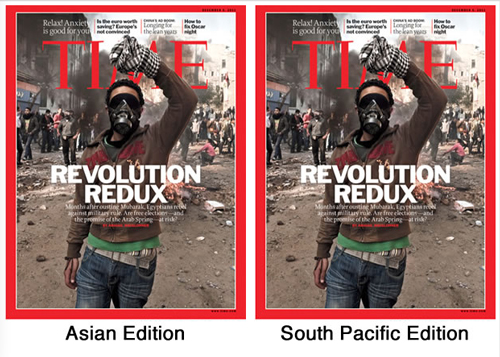
Time-USA-Europe.jpg
Time-Asia-South-Pacific.jpg
In case you can't read the small print and aren't able to place the picture because our media hasn't shown it to you, the worldwide cover image is from Egypt in the aftermath of the dictator Mubarak's overthrow where a military junta the U.S. approves was challenged by protests in the run-up to elections that many Egyptians believe are corrupt and rigged.

Common Dreams labels these contrasting covers: "And Some Wonder Why Americans Are So Dumbed Down?"

In partial defense of Time, most people in the U.S. probably see the protester as aggressive and dangerous; he and his cohorts more likely think of themselves, accurately, as oppressed and betrayed by armed authorities who have dashed their hopes. People get angry when their dreams seem crushed; we have little experience of that sort of political passion, though perhaps we are acquiring a bit these days. Time is probably not entirely wrong to imagine that their U.S. readers are more likely to identify with the forces shooting the tear gas than with the protester.

Meanwhile to the U.S. cover: what a perfect reinforcement for the belief system that props up our inequitable economic system! If you aren't a nervous, obsessed striver, you must be a useless lazy lump. I bet Mitt and Newt and their followers believe that. All those unemployed shirkers must have brought their pain on themselves by being too contented. What a shrunken vision of human flourishing we live with.

Friday, November 25, 2011

Eagle's flight loses some loft

Power and human purposes around the globe are shifting toward new patterns, new aims and new necessities. Stephen Walt offers a reflection:

... More broadly, if you compare the era in which most of us have lived to the previous fifty years (1900-1950), there's little question that we've enjoyed a period of comparative benevolence. The first half of the 20th century witnessed two enormously destructive world wars, the worst economic depression in history, and several brutal genocides. The past sixty years has its own share of tragedies, to be sure, but the overall level of violence was much lower, economic growth was fairly steady (until recently), and many of us never had to endure the insecurities, travesties, and sacrifices that earlier generations experienced or that were still common in other parts of the world.

Most Americans ought to be especially grateful for their extraordinary good fortune, and Thanksgiving is an appropriate time for us to reflect upon it. And as I watch Europe teeter on the brink of financial collapse, observe the violent political contestation that is sweeping the Middle East, note the rapidly shifting balance of power in Asia, and contemplate the tragicomic follies of our so-called leaders in Washington, I do wonder how long it will last, and whether I will look back with regret at the tranquility we have lost.

By the end of the year, U.S. troops will have left Iraq. Egypt continues the struggle to define what follows tyranny. Despite the Libyan adventure, U.S. power continues to wane in what we call the "Middle East." Tony Karon at Time summarizes caustically.

It's just as well, perhaps, that the Administration has begun talking of a "Pacific century," moving troops to Australia even as it withdraws from Iraq. Because for better or worse, 2011 will be remembered as the year the Middle East, as a region, declared its independence from U.S. influence.

We aren't good at noticing when long established human arrangements finally begin to crack open. We have a hard time assimilating that the planet itself is changing under stress. But looking away doesn't calm the storms; we're in for unfamiliar seas.

Sunday, April 24, 2011

Christ is risen! Hope lives!

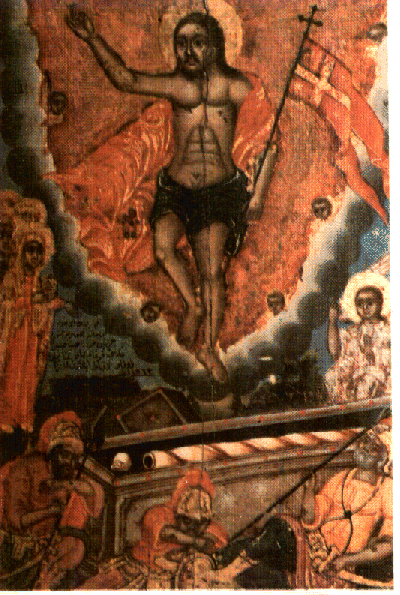
Icon.Resurrection.Coptic.gif

This icon of the resurrected Christ comes from the Coptic Encyclopedia. Coptic Christianity is one of the oldest forms of the faith. I post it here in honor of the contemporary unforeseen explosion of resurrected hope in Egypt.

In recent days, the new Egypt has seen tensions between the Coptic minority and some Islamists. Other members of the Muslim majority, including the young people who touched off the January 25 revolution and the Muslim Brotherhood, have opposed demonstrations against a Coptic regional governor.

Monday, February 21, 2011

Something is happening here ... and it is not entirely material.


There is a line that keeps coming to mind for me from an insightful Washington Post oped by Hussein Agha and Robert Malley published the day the dictator Mubarak resigned in Egypt.

The grievance Arab peoples feel is not principally material ...

That rings true, not only for Egypt and Tunisia, but for Bahrain, for Algeria, maybe even for Libya (what do any of us know about Libya?).

Sure -- in these countries, there has been repression, there is economic inequality, there are vast numbers of young people with no future prospects, there are rising food prices. But something more animates these uprisings across North Africa and the Middle East; there's a yearning for a more honest national life, a hopeful desire to make their countries into places in which citizens can feel ownership and pride. As Malley and Agha put it:

Arab states suffer from a curse more debilitating than poverty or autocracy. They have become counterfeit, perceived by their own people as alien, pursuing policies hatched from afar. One cannot fully comprehend the actions of Egyptians, Tunisians, Jordanians and others without considering this deep-seated feeling that they have not been allowed to be themselves, that they have been robbed of their identities.Taking to the streets is not a mere act of protest. It is an act of self-determination.

Everything in my life experience (I am after all a product of the hopeful 1960s) tells me that insurrections happen when material and immaterial spurs to revolt coincide. That such revolts happen doesn't mean that they win, but it takes both factors to create an uprising that presents a vital challenge to the powers-that-be.
***
All this is the context in which I am trying to understand the protests now rocking Britain against the Conservative-Liberal Democratic government's attack on the welfare state.

These started among students. The Tories brought in (and passed) a downright diabolic plan to enforce market discipline on universities. They eliminated government support for educational departments they thought failed the test of usefulness to financial capital -- such luxuries as the social sciences, English literature, and the arts -- while funding "useful" subjects like engineering and mathematics. They also cut grants to help poorer students. Oh, but they had a plan for continuing to fund higher education. They'd make loans available if any student wanted to take them out that could be used to pay for the disciplines whose funding had been eliminated. Sure, you can study poetry in an English university, if enough students want to mortgage their future to repay the government to support a department of literature.

Higher education is defined as an investment made by students to enhance their employment prospects in a corporate world (while corporations start to take over and run universities for a profit). The student’s choice is dressed up as freedom backed by government-secured loans. But they are obliged to pay to enter what many understandably feel to be a choiceless world.

Anthony Barnett

A broad coalition was so enraged by these measures they stormed Parliament during the vote in December and torched the Tories' party office. They couldn't stop the government from passing its plan -- but they understood that next up was privatizing the National Health Service through strategic cuts that would kill it over time.

And so a creative resistance has been coming into being in Britain. Innovative flash mob eruptions have become the order of the day. And Open Democracy is promoting a downloadable book about the new forms of protest and new visions for a society where all past forms of political engagement -- the parties, the media, the left sects -- seem moribund. Again, Anthony Barnett from the foreword:

A new movement? Round up the usual gatekeepers! Quite an alliance of forces are darkly jealous of its potential energy and fresh celebrity -- stretching from News International through the Tory, Labour and Liberal Democrat parties and goodness knows how many NGOs and bloggers. The gatekeepers even include those on the far-left who helped it burst into existence but want to oversee it for themselves. But this baby, as the readers of this collection can see, is not so inarticulate or shapeless. Instead, there is a conscious sense of originality thanks to the power of the modern forces that have propelled its birth. These give credibility to its double wager of defiance: that what the state, the government, and the corporate media offer to the country and especially its young as our fate is unacceptable, and that the claim which accompanies it, that there is no viable alternative, is a lie. ...

Of course there is evidence of idiocy, over-optimism and simplification as well as the usual drawbacks of student politics. But the wider anti-cuts protests that began in late 2010 are not just about fees, and reached well beyond students -- thousands across the country who are not in higher education are helping to create it. Exceptional economic, social and technological transformations are underway. Will the budding movement have the energy, audacity, persistence, imagination and intelligence to make the best of these changes? ....

This movement is now planning a mass assemblage on March 26 -- though the adherence of the trade unions and the Labour Party to this demonstration raise the specter that it will the kind of broad-based, unfocussed fizzle we saw in the U.S. last fall with One Nation Working Together. Then again, maybe the creative energy Anthony Barnett celebrates will break through. Certainly some of the available propaganda logos are fun.

Just because they speak English across the Atlantic doesn't mean I know much about the ebb and flow of their politics either.

***
And then we have the current unrest in Madison, Wisconsin stimulated by a Tea Party governor's attempt to outlaw effective unions for public employees. Can a U.S. movement find that balance of material and immaterial factors that make an uprising a true challenge? Our labor movement has largely lost touch with the culture of class solidarity which serves working people as the immaterial glue when the going gets tough. Can we find it again?
***
I'm with that great '60s band, Buffalo Springfield:

There's something happening here
What it is ain't exactly clear ...

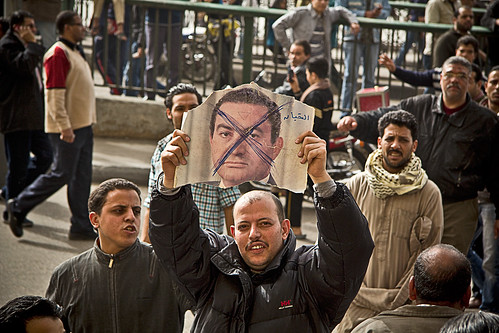
Lead photo from Cairo, via Digby.

Thursday, February 17, 2011

Gaza Mom in San Francisco

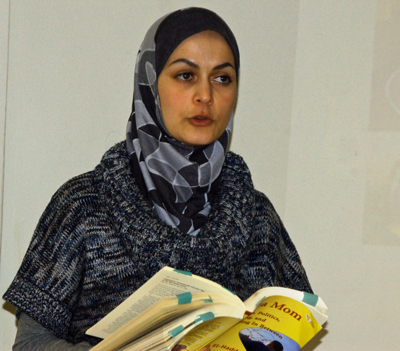
leila-el-haddad-reading-from-Gaza-Mom.jpg

Leila el Haddad who has blogged at Gaza Mom since 2004 is visiting Northern California to promote her new book of the same name. The schedule for her West Coast tour is here.

She conveys eloquently the texture of daily life for the Palestinian inmates in Israel's human zoo -- small joys, small humiliations, a life that is at once "normal and abnormal" even "incomprehensible" to those outside the walled borders. This talented journalist has been forced to live a bifurcated life because her husband, though Palestinian, is not permitted to enter her Gaza homeland by Israeli authorities. So much of her life is in Baltimore where he works at Johns Hopkins, punctuated by stays in Gaza.

For a small sample of her writing (a bit she read last night), go check out her account of trying to explain to her two year old son why they, as Palestinians dependent on Israeli and Egyptian whims, cannot cross the border at Rafah to be with the child's Gaza grandparents.

Much of her writing is about that border with Egypt, Gaza's primary entrance and exit. Of course we, her audience, wanted her thoughts on the uprising and overthrow of Mubarak. But how could a Palestinian, dependent on passing through Cairo, accustomed to Egypt acting as co-jailer along with the Israelis of the 1.7 million Gazans, be anything but circumspect? Though naturally glad to have seen Mubarak fall, all she could or would say, sensibly, was

Palestinians have learned to be cautious ...

Tuesday, February 15, 2011

Egypt afterglow

matson-egypt.jpg

This Matson cartoon catches something all of us who struggle among the excreta of our plutocratic declining empire need to remember: somewhere underneath the indifference and ignorance, among most US people, there's a delight in liberty and an enthusiasm for freedom that can well up unexpectedly. If we want a better country, we need to nurture this, not just rave at our collective faults.
***
With this in mind, I think it needs to be said that President Obama's performance as the Egyptian revolution's most globally prominent spectator confirms the instinct that brought most of us around to supporting him rather than Hillary Clinton during the the 2008 Democratic primaries.

No one who could be elected as head-honcho of the world's dominant empire was going to dismantle it. So the question posed in that election was who among the options seemed to understand that the Bush regime had demonstrated the limits of imposition of US power by brute force -- and who would try to find less violent means to maintain a dwindling hegemony. That's not a very satisfying question to be forced to answer, but such choices are the fate of US progressives, until or unless we get our own uprising. Most of us plumped for Obama and I think the last few weeks have shown us we could have done worse. At least in this White House (as opposed to one with Clinton at the top), there was a set of advisers that didn't want to go down with the Mubarak ship. Weak tea, this -- but weak tea is what get until we change things.
***
Thank you Egyptians for a gift of hope.

Sunday, February 13, 2011

Egypt: Thinking about tactics for overthrowing despots

Crossed Out

Exhilaration from watching Egypt's so-far-successful revolution continues to grip me. As a friend wrote this afternoon: "I've been riveted by events there..." A blog commenter was moved to come up with a new word for what we're seeing:

... in time, sufficient numbers will do a "Tungypt". There, I just created a new word / noun. A Tungypt: where the people finally assemble, and through daily protests force the government to create a government for the people, of the people, and by the people.

Nobody knows how this will play out over time, whether in a flowering of democracy or in dashed hopes. Egyptians will fight that out. But even now we can begin to look at the tactical level, the nuts and bolts of protest, and try to learn something.

I was struck to hear Robert Malley pointing out on NPR on Friday afternoon soon after Mubarak "resigned" that "both opposition activists and the regimes across the region are already looking at Egyptian events and adjusting their tactics to take these events into account." [Paraphrase; can't find a transcript.] Yes, all sides are looking for lessons.

I encountered the following attempt to draw tactical lessons in comments on a Professor Stephen Walt survey of the Egyptian and regional situation. The poster uses the name "Belisariusorb." I have no idea who this might be or where these points originated. My comments -- derived from a distant past in student movements and years of organizing since -- follow each item in italics.

Decalogue for People-Power Revolutionaries

1. Don’t have a visible spokesperson or committee to speak in public for the revolution. A beast with one head can be beheaded, by assassination, arrest or smear. A many-headed creature cannot be killed.

But can a many-headed creature find its way? Maybe, for a while, in very simple circumstances. but without trusted leaders, how will most people know whether to stay or go (for example) when the going gets tough? Having visible leaders sets some people up to be picked off, but lack of visible leadership can create opportunities for infiltration and confusion.

2. Keep your aims and demands simple and don’t have too many. The more stated demands you have, the easier it is for the regime to satisfy some of them and split off support. Justice must be the first demand.

Yes. Simple broad demands are unifying; laundry lists are meaningless and boring. Appeal to broadly shared values.

3. Use ridicule, satire and contempt as your primary weapons. This has a two-fold effect -- tyrants are extremely vulnerable to embarrassment, and are unsettled by disrespectful attitudes; and at the same time a sense of humour will make you much more attractive to the outside world.

Yes, but using humor is not a spectator sport; make satire, don't just watch Jon Stewart!

4. Your principal strategy is to make the regime uncomfortable. Anything -- from striptease protests to pirate videos to simply violating existing etiquette and forms of address -- is valid here. Think big in your aims and think “small and many” in your actions.

I like the second part better than the first. The youth of the US in the 1960s broke taboos so successfully that the society has never retrieved either prudery or gravitas. But we sure didn't get a revolution. On the other hand, many small actions are great because you don't know what will work until you try it.

5. All despotic regimes have a state TV station -- that is the principal target. Cut the cables and power lines, jam it with radio signals if you can, blockade it to stop staff getting in.

Egyptian protesters never achieved this. State TV carried on -- until it became the vehicle for announcing that Mubarak was history. Does TV matter as much as it once did in the internet/twitter/cellphone era? We don't know yet.

I agree with this from TechCrunch: "The people of Egypt made use of what means they had available, just as every oppressed people has in history. Twitter and Facebook are indeed useful tools, but they are not tools of revolution — at least, no more than Paul Revere’s horse was. People are the tools of revolution, whether their dissent is spread by whisper, by letter, by Facebook, or by some means we haven’t yet imagined. "

6. All despotic regimes have nations that back them or trade weapons with them -- the public in those countries will be guilty about participating in your oppression. You must also target them with letters to newspapers in those countries, telephone interviews, blog comments, and all other media.

I like this. Soften up the enablers of tyranny! Recruit allies where you can.

7. Don’t attack or storm any regime positions -- swarm around them. Never harm anyone. Isolate anyone in your movement who urges violence, don’t allow them to act in your name.

Non-violence is essential -- not because you think it a moral imperative, though you may think so -- but because the other side always has more guns and you've got to find a way to take the struggle off the terrain of who has the bigger stick.

8. Don’t act in the darkness -- dictators love the night. Try to coordinate all events in the full daylight so that the videocameras can record any repressive or violent action.

Or make sure you bring floodlights and generators!

9. Find out which officers command the platoons and companies on the front lines, and try to find family members of those officers who will stand with them in the protest. Also sergeants and private soldiers if possible. This reinforces the idea that the army are the people, and discourages any violent response from the soldiers.

One of the most frightening aspects of the current US is that the military is becoming a society apart from civilian life. If we're serious about future progress here, we'll try to keep lines of communication with the soldiers open.

10. Believe no promises from the authorities. Ever. Even the most democratic of politicians lie to save their positions, and a despot will lie more grandly and more readily than any other.

Yes. Listen -- then test and verify.

Photo: Flickr: darkroom productions.

Saturday, February 12, 2011

Enjoy this


Thanks to Jadaliyya.

When I saw this guy, I wondered whether he'd been embalmed somewhere since the early 20th century. He looked like something out of President William Howard Taft's era.

Friday, February 11, 2011

Egyptians celebrate


Mubarak is gone. What's ahead will be hard -- and perhaps not everything these brave exhilarated protesters wish. But today the unimaginable has come about because the people demanded it.

The ripples of possibility that spread out from their achievement will lap at authoritarian governments across the world and discomfit every regime that counts on the immutability of existing arrangements. (Yes, that includes Tel Aviv and Washington!)

End of history, indeed!

Al Jazeera English live stream is here.

Egypt on my mind

I feared this Friday morning I'd wake up to news of a bloodbath by the Nile. Not yet. As the Al Jazeera commentator is saying at this moment of the crowds outside the Presidential palace, "every time these people come together, they raise shout of "Peaceful, Peaceful." So far, the men with the weapons haven't used them.

Yesterday's events -- the expected Mubarak resignation that evaporated when he spoke on television -- reminded me of something. In 1962, President John F. Kennedy told us:

Those who make peaceful revolution impossible will make violent revolution inevitable.

Coming from a vigorous proponent United States world hegemony, this was a theory for understanding apparently unavoidable social change. It was less an endorsement of "revolution" than a prescription for a more or less democratic outcome. But that caveat does not make it false.

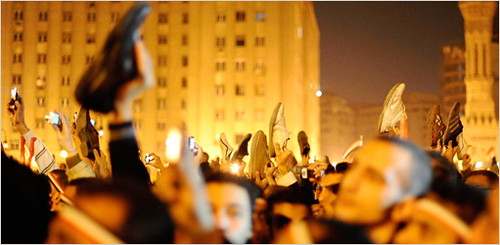
Cairo, end of Mubarak's speech via twitter.jpg

As Mubarak made it clear he wasn't going anywhere, the people raised their shoes in a sign of rejection. Graeme Wood, writing for The Atlantic, caught the moment as felt in Cairo's Liberation Square.

As Mubarak started his speech tonight, the crowd hushed and was ready to hear him out. They wanted celebration, not blood. They seemed ready to cheer and exult, and would surely have done so even if all Mubarak said was that he intended to resign immediately. He wouldn't even have had to agree to a fixed date for elections: A simple "I'm going" would have sufficed. Instead the crowd murmured in disbelief as Mubarak droned on, defiantly granting no substantive concession whatsoever.

Nervous tics in the crowd surfaced, and young mothers with toddlers up past their bedtime started packing their things in case the scene turned ugly. Tears gave way to anger in about 90 seconds, and by the end of the speech no one cared what Mubarak was saying. The protesters heard only themselves, yelling "Irhal," or "Go away."

The uprising of the last three weeks has focused the world media spotlight on putrefying corpse that is the Egyptian regime. I don't routinely look to Radio Free Europe/Radio Liberty for revelatory accounts of dictatorship. After all, these are media outlets were set up by Congress to put out U.S. propaganda during the Cold War. But last week in Egypt, their reporters got a dose of the treatment that so many Egyptians associate with the regime. Picked up on arrival in the country by state security, their Arabic speaking reporter told what he heard while blind-folded in a lock-up with other prisoners.

He heard an intelligence agent ordering, "Get the electric shocks ready, this lot are to be made to really suffer," as a new batch of prisoners were brought in.

"In this hotel, we only have two things on the menu for those who don't behave -- electrocution and rape," the unfortunate detainees were told. ...

Then the screaming started.

New York Times reporters had a similar experience. That's what this regime is, a rotting structure that has nothing left except force to hold it up.

And it's dead, but the corpse remains unburied.
***
Al Jazeera is reporting that Egyptian state television is now grabbing world media reports on their own country. That is, not even the regime knows what is going on at this moment. Let's hope "Peaceful, Peaceful" prevails.

The picture flew by on the #Egypt twitter stream.