Showing posts with label Japan. Show all posts

Saturday, March 06, 2021

No easy answers

As I wait for the electrician, here's a quick take on the frustration I feel when thinking about nuclear power.

The mantra of the best folks working to reduce carbon emissions by ending our dependence on fossil fuels these days is "Electrify Everything!" Insofar as I can understand, this seems believable as a strategy to mitigate the climate change we're living.

But, for many of these climate hawks, Electrify Everything! includes not only extending the life of existing nuclear plants, but also building new ones, perhaps smaller and more numerous.

And I'm open to the idea that our engineers may have learned a lot from 75 years of managing nuclear energy and 50 years of building and running power plants. Experience does lead to improvements. 

But when I encounter these discussions that insist on the necessity of nuclear power, I always try to interject the question -- what are we going to do with the radioactive waste? These plants throw off materials that will be dangerous to life for thousands of years. What are we going to do with this stuff?

This brings me to the random article I ran across this morning in the Washington Post:

A decade after Fukushima nuclear disaster, contaminated water symbolizes Japan’s struggles 

Ten years ago, three power reactors on the Japanese coast melted down when hit by a tsunami. Heroic workers managed to contain much of the nuclear material released but

more than 1,000 huge metal tanks loom in silent testament to one of the worst nuclear disasters in history...

The tanks contain nearly 1.25 million tons of cooling water from the 2011 disaster and groundwater seepage over the years — equivalent to around 500 Olympic-size swimming pools — most of it still dangerously radioactive.

The power company that owns the disaster site says this contaminated water can be treated and released into the ocean. Or at least most of the hazardous nuclear isotopes can be removed. If they do it right and patiently. Not surprisingly, given the damage that their industry has already suffered as a consequence of the accident, people who work in fishing off Japan and South Korea are doubtful.

And scientists not tied to the power companies maintain that a pledge to eliminate all the extremely radioactive corium from the waste is a lie, given that "the technology to do so doesn’t yet exist."

There are tremendous incentives to trust that we can push the question into some future of how to truly remove the radioactive waste we generate while replacing fossil fuels with nuclear. But the track record is not reassuring.

Let's hope smart engineers and governments can do better on this without poisoning people who become sacrifices to progress.

Thursday, August 06, 2020

75 year ago, we dropped the Bomb

The Imperial War Museums (there are multiple locations) in Britain seem remarkable institutions. As a younger friend exclaimed after a visit, "that could be a peace museum!" In a way unlike how such an institution might act in the U.S. of A., their culture treats wars soberly, as terrible, anti-human, eruptions, not occasions for bluster and chest beating.

For the occasion of today's anniversary, IWM asks:
Hiroshima and Nagasaki were experiments in a new kind of warfare, whose full implications were not entirely understood at the time. The bombing of these cities in August 1945 brought an end to the Second World War, but at a terrible cost to the Japanese civilian population, and signalling the dawn of the nuclear age. What had led to the fateful decision to deploy these new weapons of mass destruction?


As a confirmed peacenik, I recoil from the atrocity that my country perpetrated to end the war of my parents' time. The scene in the video in which Churchill, Truman, and Stalin appear to be yucking it up appalls. War breeds more war; Hiroshima and Nagasaki only make macabre sense in the context of years of brutalizing, coarsening combat. As well, the Pacific war between Japan and "the West" -- Britain and the United States -- was a race war. Both sides routinely denied the shared humanity of the other.

I also know, I have no business judging. Future generations, if there are any, will condemn mine for our profligate addiction to fossil fuels.

At the annual ceremony at the peace memorial site at Hiroshima this year, journalists report the crowd was diminished. Many survivors have died; some of those who remain alive stayed away for fear of the coronavirus.
"Despite the health risks, a relatively small number of survivors attended this year. They believed that 'they’ve come this far' and 'can’t quit,' Mr. Sakuma said, adding that 'sending this message from Hiroshima is extremely important.' ...

... The United Nations secretary general, António Guterres, who was not able to travel to the event because of the virus and delivered remarks by video, issued a stern warning about the dangers the world faced as international arms-control regimes began to break down.

"'Today a world without nuclear weapons seems to be slipping further from our grasp,' he said, adding that 'division, distrust and lack of dialogue threaten to return the world to unrestrained nuclear strategic competition.'"

After Hiroshima and Nagasaki, we no longer have the excuse of not knowing.

Tuesday, October 13, 2015

Struggle against U.S. bases continues in Okinawa

U.S. bases on Okinawa, via Wikipedia. "As of 2006, 75% of all US [Forces in Japan] bases were located on Okinawa, and U.S. military bases occupied 18% of the main island."
The elected governor of the Japanese-controlled island of Okinawa has said no, again, to further construction of a new U.S. base. Okinawans have been trying to reclaim their territory for decades. The island is part of the Ryukyu archipelago which the U.S. conquered at the end of World War II. Japan recovered sovereignty, but although since 1945 Japan has been ostensibly a nuke-free zone, the U.S. has been allowed to bring nuclear armed vessels to Okinawa if not the Japanese mainland.

The 1.3 million Okinawans have repeatedly elected officials who promise to oust the U.S. military. These local officials have then been overruled from Tokoyo repeatedly.

The U.S. Marines are not considered good neighbors on the island: they are seen as the source of drunken louts and rapists who usually enjoy impunity from the local justice system.
Between 1972 and 2009, U.S. servicemen committed 5,634 criminal offenses, including 25 murders, 385 burglaries, 25 arsons, 127 rapes, 306 assaults and 2,827 thefts.
The government of Japan, currently in a phase of newly assertive nationalism, appreciates living under the US. security umbrella, especially since they have offshored the basing tensions.

Okinawans are Japan's largest minority group.

I have written previously about Okinawa's special place and its irritants to the U.S. empire here and here.

Tuesday, August 19, 2014

Whither Japan? and some thoughts on accountability

In the hope of musing on something completely unconnected to the horrors of the moment, I've been reading David Pilling's Bending Adversity: Japan and the Art of Survival. I know almost nothing about Japan except that Paul Krugman continually holds up the economic stagnation in that nation as a horrible precursor of where we may be going.

After reading Pilling, I can say I've been exposed to a bit more, even if I don't feel exactly enlightened. Pilling, a Brit who worked in Tokyo for the Financial Times from 2002 through 2008, sets out to share aspects of Japanese culture by way of historical data and voluminous interviews with contemporary Japanese leaders, scholars and ordinary citizens. He begins and ends with the March 2011 earthquake, tsunami and nuclear meltdown followed by devastation and some recovery on the country's north sea coast. In between we meet government leaders, technocrats, entrepreneurs and non-profit enthusiasts, all contesting, mostly politely, the future of their country. I found the book fascinating, though sometimes hard to follow.

Perhaps wisely, though to the detriment of incisiveness, Pilling is partial to a familiar journalistic formula: recourse to on-the-one-hand, on-the-other hand story telling. And he hedges his conclusions. Some specimens of his technique, borrowed from James Fallows' review.

“It would be foolish to suggest that rapid aging doesn’t present big challenges.”

“It would be rash to claim that a single event, even one as traumatic as the March 2011 tsunami, could change society overnight.”

“We should be wary, though, of looking only at the surface.”

My personal "on the other hand" to my own critique seems warranted: what foreign observer can make strong pronouncements about a wildly different culture and country without including some cautionary qualifiers? Only a foolish one. David Pilling seems no fool and I appreciated what I learned from this volume.
***
One historical reality that may prove important for Japan's future is the country's failure to move beyond continuing resentment among people in places victimized by Japanese aggression in the mid-20th century. Quite understandably, Chinese and Koreans easily become aroused at any whiff of Japanese assertiveness. This makes for continued tensions with near-neighbor states and promotes continued Japanese dependence on an unequal alliance with the United States. (Japan was even drawn into committing troops to "humanitarian" missions in our Iraq war.)

Pilling attributes Japan's inability to soften its national image to a combination of its own nationalism, its feeling of victimization as the one people ever subjected to nuclear attack, and U.S. choices after the war. U.S. observers reflexively call out the Japanese for "racism. Pilling emphasizes a particular history.

The Americans' exoneration of the emperor, [scholar John Dower] concluded had turned the issue of 'war responsibility' into a joke. In post-war Germany, by contrast, Nazi leaders, ... had died or been executed. ...In Japan's case there was no such clean break with the past. ... Bureaucrats and politicians who had served during the war continued to play a prominent role after it.

Accountability for Japanese war crimes never took place, so no clean break ever came as far as Japan's critics are concerned.

When I think of the long catalog of crimes committed by my country, even if I limit my thoughts to the last century, I find it nearly impossible to imagine all the accountability we'd have to accept and the amends we ought to make to countries and peoples around the world. In addition to Japan's representing a cautionary story of the limits of bubble-inflated hypercapitalism, it also serves as a cautionary example of what happens when a country fails to face up to the evils of its own past actions. Horrors.

Monday, September 02, 2013

Workers still at work on this day


On this Labor Day, let's offer some thanks for the workers still laboring at the ongoing disaster that is the Fukushima nuclear plant. The Guardian reports Fukushima radiation levels 18 times higher than previously thought.

Every since the earthquake put the plant into meltdown, I've carried gratitude for the people who are shortening their own lives to save millions of people -- as well as the necks of their corporate employer. Assuming this burden became their job; I'm sure they didn't ask for it.

The video clip dates from mid-August. These sorts of reports surface repeatedly because the radiation danger is not close to contained.

Tuesday, March 12, 2013

Fukushima on their minds

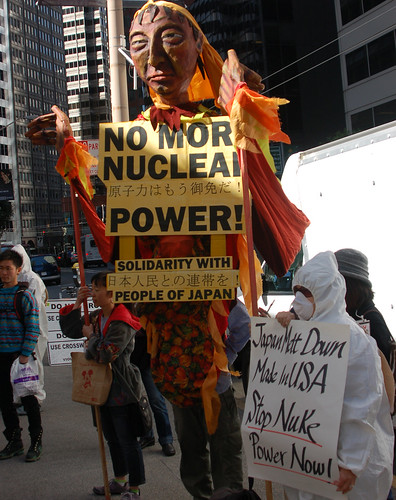
no more nuke power.jpg
Anti-nuclear power activists rallied outside the Japanese consulate in downtown San Francisco on Monday.

When the earthquake and tsunami hammered the Fukushima nuclear plant two years ago, I remember thinking something like well, at least this happened in Japan -- they are a lot better at earthquake engineering than we are … As it turned out, though I still think that is true in some respects, Fukushima showed that a commercial power provider cannot be trusted to make nuclear power safe. The incentives are all wrong. Skimping on safety leads to higher profits now. Catastrophic events are rare. Probably the individuals who make the decision to skimp will have cashed out and moved on by the time problems are revealed. So corporations and their regulators will often cut corners. After all, in the long run, we're all going to be dead.

Christoph Neidhart, a Swiss writer and journalist based in Tokyo, summed up the shock of the Fukushima meltdowns.

The disaster at Fukushima was triggered by a natural catastrophe, a tsunami, but it was allowed to happen, because Tepco, the plant’s operator, and subsequent Japanese governments ignored ample warnings, an earthquake or a tsunami of this magnitude might knock out the emergency back-up systems.

Tepco systematically violated safety rules. In more than 200 instances between 1977 and 2002, the utility submitted false data to the authorities, as stated by a commission of the Japanese parliament, the Diet. The nation’s nuclear safety authorities and government were complicit in Tepco’s blunders.

… Japan sees herself at the pinnacle of technology, a major exporter of nuclear power. Despite the fact Japan’s nuclear industry has suffered a substantial number of accidents before, the country did not have any contingency plans to deal with a nuclear accident as it happened in Fukushima. Six days into the catastrophe, Japan had no idea how to get the plant under control. In a desperate attempt, seawater was dumped from a helicopter to cool spent nuclear fuel. Despite warnings, Tepco failed to prevent hydrogen-explosions.

… Japan, a nation proud of her safety standards and disaster preparedness, was totally unprepared for an accident that had been predicted by experts. The nation of the industrial robot did not have a single machine to mitigate the crisis.

If the Japanese can't build and run these things safely, don't ask me to think U.S. companies can do it. I'm just not that credulous. This is too bad. Nuclear does look like a better alternative than coal -- but at the price of occasionally making large swathes of land uninhabitable for generations? Not to mention, nobody seems to have figured out what to do with the nuclear waste they generate except to make bombs out of it.

According to Elaine Kurtenbach and Mari Yamaguchi, writing for the Associated Press, the clean up is not going so smoothly either.

Two years after the triple calamities of earthquake, tsunami and nuclear disaster ravaged Japan's northeastern Pacific coast, debris containing asbestos, lead, PCBs — and perhaps most worrying — radioactive waste due to the crippled Fukushima Dai-Ichi nuclear plant looms as a threat for the region.

So far, disposal of debris from the disasters is turning out to have been anything but clean. Workers often lacking property oversight, training or proper equipment have dumped contaminated waste with scant regard for regulations or safety, as organized crime has infiltrated the cleanup process.

To clear, sort and process the rubble — and a vastly larger amount of radiation-contaminated soil and other debris near the nuclear plant in Fukushima, the government is relying on big construction companies whose multi-layer subcontracting systems are infiltrated by criminal gangs, or yakuza.

In January, police arrested a senior member of Japan's second-largest yakuza group, Sumiyoshi Kai, on suspicion of illegally dispatching three contract workers to Date, a city in Fukushima struggling with relatively high radioactive contamination, through another construction company and pocketing one-third of their pay.

He told interrogators he came up with the plot to "make money out of clean-up projects" because the daily pay for such government projects, at 15,000-17,000 yen ($160-$180), was far higher than for other construction jobs, said police spokesman Hiraku Hasumi.

Well that is straightforward: when the criminals in the boardrooms make a mess, hand it over to a mafia to clear it up. The hell with the workers ... This episode is only one of many instances of untrained and underpaid workers unwittingly carrying the risks of the clean-up.

It's hard to believe there is any such thing as safe nuclear power when there are greedy humans involved -- and I don't know how we accomplish an ethical shift to change that. The nukes may be okay, but we're not ready for them.

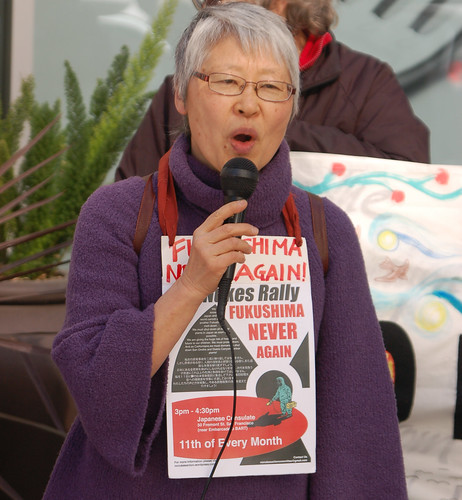
no nukes speaker.jpg

Wednesday, August 10, 2011

Warming Wednesdays: Hiroshima, Nagasaki, Fukushima Daiichi


Each August, I try to mark my country's choice to unleash the nuclear genie in 1945 by obliterating the cities and people of Hiroshima and Nagasaki. This year, it seems appropriate to highlight that that the survivors of this signal event have chosen to speak out about Japan's current dependence on nuclear power.
NAGASAKI, Japan — In 1945, Masahito Hirose saw the white mushroom cloud rise from the atomic bomb that incinerated this city and that left his aunt to die a slow, painful death, bleeding from her nose and gums. Still, like other survivors of the attacks here and in Hiroshima, he quietly accepted Japan’s postwar embrace of nuclear-generated power, believing government assurances that it was both safe and necessary for the nation’s economic rise.

That was before this year’s disaster at the Fukushima Daiichi nuclear plant in northern Japan confronted the survivors once again with their old nightmare: thousands of civilians exposed to radiation. Aghast at the catastrophic failure of nuclear technology, and outraged by revelations that the government and power industry had planted nuclear proponents at recent town hall-style meetings, the elderly atomic bomb survivors, dwindling in numbers, have begun stepping forward for the first time to oppose nuclear power. ...

“Is it Japan’s fate to repeatedly serve as a warning to the world about the dangers of radiation?” said Mr. Hirose, 81, who was a junior high school student when an American bomb obliterated much of Nagasaki, killing about 40,000 people instantly. “I wish we had found the courage to speak out earlier against nuclear power.”

NYT, August 7, 2011

There are environmental prophets like George Monbiot who have concluded that some increase in nuclear power generation is the only available "bridge" to a global society that has given up fossil fuels for renewables. In the linked article he makes his best case. But Japanese survivors bring moral force to a debate in which the pr0-nuke arguments more and more seem to require willful disregard of the limits on human capacity to achieve technical and moral perfection.

As the New York Times reported yesterday, the more that comes out about Fukushima Daiichi's multiple meltdowns, the more it is proved that both the power company and the government lied repeatedly about dangers they knew were real and present. Why? Because numerous very human mistakes were made -- and admitting the truth would have added to the already staggering toll of the earthquake and tsunami.
In interviews and public statements, some current and former government officials have admitted that Japanese authorities engaged in a pattern of withholding damaging information and denying facts of the nuclear disaster — in order, some of them said, to limit the size of costly and disruptive evacuations in land-scarce Japan and to avoid public questioning of the politically powerful nuclear industry. As the nuclear plant continues to release radiation, some of which has slipped into the nation’s food supply, public anger is growing at what many here see as an official campaign to play down the scope of the accident and the potential health risks.
The people responsible for nuclear safety didn't dare -- in the crunch -- to tell the people who might be harmed the truth that their precautions had failed. This seems to be a pattern in relation to nuclear energy: the authorities in most countries deny and obfuscate as long as they can. And errors are not rare: in California we've got a reactor which was licensed despite earthquake supports installed backwards.

Though in many countries, including the U.S., Japan, and the United Kingdom, nuclear generating plants are privately owned, it is impossible to build them without government protection against liability. Insurance companies aren't willing to be on the hook for the potential costs of a mishap -- something no engineer in his right mind can really promise given the history of a meltdown every decade or so. And the costs spread out over a country's whole life. Back in March, long before the worst of the Fukushima situation was known, Craig Bennett described how the disaster rippled outwards:
Following the incredibly expensive evacuation, there has been a suspension of sales of food from the area, and now even fears about drinking water in Tokyo. These measures will hopefully ensure the health impact remains minimal.

As well as being incredibly distressing for the people living nearby, this is all costing a fortune. Add to it the clean-up costs, more stringent safety regulations and an inevitable increase in insurance arrangements, and the economics of nuclear will be forever changed. And they weren't particularly healthy to start with.

... No nuclear power station has been built without state cash ... No subsidies means no nuclear. Supporting nuclear means getting behind taxpayer-funded subsidies ...
My emphasis. And that's one of the worst aspects of these things, on top of the actual dangers. Technocrats like nukes -- they trust themselves to do it better next time. But ordinary people have pay for them. And in general, when democracy is working, we don't want them, especially if we have to live near them.

Nukes only get built when the wishes of the neighbors can be discounted and run over. Neighbors seldom enthuse about the cooling tower down the road; they worry. NIMBYism may look unattractive --selfish -- but it is a natural response to a dangerous technology whose owners and sponsors have repeatedly been shown to be over-optimistic at best, and more likely just liars.

Nevada NIMBYism has prevented the U.S. from sinking nuke waste in the ground, a much contested "solution" to the inevitable waste disposal conundrum. Nuclear promoters have to claim they'll find a magic solution to waste disposal, though no answer have turned up over the last 60 years. Fukushima wouldn't have been so dangerous if it had not had pools of radioactive waste sitting around -- U.S, nukes mostly have those too, since we have no national plan for disposing of the deadly stuff. Nuclear engineers always hope a solution to the waste is just around the technological corner, but so far, nothing convincing.

If something goes wrong with a nuke, experience has shown over and over that authorities lie and minimize. They don't trust people with true information.

Nukes are a deeply anti-democratic solution to the problem of human generated global warming. They seem to require lies to get built, to require disguised promises of tax dollars to run, and require companies and governments to deceive in a crisis. I'm just not so desperate yet about climate change to be willing to go there; let's get serious as a society about renewables -- that's hard enough to achieve and a damn sight less dangerous.

Tuesday, May 17, 2011

Japan: past defeat and present recovery

The images from the March 2011 earthquake and tsunami in Japan were devastating, that wall of water crashing through houses, highways, entire towns. I found myself wondering not only about the the ongoing crisis at the nuclear plants and the people killed, but also about the survivors. What does it mean to people to survive in a place where friends, family and even most familiar structures have been swept away?

Someone suggested John W. Dower's Embracing Defeat: Japan in the wake of World War II. Dower is an historian I've read before. His War without Mercy: Race and Power in the Pacific War is, as far as I'm concerned, the indispensable history of that conflict, showing conclusively that for all parties it was a race war.

Embracing Defeat didn't actually tell me much about how Japanese will adapt, respond and recover from the current horror. But it is quite fascinating. Among other insights, Dower emphasizes that if there was one experience postwar Japanese were socialized to expect, it was being subjected to involuntary changes. Constant change had been the texture of Japan's modernization and imperial ambitions since its "opening" to the West in the mid-1800s.

For almost a century, the Japanese had been socialized to anticipate and accommodate themselves to drastic change. When World War II ended, they were well prepared -- not merely by the horrors and manifest failures of the war, but also by the socialization of the past and even the psychic thrust of wartime indoctrination -- to carry on the quest for a "new" Japan.

The arriving U.S. military occupiers, expecting an exotic, hidebound and feudal society, were astonished by the unexpected flexibility of Japanese responses to defeat, responses which were far more creative than just putting on a show of compliance for the conquerors. I wonder if some of that resilience may still be available to the survivors in Fukushima Prefecture?

General Douglas MacArthur's army of occupation threw itself into the contradictory project of creating a democratic "revolution from above" -- the original instance of George W. Bush's mad fixation on implanting his idea of democracy in other peoples' countries. Oddly enough, according to Dower, a remarkable synergy between indigenous Japanese impulses and an uncomprehending imperial authority, did leave Japan with a governmental system very much its own and partially democratic.

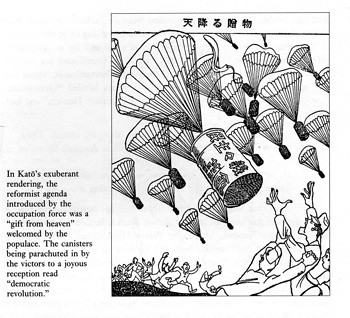
Some Japanese even liked the strange experience of U.S. occupation. This contemporary Japanese cartoon, according to Dower not intended to express irony, shows that, for at least a short season, those conquerors were greeted as donors of a welcome gift of democracy.
Dower-Embracing Occupation001.jpeg
As pure curiosity, this history would be hard to beat.

Friday, March 18, 2011

Japanese really do use different metaphors

At least so I think. Here's a cartoon for children explaining what is happening at the damaged nuclear plants.


All I can say is, I don't think I'd like to be a little girl in Japan. But if this communicates to kids, that has to be good. I can't fathom the levels of anxiety, not to mention actual deprivation, that survivors of the last week's quake and tsunami must be experiencing.

H/t Salon.

Wednesday, March 16, 2011

At least we're not mixing nukes and war, this time


Let's think about the twin horrors of the day together for a moment.

In Japan, as the clip reports, some degree of nuclear meltdown is happening at the damaged power plants. And, perhaps even worse, hundreds of thousands of survivors of the earthquake and tsunami have had their existence literally reduced to rubble. As the social adrenaline abates, what will happen to them?

Meanwhile, the agony in Japan has pulled the world's eyes away from the revolt in the Libyan desert. As of today, it looks as though Colonel Qaddafi will succeed in taking back the rebel-held cities. We probably won't be able to see the violent retribution this dictator will visit on people who turned against him. Nor will we know for awhile whether military defeat means the popular revolt in the North African country is truly crushed or merely forced underground.

Our instinctive response to these horrors, as it is to some many others, is an anguished cry: IT ISN'T SUPPOSED TO HAPPEN LIKE THIS!

But it does happen; it can. Power hungry men with enough money and guns can triumph over hope. Brilliant engineering and even the heroism of nuclear emergency workers can't ensure the safety of our attempt to harness the forces embedded in the stuff of the universe.

We will try over the next few months and years to put those insights out of our minds. That's what our ever-hopeful species does. It's not hard; there's lots of other things to concern us, from trying to help salvage lives for the injured from these events to going back to tweeting about Charlie Sheen.

But, at a minimum, let's try not to bring today's two horrors together. Nobody is talking much about this at the moment, but a year ago just about every developed exporter of nuclear technology was crowing about the possibilities of the Libyan reactor market.

The north African country already has a Russian 10 MWt research reactor, which has been operating since 1981 and is under International Atomic Energy Agency (IAEA) safeguards. France, Argentina, Ukraine and Russia have all signed agreements on the peaceful use of nuclear energy with Libya since its voluntary decision to halt a clandestine uranium enrichment program and fully open itself to IAEA inspections in 2003. Canada has also signed a memorandum of understanding with the country.

The ongoing Japanese meltdown illustrates, again, that human ingenuity cannot insure against all contingencies. Neither can humans avert war and civil strife. But we can try not to mix the two hazards.

Monday, March 14, 2011

Earthquake, tsunami and human adaptations


Here's comes Yukio Edano, Japanese Chief Cabinet Secretary (what's that?), again with his deadpan delivery of the latest announcements about whether those earthquake- and tsunami-damaged nuclear power reactors are on the way to turning themselves into dirty bombs. I've been watching the CNN feed of English language news on NHK World off and on since Friday.

And behind him, there's the Japanese Sign Language (JSL) interpreter. Is this participant in the press conference the norm on Japanese TV? I don't know. I like the idea that if Mr. Edano ever admits that it is time to hit the panic button, at least deaf people will have a chance to run as much as the hearing.

According to the linked article on JSL, the widespread use of the language has led to

a subtle cultural change in views about the Deaf in Japan evolved. The long-standing concept that "deaf" only means "people who can't hear" emphasized a physical impairment as part of a biomedical disease model; however, this was gradually replaced by a slightly different paradigm. "Deaf people" were more often identified as "people who use Japanese sign language."

Interesting.

I have no idea where to find believable information about the Japanese nuclear plants. Probably at this point, nobody knows all we'd like to know and some of the people who know a lot have incentives for not telling. One source that may be trustworthy is the Union of Concerned Scientists' "All Things Nuclear."

It's never hard for a San Franciscan to imagine the horror a quake might leave behind. Clearly rescuers will keep finding bodies for days. I ache too for the living survivors. They may have lost family and friends; they will certainly have to endure hardships before any semblance of normal life returns.

We count on terra firma under us. The knowledge that land and sea can rise up, seemingly against us, must leave inner marks.