Showing posts with label NOLA. Show all posts

Monday, August 31, 2015

Gotta keep an eye on the powerful and the profiteers


On this anniversary of Katrina, Nick Buxton and Ben Hayes urge us to look not only at past horrors in New Orleans and on the Gulf Coast, but also at what militaries, governments, and big corporations have learned from that tragedy.

Could it happen again today? ...

... the structural inequality and institutional racism that underpinned the Bush administration’s response is still there, a fact that President Obama noted on his visit to New Orleans this week. Moreover, the already bloated military and security complex that reflected these power relations has expanded enormously since Katrina – and is now using the spectre of climate change to grab yet more public resources.

Two years after Katrina, in 2007, the Pentagon released its first major report on climate change, warning in no uncertain terms of an “age of consequences” in which, amongst other things, “altruism and generosity would likely be blunted.” This was followed up a year later by an EU security report that talked of climate change as a “threat multiplier” that “threatens to overburden states and regions which are already fragile and conflict prone.” It warned that this would lead to “political and security risks that directly affect European interests”. ...

... in one sense, the accuracy of the predictions doesn’t really matter. On the anniversary of Hurricane Katrina  we only have to look at how the humanitarian crisis on Europe’s doorstep and in its borderlands is unfolding. In Calais, we see a humanitarian emergency being treated as a security issue as the British government has pledged 22 million Pounds on fences, police and dogs to keep out refugees fleeing war and torture. Both Hungary and Bulgaria announced this week that they were deploying troops, so-called “border hunters”, to prevent refugees entering the country from the former Yugoslavia.

Further afield in Brazil, there were reports this summer of authorities mobilising troops to defend water infrastructure amid an ongoing drought in the megacity of São Paulo. ...

... And we can already see how the national security planners are factoring protests against inequality and social injustice into the new crisis management paradigms: by trying to predict complex emergencies and social unrest. Today, the UK’s National Risk Register, for example, lists “public disorder” and “disruptive industrial action” as among the most severe and likely security threats facing the country.

... Dystopian preparations by the state are reflected in the corporate arena. Where we see a future climate crisis, many companies see only opportunity: oil firms looking forward to melting ice caps delivering new accessible fossil fuels; security firms touting the latest technologies to secure borders from ‘climate refugees’; or investment fund managers speculating on weather-related food prices – to name but a few.

... Hurricane Katrina was a watershed moment and a warning to us all ... We the people have to combine our actions to end worsening climate change with a transformation of the institutions that seek to respond to its impacts. 

What they describe here (and presumably will elaborate on in their forthcoming book The Secure and the Dispossessed) is the line up of institutions and individuals who are counting on enhancing their profits and power through the disruptions of climate change.

Sunday, August 30, 2015

Ten years after Hurricane Katrina


Ten years ago, I spotted this sign in the window of the neighborhood video store. The rapper Kanye West, at a concert for storm relief, had blurted out some truths:

I hate the way they portray us in the media. You see a black family, it says, 'They're looting.' You see a white family, it says, 'They're looking for food.' And, you know, it's been five days [waiting for federal help] because most of the people are black. ... George Bush doesn't care about black people.

West's outrage felt a relief. What we'd all seen on the TV was so horrifying -- New Orleans drowned and so many of its people still trapped by water and the failure of our systems to provide help.

West gave us somewhere to direct our rage -- this travesty must be George Bush's fault. In 2005, we were still close in time to the 9/11 attacks, after which for awhile the national need to pull together had made it hard to voice criticisms. Of course many of us had protested the Bush administration's follies and crimes: the Iraq invasion, Abu Ghraib tortures, the absurd security theater at airports, the color-coded alerts. But West's blunt declaration seemed to open the floodgates for all of us who desperately needed to scream at the administration: "you are taking the country in a wrong direction!" Thanks Kanye.
***
Looking back ten years, I now have to wonder whether Kanye might have spoken more accurately if he'd raged, "America hates black people." Yes, New Orleans got rebuilt ... without many of its poor and black citizens and perhaps much of its uniqueness. Over the last decade despite an administration headed by a black man, shockingly, blacks have ceased to be an absolute majority in Washington DC, now a boom-town for the young, affluent, hip and white. There goes another enclave of black culture and some autonomy. The nation continues to push aside, lock up and sometimes simply shoot poor black people. No wonder there's a broad movement to shout "Black Lives Matter."
***
I sent this photo to Steve Gilliard at The News Blog and he used it more than once. Steve was a towering presence in progressive blogging in those days. He died in 2007, one more loss along the way.
***
I was exceptionally lucky during the days after the hurricane to find myself working in what was one of the few usefully responsive institutions in the country. At the California Nurses Association (now National Nurses United) people did know what to do. Within twenty-four hours after the levees broke, CNA staff were on the phones, organizing medical personnel to fly in, hustling resources, and shaming anyone in authority who dragged their feet. For two weeks I listened to these urgent conversations and could feel assured that someone was doing something.
***
Just one more point, ten years later. Amazingly, despite technological change and finding itself located in the very epicenter of the San Francisco tech-fueled boom, the video store is still alive. That little business seems to have nine lives. It's owners have been nimble, merging with a music distributor and together providing quirky non-commercial offerings. Long may they last.

Wednesday, January 07, 2015

Today is all about windows

Regular blogging will resume when the installer gets finished. More insulation ahead!

This 2006 sculpture by Leandro Erlich is on display in the outdoor garden at the New Orleans Museum of Art.

Friday, October 03, 2014

Friday cat blogging


From his perch on the weaving in progress, Bentley greets each visitor to the rug shop in the French Quarter in New Orleans. He accepts petting from all.

Sunday, September 01, 2013

Racial derangement marks responses eight years after the storm

“Hurricane Katrina” still occasions crazy responses with a racial tinge.

On August 29, 2005, the Category 3 storm drowned New Orleans and nearby areas of the Gulf Coast. Nearly 2000 persons perished in landfall’s wake. Municipal, state and national government responded miserably, leaving millions to fend for themselves without help for days. President George W. Bush’s inept disaster bureaucrats came under a media spotlight as the evacuation and aid effort stumbled repeatedly.

“Katrina” became a synonym for callous racist brutality inflicted on the Gulf Coast’s poor, heavily Black, population.

Recently Public Policy Polling plumbed the memories of some residents of Louisiana.

In answer to the question, "Who do you think was more responsible for the poor response to Hurricane Katrina: George W. Bush or Barack Obama?," 29 percent of a pool of Republican primary voters in Louisiana blamed Obama, who took office in 2009, and 28 percent blamed Bush, whose term lasted through 2008. Hurricane Katrina hit on Aug. 29, 2005.

Nola.com, 8/21/13

In 2005, Barack Obama was still in his first year as a newly elected Senator from Illinois. What ails Louisiana poll respondents? The Washington Post columnist Dana Milbank asked the pollster:

"Obama derangement syndrome is running pretty high right now among a certain segment of the Republican base," Tom Jensen, director of Public Policy Polling, told me. "There's a certain segment of people who say, 'If you're going to give me the opportunity to stick it to Obama, I'm going to take it.'"

In other words, a large number of that 29 percent who said Obama was responsible for the Katrina response knew that he wasn't but saw it as a chance to register their displeasure with the president. Obama has driven a large number of Republican voters -- Jensen puts it at 15 percent to 20 percent of the overall electorate -- right off their rockers. …

It’s not hard to guess the race of this fraction of respondents. It is also worth noting that the guy who takes these measurements believes the incorrigibly racist fraction of the United States’ whole is “only” 15 to 20 percent.
***
The Institute for Southern Studies, by way of the Bridge the Gulf Project, provides another take on the eighth anniversary of Katrina. Derrick Christopher Evans is a native of the Mississippi Gulf Coast and he’s got some questions. Watch this:

… The word "hurricane" is from the Caribbean Islands, from the Taínos. It's an indigenous word -- huracán. Huracán was a deity, a god of chaos and destruction, that they celebrated. Why would they celebrate it? Because what it did was it blew out and eliminated the old, the weak, the dying, or whatever it didn't want to have stick around, to create new life. To them, it was like the god of creation.

And what burns me up to this day about the recent disasters in this part of Turtle Island, these disasters that have plagued the Gulf Coast haven't fulfilled that hope or promise of Huracán. I would have thought -- I did think, like a fool -- after Hurricane Katrina that the very best minds from academia, from every sector of American life, would have blown in to combine with the good that survived here to create a bold, better, and creative, sustainable, healthy future.

But in the aftermath of Katrina, and every day since then, and in the aftermath of BP, all of these emperors with no clothes, they can't get nothing right. Use total destruction, total chaos, to come back better, come back stronger. I mean, why waste a good huracán? Why waste a good BP oil disaster, you know?

Could it be that “they can’t get nothing right” because these disasters have overwhelmed the wrong people, poor and Black people?

Wednesday, October 06, 2010

The faith of Zeitoun

...what is building, and rebuilding and rebuilding again, but an act of faith? There is no faith like the faith of a builder of homes in coastal Louisiana. And there is no better way to prove to God and neighbor that you were there, that you are there, that you are human, than to build. Who could ever again deny he belonged here?

This is the assertion that I cannot get over, that haunts me as I try to assimilate Dave Egger's Zeitoun.

In all my voluminous reading, I've never encountered anything quite like this magical work of truthful non-fiction. Abdulrahman Zeitoun and his wife Kathy survived both Hurricane Katrina and the subsequent terrified security regime that brought terror to their home. They emerged ready to tell their tale. Eggers was there to hear and construct it for us to share. He is a novelist, writer, editor, publisher -- and on the strength of this volume, a most sensitive witness to the vagaries our fragile civilization.

The Zeitoun clan came out of a Syrian port and its trajectory seemed bound up with the sea. No wonder, somehow, that Abdulrahman came ashore and into married life in New Orleans.

Following Abdulrahman about the drowned city in the days after the storm, we learn that devastation can contain beauty. Following Kathy in exile from her husband and city after the storm, we learn that that the one who seems to escape can also suffer.

One myth that dies in this book: no one should assume that Muslims can't abide dogs.

I'm not going to tell more here. Just read it if you have not yet done so.
***
This volume is the focus of San Francisco's One City, One Book citywide literary event that urges residents to read the same book and discuss it together. Quite coincidentally, I've just read what everyone else, I hope, is reading.
one-city,-one-book.jpg
San Francisco bus shelter ad.

Sunday, August 29, 2010

Five years after Katrina ...

New Orleans and the Gulf Coast still are hurting. This weekend, we're deluged in a flood of words and images from that time.

pakistan flood.jpg
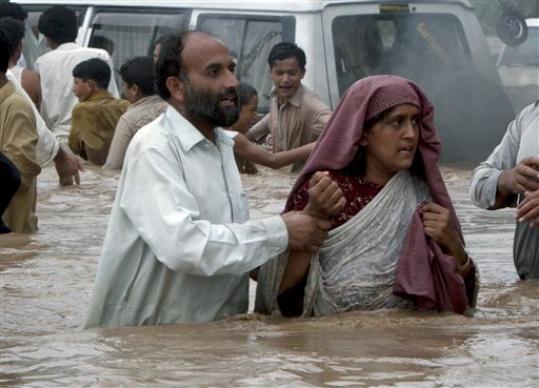
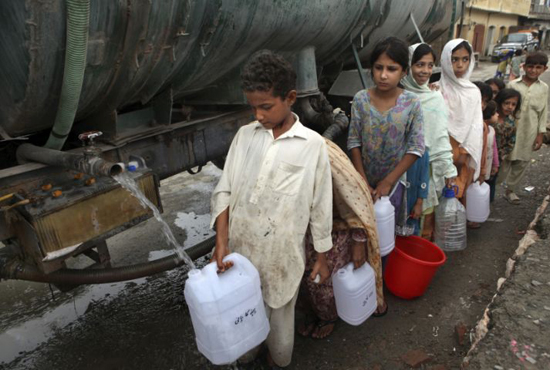
And a world away, a natural catastrophe of far greater magnitude continues to drown thousands and shatter the lives of millions. Since July 22, monsoon swollen rivers have rushed through one fifth of Pakistan, displacing at least 18 million people and killing thousands. The flooding is ongoing; just yesterday levees broke in Sindh province, displacing another million people. According to a United Nations relief official:

"This disaster is worse than the tsunami, the 2005 Pakistan earthquake and the Haiti earthquake ..."

Australian Broadcasting Company

I try to imagine what an equivalent disaster would look like in the United States. Perhaps the magnitude would be somewhat equivalent if one spring when winter snows melted, the entire Mississippi River basin were engulfed by surging waters. In Minnesota, Lake Itasca would overflow and soon thereafter, the river would rush through parts of Minneapolis and Saint Paul. In Iowa, Dubuque and Davenport would be warned the flood was coming, but their sand bags would be breached and neighborhoods inundated. Next St. Louis would get its turn. Cairo, Illinois, at the confluence of the Mississippi and the Ohio Rivers would simply disappear. Despite the best efforts of Army engineers and the National Guard, large sections of Memphis would be the next to go. New Orleans may have some protection now from a hurricane storm surge, but could it survive a deluge flooding out of the entire central drainage of the continent?

Pakistan is supposed to be some kind of U.S. ally. Foreign policy scholar Stephen Walt points out that fruitless U.S. wars in Iraq and Afghanistan have left this country unable to offer significant help in a situation where we could actually do Pakistanis and our own security some good.

Horrible as the Pakistan floods are, they have not received the kind of obsessive first page news attention that we saw for the tsunami or the Haiti earthquake. And consequently they are not getting the kind of charitable help that is so needed. There are groups that have been working in Pakistan for years that can use well any donations U.S. individuals can spare for Pakistan. In particular, you might want to take a look at Global Fund for Women and Doctors without Borders.

Five years after Katrina, I can't push away the memory of the latest flood victims anymore than I can get those awful images of people abandoned on roofs in a flooded U.S. city out of my head.

MSF-Pakistan.jpg

Sunday, August 31, 2008

Hurricane Gustav


I was supposed to be flying to New Orleans Tuesday morning for a week of meetings. Well that's not happening. And this disruption of my schedule is nothing on what's happening to the hundreds of thousands of people now evacuating who have to wonder, will they have homes to return to?

Some thoughts:
  • Yesterday Gustav pounded Cuba as a Category 4 storm, with winds in the 150 mph range. I've been in Cuba in torrential rains; it floods. What I saw of Cuba didn't make me love their society and government. But I've seen a little of how their practice at discipline and working together serves them in time of crisis. Jeff Masters, Hurricane watcher extraordinaire, had high hopes for how the island would do:

    Fortunately, Cuba has a top-notch hurricane civil defense operation, and I'm confident they have gotten all of the population at risk out of harm's way.

    I sure hope he was right.
  • Now Gustav is barreling across the Gulf of Mexico -- toward New Orleans -- and toward those drilling platforms that Senator McCain wants us to encourage more of. Uh, oh. Turns out that oil company practices ensure that an ill-winds blows their profits good.

    Afterward .. already painful gasoline prices could hit $5.00 a gallon quickly. Unlike the hurricane, it's a preventable event. The storm may well cut refining capacity along the Gulf, but if the U.S. had a decent supply of gasoline on hand, price spikes would also be muted. But refineries have cut back production to keep prices up even as gasoline consumption falls. So U.S. gasoline supplies now are lower than before Hurricane Katrina in 2005.

    Oil Watch

  • Grandmere Mimi, who has now successfully evacuated from the Louisiana Coast, wants to us to know that it's an oil advocates' myth that none of those same oil facilities leaked under Hurricanes Katrina and Rita:

    As a result of both storms, a total volume of 17,652 barrels (or roughly three-quarters of a million gallons) of total petroleum products, of which 13,137 barrels were crude oil and condensate, was spilled from platforms, rigs and pipelines. 4,514 barrels were refined products from platforms and rigs.

  • If I'd gone to New Orleans, I had meant to point readers to this extraordinary archive on the city, its people, and their struggles in the context of Hurricane Katrina and its human-induced aftermath. The Katrina Reader brings together online accounts and analysis of grassroots struggles led by African Americans in New Orleans for their communities and their way of life. Katrina tore the mask off systemic racism -- this is that story.

Sunday, September 23, 2007

A fire for justice...


Gay Episcopalians wondered this weekend whether the bishops of our church gathered in New Orleans would throw us under the bus to preserve the Anglican Communion -- it’s a church kafuffle, if by chance you don't pay attention to this teapot. So it was great to read that they'd gotten an earful about the place they were visiting from Gus Newport, former mayor of Berkeley, an urban visionary, and a long time agitator for justice who can be trusted not gloss over realities. Episcopal News Service reports his talk:

"I have never seen such devastation, and I've been in war zones," Newport told the joint gathering of bishops and spouses about his first few weeks in New Orleans after Hurricane Katrina. ...

"Every evening, I would just cry, and wonder why there were no mental health experts here to help people get through this. When Columbine happened, that area was saturated with mental health professionals. How can a society like ours not think about mental health professionals, it's just plain racist," he said. ...

He told the gathering that present conditions were created after World War II when, in about 80 percent of the nation's cities, manufacturing and other jobs were outsourced to cheaper labor markets, interstate freeways were constructed and in many cases were built in the heart of black economic districts, effectively killing them and disenfranchising cities. At the same time, he said, real estate developers built suburban shopping malls and most of the white middle class moved away.

"That in a sense removed all the economies from the inner city, all you had left were philanthropy dollars and then they wonder why there's so much crime and violence. It's failed public policy." Newport said. ...

Now, he added: "These cities are time bombs waiting to detonate. In the case of New Orleans, the infrastructure was extremely flawed, there was a poor tax base, the levees hadn't been fixed for years. We wonder sometimes where are our priorities as a society.

"How can we spend trillions of dollars going into war in Iraq at the expense of a country so deteriorated, where our public school system is in such a state of decline?"

Newport has always told it like it is.

I have a vivid memory of Newport from the mid-1980s. President Reagan was funding a guerrilla assault on the elected government of Nicaragua without telling Congress where he was getting the money; in El Salvador, the U.S. was propping up a brutal military and right wing death squads. Bay Area activists in solidarity with popular movements in Central America held a meeting in the Physical Sciences Lecture Hall in Pimentel Hall at UC Berkeley; as a courtesy, the mayor was invited to say a few words.

Newport got up and rocked the house, saying something like this:

I don't understand you white people. The government in D.C. is making war on some the most important movements of poor people on the planet and you are sitting around talking. If I were you, I'd be organizing people to stop this right now. You hand out all these papers; you could have people out there with torches messing up the ATMs at these banks that pay for this stuff. You could be forcing the government to stop. That's what being serious about liberation would look like. Stop them!

Well, we didn't do it and Newport didn't either, but he meant it about seriousness -- and we still need that kind of fire. Glad the bishops got to hear from him.

Saturday, September 01, 2007

In which a bishop lays into a king (well, a President...)


AP Photo

Though I'm an Episcopalian Christian, I'm also a normal individualistic resident of the contemporary United States: I don't usually expect to get my moral guidance from the clergy -- they just get a hearing, as do other moral exemplars.

So I'm moved to read the challenge Bishop Charles Jenkins of Louisiana laid down to our ostensibly pious chief executive on the second anniversary of Hurricane Katrina:

Recognizing our vulnerability, not to terrorism, but to the deadly force of severe weather, I would like to ask the President how he plans to clearly demonstrate his calculation of our people’s worth and his government’s commitment to our safety? The question is one that Providence has put to this President, and it is one of those tests all human beings dread – the kind that determines who you really are....

We already know who faith-based America has proven to be. These volunteers have not sacrificed for the “safe” above-sea-level neighborhoods or the economically secure residents of this city. They have not given their time, talent, and hard-earned dollars to the recovery of communities that rest securely on higher ground.

The volunteers of this country are still coming in larger numbers than ever to help heal the lives of their fellow Americans – the same vulnerable Americans we saw trapped, suffering and dying on our televisions two years ago this week. And those “looters,” “those people down there” as the President has called us, are proving to be some of the most courageous and resilient citizens of this land....

It means, Mr. President, that a huge number of Americans love their neighbor as themselves. Not in words alone but in actions. This segment of our society, a segment whose values you claim to represent and share, has already cast its vote in the referendum on New Orleans. We clearly do not believe any of New Orleans or its people are dispensable or undesirable. We stand together in our fight to recognize and cherish the dignity and worth of every citizen of this city, and we believe how the citizens of this city are treated says who we really are as a nation. ...

We can be reconciled, Mr. President. New Orleanians are a long-suffering and forgiving people. But to be so you must show us that you see and value our humanity before it is too late.

Emphasis mine. The full text of the statement is at this link.

Via a comment at The Wounded Bird -- Grandmere Mimi's digs -- where she also shares her own Katrina experience.

Tuesday, August 28, 2007

Crisis reveals perversion of democracy


AFP PHOTO / Aris Messinis

All nations at important moments in their history face pivotal moments when they must urgently address pressing matters of great collective concern if they are to avoid regression. ... such a moment has arrived. Unfortunately, neither of the two major political parties that have taken turns to govern the nation ... have displayed the administrative competence or the intellectual understanding now required to address the ecological threat confronting the country. ...

The nation is in dire need of new, bold, courageous leadership. It urgently requires a long-term strategy that pioneers will a sea-change in the country's approach towards the environment. Shortcuts will be very dangerous. Complacency may be fatal. Moral consciousness must be awakened and a grand vision needs to be developed to avert the nation's ecological collapse. ...

It is a genuine shame that a country that gave form and shape to democracy and civil virtue and once prided itself on the cultivation of aesthetics as the true meaning of life today displays astounding mental perversity in sacrificing the environment and its ecological system on the altar of greed and political clientilism.

Has Al Gore completely lost it? It would be hard to blame him.

But no, the author is Chronis Polychroniou, head of academic affairs at Mediterranean College in Athens, bemoaning what the current inferno in his country has revealed about its polity.

On the second anniversary Hurricane Katrina, when our system let a major city drown -- probably for Republican political gain -- we should find this all sadly familiar.

What are we, and the Greeks, going to do about it?

Thursday, August 24, 2006

Katrina in Edgartown

1eventsign2
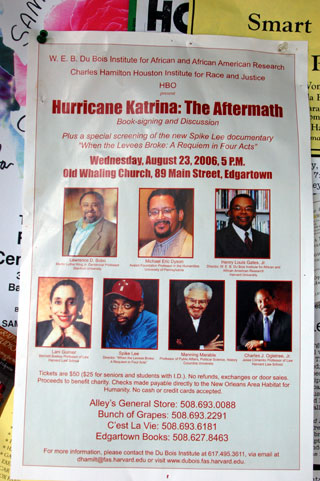
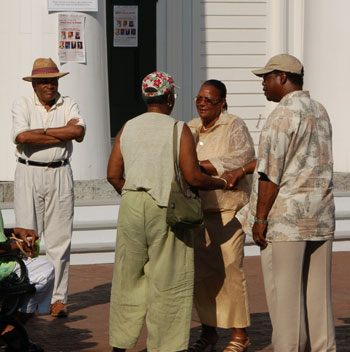
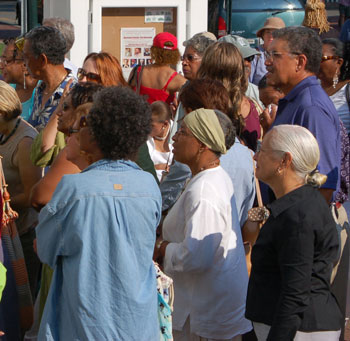
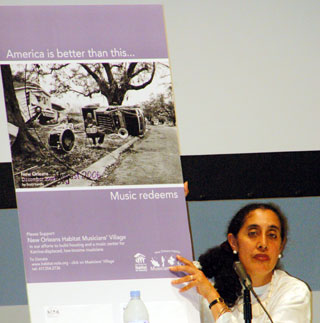
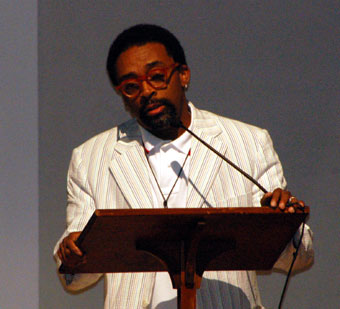
THE place to be on Martha's Vineyard yesterday was at the Old Whaling Church in Edgartown for an event titled "Hurricane Katrina: The Aftermath." Spike Lee, along with one hour of his HBO documentary, headlined the event. A panel conisting of African American academic luminaries who summer on the Vineyard followed, urging the audience to remember the storm and how our society treated its victims.

2gatheringforevent
Folks gathered early to be sure to get into the sold out event.

3crowdwaiting
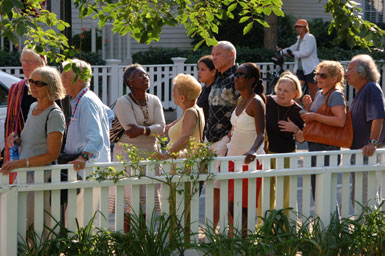
Thinking the doors were opening, they pushed forward...

4waitinginline
but gradually formed a more orderly line. The panel was distinguished.

5charlesogletree
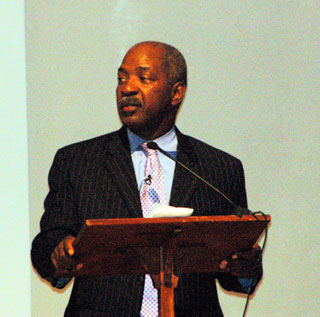
Moderator Charles J. Ogletree of Harvard Law School and the Charles Hamilton Houston Institute for Race and Justice

6miabagneris_marable
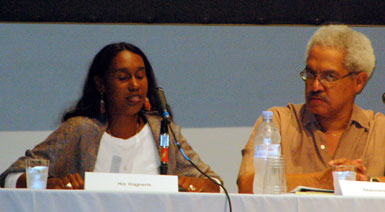
Mia Bagneris, New Orleans native and Harvard graduate student (left), Dr. Manning Marable, historian, political theorist, and human rights activist

7laniguineer
Lani Guinier, Harvard Law School

8spikelee
Film maker Spike Lee really said it all though:

While we're all up here on the Vineyard
living high on the hog,
let's remember those people down in the bog...

The event raised some $12,000 for hurricane-related relief.

Saturday, December 03, 2005

Snippets from headlines


Photo by Justin Sullivan

All from today's WaPo:

Agency Calls for Troops, Reporting Threats of Violence

Former Secretary of Homeland Security Calls for More Training

Feb. 4 Elections… Are Postponed

Residents… [may] … not stay in the area, which still lacks electricity.

Workers…have been advised against wearing clothing with the agency logo in public.

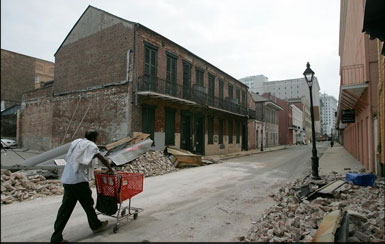
No, not Baghdad -- New Orleans.

Wednesday, September 28, 2005

Katrina aftermath: No picture here

The photos are over at BAGnewsNotes. Photographer Alan Chin is discussing his images from flooded New Orleans in comments. Shooting in black and white, he has captured something of the mythic scale of the physical and psychic devastation. His observation that stopped me cold:

His subjects were "amazed that the story was getting coverage in more than just the local New Orleans or Louisiana media."

What desolation! Take a look at the pictures yourself

Thursday, September 22, 2005

Oncoming doom


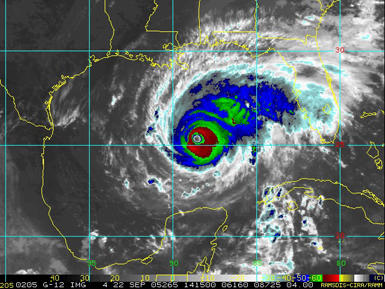
Steve Gregory's Wunderground blog describes the latest Hurricane Rita projection:

The storm has PEAKED in intensity, but remains an extremely dangerous Hurricane … By the time of landfall Saturday morning, Rita should be a CAT 4, with winds of 120mhp, and gusts to 150mph. Enough to cause tremendous wind damage to well built, non masonry structures.

However, the storm surge will cause complete devastation within 1-3 miles of the coastline near the point of landfall….

A tidal surge of 20-24ft will come onshore near and to the right of the point of landfall, with a 15-20 foot surge extending for up to 80 miles east of the strike point. From 80-120 miles east of the landfall point, a storm surge of 10-15 feet is likely3-5 foot above normal tides will affect those living as much as 300 miles to the east - which includes Southeast Louisiana. Keep in mind, riding 'on top' of the storm surge will be huge 30-40ft wind driven waves.

Hopefully most people who would have been under that surge will be long gone. After Katrina, very likely evacuation will look like a better deal.

The only thing I can imagine analogous to how folks in the way of this hurricane's violence must feel is how residents of Baghdad must have felt in the winter of 2003: You know it is coming; you know what it is going to do; and there is not a damn thing you can do to stop it.

For most of the people of Baghdad, the aftermath has been worse than the anticipation and the initial event. Let's do what we must not to repeat that pattern.

Tuesday, September 20, 2005

Katrina for the undocumented means hiding and working harder


Recent weeks have been a revelatory experience for much of the mainstream media and through them for many middle class US white people: the hurricane laid bare the extreme poverty in which many African Americans pass their lives. Further, it reminded the nation that Black-White is our historic paradigm for understanding "race" in our collective lives.

But New Orleans and surroundings had many residents from other non-white groups; what happened to those communities? Here's some reporting beyond Black and white:

Illegal immigrants afraid to get storm aid:
Some sneak into shelters at night and then slip out in the morning, praying they won't be noticed. Others avoid government help altogether, preferring to ride out the chaos and destruction alone in a foreign land.

For illegal immigrants, the aftermath of Hurricane Katrina has meant not only living without a home, money or belongings, but also steering clear of the government officials who have flocked to the area, for fear of deportation.

Somewhere between 20,000 and 35,000 undocumented persons, mostly of Mexican and Central American origin, lived in the path of the hurricane. Many did not evacuate; "four roommates - three Mexicans and a Honduran - decided to ride out the storm in their trailer in Marrero. They were asphyxiated by a faulty generator after the storm passed."

Those who weathered the storm looked for informal resources they could trust:

Where Have All the Hondurans Gone?
…in Houston, when the first of Katrina's Honduran evacuees trickled into town, most didn't go to the city's public shelters, the Honduran consulate or to the Astrodome. Instead, through a network consisting mostly of word-of-mouth tips, many found their way to El Coquito, a Honduran restaurant.

Meanwhile, the Department of Homeland Security announced a 45-day moratorium on fining employers who hire undocumented workers.

Not surprisingly, Latinos are concerned that this gesture is just the prelude to the usual practice of using up and throwing away imported workers:

So undocumented Latinos, if you speak English and can read this, here’s the deal: You can go along on the underpaid, exploitation-filled work gangs to clean up our American city of New Orleans, and your employer won’t be in danger of being prosecuted (for 45 days, anyway). But tengan cuidado: if someone decides to report you, you may have to turn in your rags and dust masks, and stop cleaning our country and head back to yours. Que Dios os bendiga.

For the undocumented, Katrina very likely means more of the same, only tougher conditions.

Saturday, September 17, 2005

RNs to the rescue


As I posted last week, California Nurses Association is going to extraordinary lengths to send nurse to the Gulf Coast. Scheduled flights became nearly impossible to organize, so on Thursday these nurses left on a chartered airplane!

CNA still needs help meeting the costs of sending RNs to stricken Mississippi, Louisiana and Alabama. Please consider donating here. The feds aren't going to do their job (hell, they may just walk away for our money -- see below); peoples' organizations have to do the work of caring.

Hurricane con begins: federal credit cards


Little noticed among the many derelictions in the federal response to Hurricane Katrina is that low level employees who use government credit cards just had their purchase limit raised to $250,000 per transaction. That's right -- the "micro-purchase threshold" is now a quarter of million dollars per transaction if you claim the purchase was disaster-related.

You may comfort yourself that there can't be many of these government-issued megacards, but you'd be wrong. According to an L A Times story there are currently 300,000 of them in circulation. And their use is not limited to professional buyers; very often they are issued to agency support staff -- perfectly reasonable if you are trying to keep the office in copier paper; madness if you are reconstructing a city.

Apparently there is a long history of mismanagement of credit cards in the federal government, just as there often is in businesses and non-profits. Plastic is just so easy to use; it lends itself to abuse. In fact, the Office of Management and Budget was just about to issue a circular on a new program to try to get a grip on credit card use named "Improving the Management of Government Charge Card Programs." Guess that is at least postponed. Forbes Magazine asserts:

[T]he Government Accountability Office has found in previous [disaster] cases the cards have been used to buy jewelry, leather goods and entertainment.


We all want to do all we can to help the people of the Gulf Coast recover -- but I do think that Congress, which approved the new "limit,' could have put in a few controls over what is done with our tax dollars.

I admit it is sort of fun to think about what might be purchased with those cards. If I had one, I might think the disaster required a nice light-weight kayak; what would you buy?

Sunday, September 11, 2005

More hurricane stories


Auryn24' coworkers just before the helipcopter finally lifted them out of hell.

I keep thinking I'll write about something besides the hurricane. After all, I am thousands of miles away and not materially affected. What right have I got to litter the internet with this stuff? But I can't get the stories out of my mind. Here, I am just going to point to a few that are haunting me.

From "autryn24," an account of survival inside Methodist New Orleans East Hospital where she worked as a nurse.

On the night the storm hit:

When i got to the end of the hall, MaryAnn was screaming for us to get the patients out of the rooms and there was an 80ish year old lady laying in the middle of the hallway, pale as can be, looking dead (she wasn't, she was breathing) and her husband (?) laying over her and crying and screaming. A nurse came up to me/us and was out of breath and shaking and crying and pointed to another room and said "there's still a patient in there."

I ran to the room and tried to open the door and I COULDN'T BUDGE THE DOOR. It was sucked shut. Steven and Chuck came up to me, forced the door open, braved the torrential winds and got the light fixture/roof/ceiling off of the patient and rolled him out in his bed. The patient was out of it, but appearantly this was normal for him. He was NOT hurt. Come to find out the lady on the floor almost got SUCKED OUT OF HER WINDOW. Her window exploded out due to the pressure, and she was sucked toward the window, and her husband grabbed her and kept her from flying away. Jesus Christ.

That was before things got bad.

Two days later, still without any sign of rescue:

We watched the patients take their meds with just a small sip, and told them that the water had to be conserved throughout the day as much as possible. … We would all discuss the fact that we would only make about 50 cc's of urine a day, and when we DID pee, it was a moment worthy of applause.

Food was also scarce. … I didn't need to eat, but our men and smaller staff needed to. I made jokes about us starving, and for them to kill me because my fat self would feed everyone for weeks. Morbid, huh? We all talked like this. I completely lost it one day because I catnapped and had dreams about dying at Methodist. I cried, the staff cried. …

During these days, I saw a dead body floating past the hospital. I mean, I've seen LOTS of dead bodies, but none that were because of a disaster. It hurt. It scared me. Maybe that would be me?

Read the whole story. She got out, but her life is a shambles.

From Robert Davis, a USA Today reporter, writing about "Treating those left behind," in the New Orleans Convention Center:

I came here as a reporter but as a former paramedic, I didn't have it in me not to try to help these people. I go in with about 20 paramedics. …

The scene that awaits us is like something out of a big-budget disaster film. There is a murdered man lying out on the street, his throat slashed, a pair of scissors lying next to the body. A block away, a body of an elderly man is lying in the median. Both bodies are covered with blankets.

As we walk in a line towards the center, a remarkable thing happens. Seeing the blue EMS shirts, people start to cheer.

The guards may have been wearing bulletproof vests but the paramedics found what they usually find in volatile situations: Once people realize that you're here to help, they don't mess with you. Even the most violent thugs have seen their friends helped by paramedics.

Again, read the whole thing.

And then there are the evacuees who have lost everything, not only their homes and belongings, but also the web of community connections that keep us going wherever we live. Though they may be getting an effusive welcome now, how long is that going to continue? Today's New York Times has a good story on the New Orleans diaspora:

"I'm still not sure where I am - what do they call this, the upper West or something?" said Shelvin Cooter, 30, one of 583 people relocated from New Orleans to a National Guard camp here on a sagebrush plateau south of Salt Lake City, 1,410 miles from home.

"We're getting shown a lot of love, but we're also getting a lot of stares like we're aliens or something," Mr. Cooter said. "Am I the only person out here with dreadlocks?"

More to read.

Finally, the Hurricane Katrina catastrophe rightly terrifies all of us who have to wonder whether we might be the next to suffer the penury and neglect of a government whose purpose seems to be to enrich Bush cronies. For those of us in California, Louis Uchitelle examines the condition of the Sacramento River delta levees. This, too, is not a happy story.

Saturday, September 10, 2005

"Nurses respond"


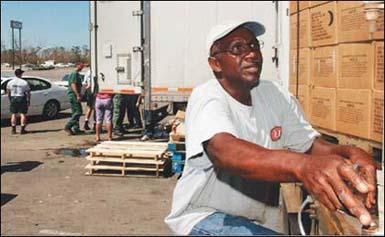
Fulton Alexander, of Biloxi, works Wednesday at the FEMA distribution point at Cedar Popps Plaza in Biloxi. Alexander has worked as a volunteer for Hurricane Katrina survivors since last week. JOHN FITZHUGH / SUN HERALD

All week I've been overhearing one end of the phone conversations in the office behind me: "Yes, we are sending nurses; when would you be able to go?" -- "No, I can't tell you now when you'll leave, but we're making arrangements now and I'll call you back." -- "We have a flight arranged for tomorrow morning, can you still go?"

And they have gone. The California Nurses Association (CNA) and the National Nurses Organizing Committee sent 100 nurses to the Gulf Coast to help hurricane evacuees long before federal relief authorities began to get their act together. More nurses are still going.

The South Mississippi Sun Herald reported their arrival in Wiggins:

Though tired from the long trip, the nurses were eager to get to work. Mike Barber of Grass Valley, Calif., who had just changed into his blue hospital uniform, said, "We're nurses and typically nurses, when called into action, respond."

Shelia Hidalgo of San Francisco also was ready to help, "This is the United States. It's our people. We need to help."

CNA is still taking names of volunteers here.

Almost as important, it is asking for contributions to help pay for its relief flights. CNA/NNOC is covering transportation and lodging and, depending on the assignment, may cover other expenses. They estimate costs at approximately $2,500 per nurse. If you can help, donate here. "100% of the money goes to sending nurses and 0% goes to administrative costs," according to CNA.

The hurricane and breakdown of government's responsibility to cope with disaster made this week emotionally frustrating for those of us watching in horror -- it was a good week to be working temporarily for a union that really tried to help.