Showing posts with label peru. Show all posts

Saturday, November 19, 2022

Ah, globalization ...

One of the small pleasures of our extended stay in Reno was that blueberries never stopped being available in grocery stores. 

How strange was that? Don't blueberries have a season, a short one in late spring, and then disappear from the shelves or become prohibitively expensive?

Not anymore. Adam Tooze shared a thread which explains:  

One guy’s experiment drove Peru to become the world’s #1 blueberry exporter and #2 overall producer.

Carlos Gereda was the spark that lit Peru's blueberry boom of the past decade. He asked a simple question: "can blueberries grow in Peru?" In 2006, he brought 14 varieties from Chile to see which ones adapted well to the Peruvian climate.

He narrowed it down to four and, in 2009, founded Inka's Berries. The company's service consisted of assisting the development of plantations that adhered to the growing standards Carlos had conceived. The blueberry revolution ensued. ...  production multiplied by more than 6,000x in ten years. Blueberries are now the country's 2nd most significant export, just behind grapes.

... Peru's climate allows for year-round production, giving the country a competitive edge over seasonal agriculture. The productivity of Peruvian land is 13 tons per hectare. The world's top player, the USA, produces 8 tons per hectare. Given the massive competitive edge, we believe it's only a matter of time before Peru becomes the blueberry capital of the world.

And so we could buy "out of season," reasonably-priced blueberries into November. What a world we are making!

Monday, July 04, 2005

Heroina

heroinasmall
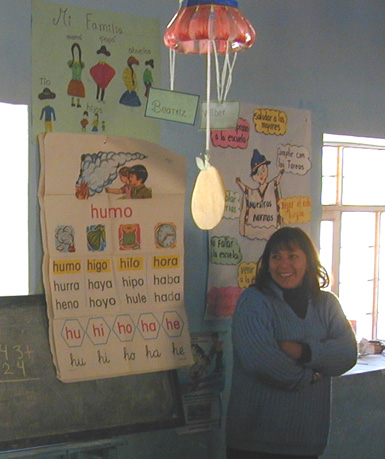
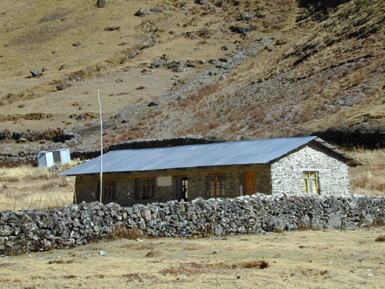
Her name is Katia. She teaches at the "Learning Place of the Heart," a one room school, high in an Andean valley on the sparsely populated edge of the national park that surrounds Machu Picchu. Her own children and husband live in the Peruvian city of Cusco; visiting her family requires a 4 to 6 hour walk out of the mountains, then long hours on a bus. Mostly she lives alone in a hut by the school. As a job necessity, she speaks both Quechua and Spanish. The schoolroom is full of pictures, mobiles, balloons -- she almost certainly provides them herself (with occasional help from tour groups like ours.) Some inner city schools in the US would be happy to have as many materials.

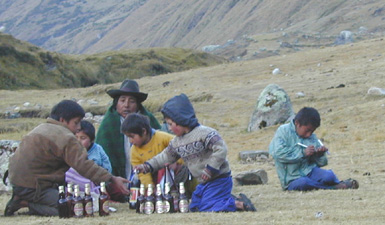
Her students are the children of the herding families in the park. I don't really know for certain, but I suspect they are pretty well off, by the standards of Andean alpaca and cattle herders who also grow a few potatoes. They have good-sized herds and large, close to pristine, areas on which to graze them. But their life style is not likely to persist into the next generation -- the park may decide they and their animals interfere with its overriding objective of capturing the tourist dollar. Already adult farmers must work off the land during fallow seasons to earn currency; grandparents and children remain behind in the remote valleys.

When the students grow up (at 13 or 14?) will they drift, out of necessity, to the margins of the cities, serving others as laborers and laundresses -- or will they have a chance to grab a piece of Peru's modern economy? The devotion of the Katias of the world will play a large role in their fate.

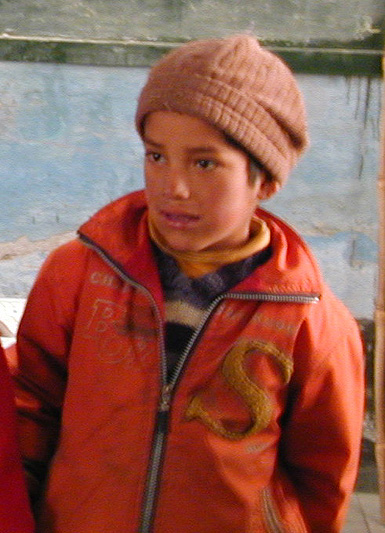
studentsmall
Student


schoolsmall
Learning Place of the Heart


cornerstoresmall
When the tourists come, residents set up the corner store.


housessmall
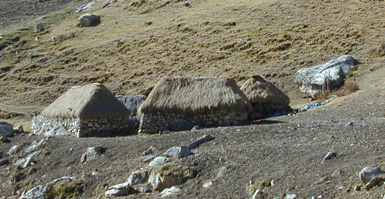
Herding families' homes

Friday, July 01, 2005

Cusco, Peru
that is, in Quechua, Qosqo

1992small
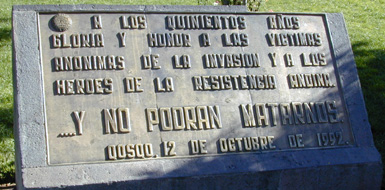
"At the 500th Anniversary -- Praise and honor to all the anonymous victims and to the heroes of the Andean resistance -- they could not kill us all! Cusco, October 12, 1992"

In Inca times, this city was "the navel of the universe," the capital of the empire from 1458 to 1532. The Incas seem to have been similar to the Romans in Europe: brilliant organizers of subject peoples who had already developed cultural riches, binding the whole together with roads, public works, an army, and an imperial cult.

Spanish conquerors briefly ruled from here in the mid-16th century before moving the capital of Spanish America to Lima. Today Cusco claims to be at the center of the Fourth World, the indigenous world, as the monument shown above asserts. Certainly spirited engagement with politics seems common: in a week's time we saw protest marches by school administrators and campesinos.

Cusco is a wonderful experience for the tourist, thoroughly geared to separating the visitor from her dollars -- and delivering just the right combination of visible history and an exotic present to make the experience thoroughly delightful.
andeanchildwithlambsmall
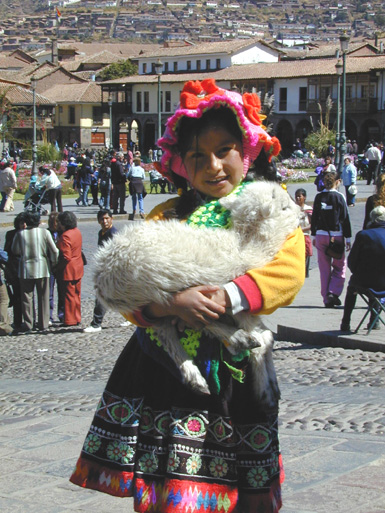
This young woman is working to support her family, posing for pictures in the hope of getting tips averaging 1 Nuevo Sol (35 cents) per shot. On a good weekday, I doubt these children make more than 20 S/, about $7, but this is a major contribution. The municipal police, protecting the interests of town merchants, hassle rural people like this child who try to get their bit of the tourist trade.

In the old city, a maze of narrow cobblestone streets around a Plaza des Armas, most of the visible monuments, including ornate gilded churches, are of Spanish vintage. But their foundations are the Inca stonework. The invading Spaniards, fresh from driving Muslims and Jews from Spain, destroyed all Inca buildings with full crusading zeal. But they then used the foundations (and indigenous craftspeople) to build their colonial city. However, the town is subject to earthquakes. In 1650 and 1950 major shakes damaged many Spanish buildings (the more prosperous ones since repaired.) The Inca foundations survived intact.
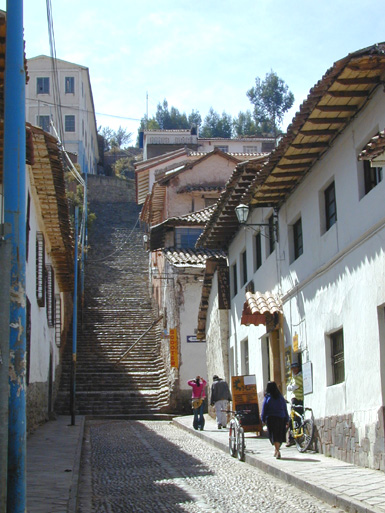
streetscenesmall
Cusquenos seem to be enterprising and busy. Many speak Quechua (the local indigenous language), as well as Spanish and often some English. One of our acquaintances assured us "we are all mestizos [mixed heritage, indigenous and European] now," but it is hard for a tourist to gauge how widespread that characterization is.
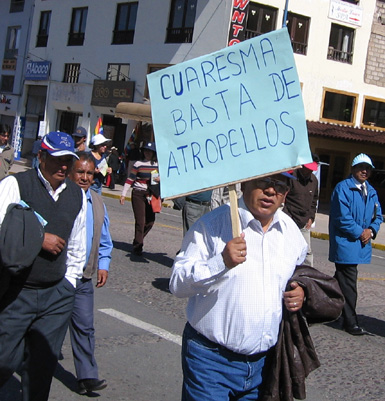
Educators marchsmall
Educators marching against reorganization

Just when one begins to wonder whether the whole city is just an elaborate stage set for tourism, along comes the weekly Sunday morning parade in which enthusiastic school bands, sports clubs, and professional societies march to the applause of their neighbors and families. It is a little hard to tell what this exercise is about, but it is clear that whatever it is, it commands the delighted participation of the people of Cusco.
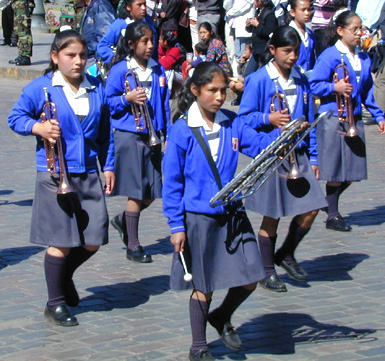
girlswithhornssmall
Located at 11,300 feet above sea level, the city is a great place to acclimatize before undertaking higher Andean treks or the Inca trail pilgrimage to Machu Picchu. Hotels are eager to help you get used to the altitude -- the local remedy for altitude queasiness is coca tea, freely supplied at every turn. It does not give a buzz. If that doesn't work there are always "pisco sours," a sweet brandy cocktail that is the national drink of Peru.

Of racist Mexican stamps and racist Peruvian fast food

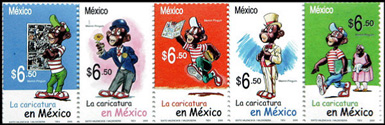
Lots of good folks in the US are protesting Mexico's new postage stamps featuring a stereotypical Black cartoon character.
mexicanstamps
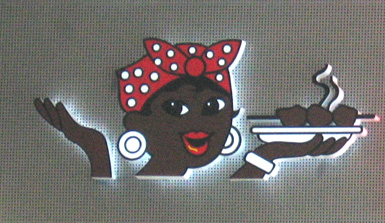
They could look south further as well. Last week in the Lima airport, I sat for many hours under the logo of "Mama Morena's," just as classic a stereotype, and female to boot.
mamamorenoscropped
I guess sensitivity to the "New World's" involuntary inhabitants is something both Americas need to work on.

Wednesday, June 29, 2005

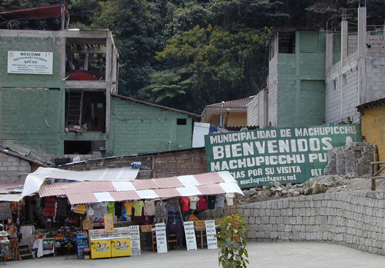
Refreshingly unabashed promotion of tourism below Machu Picchu

bienvenidossmall

The village of Aguas Calientes is the terminus of the rail line that runs through the valley of the Urubamba River from the regional capitol Cusco, Peru. The mysterious, hallowed Inca ruin, Machu Picchu, is located on a peak several miles above the river, accessible by bus from the end of the train tracks. Machu Picchu lives up to its UN designation as a World Heritage site, thoroughly worth the effort to reach it, whether on foot via the Inca Trail or by rail.

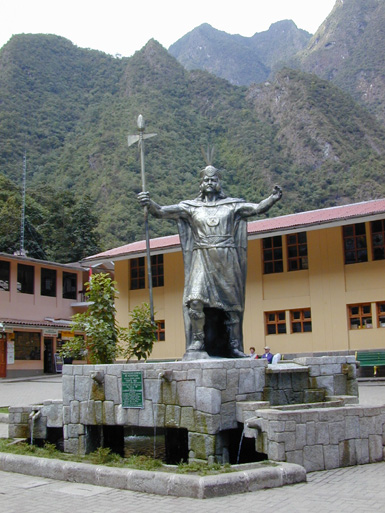
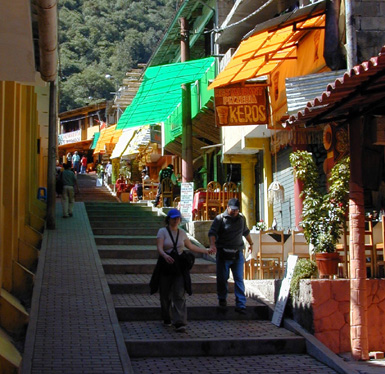
The town below seems scarcely a place of human habitation; rather it is a chaotic jumble of buildings where, as a friend remarked, "restaurants seem to spring from the gutters." A commanding statute of an Inca (ruler) towers over the main square, but there seems no living center. A couple of years ago a landslide swept down the overhanging granite slopes, leaving eleven people missing. The town's only purpose seems to extract dollars from tourist/pilgrims.

9thincasmall

The municipality is refreshingly honest about its purpose and its relationship with its visitors. On every ticket on the bus to and from the ruins riders can read the following message, conveniently rendered in the town's English:


Municipality of Machupicchu

The mayor and councilmen of the Municipality of Machupicchu cordially welcome you to the Village of Machupicchu (mistakenly called Aguas Calientes [for example, by area maps]) . . . created by law 9396 in 1941.

The village of Machupicchu features hotels, restaurants, bus service to the Inca Sanctuary and the rich and varied production and sale of handicrafts which benefit the local people. Thanks to tourism it is possible to guarantee the local urban and rural economy.

We invite you to come to Machupicchu and stay longer . . . .

Our concern is the twelve peasant communities in that suffer the harsh blows of poverty, in spite of the precarious farming activity carried out on a small scale. We are looking for greater economic resources to socially attend to this rural sector and to carry though on the social development of its children, education, health, beautification, and the basic services of water, light, sewage and communications, in order to improve conditions of life.

We want that you be our strategic allies, helping us to help, promoting greater purchases of handicrafts, food and basically creating more tourism of longer duration in the Village of Machupicchu.

Consume and Purchase in the Village of Machupicchu.

The message reminded of me of the post-911 slogan promoted here in San Francisco: "America -- open for business."

streetscenesmall