Tuesday, March 14, 2006

Democracy requires vision as well as wins

(Working on the various instructional pieces for community groups about winning elections lately -- see here and here -- has me reflecting a little on big picture concerns.)

For years I've been saying it: the attributes that make a good candidate are pretty much the opposite of the characteristics that enable someone to govern. A good candidate needs monumental self-confidence, a thick hide, and a monomaniacal focus on getting her/himself into office. Everything else -- family, interests, and policies -- has to be secondary in campaign season. Not surprisingly, most people who master these requirements aren't terribly much use to the people who elect them once we put them in office. In office, we need quite different qualities from our leaders, including wide breadth of knowledge, curiosity, imagination and the ability to get people to work together.

We are seeing lots of the product of mastery of this system in Washington these days. The creatures of Rove get elected, but then all they can do is thrash around waving their newly won weapons, pillaging, and pandering to the theocrats who put them there. Meanwhile their Democratic foils cringe and try to slide by.

Refreshingly, someone with a lot more cred than I'll ever have has called out this systemic failure. The professional publication for political consultants is Campaigns and Elections. Ron Faucheux was a columnist for the magazine for 13 years, writing reams of perceptive copy on how to win elections. Now he is off to be a staffer for Senator Mary Landrieu (D-LA) and writes this critique of the culture of contemporary elections.

I am compelled to make the case that for political involvement to be worthwhile -- for it to merit the sleepless nights, the begging for money, the blood-thirsty antagonism and the endless hours of back-breaking exertion -- it must be about something more than just winning and personal ambition.

There's nothing wrong with winning, of course. In political campaigning, winning is the normal measure of success. If you don't win, you're always on the outside looking in, with little ability to accomplish much. For years, I've taught thousands of candidates and campaigners about winning. But for democracy as a system, and for the people it is meant to serve, winning is only the start of it. After you win, you then have to govern, and the governing part -- the part that matters to the voters -- is something that's far too easy for political practitioners to lose sight of in our attempts simply to win elections....

*****

The focus on winning has riveted so many of us for so long to the means of gaining power that we too often forget about the ends, about the consequences of campaigning and the purpose of policy-making....

In today's echo chamber, talking about the common good sounds like greeting card drivel, something you wouldn't say at a private political meeting with a straight face. But that's the problem. ...
*****

A direct consequence of too much campaigning and too little leading is the inability of people in public office, once they're elected, to be able to effectively work together across party lines to accomplish the things that the public has a right to want.

Coming from someone who has devoted such a large part of his life to campaigns and elections, and who was once publisher and editor of this magazine of the same name, this may sound like a “Nixon in China” moment. Perhaps it is. But when every battle is seen as a prelude to an election, when so many public officials spend so much of their time positioning themselves and their enemies for the coming campaign, when performance is secondary to headlines, then who leads? Who keeps the promises? Who delivers?

Campaigns and elections are fun. Let's face it, there's nothing quite like a triumphant election night. But the campaign process -- the topic that this column has focused on since early 1993 -- tends to bring out the best and the worst in all of us. Our job, more than ever, is to make sure it's the best. That, in the end, will make it more worthwhile. And more fun.
Lofty sentiments, but probably not something that any of us can easily remember in the heat of battle.

Faucheux is speaking about a professionalized politics practiced by the consultant class his magazine helped define. Grassroots groups come to politics from different premises. They are seldom comfortable or welcome in the world of the professionals. Their culture (ragged, sometimes emotional, participatory) and their values (usually egalitarian, both economically and socially) are antithetical to campaign discipline. Yet they can bring what money can't buy (and what democracy is supposed to be about): enthusiastic people.

When winning becomes "the only thing," elections become thoroughly hostile to participation by grassroots groups. Most ordinary people recoil from politics as a "fun" sport -- they'll engage because the process offers them a way to get something they need or to actualize something they believe in. They don't want a box score, they want to be inspired. They want that pesky "vision thing," something few politicians can offer on demand.

Monday, March 13, 2006

A didactic building


Last week I worked temporarily in an office within the Phillips Eco-Enterprise Center (pictured above) in Minneapolis, Minnesota. Its developer, The Green Institute, views their building as a “living experiment” that will serve as a regional model for green commercial construction. And though the building's educational earnestness can feel a little overwhelming at times, it does make a pleasant work environment.


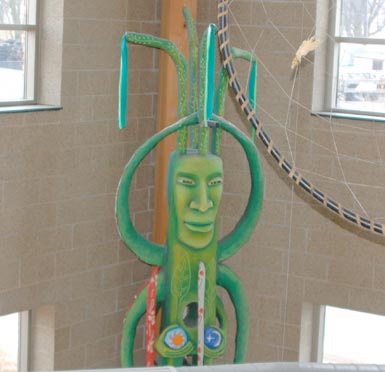
A "green man" statue guards the lobby.


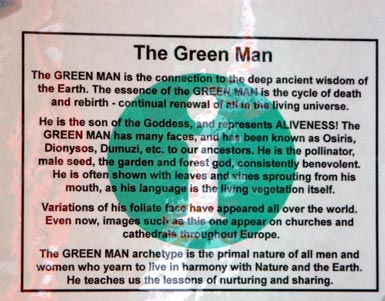
And just in case he may seem culturally unfamiliar, a poster explains.


In fact, everywhere you turn, there are an explanatory sign.


A sign on the bathroom door not only explains the fixtures, it also promotes bike commuting. Workers in the building told me that bike commuting would be more desirable if the roof didn't pour draining water onto the bike rack.

Much of the roof is a solar panel farm...


while some is a pleasant "meadow" atop a section of sod.


Even the exterior is signed: that's not a lot full of weeds, it is a "prairie restoration area."

It is easy to laugh at all this, but the building certainly has its successes. According to the Minnesota Sustainable Communities Network:

PEEC's average annual utility bills total only $25,000, or 5 percent of its annual operating budget, compared with 20 percent that the Building Owners and Managers Association (BOMA) considers typical for a building of that size. Similarly, PEEC spends a total of only 17 percent on repairs, security and grounds maintenance, compared with a BOMA figure of 23 percent.

Not bad.

This post is dedicated to sf mike at Civic Center who routinely demonstrates how we bloggers can highlight our surroundings in pictures.

Sunday, March 12, 2006

How to fool the no-fly list


This morning the blogosphere is buzzing about a Chicago Tribune article that claims that CIA operatives can be identified using simple Google searches. Reactions seem to range from ex-spook Larry Johnson's scorn to bemused amazement that the apparently universal incompetence of our regime, demonstrated in Iraq and New Orleans, extends to its "covert" operations.

Would you be even more worried if you learned that the government's famous "no fly list" could be easily circumvented by any moderately computer savvy terrorist?

According to CSO - the magazine for security executives, getting past the TSA and onto a plane would take nothing more than a laser printer and a stolen credit card. The author walks you through what you would need to do -- it certainly reads as if it would be within the skills of most of us. Click that link if you want to know.

The anonymous author comments:

As a frequent flyer, I hesitate to write this article, but as an auditor of security and information systems, it’s the right thing to do. If you’ve ever wondered whether airport security has improved since 9/11, let me set you straight: It has not. There is a gaping hole in airport security, and the Transportation Security Administration (TSA) has done nothing despite being alerted to this vulnerability more than 11 months ago.

As a person who had her own brush with the no fly list, I've long contended that most of the airport security rigmarole we go through is just a Theater of Fear, designed to accustom us to scared compliance with authority. Certainly if so-called "security" is this easily evaded, they can't mean it to keep us safe.

Saturday, March 11, 2006

Tom Fox found dead in Baghdad

Some truths are too simple to understand. We are not here to make war. "We must love one another or die," as W.H. Auden wrote.

Tom Fox lived. He rests in peace. His life and death are a challenge to the living.

For more of Fox's truth, read his blog or these excerpts. See also Christian Peacemaker Teams, Fox's comrades, who are the source of the photo.

Minnesota DFL caucuses -- so what?


On the evening of March 7, members of the Minnesota Democratic-Farmer Labor party held precinct caucuses in neighborhoods across the state. These meetings, divided by electoral wards and subdivided into precincts, choose delegates to local party endorsement conventions and propose policy resolutions. Subsequent conventions, organized by state senate districts and by county, send delegates to a statewide convention that makes DFL endorsements in the primary election and winnows down the policy resolutions to write a party platform.

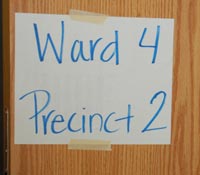
Thanks to friends who are DFL activists, I got a chance to see this form of neighborhood democracy in action. Ward 4, Precinct 2 and other many precincts met in Como Park High School, an echoing cinderblock maze of tiled hallways lined with yellow metal student lockers. At this local meeting, some 85 people crowed into a classroom equipped to seat about 50.


It was a gathering of old acquaintances, almost all appearing to be white and over 50, mostly eager to chat. Promptly at 7 pm, precinct chair Rick Winter brought the meeting to order -- and promptly was re-elected to continue in what seems to be considered a thankless chore. He leads a good meeting, an efficient combination of pushing the agenda forward with ensuring that all who wished could speak.


L to R: State Senator Ellen Anderson; Candidate for Ramsey County Sheriff Bill Finney; State Representative Alice Hausman
Various candidates for area offices wandered through, taking a couple of minutes to seek support and congratulate Ward 4, Precinct 2 on having the largest gathering among the many precincts in the High School building. They were repeatedly asked by caucus members wheter, if Ward 4, Precinct 2 was the largest, couldn't they be sited in the cafeteria next time? (On this evening, that space held several less well attended precinct meetings in different corners.)

Promptly at 7:30 pm, the precinct began selecting its delegates to the next level. This turned out to be easy: this precinct is entitled to 40 delegates -- only 36 volunteered so there was no need for an election. These delegates were not pledged to any candidates; they simply volunteered to attend the next level meeting and express candidate preferences at that meeting.

Then the assembly got down to discussing the policy provisions they cared about. First up was an older Eastern European immigrant who presented the resolution promoted by Peace in the Precincts, speaking with a strong accent. He was passionate:

I came to this county in 1965 -- this is not the country I came to. Then America stood for freedom, for law. Now we invade countries for no reason and this bunch in Washington thinks they can do anything....(my paraphrase)

There was no dissent on the peace plank. It passed unanimously.


Several resolutions promoting health care for all and more funding for education also passed smoothly. Then a woman rose to suggest that DFL lawmakers should work for a state law to force pharmacies to fill all lawful prescriptions; pharmacists who might have scruples about some drug such as the morning after pill could personally abstain from filling it, but a licensed pharmacy would be barred from giving an employee's conscience preference over a patient's right receive a drug. There was considerable discussion: people were fearful that fundamentalist pharmacists might reduce access to birth control or HIV drugs, but they also were accustomed to wrestling with issues of personal conscience and therefore wanted to make sure that companies and employers bore the burden of the policy as opposed to individuals. The discussion seemed to clarify the issue and that policy resolution passed unanimously.

So, what's an outsider to make of the DFL caucus I saw? My DFL friends are pretty cynical about the process. They see a bunch of bleeding heart liberals (like themselves) who vote for feel good resolutions and can't even fill up a slate of delegates to carry their positions forward to the next level.

I came away rather more impressed. I organize in elections. I am impressed by any party system that can attract 85 people from a precinct to a meeting on a rainy March evening, not to cheer candidates, but to express their political hopes and ensure they have some representation at more influential levels of the endorsement process. There are not many corners of U.S. democracy where you get that kind of participation at the grassroots. Sure, these were the experienced and the comfortable, but they do show up and nearly all of them do some work in electoral battles in a highly contested state. That's terrific.

Friday, March 10, 2006

Conventional wisdom, voter targeting and community organizing


(This post is one in a series based on work for a project that will assist grassroots community groups to find their way into working with and for their constituencies in elections.)

Political campaigns, like military leaders, are always fixated on the last war. From the point of view of the folks who organize and fund campaigns, the "last war" was the Kerry campaign in 2004. Many believe that losing effort targeted avaiable field resources poorly. At best they characterize the GOTV effort, though sizable, as ineffectual and inefficient. This easily hardens into a conventional belief that Democratic targeting was wrong in absolute terms; instead the notion gains force that Dems should look at what the Republicans do and do likewise.

Though the actual practice was far more nuanced than this description, a major premise underlying Democratic voter targeting in 2004 was that, since most people poll in agreement with Democratic positions, simply raising turnout among known Democratic constituencies should be enough to push a Dem into office. The fact that Al Gore won the popular vote though losing in 2000 seemed to support that idea. So did the readily observable reality that turnout is lower among people of color, low income folks, and young people. Insofar as these groups have political stances, they are likely to vote Democratic.

Consequently, various independent expenditure committees (known by the name of their legal form as "527 committees") put a lot of money into registering and turning out high numbers of voters in Democratic demographic groups, especially in highly contested swing states. The effort was vibrant, chaotic, and often offended established local players. Although it was certainly also a mess, it is important to understand that much of it succeeded in meeting its goals.
  • The youth vote spiked upwards for the first time since 1992; 18- to 29-year-old turnout was up by 4.6 million voters from the 2000 election according to exit polls.
  • Native American turnout grew by 11 percentage points in 2004 in the states of Alaska, Arizona, Minnesota, Montana, New Mexico, South Dakota, Washington and Wisconsin.
  • Those who lived in swing states generally voted in higher proportions than those who did not. Minnesota, one of the most closely contested states, had the highest turnout rate (79 percent); Hawaii, which the presidential candidates ignored until late in the campaign, had the lowest with 50 percent.
So all that activity wasn't futile -- but Bush won, so obviously it wasn't good enough. And, even more strikingly, Bush won the popular vote as well as the Electoral College.

So what did the Republicans do in 2004? They centralized their turnout efforts through the Party (no anarchic constituency-based 527s for them) and very tightly marketed their product to potential new supporters found by interweaving consumer data with voter data. "Technology help[ed] them gain a percentage point [where they needed it] by courting the right people in the right state with the right message," according an article by Jon Gertner in the New York Times magazine. (This description actually was written before the election, but proved prophetic. Obviously the Republicans also motivated fundamentalists and other conservatives to vote their convictions, but election post-mortems credit the micro-targeting for much of their gains.)

For example, the Republicans apparently focused their efforts among Latino voters on members of Protestant churches, a relatively small part of the Latino community. According to a Pew Hispanic Center report from June 2005:

Religion appears to be linked to President Bush’s improved showing among Hispanics in 2004 over 2000, when he took 34 percent of Latino votes. Hispanic Protestants made up a larger share of the Latino vote last year (32% in 2004 compared with 25% in 2000), and 56 percent of these voters supported the president in 2004, compared with 44 percent in 2000. The president’s share of the Hispanic Catholic vote remained essentially unchanged between 2000 and 2004.

That's micro-targeting in action.

Democrats got the message from these kinds of Republican success. In the most watched gubernatorial race of 2005, conventional wisdom holds that Virginia Democrat Tim Kaine used micro-targeted messages to suburbanites worried about traffic and education to trump Republican Jerry Kilgore's appeal to conservative social issues.

So what does this mean for 2008? It means that community groups wanting to make an argument to political players (the Democratic Party, unions, etc.) that they have a role to play, may find they have to overcome a backlash against the perceived mistakes of 2004.

How to make that argument:
  • Remind your listeners that the voters found by sophisticated micro-targeting have to be added on to a strong base vote. You will work to get out that base vote. You are uniquely suited for that role.
  • Show that you understand numbers. How many voters can your work add over past performance?
  • Show that you have capacity at scale. Even if you have little electoral experience, you should ask yourself how many volunteers you will mobilize? What previous work supports your claim you can recruit those people? What will you do with them? Again, give numbers.
And understand, nobody will really believe you until you show that you can deliver -- but if you do deliver, you will have a new kind of influence in your community.

Feedback sought -- any suggestions for budding grassroots politicos will be appreciated.

Wednesday, March 08, 2006

International Women's Day


Peruvian women to be.

For international women's day, here are links to a few women's blogs NOT from the U.S. (but in English, because I'm linguistically impoverished.)

What An African Woman Thinks by Rombo from Nairobi, Kenya. Wonderful writing about a woman's life. Do check out the story of the clerk and those videotapes.

Lavinia Live by Lavina Mahlangu, a journalist, from Pretoria, South Africa. She has just lived through covering municipal elections with lots of pictures

Raising Yousuf: a diary of a mother under occupation by Laila El-Haddad from Gaza. Israeli settlers may be gone, but the grinding reality of the occupation continues. Laila has reason to be tired.

Black Looks This site is THE invaluable source for all developments African. Today she honors Mrs. O. C. Odua, a founding member and President of the Egi Women’s Council and the Egi Widowhood Association both based in Erema Town, Egi, Rivers State, Nigeria.

Tuesday, March 07, 2006

Browning*, the emerging "white" minority and other anxieties


1870's Political Cartoon. Anxiety about changing racial demographics is nothing new. White settlers feared that Chinese immigrants took jobs away from white men.

Whatever else may be happening here, the browning of the United States goes forward. The NY Times announced today "Whites to Be Minority in N.Y. Soon."

The article tells us: "What's happening in New York has already occurred in metropolitan areas in the West and South, including Los Angeles, Miami, Houston and San Francisco." But this demographic shift is new to the Northeast. Whites and Blacks moved away from New York in the last six years, while the metro area saw a continuing influx of Latinos and Asians.

Whites (whatever is meant by that designation) will be a minority in the total population by 2050.

Yesterday Professor Marcelo M. Suarez-Orozco provided an interesting op-ed article to the Washington Post that contended that this demographic change, insofar as its cause is immigration, is proceeding more smoothly in the U.S. than in Europe. He argued that immigrants to the U.S.
  • are not blocked by discrimination from acquiring education and can move into good jobs in the second generation;
  • they frequently marry outside their groups rather than importing spouses from the "old country;"
  • and they are able to imagine a place for themselves in the national cultural narrative that proclaims this a "nation of immigrants."
He concludes that:

In the United States, the current anxiety is over illegal immigration. In Europe the continuing concerns are cultural practices -- within-group marriage, arranged marriages, free speech, equality between the sexes in Muslim immigrant communities, and the separation of religion from the political process -- all of which, when combined with enduring European xenophobia and labor market discrimination, will prove to be much harder to address, let alone fix.

Immigrants to the U.S. are often treated badly, but in the aggregate, this country does work at inventing ways of living with diversity. Immigrant populations that were once not "white" -- the Irish, southern and eastern Europeans -- "became white" after time in this country. By 2050, very probably the definition of "white" will have changed yet again.

Not that, as Anne Braden taught, the ideology of white supremacy will not also very probably still be an enduring blemish in the national cultural narrative. The national myth that someone, even if a historically shifting someone, is lesser because "not white" originated with the enslavement of Africans and has been a constant in the country's psyche through waves of diverse immigration. If we cannot find it in ourselves to shake white supremacy completely, "whiteness" will continue to plague us, even as we become brown.

* Author Richard Rodriguez develops a nuanced discussion of "browning" of which my usage is a poor, but convenient, simplification.

Monday, March 06, 2006

Anne Braden, 1924-2006

Anne Braden died today in Louisville, KY at the age of 81. Little known nowadays outside her home state and region, Braden, along with her husband Carl who died in 1975, was a pioneering white advocate for racial justice in the U.S. South. A southerner herself, she helped create a series of organizations to combat white supremacy, the evil she believed to underlie all other forms of social inequity in this country.

The incident that made the Bradens famous was their choice in 1954 to buy a house in a segregated subdivision of Louisville for Black friends. White residents objected violently and the other couple, the Wades, saw their house firebombed. The bombers were not arrested, but the Bradens were called before a grand jury and charged with being communist agitators. Carl Braden was convicted of "sedition" against the state of Kentucky and served 8 months of a 15 year sentence before being released on bail.

The state of Kentucky was not through with the Bradens. "In 1967, they were again charged with sedition for protesting the practice of strip-mining in Pike County, Kentucky. Fortunately, they were able to use this case to test the Kentucky sedition law, which was eventually ruled unconstitutional."

From 1957 until 1973, Anne Braden worked with the Southern Conference Educational Fund (SCEF), an interracial organization whose mission was to bring whites into the civil rights movement. Trained as a journalist, she edited its publication, The Southern Patriot. SCEF was redbaited continually and was target of the federal House Un-American Activities Committee (HUAC). From 1975 forward, she worked with the Southern Organizing Committee for Economic & Social Justice (SOC).

Braden's friend, the African American Mennonite civil rights leader Vincent Harding, wrote that when he and his wife Rosemarie first met Braden they knew "we had met a sister, and we knew that we were meant to hold onto each other, both in spite of and because of the attacks that were constantly waged against her. On deep levels, we felt the sense of loneliness that sometimes seemed to surround her" because of the constant redbaiting she and Carl faced. Like the Hardings, Anne Braden was a religious believer (in her case an Episcopalian in a denomination that cannot have been universally welcoming to such a radical.)

Braden's book about the 1954 episode, The Wall Between, is a civil rights classic. Her life and work is the subject of a 2001 biography, Subversive Southerner: Anne Braden and the Struggle for Racial Justice in the Cold War South, by Catherine Fosl.

In 2001 June Rostan interviewed Braden for ColorLines magazine. The veteran activist explained her commitment to struggle for racial justice and her vision of the way forward:

The "open sesame" for my generation was race. Once we could understand what racism had done, then everything fell like a house of cards. It opened everything to question: economic injustice, foreign policy. If you don't understand white supremacy, then you do not understand the country. The first thing I had to realize was that the people I loved, my family, my friends, the people running Alabama were wrong. But once you realized that, it was not hard to realize that the people running the national government were wrong too.

.... The main thing you do, when you don't see the mass movement you have been hoping for, is work to build struggles around specific issues.... We need an organization in every community that makes a frontal attack on white supremacy. Those organizations need to involve white people and be led by people of color.

Still wise prescriptions I believe.

Photo: Louisville Courier Journal.

Sunday, March 05, 2006

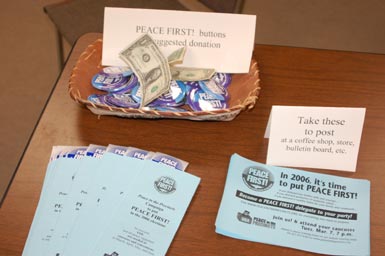
Peace in the precincts:
training for Minnesota caucuses

Yesterday I got a look at an ambitious peace movement organizing project that aims to influence war and peace discussion through the caucus system used by political parties in Minnesota.

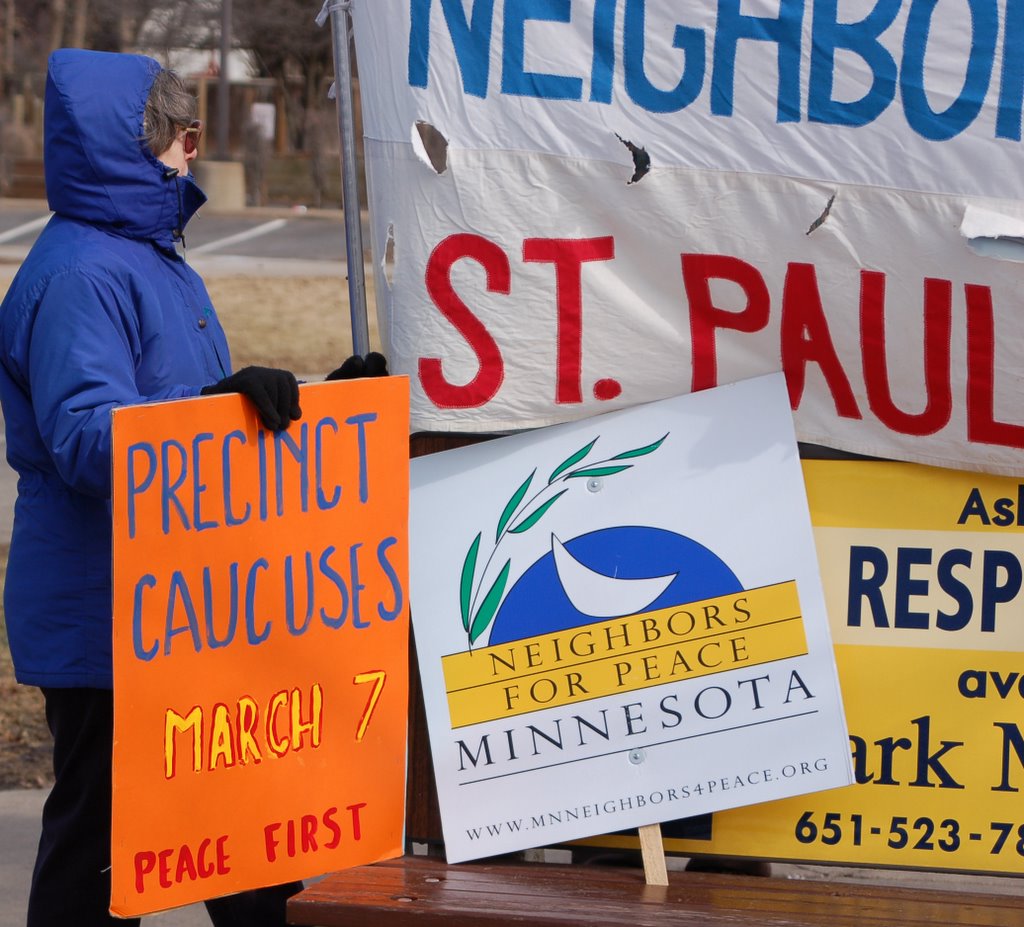
The local round of the caucuses that choose delegates to party conventions and propose candidate endorsements takes place next Tuesday, March 7. St. Paul activists held a session in a public library basement to get people primed to carry a peace message at those meetings.

There were 15 or so participants, what I consider pretty good turn out on a sunny Saturday morning. Organizers showed a video describing how open the caucus process is to citizen-originated resolutions. The core message was "you can work this system." If you want to be elected a delegate to the larger area caucuses, be there, make your case, promote your cause, and you can almost certainly go.

The group Peace in the Precincts has a strategy to try to get state politicians committed to the Peace First! Standard, a fairly simple pledge to work to end the war, provide for veterans, reconstruct Iraq, and end contractor theft and privatization. The pledge is aimed most plausibly at Democratic-Farmer Labor nominees, but there is nothing inherently partisan about the effort.

This cycle, the focus is particularly on the Senate contest for the seat left open by Mark Dayton's retirement from office. The DFL has a presumptive nominee, Amy Klobuchar, a cautious politician, who questions the Iraq war but is far short of calling for immediate withdrawal. The other candidate is Ford Bell who puts getting the U.S. out of Iraq front and center in his campaign.

Peace in the Precincts aims to get its peace resolution adopted at as many local caucuses as possible, but even more important, to elect enough "Peace bloc" delegates (uncommitted to either candidate) to the state convention to block a first ballot choice of Senate nominee (this requires 60 percent.) They would then extract support for a peace platform in exchange for the bloc's votes. Their plan is simple:

PEACE FIRST! Priorities


1. Put the Principle first
(adopt the Peace Standard)
2. Put the Person second
(candidate's record)
3. Put the Politics third
(electability)
The project is conceived as a long term organizing effort. This cycle, they have held something about 19 trainings like the one I saw yesterday in several locations: Minneapolis, St. Paul, Burnsville, Lakeville. At least one session was in Spanish.

Tim Wulling who conducted the local session was realistic. He knows creating a peace constituency within the political process is going to take many years. But he was so impressed by group Peace in the Precinct's strategy that an inquiry ended him up doing the educating and joining the steering committee. That's how grassroots organizing works.

Saturday, March 04, 2006

Can this be right?

According to Aviation International News a company named Aviation Technologies has announced software to help check "air passenger and employee names against Transportation Security Administration (TSA) 'no-fly' and 'selectee no-fly cleared' and 'selectee cleared' watch-lists. Those lists now total more than 120,000 people, most of whom are barred from flying or for whom additional security measures are necessary. Two other lists comprise those who have been cleared to fly or for whom no additional security measures are required." That is a lot of people.

The vendor explains that airlines and charter operators are required to download TSA created lists daily to run the checks. But get this: "It's the responsibility of the user to decide whether an individual whose name appears on the no-fly or selectee list is allowed to board the aircraft." Does that really mean that each airline is figuring out what to do if the names match? The government can't expect anyone to take this no fly list rigmarole very seriously. One more indication that it is all just Theater of Fear.

Friday, March 03, 2006

Friday Cat Blogging

These beauties are being kind enough to put up with me staying in their house.

Iris

Sadie

Thursday, March 02, 2006

Rules of the election game for community groups


I am currently working with the Progressive Technology Project on curricula for community groups that want to involve themselves in elections. Don't worry -- we do try to make sure they know and observe the legal rules. But we also try to get them into a more appropriate mindset for the tasks ahead and that takes some doing. We'll be teaching some of the concepts in this post. Comments and suggestions are very welcome.

Community groups frequently come to electoral work with all sorts of misgivings, but seldom with an understanding of the most important fact about elections: elections are almost certainly different from anything your organization is ordinarily doing. You are about to play in a new game with unfamiliar rules.

It probably doesn't look that way at first: after all, getting lots of people together, raising money, talking to the press, convincing people of your point of view -- that's what you do all the time. On the surface electoral work looks similar, but it usually is not. Here's why:

1) Elections are a zero sum game, a war conducted by non-lethal means. One side wins and the other loses. Generally moral victories don't count (though a good showing in a losing cause in a particular location can increase your influence with local politicians.) Elections are a fight, and not necessarily a fair one. Any legal tactic that wins votes is not only considered acceptable; among elections professionals, tactics that skirt legality and flaunt amorality sometimes win admiration. (Just look at Rove.)

This warlike thinking is out of sync with the mind set and culture of most grassroots advocacy and service groups and even with some quite assertive community organizations. People often come together precisely to reduce the amount of struggle in their lives; many of us are explicitly engaged in violence prevention or conciliation. We tend to work on bringing people together, not separating them out and driving them apart onto their respective "teams." Yet separating friends from enemies must be done in an election. Enemies using the political process can and have launched attacks which assault our core values, such as tax cuts for the rich or Bush's war. Once in the electoral arena, we only hurt ourselves if we fail to learn and appreciate the rules of this new game. Only after we have mastered the ordinary rules can we meaningfully decide how far we are willing to go in adopting unfamiliar and sometimes distasteful methods.

2) Good electoral organizing is wide, not deep: some might even say shallow and superficial. If your organization prides itself on having a nurturing culture, this can come hard.

Campaigns must move huge numbers of people in a very short time to perform one simple act: to cast a ballot our way. You will never have the time or resources to conduct deep organization or education with your voters, or even with all the people who work on the campaign.

With people reached as voters, all you have to do is make sure they are on your side and then make sure they vote.

With people reached as volunteers (some of them found while doing voter contact), all you have to do is make sure they are willing to carry out some phase of your program. At least initially, you don't care why they are willing to work on your campaign. Obviously you want to listen to the volunteers you attract (you might learn a lot about what moves people to your side) and try to win volunteers to your political perspective. But mostly you simply have to recognize that you'll be taking people as they come.

You can however, train your leaders to try to identify people you meet while working on the election who might become organization members of supporters -- afterward!

3) Elections make strange bed fellows. The "wide not deep" principle applies to allied groups as well as individuals. Campaigns force you to work in broad coalitions where anyone who agrees with you on a particular issue must be brought to the table. Suddenly, you could find yourself on the same team as the police union or the Chamber of Commerce. For the duration of the campaign, on the one issue the campaign is about, these people become your friends. It can be unsettling.

But if you are going to work in elections, you don't have much choice about who you work with. Sure, you would kick the KKK out of a coalition. But to get a majority of votes, you are almost certainly going to have to work with allies who are either unfamiliar or even distasteful. Your allies will not share all your values. But probably to assemble a majority of votes, there will be groups in your coalition that represent a rough community majority.

The better you understand the necessities of electoral organizing, the better able you'll be to navigate: you'll learn neither to make compromises with your new-found "friends" which will be destructive to your organization's objectives after this round is over, nor, alternatively, to turn away genuine help which comes from an unexpected source. At times groups who could not be in the same room can work on parallel tracks toward a common goal. Knee jerk politics cannot stand these kinds of arrangements, but if you are going to work in elections, you have to learn not to make quick judgments about who is there with you.

4) Sometimes your friends are NOT your friends. Elections are the place in our society in which governmental power and its related perks get distributed. Community groups usually get involved in initiative campaigns because they care about issues, especially when issues on the ballot directly impact their members and constituencies. But most experienced players in the election game are there for power. Their own power. They may genuinely be on your side, but their interests in the situation are their own, not yours. And elections are usually their turf, not yours. This can lead them to behave in ways that are at best surprising to community groups and at worst can sabotage your efforts.

Progressive community groups especially need to be aware of three varieties of friends who are sometimes not friends: politicians, professional campaign consultants, and the trade unions.

Politicians: The primary business of most politicians is to get re-elected to their present office or elevated to a higher office. Sure, some of them routinely vote your way and a very few of them genuinely support you on the issues. You almost certainly know who they are. When confronted with a hostile ballot measure, many community groups instinctively turn to politicians for advice about how to maneuver in an election; after all, elections are what politicians do.

This impulse is not wrong. If they want to help, politicians have the contacts and staff, know the ropes (and the donors), and can command media attention to your side of an issue. But unless you are clearly winning, by which time you need them less, most politicians are going to be very careful about forcefully aligning themselves with you. For them, the costs and dangers are greater than the potential benefits. They risk pissing off your opponents and probably won't lose the support of your supporters if they merely give lip service to your side.

Politicians' lip service can be deceptive. They certainly don't want you to know that they aren't going to make a serious effort, so you may get lots of unfulfilled promises. It is appropriate and in your long-term interest to be very demanding of politicians who claim to back you; even if you don't get much, politicians who discover during the heat of a campaign that you are not pushovers will treat your issues more respectfully later.

Everything said about politicians goes double for the Democratic Party. Look out for lip service to your issue that is not backed up by any helpful action. If fact, be on the look out for sabotage; if community groups really mobilized to be influential in elections, they could out-organize the moribund structures of the party in most areas.

Professional campaign consultants: These folks are literally in the business advising or running election campaigns. Some of them (probably a minority) are very good at their work. All of them who will talk to you at all (consultants don't like dicey, highly charged, poorly compensated initiatives) will impress you with how much more they know about these things than you do.

Unless you have a lot of money, it is going to be very hard for you to make good use of the consultants you borrow or hire. Here are some things to think about when evaluating consultant advice:
Who is paying the consultant? If it is not you, you should be looking for the consultant's advice to serve the interests of whoever is paying the bills -- which may be slightly different from yours (see remarks on politicians and unions). In particular, the consultant's next job will likely come from candidates, not you, so they are likely to be looking out for interests in addition to yours.

Does the consultant's advice fit the issue and your community? Community groups may not know elections, but they do know why issues move their base to action. Consultants know how to assemble majorities for candidates; they don't necessarily know the communities and the concerns you do. They are likely to think that media, money, and endorsements from politicians are the be-all and end-all of the campaign. You may know however that there are endorsements you can get from religious or professional leaders that would be far more influential on your issue. For example, an immigrant rights group that encourages citizenship will very likely have a far better idea of what moves new citizens to vote than a consultant. Don't ever let a consultant run over your ideas, especially when yours come out of your genuine area of expertise. You might just have something to teach the consultant.
The Unions: Unions are the most powerful repository of political expertise (and the largest source of funds) on the progressive side of things in the current United States. Very often, they are the best friends we have. They are also not simple or easy allies for community groups.

You need to understand that although by and large the top leaders of many unions understand the value of community alliances and are mildly progressive, they have to worry about taking positions that seem far-out to their members. Many unions have very little interaction with their members apart from immediate work issues and consequently the members may well harbor all the prejudices found in the general public. Or union leaders may think their members have those attitudes -- real back and forth between the members and leaders is rare. So union political leadership may be very cautious about getting involved with a controversial position advocated by a community group.

Moreover, unions that are good at the political game are usually heavily invested in particular politicians. They have put their money and their people into getting these politicians elected and they get concrete help for their members in return. These relationships, these sitting politicians, are much more important to the unions than anything you are working on. So though they may support you ideologically, they will always be looking out for the interests of their politicians. If your effort threatens the election or re-election of their candidates, look for lip service, token contributions, or well-meaning advice that amounts to downplaying the inflammatory content of your issues. Be warned and be grateful for what you do get that you can use.

Some of this material was first developed for use by Californians for Justice.

Wednesday, March 01, 2006

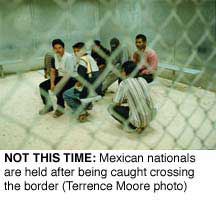
Crossing borders


High Country News photo

Ash Wednesday is un-American. The day's central message is that which, drowning in our things, we hope to repress: we die. "You are dust and to dust you will return."

It is a good day to fight the terror of terror that has griped the country since 9/11. So it is good to read that the Roman Catholic Cardinal of Los Angeles, Archbishop Roger Mahony, has seized this occasion in the church calendar to denounce the fear of immigrants that is currently being exploited by politicians who thrive on fear. According to the LA Times

Mahony said he planned to use the first day of the Lenten season to call on all 288 parishes in the Los Angeles Archdiocese, the nation's largest, to fast, pray and press for humane immigration reform. ... "The war on terror isn't going to be won through immigration restrictions," he said, adding that Al Qaeda operatives would not trek through miles of deadly desert to infiltrate the nation.

In his most forceful comments to date, Mahony said he would instruct his priests to defy legislation — if approved by Congress — that would require churches and other social organizations to ask immigrants for legal documentation before providing assistance and penalize them if they refuse to do so. ...

"There is enormous ignorance out there," said Mahony, disputing as "myths" accusations that undocumented immigrants take jobs from Americans or don't pay taxes. "This is a teachable moment to help people understand that all of us are immigrant people."

We need some teaching on Ash Wednesday, a day to remember we all die alike, "lega" and "illegal."

Via the invaluable site Migra Matters, I've found a coherent discussion of what seems intuitively obvious: if capital, money, is to be free to run around the world seeking the highest profit, workers have to be free to seek better wages -- and that means open borders. Although for most of the history of the U.S. we had just that policy, in this time of fear it has become hard to make a picture of what it would mean if we tore down the walls and accepted that globalization has thrown millions of hungry people out of work in their own countries, sending them here in search of work.

Peter Laufer, author of Wetback Nation simply argues we should accept the reality we've created:

[T]he border issue, everybody agrees that what’s going on now is no good....So what I did is I looked at that and tried to figure out where to go next.

The next step that I come up with is that pretty much any Mexican who wants to come north, comes north. That’s the status of affairs currently. That’s one of the reasons why the border is out of control. ...

Then the third part of this thing is we want them to come north. Whether we admit it or not, we want them to come north. ...

But when you take those three things in a row, then you get to where I come—and it takes me 300 pages or whatever just to try to make this argument in a way that I think is cogent and defendable. But since everybody’s coming anyway that wants to come, since we want them to come, since we all agree the status quo doesn’t work, why don’t we try something radically different. And what could that be? Well, we just regularize what’s going on anyway. Because we’ve got ancillary problems on the border.

Those "ancillary problems" include a militarized frontier, people dying in the desert, a large underground population whose names and activities we can't keep track of, and lots of unnecessary separations of families and children.

Laufer says open the border and deal with reality. There's a "reality-based" answer to the "immigration problem."

Tuesday, February 28, 2006

We're well and truly screwed


There is little doubt among Americans about Iran's intentions. Eight of 10 predict Iran would provide a nuclear weapon to terrorists who would use it against the USA or Israel, and almost as many say the Iranian government itself would use nuclear weapons against Israel. Six of 10 say the Iranian government would deploy nuclear weapons against the USA.

Looks like we can be pretty easily convinced that using those things is merely innocent self-defense.

Monday, February 27, 2006

Three women in three war zones


Guess where. This is not a test; it is a reality. The links will show you where.
I wouldn’t say my life is ”ordinary” by any stretch of the imagination. In fact, I think it's quite outside the entire realm of the ordinary.

Just ask my [2 year old].. He often mistakes ... helicopter gunships for birds, dances to the revolutionary songs blasted during political rallies marching by our house, and has learned to distinguish between ... tank shell fire and machine-gun banter.

***

Most commonly, they ingest a whole bottle of quinine pills, with castor oil…we try to get them to the ER before their cardiac rhythm is interrupted…Sometimes they douche with very caustic products like bleach. We had a patient, a teen, who burned herself so badly with bleach that we couldn't even examine her, her vaginal tissue was so painful….

***

I’m reading, and hearing, about the possibility of ... war. The possibility. Yet I’m sitting here wondering if this is actually what civil war is like. Has it become a reality? Will we look back at this in one year, two years… ten… and say, “It began in February 2006…”? It is like a nightmare in that you don’t realise it’s a nightmare while having it- only later, after waking up with your heart throbbing, and your eyes searching the dark for a pinpoint of light, do you realise it was a nightmare…
Perhaps we are all just watching and waiting.

Sunday, February 26, 2006

Drowning in our own excess


Getting outside my ordinary routine jolts me into more appreciation of just how rich this country is. I have just returned from a weekend helping a good friend treat her two grandchildren and two friends to ski lessons and outdoor fun. A great time was had by all, at least most of the time, which is probably about the best that can be said of a group of seven and ten year olds.

But my goodness, what a lot of stuff these children have and consider necessary! They came with battery operated DVD players and multiple movies to watch during the drive to the ski area. They own ski clothes including bib overalls, goggles and helmets (understand, these kids ski maybe once a year, if that.) Their grandmother, a canny survivor, offered them multiple choices of dinner and breakfast foods, and made sure they got what they wanted.

I too have my stuff. And I too love having the freedom to drive to the mountains. But the bumper to bumper traffic both up and back made me wonder, how long can we sustain having private vehicles taking so many to the "country"?

I wish these kids all the best, but seen in a global context, the sheer excess of things within whose orbit they live leaves me gasping. The land whose appreciation such a weekend teaches can't take it. The planet can't take it. The other people on the planet won't take it forever. And we keep taking.

Friday, February 24, 2006

Make migrants pay!


Let's build a wall.

My friend Francis Calpotura at TIGRA passed on an obscure article reporting an anti-migrant initiative that we may see more of.

In Arizona, legislators want to put on the ballot a measure to build an impenetrable border fence. The origin of the idea is quite clear:

The ballot question asks voters to approve a Mexican border wall to be constructed by the state government. It piggybacks on federal plans to construct border walls and security fences along the 2,000-mile southern border.

Arizona Republican Congressman Trent Franks and Rick Renzi have voiced support for increased border walls and fences. Franks supports a measure building a wall along the entire border. Renzi supports Israeli-style security fences near border cities and well traveled crossing points.

But what is really special about this Arizona measure is how they propose to pay for it. Arizonans want grab 8 percent of international money transfers from Arizona to build the wall. That is, they want to charge Mexican workers who risk their lives crossing the desert seeking work to feed families at home for the cost of trying to keep them out. As Francis says, "twisted."

Georgia legislators hope to get into a similar act, though they don't have a border wall to finance. A recently passed measure aims to make banks collect a 5 percent tax from anyone who tries to wire money outside the U.S, but can't prove legal immigration status. There was opposition.

"What we're about to do is tax people who are doing the best they can to provide for their families," said Rep. Austin Scott, R-Tifton, the only Republican to vote against the bill. "I have a moral problem with that."

Rep. Al Williams, D-Midway, lectured his Republican colleagues for pushing legislation to allow counties to display the Ten Commandments at the same time they're targeting illegal immigrants. "You can't insist on having the Ten Commandments hung if you don't live the Ten Commandments!" he said.

Nice to know someone in the Bible belt has actually read the book.

Wire transfers by migrant workers out of the United States are estimated to amount to $100 billion annually. If these measures are implemented, a 5 percent tax would yield something like $5 billion for exclusionary measures. Lovely prospect.

Friday cat blogging


Why do you point that thing at me?


A cat can look at a queen.


"I like pigs. Dogs look up to us. Cats look down on us. Pigs treat us as equals." Winston Churchill

Thursday, February 23, 2006

Iraq miscellany


Shiite Muslim women and children rally condemning the previous day's attack on Shiite shrine in Samarra, in Baghdad, Thursday, Feb. 23, 2006. (AP Photo/Hadi Mizban)

As Iraqis protest, seethe and hunker down hoping to ride out the storm in the aftermath of the mosque bombing, several recent developments in that unhappy region are in danger of passing unmarked.

Did you know that that U.S. forces have been bombing Baghdad? Neither did I. But reporter Christopher Allbritton, recently returned to Iraq, reports that last week, they did. He's more than a little surprised:

I’m not sure, but I don’t recall air strikes in or near Iraq’s capital city for a long time. In fact, I can’t remember any since I got here in May 2004, although these things tend to blend together after a while. But if the war’s going so well, and the Iraqis are taking the fight to the terrorists, blah blah, why are the Americans resorting to air strikes here? That’s, like, so 2003.

We've been hearing plans for U.S. forces to get off the streets and into their secure (permanent?) bases for awhile. Guess this is what a U.S. pullback looks like -- just bomb those hajis.

Did you know "the West" is drifting toward negotiations with "terrorists"? Salem Adil at Asterism reproduces a British Foreign Office letter urging such talks because "engaging with movements such as the [Egyptian] Muslim Brotherhood will help increase our understanding of 'political Islam' generally, as well as in the specific Egyptian context" and "we should be trying to influence these groups." It goes on to suggest the Foreign Office should try to get the U.S. and the rest of Europe to join such conversations.

Adil observes:

Here is Britain telling the Americans to face up to some reality. What we see here is the start of the pathetic end to the 'War on Terror'. As any politician will tell you, the first step to peace is negotiation with the enemy. What could have happened to cause this change of heart? Well, simply put, Iran happened.

Bush's whole policy towards the Arabs has been to villainise Sunni Islam because of their opposition to direct American occupation of Arabia and, gee, because America needs an enemy in this world. So America turned a blind eye to Israel's humiliation of the Palestinians, ousted the Taliban in Afghanistan and forced the Sunnis out of power in Iraq by disbanding the army and 'de-Baathification'. America has also fought a three-year bloody war with politicised Sunnis in Iraq.

Now, the West is slowly waking up to the realisation after all these years that the Sunnis were their best allies. They were keeping a lid on popular independence movements, diverting Arab attention away from Israel and, most important, they were the real barrier against Iranian influence.

Iran is now emerging as the single biggest threat to Western domination of the region and America is powerless to stop it.

Well, maybe. And maybe we're just reading a particular Sunni Iraqi point of view here. But fixed realities are shifting in and around Iraq -- and then some force decided to blow the situation sky high.

The same blogger provides a round up of Iraqi blog opinion about the mosque bombing at Global Voices. The one point of agreement seems to be that no indigenous Iraqi placed those explosives: it must have been one of the foreigners swarming around, whether U.S. operatives, Al Qaeda jihadis, or even Iranians.

Wednesday, February 22, 2006

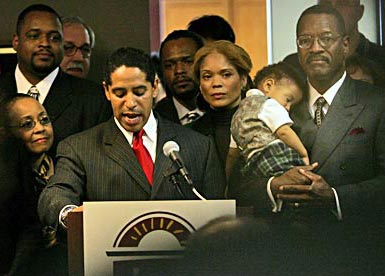
"Campaign finance reform" and Martin Ludlow


Martin Ludlow is surrounded by family as he speaks at Tuesday's news conference. (Bob Chamberlin / LAT)

The news appeared this morning that Martin Ludlow is stepping down from his post as head of the Los Angeles County Labor Federation hoping to avoid jail time in a scandal involving union money that illegally helped his 2003 campaign for the City Council. No one seems to be contesting the prosecutor's core assertions: SEIU Local 99 put some campaign workers on its payroll and ran some phone banks, giving Ludlow $53,000 worth of help that it didn't report. That is the crime.

Now there is no doubt this is illegal. Multiple levels of campaign law, local and state, place limits on and require disclosure of sources of election help. And violating those laws frequently leads to stiff fines. There are very few career politicians who haven't at least been investigated for some reporting irregularity. But what makes Ludlow's case special is that union political contributions are governed by additional federal law giving the Department of Justice and the FBI authority to step in with criminal sanctions. The LA Times reports concerns about the federal involvement:

Ludlow has run afoul of a section of the United States Code titled "fiduciary responsibility of officers of labor organizations." In particular, according to sources, Ludlow was investigated by the federal government for conspiring to embezzle money, property or other assets from a labor organization.

The regulation of unions has long been the domain of the federal government. ...Labor unions have complained that they are being singled out and constrained in a way that their natural opponents, the business community, are not. Such protests have only increased under President Bush, some legal scholars say.

I'm sorry, if this had been a corporation, the activity of hiring campaign workers for a friendly candidate wouldn't have been treated as "embezzlement" from the stockholders -- it would have been applauded as a good investment. And I am sure Ludlow's being Black didn't help either.

Ludlow's departure from the LA County Fed is bad news. He's been a close ally of progressive mayor Antonio Villaraigosa. His accession to the job following the untimely death of Miguel Contreras signaled the strength of the "Black-Brown" alliance that is trying to set LA politics on a new course and model new possibilities for Democrats nationally. That current is so strong that it can likely survive the departure of one leader, but it is hard not to wonder whether we aren't seeing here that Republicans in power know a real threat when they see it.
The whole ugly mess should also be a warning to progressives enamored of various campaign finance gimmicks they hope will "level the playing field." Tinkering at the edges of how cash comes into campaigns with donation limits and partial spending caps simply disadvantages candidates and groups that start with less money. These campaign finance reform practices require people who run for office to hire armies of lawyers, accountants and specialist consultants to ensure that they stay legal. For rich candidates, this is just a cost of doing business. For insurgents, compliance with "ethics commissions" and "fair political practices" regulators is a drain on funds that should go to voter contact.

There are forms of "campaign finance reform" that would work better. The right of rich candidates to self-finance without limit (Buckley v. Valeo) must be made subject to regulation or we are further on our way to plutocracy. "Clean Elections" schemes that give state financing under regulated conditions (versions exist in Maine and Arizona) have shown promise.

But progressives need to be very careful about simply jumping on the latest "campaign finance" bandwagon. Elections are about who has power. Money will get into them because money is power. We'd be crazy to hamstring ourselves.

Tuesday, February 21, 2006

National ID cards: is resistance futile?

There's a rumble about national ID cards in the air.
  • In the United Kingdom, Tony Blair's New Labour government has carried out a campaign pledge to "introduce ID cards, including biometric data like fingerprints, backed up by a national register." Overcoming some reluctance, they rallied their Members of Parliament to strip out a clause in a proposed ID card creation bill that would have made registering for the cards voluntary. Civil libertarians are now pressing the House of Lords to put the clause back in again. Curious Hamster has the story.
  • Meanwhile, in the U.S., the NY Times ran an op-ed today by Douglas McGray of the New America Foundation cataloging reasons why a national ID card would be good for liberal policy objectives in health care, voter empowerment, poverty, education, social welfare, and immigration. McGray's arguments are certain to be controversial and mostly seem pretty darn thin -- ID cards are unlikely to end intimidation of racial minority voters, for example. But what seems significant is the publication venue and the "liberal" cast to the argument.
The issue of national ID cards is clearly on the agenda in English speaking countries.

I first thought about national ID cards in 1994 during the campaign against Prop. 187, California's anti-immigrant initiative. Prop. 187 was going to bring questions of legal identity to the fore in every institution in the state by making hospitals, schools and all state bureaucracies into enforcers of restrictive immigration laws. Many civil liberties groups argued against the initiative because it would require new state ID cards to enforce it. Yet I quickly learned that this argument did not resonate with younger people involved in the campaign. They assumed that national ID cards were inevitable: since the technology existed to track everyone, everyone would be known and everyone would be tracked. Resistance to the ID cards was futile.

This horrifying perspective took awhile to sink in, but it has; I now believe that resistance to erosion of freedoms that counts on maintaining the inefficiencies of a bygone technological era is futile. Ain't gonna happen. We will all eventually switch to the automatic teller, adopt the radio-powered transponder that collects our tolls, browse the information super highway, or choose some other enticing, if intrusive, convenience. If we want to ensure personal liberties, we'll have to do so by creating a political culture that values such liberties, not by hoping "they" can't find us.

Perhaps, ultimately, we'll all just have RFID chips implanted in our bodies. Some workers in Ohio who need access to a particular secure room already do. George Monbiot of the U.K. Guardian paints a picture of future uses of RFIDs:

The company that makes these "radio frequency identification tags", the VeriChip Corporation, says they "combine access control with the location and protection of individuals". The chips can also be implanted in hospital patients, especially children and people who are mentally ill. When doctors want to know who they are and what their medical history is, they simply scan them in....

[A]nother implantable device emits a signal that allows someone to be found or tracked by satellite. The patent notice says it can be used to locate the victims of kidnapping or people lost in the wilderness. There are, in other words, plenty of legitimate uses for implanted chips. This is why they bother me. A technology whose widespread deployment, if attempted now, would be greeted with horror, will gradually become unremarkable. ...

I don't believe that you or I or most comfortable, mentally competent people will be forced to wear a tag. But it will become an increasingly acceptable means of tracking and identifying people who could be a danger to themselves, or who could be at risk of sudden illness or disappearance, or who are otherwise hard for companies or governments to control. They will, on the whole, be people whose political voice is muted.

There's the rub. This stuff creeps in when we let it be used on those who don't have the political power to fight it -- we have to ask ourselves, who's next?

And then, I believe, we can only fight for freedom and privacy by taking our heads out of the sand. There will be ID cards and numerous other intrusions on our property and even our bodies. What will count is whether we can win enough legal safeguards to outlaw their misuse to control anyone. Sure there will be violators of any restrictions, but it is up to us to create a political culture that makes these transgressions deeply taboo.

We are currently seeing how very difficult it will be to put spying and monitoring off limits to the powerful. And technological progress will only make it harder. But, as Carl Schurz, the German immigrant who ended up a Union Army general and U.S. Senator in the late 1900s proclaimed: "If you want to be free, there is but one way; it is to guarantee an equally full measure of liberty to all your neighbors. There is no other." There is no other, indeed.

Monday, February 20, 2006

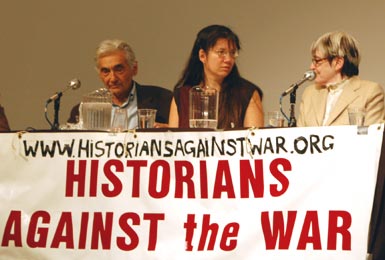
Historians against the war:
Some activist observations


Howard Zinn, Andrea Smith, and Roxanne Dunbar-Ortiz at the conference plenary

Many years ago I was on track to become a professional historian, but I jumped off that train. I like to joke that I decided that it was more interesting to try to make history than to write it -- and this past weekend's Historians Against the War conference confirmed my understanding that I am better cut out for activism than for academia.

Aside from keynoter Rashid Khalidi, almost all the speakers made a point of insisting that attempts to predict the future on the basis of the past are an improper role for an historian. Okay, I know that "past performance is no guarantee of future results" as all prospectuses say, but I do study history to help me discern possible futures -- my activist gut growls: if I can't do that, what is the point? Besides, though historians claim to eschew prediction, in fact many of their papers easily lend themselves to it: neither John Mason Hart who sketched the trajectory of U.S. empire nor James Carter who outlined the history of profiteering in U.S. wars would ever suggest these trends were unlikely to continue.

I left the presentations (again Khalidi aside) feeling that a lot of issues that matter to me were unexplored. What follows are my musings on general issues at the intersection of academic history and activist intellectuals.

Some questions
Do the Bush administration's militarist and authoritarian activities and/or the war in Iraq suggest that we are now experiencing something new in U.S. history? Or is the predominant theme continuity with the long story of U.S. imperialism? Most presenters did not explicitly address this question, a distinction that seems to me crucial to activists hoping to accurately understand our challenges.

Should antiwar inquiry (and potential action) be focused on the objects of U.S. attack (on the "Middle East") with the implied need to prioritize "Middle Eastern" voices and scholars who can explicate those societies? Or, should antiwar scholarship aim predominantly to understand (and change) U.S. society -- an effort that points to lifting up different speakers? The study of history has some light to shed on this perennial challenge I think, but this conference both ignored and straddled the question.

Although the title of the conference was "Empire, Resistance and the War in Iraq," very few of the speakers addressed what seems to me a pretty critical question for popular resistance: are we faced with a U.S. empire still on the rise and feeling its oats or, perhaps even more dangerously, with a wounded beast struggling to arrest its decline? Our perspectives on that question color what we see and help determine what we do. I think I would have learned quite a bit if more panelists had addressed this other than tangentially.

Some observations:
What passes for legitimate knowledge as defined by academia over the last 100 years or more has been understood as existing across an unbridgeable chasm from the teachings of religion(s). It would not be an exaggeration to say that respectable contemporary ways of knowing, as much in the humanities and the social sciences as in the hard sciences, are based on an assumption that religious understandings of the world are in the process of withering away. Consequently, the conference confirmed that historians seem pretty much flabbergasted and certainly not very competent to describe the contemporary situation in which religious passions are moving populations as much in North America as in the Islamic world. This ignorance is not a good thing from the activist perspective.

Over and over, speakers seemed to run up against a wall created by a professional doctrinal imperative that academic knowledge must be only descriptive, not prescriptive. In history, that means we'll tell you what happened, perhaps acknowledging the point of view from which we observe it, but we can't tell you how we evaluate what happened, whether we approve or condemn it. The latter sort of interaction with the data is considered unprofessional. That is all very well, but this professional stance stymies social and political action even to defend the possibility of free inquiry, much less to combat empire. Adherents to this code are left unprepared for some inevitable challenges. For example, how to answer the student who admits that pursuit of empire is murderous, but if that is what it takes for people in the U.S., for our own families, to live a good life, what is wrong with empire?

Having pointed to all these big questions, I certainly don't want to trash this conference. This activist was glad to have the opportunity to step back and think about these questions with a room full of smart, informed, committed people.