Monday, April 20, 2009

Chavez offers a gift


So Venezuela's President Hugo Chavez gave Obama a book -- Open Veins of Latin America: Five Centuries of the Pillage of a Continent by the Uruguayan writer Eduardo Galeano.

Evidently, the copy in question was in Spanish. This may account for the slight hint of recoil we see from Obama. Galeano's sweeping history was the standard account of Latin American development available to thoughtful North Americans in the 1980s. I'd be surprised if Obama had not encountered it back then and probably read it.

I guess it was polite of Chavez not to offer a copy with this cover from the 70s.

As of this evening, the current edition has risen to Number 2 ranking at Amazon. A lot of people are in for a good read. The book is a vivid, broad-stroke introduction to why Latin Americans might be more than a little suspicious of Big Brother north of the Rio Grande.

As in so many arenas, Obama wants to look ahead when relating to Latin America.

I didn't come here to debate the past -- I came here to deal with the future. (Applause.) I believe, as some of our previous speakers have stated, that we must learn from history, but we can't be trapped by it.

Transcript of remarks

I don't know if he'll be able to pull that off. Think about it -- the U.S. has only focused on mucking about in the affairs of the oil states of the Middle East since 1945 (Barbary pirates excepted.) And we've stored up a heck of a lot of grievances in that short time. In Latin America, we've been asserting our dominance over resources and political systems since the early 1800s. It will take more than nice words to work through that ugly history.

Oddly, recent U.S. wars of empire in Iraq and Afghanistan have created some breathing room for Latin countries to strengthen their economies and political systems while the Yankis were distracted. (That happened during World War II as well; U.S. wars elsewhere have been good for our southern neighbors.) Latin America is more ready to meet the U.S. from a stronger footing than perhaps it has ever been. As in so many arenas, the world is changing ...

Sunday, April 19, 2009

President serves ball to the people


It took some guts for the President to make the torture memos public; let's give him credit for that. He undoubtedly is surrounded by buzzing "intelligence" apparatchiks, a bunch of Chicken Little’s announcing that the sky is falling.

It would take even more guts to let the law take its course and make subject to prosecution people who violated laws and treaty obligations (those are laws too). The question of prosecution should not be a matter for argument. If this really is a country of laws, it will happen -- and we have direct experience of what happens when executive law breakers are let off.

"During this long period of delay and potential litigation, ugly passions would again be aroused. And our people would again be polarized in their opinions. And the credibility of our free institutions of government would again be challenged at home and abroad. ... My conscience tells me it is my duty, not merely to proclaim domestic tranquility but to use every means that I have to insure it."

Statement by President Gerald Ford on pardoning former President Nixon,
September 8, 1974

So what happened? Nixon, personally, aged out of most action, rather bitterly. But the thugs (yes, they are thugs) who learned
executive abuse of the power under his administration came right back.

Donald Rumsfeld: functionary under Nixon; White House chief of staff, then Secretary of Defense under Ford; diplomatic envoy for Reagan, including taking the old boy's greetings to Saddam Hussein during the Iraqi dictator's war on Iran; Secretary of Defense under Bush II, architect of the Iraq war, Abu Ghraib and Guantanamo.

Dick Cheney: assistant to Rumsfeld in the Ford White House, then Chief of Staff; a Congressman under Reagan working for such causes as blocking sanctions on South African apartheid; Secretary of Defense under Bush I; exponent of the monarchical executive; finally a Veep who claimed to be a previously unheard of fourth branch of government.

Those two old wannabe dictators aren't likely to be back -- it's their intellectual heirs who must face legal jeopardy if Obama's verbal repudiation of torture is to amount to anything. Addington, Feith, Bybee, Bradbury, and Yoo, minimally, need to explain to a court their conspiracy to violate American and international law. If they are allowed to waltz off to live on right wing welfare (and a federal judge's salary in the case of Bybee), Obama hasn't restored the rule of law. He's just postponed the country's next leap into the abyss.

"We have been through a dark and painful chapter in our history," Obama said. "But at a time of great challenges and disturbing disunity, nothing will be gained by spending our time and energy laying blame for the past."

Salon,
April 16. 2009

Mr. President, you are playing with being your own law unto yourself there. If an officer of the law uncovers evidence that crimes have been committed, investigation is mandatory, not optional.

There was also this:

"In releasing these memos, it is our intention to assure those who carried out their duties relying in good faith upon legal advice from the Department of Justice that they will not be subject to prosecution."

The Plum Line.
April 17, 2009

Many commentators, notably the ACLU lawyers whose efforts helped drag this crap into the light, wonder whether the President and his Attorney General aren't leaving themselves some wiggle room for prosecutions in that statement. It says nothing about the intellectual authors of the torture -- nor about CIA spooks who got a lot more enthusiastic about slamming around their prisoners than even the antiseptic bureaucratese of the torture memos allows. (There's plenty of evidence of such "excess" torture in the recent report of the International Committee of the Red Cross. And after all, 108 prisoners died in U.S. custody by 2005 during the period of mandated abuse.)

As usual, the people of this country will get as much democracy and rule of law as we demand, and no more. So we have work to do, forcing unwilling politicians to do the right thing. Obama has lobbed the ball into the people's court. It's a tough game -- can we take it?

Saturday, April 18, 2009

Tea party opportunity missed


I didn't attend one of the "tea parties" on Tax Day this week. I'm lucky enough to have a job and I was working at it.

If I had gone, I probably would have done no more than take a few pictures -- and likely felt sad about the state of U.S. education that leaves so many people prey to media that sell a regressive populism as entertainment. My instinct would have been to mock the protesters -- and I would have been wrong.

The Salon.com writer Joan Walsh did attend and did interact with folks. According to her account, they were just as white, suburban and bamboozled as I might have anticipated. Also not unfriendly. But she talked with one woman whose perspective deserves more exposure.

That one, Christina Plutarkos, responded to Walsh's story with a note that deserves wider circulation:

Christina Plutarkos here, the liberal-progressive, anti-bailout bank employee. You interviewed me at the rally. ...

My sign actually read: "Why did Treasury let AIG close out the CREDIT DEFAULT SWAPS" (not CDO's) "at 100 cents on the dollar."

... It gets to the heart of how little oversight we're allowed for our nearly trillion dollar bank bailout. And that same question tells you how very broken our government is. And that is something we all agreed on today. Our political system is broken. The economic crisis is the result. ...

I tried to get my liberal and progressive friends to come out and cheerfully and good-naturedly and RESPECTFULLY engage the Tea Party attendees, and almost everyone turned me down. They apparently think conservatism is contagious. Hogwash.

As a liberal progressive who's been a lifelong Democrat, I have to say that everyone at the Tea Party was very nice to me, even though I had a different point of view, and we found a lot of common ground against the bailout. They really listened, and I listened too.

The best part was when a lovely older woman who first disagreed with me came around to thinking about the situation in a new way, and then she clasped my hand in hers, and could hardly let go. At that moment when we forgot our differences to focus on a goal we could help to achieve, America was stronger.

This is a nerve-wracking time for retirees like herself, and it was instructive to me to remember that I wasn't there as some kind of social experiment, but because like all Americans, I am worried about what will happen to actual people.

Once upon a time I was a tax protester. I thought it immoral to pay for U.S. wars and largely lived under the radar of the I.R.S. throughout the 1970s. Eventually life led me to compromise and now I do my tax bit for our shared community, still knowing that 50 percent of my payment goes for wars past and present (and this year some large fraction goes to shoring up rich guys.)

I have no business dismissing the Tea Party folks as mere crazies. I've been to any number of incoherent progressive protests where folks are mostly just getting their sense that they share outrage confirmed.

The administration's "Change" mantra may just be a useful buzzword, but objectively the lines of division between people in this country are changing. Though I'd certainly contend there is still a left-right axis to our politics, we have come into a new time and that axis need not cut exactly as it has for the last decade and more.

Progressives do need to talk with those among these folks who will talk with us; we can be sure that if we aren't trying to communicate with them, dangerous right wing proto-fascists will be scooping up and organizing their legitimate anxiety.

Friday, April 17, 2009

May 19 election: not the election we need


Here we go again. California is having another of its out-of-season special statewide elections. It's the usual -- the people are being asked to do the job of the legislature. Not that this is entirely the legislature's fault. In several earlier rounds of legislating by initiative we trashed a lot of the rules that enable representative bodies to make laws and policy.

Anyway on May 19, we are being asked to vote on a morass of propositions that would add additional wrinkles to the already broken budget process. I'm glad to see that several California groups I respect, including Calitics and the Wellstone Democratic Club, have come to the same conclusion I'd come around to.

All the propositions on the May ballot deserve a resounding NO.
  • Prop. 1A -- State spending cap: that's right -- proponents want to take the away from the legislature the job of making fiscal choices for the state that take into account their constituents' wishes and economic realities. Instead this would tie legislators down with formulas that put Republican refusal to pay for needed services into the state constitution. This is an ugly piece of extortion put on the ballot in desperation so the legislature could pass any budget at all this year. Just say no!
  • Prop. 1B -- shields some education funding from the cuts required by Prop. 1A for one year; it only becomes law if Prop. 1A passes. I suppose this is on the ballot to attempt to take the Teachers' Union out of action in the election. It's still bad law, not a fix for lack of education funding, just another wrinkle in a jerry-built system. Besides, if Prop. 1A passes, education funding is screwed, just like all other public services. No!
  • Prop. 1C -- They want to sell bonds backed by proceeds of the state lottery. I'd call that gambling on gambling. How much more of a house of cards can the state government become? No.
  • Prop. 1D -- seeks to raid funds raised from cigarette taxes for early childhood education and use them to plug the state's general budget hole. Designated funds like these are terrible policy, but given the Mickey Mouse way we've broken the budget process by previous initiatives, designated funds are the only way we get early childhood education paid for at all. No.
  • Prop. 1E -- This one is a raid on another designated fund, the one that pays for mental health services by hitting people who make over $1 million annually with a 1 percent tax surcharge. I see no reason to believe we don't need mental health services -- and all too much reason to believe we do need them. No.
  • Prop. 1F -- this one is populist bait. It proposes to punish legislators by preventing them from getting any pay raise if the state budget runs a deficit. Not that they really have much control over whether the state finds itself in deficit; there's a little thing called the national economy that largely determines that. But we want someone to blame when times get tough. On the scale of the state's budget problems, we're talking chump change here. This is just a way for voters to throw a tantrum. No.
What's wrong with the May 19 ballot is that the only measure which would do the state's fiscal crisis any good is not on it. That would be an initiative to get rid of the ridiculous requirement that two thirds of both houses of the legislature have to vote in favor of any budget.

This rule empowers small minorities of Republicans to impose their anti-general welfare agenda on the whole state. If they want to do without police, fire fighters, ambulances, hospitals and schools in some gated enclave, fine, let 'em. But the rest of us live together in communities and need government to do its job.

Minorities should not be able to tie the state government in knots and confront voters with garbage elections like this. Let us vote to restore majority rule to the budget process! That's a ballot measure I can believe in.
***
The flyer on the left in the picture above may be of more interest to many in the neighborhood -- it exhorts "Stop the Raids and Deportations" of undocumented immigrants.

Friday cat blogging


Socks has a great life. She picks out neighbors who meet her standards to visit and moves in for a few hours. Everyone sends her home by 9:30 at night though.

Thursday, April 16, 2009

Providing a usable past


Mike Lux speaking at a book promotion in San Francisco.

We all read history through the lens of our own time. That's not a criticism; it is just a fact. If we work very, very hard at it, we can sometimes imagine that people in other times and places genuinely responded to events and people differently than we do -- but only if we invest disciplined effort at cutting through our assumptions and broadening our perceptions. When we work at, the study of history then becomes the study of how and why people moved from the ways they were to become the people we are. Discerning how societies and individuals change is exciting, but it must start from a dispassionate apprehension that then -- material circumstances and people's consciousnesses -- was not the same as now.

I really hoped to love Mike Lux's new book, The Progressive Revolution: How the best in America came to be. Lux is one the founders and proprietors of the progressive blog Open Left, one of the more sophisticated places on the web to discuss progressive politics. I like his sensible commentaries on that site. He's also a long time Democratic Party guy -- an experienced political operative and policy wonk who knows how things actually get done. It's an unusual combination and I've enjoyed reading him.

"The Progressive Revolution" is an attempt to offer the current generation of newbie Democratic activists a usable past, a retelling of U.S. history as a long struggle between "progressives" and "conservatives" along lines that pre-figure contemporary struggles. Unhappily, I don't think it quite works. Lux too often slips too easily into writing as if contemporary categories were universals that could be read back into history, a method that takes the intellectual friction out of looking at the past.

I don't want to nitpick this effort -- he's attempting a sweeping picture and will inevitably be vulnerable to small inaccuracies. So I'll try point out what disappoints me from the example of one of his major set pieces. In describing the U.S. revolutionary period and subsequent adoption of the Constitution, he sets up John Adams as the elitist conservative and Thomas Jefferson as the popular democratic progressive. And certainly that's a way to frame the political behavior of these two gentlemen. But it is a way that erases the nuances that make the period more than a backdrop on which to fight current battles. After all, in 1776, Adams was a vigorous proponent of declaring independence who maneuvered strenuously in the Continental Congress to get his supposed opponent Jefferson the job of drafting the Declaration. And while Jefferson's stance in the early days of national politics was the populist one, personally he was the rich plantation owning aristocrat, while Adams was much closer in his life experience to being the sturdy self-made yeoman that Jeffersonian politics claimed to empower. History is complicated.

History also sometimes reveals unpleasant truths about the shallowness of current posturing, especially when we get closer to our own time. Lux writes

...Republicans rolled back the Glass-Steagall in 1999, exposing our economic system to more risk.

Come on, Mike -- admit it. At the end of the Clinton era, many Democrats in Congress were nearly as enamored of "deregulation" -- letting the financial barons play fast and loose -- as the Republicans. They gave Republicans veto-proof margins for the repeal. Engaged citizenship has to include calling out your own leaders and your own party when they are wrong as well as beating up on the other side.

I've written enough here to show why "The Progressive Revolution" wouldn't be my candidate to fill the very great need for a usable past for contemporary activists. Interestingly, we are seeing another prominent exponent of creating a story of the past to build our future in the President. He's darn good at it, a subtle interpreter of a very mixed bag, as a Black man almost has to be.

For an historian's effort along the same lines, many in my older generation of progressive activists turned to Howard Zinn's A People's History of the United States: 1492-Present. This is not as neat as Lux's effort, but no concerned reader will come away without gaining fresh insight into how we got to where we are.

One more reason I have to like Lux: while doing the book talk where I photographed him in the image at the top, this is what he had on below. Not a pretentious guy!

Wednesday, April 15, 2009

Iraqi refugees: still unsettled


United Nations staff register Iraqi refugees in Syria. Ramzi Haidar photo.

According to Ken Bacon who works with refugees:

When President Obama met with Iraqi Prime Minister Nouri al Maliki in Baghdad last week, he mentioned the U.S. interest in helping displaced Iraqis return home.

That is a welcome change. The Bushies liked to obscure the fact that their invasion and occupation had displaced some 20 percent of the Iraqi population. When we visited the region in 2006, an obvious feature of life in Jordan and Syria, as yet largely unmarked by Western reporting, was the flood of Iraqi refugees set in motion by the war. They are still there -- and huge numbers of people are still displaced inside the country as well. It is hard to envision peace when so many people have no settled homes and communities.

Refugee returns are currently a political football in Iraq. According to a report by Refugees International, the al-Maliki government wants to declare the refugee problem is over whether it is or not. It has offered transportation from Jordan and Syria for those willing to return and aims to close down its record of "internally displaced persons" this year. But returns are still rare.

Refugees International recently met with Iraqi officials, who all expressed the desire to see the "IDP file" closed in 2009, as there are "no longer reasons to be displaced" in Iraq. As a result, internally displaced people are no longer being registered as the government hurries to make the displacement problem disappear.

Moreover, Prime Minister Al Maliki’s Shi’a government has little sympathy for the largely Sunni refugees in neighboring countries. Syria and Jordan state that almost two million such refugees are still in their countries, but the Government of Iraq states that there are no more than 400,000, and fewer have registered with the Office of the UN High Commissioner for Refugees (UNHCR). According to a UN diplomat in Baghdad, the Prime Minister sees all refugees as "traitors" or "baathists" who prefer "getting money without working" rather than helping to rebuild their country.

Returns remain a trickle rather than the solution of choice for most displaced.

The occupation has made -- or allowed the emergence of -- an Iraq segregated by sect and ethnicity. Individual families became flotsam in the great sorting.

The U.S. has an ongoing obligation to fund efforts to enable all these people to get settled again. At the end of 2008, the U.N. appealed for $547 million to help Iraqis inside and outside the country. So far the appeal is falling short amid the world financial downturn. The least the U.S. can do is fund it generously.
***
Meanwhile, Iraqis hoping for a better future continue to leave their country. For years, because U.S. authorities wanted to pretend all was well in "mission accomplished land," we allowed very few Iraqis to immigrate to the United States. Under humanitarian pressure, the annual quota has now been raised to some 17000. And, naturally, after six years of occupation, there are a considerable number of Iraqis whose marketable skill has become working with Americans. A New York Times reporter explains his thinking about why he has decided to join the exodus, now that he can:

It’s been really hard for all of us living in Iraq. Things are better now but still fragile and uncertain. The security situation may be better but life isn’t that normal yet. The American-led invasion has changed Iraq for good and for bad. Bad things can’t be removed in one night, especially in Iraq. It’s been hard to predict the future of Iraq lately, but I think it will be easier in the States.

I have a good job with The New York Times now. I get a decent salary compared with the living standards in Iraq. But I still lack many other things as a young man: I don’t get the chance to date a girl or have fun like the others around the world because of the recent situation in Iraq.

I’ve also applied for my family to come with me. That includes my parents, my younger brother and my sister’s family which consists of four members and is considered a part of my immediate family because social relations are very strong in Iraq. We’re all looking for a change outside Iraq, and are willing to start over in America.

I bet he'll do well here, like millions of immigrants before him. Too bad we had to tear up his country to push him to this decision.

Tuesday, April 14, 2009

Tab dump


This is lazy blogging, but today I won't resist. What follows are some unrelated items that grabbed my attention -- and which I thought others might enjoy without my needing to write much about them.

A small step for womankind... Apparently "potty parity" in public accommodations is now the law, or at least the building code. Architects have recognized that women take longer in rest rooms, what with needing individual stalls, wearing more complex clothes, and often escorting children, so stadiums are beginning to be built with enough toilets. I never thought I would see the day! Maybe with this, we'll begin to take up a more equal proportion of the seats at sporting events, in addition to enjoying concerts and other mass festivities more.
***
Obama allows more travel to Cuba ... and leaves most of us in the United States as second class citizens. Sure, it is great news that he has relaxed the Bush era restrictions that prevented Cuban-Americans from visiting their relatives -- but what's with continuing to prevent the rest of us from traveling there legally?

I know, many of us go to illegally from Mexico or elsewhere. I did it myself from Canada over 20 years ago. I didn't come back a Cubaphile, though there's a lot to like on a Caribbean island with wide beaches where everyone has access to health care. Back then, heterosexuality was far too compulsory for my taste. I hear that is no longer true and can believe it -- presumably the Revolution's misguided attempt to repress visible gayness had a lot to do with how much underlying pansexual liberation was trying to break out.

But who cares what I think about Cuba? What's infuriating about Obama's half measure is that Cuba policy is not a foreign policy issue. Like Israel, it's domestic political theater masquerading as serious high policy. Baloney. It's about very localized bloc voting and campaign contributions and that's no reason to let those dictate our country's relations with millions of real people.
***
Justice Clarence Thomas said something I find endearing... I know, that's impossible. But this observation accords completely with the way I see the world:

"I have to admit," he said, "that I’m one of those people that still thinks the dishwasher is a miracle. What a device! And I have to admit that because I think that way, I like to load it. I like to look in and see how that dishes were magically cleaned."

Wonder if he really does load the dishwasher? As for the rest of his ideas -- no, not for me.
***
Oh, and like most everyone else, I'm a sucker for the White House dog.

You're a nice addition to the national reality TV show, Bo. Glad you are along.

Monday, April 13, 2009

Junketing around the empire

Congressman Jared Polis, D-CO (he's the gay guy from Boulder and environs, newly elected in 2008) has just been to Iraq and Afghanistan on a CODEL. That's a Congressional delegation. He's got sharp things to say about the two countries -- but more interesting is his candid description of what it is like to travel on one of these trips.

Polis writes in the Huffington Post:

We visited two cities in Afghanistan, Kabul the capital and Kandahar in the south near the Pakistani border. What a mess. What another world. No one can make sense of Afghanistan because it doesn't really make sense.

We hardly glimpsed the real Afghanistan. Through the bullet-proof windows of our van, we saw a few children playing, women in Burkhas, and men going about their daily business as we drove from the airport to the Embassy, but our briefings were all in military bases or government buildings. ...

On this trip to Afghanistan, unfortunately not a single bite of Afghan food passed our lips. We stayed on the military bases and embassy compound, ate in cafeterias, and the only Afghani we even met with was the Minister of the Interior.

Thus, despite traveling thousands of miles and visiting the country itself, my context and understanding of Afghanistan is pretty much the same as the average American's--based on the same information that the Obama administration and US military have given us in making their decisions.

Two questions:
  • Why are we footing the bill for Congresscritters to learn hardly anything but what their military and state department handlers want them to?
  • Do most of those Congresscritters know they are learning so little?
Rep. Polis is to be applauded for his candor.
***
He was also pretty candid about what he learned during the Iraq phase of this trip.

In the afternoon in Baghdad, we went to the Iraqi Parliament and met with two female members. Both covered their heads and wouldn't shake the hands of men. ...

The two members of parliament were the only Iraqis we formally met with; this visit was skewed toward visiting with our own military and learning about our mission and successes and failures from the American perspective. The few times we talked to Iraqis on their own, they told us only what they want American officials to hear. I learned more about the situation in Iraq on my previous visit [before Polis' election], in November 2007, when I met with Iraqi refugees in Jordan who spoke much more freely about their observations and opinions.

This guy is an incisive obsever. Can he stay that way in Congress?

Sunday, April 12, 2009

A letter to the President


Dear President Obama,

I've got an idea! In these hard times, don't you think we could all save some taxpayer money if you'd cancel the flight of the Blue Angels over San Francisco during Fleet Week in October?

The Chronicle already reports that "the Navy will send only a single ship this year." How about we do away with buzzing the city altogether?

According to the Navy,

On the average, one F/A-18 uses approximately 8,000 pounds or 1,300 gallons of JP-5 jet fuel at a cost of roughly $1,378. ... Over a one-year period, the squadron, including Fat Albert [an accompanying C-130 transport], burns approximately 3.1 million gallons of fuel.

That was in 2003. I find it hard to believe that jet fuel still runs only a little over $1 a gallon. Suppose jet fuel now ranges from somewhere around $2.50 to $5.50 a gallon. We're looking at fuel costs of $7.75 million to $17 million annually for this aviation stunt. That's not on the order of what your administration is spending to bail out Wall Street, but not chump change either. I'm sure you could find something else to do with that money.

And think -- all that CO2 wouldn't be spewing into the atmosphere. That would be nice too. We sometimes complain that the Bay is cold in the summer, but we don't much like being surrounded by forest fires as the planet heats up either.

Besides -- you do know, don't you, that these planes sometimes fall down. Most recently, a Blue Angel crashed in Beaufort, South Carolina in 2007. Eight people on the ground were injured and several houses trashed. It sure doesn't seem smart to be doing the loop-de-loops over a crowded city. At least I don't think so.

I know you've got nothing against the Navy. I mean, you used the Navy today for what it is really good for, rescuing a ship's captain from the Somali pirates. But do you really think you support the Navy by having it show off for civilians?

Instead, aren't you trying to encourage us to do service for our communities? Maybe instead of an air show, we could get people to come out and clean up the shoreline? That would be a good project.

I know you've got a lot on your mind, but really, do we have to have the Navy fly-guys blasting around over San Francisco every year? Isn't this terrible recession year a good time to move beyond the Blue Angels.

Just an idea for a change for the better.

Yours truly,
A concerned San Franciscan

Saturday, April 11, 2009

Good Friday 2009

Friday started badly. Scanning the news, I ran across a Washington Post report that some Christians feel their rights are violated by civil rights statutes that require them to provide services without discrimination to gays and lesbians. They think LGBT people have cooties and want to be able to refuse to deal with us. Seems to me, all these folks can believe anything they want, but when they work out in the world, they need to accept that this is a society where differences co-exist.

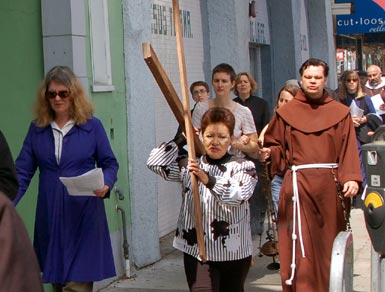
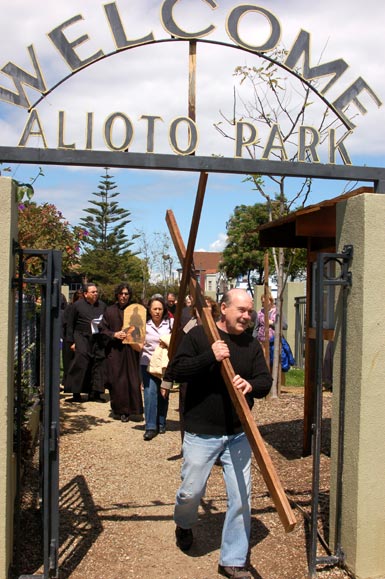
Fortunately, I got to spend the middle of the day -- the observance of Good Friday, the Christian commemoration of the Jesus' crucifixion -- with another kind of believer. The community of the Episcopal Church of St. John the Evangelist/El Buen Samaritano, along with folks from other parishes in the SOMA Ministry (Holy Innocents, St. Aidan's and St. Gregory of Nyassa) processed through San Francisco's Mission district marking Jesus' last walk to his execution with prayers in front of various community landmarks.

1carrying-cross!.jpg

In the past we've done this in the Castro and spooked some of the natives. In the Mission, 50 or so processing Episcopalians, many LGBT, praying in English and Spanish, seemed more run of the mill.

2alito-dan-miriam!.jpg

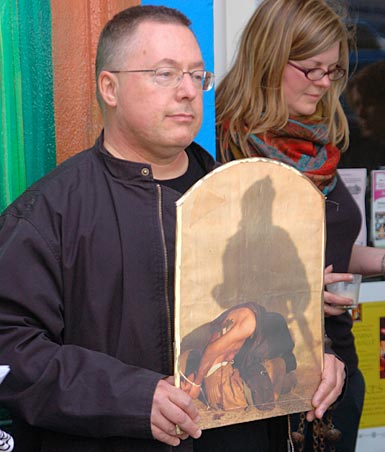
3icon-&-bearer!.jpg
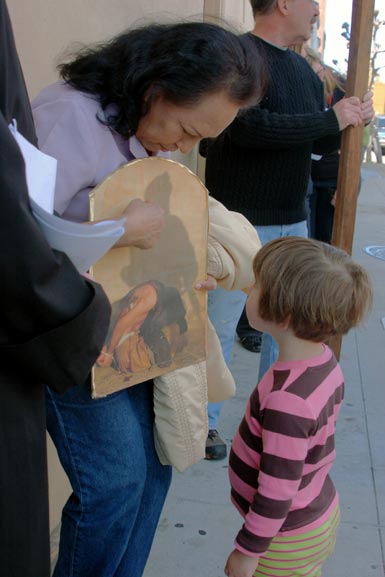
In addition to the cross, we carried a contemporary icon, a photo by Tyler Hicks of a wounded Iraqi held captive by U.S. soldiers.

4miriam-explains-icon-to-fi.jpg
How to explain such fearful agony to a curious child? But human pain and cruelty cannot be entirely hidden.

5do-it-by-the-book!.jpg
We did meet one detractor -- this gentleman waving his Bible and American flag felt we were not doing our bit to purify the Sodom that is San Francisco.

He's right. We try to be more about compassion than condemnation; sometimes we succeed.

Friday, April 10, 2009

Hope for opponents of "Af-Pak" war


So the U.S. is blundering into more war in Afghanistan -- and apparently our generals intend to push into Pakistan without Pakistani permission. We used to call that sort of thing aggression -- but only when it was done by somebody else.

Meanwhile there are a few faint smidgens of sanity on the horizon. Some of our better Congresscritters are asking questions:

CPC chair Lynn Woolsey (D-CA)--"I don't think we should be going there"--Jim McGovern (D-MA)--"I just have this sinking feeling that we're getting deeper and deeper into a war that has no end"--and John Conyers (D-MI), who had the harshest words for the President of all. He called the strategy, such as it is, in Afghanistan "embarrassingly naive," saying that though Obama may be "the smartest man in American politics today...he occasionally gets bad advice and makes mistakes. This is one of those instances."

TPM

These are outliers from the usual chorus of pugnacious Democratic posturers proving their imperial chops, but any movement against more war needs these to come out first, and they are beginning to.

And some interesting ideas are bubbling up. Donald Cohen of the Center on Policy Initiatives suggests we commit to paying for our wars as they are undertaken. How novel!

We need an entirely new approach of sending our troops to battle that ensures the wars we wage [are] truly in our national interest, that we actually have the resources we need and that taps into an enduring American tradition of shared sacrifice when needed and when asked.

We should simply modify the War Powers Act so that every commitment of 50,000 US troops or more would automatically - without legislative action - trigger a broad, progressively levied surtax to pay for the costs of war. ...

An automatic war-tax ... would cause us all to think a little harder about why and when we should go to a war.

Huffington Post

Good idea. How about extending it to cover the establishment and maintenance of bases outside our borders as well? That would hamper imperial overstretch considerably.

Actually, lots of good ideas about how to push back against Obama's "Af-pak" adventure are out there. See the April 27 Nation for 10 useful suggestions.

Thursday, April 09, 2009

In which Larry Summers impersonates a pig


[2:46] A smug, well-fed and watered, pig at that. There's one financial guru President Obama doesn't need.

Way to go, Code Pink! That was a very disciplined action that delivered an understandable message to those with ears to hear -- not apparently Larry's crowd at the The Economics Club, but certainly to the rest of us.

"Good guys doing bad things" are frittering away our rights


Needs no further comment from me. Worth it -- [4:12].

Wednesday, April 08, 2009

Spring hike

1water-over-moss.jpg
Last Sunday a friend and I went looking for Warner Falls in the hills above Mill Valley in Marin County. Contrary to the link I've just given you, there is such a place and rather pretty it is, as you can see above. Okay, there is no cascading torrent here, but at this season a steady stream runs down moss-covered rocks.

2sky-reflected.jpg
In spots the stream forms pools large enough to reflect the overhanging tress and sky.

3creek-in-warner-canyon.jpg
This secluded flow makes for interesting light.

4wild-iris!.jpg
Climbing out of Warner Canyon into the sunlight, we found wild iris in full bloom.

5city-through-trees.jpg
Eventually we came out on Blithedale Ridge where we caught glimpses of San Francisco across the Golden Gate.

Tuesday, April 07, 2009

God(s) and fear of change

Last Sunday, Palm Sunday, the Rev. Gloria del Castillo asked during her sermon at the Episcopal Church of St John the Evangelist in San Francisco:

Why did the same people who greeted Jesus with cries of Hosanna when he paraded into Jerusalem, just days later shout 'crucify him!' Were they afraid of change?

Religions as well as individuals encounter existential dilemmas when confronted with changes in human societies. Tamim Ansary's wonderful memoir, West of Kabul, East of New York, contains a section describing the Afghan-American author's quest to re-encounter Islam while traveling across North Africa. One episode he describes is learning about how a religious tradition responds to the reality of human social mutability while cleaving to a belief in the unchanging divine. I am going to quote quite a long piece of it; it is worth reading all of this excerpt and wading through the gendered language about God.

...on the train across Morocco, I was reading an intellectual history of Islam by an erudite Pakistani scholar named Fazlur Rahman. His account of one doctrinal dispute in the early centuries of Islam hooked me. I couldn't stop thinking about it, couldn't stop spinning out the implications -- and I have been thinking about it ever since.

The dispute raged between orthodox scholars and a school called the Mu'tazilites, the "rationalists." The two schools didn't disagree on how people should behave or what they should believe. Their debate centered on one of those questions so abstruse, they give scholars a bad name -- namely, Are certain beliefs and behaviors good because God commands them? Or does God command them because they are good?

Hairsplitting, you say? Not so fast. If certain beliefs and behaviors are good only because God commands them, it means that God might change His directives at any time. Logically, it's possible that justice and charity would suddenly be foul and murder good. ...

Unthinkable, you say, that God would ever promulgate such an ethos? Why not -- because it wouldn't be right? If you think that way, you've slipped over to the other side. You've assumed that right and wrong, good and bad, have a status prior to God and more fundamental than He. If God cannot, from His own almighty and unknowable will, enjoin murder and cruelty as virtues, God is not limitless or omnipotent.

Unwilling to go there, the Mu'tazilites argued that the good was as fixed and absolute as God Himself. God's commandment therefore embodied principles that reason could discover. And those deep principles could be applied to all new situations. In short, they took the position that things change, but the good is eternal and the Koranic compass allows one to keep finding true north amid the turmoil of history.

Their opponents thought God was the only absolute, the only fundamental, pure, uncircumscribable will. He could, in His omnipotence, determine freely what was good. A human, therefore, couldn't reason from God's explicit commands to original ideas, because that would be assuming that God's will was bound by what the human mind could conceive. They took the position that the Koran gave the prescription for freezing history. ...

Significantly this debate unfolded in a political context. Everywhere from Cairo to Delhi was Muslim at that point. Throughout the realm, a smattering of Arabs presided over oceans of locals. Everyone in the realm accepted Islam, however, so power ultimately resided in the religious ideology.

If the orthodox school was right, the Arabs owned the ideology. The orthodox doctrine implied that questions about right and wrong, about jurisprudence, laws and contracts, could only be resolved by recourse to the word of God as revealed in a particular time and place. Therefore, anyone who had actually been in that time and place had a leg up on knowing the truth. Those would be Arabs ...

By contrast, if the Mu'tazalites were correct, any Muslim, anywhere, anytime, could discover from studying the Koran and the life of Muhammed the principles on which God's commandments were built. Judgment and reason trumped authority and eyewitness testimony. In their ideological sphere, the Arabs had no particular advantage.

The orthodox scholars won. ...

Sound familiar? It certainly does to me. People who want to hold on to power always have an interest in promoting a source for laying down rules to which they control unique access. And this often takes the form of claiming that a particular historical era (as they describe it) has all the answers about the good life, so don't anyone go thinking up changes. The contemporary Roman Catholic Church seems to like medieval European Christendom as its reference era, while U.S.-based fundamentalism looks to an idealized U.S. suburbia of the 1950s.

More than once in his memoir, Ansary identifies with the Mu'tazalites, insofar as he is willing to take anything from Islam. That way is not the God/metaphor I live inside, but I too relate well to the idea of a deity that expects humans to draw first principles from Being and figure out what that means in the context of lived experience. That is, I believe we are all capable of being responsible moral actors, not dependent on the guys (it is nearly always guys) that claim to know how we should live on the basis of some past era. And that means we have to embrace change sometimes.

Once you start thinking that God's good really is good, not some arbitrary divine construct, as the Mu'tazalites decided, you find yourself wrangling with what that means in real human circumstances. I'm seeing that all the time these days: for employment I'm working for full inclusion of all people (that means queers too) within the full life of the Episcopal Church, a religious outfit that by and large has decided it has to learn to understand ancient truths within this actually existing human society. Change is hard.

That's what the Rev. Gloria was pointing to last Sunday. We don't always want the terrible responsibility that goes with discerning the meaning of the good as responsible adult actors. It would be a lot easier if God were that being in a book, fixed forever in a text, demanding only conformity mediated by a special class of priests who tell us the rules. Those people who enjoyed the excitement of Jesus's parade into Jerusalem also wanted the security offered by known religious authorities. They were ready to be led to kill the disturber of their known order. Jesus was saying there had to be change, but that unimaginable change could be of God. Humans kill people for such impudence.

Monday, April 06, 2009

On boiling frogs and human habits

Remember the one about how if you bring a bucket of water full of frogs to a boil slowly, the critters won't notice til they sizzle? Apparently it is not true.

Maybe the idea came from observing us.


H/t Dave Roberts at Grist: a beacon in the smog.

Afghanistan: a luxury Obama can't afford


The coffin bearing Air Force Staff Sgt. Philip Myers, who was killed in Afghanistan on April 4, arrived at Dover Air Force Base on Sunday night. Sgt. Myers' family gave consent for this photo by Brendan Smialowski for The New York Times.

(This post is my contribution to the Get Afghanistan Right blogging project.)

The most interesting tidbit of news that came out of the NATO meeting in Strasbourg didn't come from Barack Obama. It is this unsourced admission quoted in the New York Times:

"No one will say this publicly, but the true fact is that we are all talking about our exit strategy from Afghanistan," a senior European diplomat said Saturday. "We are getting out. It may take a couple of years, but we are all looking to get out." He spoke on the condition of anonymity under diplomatic rules.

Europe is done with Afghanistan, while Obama is committing over 20,000 new troops for a total of 68,000. It seems reasonable to ask: why is the U.S. escalating rather than joining the exodus? Those of us who insist that further U.S. war-making in Afghanistan is a waste of Afghan and U.S. lives need to understand why as we work to build a peace movement.

Barack Obama does have an answer to that question. In the same article from Strasbourg, he is quoted saying:

"We want to do everything we can to encourage and promote rule of law, human rights, the education of women and girls in Afghanistan, economic development, infrastructure development," he said. "But I also want people to understand that the first reason we are there is to root out Al Qaeda ..."

I've argued previously that we should listen to this President, because he very carefully uses his words to win and exercise power. But that doesn't mean we have to treat his utterances as incontestable. I assume by this statement he's reiterating an undeniable political fact: no U.S. president can afford to allow a major terrorist attack of foreign origin to occur on his watch. George W. used up the only free pass any U.S. ruler is going to get on a terrorist attack.

But going beyond the words -- where's the argument that making war in Afghanistan is going "root out Al Qaeda"? The president's own intelligence agencies say Bin Laden and Co. are almost certainly in Pakistan, not Afghanistan. They also say that the more U.S. troops, the more civilian casualties, spurring more angry Afghan adherents to a fundamentalist, tribal Islam who are ripe for recruitment for terrorism. Obama has not made the case that his actions will achieve his stated ends.

So if the explanation for why the U.S. must fight on in Afghanistan is paper thin, it's probably worth going back over all the purported "reasons" that form the background inertia for continuing this war. The list is depressing.
  • From the get-go, Afghanistan was about revenge. Somebody killed 3000 people in New York and Washington and robbed us of our absolute assurance of safety from foreign attack. Somebody had to pay. Afghans lost.
  • The Taliban were a brutally illegitimate bunch; nobody, including most Afghans, was going to mourn our making them the sacrifice to take the edge off our hurt.
  • The U.S. has an expensive, permanently far flung military that claims to be ready for any task. When what you have got is a hammer, you are liable to treat any problem as a nail and bang away. Never mind that the threat from non-state terrorists could and should have been dealt with by international law enforcement, not shock and awe bombing of Afghanistan's already deep rubble.
  • Wars that don't cause many U.S. casualties are popular with military contractors -- and don't think that Congresscritters who need campaign contributions and jobs in their districts don't remember that.
  • Some oil companies had (and maybe have) fantasies of controlling Central Asian oil and gas pipelines. Afghanistan makes a good base to advance their interests -- otherwise China or India might get the energy supplies.
  • Finally, Democrats have to prove they are tough guys (that includes our women politicians). The Republicans have successfully made "Democrat" equal "wimp" in the public psyche; winning Democrats prove they are butch. Wars are very butch. And generals cooperate with civilian authorities when they get to have (winning) wars.
So the U.S. war in Afghanistan is an ugly mess. Is there any hope the U.S. will ever find the "exit strategy" President Obama said he wanted only a week ago?

I think yes -- people who want peace should be hopeful indeed. This President is a pragmatist. He's got a massive number of genuine, pressing problems on his plate. As it become mores evident that the Afghanistan adventure is simply a human and economic waste, he's not going to clench his war in a death grip. Why U.S. forces might discover that they can have an "exit strategy" -- their commander can order them to leave.

The project for the peace movement is to drive into the popular consciousness the complete futility of the Afghan war and similar wars of empire. By doing so, we're helping a pragmatic president survive and govern. The country has real problems: terrorism, yes, but that just needs law enforcement. The true quagmires are a domestic economy that no longer produces employment or commodities for survival, a reeling international economy of which we are the dysfunctional leader, and a planet that is burning up. Nasty little far away wars are no longer an acceptable luxury for this country, not to mention their victims.

Saturday, April 04, 2009

You have to love a parade

1lead-banner!.jpg
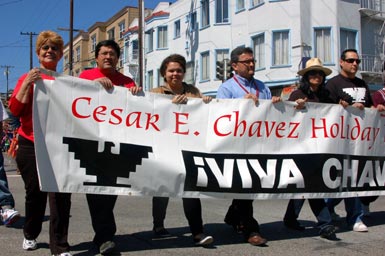
It's been so long since I've seen a neighborhood parade that wasn't overrun with self-aggrandizing bigwigs and corporate sponsors that it took me a while to understand what felt different about today's Cesar Chavez Day march in the San Francisco's Mission district. This was my neighborhood, strutting its stuff! Sure the local pols (David Campos and Tom Ammiano among them) carried the banner. But mostly this was Mission people, celebrating an honored hero.

2aztec-dancers-on-parade.jpg
The Aztec dancers were in fine form -- after all, Carnaval in San Francisco comes along in May, so practice is well under way.

3aztec-drummer-woman.jpg

4mission-ed-center-on-march.jpg
If you want your kids to learn about your community's heroes, what better way than to bring them to march in a parade?

5alice-fong-yu-close-up.jpg
Especially if they are in Chinese immersion instruction. That's San Francisco for you.

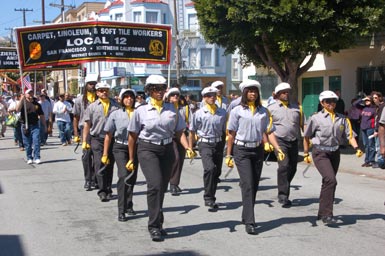
6ILWU-drill-team-and-banner.jpg
The International Longshore Workers' Union drill team led the labor banners. Cesar was, after all, a labor leader -- and so much more. (Some of my thoughts on the strains that developed within Chavez' farmworker movement as a consequence of that "more" are here.)

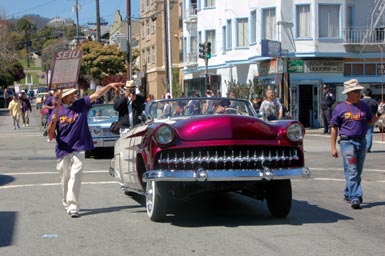
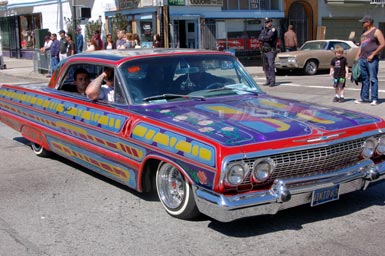
Then came the true stars of the day:

7lowrider-up!.jpg

8low-rider-smooth-gray-chev.jpg

9low-rider-glorious-painted.jpg

10low-rider-pontiac!.jpg

I sometimes wonder how many of my neighbors know who Cesar Chavez was. I remember that when he died in 1993, many thought the famous man who was being mourned was the Mexican boxer, Julio Cesar Chavez. In California and Texas, the United Farm Workers Union Chavez' birthday, March 31, is a state holiday. In California history, Cesar Chavez was the inspirational leader of many poor Latino farm workers struggling for fair pay, dignity, and respect. Their children will soon be an absolute majority in the state.

A political junkie's delight


Click on the little full screen icon (second from right) underneath to view across your full screen. It is much better that way. Hit escape to get back out of full screen mode. Enjoy.

Friday, April 03, 2009

Canadian still stranded.
Maybe Kafka could explain


Downtown Khartoum. Might be an interesting place to visit, but Abousfian Abdelrazik doesn't want to be forced to live here.

Abousfian Abdelrazik -- a Canadian citizen blacklisted as a terrorist -- is still stuck in Khartoum, living on the charity of the Canadian embassy. In 2003, he flew to his native Sudan to visit his ailing mother, was fingered by some Canadian police outfit as a terrorism suspect, and jailed and brutalized by Sudanese authorities for 19 months before they tossed him out without charges. By then, the Royal Canadian Mounted Police and the Canadian Security Intelligence Service were smarting with embarrassment over their misconduct in sending Maher Arar to be tortured; they cleared Abdelrazik.

But somehow, the spooks' finding of innocence didn't mean he could return to Canada. He was told that the U.S. had put him on a UN watch list -- and he should get himself off somehow. Later, the line was that the Canadian government would only renew his passport if he could schedule a flight -- but airlines won't sell a ticket to a person on the UN list. When supporters finally found an airline that would carry him, the government changed its requirement, insisting that they wouldn't give him a travel document without a fully paid ticket. And it threatened people who offered to buy him one with prosecution for aiding a terrorist. Several hundred Canadians chipped in; he was supposed to fly home today -- but instead the government curtly faxed a note to his lawyer, claiming a right to

"... refuse or revoke a passport if the minister is of the opinion that such action is necessary for the national security of Canada or another country."

What other country, this jaded U.S. citizen wonders? A broad cross section of Canadians are disgusted. They cry racism.

In Ottawa, Abdelrazik's supporters, including MPs from all three opposition parties, described his situation as "Kafkaesque" during a small protest and news conference on Parliament Hill Friday.

"Obviously, there's a question of racism here," Amir Attaran, a University of Ottawa law professor, told the CBC in an interview.

"He has the unfortunate problem of being the same colour as the president of the United States and the Governor-General. He's Muslim. He has an odd name, but there's no legal reason to deny him a passport."

Referring to the case of Brenda Martin -- the Canadian woman jailed in Mexico whom the Canadian government sent a private jet to bring home last year -- NDP foreign affairs critic Paul Dewar said there was a double standard at play.

"It saddens me greatly. If Mr. Abdelrazik's last name was Martin, would there be a different outcome?" Dewar said.

"... If this had been someone with a different skin colour and with a different last name, would there have been a different outcome?"

CBC News

To be continued, Mr.
Abdelrazik and many other Canadians hope...

Thursday, April 02, 2009

Mission marches against service cuts

deserve-after-school-progra.jpg
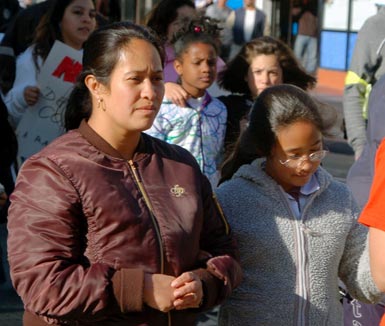
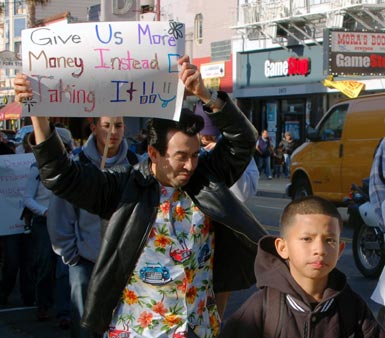
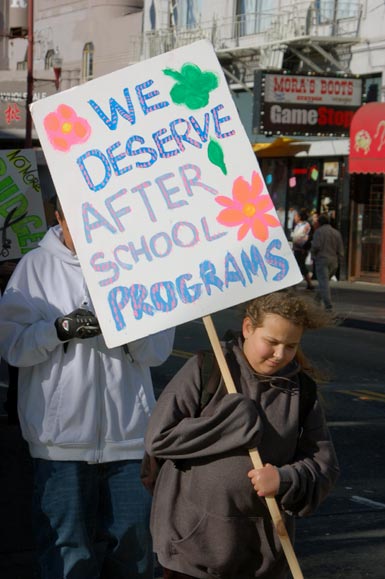
Struggling to hold signs against gale force winds, several hundred people, mostly youth, marched from 16th up Mission Street to 24th Street this evening, protesting Mayor Newsom's plan to balance the city's budget by cutting service programs for families.

protect-services.jpg
Marchers believe (and I agree) that whenever the city is in trouble financially, the Mission neighborhood, the city's gateway to all sorts of new immigrants, bears a disproportionate burden.

family-together.jpg
Whole families turned out.

asian-mother-&-kid.jpg
For people who depend on youth programs to help their kids lead better lives, the cutbacks are frightening.

give-us-more-money-instead-.jpg
The Mayor's plan would slash public healthcare and substance abuse programs, take $1.2 million from programs for youth and families, and lead to a $6 million reduction in violence prevention services. Why should the city's poor people have to bear these burdens? How about those fat cat donors to Mayor's campaign for governor paying a little more?

don't-take-what-we-need.jpg
You gotta like it that part of life for Mission young people is learning to fight for your family and community.

teresa-almaguer-thumbs-down.jpg
At the rally after the walk, Teresa Almaguer of the Poder Youth Program called out thumbs down on Newsom's budget.

The march was sponsored by a who's who of Mission district institutions: Boys & Girls Clubs of San Francisco/Mission Club House, Brass Liberation Orchestra, Dolores Street Community Center, 826 Valencia, GirlSource, Good Samaritan Family Resource Center, HERE Local 2, HOMEY, Horizons Unlimited of San Francisco, Inc., Instituto Familiar de la Raza, Iris Center, Jamestown Community Center, La Raza Community Resource Center, Loco Bloco, Mission Beacon, Mission Community Council, Mission Graduates, Mission Neighborhood Center, MNC/Precita Center, New Door Ventures, ODC, and San Francisco Mime Troupe.

She is different

My latest "Gay and Gray" column is up this morning over at Time Goes By. Wander over and take a look.

In it, I incongruously play movie critic. Few people could be less qualified. But it was fun.

Here's a clip [:47] from one of the films I saw at the recent International Film Festival on Aging.

Wednesday, April 01, 2009

Rock star emperor abroad


Entourages
None is likely to rival the 500 staff Barack Obama has brought along. The US president will be protected by 200 secret service personnel, his health maintained by six doctors and his appetite catered for by cooks from the White House kitchen.

Guardian,
April 1, 2009


Seating chart for the state dinner. Wonder what it was like for Merkel and Kirchner, the only two women among the princes.


Outside.


He certainly seems to be enjoying himself.