Saturday, December 05, 2009

It's NOT such a wonderful life!


Apparently the Capra movie is not under copyright. That's good. George Bailey is a national treasure; Mr. Potter was not as slick as contemporary Wall Street moguls, but his ethics would have fit right in.

Gotta keep an eye on Congress. The President may be in hock to Wall Street, but Congresscritters sometimes feel the heat.

However the system itself is stymied. Take a look at this explanation from Jeff Faux, founder of the Economic Policy Institute. He laments that we live under

a system of governance that for the last three decades has been incapable of dealing with the future because its most important financiers are still profiting from the present.

The whole article is a must read to understand where we've gotten to -- and worse, where we are probably going. We ain't seen nothing yet.

Friday, December 04, 2009

Friday cat blogging

It's been a week of hard topics. Let me introduce someone who doesn't give a bird's tail feather about any of them.

billieforblog.jpg

Billie only wants lots of cat food and to be admired. If you are cautious, you can scratch his belly, though your hand might be taken for a toy and treated as a pin cushion. I get to visit Billie many Sundays in the fall because his people watch football on TV and invite their friends. Often Billie comes in to receive homage from the guests.

Muslim civil rights report issued

Zahra-Billoo-speaking.jpg
Zahra Billoo, program and outreach director of CAIR-San Francisco Bay Area introducing CAIR's new report: "The Status of Muslim Civil Rights: 2009."

Thursday the national Council on American-Islamic Relations (CAIR) issued a study of complaints it has received of discrimination, anti-Muslim violence and harassment over the last year. In 2008, CAIR recorded 2778 complaints, a 3 percent increase over the previous year. The highest number came from California, Illinois, New York, Florida, Virginia, Ohio, Texas, Minnesota, and Pennsylvania. Eighteen percent of incidents occurred in California of which over 200 were in the San Francisco Bay Area.

Zahra Billoo has only worked in the Santa Clara-based CAIR-SFBA office for a few months. But she has noticed a pattern in her work. Many calls to her office concern problems Muslims experience in workplaces about negotiating time off for Friday prayers or wearing head coverings or beards. Muslim kids have reported their teachers in the schools saying insulting things about their faith.

But an additional category of apparent discrimination happens all too often. F.B.I. agents have been turning up at the doors of families in Muslim communities, without warning or warrants, and asking to come in and just talk. Since there can be dangerous legal consequences for immigrants and others from what seem like simple conversations, part of her work has been finding lawyers to advise these families and perhaps be present if they do talk with the F.B.I. People who want lawyers, or who don't want to talk with law enforcement at all, are within their rights, but people often don't know they have such rights.

The printed report's recommendations speak to this situation:

Law enforcement authorities have every right to follow up on legitimate leads in any investigation, but a "round up the usual suspects" approach will only serve to intimidate those whose cooperation is sought.

In a community subjected to much suspicion and hostility in the last few years, it is not surprising that many interactions with authorities feel like "religious profiling" unless prior trust has been established.

According to the national organization's press release:

...the report also offers recommendations for action by the Obama administration, Congress and American Muslim institutions.

The Obama administration is asked to 1) review and revise guidelines issued by then Attorney General Mukasey in late 2008 that allow racial and religious profiling, 2) to reduce the size of the watch lists, and 3) to implement effective means by which travelers who believe they have been profiled may seek redress. President Obama is also asked to visit an American mosque.

CAIR is recommending that Congress pass the End Racial Profiling Act (ERPA) and the Fair, Accurate, Secure, and Timely Redress Act of 2009 (FAST Redress Act of 2009), and not offer a 'legitimizing platform" to anti-Muslim bigots.

The full report can be downloaded as a pdf from CAIR.

Thursday, December 03, 2009

Where's the hope?

An acquaintance works for the Salvation Army in the Tenderloin, San Francisco's densely packed skid-row-cum-immigrant-tenement-housing-cum-drug-market and human dumping ground, where culture and life struggle against urban neglect. At this season, she is registering families to receive toys for their kids at Christmas.

This is San Francisco -- they are NOT questioning the immigration status of the families, as has been charged about the charity in Houston.

But she reports a huge change among the African-American folks she interacts with (she's Black herself.)

Last year they'd come in. Whatever it was about, the talk would always go round to Obama. They were still on the streets, but Obama was in. Obama meant things would get fixed.

Now it's so different. I think they are in denial. Or afraid they'll feel ashamed for their guy.

The programs get cut and cut. And they never mention Obama anymore, just never.

No wonder Democrats are beginning to wonder where their voters went. There are hurts out there that go far deeper than a smaller disability check or an over-crowded food pantry. And those hurts fester.
***
UPDATE: Five Thirty Eight highlights a poll that suggests this anecdote may illustrate a widespread reality.

The racial demographics, however, are perhaps even more striking. Whereas 68 percent of white voters told Research 2000 they were definitely or probably planning to vote in 2010, just 33 percent of black voters did.

Although whites have almost always turned out at greater rates than blacks, the racial gap has never been nearly that large, and indeed was at its smallest-ever levels in 2008 with Barack Obama on the ballot.

That's a lot of pain.

Wednesday, December 02, 2009

A president chooses more war;
people yearn for peace

1hopeless-escalation-sign.jpg

Sadly, our brilliant President has embraced the oh-so-human fantasy that war, once unleashed and escalated, can be controlled. What we've seen over the last few months of "consultations," culminating in the speech at West Point, is war's evil dynamism running away with well-intentioned people. The Bush-Cheney regime grabbed the bait Bin Laden set for them in 2001: they responded to outrageous provocation not by enlisting the peoples of the world to use the force of law against terrorism, but with the blunt instrument of invading and occupying other people's countries. Horror ensued and no one is safer. Much of the world can not see any justice in U.S. wars. Now a successor President finds no way out of the dead end journey of hatred the last administration left him with.

Code Pink in San Francisco marked this sad moment with a press conference at the Federal Building on Tuesday that brought together some of the people who know better.

2john-avalos-in-front-of-sign!.jpg
San Francisco Supervisor John Avalos talked about his seven year old daughter. The Afghanistan war has been underway since before she was born. Will she ever know peace? He fears President Obama has lost his path.

3eddie-falcon.jpg
Eddie Falcon served two tours of military duty in Iraq and two in Afghanistan. He fights flashbacks. "This is about OUR humanity."

4sundas-strong.jpg
Samina Sundas founded American Muslim Voice after 9/11 to work for peace and understanding between all of us in this country. She has recently visited in Pakistan where she has many relatives. People are frightened, of terrorist bombings, but also of U.S. drone attacks that kill many from the sky. She described Obama's Afghan war as a "shortcut that will crush other countries." She fears that war and more war prosecuted by this inspiring President will "destroy the hopes and dreams of people around the world."

I fear that too.

In the form of commentary on Psalm 137, Melissa Harris-Lacewell writes about the sadness of war on a Nation magazine blog:

I believe we have already destroyed too much of ourselves and of our so called enemies. I mourn this decision to feed the dogs of war and to bash the heads of babies against the rocks.

***
Hundreds of events in response the Afghanistan escalation are planned over the next few days. Check these sites:

Tuesday, December 01, 2009

Empire assimilates Obama


What's hard about watching Obama cave in to the imperial military project in Afghanistan is that he has given ample evidence that he's smart enough to know better. Our previous ruler, you could never be sure: maybe he was just excited by flight suits and believed the nonsense Dick fed him.

But this one -- you know he knows that Afghanistan is hopeless. The local clans don't have the military capacity to throw us out. But unless we are prepared to make Afghanistan the 51st state, they can pick off our forces for a long time, keep the place ungovernable, and wait the latest invaders (us) out.

The last few months have provided an endless stream of evidence that the Karzai "government" is a corrupt, illegitimate sham. As Speaker Nancy Pelosi pointed out last week, "we don’t have a connection to a reliable partner..." (Wonder if she'll backtrack out of party loyalty or represent her overwhelmingly antiwar constituents for once?)

For goodness sake, Pakistan -- a real country with a real army on the ground and support from the vast majority of its citizens -- can't control the parts of its own territory that are much like Afghanistan. Thinking that throwing more of our troops and some contractors and some reluctant Europeans into the mix is going to change things is delusional. And you know Obama is smart enough to know this.

The best description of the "consultations" Obama has been conducting about Afghanistan for months now came from Rory Stewart, a Brit who is a professor of human rights at the John F. Kennedy School of Government at Harvard. Working for the British Foreign Service, he served as governor of a province in occupied Iraq and also walked across Afghanistan in 2002. He describes the experience of "being consulted."

They listen politely, but in the end, of course, basically the policy decision is made. What they would like is little advice on some small bit. I mean, the analogy that one of my colleagues used recently is this: it's as though they come to you and they say, "We're planning to drive our car off a cliff. Do we wear a seatbelt or not?" And we say, "Don't drive your car off the cliff." And they say, "No, no, no. That decision's already made. The question is should we wear our seatbelts?" And you say, "Why by all means wear a seatbelt." And they say, "Okay, we consulted with policy expert, Rory Stewart," et cetera.

Unhappily, the realities of the Afghanistan situation -- and having a President who is capable of understanding them -- are having next to no impact on the inertial forces of empire. Once involved, our elites believe the U.S. can and must prevail. Any Democrat must prove he's not a wimp. Upholding the myth of U.S. capacity to shape the world to our elites' liking must outweigh over any realistic assessment of national interest. The military budget must never be reduced. Most countries do better by trying to get along with others, but that's not for U.S.

We'll get some pretty words. Maybe the long suffering women of Afghanistan will be dragged out again as a pretext of occupation.

We can count on Obama to thump his chest and threaten Al-Qaeda. He's shown that he knows that making peace with the Islamic world would undermine these guys more than any number of brigades. But that wouldn't satisfy the drive to domination; empire wins.

Regardless of what cover Obama tries to give himself in the way of "off ramps" and "timetables" and "metrics," the reality remains simple: the way out of Afghanistan begins with not going further in. Every escalation, every new tactical innovation, every hopeful development scheme our military comes up with will only lead this country further in. The way out requires turning back. It usually does when you've gone down a wrong path.

Since apparently we don't have a President who will get us out, once again the people will have to take the lead in opposition to a ruler who chooses empire over us. Oh yes, the U.S. will leave Afghanistan -- that's only a matter of time and national bankruptcy. The people's job (and interest) is to make withdrawal happen sooner rather than later.

Monday, November 30, 2009

Health care reform shorts:
Data exchange


Best news of the day:

VA, Kaiser to exchange digital patient data
The Veterans Affairs Department will begin exchanging patient medical records this month with Kaiser Permanente as part of a demonstration of large-scale health data exchange, agency officials announced.

The pilot program connects Kaiser Permanente HealthConnect and the VA's electronic health record system (EHR), known as VistA, two of the largest electronic health record systems in the country.

The VA is participating in a dialogue with industry on the possibility of making VistA available to the private sector.

Federal Computer Week

Experts seem to agree that the VA has the best data system currently available. And as a Kaiser patient, I can testify that the system's medical records capacity is wonderful and avoids all sorts of potential for error. When a doctor needs to know what tests you've had and what drugs you take, it is all there. If you are in any other system, think of the time that would save ...

H/t Craig Newmark's twitterfeed -- [down as I post this.]

Health care reform shorts:
The "war on cancer"


Perhaps it's because two people in my orbit -- my partner's father and a dear friend's son -- have died of cancer recently, but I found Dr. John Marshall's oped, "Fighting a smarter war on cancer," in the Washington Post yesterday one of the more challenging pieces I've read during the reform brouhaha. Here's a taste:

Cancer medicine is often regarded as an area of significant progress and clinical research, so we should be able to tell without much difficulty what kinds of treatment are valuable and what kinds aren't. But given that 80 percent of my patients will die of their cancer, it's clear that we have not found an "optimum" therapy.

... Most poor countries do not support any cancer care; most developed countries highly restrict it because of its cost and limited effectiveness. The United States is the only place on Earth with relatively unfettered access to cancer care, including the latest medicines, sophisticated scans and high-tech radiation, all of which are very expensive. But despite their more limited access, cancer patients in other high-income nations may live longer and with a higher quality of life than patients in this country.

... How did we end up here? The answer is simple: Cancer patients are scared for their lives and will accept what is offered, and we oncologists want to offer improved outcomes and recommend the best treatments we can. Insurance will pay for these treatments. A portion of fees collected by cancer doctors and hospitals is based on how much chemotherapy we administer. So the more drugs we give, the more radiation we give, the more we collect from health insurance. The incentive system makes it less lucrative to talk to patients -- to counsel them, to help with their decision-making -- than to treat them, regardless of the value of the treatment.

Dr. Marshall believes that medicine can move beyond shoving poisons that mostly don't work (though they may briefly extend life) into cancer patients. Health care reform for him involves collecting national data, including genetic data, on cancer outcomes into databases and encouraging more patients to participate into clinical trials, a choice that current insurance practices usually discourage. The current bills go some distance in these directions.

These aren't the stuff that has dominated the political arguments, but whether and how reform implements these seemingly-peripheral details will have a lot to do with whether all the sound and fury proves worth it.

Seen in the 'hood

wide-angle.jpg

The decommissioned former gas station at 23rd and Valencia has a new, LARGE sign.

smile.jpg
I didn't actually see any cameras. Possibly they are well hidden. San Francisco police complain that the city owned cameras don't do them much good because they can only consult them after a crime has been reported. On the buses, half the cameras don't work.

But that sure is a big sign.

Sunday, November 29, 2009

Seasonal musings

Today is the first day of the Advent season in the Christian calendar -- a sort of New Year's day, though not much celebrated as such. The new season calls the faithful to heightened awareness. What's past is past; what's to come will come, a future we must await with both some anxiety in "fear and foreboding" and also with "joyful hope." For Christians the annual wait has a short gestation: at the end of the month we celebrate the joyous arrival of the child who signals that God's love runs through this broken creation.

The Advent season works well in the northern hemisphere. Soon the days will stop getting shorter and there will be more light. More light helps. I've never lived Advent in the South -- somehow I suspect the season has different resonances.

Recently I've been reading Diana Butler Bass' A People's History of Christianity: The Other Side of the Story. Bass is trying to provide some answers for folks who can't explain what we value in Christian tradition; after all, we're up against the all-too-well supported reality that the loudest "Christians" in our society are bigots, obstructionists, misogynists and scientific ignoramuses. Some of them even bless "greed is good" in a "Prosperity Gospel." That's a lot of dreck in the way: is there really anything to value in all that old stuff?

Bass says yes. Consciously modeling her work on Howard Zinn's People's History of the United States, she introduces her readers to all sorts of interesting moments in the Christian past, most of them more in tune with contemporary notions of justice, peace, and inclusive love than commonly encountered in our culture. Unlike Zinn, she doesn't try to structure an overlying edifice for the historical story. She settles for cherry picking events and trends that matter to her and probably to us. I suspect she is confident that the narrative structure of Christian history already exists without much tweaking from her, however dimly we perceive it.

Bass includes a nice section about how the early Jesus movement

began to celebrate time in a different manner than did their neighbors. ...having a cycle of their own time marked the Jesus community in a unique way, providing their festivals and spirituality with alternative rhythms to those of both Judaism and pagan religions.

That speaks to what I like about Advent. It's a reminder to Christians that we profess to live in a different time -- or perhaps an additional, concurrent time as well as in our society's sociality-constructed ostensible time.

The center of the Christian year (in history and now) is not Christmas, but Easter -- the far more mysterious observance of life's repeated triumph over death. (That, too, might seem quite different if we observed it on the way to the winter solstice. I have to wonder about that ... I don't expect to ever see it in the Southern hemisphere, but who knows?)

I have enjoyed dipping in Diana Butler Bass' Christian history. For the historically minded, it's a solid, clearly written, popular introduction to some interesting Christian possibilities

Saturday, November 28, 2009

A working harbor hunkered down for winter

1menemsha-mass.jpg
The summer visitors -- cabin cruisers and almost yachts -- are long gone.

2dockside-reflections.jpg
Much of the jetty is empty. There's neither sport nor commercial fishing this time of year; the season is over.

3quitsa.jpg
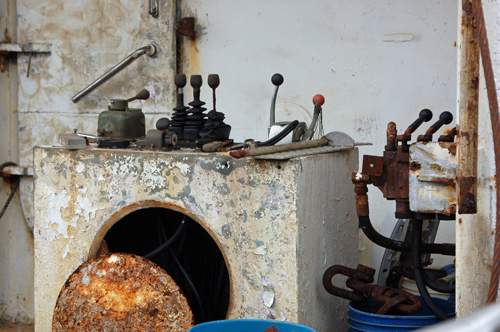
A few rusted fishing vessels are getting their winter maintenance.

4unicorn-across-the-water.jpg

5deck-debris.jpg
The sea has taken its toll.

6buoys.jpg
Buoys wait for the new season. Cheerful, aren't they.

7bird-perch-lobster-trap.jpg
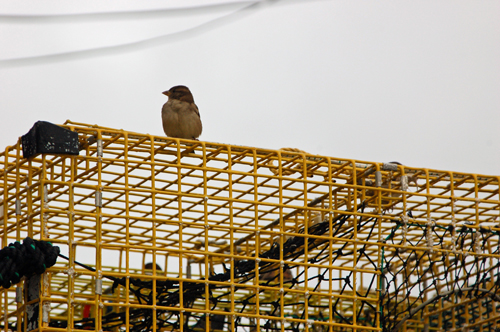
A lobster trap makes a nice perch.

8scale-weight.jpg
Come summer, perhaps there will again be fish to weigh.

Friday, November 27, 2009

A tortured Christmas carol


Actually, I think the outcome is in the hands of the administration and the Congress would follow strong leadership. But if the people don't repudiate torture, the executive is not going to offer that kind of leadership. This is not a set that stands up for principle unless pushed.

So, as we enter the Christmas season, do we care?

On this largest shopping day of the year ...

we enter the season of the Great American Consumption Holiday. Check out this instead. [2:28]

Then visit Trade As One, especially the shop.

Thursday, November 26, 2009

We're in the gap between seasons

bow-hunting.jpg

Happily, in consequence, I can venture on the wooded trails.

hunting-season.jpg

Thanks-giving


Not a good day for turkeys.

On this most familial of holidays, I decided to take a family poll. This holiday, we're five older white U.S. adults, ranging from a youthful 57 to nearly 80, well read, well informed, and inclined to liberalism. Sorry, no outliers here; we're a pretty heterogeneous bunch.

Here's the question:
Who is the living public figure you feel thankful for?

And the answers I got:
  • Nelson Mandela: the greatest statesman alive.
  • Barack Obama: not so much for what he has accomplished as for the symbolism of his election
  • Bill Moyers: his PBS Journal TV program has set the standard for a political blog -- informative, sometimes breaking news, thoughtful and still idiosyncratically personal
  • Paul Farmer: medical doctor and social irritant best known for his work bringing health care to the poor, especially in Haiti
  • Berto Nevin: "because I'm still here."
Who is the living public figure you are most thankful for?

Wednesday, November 25, 2009

A tale of two Presidents


When we look at what appears to be President Obama's deteriorating political situation -- the likelihood that the man who inspired such high hopes will ended up tagged as the guy who couldn't get too many of us back to work -- there's an impulse to compare Obama negatively with Franklin D. Roosevelt. Didn't Roosevelt come in as banks were shutting their doors? Didn't he immediately start a slew of programs including the Public Works Administration, Works Progress Administration and the Civilian Conservation Corps that put millions to work.?

Yes -- Roosevelt did initiate those programs. And they put millions to work very quickly. But it's hard for us to imagine how much freer to act Roosevelt was than Obama is today. By the time of his inauguration in March 1933, non-farm worker unemployment was something like 37 percent! Angry people who were losing everything were storming government buildings including the Nebraska statehouse and the Seattle city town hall. On the eve of Roosevelt's inauguration, the New York Herald-Tribune ran the headline: "FOR DICTATORSHIP IF NECESSARY." Newspaper columnist Walter Lippman, the David Broder-like grand old man of that time's journalism, suggested to the new President that he should take "dictatorial powers." But Roosevelt didn't want to go there and chose to continue to work through Constitutional institutions. (Good historical summary here.)

Economist Jamie Galbraith recently suggested that

Obama's objective situation is much more like Herbert Hoover's than it is like Roosevelt's.

That seems right. The financial arrangements that have dominated the U.S. economy since 1980 have shown themselves to be utterly unsustainable for all but privileged inside players. But the way out of the hole the bankers have dug for us is unclear. The status of the United States in the world is changing: in Roosevelt's day the country was the ascendant international power if it wanted the job (folks were still dubious about empire); now we're a declining imperium in an ever more multi-polar world. Declining powers tend to lose their flexibility. And this President, like Hoover, seems inclined to lean on "expert" policy wonks, not to listen to the anger building among ordinary people.

So far, the crash of 2008 was not enough to create a popular demand that shakes up the congealed organs of government. Even Obama's first and most important economic initiative, the stimulus, was pared down by carping Congresscritters in ways that were obviously counterproductive. Probably the most useful thing the feds could have done would have been to backstop state budgets hit hard by lower tax revenues -- state programs would have kept millions of teachers, park rangers and civil servants working. But no, that was too much government intervention for too many Congress people, including some Democrats. And even at his moment of greatest popularity, this President did not choose to fight the legislative gridlock.

It's not enough to say, Roosevelt would have jammed it through. Roosevelt could (and did) jam things through Congress because the Congress was scared of peasants with pitchforks at their doors.

It's hard to know whether more populists with pitchforks (and I don't mean deluded teabaggers who think they are fighting "socialism") would get Obama to fight for drastic economic remedies. Obama has proved he's good at doing what it takes to get elected. He has not proved he's a fighter for any popular agenda. But Hoover-like fancy technical fixes are meaningless to people who are hurting. And hurting people take it out on Presidents.

Tuesday, November 24, 2009

Mammograms, pap smears and our medical culture


Anyone following the news knows that panels of scientific experts have suggested that women without extraordinary risk factors don't need to begin universal breast and cervical cancer screening beginning as young or repeated as frequently as has been considered medical best-practice until recently.

Well actually, that's probably not how you've heard this news: you are much more likely to have heard that the government and/or mean doctors want to deny needed cancer care to vulnerable women. Or perhaps you've heard that women worried about breast and/or cervical cancer are irrational, anti-scientific hysterics who won't listen to well-researched reason.

We're having a mammogram/pap smear panic here, not enhancing the understanding of any of us.

I guess the heat on these subjects shouldn't be too surprising -- we're dealing with life and death questions. But it might help if we could contextualize our reactions a little.

For starters, in the lifetimes of quite a few of us, it was not at all assumed by most people that more doctoring could extend lives. I think about my own mother, born in 1908, died in 1999. She never had either a pap smear or a mammogram in her life. She didn't hold much with medicine: in her understanding, you tried to take care of yourself (mostly through folk health practices), you lived your allotted time, and you died. You might go to a doctor if you were sick, but mostly the doctor reinforced the good health practices you already knew and comforted you.

Obviously, this is not how contemporary medicine works. Doctors have, in many instances, learned to do more good than harm in the last century. But it is worth remembering that helpful, life enhancing, medical intervention is a novelty. And some of the sense my mother had that there are limits to what medicine can do could be a corrective to excessive demands for unlimited extension of healthy life. Medicine still has limits.

One of the cultural reasons that current medicine does better than it used to is that in the middle of the last century, assertive women began demanding that we be considered just as much its proper subjects as men. It is probably hard to imagine today, but not that long ago much medical and drug research neglected to bother with studying the effects of practices and procedures on "non-standard" people -- that is, on women. Changing that didn't just happen; women demanded our inclusion. Concurrently, a lot more women became doctors, so it is now harder for medicine to leave us out altogether.

Beginning in the 1980s, the eruption of HIV-AIDS into the consciousness of the developed world also has had a huge impact on popular understandings of medical best practices. Here was a brand new, lethal disease that seemed to strike a despised but not entirely helpless population. It was not at all clear that the scientific establishment, or government health authorities, would devote resources and brain power to understanding and treating it. Who cared if some fags were dying? So a very determined and quite sophisticated patient advocacy infrastructure was built -- in the early years, gay HIV advocates were frequently ahead of the health authorities in their understanding of the disease. They dredged drug treatments out of cautious doctors years before these would have emerged without their insistent demands. The HIV-AIDS experience in which informed patients and advocates kicked the medical establishment into better practice became to some extent the paradigm of how we deal with threatening diseases.

No wonder recommendations from dispassionate scientific experts about life and death threats evoke lots of heat: too many of us have had lived experience over the last fifty years that the doctors don't really "get it" until we make them.

For myself, I'm willing to believe what the expert panels are telling us. The value of conventional medical practices should be validated by repeated studies. If they couldn't be scrutinized, we might still be treated with leeches. I'm also willing to believe more is not always better.

I do have to wonder though, do expert panels have any idea of the social context into which they drop their findings? I've written this post simply out of my memories and experience, but I think it hits elements of our muddled consciousness about these issues that are legitimate parts of our response. Somehow I have a guess that our scientific experts are afflicted with social tunnel vision, oblivious to how their recommendations might be received by the women whose lives will be changed by them. That's a problem.

On the road today...

diablo-panorama
This was what I say yesterday while running on San Bruno Ridge on an extraordinarily clear day. San Francisco Bay and Mt. Diablo in the distance seldom look this lovely. Usually more sludge passing for air.

boston.jpg
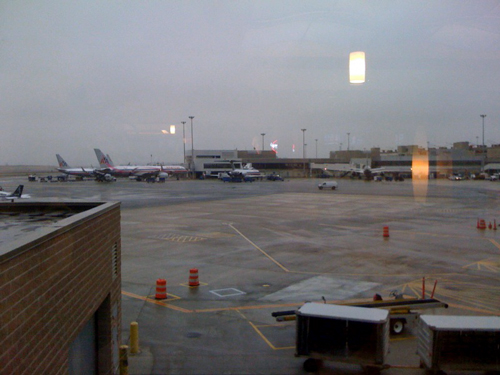
This is the view out the window at Logan Airport in Boston this morning. Those odd floating yellow sausages are the reflection of the lights in the Burger King.

Monday, November 23, 2009

Health care reform shorts:
Nate Silver has advice for Blanche Lincoln

This is about the politics, not the substance, of this thing that we may get that may (or may not) that do something to make health care more available and more affordable for more of us. Thanks Five Thirty Eight.


This graph shows what happens when a Senator takes a high profile role in the health care reform discussion. Montana's Dem Senator Jon Tester is no liberal and his state is more Republican than Democratic (barely). But he signed on to "reform" early on and shut up. His Dem colleague Max Baucus of the Senate Finance Committee fame tried to be the "hero" who brokered a "bipartisan" bill -- and he got hammered from right and left.

Senator Blanche Lincoln of Republican leaning Arkansas has the potential to cast the deciding vote on whether this thing passes. Silver says to her: look at the Montanans.

...the path of least resistance would seem to be committing to voting for cloture, so that the Democratic base, your colleagues in the Senate, and the national media don't go nuclear on you -- but against the underlying bill, which is unpopular in your state. Dithering, on the other hand, gives pretty much everyone the opportunity to be unhappy with you. And the polling evidence shows that if you give your voters an opportunity to be unhappy with you on health care reform, they probably will be.

Let's hope she prefers being re-elected to being the center of attention which is what holding out against the bill will get her.

Then there's the noxious Joe Lieberman whose sole discernible purpose in life is being the center of attention...

Decision time on Afghanistan:
the people need to get into the deliberations

The latest from the President is that an announcement of a plan for future U.S. involvement in Afghanistan will come after Thanksgiving.

Let's hope the President is listening to people like Matthew Hoh. Hoh recently quit a position as a senior civilian official for the U.S. State Department in Zabul province. He does not believe that the U.S. is accomplishing anything positive. In this clip [3:47], he reads from his resignation letter and explains why he opposes any further commitment to the U.S. war in Afghanistan.


Thanks to Rethink Afghanistan for this and many other informative videos.

Peace organizations including the coalition United for Peace and Justice, American Friends Service Committee, Peace Action and Code Pink are encouraging people to call the White House comment line at 202-456-1111 on Monday. Nov. 23 through Wednesday, Nov. 25 -- 9:00 a.m. - 5:00 p.m. eastern time.

War -- sending people to die -- is too important to leave to generals and politicians.

Saturday, November 21, 2009

Transgender Day of Remembrance: part II

SFPD blew it bad on this one. In comments on the previous TDoR post, Mike from the excellent blog Civic Center has alerted me that the San Francisco Police Department has apparently just learned they were sitting on evidence pointing to who may have killed Ruby Ordenana. The guy had had time to embark "on a string of savage attacks, mostly on transgender prostitutes, beginning with the slaying of Ordenana on March 16, 2007." According to Jaxon Van Derbeken writing in the San Francisco Chronicle today:

The San Francisco police evidence lab failed to process DNA samples from the 2007 slaying of a transgender prostitute for two years, leaving the suspect free allegedly to rape and brutalize at least three other transgender women before being arrested, The Chronicle has learned. ...

Assistant Police Chief Kevin Cashman was reluctant to discuss details of the Ordenana investigation, citing [Donzell] Francis' upcoming trial on the separate kidnapping and rape charges.

But he acknowledged that the case "could have been handled better" by the crime lab. "This should have been given a much higher priority," Cashman said.

This is not our police department's finest hour. As long as things like this can happen, it remains hard to convince open minds that transgendered persons are not "less equal" in the eyes of law enforcement.


While the Senate dithers on health care reform: some sharply directed anger


Josh Marshall has a quote up from an anonymous "Senate Democratic Chief of Staff" whining about progressives.

There is a lot of misplaced anger coming from many of our fellow progressives about Senate Democrats (which often is just shortened to "The Democrats") inability to pass a robust healthcare reform bill, climate change, etc.

...If progressives REALLY want to transform America, they'll make an issue of the anti-democratic rules of the Senate which make real change virtually impossible. Blasting their elected Democratic officials, the vast majority of whom will vote for the Senate bill (and would also support a more robust public option if we didn't need 60 votes to achieve cloture), may make folks feel good, but is both short-sighted and stupid.

You just don't get it. WE don't run for office promising to fix things. WE don't think we ought to be returned over and over to a cushy job whether we do anything or not. WE work and contribute money to put these people in office and WE expect them to do what needs to be done to get done the things done that they promise.

THEY (these office holders) are the ones who could change the rules if that is what it takes. THEY are the people in position to corral their more conservative colleagues to get things done. And we expect THEM to get the job done.

This is a representative democracy -- once THEY get to Washington, WE expect them to do the job WE put them in position to do, not to complain that it is hard. THEY knew what the job was, THEY knew it would be hard and THEY should get on with it and stop whining.

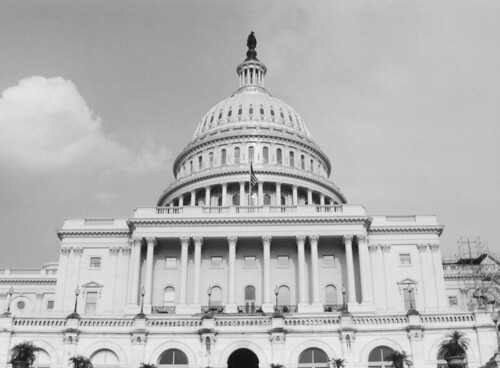
Photo of U.S. Capitol:

Friday, November 20, 2009

Transgender Day of Remembrance

International Transgender Day of Remembrance is observed on November 20 annually. Why do we need such a day? Because people whose aura and/or appearance makes someone else anxious about gender still get killed for being "too weird."

The Transgender Day of Remembrance was set aside to memorialize those who were killed due to anti-transgender hatred or prejudice. The event is held in November to honor Rita Hester, who [was] murder[ed] on November 28th, 1998 ... Rita Hester's murder -- like most anti-transgender murder cases — has yet to be solved.

Here at this blog, I'm always aware of these murders because, month after month, one of the pages getting the most visits is this photo-spread about the murder of transwoman Ruby Ordenana and the community that mourns her.

Other commitments have kept me from attending any of the local observances this year, but I'm less unhappy about that than I might be because I had the great privilege to attend a most inspiring event in the transgender community lst summer, a event that gave one small community a great sense of possible progress.


Photo from the camera of the Rev. Vicki Gray (at right) -- don't know who took it.

I'll let the Rev. Michelle Hansen (far left above) describe the magic of this event.

For the very first time, ever, TransEpiscopal held a Eucharist at General Convention [an enormous triennial Episcopal Church meeting]. Last night 19 Trans people, allies and friends gathered together in a small room at the Mariott Courtyard and celebrated the Lord's Supper together.

We had chairs in a circular pattern and a collapsible table. Gari went out and bought wine and a waiter at the Mariott gave us a loaf of bread. We borrowed a plate and a wine glass from the bar and we came together in the presence of the Lord and were filled with the Holy Spirit. We lifted up transitioning to the Lord in our words, in our hearts, and in our lives.

I was moved especially by the presence of the friends and allies who joined us and became part of us. We are not alone!

Being with each other is not always easy, but nobody should have to be alone.

Depressing headlines of the day


State jobless rate rises to 12.5 percent

California's unemployment rate increases in October from September's rate of 12.2%, giving the Golden State the fourth-highest rate in the country.

Poll: Voters Want to Repeal Stimulus

51 percent believe canceling the rest of the stimulus money would create more jobs, and only 32 percent ... want to keep spending it.

Okay, so we have a citizenry that is economically illiterate.

This one is pretty simple: if no one is spending, there will be NO jobs. If people can't spend, spending has to come from somewhere. Our government is the only place spending can come from, essentially because it can borrow money to spend if necessary. Lenders trust it won't collapse and will pay back. (If that trust goes -- and in some circumstances such as Germany in 1922 it does -- then you are really up shit creek.)

The 2009 stimulus should have been larger, not smaller. It should in particular have helped the states which can't borrow unlimited money without losing their credit ratings and paying too much for what they borrow. Cuts in state programs hurt employment and quality of life very directly.

Let's hope there are enough economically literate politicians who understand that throwing even more people out of work will not help, so this particularly bit of polling is ignored. But also, it is the responsibility of people who do understand that 2 + 2 makes 4 to explain: yes -- we do need our government to act in order to keep this creaky greed fest of an economy going.

Thursday, November 19, 2009

Health care reform shorts: A modest proposal


How about a ban on federal funding for sexual enhancement drugs -- Viagra, Cialis and the like -- if legislators are so hot to cut costs and legislate morality? Why should my tax dollars go to trying to repair the self-esteem of old guys who can't get it up? They won't die if they have to pay privately to maintain their jollies. Force the insurance companies remove coverage for these non-essential medications!

More women will die if the structure of "reform" makes abortion even more inaccessible, if it causes abortion coverage to be removed for all insurance. And that's what the House passed Stupak amendment will do according to the George Washington University School of Public Health and Health Services. Opponents of abortion have long made clear that they don't care if a young woman's misfortune works as a death sentence.

The Hill reports that anti-abortion Senators are pleased with the Senate version of the abortion exclusion provision.

Perhaps my proposal would help build support for reform, at least among the majority of the citizens, if not among the sclerotic bunch that populate Congress.
***
Much more later as more informed people than I wade through analyzing the new Senate bill. We all have to count on them.

Early returns: looks like cost control has so trumped providing affordable access that most people will discover that they receive little more ability to get medical care than they ever had. And many immigrants will have less -- what's this barring them from spending their own money to buy insurance? I thought we liked private spending ... Let's mobilize the insurance company lobbyists to fight that one ...

Democrats seem to have come unhooked from reality. As Democratic consultant Mike Lux spelled out yesterday, if they continue on this track, failing to deliver to their constituents while mesmerized by the big money interests, they can kiss their asses goodbye in the next few elections.

If Democrats follow the safe conventional wisdom formula in the 2010 elections, they will get their butts handed to them. Voters are not happy with incumbents, base Democratic voters feel like no one is fighting for them, independents feel like nobody cares what they think.
And they'll deserve to take the hit, but we won't.

Wednesday, November 18, 2009

Torture pictures and the cover up

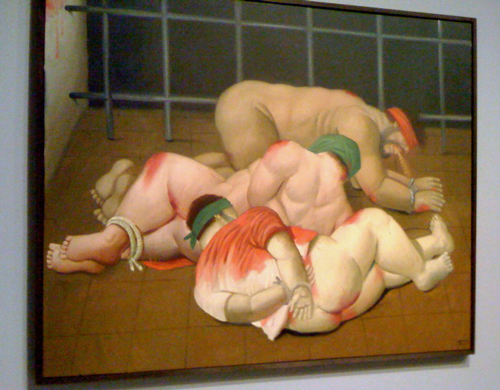
3-bloody-men-vomit.jpg
Even the New York Times has said it: by adopting the Bush regime's arguments for curtailing legal processes and transparency about government actions in the name of "security," we're now well into the era of "President Barack Obama’s cover-up." It's not that we don't know that the rule of law has been bent beyond breaking through process-devoid renditions and torture, through dragnet National Security Agency surveillance of the planet, and through targeted killings of a list of "enemies." The cover up means that our government is actively working to obscure the truth about its law-breaking in order to protect past perpetrators and retain the freedom to practice new abuses at its discretion. Some moves away from this lawlessness have been made, including the decision to prosecute for their crimes some of the Guantanamo prisoners. But overall, Obama's administration seems more attached to protecting those who occupied their seats before them than in restoring the rule of law.

Adam Server reported another aspect of the cover-up at TAPPED.

On Friday, Secretary of Defense Bob Gates used his newly granted authority to exempt photos of detainee abuse from Freedom of Information Act requests to block the release of several photographs that are the subject of a Freedom of Information Act lawsuit from the ACLU. The White House-supported amendment granting the secretary of defense this authority was added to the Homeland Security Appropriations bill by Sen. Joe Lieberman.

They don't want us to see what was done (is being done?) -- we might be revolted and revolt?

Hiding the visual evidence is not a new practice for U.S. governments. When the U.S. dropped the first nuclear bombs on Japan, General Douglas MacArthur made it one of his priorities to prevent publication of photos that documented the results. Last summer, Hugh Gusterson of George Mason University wrote about the consequences in the Bulletin of the Atomic Scientists:

General MacArthur was surely correct that the publication of pictures from Hiroshima would have incited criticism of the United States and nuclear weapons. ... The resulting naïveté about the physical effects of nuclear weapons deformed public debates about nuclear weapons policy in the years after World War II just as our ignorance today about the full range of detainee abuse in Iraq is inhibiting a fully candid and informed debate about that war.

If past is prologue, we will, one day, see the pictures Obama has kept from us, just as we eventually came to see the grainy black-and-white images of unspeakable suffering from Hiroshima and Nagasaki. He can delay--but he cannot prevent--the materialization of this visual truth.

I believe Gusterson is right about this.

man-with-gloved-hand-on-him.jpg
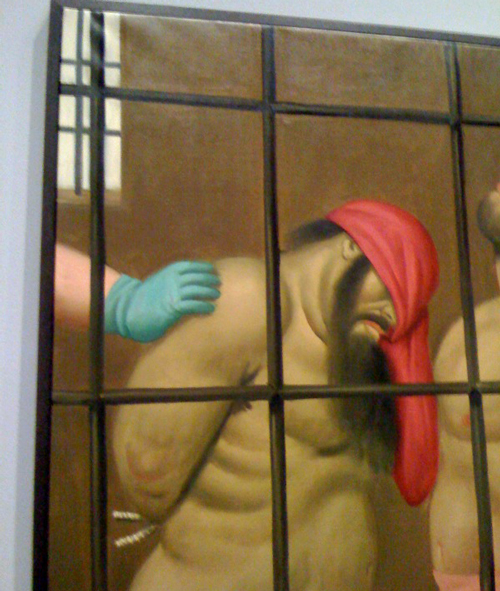
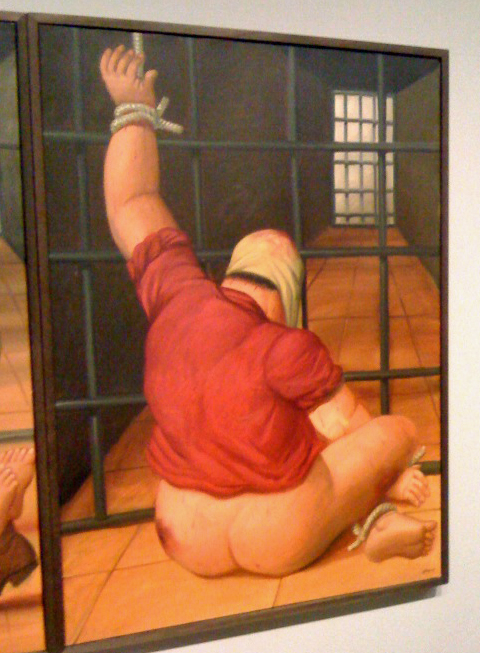
Meanwhile, our images of prisoner abuse are shaped by the few pictures that have emerged, mediated through the imaginative response we inevitably make to these phantasms of horror. In that connection, Fernando Botero's paintings, the fifty-six images of The Abu Ghraib Series on display at the UC Berkeley Art Museum until February 7 are probably the best known.

The Columbian artist read Seymour Hersh's reporting on Abu Ghraib and just started drawing. Quite obviously, his vision arises not only from the Iraq experience, but also from the Latin American awareness of the many torturers sent forth to abuse for so many years from the U.S. School of the Americas.

In 2007 Botero gave an interview about why we visualize to San Francisco Chronicle art critic Kenneth Baker:

"Art is important in time," he said. "It brings some kind of reflection to the matter. We have analyzed this thing from editorial pages and books, but somehow this vision by an artist completes what happened. He can make visible what's invisible, what cannot be photographed. In a photo, you just do a click, but in art you have to put in so much energy. This concentration of energy and attention says something that other media cannot say."

Call it faith in painting. Most painters I know voice it in some terms. But once a painter ventures into territory as painful as making torture a pictorial theme, how does he know when to stop?

"One day, I didn't have anything more to say," Botero said. "You feel kind of empty and kind of quiet. You've taken out all your anger and your frustration."

What remains is the conviction of having done a right and necessary thing.

"Art is important," Botero said, "because when people start to forget, art reminds them what happened. Like 'Guernica.' People would not remember the tragedy of Guernica today if it were not for that painting."

The lousy cell phone photos interspersed here give some sense of the exhibit. But if you have a chance, go see for yourself wherever the Abu Ghraib series turns up next.
solitary-hanging-man.jpg

Tuesday, November 17, 2009

Contradictions: Iran, the United States and world citizenship

Roya Hakakian's Journey from the Land of No: A Girlhood Caught in Revolutionary Iran includes one of the most poignant descriptions of the joy that attends a popular triumph overthrowing misrule that I've ever read.

On February 14, two days after the victory of the revolution, began the romance that lasted a year. Nineteen seventy-nine was a year of love, though not the kind of love I had ever known: not the love between a man and a woman, a sister and a brother, a child and a parent; not a love of art, work, or religion. It was the mother of all loves, so vast, so deep, that in it every other love could grow.

And then the dictates of the Iranian mullahs clamped down on that flowering of joy and delight -- and Hakakian and her Jewish Persian family ended up unwilling emigrants to the Great Satan, to the United States. For many years, she didn't talk about her early life, until coaxed to speak when hints of "moderation" periodically peeked out from the Iranian present. A radio talk (with Terry Gross on NPR, naturally) last summer alerted me to this fascinating memoir.

I think I risk being one of Hakakian's "misguided Americans." She explains she seldom spoke of her life because...

[b]right individuals abandoned inquiry and resorted to obsolete formulas: America had done Iran wrong. Therefore the clerics were leading the nation to sovereignty. These individuals had yet to realize that though Iran's rulers fervently opposed U.S. imperialism, they were neither just to or loved by their own people. This ... group had not accepted the notion that the enemy of their enemy was yet another enemy.

I don't want to be one of those, though perhaps I am. More than many in the United States, I was aware of the horrors of the Shah's pre-1979 regime: families like Hakakian's sent their sons to northern California for college -- and to get them out of the political cross hairs. I remember spending Thanksgiving evening in 1967 in Berkeley with three young (as they called themselves) Persian Jewish guys who were both literally and metaphorically intoxicated on this holiday in a strange land they found marvelously free. I was vaguely aware that the U.S. CIA had short-circuited Iranian progress toward democratic self-government in the 1950s and imposed the Shah.

As a proper liberal young insurgent of the 1960s, I had no doubt that U.S. meddling in Iran had been an evil thing.

And so, in 1979 and thereafter, I did give the mullahs some benefit of the doubt. But mostly, I gave them the pass that I think U.S. progressives pretty much have to give to most states in most of the world. It's an awful truth that United States intervention can't help. Indigenous governments may treat their own people terribly -- but the easiest way to cement their legitimacy is for the superpower of the day to challenge their behavior. Hard as it is for us to to see here, this empire's government -- with its invasions and occupations and renditions and torture chambers -- has no moral standing to critique the human rights violations of others.

Individual citizens of this country can take a harder line -- and agitate -- via international organizations. But our first responsibility is to rein in our own government. The very considerable freedoms we enjoy create an ethical imperative to use them. At this time, our responsibility is to get the U.S. out of Iraq and Afghanistan. We also need to continue to discourage our government from making aggressive moves against Iran.

Monday, November 16, 2009

Obama in China


Election propaganda seen in San Francisco, 2008. It's interesting to see Obama as represented by (presumably) a Chinese fan.

On Saturday, I spent a long time mulling over with friends what we could do to encourage popular resistance a U.S. commitment to an unending Afghanistan quagmire. And later, I gulped down yet more analysis of the implications of health care reform. But really, that stuff is not the most important challenge facing our still new U.S. regime. U.S. relations with and posture toward China very likely will do far more to determine the quality of life for folks in the future.

James Fallows explains what matters as the Prez of the 20th century's top empire visits the ancient and modern empire:

Thirty years from now, the most important aspect of Barack Obama's interaction with China will be whether the two countries, together, can do anything about environmental and climate issues. If they can, in 2039 we'll look back on this as something like the Silent Spring/Clean Air Act moment in American history, which began a change toward broad environmental improvement. If they can't....

Because making the planet -- "our island home" -- far less habitable is something our clever species has not achieved before, it is hard to keep focused on the need to try to mitigate human-induced climate change. But this is certainly what our successors will blame or praise us for.

We may not be very aware of this, but China is working to reduce carbon emissions despite its need to bring vast amounts of energy on line as fast as possible to grow the economy for its billion people. The New York Times reported in May:

China’s frenetic construction of coal-fired power plants has raised worries around the world about the effect on climate change. China now uses more coal than the United States, Europe and Japan combined, making it the world’s largest emitter of gases that are warming the planet.

But largely missing in the hand-wringing is this: China has emerged in the past two years as the world’s leading builder of more efficient, less polluting coal power plants, mastering the technology and driving down the cost.

While the United States is still debating whether to build a more efficient kind of coal-fired power plant that uses extremely hot steam, China has begun building such plants at a rate of one a month.

An expanding economy presents opportunities that we, in our congealed casino, can no longer easily imagine. Rapid movement on anything seems awfully difficult for the United States these day. Signs of an aging empire ... that was quick.

Sunday, November 15, 2009

Health care reform shorts:
The Massachusetts plan corrals the "left"


Health policy writers seem to be filling the lull between passage of a House bill and Senate Majority Leader Harry Reid bringing forward some as-yet-not-fully-defined legislation by writing about the Massachusetts experiment that has been underway since 2006. That state has greatly increasing nominal insurance coverage, reaching almost all residents, though a Kaiser Family Foundation assessment from September 2009 reports that 21 percent of insured people still don't feel they can afford medical care. And the wonks applaud it even though Massachusetts has not succeeded in lowering costs, either in the form of insurance premiums paid by individuals or to the state.

But Ezra Klein at the Washington Post and Jonathan Cohn at the New Republic are fans of the Massachusetts effort -- and they highlight one very similar observation. Klein, interviewing Jon Gruber, a health economist at MIT, elicited this quote:

We passed our bill. The lobbying group Health Care for All was incredibly important in that. But they were primarily about coverage. But then they realized that they would lose all this coverage they'd gained if it didn't control costs. So they got behind real cost-control measures. ...

Cohn makes the same point in his own voice.

If costs continue to skyrocket, the state's health care reforms will become unsustainable, requiring either large cuts or tax increases. Then again, until recently, Massachusetts hadn't seriously tried to reduce costs. The goal was simply to expand coverage and, perhaps, deal with costs later--which seems to be what's happening now. ... [T]he new system, by giving the state a greater stake in health care costs, has focused public attention on the problem and provided the government with more leverage to solve it. The left also seems more invested in the cost issue now, if only because it recognizes that controlling costs is necessary to sustain the recent coverage expansions.

I read both of these men to mean, more or less, that the good thing about passing some sort of health care reform structure is that it will shut up those annoying idealists who think health care is a human right and simply a proper benefit of living in a wealthy, civilized society. A coverage reform would get these bleeding hearts on to the serious business of controlling costs -- without the baggage of their fantastic egalitarian policy prescriptions.

I find this galling as policy prescriptions for controlling costs doesn't look so hard to imagine when a right to health care is assumed: simply make the government the payer for all health care and pay what the society decides democratically to allocate to health. We'd probably be willing to go for 15 percent of the government's tax income and that's a lot. Some variant of this is what every other developed country does, one way or another. There are still doctors and hospitals in those countries -- they just don't make mega-bucks.

For a more skeptical consideration of the Massachusetts plan, Cohn pointed to an extensive series in the Columbia Journalism Review by Trudy Lieberman. That reporter had this to say about what the state plan implies about cost control:

It's no secret that Massachusetts' lack of cost controls, deliberately avoided when reform passed, threatens to undo the law. Ultimately, if the state has no way of paying for subsidies to cover insurance premiums, the law is doomed. Same goes for national reform. ... People I interviewed mentioned the lack of a dedicated funding source, similar to that which exists for Social Security and Medicare, that would pay for the subsidies. Without such a source, financing is always at the whims of politics and competes with other state priorities. ...[W]e urge reporters to stay on top of this one, because it will mean the difference between life and death for any health plan politicians try to sell to the American people.

She doesn't want to rein in the idealists -- she just looks for the shortest distant between two points. If the government needs money, tax someone who can pay to raise it. Taxes are the price we pay for living in a civilized society. A society that refuses to pay for its own welfare is well on the way to death. (I know, I live in California which works that way.) This posture strikes me as realistic, while elaborate schemes to cajole profit-seeking entities to moderate their profits seem the flights of fantasy in the health care discussion.

UPDATE: Jonathan Cohn has written me to protest that he has

been making the case for universal health insurance, purely on moral grounds, for more than a decade. And i've always supported single-payer, although I also support lesser measures that, in my view, still do a lot of good.

It so happens I also think we need to get a grip on rising costs, simply because the system is becoming financially unsustainable. And, as a practical political matter, I do think that taking care of coverage makes it easier to interest liberals (a label I've always embraced) in the cost issue.

But, for me, health care reform has always been -- first and foremost -- about making sure all people can get the medical care they need at a price they can afford. Guess you could say I have a bleeding heart too.

I think I owe him an apology or at least an explanation. I write about health care reform out of an ongoing fear that the realities of people's experiences will get lost in the fog of policy and political claims and counter claims. Responsible citizenship, in my view, requires repeatedly getting back to what it like to live in this mess and also reiterating ethical imperatives. I often fear that "understanding health care reform" almost requires forgetting what we know experientially. I've worked hard enough on understanding reform that sometimes I fear I am doing that myself.

Cohn presented the horrible present realities in his 2007 book, Sick.