Monday, July 24, 2023

When the home place dwindles

Monica Potts. a senior politics reporter for the data journalism website FiveThirtyEight, grew up Clinton, Arkansas, a tiny town in the Ozark Mountains which has no economic reason for continuing to exist. She had a mother whose primary aim for her children was for them to escape out of this dead-end place. Potts did escape. She attended Bryn Mawr College near Philadelphia on scholarships and became employable and acculturated to the contemporary American world. Neither her talented sister Ashley, nor her dearest childhood friend Daria made it out. The former was killed in a teenage auto accident; the latter became addicted, lost her children, was often jailed, and endured without hope.

The Forgotten Girls: A Memoir of Friendship and Lost Promise in Rural America tells the stories of these women of Clinton, movingly and painfully. The women are not caricatures, but readily imaginable, appealing individuals who had very little chance in life. 

Because Potts really is a data journalist, her accounts of life incidents -- church services, high school team sports, parties with boys who drank, jobs found and lost -- are interspersed with demographic data.

When she gets to explaining the central feature of these young women's lives, that their expected destiny was to bear children early and often, you get both the vignettes and the sociological facts:

My friends began to wear "promise rings" in middle school, public signs of their pledge to remain virgins until they were married. Because some of them already had serious boyfriends, they dedicated these "promise rings" to their boyfriends, sort of as pre-engagement rings. In other words, we were thinking about marriage at thirteen and fourteen -- before we were thinking about high school. ...
An explanatory ethnographic paragraph follows in a footnote:
In 2019, the most recent year available at the time I was writing this book, CDC numbers showed Arkansas had the highest number of teen moms per capita ... In general, the rates of teen pregnancy are highest for Black and Latina girls, but because there are more white girls in the population, the numbers of young mothers in each group are nearly the same.
For me, this mildly pedantic approach worked well. Potts is a worthy narrator for these women's lives; they are her people. These lives could have been her own if not for some lucky accidents. If you care about women's realities, this is a book to cry over.

• • •

I had an additional, more personal reaction to this book. I, too, grew up in a place losing its economic reason for being. In my earliest days, Buffalo, New York, was shaped by echoes of its honorable role in the World War II era, a center of industrial production, automotive and aerospace, and chemical factories. But all that was aging out, decaying, dying. And what would be left?

A child doesn't understand when purpose is draining out of her home place. But, especially for an unconventional young person (lesbian in my case), there's a nagging feeling -- a feeling that suggests that the assumptions which the adults hold about the place have become inaccurate. Maybe even dangerous. And that probably it is better to look for more promising places.

Potts' description of how loss of economic purpose in her Arkansas home place changed how people related seems so familiar to a Buffalonian of the 1950s and 60s. Here's how she observed it:

... The young people I spoke to in high school took it for granted that they would have to move away to find jobs, whether they wanted to or not. And when high school graduates move away, rural hometowns experience continued population loss. ...
... People who returned to Clinton with degrees often filled the same roles their parents had: they were dentists, doctors, lawyers, business owners, and teachers. They went to the same churches they's grown up in and lived much as they had growing up. A few of them returned with the idea that they would improve people's lives here, but most came back because they liked Clinton and because their families had been successful here and still lived here. Few thought anything in town needed to change, so nothing much ever did. They thought of themselves as town leaders, and they were well off enough to weather any storms Clinton suffered. But this small group of town elite were the exceptions: most the people who stayed in town were the worst off, with the least prospects.
When the majority of high school graduates don't start their adult lives in their rural birthplace, they don't buy homes there, get married, have children, and enroll them in their alma maters. They don't start jobs and businesses, volunteer, or bring back the expertise they've acquired elsewhere. The result is a smaller property tax base, fewer kids in schools, fewer jobs, and other signs of decline. Fewer people come in with new ideas and new money and earning power -- the dynamism that drives city life. These towns are less likely to have robust civic institutions or services to help people. All these factors affect health, well-being, and life expectancy. ...
... Clinton, like many small towns in rural America, was the kind of town you could get stuck in.
Yes! That's how it was for a long season in the Rust Belt too. 

This kind of decline isn't limited to rural areas. What were once the thriving cities of the Midwest have also undergone this loss of dynamism. Some, like Pittsburgh, have found new purpose; in that instance, a healthcare empire. Others, like Cleveland and Buffalo, not so much so.

No wonder we live amid the politics of grievance. The need for broader dispersion of prosperity and consequent purpose isn't just about Potts' sad Arkansas. For too many places and people, hope is still in short supply. Especially for the women.

Sunday, July 23, 2023

The jealousy of powerful men

Economic wisdom from the streets. Not Prof. DeLong's dish.
J. Bradford DeLong is a powerful man himself, a full professor of economics at UC Berkeley and once a Deputy Assistant Secretary of the U.S. Department of the Treasury in the Clinton Administration. But he struggles to understand the thin skins of other powerful economists when it comes to admitting the contributions of women to the discipline.

In mid- and late-20th century America, the mathematical turn of economics made it much less friendly to women coming in. And then, I think, the thing snowballed—in large part due to the aggressive seminar culture spreading from Chicago, focused on testing ideas in a blast furnace and also establishing an intellectual pecking-order rather than building a harmonious community. But why it then takes the form of aggressive misogyny I do not know ...
[He quotes] Rakesh Bhandari: ‘I don't understand what is it about economics as it is, neoclassical and mainstream macro, that would attract such aggressive misogynists to it. I can't imagine such discussions in sociology or anthropology. Perhaps philosophy and political science?…
On the—admittedly few—occasions when I have talked frankly to people who strike me as in the same sociological space as the toxic posters ... what comes off is absolute rage at affirmative action.

The argument that our ticket-punching indicators of “quality” are very noisy, that women face huge headwinds in our profession, and thus that given those headwinds a woman who is at the 95th [percentile] of “ticket punching” “excellence” is almost surely a better asset to the university than a man who is at the 98th [percentile] —they are neurologically incapable of allowing that or other arguments that we do not want an intellectual monoculture enter their brains.

Hence they are all 100% certain that women as a group are stealing their rightful jobs and keeping them from having the careers they deserve. And every individual woman thus becomes someone to be dissed because she is a participant in this great female conspiracy to do them down.

Or such is my guess.

I read this forming an image of the women so dissed as white. Think what these great men make of Black men and even Black women in economics.

It's enough to make one wish for the Great Replacement. We might learn something about how to make the process of making and organizing all the fruits of land and human ingenuity serve all the planet's beings with a different cast of students of economy. Or perhaps not. This will be a worthwhile experiment.

Saturday, July 22, 2023

Generational sea change, part 2

Looking at polling about the attitudes of young citizens is to realize we're sailing into a different world. And there is reason to hope that world is a better, more benign, democratic (small "d") place. Really.

Item: John Della Volpe studies young Americans. 

For more than two decades, I’ve been embedded in the land of young Americans. First millennials, and now Gen Z with an eye on Gen Alpha. From my perch since 2000 as polling director at Harvard Kennedy School’s Institute of Politics, at SocialSphere, and as the dad of a few Zoomers and one Zillennial — I spend most of my time talking with, surveying, and thinking about young Americans.

He sees a pattern I find fascinating:

Gen Z is in the midst of the best job market in their lifetime — and also most of the lifetimes of their parents and grandparents. The youth (16-24) unemployment rate is 7.5% — the lowest at any point since the Eisenhower administration. Among Gen Zers between 20 and 24 years old, the unemployment rate is 6%; it is only 5.3% among young women.

Click to enlarge

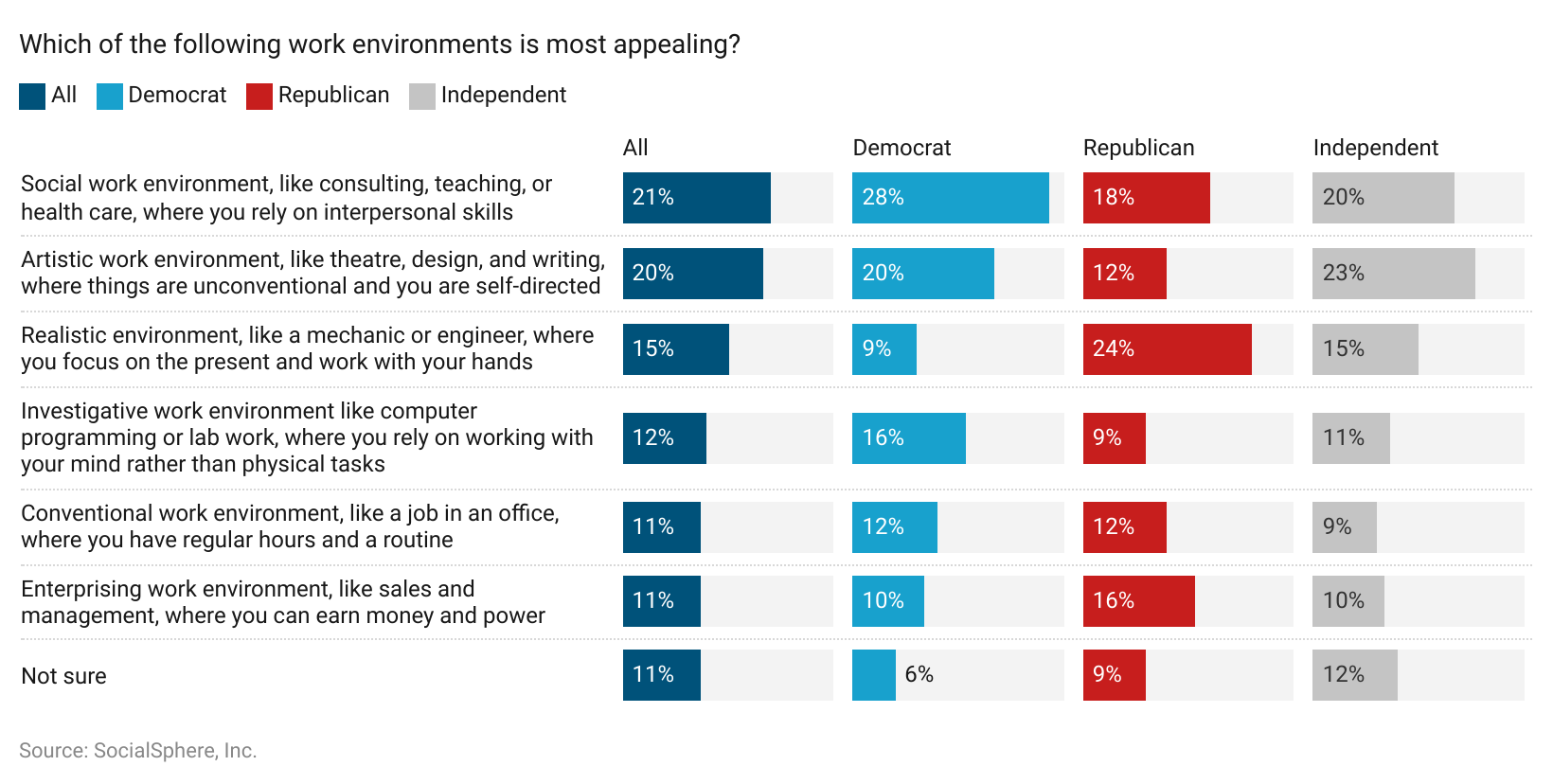
Gen Z seeks unconventional, self-directed work environments
Currently, over half of Zoomers between 15 and 25 are working part-time or full-time jobs (52%) – with nearly a quarter (23%) working more than one job. Living up to their own standards, nearly two-thirds (62%) have found roles that leave them fulfilled.
Very few Zoomers that we interacted with over the last year showed an interest in the jobs that their parents once or currently hold. Gen Z is witnessing the regrets of their parents playing out in near real-time, sacrificing family time and personal fulfillment for a work culture where the rewards are reaped by only a few.
Only about one-in-ten Zoomers aspire to a “conventional work environment,” we found that far more find conditions with “social” (21%) or “self-directed” and “unconventional” (20%) elements appealing.

I read this and I am reminded of my own early Boomer cohort which came of age in the late 1960s. We had NO interest in joining the conformist work culture of many of our parents who had happily traded the struggles of the Depression and WWII for calm and consumption. We aspired to make something better, more meaningful -- and in the context of general prosperity, we did change the country -- and did make life somewhat freer for communities of color, women and queers. Sure we had many failings, but the culture never reverted and the MAGAs are still pissed off about it.

Wonder what the Zoomers will do?

Item: This is less general, but something very interesting is happening in California voter registrations.  Demographic change -- becoming a "majority/minority" state where no ethnicity amounts to over 50 percent -- facilitated the state turning heavily Democratic (capital "D") around 2000. 

This shift did not include newly engaged voters enthusiastically signing up as Dems. In fact, the fraction that chose "independent" has grown ever since. The traditional political party divisions did not appeal.

But, unexpectedly to me, the increase in independent registrations seems to have peaked or even declined among young people, according to the LA Times.

Voter registration data in many states also has shown an increase in independents, although there’s intriguing data from California suggesting that trend may have started to turn around.
After decades of steady increase, the share of Californians registering as nonpartisan peaked in 2018 at 28%. It has dropped since by 5 points, with the biggest declines coming among young voters. Among voters younger than 35, the share registered as nonpartisan is the lowest it’s been since 2006, according to analysis by Eric McGhee of the Public Policy Institute of California. 
... Party polarization has been strong for years, but since the Trump era, “it’s entered into a whole other gear,” [McGhee] said. “I wonder if that hasn’t changed how people think about the parties” and made the option of sitting outside the party system feel less attractive.

I'm not such an unfaltering Democrat that I'm jumping for joy about this -- but I've long accepted that, if you want to play, you have to get in the game. New registrants, mostly young, seem to be coming to play.

Friday, July 21, 2023

Friday cat blogging

A moment of calm -- unfortunately, too often what comes next is that Janeway bites that alluring yarn. She is very much with us.

Thursday, July 20, 2023

Generational sea change

This old queer feminist never thought I'd see this.

White House national security spokesman John Kirby on Monday passionately defended the Pentagon’s policy of paid leave and travel reimbursement for abortions, calling it the right thing to do for Americans who volunteer to serve in the U.S. military. 

... “It can have an extremely, extremely significant impact on our recruiting and our retention,” he added. “It’s just the right darn thing to do for people who raise their hand and agree to serve in the military.”

... “When you sign up and you make that contract, you have every right to expect that the organization — in this case, the military — is going to take care of you and they’re going to take care of your family. And make sure that you can serve with dignity and respect no matter who you are or who you love or how you worship or don’t,” he said.

“Our policies, whether they’re diversity, inclusion, and equity or whether they’re about transgender individuals who qualify physically and mentally to serve to be able to do it with dignity,” he added. “Or whether it’s about female service members, one in five, or female family members being able to count on the kinds of health care and reproductive care specifically that they need to serve.”

If you are going to have an all-volunteer army, you have to pay attention to the attitudes of the generation you are trying to recruit. The US military knows this. Most likely life in the military isn't as welcoming of the culture of young people as Mr. Kirby might insist, but reality forces change and improvements.

Pollster Celinda Lake and filmmaker Mac Heller (gift article) explain a great deal about how Gen Z coming of age will change us all. 

Gen Z voters say their motivation is not a party or candidate. It is, instead, strong passion on one or more issues — a much more policy-driven approach than the more partisan voting behavior of their elders. ...

For Republicans, the message is obvious: Listen to the voices of this soon-to-be-dominant group of voters as you formulate your policies on climate, abortion, guns, health care, inclusion and everything else. Unlike some older voters, they are listening to what you say — and to how you say it. Change your language and style from the unmitigated male id of “Never Back Down” and “Where Woke Goes to Die” to words of community, stewardship, sharing and collaboration. That’s the new patriotism, and young voters believe that approach will solve problems more effectively than what they’ve seen over the past two decades. ...

There are stark messages for Democrats too. Meet young voters where they are: on social media, not cable news. Make your messages short, funny and somehow sarcastic yet authentic and earnest at the same time. Your focus should be issues first, issues second, candidates third and party identity never.

This is the United States that is ... and the country we are becoming. Kind of scary the military understands this before so many politicians, but I am thankful for any clear sightedness this embattled nation can muster.

Wednesday, July 19, 2023

A summer election to watch

When people have a chance to vote on abortion rights, abortion rights win. We've seen that in Kansas. We've seen that in Wisconsin when voters statewide had the chance to elect a state Supreme Court justice who supported the right to inclusive reproductive health care.

So politicians in Ohio who want to ban abortion thought up a simple remedy for voter unrest which might lead to protecting abortion access: raise the number of voters required for a state constitutional initiative from 50 percent +1 to 60 percent. And schedule the vote on their change in the rules for an obscure Tuesday in August when no one is paying attention.

According to the Bowling Green Independent News, lifelong Republican, former Wood County prosecuting attorney, Ohio senator, state auditor and state attorney general Betty Montgomery is having none of it.

Issue 1, which if passed by 50% plus one vote, would require 60% support to pass any future citizen-initiated amendment to the state constitution. That is wrong on many levels, Montgomery said during a weekend phone interview. 

“There is so much about Issue 1 that is anti-democratic,” she said.

Her concerns about Issue 1 include the basics of who, what, where, when, why, and who’s paying? Specifically:

  • The traditionally low voter turnout in August that will be deciding the future of Ohio citizen initiatives.
  • The new petition signature requirements that go far beyond any other state’s requirements and open the process up to corruption.
  • The hypocrisy of using special interest money to fund an issue that is being presented as a way of stopping special interests in Ohio.
  • The reasonable safeguards already in place for citizen proposed amendments.
  • The obvious “nefarious” legislative motives behind the issue to promote anti-abortion law in Ohio and continue refusal to comply with redistricting laws.

In general, voters like the initiative process -- often more than political junkies or legislators and even if they grumble -- and will reaffirm it when it is challenged. But right now the democratic rights of people in Ohio are threatened. 

The campaign to Vote NO in August needs any help anyone can give, even from out-of-state friends concerned about democracy. Early voting has already begun. As so often these days, our democracy is on the line, but we can and must fight back.

This is delicious


No further comment.

Tuesday, July 18, 2023

When it comes to policing, there are multiple stories

Radley Balko is an extremely unsentimental observer of US policing. His 2013 The Rise of the Warrior Cop is an essential history of the evolution of violent policing, even if, I believe, properly subject to criticism for not integrating an understanding of historic white supremacy into his narrative.

Though still libertarian in his instincts, he's no longer on that page -- thanks BLM. We live and learn, all of us.

This guy sticks with the beat. On his newsletter, he has recently published a complicated assessment of positive developments in policing since George Floyd's videoed murder. Some excerpts:

... Three years later, it seems safe to say that the 2020 demonstrations brought real, substantive change. Not enough, but more than in any of my 20 years on this beat. If you had told me in 2018 that within five years, dozens of cities and a few states would impose restrictions or outright bans on no-knock raids, I’d have rolled my eyes at you. We’ve also seen a wave of bans on chokeholds, and state restrictions on civil asset forfeiture (though many of those pre-date 2020). A few states have even stripped police of the qualified immunity that shields police officers from federal lawsuits when they’re sued in state court. 
We’ve seen reformist police executives take over many big city police agencies, where they’ve implemented policies like mandatory deescalation, prohibitions on shooting into moving cars, and barring high-speed chases for minor offenses. We’ve even seen some jurisdictions attempt to limit the role of police in traffic enforcement.
Many of these reforms were only possible because of the protests that followed the killing of George Floyd and Breonna Taylor. For all the criticism of “defund” and police abolitionists, the protests dramatically shifted public opinion in a way we haven’t seen since the civil rights era. There’d been some movement in polling after Ferguson, the death of Eric Garner, and other high-profile incidents of police violence, but within months public opinion tended to regress back to the mean.
That hasn’t been the case since the George Floyd protests. ...
It’s hard to overstate the significance of this shift. Prior to Ferguson, public support for all but the most cosmetic police reforms was pretty much nonexistent. Even after Ferguson, it remained pretty low. The 2020 protests not only spurred a massive swing in public opinion, support for reform has remained high even as crime has gone up, and even as one of the two major political parties has gone out of its way to demagogue police reform as a major contributor to violence and disorder. It’s notable that in that YouGov poll, a plurality of Republicans still favor every reform polled but two — banning no-knock raids and prohibiting military gear.
The country clearly wants change. The main barrier right now is politicians.
So why aren't we seeing more reform, more public safety, less occupying army in the 'hood? Balko thinks he knows:
The problem is that though a healthy majority of the country thinks policing is in need of change, there’s a loud, well-funded, and politically powerful constituency that feels otherwise — groups like the U.S. Chamber of Commerce, older voters, and police and prison guard unions. (I suppose we can also now add “middle aged tech bros” to the mix.)
Successful reform means overcoming political inertia, and to do that you need to convince politicians of one of two things:
1) The support they’ll get from backing reform is greater than what the support they’ll lose for abandoning the status quo.
2) Reformers are capable of imposing a political cost for failing to support their policies.

For the moment, the political force for change is not there. But we know there will be more atrocities ...

• • •

Unhappily, San Francisco is not one of the places leading the way on police reform. In 2016, the Justice Department blasted our local cops for a catalogue of racist use-for-force practices culminating in five police killings of unarmed residents in a two year period. But this was unenforceable, not a binding consent decree. The incoming Trump DOJ dumped the process. Chief Scott assures our toothless Police Commission that reforms are underway, but without external enforcement and with a rabidly anti-reform police union, that's doubtful.

Mayor London Breed flanked by a smiling Chief Scott
Meanwhile, with a captive Mayor and District Attorney, the SFPD seems unwilling to simply do the job. 

San Francisco Chronicle columnist Heather Knight has concluded we have "a police department asleep at the wheel." She interviewed an immigrant-led business that is giving up in the Tenderloin, the city's urban core.

Damian Morffet and Ron Haysbert, who work security at La Cocina, put the blame for its failure squarely on a shrugging City Hall and an inconsistent, lackluster police department. They said when they were growing up, drug dealers and people using drugs felt uncomfortable in public — but now they’re given free rein over public sidewalks while families, kids and people just trying to get lunch are made to feel uncomfortable.
“If the police were consistent with their patrols and efforts, people would come out here at night,” Morffet said.
“The cops drive by and look, and they don’t do anything,” Haysbert agreed.
Obviously we don't want trigger-happy enforcers, but if we have to pay for this police department, they could at least make it look as if they are working for their fancy salaries and pensions.

Monday, July 17, 2023

On leadership: no shortcuts

Retired Australian Army Major General Mick Ryan writes a military blog about the Russian invasion of Ukraine. He provides some interesting commentary on the practice of leadership.

Good leadership is developed through experience, study, reflection, mentoring and the mental capacity to embrace variety of ideas.
Providing the "why", or purpose, is also a central responsibility for leaders. Purpose is more vital than the tasks to be undertaken. Leaders inspire through giving their people meaning.
But the authority granted to leaders has many limitations. Consequently, leading through influence is a critical skill. Clear purpose helps, but leaders must invest in developing the logical and emotional appeal of tasks and missions, collaborate with others and then communicate using various mediums. This has been proven again during the war in Ukraine.
... Creativity is a foundation for new tactics and strategic approaches, and it should also influence a leaders’ self-learning activities to build and sustain excellence in their profession. And creativity stems from curiosity. Military institutions must have the right incentives to nurture curiosity in their leaders. This has not always been the case in many Western institutions.
... The most vital human skill in any military organization is leadership. Those who are appointed to command service personnel – at whatever level of military activity - must be able to lead and to influence.  To be an effective military leader, they must develop the command presence to convince others to do very difficult things in trying circumstances.
This is not an art, or a skill, which arises spontaneously in any individual. Leaders must be developed, and incentivised within a transparent and relevant promotion pathway. It is a process that requires deep institutional investment over time, as well as a personal commitment to professional learning by leaders at all levels.

I don't know anything about war except that it is always evil -- and in the case of this terrible Ukrainian conflict, probably just and necessary. Such is the horror of the human condition, when humans must lay everything on the line for home and freedom.

But I have seen a good deal of leadership and even exercised some, especially in large electoral campaigns. In large endeavors involving lots of people working for a common cause, even in an entirely civilian context, Ryan's prescriptions seem to me deep and true. There are no shortcuts. 

Conscious attention from existing leaders to care in helping others develop the skills helps. In a fairly benign environment, many people can find a right level of leadership for their talents and possibilities. And organization which develops leaders well will thrive if thriving is possible.

Sunday, July 16, 2023

All is not lost ...

Hard as it is to believe in a season of fire and flood, heat waves and torrential rain, human-made magic is afoot.

Let's start with the paint man. I've been on a lot of roofs. I love this guy.

The paint’s properties are almost superheroic. It can make surfaces as much as eight degrees Fahrenheit cooler than ambient air temperatures at midday, and up to 19 degrees cooler at night, reducing temperatures inside buildings and decreasing air-conditioning needs by as much as 40 percent. It is cool to the touch, even under a blazing sun, Dr. Ruan said. Unlike air-conditioners, the paint doesn’t need any energy to work, and it doesn’t warm the outside air.

Renewables are coming. Via Kevin Drum:
The Rocky Mountain Institute released a report today forecasting that solar and wind are growing so fast and getting so cheap that they're now on track to produce 30% of all electricity by 2030 and upwards of 70-85% by 2050
You don't have to take it from Drum, a semi-retired, former Mother Jones econ-pundit. Here's how our financial overlords at Goldman Sachs view the energy future.
And if you want more hope, read this long, deep future vision from the forgotten continent:
The Future of Human Civilisation is African
... the real story of Africa is about its vast future potential as a high-technology centre of sustainable civilisation. Africa holds the key not only to solving our biggest climate challenges, but to unprecedented clean energy abundance and economic prosperity. Moreover, this is a future that we are racing toward thanks to the economic dynamics of disruption. Of course, we aren’t racing fast enough – and if we don’t accelerate, we could lock in dangerous climate change with devastating consequences.
Now that's forward looking, just what we must learn to be in a season of unprecedented natural change, threat, and promise.

Saturday, July 15, 2023

Because joy is contagious ...

This month, former President Jimmy Carter and Rosalynn Carter celebrated their 75th wedding anniversary. The Atlanta Journal Constitution marked the occasion.

Jimmy Carter won the presidency and a Nobel Peace Prize.
But the best thing ever to happen to him, he says, occurred on July 7, 1946, when he exchanged wedding vows with Rosalynn Smith at a tiny Methodist church in Plains.
... [Seventy-five years] is a mark so rare that the U.S. Census Bureau doesn’t keep statistics on how many couples make it that far. But only 6% of married couples make it to even 50 years.
So how has all of that evolved over the 75 years?
Mrs. Carter: We still love each other.
President Carter: I think it has increased.
How has it increased?
President Carter: We have grown closer to each other. We’ve learned from each other. And we have learned to accommodate each other’s idiosyncrasies. And we’ve learned how to give each other plenty of space. We can each do our own thing and the other one absent.
Mrs. Carter: And we also look for things to do together.

Mr. Carter, 98, is in home hospice care. Mrs. Carter, 95, is dealing with dementia. 

He wasn't a great president (is anyone?), but the couple have demonstrated so much about how to be great human beings.

Friday, July 14, 2023

Friday cat blogging

I've realized that the majority of photos of Janeway I post here show her at rest, in one posture or another. But truly, she's still the Tiny Terrorist, eager to sink teeth and claws into something, too often me.

Here is a Janeway morning hunting sequence. 

Maybe I can sneak up on it ...

Closer and closer ...
 
There's no escape from these teeth and claws.
She thanks her love object Allan for her current array of chew toys.

Thursday, July 13, 2023

They still would not be welcome ...

Landing at Veracruz, Mexico in 1847
If you don't live in the rightwing media infosphere, you may not know there are a lot of GOPers advocating that the United States attack Mexico. Sure -- invading a proud and instinctively anti-imperial neighbor would be great way to solve our fentanyl problem. That's dangerous baloney!

Former George W. Bush speechwriter and political pundit David Frum summarizes this madness succinctly:

War with Mexico? It’s on the 2024 ballot, at least if you believe the campaign rhetoric of more and more Republican candidates. ...
Fareed Zakaria describes what's going on here:
... the latest policy idea that has been endorsed in some form or another by almost all the front-runners for the Republican presidential nomination: effectively declaring war on Mexico’s drug cartels. Donald Trump plans to “wage war” and impose a “full naval embargo” on them. Sen. Tim Scott (S.C.) says he wants to use “the world’s greatest military” to solve the problem. A recent poll found strong support for military action among GOP primary voters, so expect to see more such wild statements.
... it would be an act of war against Mexico. That country’s government has been clear that it is utterly opposed to any use of the U.S. military to deal with its drug problem. ... “the world’s greatest military” was unable to stop the drug trade in Afghanistan, a country that it occupied for 20 years? The problems in Mexico would be even greater: large areas of no-man’s land where the cartels operate, massively funded and armed militias, and many ways to shift production across borders.
These Republicans are nuts -- and monsters whose hubris would guarantee decades of additional pain on our southern boarder.

Yes, fentanyl is killing a frightening number of victims. In 2022, 109,680 people died of drug overdoses, mostly fentanyl. Precursor chemicals flow from China, go to drug cartels in Mexico where the deadly substance is manufactured, and and from there is smuggled into the US. We don't like to think about it, but this trade only exists because the market is here. Our addicts will risk death to get the drugs.

And we can provide something the drug cartels want very much: according to the Mexican government, 200,000 illegal guns are trafficked south over the US border into Mexico annually. Frum continues:
Mexico has about one-third the population of the United States, but four times the homicide rate. ... Does Mexico do too little to halt the flow of opioids northward? The United States does nothing to halt the flow of guns southward.
Our drug habit is killing Mexicans in cartel fights over the market and meanwhile Republican politicians bluster for "gunboat diplomacy."

Mexican fentanyl also is killing peaceful US tourists in a less obvious way. According to the LA Times:
... independent Mexican pharmacies catering to tourists are selling pills that are labeled as oxycodone, hydrocodone and Adderall but are fake and contain fentanyl or methamphetamine.

The Biden administration is seeking international "collective action" against the drug trade. Neither China nor Mexico is onboard, so that's not likely to stop the trafficking. As long as Americans will pay for the stuff, none of this is likely to make much difference.

But please, let's stop posturing about invading Mexco.

Wednesday, July 12, 2023

When the best party in town is a cult

Back when, for a season (mid-1990s), it was my task to lead an emerging group of mostly young people in combating California's racist ballot initiatives, I often insisted that a part of project had to be to ensure we were "the best party in town." 

It was tough work; the majority just wasn't there for the anti-racist California we're still inexorably becoming thirty years on. And we were committed to being mostly honest with the people we drew into the struggle: we were unlikely to win right away. So emphasizing the role of joy in struggling together for a distant aim was all the more important.

This is what movement energy should look like. Happy faces at the March for Science in the spring of 2017.
Movements that include joy alongside discipline and ferocious dedication are powerful.

So from that background, I was struck by David French's explication [gift article] of what's with fanatic Trump fans. Their attachment to this loathsome man seems so inexplicable. French explains: for his fans, he's fun.

... their own joy and camaraderie insulate them against external critiques that focus on their anger and cruelty. Such charges ring hollow to Trump supporters, who can see firsthand the internal friendliness and good cheer that they experience when they get together with one another. They don’t feel angry — at least not most of the time. They are good, likable people who’ve just been provoked by a distant and alien “left” that many of them have never meaningfully encountered firsthand.

... Indeed, while countless gallons of ink have been spilled analyzing the MAGA movement’s rage, far too little has been spilled discussing its joy.... For them, the MAGA community is kind and welcoming. For them, supporting Trump is fun. ,,,

Perhaps it is not surprising to find an observer and historian of religion offering an insightful description of the Trump cult. It functions like a religion in an a-religious environment. Diana Butler Bass writes The Cottage.
If the last two decades have taught anything, they’ve revealed that politics isn’t about intellectual assent. It, like every other form of congregating, has become an expression of identity and a quest toward a more authentic self (as well as public performance)...
... In the United States, Trump supporters — “MAGA” — don’t act like a traditional political party. They had no platform for the 2020 election. They behave in ways that seem counter-productive to recruiting new adherents or forging political compromises. Indeed, some critics refer to them as a “cult,” a moniker that might be the closest to reality.
MAGA is an identity. It was birthed in a decades-long crisis of legitimacy and strengthened through institutional failures (especially in the Great Recession and its aftermath). Certain like-minded Americans discovered that others had the same grievances about work, class, status, and race. They clustered together and found common enemies — and eventually forged a new vision of what it meant to be American and a new hero (Donald Trump) to embody their political dreams. Theirs is not a political party based on a set of ideas. It is a community borne out of frustration with social change and a certain kind of malformed nostalgia. They don’t vote for a political party. They formed a community and follow a leader (the reverse is possible as well — following a particular leader forms them into a new identity found in community).
So how to detach a huge fraction of white America from the satisfactions of the Trump cult? They are by no means a majority, and the weight of their numbers is declining, but there are a lot of them. 

I think the Biden administration has this right. The first prerequisite would seem to be a decade or so of secure, rising living standards. In the context of domestic conflict and climate disruptions, that's a tough order, but probably essential. This is the aim of Bidenomics. So far so good.

The other portion of the remedy is probably spiritual. Can a large majority of the people of this country unite around any kind of inspiring vision? The vision I cherish -- the hope of a multi-racial, gender-exploring, safe, equitable, and sustainable community -- merely looks like hell to too many MAGAs. But there seems to be no humane alternative to making something like it work. I still hope to be part of the best party in town.

Tuesday, July 11, 2023

Not going quietly

Iowa is holding a special legislative session at which the Republican majority plans to outlaw abortions.

Des Moines resident Felicia Hilton came to testify against the ban. She is not impressed by the legislators.

 "You're the same people who will slap loaves of bread out of Jesus' hands ... [You] celebrate the oppression of women ... [while the Governor] is cutting food assistance." 

 "This state is ridiculous."

H/t Jessica Valenti.

Monday, July 10, 2023

Beyond bad cops and bad neighborhoods

Sociologist Patrick Starkey wanted to explain, first why crimes against property and people soared in the 1970s and 1980s -- and then rapidly declined after 1993. In Uneasy Peace: The Great Crime Decline, the Renewal of City Life, and the Next War on Violence, he outlines, both meticulously as befits a quantitative scholar, and journalistically, as suits an author who wants to be read, what he found out.

It's all there, from theories of widespread lead poisoning in inner cities leading to more violence (he's skeptical) to figures on increased militarized policing (he attributes to this both some success and some exacerbation of racist violence) to an examination of what growing up amidst heightened violence does to children (not good, as you might expect.)

The most novel bit of his survey to me -- as someone who lived these years by choice in what is widely considered a violent, depressed urban neighborhood -- was his appreciation of successive nonprofit efforts at community building and rebuilding that characterized some to the worst locales.

Yet for all its virtues, I would describe this book as "stranded." Starkey wrote in the mid-2000 teens -- he identifies 2014 as the deepest year of the "great crime decline," knowing as early as 2017 that crime was again on the rise. Of course he couldn't predict the pandemic and its discontents which seemed to raise the murder rate, then has seen it drop, while reported burglaries and assaults have gone up and then gyrated. He saw trouble ahead. He concludes:

The calls for justice that have dominated recent debates about policing, poverty, and crime are well justified and crucially important to developing effective reforms of law enforcement and the criminal justice system. But the war on violence -- with all its tremendous physical, emotional, social, educational, and financial costs --starts with investment.
• • •

I'm suspicious of survey research on crime. Sure, there is hard evidence which enters into this -- there are bodies on the street. 

But not in most places in the country, most of the time. For most Americans, even in the bad old '70s and '80s, crime was something over there, among those people. But our media told us it was bad and out of control. And even when material evidence says it is bad, most of us don't encounter its violence in person everyday. 

I suspect it would take a long period of rising incomes and social peace before most of us would tell a researcher that crime is getting better. Our fears exceed our realities, even when the underlying trends are good. We're not smart about objective observation -- for the good reason that overconfidence might be dangerous.

Sunday, July 09, 2023

Reading the paper

I spend a good bit of my Sundays (and every day, I admit) perusing various "newspapers." (Can I still call them that, now that I do all this reading online?)

In today's Washington Post, the reliable and sometimes wise E.J. Dionne, is bemoaning a deficit of hope in the United States.

He needs to read his fellow opinion columnists. Heather Long offers a wonderfully upbeat discussion of what our (maybe) close to full employment economy is meaning to people who have been used to getting the short stick.

Click to enlarge.
The mistaken notion that Americans don’t want to work can now be put to rest. Nearly 81 percent of Americans ages 25 to 54 are working, the highest share since 2001. What has been particularly jaw-dropping is how resilient job gains have been since March 2022, when the Federal Reserve started aggressively hiking interest rates. Back then, Fed Chair Jerome H. Powell argued the labor market was “unhealthy.” There was a misguided belief that it would take a recession to get supply and demand for goods — and workers — back to more normal levels. But what many experts missed was how many workers of color and immigrants wanted to work and were still looking for opportunities.

Fewer White people are employed now than pre-pandemic. In contrast, over 2 million more Hispanics are employed now, over 800,000 more Asian Americans and over 750,000 more African Americans. This same trend played out just before the pandemic. Companies were also complaining then that they could not find workers, and experts were saying the nation was at “full employment.” Yet month after month, Black and Hispanic people (largely women) kept entering the labor force and getting jobs. It’s also notable that over 2 million more foreign-born people are employed now than before the pandemic. This means that more than half of the new workers have been immigrants.

If the U.S. economy ends up having a soft landing, it will largely be because immigrants and people of color have kept entering the labor force — helping to keep production going, consumption solid and wage growth (and inflation) cooling to a more sustainable level.

What’s going on is partly a result of low unemployment, what economists often dub a “tight” labor market. Black and Hispanic people often do not get hired until late in a recovery. In the past year, there has also been a strong uptick in jobs in government and health care, sectors in which women of color have historically found employment opportunities. Employers have also expanded their hiring searches, improved pay and benefits, and removed requirements for college degrees for many positions. All of this has helped expand opportunities. This past spring, for the first time, Black Americans were as likely to be employed as White Americans.

Long goes on to ask, why is employment down among older white men? The decline is most male. Perhaps because the Boomer generation, so much whiter than contemporary America, is retiring? In any case, the health of the labor market inspires hope:

How many more people could find jobs? And why aren’t policymakers trying to find out?

Right question. And let's be glad for the excellent rise in jobs being filled by people who look like the country that is.

Saturday, July 08, 2023

Patricia (Pat) Sousa: 1929 – 2022

Way back in 2010, writing at age 80, my friend Pat Sousa wrote an autobiographic account of her long working-class, lesbian life -- and I published a sort of dialogue between her times and mine in a Gay and Gray essay at Ronni Bennett's Time Goes By.

Pat was nowhere near done with life; she lived to be 93, leaving us last October. Today we are attending a memorial in her honor. 

And so I want to bring forward again her own account of her remarkable life. She was brave, inquisitive, and patient with younger friends scurrying about. Here's Pat's life, in her own words.

"I was born at home, with the help of a midwife, near Hayward, California, on July 12, 1929. That's exactly what my birth certificate says, "near Hayward...”
“I would call the neighborhood 'city lots' but in those days, that meant quarter acre lots...and everyone had vegetable gardens, chickens, rabbits...everyone. It was the depression!
“...We were low class. Now I guess the word is working class. Everyone was poor, but everyone got by. Like many others in the neighborhood, my mother and her sisters worked at Hunt Brothers Cannery, which was only a block away.”
”I never did very well at school. I had a very hard time with learning to read. Looking back, I wonder if I had some hearing loss even then, or some kind of learning disability. Who knows? But I really struggled. By the time I was 16, just starting 10th grade, I was impatient to go to work, earn a living, have some money in my pocket. So that's what I did, I quit school and went to work in the canneries. Within a year, I'd settled into line work at Owens Illinois glass factory, although I'd had to fudge my age a little in order to get hired...
“No one would believe me if I told you how shy and quiet and serious I was when I started at Owens. I was a 'mind your own business' kind of person. It took quite a few years before I began to speak out and express myself...it was a slow process. But gradually I got more confident. I became active in the union, I was a shop steward, and even union president. Part of that 'growing up' included going back and earning my GED. Owens encouraged people to be educated and was very supportive about that.”
”Owens was a community in itself - there were almost 2000 employees altogether and we did shift work, one week on days, one week on swing, then a week working graveyard; that's how they did it in those days, and that was my life for the next 30+ years. Owens had a women's softball team, and Owens had women like me! I made friends, buddies; I didn't feel so alone...
“In those early days at Owens my hair was short - they all knew...but the word "lesbian" was never used. You were 'butch.'
“I remember reading The Well of Loneliness...I thought, 'wow, they write books about it!' There was so much I was in the dark about...
“My social life centered at Owens. There were gay bars that you could go to, Last Chance, Pearl's, but I was cautious, not wanting to get caught in a pick-up, a raid, which were frequent particularly in the 40s and 50s. Owens had a policy that what you did away from work was a reflection on your work...so if you weren't 'a good citizen' you could get yourself fired.
“My buddies and I were attracted to straight women. That's all that we knew; that's just how it was. We always hoped they would stay with us 'forever,' and some were lucky; my buddy Mick and her partner Erla were together about 30 years until Erla's death. Most of us, though, would end up with broken hearts. We all did the best we could.”
”I knew from my experiences at Owens that there was no reason a woman could not be a crew leader or even a manager. We were training the men, and they got the promotions. There had never been a woman in management at the Owens Oakland plant.
“In the early 70s, with Equal Opportunity, I filed a grievance to become crew leader. There was a lot of haggling back and forth, management would come up with reasons against, and I'd respond; it kept on and on and finally they said, 'OK, Pat, we give up,' and I became the first woman crew leader at that Oakland plant.
“A few years later I was finally promoted to management - no more shift work, no more hourly pay! My final position at Owens before retirement in 1984, was as a 'service engineer,' visiting our customers' facilities, mostly at that time wineries all over northern California, and trouble shooting whatever problems they might be having with the manufacture of our various commercial containers.”
... “And every day I give thanks to the Creator; I give thanks for everything. I walk in my garden and every little growing thing is a miracle. There has to be something larger than a man or a woman, larger than 'God' to create all this! It's a shame we don't spend more time in awe about what's all around us, and appreciating it rather than destroying it. So I give thanks for life, for the life of every one and everything around me.”

Pat is survived by hundreds of friends, including special friend, Laura Tow.

Friday, July 07, 2023

Friday cat blogging

Janeway surveys her domain. Not much escapes her notice. Yes, she is growing up -- and out.

Thursday, July 06, 2023

The people push back

Amid the din of Trump spewing lies, DeSantis endorsing hate, and most GOPers enjoying the ride to strongman rule, it's worth noting more muted developments which signal majorities of us aren't ready to give up on a more equitable, more inclusive country. 

Ohio: Ohioans for Reproductive Freedom this week dropped off 422 boxes of signature petitions with the Republican Secretary of State, aiming to qualify an initiative on the November ballot to protect abortion rights through the state constitution. They claim these contain about 700,000 names, far more the 414,000 needed.

Campaigners must first contend with an August vote by which abortion opponents aim to increase the winning margin required to amend the Ohio constitution from 50 percent plus 1 to 60 percent. So right now abortion rights advocates are campaigning to keep the current rules. This will be a tough fight, requiring intense organization to prevail in a very low turnout environment. But polls show that if they can prevail, well over 50 percent of Ohioans want to keep abortion legal in the November election. 

We can help #ProtectChoiceOhio climb these tough hills by donating here.

National: If you are like me, your email at the end of June was flooded with appeals from Democratic candidates for cash they could report at a fundraising deadline. (And if you are like me, you try to be strategic about these urgent messages, using trash liberally.)

But a summary in The Hill reports small donors on the Democratic side of politics are punching above our numbers.

Democrats are more likely to have donated to a political campaign within the past two years than Republicans, according to a new poll. 

The NBC News poll of 1,000 registered votes found that, in total, 30 percent of registered voters made campaign contributions within that period.  

Out of those voters, 37 percent were Democrats, 26 percent were Republicans and 22 percent were independents, according to the outlet. 

“It speaks to the new era we’re in where the small-money Democrats are just swamping the small-money Republicans,” Bill McInturff, a GOP pollster with Public Opinion Strategies, told NBC.  
As a practitioner of retail politics, I try to remember that I can become mesmerized by visible signs of political enthusiasm, like candidates' lawn and window signs, and usually don't know whether such manifestations mean anything. But small donor contributions at this scale make for a meaningful measure, much as number of doors knocked and voter conversations do. One hopes the campaigns figure out how to use the money well, but simply collecting it from so many donors increases democratic (small-d) engagement.

Wednesday, July 05, 2023

A friend I met on my walk

Just striding along next to me in Golden Gate Park.

Tuesday, July 04, 2023

The struggle for liberty is not finished, or even fully engaged

Carla Hall is an opinion writer for the Los Angeles Times

In America, liberty has never been part of a woman’s brief, and our personal autonomy has neither been spelled out nor assumed. It took suffragettes more than 70 years to win a federal right for women to vote with the ratification of the 19th Amendment to the U.S. Constitution in 1920. Congress still won’t pass the Equal Rights Amendment.

... Now, instead, what is being spelled out in the law is what women can’t do with their bodies. In some states, they can’t terminate a pregnancy after 12 weeks of gestation, or six weeks — or ever, unless maybe they get so ill during a pregnancy that they will die without an abortion. Millions of child-bearing women live in states with no abortion rights or extremely restricted rights, putting them at risk of having to give birth against their will.

What kind of a country that believes in the pursuit of liberty and happiness does that? ...

 ... After the 1994 uprising in Chiapas, the Zapatistas enshrined women’s rights into the Women’s Revolutionary Law, which rules the way they live today. It reads in part: “Women have the right to decide how many children they will have and take care of.”

It shouldn’t take another American revolution for women in this country to simply have full autonomy over their bodies. We don’t need a new government. We just need the people who run this one to realize that without personal autonomy there is no liberty.

On this Independence Day, liberty still needs its ardent, determined friends.

Monday, July 03, 2023

As queers have long insisted, we are everywhere

Tim Mak was reporting from the war in Ukraine for NPR until that network laid him off in March in response to funding shortfalls. The former DC journalist and US Army combat medic decided he wasn't done. So he has stayed on in that invaded country and launched a substack, The Counteroffensive, promising: 

Readers will come with me to cities all across Ukraine, tasting the soups made by Ukrainian cooks, meeting the heroic animal shelter volunteers in frontline cities, and listening to patriotic Ukrainian music that’s making a comeback.

You will also experience the cruelties of war: walking through bombed out cities with Ukrainian soldiers; late-night conversations in a bomb shelter with a four-star general; observing war crimes that the Russian military and Putin are responsible for.

Pursuant to that mission, along with his journalist friends, he followed a story -- and get a rude reminder of our domestic culture war.

Editor’s note: This week we posted a story highlighting a trans activist in Ukraine; after all, Russia cited LGBTQ+ rights as a reason for the war. We didn’t anticipate the negative reaction: more than 1,000 readers unsubscribed, and we lost paid subscribers as well.

For a publication that is just two months old, it was devastating. We work seven days a week to grow our audience. However, we believe that subscriber numbers don’t mean anything if we don’t hold true to our values. We will continue to highlight marginalized communities and the people you don’t hear about in other outlets.

The Counteroffensive offers both paid and free subs. Check it out. 

• • •

Over the past weekend, the Episcopal Church commemorated the life and witness of the civil rights activist and legal innovator, the Rev. Pauli Murray. Decades before Rosa Parks, Murray refused to move to the back of a segregated bus and was arrested for her pains. 

While in law school at Howard University in DC during World War II, she participated in sit-ins demanding service at a lunch counter that refused to serve Black people. (I think we can assume Murray would have viscerally recognized the threat to all public accommodation laws implicit in the Supremes' recent decision exempting a website designer from the legal obligation to serve all comers.) 

NAACP lawyer and future Associate Supreme Court Justice Thurgood Marshall (he's May 17 in the Church calendar) called Murray's writing "the 'Bible' for civil rights litigators." Justice Ruth Bader Ginsburg credited Murray for developing the legal underpinnings for Equal Protection law -- which is all we've got in the absence of the Equal Rights Amendment.

Late in life, Murray followed a calling to be ordained a priest, one of the first set of women to take up the vocation in 1977.

Murray enjoyed a long, complicated friendship with First Lady and human rights agitator Eleanor Roosevelt; the fragments in the previous couple of paragraphs derive from the short bio of Murray posted at the National Park Service site for one of ER's residences. 

That site attempts honestly and honorably to present one of the puzzles the amazing Pauli Murray sets for us in our current state of understanding of who people are (and who they were) to themselves:

Pronouns, Gender, Pauli Murray

Terminology and language referring to LGBTQ communities, gender expression, and gender identities is different today than it was in Pauli Murray’s lifetime. Murray self-described as a “he/she personality” in correspondence with family members. Later in journals, essays, letters and autobiographical works, Pauli employed “she/her/hers'' pronouns and self-described as a woman. Scholars use a range of pronouns when referring to Murray: “he/him/his” pronouns (Simmons-Thorne), “they/them/theirs” pronouns (Keaveney), “s/he” pronouns (Fisher), and “she/her/hers” pronouns (Rosenberg, Cooper, Drury). We don’t know how Pauli Murray would identify today or which pronouns Pauli would use for self-expression. This remains an ongoing discussion in the National Park Service, but we do recognize that pronouns matter.

Exactly. We don't know how Murray might have engaged with the possibilities of expanded understandings of sex and gender. But I think we can be sure she would have engaged forthrightly and bravely.

Sunday, July 02, 2023

Judicial inhospitality meets prophetic practice

Diana Butler Bass preached today on the bit from the gospel of Matthew (10:40-42) which reports Jesus telling his rag-tag comrades: “whoever welcomes you welcomes me.” She sees a Supreme Court majority locking down any promise of welcome.

... While we may be blessed enough to extend hospitality, sooner or later, every one of us shows up at a door unexpectedly and unsure who might be on the other side. We need to be welcomed as we are, without qualification, accepted and cared for. ...

... In 1954, a SCOTUS ruling made Americans choose: Would white people open racially segregated public spaces to those they deemed strangers? Would outsiders be greeted with genuine welcome? The court insisted white Americans open these institutions to Black citizens. ...

This week, SCOTUS rulings reversed direction. Instead of pushing Americans toward a society of larger hospitality, the court pulled up the drawbridges of welcome in education and business. Their decisions against affirmative action and LGBTQ rights circumscribe the spheres in which some people can participate in and benefit from the rights of citizenship.

The justices turned back the buses of democratic progress. In effect, they gave a few permission to exclude others, allowing those with power to deny certain people dignity and welcome. They took their weight off the legal scales of inclusion.

Like the 1954 case, these rulings also make us choose. How do we resist the inhospitality now deemed legal?
How do we welcome strangers who are unwelcome in other settings? How do we treat those who now find themselves the legal targets of rejection and exclusion?

... The New Testament is clear. When Caesar’s law rules against hospitality to strangers, God’s people inveigh against such laws. We welcome everybody. We respect the dignity of every person. If you turn people away, you are turning Jesus Christ himself away.
The justices seem to think they are defending religion and believers; Bass contends, on the contrary, their decisions have "turned hospitality into prophetic practice."

Saturday, July 01, 2023

The question is, who counts?

In 1857, Chief Justice of the Supreme Court Roger B Taney set the stage for the violent sectional conflict that we call the Civil War by baldly ruling that some people could not possess the full rights of human kind within the United States.

[African Americans] had for more than a century before been regarded as beings of an inferior order, and altogether unfit to associate with the white race, either in social or political relations; and so far inferior, that they had no rights which the white man was bound to respect; and that the negro might justly and lawfully be reduced to slavery for his benefit. He was bought and sold, and treated as an ordinary article of merchandise and traffic, whenever a profit could be made by it.
Taney's legal atrocity was overturned by blood, by 618,000 deaths, roughly 260,000 fighting for the Confederacy, 360,000 for the Union. We think of our times as uniquely partisan. We think of Abraham Lincoln as a wise patriarch, whose best angels looked beyond his immediate battles. And that's a truth. But we should remember, Lincoln was a peacemaker by way of the sword. The cause of human freedom evoked violent defense. Our tradition is not comforting.
Fondly do we hope, fervently do we pray, that this mighty scourge of war may speedily pass away. Yet, if God wills that it continue until all the wealth piled by the bondsman’s two hundred and fifty years of unrequited toil shall be sunk, and until every drop of blood drawn with the lash shall be paid by another drawn with the sword, as was said three thousand years ago, so still it must be said “the judgments of the Lord are true and righteous altogether.” 2nd Inaugural Address, March 4, 1865
Our rogue, rightwing, results-oriented, Republican Supreme Court is in the process of imposing a series of legal rulings which undermine the humanity of their political opponents no less than Taney attempted in his day.
• Last year, the Dobbs decision allowed states to force pregnancy (and consequently child raising) on women who might have aborted an unplanned, unwanted fetus. States quickly undermined medical provision for all kinds of maternal healthcare. By now, we now have a year's evidence that pregnant women are more likely to die in states with abortion bans.

• On Thursday, the Court outlawed attempts to overcome the effects of past and ongoing racial discrimination in college admissions, by asserting against all evidence that white supremacy is a thing of the past. As too ample experience in California has demonstrated, the affirmative action ban amounts to kicking Black people when they are down.

• On Friday, the Court decided that a Presidential attempt to reduce the burden of loans taken out by students to pay for often dubious "education" could not proceed. Because ... well, because it can. Wouldn't want the young and poor getting educated.

• And further, the Court decided that some lady who didn't want to make websites for same-sex weddings (which no one had asked her to make) was within her free speech rights to discriminate against LGBTQ couples. So much for public accommodation laws requiring businesses to treat all customers equally, what the student Civil Rights movement of the 1950s and '60s sat-in at lunch counters for.
For all the surrounding legal google-de-guck, these decisions announce, as once did Taney, that women, Black people (again), other people of color, young people, and queers have no rights that old white men (one honorary) are bound to respect.
Are we going to put up with this? We are the majority. We kick the system until people in power fix it.