Showing posts with label Mexico. Show all posts

Friday, July 25, 2025

Checking in on the siege of Los Angeles: a summer of ICE

Those us of elsewhere shouldn't lose sight of the Trump regime's martial law play acting and real raids on immigrants in the Southland. We can learn a lot about what Stephen Miller and Tom Homan want for our future. And we can mourn and take heart from our California siblings.

When South African, naturalized-American, medical entrepreneur and newspaper magnate, Patrick Soon-Shiong cancelled the Los Angeles Times' endorsement of Kamala Harris, I cancelled my subscription to the paper. Since then, I've watched the paper bleed interesting journalists, much as the Washington Post has. It's sad. Unlike a lot of northern Californians, I am fond that overwhelming megalopolis to the south.  So interesting and so varied. And -- as so often -- where it is happening.

But losing the LA Times has not meant being altogether cut off. In order to try to entice me to resubscribe, the LAT still sends me a kind of editor's digest which gives me some access to the state of the metropolis as seen by the newspaper. A letter from Deputy Managing Editor Shelby Grad passes on a surprisingly upbeat and eloquent contextualization from the beleaguered city:

In today’s divided media world, these events were instantly cast as either a dangerous erosion of democracy or grandstanding by politicians searching for a viral clip, depending on your source.

But they underscored a clear message from our summer of ICE: Los Angeles isn’t afraid anymore.

A lot of very dark things have happened in Los Angeles over its 244-year history, events driven by misguided zeal, greed, bigotry and intolerance.

But they are always abetted by fear.

• One of the most notorious lynchings in American history occurred not in the Deep South but in 1870s Los Angeles, when a mob killed 19 Chinese people and some in the city were driven by blood lust.

• An estimated 170,000 Japanese Americans — many in California — were rounded up and taken from their homes, farms and businesses and held in prison camps. Both the right and the left put aside their differences to eagerly back the internment.

• A year later, in 1943, the streets of Los Angeles became the scene of shocking mob rule as scores of Mexican teens and young men were beaten, stripped of their ornate “zoot suits” and left bloody and naked on the sidewalk. Police officers laughed, encouraged the beatings, then arrested the victims. Politicians and the papers blamed the Mexicans.

Shelby Grad continues: 

 Fighting our fears

California historian Kevin Starr wrote eloquently about that part of the Los Angeles psyche that sets the city into “a state of psychosis, surrendering itself to the dream-fear.” Real events become magnified into anxiety that no one is willing or able to control. In 1993, Starr wrote about the paranoid rumors sweeping the city in advance of the verdict in the Rodney King civil trial. (More riots! Military occupation! A gang invasion of the Westside!) He thought immediately of the city’s past sins.

“Future historians will look back to these days and struggle to interpret a time in which fear became fact and rumor became the basis of policy,” he wrote. “It became its own horrible reality, and the City of the Angels, as it always feared it would, dreamt itself out of existence.” A city of dissent

There are a lot of reasons for L.A. to fear criticizing the sweeps and stay silent. It just gives Trump more ammunition. What will he unleash on us next?

But that is not happening this time. The protests, the aid efforts, and the many individuals speaking out against the arrests happening before their eyes show that dissent is alive and well here. Yes, living in a deep blue state gives them some cover. But isn’t it better to speak your mind and not fear the consequences? Isn’t that one of the things supporters love about Trump?

Taking a stand can also bring change.

The 1871 Chinese massacre occurred in an L.A. still ruled by vigilante justice, which made dissent hazardous to your health. But as John Mack Faragher chronicles in “Eternity Street,” the killing of 10% of the city’s entire Chinese population brought shame to L.A. — and forced some to finally speak for change. A few brave voices led to a larger movement that established L.A.’s first real criminal justice system and police force, marking an end to the vigilante era.

It didn’t curb racism or injustice, but it was a start.
• • •

Today's Angelenos are not a cooperative bunch when it comes to Trump's attempts to suppress speech in the city. From Talking Point Memo

A major new development out of Los Angeles, where the LA Times reports that U.S. Attorney Bill Essayli has been no-billed by grand juries in some attempted prosecutions of ICE protestors: 
The three officials who spoke to The Times on condition of anonymity said prosecutors have struggled to get several protest-related cases past grand juries, which need only to find probable cause that a crime has been committed in order to move forward. That is a much lower bar than the “beyond a reasonable doubt” standard required for a criminal conviction.
Citizen jurors sometimes do speak for the people.

• • •

Politico notes that the Trump/Miller/Homan invasion merely reinvigorates California Latino revulsion against the Republican party, just as each wave of bigoted nativism has done for the last 30 years. 

“Grabbing people with criminal histories, I think there’s a lot of support for it,” [Rob Stutzman, a Sacramento-based GOP strategist]  said. “But catching people who have been here for 30 years, have family, work, contribute to the economy — and the only reason they’re undocumented is because America has failed to provide a program for them to be here legally — I don’t think there’s going to be a whole lot of stomach for that.”

 • • •

The New Yorker found an oblique angle from which to approach the city's struggles, a profile of the local consul-general of Mexico, Carlos González Gutiérrez. After a long, distinguished diplomatic career, he finds himself in the midst of an emergency for people he serves in a place that is their home and in some ways also his.

... The weekend after the Presidential election, he said, consuls-general across the United States called him to express their concerns about what the second Trump Administration would mean for Mexican nationals. ...

In June, González Gutiérrez began to see enforcement tactics that seemed unprecedented during his time in Los Angeles. ICE had begun raiding workplaces, snatching people off the streets, and arresting them as they waited to enter immigration courts. The government was apprehending people without criminal records, many of whom had been members of the community for decades. 
... On June 7th, he advised Mexicans with immigration hearings to inquire about the possibility of moving them online, and reminded them that, if they got detained, they should stay calm, not sign any documents they don’t understand, and, last of all, “remain silent and be in touch with your consulate.” Three days later, he still urged calm, and told people to protest peacefully if they protested at all. “In Mexico,” he said, “we’re deeply proud of you—of your work, your bravery, your dignity, and your identity as Mexicans. It is absolutely compatible to be a citizen or resident of this country who is both loyal and honest, and at the same time feel proud of your country of origin.” 
... As of early July, staff from the Mexican consulate had interviewed three hundred and thirty Mexicans who had been detained there during the previous month. Fifty-two per cent had lived in the United States for more than ten years. Thirty-six per cent had lived here for twenty years. Several more had been in the country for thirty years, and some for forty. Sixty-four of the people they’ve interviewed have already been deported, some forcibly and some voluntarily. 
Three hundred and nine of the interviewees were men; twenty-one were women. Immigration raids typically target men, but George Sanchez—a historian at U.S.C. who is perhaps the foremost scholar of L.A.’s Mexican and Mexican American communities—made the point that these latest raids have been particularly “masculinist.” “ICE has gone to Home Depots, not the transportation centers where buses pick up women every morning in East Los Angeles, taking them to the west side where they care for white people’s children,” Sanchez told me. “The Administration doesn’t want complaints from these families, whereas the day laborers at Home Depot conjure an image of the supposedly threatening foreigners they claim to be after.”  
... González Gutiérrez told me about two men who have lived in Los Angeles for forty years but had never applied for citizenship. Now they face deportation. “The fact that so many people have established roots in this country, that they have kids here, that they are a full part of communities they’ve helped prosper, that they still have to live in the shadows as undocumented people—this is the tragedy of this community,” he said. 
... González Gutiérrez cannot ultimately shape the outcome of immigrants’ cases. As a diplomat, he told me, he, too, is just a guest in this country. Like all other diplomats, he said, he abides by the rule of reciprocity: he can only do here what he would want an American diplomat to do in Mexico. ... 
... “When you are here, if you are a Mexican national, you realize that you belong, that, to a great extent, this is a Mexican city. I don’t say that in a chauvinistic way,” he told me. 
“What I mean is that L.A. celebrates diversity.” In a ten-minute drive, he noted, you might pass through Little Armenia, Little Tokyo, Chinatown, Koreatown, the Maya Corridor. “L.A. belongs to everybody,” he said, “but Mexicans are part of it in a very central, essential, structural way.” ... 
... Los Angeles, as González Gutiérrez described it to me, is still the “political capital of the Mexican diaspora.” That’s why the Trump Administration’s actions there, and the resistance against them, have been so fierce. ICE officers will soon be bolstered by the billions that Trump’s “Big Beautiful Bill” gives them. With infinitely fewer resources, the protesters are becoming more organized, too.  
... On the morning that I met the consul-general, I had breakfast at La Chispa de Oro, in the predominantly Mexican American neighborhood of Boyle Heights, with the Los Angeles Times columnist Gustavo Arellano. He told me that “at first people were scared, but now they’re pissed. You get masked agents with guns pulling random people in public, that’s terrifying. Too many people in L.A. know that type of terror from our ancestral countries. You think it can’t happen here, then it does. So you feel sad about it, but then you’re, like, ‘No.’ ”
I weep for the city of the angels and I applaud its people. That's what this season of nativism is like.

Wednesday, August 16, 2023

What the neighbors are up to ...

Mexico's power class is not all men any longer.

Or so women aspiring to run for president hope.

The Los Angeles Times has shared a fascinating glimpse of two women from very different political parties with sharp differences who are trying to get into the ring to compete in the coming presidential election.

The two presidential front-runners grew up exposed to sharply different visions of what a woman in Mexico could aspire to be.

In her impoverished home in the state of Hidalgo, Xóchitl Gálvez faced beatings from her alcoholic father, who once threatened to kill her mother. She’d hear the men in her family quip, “Women are only good for the petate (a bed) and the metate (a stone to grind grains).”

Claudia Sheinbaum grew up hearing her parents, both scientists and former student activists, talk politics in their home in the state of Mexico [City]. She saw firsthand what a woman could accomplish, spending a night at age 15 at a hunger strike with Rosario Ibarra de Piedra, the pioneering crusader for the disappeared whose work helped build Mexico’s human rights movement. ...

Contrary to what a casual US news consumer might expect, Gálvez, a sitting senator, seeks to lead the more rightward leaning party coalition, while Sheinbaum, a former Mexico City mayor, comes out of the current president's left-populist party.

Both speak loudly about the role of gender in the election:

“Mexico is no longer written with the M of machismo ... but M of mother, M of mujer” or woman, Sheinbaum declared to thousands of supporters just before leaving her post as mayor to enter the presidential race.

Gálvez has called Mexico’s president a “machista” and told reporters, “You need many ovaries like the ones I have to confront such a powerful man.” 

Though the two major parties may put forward women candidates, Mexican political scientists caution this election will likely turn on voters' evaluation of current president Andrés Manuel López Obrador (AMLO). 

“People vote for women without a problem. What matters is the political party, and you have to understand that Mexico is not a feminist country,” said Karolina Gilas, a political scientist at the National Autonomous University of Mexico, or UNAM. “Mexican society continues to be very conservative.”

While the presidential hopefuls can’t ignore feminist issues in a country where an average of 10 women a day were slain last year, the movement doesn’t have the weight to tip a national election either, Gilas said.

The election will be held June 2, 2024.

• • •

Two comments from me: 

1) Around the world, women seem able to make more incursions into the highest elective offices than we see here in the USofA. Latin America has elected women leaders in Argentina, Chile, even Nicaragua and Honduras. Way back in the mid-1960s, I remember marveling that Mrs. Bandaranaike could become the first premier of post-colonial Sri Lanka. A wise professor who had lived in the country explained to me when a government/system of government was in the process of finding it's feet, there might be more room for women. 

Perhaps if we get through the current trauma with US democracy intact, we'll be in a season in this country when unprecedented space opens ... we'll see.

2) Thanks to the Los Angeles Times for the best mainstream coverage of Mexico available to me. We are not alone on this continent and the neighbors matter.

Thursday, July 13, 2023

They still would not be welcome ...

Landing at Veracruz, Mexico in 1847
If you don't live in the rightwing media infosphere, you may not know there are a lot of GOPers advocating that the United States attack Mexico. Sure -- invading a proud and instinctively anti-imperial neighbor would be great way to solve our fentanyl problem. That's dangerous baloney!

Former George W. Bush speechwriter and political pundit David Frum summarizes this madness succinctly:

War with Mexico? It’s on the 2024 ballot, at least if you believe the campaign rhetoric of more and more Republican candidates. ...
Fareed Zakaria describes what's going on here:
... the latest policy idea that has been endorsed in some form or another by almost all the front-runners for the Republican presidential nomination: effectively declaring war on Mexico’s drug cartels. Donald Trump plans to “wage war” and impose a “full naval embargo” on them. Sen. Tim Scott (S.C.) says he wants to use “the world’s greatest military” to solve the problem. A recent poll found strong support for military action among GOP primary voters, so expect to see more such wild statements.
... it would be an act of war against Mexico. That country’s government has been clear that it is utterly opposed to any use of the U.S. military to deal with its drug problem. ... “the world’s greatest military” was unable to stop the drug trade in Afghanistan, a country that it occupied for 20 years? The problems in Mexico would be even greater: large areas of no-man’s land where the cartels operate, massively funded and armed militias, and many ways to shift production across borders.
These Republicans are nuts -- and monsters whose hubris would guarantee decades of additional pain on our southern boarder.

Yes, fentanyl is killing a frightening number of victims. In 2022, 109,680 people died of drug overdoses, mostly fentanyl. Precursor chemicals flow from China, go to drug cartels in Mexico where the deadly substance is manufactured, and and from there is smuggled into the US. We don't like to think about it, but this trade only exists because the market is here. Our addicts will risk death to get the drugs.

And we can provide something the drug cartels want very much: according to the Mexican government, 200,000 illegal guns are trafficked south over the US border into Mexico annually. Frum continues:
Mexico has about one-third the population of the United States, but four times the homicide rate. ... Does Mexico do too little to halt the flow of opioids northward? The United States does nothing to halt the flow of guns southward.
Our drug habit is killing Mexicans in cartel fights over the market and meanwhile Republican politicians bluster for "gunboat diplomacy."

Mexican fentanyl also is killing peaceful US tourists in a less obvious way. According to the LA Times:
... independent Mexican pharmacies catering to tourists are selling pills that are labeled as oxycodone, hydrocodone and Adderall but are fake and contain fentanyl or methamphetamine.

The Biden administration is seeking international "collective action" against the drug trade. Neither China nor Mexico is onboard, so that's not likely to stop the trafficking. As long as Americans will pay for the stuff, none of this is likely to make much difference.

But please, let's stop posturing about invading Mexco.

Saturday, June 03, 2023

Let's not take up the next war ...

While the many of us were looking elsewhere, Republicans have normalized the idea of the U.S. bombing Mexico. No, really. Trump claims he'll do it if elected in 2024.

Mexico City: independencia and global commerce
It is true that the fentanyl deaths all around us in the United States are the consequence of a kind of quadrilateral trade whose end product is murder. The precursor chemicals to the drug enter Mexico from China. Inside our southern neighbor, the drug cartels manufacture the addictive poison and from there ship it to our abundant population of American users. With the proceeds, the cartels arm themselves with military quality guns which travel in the reverse direction. In Mexico, the cartels subvert and battle the government for unfettered power; 30,000 Mexicans are killed in Mexico annually by the drug cartel conflict.

Adam Tooze lays out the frightening contours in a long Substack post, "So far from god" ... friend-shoring and the debate in Washington over whether to bomb Mexico". This begins with a concise survey of Mexico's fraught history with its imperial neighbor (that's us), looks at Mexico's current relationships with Latin America and China -- and then takes up the crisis looming over the drug trade. His conclusions are terrifying and should be demanding of those of us who don't want to compound the drug war with an international atrocity.

The problem for those favoring restraint is that the situation is truly disastrous, they have no good alternatives to offer and America’s planetary conception of its own security provides no official with any wiggle-room. It is their duty to protect Americans everywhere from every threat and to use the tools at their disposal to do so.
So in March 2021, Head of U.S. Northern Command General Glen VanHerck stated that 30%-35% of Mexico constitutes an “ungoverned space”, which as he warns opens the door to cartels and their foreign friends. That then raises the question of how any American President could stand by and allow a lethal threat to America to develop on its border without acting. As the explosive memo to a putative President Trump highlighted by Rolling Stone, remarks: “It is vital that Mexico not be led to believe that they have veto power to prevent the US from taking the actions necessary to secure its borders and people.”
... At one level this is an outrageous carte blanche for an infringement of Mexican sovereignty and a forever war on drugs. At another level it is merely the assertion of the basic principle of self-defense in the face of an unregulated transnational threat on America’s borders. America’s sovereignty and the paramountcy of its own interests means that Mexico can have no veto. To concede anything less is tantamount to treason. ...

Tooze is not arguing for a new (renewed?) Mexican War. But he has made the threat implicit in the current situation real. Those of us who find military action against Mexico unthinkable and absurd should take notice. This is not just habitual Republican posturing, bellicosity, and racism. 

As in so many arenas, the Biden administration is struggling to manage the complicated, ugly, multilayered challenges which confront a country learning to live as one fish (a big one) among many. If we care about peace and justice, Tooze has convinced me that this is a vital direction in which to be paying attention.

Saturday, November 14, 2020

Neighbors

As this Mexican cartoon demonstrates, this is not the moment for "Long time -- no see!" visits. Mexico is currently approaching one million diagnosed COVID cases and 100,000 deaths. Mexico City, unsurprisingly, leads the tally.


North of the widely infected U.S. Dakotas, a Canadian agricultural journal warns farmers not to take COVID risks. Canada is approaching 300,000 cases and has seen more than 10,000 deaths.

As of this morning, the United States has had 10.8 million reported cases and 244,000 deaths.

Friday, June 12, 2020

Solidarity in the long struggle for justice and freedom

Murder of George Floyd as seen from Mexico

"We, the detained people of dormitories A, B, and C at Mesa Verde ICE Detention Facility, are protesting and on hunger strike in solidarity with the detained people at Otay Mesa Detention Center. We begin our protest in memory of our comrades George Floyd, Breonna Taylor, Oscar Grant, and Tony McDade. Almost all of us have also suffered through our country’s corrupt and racist criminal justice system before being pushed into the hands of ICE."

ICE, which runs this jail, tried to say it wasn't so.

When Immigration and Customs Enforcement first announced the hunger strike at the Mesa Verde ICE Processing Center in Bakersfield, Calif., on Friday, they alleged that detainees were being coerced — both internally and externally — into a hunger strike, and detainees reportedly said they were told that the purpose of the hunger strike was to protest the repetitive cycle of the menu.

Further investigation revealed that detainees began refusing meals as a show of solidarity for Floyd, who died while being detained by a Minneapolis police officer on May 25 and whose death sparked protests against police brutality that continue across the nation.

Video via the Interfaith Movement for Human Integrity.

Tuesday, August 06, 2019

When the invasion was not imaginary ...

That is, the invasion of Mexico by the United States. TPM passes along that

Natalie Martinez, a researcher at Media Matters, flagged yesterday that since May 2018 President Trump’s reelection campaign has run roughly 2,200 Facebook ads using the word “invasion.” Unsurprisingly, a quick perusal suggests they’re all about immigration — namely, a Mexican and/or South American “invasion” of the United States which can only be prevented by President Trump and his wall.

Guess that's Trump's election message, successfully transmitted to the El Paso killer who drove 571 miles to find his brown targets.

Mexicans remember heroism under foreign assault from their own perspective. In 1931, muralist Diego Rivera painted bravery in defense against the firepower of the United States Marines in the Palacio Nacional de Mexico:

To defend [Chapultepec] castle [above Mexico City], Santa Anna installed General Nicolas Bravo with 1,000 troops, fifty military cadets, and some artillery in buildings and supporting earthworks. Beginning on 12 September [1847], Winfield Scott’s artillery bombarded the castle; on 13 September, he launched his main attack.... The battle is rich in lore. Five teenage military cadets who refused to retreat and who defended the castle to their death—one jumped from the castle with the Mexican flag wrapped around his body, so the Americans could not capture it—are widely memorialized in Mexico as "Los Niños Héroes." ... Losses: U.S., 130 dead, 703 wounded, 29 missing; Mexican, at least 1,000 dead, wounded, or captured.

Encyclopedia Britannica

Mexicans continue to take casualties of our dangerous entitlement. Time to tear down walls and restore peaceful commerce to the border.

Monday, June 03, 2019

The other side of the Mexico tariff story

While Donald Trump ricochets about announcing crazy "national security" tariffs on imports from Mexico, another politician who has seldom been at a loss for words has something to say. AMLO (Andrés Manuel López Obrador), Mexico's wildly popular president, has chimed in. I haven't seen this reported much in U.S. but he has a distinctive message to the bully north of the border.

I’ve learned about your latest position regarding Mexico. First of all, I want to express that I do not want a confrontation. When facing a conflict in our relationship, no matter how serious, the cities and nations we represent deserve that we turn to dialogue and act with caution and responsibility.

Mexico’s best president, Benito Juárez, maintained an excellent relationship with his Republican counterpart, Abraham Lincoln. Later on, during the oil expropriation (when Mexico kicked out foreign oil companies), Democratic President Franklin D. Roosevelt understood the profound reasons that led patriot President Lázaro Cárdenas to act in favor of our sovereignty. Indeed, President Roosevelt was a titan of liberty. Before anyone else, he proclaimed the four fundamental human rights: the right to speak freely, to practice religion freely, to live free of fear, and to live free of misery.

That’s the thinking behind our politics when it comes to the migration issue. Human beings don’t abandon their hometowns because they want to, but because they need to. That’s why, when I first took office, I proposed to partner in helping develop Central American countries by making productive investments that will create jobs and address the root cause of this terrible issue.

You must also know that we are complying with our responsibility to prevent, to the extent possible and without violating human rights, passage through our country. It’s worth reminding you that, before long, Mexicans will no longer need to go to the United States, and that migration will be optional, not forced. That’s because we are fighting corruption, Mexico’s main problem, like never before! And that’s how our country will become a great power with a social dimension. Our fellow citizens will be able to work and be happy where they were born, where their families, traditions and cultures are.

President Trump: You can’t solve social problems with taxes or coercive measures. How does one transform, overnight, the country of fellowship with immigrants from around the world into a ghetto, a closed-off space that stigmatizes, mistreats, chases, expels and cancels legal rights to those who are seeking —with effort and hard work— to live free of misery? The Statue of Liberty isn’t an empty symbol.

With all due respect, while you have the sovereign right to say it, the slogan “America First” is a fallacy, because until the end of times, and above national borders, universal justice and brotherhood will prevail.

More specifically, my fellow president: I propose that we deepen our dialogue to find alternative solutions to the root cause of the migration problem, and please, remember that I don’t lack courage, that I am not a coward or timid, but that I act based on principles: I believe that politics, among other things, was invented to avoid confrontation and war. I do not believe in the Talion Law, in a “tooth for a tooth” or an “eye for an eye,” because, if we go there, we’d all end up toothless and blind in one eye. I believe that people of the state, and even more so, as people of the nation, we are obligated to find peaceful solutions to our disputes and to always practice the beautiful ideal of non-violence.

Lastly, I propose that you instruct your staff, if it’s not an inconvenience, to meet with representatives of our government, led by Mexico’s secretary of foreign relations, who are heading to Washington tomorrow so we can find a solution that benefits both our nations.
Nothing by force, everything with reason and by the Law!

Your friend,
Andrés Manuel López Obrador
President of Mexico

Translation via Vox

My emphasis. Apparently the Mexican president is warning that he doesn't roll over for bullies.

The vast majority of migrants coming across our southwestern border in hope of asylum come from El Salvador, Honduras, and Guatemala these days. Only three percent are from Mexico. No wonder AMLO understands that the U.S. and Mexico need to be in this together.

Wednesday, December 05, 2018

Inadequately noted: AMLO ¡Presidente!

What if a massive earthquake shook the big building down the street we live on -- and we shrugged, if we even noticed? That's how the US media seems to be treating the inauguration of AMLO as president of Mexico on Saturday. No, Mexico is not some poor backward country of no account in the world. Our southern neighbor is a large, complicated, oil-rich, middle class nation and one of our most important commercial partners; AMLO's arrival may well force the self-referential USA to pay some attention.

Andrés Manuel López Obrador won election in July, but Mexico puts presidential winners through a long transition period. He is
the first classical leftist president of our southern neighbor since the end of the Mexican Revolution.

His inauguration day marked a radical shift from the same moment six years earlier, when tens of thousands of protesters streamed onto the streets of Mexico City and violently clashed with repressive riot police as former President Enrique Peña Nieto came to power.
AMLO is a man of the left, an immensely popular politician -- and a proven success at making government work in near impossible circumstance. As Mayor of the unwieldy monster that is Mexico City from 2000 to 2005, he managed to both fund social programs to improve the lives of the urban poor, and rebuild the city center while leading a commercial renaissance. No wonder Mexico's urban masses have long supported him.

The few mentions of the new Mexican president I've seen in the US press were speculations about whether the new government will cut a deal with Trump to hold asylum seekers in their insecure country; Vox's Dara Lind speculated on the Weeds podcast that AMLO might be open to a deal on migrants that paid off enough to fund his social development plans for Oaxaca. Could be; he's a far more sophisticated wheeler-dealer than our Orange Maniac. But he is also likely to prove a surprise on both sides of our border.

This story from L.A. Taco catches some of the excitement many Mexicans, in that country and here, are feeling about AMLO. He quickly took up Mexico's migration quandary.
During his inauguration speech this weekend, Lopez Obrador did make a nod to the sacrifices and resilience of Mexicans in the United States — another first. “During the neoliberal period, we became the second country in the world in terms of migration,” Lopez Obrador said, according to the official transcript of his remarks at Mexico’s congressional chambers.

“Twenty-four million Mexicans work and live in the United States,” he went on, apparently grouping both immigrants and U.S. citizens of Mexican descent. “We have the example of our compatriots who out of necessity have gone to build a life in the United States, and now they send their families $3 billion annually.”

... Migration north is a brain-drain, a population drain, and a fundamentally destabilizing phenomenon for both Mexico and the U.S., although for neoliberal, free-market enthusiasts, it’s always been a sort of too-bad, oh-well status quo. ... Mexican migrants in the United States continue to prop up both countries’ economies through taxes, remittances, and purchasing power ...
L.A. Taco wonders where AMLO will go with migration policy, but they enjoy the fresh breeze as it blows in.

North Americans need to stop treating Mexico as a poor, helpless, dependent; this attitude is our racism showing. Mexico has a new president who may well surprise us all.

Monument in Mexico City commemorating the nationalization of the country's oil. Gotta love a city with one of these.

Tuesday, April 03, 2018

Trump having a good influence for Mexicans

A new poll out this morning from Parametria shows that far-left presidential candidate Andres Manuel Lopez Obrador [known to friend and foe by his initials "AMLO"] is surging ahead of Mexico’s July 1 election and has opened an 18-point lead, thanks in part to hatred for Trump south of the border. He formally kicked off his campaign yesterday with a rally in the border city of Ciudad Juárez, where he gave a strongly nationalistic speech and said Mexico under his leadership will demand more respect from the American president. “A Lopez Obrador victory could usher in a Mexican government less accommodating toward the United States,” Reuters notes. “Lopez Obrador has backed [NAFTA], but his plan to review newly issued oil contracts sparked worries he will deter foreign investment.” There are also concerns across Washington’s foreign policy firmament that he’d be less cooperative with us on national security matters, specifically drug interdiction.

The Daily 202. Washington Post, April 2, 2018

My leftist Mexican friends will be happy, though I think they'd characterize AMLO as simply the only possible progressive choice, not "far left."

Here's a nuanced discussion of just what the former Mayor of Mexico City (population 20 million) might stand for; he has a record of accomplishment.

What could an AMLO presidency look like?
... When AMLO left office, he enjoyed an 84% approval rating. His welfare reforms were wildly popular, and he gave the city a major facelift while improving public transport and education.

... Without doubt, AMLO’s biggest achievement as mayor of Mexico City was to create the country’s first comprehensive, socially-funded retirement pension system. Before AMLO, Mexico had a mostly privatised system of income-related pensions with some government subsidies. This system was woefully inadequate. In 2000, only about 22% of Mexicans aged 65 and older had any kind of pension. Today, 88% of all Mexican seniors have a pension — largely thanks to AMLO.

... Under AMLO, streets were re-paved, new street lights installed and the city scrubbed clean. ... Tax breaks and other incentives were also used to encourage investment. Critics warned the influx of private development was gentrifying vast swathes of the city and pricing out locals.

... AMLO has pledged to make university education universally accessible while investing heavily in infrastructure. His record suggests he is dead serious.

... Finally, if AMLO has an Achilles heel, it is corruption. Despite vowing to crack down on corruption, AMLO’s record is spotty at best.

Ryan Mallett-Outtrim, GreenLeft Weekly

The whole article is worth reading. Hard to believe that our racist kleptocrat could be helping anything positive, but his influence on the Mexican electorate could bear good fruit for poorer Mexicans.

Thursday, September 28, 2017

We get by with a little help from our friends ...

as the Beatles once reminded us.

How to help recovery from the Mexican earthquakes:
My good friend who teaches teaching at the Autonomous University of Mexico suggests this group which has a long history of working with poor families in the most harmed communities:
The information included in the graphic is how to make a bank wire transfer. You can learn more about the Grupo de Educación Popular con Mujeres here.

How to help recovery in Puerto Rico from Hurricane Maria:
My friend Norma has been trying to figure out how to do the most good for her island territory and writes this:

... as you have heard and seen in the news, a week after the catastrophic disaster that Hurricane Maria caused in my country and the Caribbean, about 97% of the island's 3.4 million residents are still without electricity today, more than half of the residents do not have running water and fuel, and food is being rationed in some parts of the country. With supplies running out and no water, people in isolated areas (the countryside) are starting to drink from mountain streams. Out of the island's 69 hospitals, only 11 are open and depending on generators fueled by diesel. Two people who were on life support died in the past days in a hospital in San Juan because the generator run out of diesel.

Residents are relying on generators to keep appliances, medical devices and refrigerators running. Soon they will run out of gasoline and diesel. The biggest problem is getting supplies from Point A to Point B as the country is still battling destroyed and flooded roads. Frustration and fear is mounting because aid is not getting to the residents and people are starting to get desperate. Looting is growing and people are violating the curfew. The situation now, according to the San Juan mayor, has reached humanitarian crisis proportions.

[President Trump has bowed to pressure and belatedly waived the Jones Act which was enabling shippers to extract gross profits from Puerto Rico's pain.]

For many of us here so far from our loved ones, this situation brings up a lot of anxiety and feelings of impotency and deep sadness. That is why I'm turning to you. Many of you are wondering what you can do.

I’ve looked into the places to donate money or supplies. The situation is still so chaotic that I don’t yet feel 100% sure about the options and with time, this all will become much clearer. But for now, I have three places to suggest if you want to donate funds. I think they are trustworthy, supported by some key people and organizations, and will get the funds there.

 I’ve also included a link to an organization that can coordinate volunteers. They are not ready for that yet but you can sign up and when they know how to best use volunteers, they can get back to you. ...

These are the organizations to donate:

Hurricane Maria Community Recovery Fund
This fund is managed by the Center for Popular Democracy which many of us know. They seem to be connecting with some of the most grassroots orgs in PR, some of whom we know and surely want to support.

UNICEF
During a time like this it may be that large NGOs like UNICEF are in the best position to deliver and distribute mass aid. This fund specifically supports children and families.

UNIDOS: Program of Hispanic Federation
This fund was started by Mayor Di Blasio and some of the Nuyorican electeds who we trust (and supported by Hamilton’s Lin Manuel). From my research the Hispanic Federation seems to have a good record of financial management and integrity.

The volunteer organization where you can sign up if you want to consider on site work is called Puerto Rico Voluntary Organizations in Disaster.
We don’t know much about them. As many of you might recall from Katrina days, it took a long time for all of this to settle -who was doing what, what level of infrastructure did orgs have to manage money, volunteers, who was supporting what areas and what kinds of people, who could be trusted. I’m sure we will see that work itself out.

Fortunately we have many good friends and activists on the ground in PR, who are in the center of all of this, and are keeping us updated and informed. ...

It is time (as always) to stand with friends around the world.

Wednesday, March 25, 2015

Caravana 43: Mexican families of disappeared tour U.S.

Sign on the former police station building in San Francisco's Mission
They behead people by the hundreds. They heap headless, handless bodies along roadsides as warnings to those who would resist their power. They have penetrated the local, state, and national governments and control entire sections of the country. They provide employment and services to an impoverished public, which distrusts their actual government with its bitter record of corruption, repression, and torture. They seduce young people from several countries, including the United States, into their murderous activities.

Is this a description of the heinous practices of the Islamic State (IS) in Iraq and Syria? It could be, but as a matter of fact it’s not. These particular thugs exist a lot closer to home. They are part of the multi-billion-dollar industry known as the drug cartels of Mexico. Like the Islamic State, the cartels' power has increased as the result of disastrous policies born in the U.S.A. ...
So begins Erudite Partner's background article published on Monday about the mayhem that the U.S.-sponsored "War on Drugs" has brought to our southern neighbors. It's a good introduction to interconnected horrors in our two countries.

Families of the 43 students disappeared (and murdered) through connivance between politicians, police and drug dealers last September in the town of Ayotzinapa in Guerrero state are currently touring the U.S.
From now until April 28, 2015, parents of the 43 disappeared students are traveling in three caravans throughout the US, covering over 40 cities from the US/Mexico border along the Pacific, central and Atlantic region states. The Caravana43 is calling for justice and accountability, and will shed light on the connection between US foreign policy, and the violence in Mexico.
Families will be in San Francisco over Easter, April 5. More details as they develop.

Family members of disappeared people in Mexico met with the Human Rights Commission of the Organization of American States in Washington DC on Friday. Mexican government officials also attended the meeting. The families are demanding action that leads to searches for their loved ones:

Monday, July 02, 2012

Mexico is close by ...

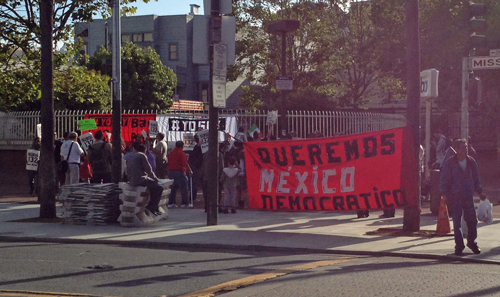
mexico-democratico-24th&Mission.jpg
Not everyone is happy about the results of the presidential election in Mexico. Opponents of the victorious candidate of the Institutional Revolutionary Party (PRI) -- Enrique Peña Nieto -- demonstrated at 24th and Mission Streets in San Francisco Monday afternoon. The PRI ruled Mexico for 71 successive years in the last century, becoming a spent force for progress, finally synonymous with corruption and electoral fraud.

The Mission District protestors carried signs from the movement YoSoy132. According to Julian Aguilar of the Texas Tribune:

Doubts that a new PRI means anything significant for Mexico have been brewing, particularly among the country's youth and a movement called YoSoy132 (I Am the 132). Though the group, which largely supports [unsuccessful leftist candidate] Lopéz Obrador, was founded by college students, it has now grown to include anyone who opposes the PRI, and Peña Nieto specifically. On Saturday, thousands in the movement descended upon Mexico City’s Plaza de Las Tres Culturas, the site of the country’s massacre in 1968 when student protesters were gunned down by military and police.

Victor Leon, 33, vowed to put the pressure on the PRI despite early reports that Peña Nieto would ascend to Los Pinos, the country’s presidential palace.

“We are committed to staying unified and moving forward with a pacifist movement,” he said.

Sunday, March 27, 2011

The making of saints


This woman displays a six year old paper poster honoring the Salvadoran bishop, Monsignor Oscar Romero, while walking in a Mission district procession highlighting the plight of immigrants yesterday. Obviously the figure of the bishop, martyred by right wing death squads in 1980, is very meaningful to her.
***
Yesterday we attended a bilingual, interfaith religious service held at Mission Dolores marking the killing of Bishop Romero thirty one years ago. The organizers were advocates for a just US immigration policy. As is the nature of such events, where many traditions must be given their moment, it was a little long, a little disjointed, and occasionally very moving. The most poignant moment was the lighting of candles to the memory of a litany of Central American and Mexican martyrs.
When you think about it, this memorial is slightly incongruous. All these people (except Bishop Ruiz, but his long life was lived in the same hard terrain) were killed for their devotion to the needs and dignity of very poor people. Their choice to live for the poor put them in the crosshairs of rich oligarchs who lived off their oppressed populations. But all of them also, would have named the systematic greed, the structural exploitation, that emanates from us, from the hypocritical national colossus to the north, as the enforcer of their local elites' crimes.

During the martyrs' lives, the United States was feeding off the blood of peoples to the south. Yet today their memory and martyrdoms are invoked by people from Central America and Mexico in their quest to stay in the United States, in the belly of the beast, in the context of a stupid and heartless immigration system. Enabling people to move to the United States and become "Americans" was absolutely not what these martyrs were about.

And yet, their lives and deaths in devotion to unspeakable truths make them figures with power for people who need any hope they can get. The historical specificity of their witness becomes blurred amid the needs of today. For those who remember the history, this can be distressing. The United States still has its boot on the neck of poor Salvadorans, Guatemalans, Mexicans.

But the people are making the saints they need. Plasticity, the capacity to take many shapes, is perhaps a feature of sainthood. The Vatican sanctification process (which may have some difficulty digesting Archbishop Romero) is one avenue to sainthood. But in all times, people find their own figures to represent higher truths in a heartless landscape.

Sunday, December 12, 2010

On Guadalupe's day

Boston Globe columnist James Carroll began a column with this story of the Virgin of Guadalupe a couple of days ago:

NEARLY 500 years ago, near present-day Mexico City, an "Indio" peasant was startled by an apparition -- the vision of a woman who, speaking his Nahuatl language, identified herself as the Lady of Guadalupe. The woman addressed the man, called Juan Diego, as "my son." She instructed him to bring her message to the archbishop, but he protested, "I am just a back-frame" -- a hauler of loads. The woman said, "I have chosen you."

The Lady's words put me in mind of this photo from the streets of Kathmandu of a man delivering a bed frame, the old fashioned way.

bed delivery better copy.jpg
There are "back-frames" hauling loads all over the world, even as some of us fly across the continents and contemplate bullet trains. The story goes that, on December 12, 1531, the mere "back-frame" Juan Diego revealed the image of the Lady on his cloak to a startled Spanish bishop.

We do well to remember always the refrain from Psalm 9:18.

For the needy shall not always be forgotten: the hope of the poor shall not perish for ever.

It was the poor man, the nothing guy who didn't even speak the rulers' language, that the Lady called "son." Perhaps she is among us even now, but we don't look where she passes by.
***
Carroll's column is a commentary on how Mexico made peace and a new identity that melded Spanish conquerors and native conquered, while North Americans still wrestle with what our growing diversity of language and culture implies. Here are his conclusions:

In North America, the self-aggrandizing religious and cultural assumptions of the founding Anglo settlers were challenged by subsequent waves of New World immigration, but the structure of white, English-speaking supremacy was never dismantled. Speaking mythically, if the Blessed Mother were to appear in the United States today, she would be expected by the majority to speak English -- but would she? She would be expected, equally, to be white-skinned. That majority is shrinking.

Cultural intermingling is a fact of the new American condition, but many are upset by it -- especially because Mexicans represent the vanguard of change. Resisting that change -- which in the United States boils down to a final defeat of white supremacy -- means denigrating Mexicans as mere back-frames, and rejecting their language. This is the subtext of the US Senate's refusal, yet again, to take up comprehensive immigration reform, the long-promised creation of a path to citizenship for so many who already enrich this country.

Let us work and hope for the passage of a small immigration reform, the DREAM Act, in the befuddled U.S. Senate next week.

Saturday, May 02, 2009

Some gratitude might be a good idea


Plaza in Mexico City, summer 2006.

Laurie Garrett of the Council on Foreign Relations and a well-known authority on emerging infectious diseases ... made a very important but little appreciated point. Mexico has made a major national sacrifice for global public health by shutting down its country and interrupting transmission of disease. The cost to Mexico has already been enormous[;] it will continue to pay in other ways. ... There will continue to be a halo of risk and danger for an indeterminate time. And there will be the inevitable backlash against the government's actions, which went from cold to scalding hot in a week.

... The irony is that the overreaction backlash will be more severe the more successful the public health measures are.

Effect Measure - a public health blog

Public health measures succeed when "nothing happens." This is awfully difficult to sell in a 24-hour news cycle culture.

Friday, August 10, 2007

Talk about blood sucking...


MCALLEN, Texas – Olga García, 33, is one of hundreds of Mexicans who cross the border into the United States to donate their blood in exchange for a few dollars.

Working eight hour days in the textile factories of Piedras Negras, Coahuila, García earns 620 pesos per week, the equivalent of $56.

But as a plasma donor she gets $70 weekly. For a year, García went twice each week to the BioLife Plasma Services laboratories, located some two miles from the international Eagle Pass Bridge, and sold 1.76 liters of her blood. With that money, García paid the mortgage on her house, as well as electricity and phone bills.

Read it all here.

In the past, blood vendors bought much of the U.S. plasma supply from the veins of skid row drunks -- but the AIDS epidemic ended that. So now we import much of our lifeblood.

At least these people aren't being enlisted for human organ farms. Not yet.

Tuesday, August 07, 2007

Creative resistance


Photo by way of Redes Ciudadanas de Jalisco

A friend writes from Mexico:

Gossip/News: Two days ago the two most famous lesbian political activists and artists in this country, Jesusa Rodriguez and Liliana Felipe, got married (well actually proclaimed their domestic partnership, sociedad de convivencia). Turning a very private affair into a political act, they walked out of Coyoacan's city hall chanting "La convivencia tambien es resistencia." "Partnership is also resistance!"

Rodriguez has been in charge of resistencia creativa in the aftermath of the rightwing theft of the Presidential election from the insurgent left movement led by Andres Manuel Lopez Obrador.

As happens all over the world, advances in one arena of progressive politics can make space in other areas of struggle.

Sunday, August 05, 2007

Fettered frontiers


Detail from a mural in the Buffalo, New York's City Hall depicting the U.S.-Canada border, circa. 1931.

In the age of the internet and global warming, national borders seem a little absurd -- until you or someone you know has trouble crossing one.

I've been collecting stories about our borders: here are a few.

The city has almost 10 million people, but no name.

Workers commute along its highways, while students shuttle to school. Companies buy and sell, patients get treatment and shoppers hop to their favorite spots -- doing their best to ignore the barrier that cleaves the city in two.

We know part of that "city" as Buffalo. The other part is Toronto and everything in between. ...

Just how much of the crossborder traffic represents local economic activity has always been difficult to gauge. ... [Thirty] percent of weekend receipts in the register at Peppermints, a male strip club in Niagara Falls, [Canada] are U.S. currency. ...

Local businesses have long clamored for easier border crossings and more coordination of infrastructure to spur economic growth. ... But Washington takes other factors into consideration when deciding how tight to make the border. A secure frontier is integral to sovereignty and plays well politically to voters in the interior of the nation.

Buffalo News,
June 24, 2007

Now the Feds plan to require passports for those intra-metropolis "border crossings." Niagara Falls's [Canada] day-tripper traffic was down 42 percent in June from 2005 numbers. Less than 25 percent of people in the U.S. even have passports, though applications have clogged the Federal bureaucracy this year. In the Buffalo area, border obstacles are creating a further economic drag on an already depressed economy.
***

DERBY LINE, Vt. -- Residents of this town and neighboring Stanstead, Quebec, are proud of the elegant granite hall that straddles the border between them. It is their rarest jewel: The Haskell Free Library and Opera House, built a century ago as a symbol of friendship between the United States and Canada and shared ever since by citizens of the two countries.

Canadians and Americans borrow books and watch plays side by side at the library, which was deliberately built half in one country and half in the other. No guards are stationed on the quiet, shady streets around the building, and Canadians who cross into Vermont to enter the library do not need to show their passports at a border station, as they do when crossing for any other purpose. Inside the library, where a strip of black tape on the floor marks the international boundary, patrons wander unchecked between the two countries on their way from the stacks to the birch-paneled reading room.

Boston Globe,
June 24, 2007

It will come as no surprise that the U.S. government wants to disturb this comfortable arrangement; a terrorist might try to pass as a book borrower?
***
Such comfortable co-existence is not limited to the northern border of the U.S.

[A residency checker for the San Luis, Arizona schools, explained:] "To people who live along the international border, it's similar to a county line," he said. "People don't think much about [crossing] it."

Certainly not Carla Molina, who walked her two children, 11 and 8, to school in San Luis, one recent morning.

"We're planning to move back here anyway," Molina said. She lived in San Luis years ago, and her children, born in Yuma, are U.S. citizens. She wants them to learn English. "It's important they learn it when they're young," Molina said.

LA Times,
June 25, 2007

Naturally our immigrant-averse xenophobes are mightily upset about this very human cross-traffic.
***
Then there are the repeated stories of border crossers who come from further away, from the "wrong" culture, or the "wrong" religion, or simply with the "wrong" last name.

Ever since Jimmy Carter was president, summer has meant one thing for Majed Shehadeh and his wife, Joanne Mulligan: time to pack. From their modest house in Bavaria, they migrate annually to their summer home in Massachusetts, where Ms. Mulligan was born and raised, with the accent to prove it....

A Syrian-born German citizen, [Shehadeh] was detained when he flew into Las Vegas in December to celebrate his daughter's passing of the California bar exam. ...

Shehadeh was taken to the North Las Vegas Detention Center, where he says he was stripped of his belongings, including $1,000 in cash, and his heart medication, which he wouldn't receive for another 36 hours. ...

Shehadeh then joined about 25 other people in a holding cell that had metal benches, concrete floors, a single toilet in public view, and no blankets or mattresses – a setup confirmed by Tim Bedwell, a spokesman for the facility.

Shehadeh was so loath to use the toilet that during his three-night detention he says he ate only a spoonful of mashed potatoes.

Sleeping also proved difficult. Court TV was blaring through the night, says Shehadeh. "You could hear the gavel pounding over and over. It was like a special kind of torture."

The next day, Shehadeh says, he was led into a room and told to strip naked. Then he was ordered to kneel down and cough while a guard inspected him from behind. ...

It wasn't until the afternoon of Dec. 31 that he was summoned for release. He quickly collected his belongings, except his $1,000 in cash. Instead, he was issued a check, which he showed the Monitor, stamped "City of North Las Vegas Inmate Deposit Account" in the upper-left corner. (Too humiliated to cash it, he keeps it on his desk.) Then he was delivered to the airport gate shackled and unshaven.

"The whole process is only humiliation over humiliation over humiliation," he says.

Christian Science Monitor,
July 11, 2007

Sounds like an ordinary U.S. jail to me -- but the Feds haven't even given a reason for this treatment of a Massachusetts home owner. He tried to cross a border.
***
Every once in a while, the boundary setters get their comeuppance. A Republican hack, one Dennis Schornack, was given a job in the Bush administration trying to map and fence the U.S.-Canada border. The Bushies didn't fund this effort of course; they just gave their guy the job and let the project fester.

Meanwhile, Shirley-Ann and Henry Leu retired to Blaine, WA aiming to raise Pomeranian dogs at their new home. Since they were located adjacent to the border with Canada, they built a $15,000 concrete wall to keep the dogs in. Trouble was, their wall encroached on the 10 foot "obstruction-free zone" that Schornack was tasked with creating. And when Schornack sued to get the fence moved, the conservative Pacific Legal Foundation stepped in to fight for the Leu's "property rights."

Mr. Schornack hired counsel and prepared a countersuit. He says he was then tackled by Justice Department lawyers, who urged him to settle the case. ...

According to Dennis Schornack, Mr. Reyes then issued an ultimatum: he had until 3 p.m. to back down. Mr. Schornack refused. The next day, he received his two-sentence fax [firing him] from the White House.

NY Times,
July 22, 2007

Schornack is now suing the President he served.
***
I can't help thinking we're overdoing this border stuff. I don't want to arbitrarily jail and humiliate people in the name of some phony "security." I don't want to live walled inside a fortress with a population of quaking cowards. But my rulers want me to live that way.

Friday, August 03, 2007

Friday Cat Blogging


Who are you?


This is my fig tree.


She lives at the site of Juan Diego's hermitage within the grounds of the basilica of the Virgin of Guadalupe in Mexico City.