Saturday, September 10, 2005

"Nurses respond"


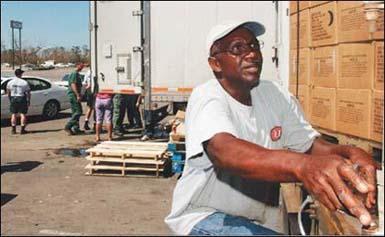
Fulton Alexander, of Biloxi, works Wednesday at the FEMA distribution point at Cedar Popps Plaza in Biloxi. Alexander has worked as a volunteer for Hurricane Katrina survivors since last week. JOHN FITZHUGH / SUN HERALD

All week I've been overhearing one end of the phone conversations in the office behind me: "Yes, we are sending nurses; when would you be able to go?" -- "No, I can't tell you now when you'll leave, but we're making arrangements now and I'll call you back." -- "We have a flight arranged for tomorrow morning, can you still go?"

And they have gone. The California Nurses Association (CNA) and the National Nurses Organizing Committee sent 100 nurses to the Gulf Coast to help hurricane evacuees long before federal relief authorities began to get their act together. More nurses are still going.

The South Mississippi Sun Herald reported their arrival in Wiggins:

Though tired from the long trip, the nurses were eager to get to work. Mike Barber of Grass Valley, Calif., who had just changed into his blue hospital uniform, said, "We're nurses and typically nurses, when called into action, respond."

Shelia Hidalgo of San Francisco also was ready to help, "This is the United States. It's our people. We need to help."

CNA is still taking names of volunteers here.

Almost as important, it is asking for contributions to help pay for its relief flights. CNA/NNOC is covering transportation and lodging and, depending on the assignment, may cover other expenses. They estimate costs at approximately $2,500 per nurse. If you can help, donate here. "100% of the money goes to sending nurses and 0% goes to administrative costs," according to CNA.

The hurricane and breakdown of government's responsibility to cope with disaster made this week emotionally frustrating for those of us watching in horror -- it was a good week to be working temporarily for a union that really tried to help.

Friday, September 09, 2005

Baghdad by the Gulf: from occupied New Orleans


Members of the Louisiana Sheriffs Task Force go on patrol through the streets of the Uptown neighborhood north of downtown New Orleans. Chronicle photo by Michael Macor
Guess they've put down the insurgency, and retaken the city. A San Francisco Chronicle writer, Peter Fimrite, reports from under occupation:

New Orleans -- I did not actually count the number of automatic weapons pointed at me, but there were at least five, and I was certain they were all locked and loaded, or whatever that military phrase is signifying that a gun is ready to blow a hole in somebody….

I must have been quite a sight alone out there on the darkened New Orleans street wearing a headlamp and holding a cell phone at an odd right angle, the only way I could get it to work. I had just been placed on hold.

"I'm a journalist working for The San Francisco Chronicle," I said quickly, trying to remain calm. "I'm out here because the signal ...."

"Step out here!" he interrupted, and his tone suggested that the consequences for not stepping out into the street would be dire. I stepped out.

Okay, so you have inexperienced part time troops on patrol in an eerie devastated city; naturally they are a little scared. Maybe they over reacted? After all "there are National Guard, police and Army checkpoints every few blocks. SWAT teams, soldiers and military squads from as far away as Puerto Rico patrol the downtown streets, stopping anyone they see."

No -- the armed posse was a New Orleans police department SWAT team. Fortunately, for Fimrite, the Chronicle had hired its own muscle: a squad of bodyguards led by Chris White, a former Navy SEAL, to protect the house and journalists, "presumably from looters, but also from arrest by police or the military."

"Don't point your f -- gun at me!" White shouted, and an already tense situation turned into a hair-raising standoff….
"That was totally unprofessional, pointing their guns at us like that," White complained when he returned. "The Army has been patrolling this street for a week, and they know what's going on here. All the police had to do was ask them, and they would have known everything they needed to know about this street."

I guess the disaster is properly militarized now.

The lawless disorder that makes a military response to disaster necessary is what you get when you fail to provide a civilian response. It is what you get when you fail to provide leadership, rescue, assistance. Militarization is what you need when you treat people as potential brutes to be controlled, as Bush's FEMA has done better than anything else.

People can be approached as potential heroes and heroines who will help themselves and those in need. The national and international outpouring of help, the thousands of medical workers who have flown in, these people show that disaster can evoke in the best in us as well as the worst. The country must get back to knowing "there is nothing to fear but fear itself" or we perish in our own toxic stew.

Thursday, September 08, 2005

Hurricane reporting and commentary -- good and terrible


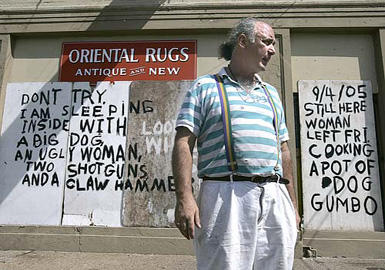
Bob Rue, owner of Oriental Rugs on St. Charles Ave in the Garden District of New Orleans, is hiding out in his shop, hoping authorities won't make him evacuate. The words on the front of his shop are meant to warn away looters. (Mark Boster / LAT)

Let's start with the awful stuff first. Katrina exposed our government's inability to perform its most basic function, enabling the people to survive and thrive, has been sabotaged by the ideologues of profit and privilege. Most of us are pissed.

So the right wingers have to deflect accountability for their failure. On one level, that just means Bushco will practice their usual stonewall. But additionally, their intellectual apologists rush to remind us that the real culprit is our underlying, nasty human nature. For conservatives, our main species characteristic is how bad we are. And our proper frame of mind is dread.

Here's Timothy Gorton Ash, of Oxford University and the Hoover Institution, warning today that we should expect to undergo "decivilization" in the coming century:

Remove the elementary staples of organized, civilized life — food, shelter, drinkable water, minimal personal security — and we go back within hours to a Hobbesian state of nature, a war of all against all. Some people, some of the time, behave with heroic solidarity; most people, most of the time, engage in a ruthless fight for individual and genetic survival....

Suppose there's a dirty bomb or even a small nuclear weapon exploded by a terrorist group in a major city. What then?... Almost having the force of a flood is the pressure of mass migration from the poor and overpopulated South of the planet to the rich North. . . . If natural or political disaster were to put still more millions on the move, our immigration controls might one day prove to be like the levees of New Orleans.. . .

New Orleans opened a small hole through which we glimpsed what always lies below.

It is so convenient: if we are all naturally rotten, how can screwing up be anyone's fault? I assume Ash is a Brit, so it is probably not right to call him "un-American," but that sure seems an accurate label for the guy. At our best, this country has thrived on hope in human possibility, on asking the best of each other and getting a lot.

"Nothing to fear but fear itself" -- FDR's first inaugural address; "Ask not what your country can do for you; ask what you can do for your country." -- JFK Those are the sentiments that have carried this country through crisis, not the doom and gloom hand wringing contemporary conservatives indulge in.

On to some good reporting -- LA Times columnist Steve Lopez is in stricken New Orleans; he's has some suggestions how we might approach disaster that seem more in tune with the better aspects of the national character:

President Bush promised to "lead an investigation into what went right and what went wrong." I think I can help shed some light.

If you pour money and manpower into Iraq, hire an amateur to run the Federal Emergency Management Agency and ignore repeated warnings of potentially disastrous flood problems, you're in trouble when a Big One hits.

It's all pretty obvious, so maybe Bush would also have time to take a good, hard look at the insurance industry. On my drive into New Orleans, I heard an insurance rep say he was sorry to have to deliver bad news to so many Katrina victims who thought they were covered, but found out otherwise.

Asked for an example of what's not covered, he said:

"Wind-driven rain."

I say we round up all the looters and insurance executives and tie them to utility poles before the next hurricane hits.

Take a look. Lopez is no polyanna; the column revolves around the theft of his laptop while he was observing the rescue. He reports bigotry and greed but he does not erase hope and possibility.

We can't allow the conservative apostles of doom to trap us in hopelessness. This country can do better than the Bush guys have done on the Gulf Coast.

Wednesday, September 07, 2005

These worlds don't mesh


Transatlantic Divide Deep, Not So Wide, Poll Finds -- LA TIMES

Bush failed to charm EU, says survey -- UK GUARDIAN

These two headlines refer about the same poll, conducted by the German Marshall Fund of the US. From the first article:

The report compiles polling data from the United States, Britain, France, Germany, Italy, the Netherlands, Poland, Portugal, Slovakia, Spain and Turkey, which straddles the Asian and European continents and aspires to join the EU. Pollsters questioned about 1,000 men and women in each country and identified a margin of error of plus or minus 3 percentage points.

The questions were designed to take the "temperature" of the transatlantic relationship. If Europe and the U.S. were a married couple, the findings suggest that divorce is not imminent, but aggressive counseling would be a good idea.

For this LA Times writer, what is important is that a strong majority of Europeans want to promote democracy around the world. (More want this than in the US in fact, if you dig into the text.) The article identifies a policy of "promoting democracy" as the centerpiece of President Bush's foreign policy, then seems bemused that "a majority of Europeans remain hostile to American global dominance and President Bush in particular."

In the UK Guardian, the poll demonstrates that President Bush did not win European peoples with his charm offensive in early July. Seventy-seven percent of those polled think relations across the Atlantic have stayed the same or gotten worse since Bush's re-election.

Maybe an amicable separation, rather than counseling?

Tuesday, September 06, 2005

Rally for relief, Oakland, CA


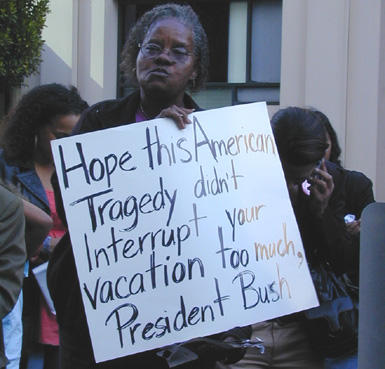
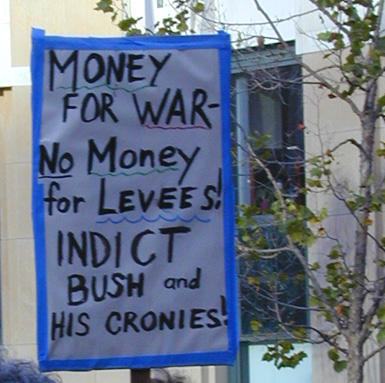
The people of California's most African American city had many relative in Louisiana's African American city. Oakland "gets" New Orleans. Oakland knows that if disaster hit Northern California, the feds and the state government might very well leave its people to die. Oakland "gets" New Orleans.

And so, today, Oakland held a little rally calling for full funding for disaster relief, control of public works programs in the stricken city on the Gulf Coast by the displaced Black community itself, bringing the National Guard home from Iraq, and taxing oil companies to fund FEMA. Local organizations shared their plans for fund raising. And people stood after work in front of the downtown Federal Building to let the world know: Oakland gets New Orleans.


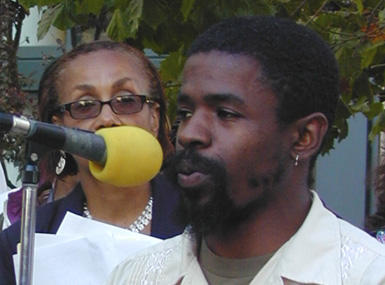
A member of the Black Dot Artists group announces a benefit for hurricane relief


Congresswoman Barbara Lee's office is leading a drive to collect for the NAACP's disaster fund


Monday, September 05, 2005

Combating the insurgency


Louisiana Army National Guard soldiers take position outside the Superdome in News Orleans as they oversee security for the mass exodus of Hurricane Katrina evacuees from the Superdome to the Astrodome in Houston on Thursday. M. Scott Mahaskey / Army Times

I didn't really think I could feel any more outrage than I already felt about the criminal, racist, bumbling non-response by the US government to Hurricane Katrina's victims. Then I read this from last Friday's Army Times:

Troops begin combat operations in New Orleans

NEW ORLEANS — Combat operations are underway on the streets “to take this city back” in the aftermath of Hurricane Katrina. …

“This place is going to look like Little Somalia,” Brig. Gen. Gary Jones, commander of the Louisiana National Guard’s Joint Task Force told Army Times Friday as hundreds of armed troops under his charge prepared to launch a massive citywide security mission from a staging area outside the Louisiana Superdome. “We’re going to go out and take this city back. This will be a combat operation to get this city under control.” …

While some fight the insurgency [emphasis added] in the city, other carry on with rescue and evacuation operations. Helicopters are still pulling hundreds of stranded people from rooftops of flooded homes.

So this was the mindset of at least some of the troops going belatedly to "rescue" New Orleans.

We do know the military response wasn't all crazed. Lt. Gen. Russel Honore, commander of the First U.S. Army stepped in:

"Put those ... weapons down!," he yelled to troops rolling in on trucks. He repeatedly strode up to soldiers, and sometimes the local police, telling everyone to point their guns down, reminding them they were "not in Iraq."

I have to believe it made a difference that General Honore, the closest thing to hero we've seen in this squalid saga, is African American.

What about Gulf Coast gays?


There has been no place to put the deceased, so many are left in the water. (Carolyn Cole / LA Times)

If my previous post on past fundraising for the Red Cross seemed to suggest that the "domestic partners" struggle was over, I'd be full of it. Gay victims of Katrina are still going to have a rough time getting their family ties honored.

The good news is that the Red Cross has a history of recognizing the needs of gay families in disaster situations.

The most effected states, Louisiana, Mississippi, and Alabama, all have laws that deny legal status to same sex couples.

The bad news is that FEMA's intervention might even make the situation of gay families more devastating. From 365gay.com:

The Federal Defense of Marriage Act prevents FEMA from providing any relief in the form of family benefits to same-sex couples. The laws also will directly impact gay and lesbian families where one partner has died as a result of the hurricane. Federal DOMA bars Social Security survivor benefits. State benefits would also be denied.

If the deceased partner were the birth or adoptive parent of the couple's children those children could be removed from the care of the other parent and placed in foster care.
Should the family home be in the name of the deceased partner the survivor would have no rights. Any insurance payouts could go to the estate of the deceased and if there is no will would go to the closest blood relative.

In cases where one partner is hospitalized the other partner would not be guaranteed visitation rights or any say in medical care.

Surviving same-sex partners even could be denied any say in funeral or burial decisions. Even in those cases where couples had legal documents such as living wills, powers of attorney or other agreements that could be valid in the states in which they were prepared and notarized there is no guarantee they would be honored in states where survivors were relocated.

We can only hope that so many heads will be rolling in FEMA that they forget to notice they have license to mess with gay folks.

Sunday, September 04, 2005

On raising money for the Red Cross…


Not New Orleans: another disaster, in another time. USGS photo

If it seems a little odd that a diehard, pissed-off grassroots activist like me is raising money for the Red Cross, I agree it is odd. But when things are really bad, the big guys sometimes can get in the door before anyone else, so I think we have to help them now. Later, many of us had better help the little guys from New Orleans, like these good folks.

Meanwhile, this is a moment to get on record the absurd tale of the last time I was involved in raising money for the Red Cross. The year was 1989; the occasion was, naturally, a natural disaster: the Loma Prieto earthquake in Northern California.

That year I was employed in an electoral campaign seeking to win domestic partner benefits for unmarried San Francisco couples (yes, that means gay folks, but the ordinance was and is inclusive of any combinations.) The campaign was, frankly, a chaotic shambles. Our gay leaders had won a pioneering, if very weak, domestic partners law which created a registry that gave those who used it the right to visit their partners in the hospital and not much more. Our pro-gay mayor signed it.

Strange as it may seem today when the issue on the table is gay marriage, this pathetic effort was a shocking innovation at the time. Even in San Francisco, fundamentalists easily gathered enough signatures to force a referendum on it. So there we were, urging a "yes on measure S."

This might have been a good educational campaign, except that our political leaders had neglected to do the educational work to build a base for the new concept of "domestic partnerships" either in the gay community or among straight liberals. The idea was unheard of: lots of gays feared it was an effort to assimilate them to heterosexual norms or simply to make them responsible for their partner's debts (a big issue in a community where 50 percent of men were HIV positive.) Nobody else had ever thought about it. And suddenly we were faced with defending an unwanted "victory" at the ballot box.

I was responsible for precinct organizing in the campaign. It was close to impossible, the only time I've ever had a 100 percent "flake rate": no one who said they would volunteer to walk precincts showed up, week after week. Our issue simply wasn't important to or understood by the population of people who usually work on liberal campaigns.

And then the quake struck; though most parts of the city had little damage, a freeway pancaked in Oakland, part of the vital Bay Bridge collapsed, and large fires burned in some San Francisco neighborhoods. At least 67 people were killed. We were indeed shaken.

But those of us working on "Yes on S" still had a campaign to run. Electricity was out and folks were hunkered down, but the next day I drove around the Bay and picked up 50,000 flyers donated by a printer in Fremont on which were listed all the relief resources in the city. And then we called through the "Yes on S" flakes, turning our next weekend precinct walk into an opportunity to carry the flyers to the neighborhoods and collect money for the Red Cross.

This project was a raving success -- 50 people went door to door, met a great reception, and came back with envelopes full of cash. Fortunately, my partner was both an accountant and a former cashier, so she took charge of counting the money; it added up to over $20,000. The campaign had no facilities for keeping that kind of cash, so we took it home over the weekend and hid it under the bed.

On Monday we brought the large cardboard box with the cash ($20,000 in mixed small bills is a lot of cash!) into the office. With the office manager, we carried it down the street to the campaign's bank. Once we saw him into the bank, I went back to the office. A little later, there he was again -- still carrying the box. Wells Fargo had refused to process so much money and he wandered around Market Street trying to figure out what to do before coming back with the loot.

To be honest, I can't quite remember what we did next -- but somehow the money was turned into a cashier's check that someone being a public face for the campaign presented to the Red Cross on a Geraldo Rivera broadcast. (Yes, we got Geraldo; for an unvarnished video exposure to his reaction to the Superdome hell this week, see Crooks and Liars here.)

Oh yeah, three weeks later, the voters of San Francisco turned down domestic partnerships, narrowly. The next year, after more preparation, the concept was on the ballot again and won. It took a third vote the following year, fighting off fundies who wanted to repeal it, before domestic partnerships became settled law here in Sodom by the Bay.
After Katrina: So now what?


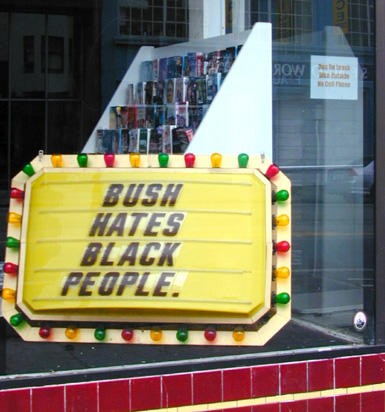
Sign in the window of a video store, two blocks from my house.

Yes, Bush hates blacks. Katrina has revealed this all too clearly. Here's some good commentary on the racism and the effort to wriggle out of responsibility for racism.

Bush also hates poor people, hard work and anybody who questions his façade of testosterone fueled bravado. He may not be quite the "worst President ever" as folks in the liberal blogosphere are fond of saying (we've had some doozies -- think Harding, for example), but he is close.

A great many people in the US like Bush's style.

If a majority of us think we should do better, how do we get there? I have seen no sign that Democrats know how to lead the country out of the Iraq quagmire; can they promise to rebuild the social solidarity the underlies emergency preparedness? Bush may be a useless horse's ass; the Republicans may be self-satisfied, selfish profiteers -- but who is going to change any of this?

Friday, September 02, 2005

A small local grief to go alongside the ones too large to comprehend . . .

The horror show in New Orleans, human suffering abetted by government indifference, wasn't the only sad news yesterday. "Read it and weep: Kepler's closes" read the headline in the SF Chron. A little thing in contrast to the monstrous events of the day (and then there was the aftermath of the stampede in Bagdhad. . .) but sad nonetheless.

Kepler's was a famously independent, politically progressive small bookstore on the San Francisco Peninsula. The founder, Roy Kepler, proved to reluctant booksellers that there could be a profit selling paperbacks, then the stepchildren of the publishing world. He also was not shy about advertising his convictions. A 50th anniversary retrospective published by a Palo Alto community newspaper last year reported:

. . . in 1956 Roy Kepler joined the forefront of the anti-nuclear, anti-war movement. Signs appeared on the window: "Peninsula's largest anti-missile bookstore." And for two years at least, Roy and Patricia Kepler got written up in local newspapers for withholding part of their income taxes to protest military spending. . . .

Roy Kepler went to jail in 1960 for protesting nuclear weapons at the Lawrence Livermore Radiation Laboratory. In 1967 he was arrested again, along with Ira Sandperl and Joan Baez, for trying to shut down the Oakland Induction Center as part of "Stop the Draft Week."

Mr. Kepler's high-visibility protests made him and his store the target of people who hated his politics and had no reservations about violence. In 1968 and 1969, there were a series of arson attempts, attacks, and a bomb at Kepler's stores in Menlo Park and Los Altos. Mr. Kepler even received a death threat. He was quoted as saying, "I suppose someone is mad at me for not being violent."

Roy Kepler was eventually succeeded by his son, Clark, in management of the enterprise; the younger Kepler focused on the business of bookselling and brought the store through many of the challenges that bedevil independent booksellers -- until today.

The takeover of print publishing by media conglomerates more interested in the bottom line that the quality of writing, internet book retailing, new media forms like this one that compete for the attention of potential book readers -- all these are killing independent booksellers. Clark Kepler's final letter tells the story:


After 50 years of bookselling in Menlo Park, Kepler’s is going out of business. The decision to close our doors has been one of the most difficult in my life. As much as we love what we do and would like to continue another 50 years, we simply cannot. The economic downturn since 2001 has proven to be more than we can rebound from.

Many years ago, when my partner and I were young and poor, our idea of a major diversion was to drive out of the city and spend a couple of hours browsing in Kepler's -- it was a kind of mini-vacation. It is hard to get that sense of going away from browsing the internet. Today I am sad for those who will miss out on it.

UPDATE: 11:00pm, 9/2/05 -- It seems investors, landlords and readers are making a last ditch effort to save the store, according to the Palo Alto Almanac.

UPDATE: 10/03/05 Great news. The Mercury News says Keplers has been saved and will reopen October 8. See also here.

Thursday, September 01, 2005

Who is FEMA? Where do I find him?


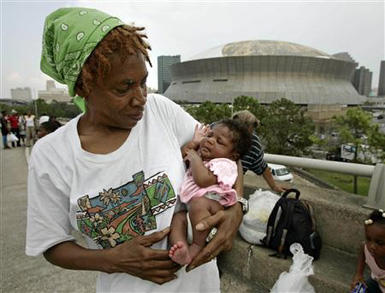
Mary Dixon carries her two-month-old grand daughter (name not given) in front of the New Orleans Superdome in the hurricane-ravaged city August 31, 2005. REUTERS/Jason Reed

Of all the hurricane stories out today, this one made the horror the most real to me -- and it is not even from New Orleans:

BILOXI, Miss. -- Once Hurricane Katrina passed, Angelia Johnson thought life would return to normal. But for many Gulf Coast residents, the aftermath of the storm has been a long wait for little help.

With her two children in tow, Johnson spent two hours at the Save-A-Lot grocery store Wednesday, standing in a line that stretched around the corner. People had heard that the store was giving away food. All Johnson got was a package of Pampers and a 24-pack of warm canned sodas.

Her family had not eaten for three days. Her clothes were dirty and wet. Her children wore the only thing they had--1-year-old Larry in a diaper and 3-year-old Shirley Ann in a pair of soggy pants.

"My children have never had to do without," Johnson, 22, said almost apologetically. "But we don't have anything. There is no milk for the baby, no clothes, no deodorant, no hair stuff. The storm messed up everything."

. . .

When store employees came out to empty water-soaked fruit and vegetables into a crate in front of the store, dozens of people rushed up, knocking each other out of the way to grab what they could. They went home with handfuls of apples, oranges and other items, most of which probably were unsafe to eat.

Lena Mae Stanton had another idea. She decided to try the trash bin at the side of the building. But as soon as she got there, others came. They picked out what wasn't soggy or rotten before the store employee asked them to leave.

"I was trying to see what kind of food I could find," said Stanton, 59, who has no food at home for her six grandchildren. "I got some apples and oranges. I know it's probably not safe, but I will wash them off the best I can."

People like Johnson didn't have much before Hurricane Katrina devastated the Gulf Coast on Monday. Now they have nothing. Scavenging is how they are trying to survive, at least until the government and aid workers bring in food, water and ice.
. . .

Johnson, her husband and two children are sleeping on wet beds in their apartment. Much of the roof is gone. Windows are broken. There is no air conditioning and no working toilets.

Her husband is disabled, but he does what he can. She has heard about FEMA, but she isn't counting on anyone to rescue her. No one came to her rescue when water trapped her family on the second floor of their apartment during the storm.

She had nowhere to go before the storm. And she has nowhere to go now.

"A lot of people told me FEMA would help, but I don't know who he is," she said. "I don't even know where to find him to get some help."
We can hammer our moron Preznit who this morning told the world: "I don't think anybody anticipated the breach of the levees." But for now, just go click on the Red Cross ad on the right of the page.

Wednesday, August 31, 2005

Disaster has its way


A man hands a child over a fence Tuesday as a group of residents moved to get to Interstate 10, which was one of the places where people could reach high ground in New Orleans on Tuesday. Times Picayune photo, by Kathy Anderson

By chance, in this week when the city of New Orleans was reduced to a shallow toxic soup and some million or so residents of Louisiana found themselves homeless refugees, I've been reading Ecology of Fear: Los Angeles and the Imagination of Disaster. Mike Davis' strange, baroque tour through the natural and human disasters that have shaped and are themselves reshaped by Southern California's real and imagined environment. The book offers an apocalyptic vision perhaps almost equal to Katrina's horrors, as we are now seeing them in photos and on video.

Maybe it needed an Angeleno to find a spokesman for the New Orleans disaster. Kevin Sack in the LA Times tells the story:

In 1718, French colonist Jean Baptiste Le Moyne de Bienville ignored his engineers' warnings about the hazards of flooding and mapped a settlement in a pinch of swampland between the mouth of the Mississippi River, the Gulf of Mexico and a massive lake to the north. . . .

But when the rainfall brought by Katrina breached levees and overwhelmed the city's pumping stations, the catastrophic consequences of Bienville's miscalculation could no longer be ignored.

. . .

"The river gives and the river basically takes away," said novelist Richard Ford, who lived in New Orleans until last year. "There really isn't a vocabulary that I have access to that describes this. And as always, it's the least able to recover from this disaster who will suffer most intensely." . . . "If you live in New Orleans," he said, "you've decided that whatever it is about that city that you like is more important than whatever anxiety you feel.". . .

"That's the structure of living in New Orleans," he said. "People feel that the place is doomed at some point, but they're going to stay. It's just a way of dealing with the end that's different from other ways of dealing with the end."
Mike Davis also aims to describe how a society built in a violent, disaster-prone land evolves its own sometimes venal, sometimes merely delusional, approach to survival. From earthquakes to human sprawl, from fire to tornados, from encroaching "wildlife" to rioting human life, Los Angeles sells Eden-like paradise in the midst of real and imagined looming threats.

The results are often tragic as when wild fires periodically sweep through luxurious hillside homes in Malibu Canyon and urban fires destroy cheaply built tenement buildings in Downtown; in neither case are fire prevention authorities able to enforce rational precautions. In the former, restricting building in dangerous chaparral prone to Santa Ana winds would reduce the profits of developers; in Downtown, enforcing building codes would lighten the pockets of landlords. Neither happens and residents of both ecologies continue to face frequent killer fires. As in New Orleans, "those least able to recover will suffer the most intensely." In Los Angeles these days, the sufferers are likely to be new Mexican and Central American immigrants -- in New Orleans, they appear to be largely poor African Americans.

In a catalogue of disasters, you have to take what humor you can amidst the pain; Davis manages to make the history of Southern Californian tornados downright funny in a chapter called "Our Secret Kansas." Los Angeles is a "tornado hotspot," hit by a twister on average every 2.2 years. But since the 1920s when the city was heavily sold to migrants from the Oklahoma and Arkansas escaping funnel clouds, local media, to this day, almost never refer to these wind events as "tornados." They are "baby cyclones," "waterspouts," "freak winds," etc. If the T-word becomes unavoidable, the event is "the first ever tornado" or "a California twister . . .strong and fearsome, but lacking the awesome destructive power of similar phenomena frequent in other parts of the country."

New Orleans is too close to Katrina for the brutal quirky humor of disaster to have much poked its head up. The Times-Picayune soldiering on with its mission to record "Everything New Orleans", made a weak try at the light touch:

Ms. Mae's Bar has been open around the clock at Napoleon and Magazine streets for 11 years. The bar stayed open during Hurricane Katrina, but owner Mae Brigham decided to shut down Tuesday at 1 a.m.

"Everybody was just worn out," she said.

But Brigham reopened about 9 a.m. later that morning, partly as a defense against looters. The bar is located across from a police station, and Brigham figured looters would be unlikely to attack a busy bar, especially since some of the patrons might be police officers.

Probably it is too early to celebrate local fortitude as helicopters buzz overhead making rooftop rescues -- but they try. For immediate and harrowing news from New Orleans, try the TP Newslogs.

To give private donations for relief, the standard charity is the Red Cross. Of course what devastated New Orleans really needs is genuine public aid: a new government that uses the wealth of the nation to build infrastructure like levees and its police powers to assist disaster victims, not invade other countries. But getting that is going to take even more than succoring those whose lives have been torn up by the hurricane.

Tuesday, August 30, 2005

"It wasn't a hate crime . . ."

stophate
That's what they usually say. The Columbia Missourian tells the story:

The police report states that Haitham Alramahi, 22, was walking home about 2 a.m. when he was struck by a car at Sixth and Cherry streets. He was in the crosswalk, but the car did not stop at the stop sign. He said four or five men got out of the car.

“I thought they were going to help me,” said Alramahi in an interview. Instead, they shouted racial epithets at him, telling him to go back to Iraq, he said.

When Alramahi, born in Jordan to a Palestinian father and a Greek mother, protested, the assailants began to punch and kick him. “It came from everywhere,” Alramahi said. “I didn’t even have time to get away.”

“It does not fit the statute,” [Investigative Division Commander of the Columbia PD] Martin said. He added simply using racist language during an assault does not automatically mean the crime was originally perpetrated because of race.

If this sort of thing is not a hate crime, I certainly don't know what is, assuming Alramahi is telling the truth. Perhaps the guys in the car did not originally hit him because he was perceived as a Middle Eastern foreigner. But once they got out and started beating him while calling him names, they were announcing a hate motivation while committing assault. What more does it take to make a "hate crime?"

If the authorities do not condemn racial, religious and gender hate acts, they condone them; apparently that is what is going on in Columbia.

In the spirit of another hate victim who asked "can't we all get along," Alramahi seems to just want to make peace: “I can’t judge all of Columbia because of this one incident,” he said. “People are nice here, very nice.”

See also my account of David Neiwert's valuable Death on the Fourth of July and follow these eruptions of bigotry at his blog.

Monday, August 29, 2005

End user's lament

Here I sit, vacillating between seething frustration and groveling gratitude. For 36 hours, my email has been down. My email is ordinarily directed to a hosting ISP, then is forwarded to a big national internet ISP and finally comes down the pipe to my computer, whether I'm on my home office DSL connection, working off a client's Ethernet network, sitting a WiFi equipped café, or even dialing up from the boonies. I get my 100s of emails a day (about one third spam funneled rapidly to "Junk") and cope and grouse a little about the volume.

Suddenly, only yesterday but it seems like ages ago, the plopping sound the Mac laptop makes when email arrives stopped. STOPPED! I had noticed my morning digest of the New York Times was missing, but didn't have time to read it anyway. It took me a while, maybe a couple of hours, to be sure that the mail really wasn't coming.

Then of course I panicked! I was going to have to deal with Tech Support. Like most end users, this is my idea of hell. They want to know things like "your name" -- only sometimes that means your actual name, sometimes it means the handle you use with that service, and sometimes it means your email address -- or even more mysteriously, it means "admin." Huh?

But I got on the web, found an obscure phone number on the hosting ISP's website and called in. It didn't go too badly. This outfit didn't want my name; they wanted me to punch in my "client ID number." Fortunately I was able to find it. I described my problem -- no mail because for some reason that was THEIR PROBLEM their server wasn't forwarding. I knew it was their problem because test emails sent directly to the big national ISP came right through as expected. They tried saying my mailbox (storage on their server) was full, but since I have set their controls to erase email when it is forwarded, there was nothing in my storage space. The nice man said he would kick it upstairs and it would be fixed in 20 minutes.

Life went on, six hours later I came back to the computer and still no email. But by now it was Sunday night and the obscure phone number led only to a message telling me to leave a message. Hmmm -- I thought they had Tech Support 24/7.

I entertained a small hope that somehow the problem would go away over night -- but in the morning, still no New York Times. So at 6:00 am I'm on the line to Tech Support again: "It is not fixed." After several rounds, Tech Support (a nice woman this time) wrote me to my other email address: "We have escalated your issue to the next tier of support. We will work to resolve your issue as quickly as possible." Off I went to my work.

Until noon, I concentrated on my client's problems, but since there was no melodic plop in the background, I knew that no miracles had occurred. By now Tech Support (a nice man again) was getting frustrated; he insisted that his company was forwarding my email -- the big national ISP must be blocking it. So, just to rule this out, off I went to their Tech Support, this time in the form of online chat (remember I'm at work and can't very well be spending all my client's time trying to get my personal email working.) Couple of rounds of this -- no, it must be the hosting service because big national ISP is not blocking my domain; no, it must be the big ISP because little hosting service is forwarding. Blah, blah, blah -- they can't both be right and they are each perfectly certain the problem is with the other party.

Me, I'm neutral. I don't care which of these outfits is falling down on the job, but I still don't have my email. Just fix it guys!

Finally it is after hours again and I am back on the phone with the hosting service's Tech Support -- another nice guy. We start over. He wants to know how long this has been going on. Days I say; that is what it feels like. Oh yes, he says, we've been having some trouble with the server your mail goes through. Maybe we can put your mail through another server. I don't scream -- hasn't the fact that this was what was needed been obvious for 24 hours? He does things in the ether; I'm not exactly feeling trusting.

Well what do you know? Early this evening, plop, plop, plop again. Maybe I'll keep getting email; maybe I won't.

Most all of us go through this sort of thing trying to keep our computers working for us. Do we need them? Apparently. Will they someday work more smoothly? Who knows. Plop.

Sunday, August 28, 2005

Kansas--engaging crackpots and strange omissions

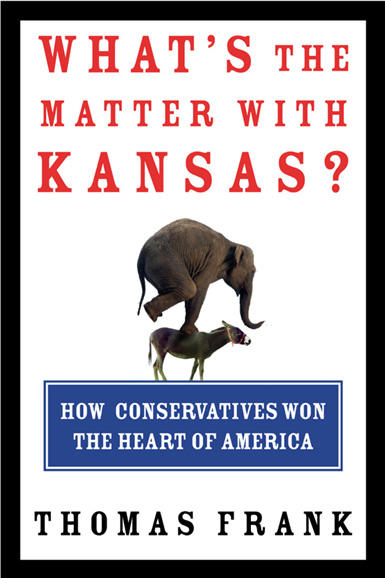
The many reviews and discussions I've read of What's the Matter with Kansas? failed to prepare me for what I found most attractive about this book: Thomas Frank actually likes Kansans. He seems to enjoy describing the peculiarities of his native state. Once an abolitionist and populist stronghold, Kansas is still home to "some of the most flamboyant cranks, conspiracists, and calamity howlers the Republic has ever seen." Frank marvels that these characters have enlisted in a crusade against abortion, gays, and above all, liberal elitism, while supporting the corporate capitalism that undermining their quality of life.

Political activists, both right and left face a similar problem: most people don't want to live a life of endless struggle. As we used to say on the left: "struggle is hard, that is why they call it struggle." Ordinary people can be roused to activism by something they feel as an immediate crisis (see mothers of US soldiers in Iraq today) but the object of their activism is usually to correct something so they don't have to continue being activists. Franks documents how the right has made permanent backlash activists out of masses of working Kansans by rousing them to a permanent state of fury with liberals.

Everything seems to piss conservatives off, and they react by documenting and cataloging their disgust. The result is what we will call the plen-T-plaint, a curious amassing of petty, unrelated beefs with the world. Its purpose is not really to evaluate the hated liberal culture that surrounds us; . . . The plen-T-plaint winds us up. It offers no resolution, simply reminding us that we can never win.

Clearly what Frank calls the "plen-T-plaint" is the contemporary form in which many Kansans respond to the reality that US society disrespects and derides working people. As long as they are pre-occupied with beefs against liberal elitists, they aren't going to notice the elephant in the living room: the encroachments of the rich are destroying their way of life.

Frank describes all this masterfully and artfully, and yet I came away from the book wondering whether, on some level, he really "gets it." The rightwing zealots he introduces us to in a chapter called "Happy Captives" have been hoodwinked into working against their economic interests, but they have also spent their lives being royally "dissed" by the culture they live in. Being despised doesn't make any of us clear thinkers; if we have spunk it usually makes us mad which, in the absence of countervailing contacts, can set us up to be manipulated. Frank is right of course that liberals have neglected these folks. (I think too Frank misses how normal these people can seem to a leftish "movement activist"; their willingness to persevere without material gain in hard political struggle is the norm for serious political activists of any stripe, setting them apart from ordinary folks who actually seek their own demobilization.)

And then there is race. . .

Where I definitely part company with Frank is his airy dismissal of white racism as underlying Kansans plen-T-plaint. "Kansas does not have Trent Lott's disease. . . .They glory in speaking of themselves as a new breed of abolitionists." According to Frank, Kansas is not following the trajectory of the old South that turned to Republicans in reaction to the civil rights revolution of the 1960s; Kansans are different. His evidence for this seems awfully thin. Sure, conservatives love to manipulate the symbols of civil rights, but do they do anything for equality with people of color?

What Frank is missing is that appropriation of the history and symbols of the Black struggle for justice is the ultimate in white racism, even more deeply offensive than outright, visible bigotry. Erasure trumps insults. Kansas conservatives have all the conventional hallmarks of racist reactionaries in the rest of the country; it would be very odd indeed if, as the non-white population grows, they don't display the more familiar signs of white reaction. (People of various non-white colors were only 10 percent of Kansas voters in 2004, confirming that at present it remains one of the politically whitest states.)

By dismissing race, Frank undermines the credibility of this otherwise very convincing book. Aside from one footnote, I had a hard time finding any evidence that he talked with any non-white Kansans. And he makes statements that leave me gasping when I fill in the unmentioned racial context. For example, he introduces us to a white working class man who supported McGovern in 1972; this man was converted to rightwing fanaticism because of he believes legal abortion is murder, even though Republican economic policy has devastated his town, leaving it looking like "a miniature Detroit." Now wait a minute -- Detroit may be a burned out post-industrial wreck, but its chief distinction today and for 30 years has been that it is a Black city. In fact, a recent study named Detroit the most liberal Democratic city in the country -- because it is so heavily African American. That progressive politics might be anchored in the communities of color is a possibility that seems to be inconceivable to Frank.

The ground Frank has covered so well in Kansas has been surveyed by other political observers who do take racial and sexual politics seriously, even if they do not write so engagingly. For a corrective to Frank's narrow focus, I would recommend taking a look at Jean Hardisty's Mobilizing Resentment.

Saturday, August 27, 2005

California's "foreign" relations make tricky footing


What a difference a few years can make. In 1998, Gray Davis was elected Governor with a deluge of Latino votes. Latinos were eager to repudiate Pete Wilson's perceived immigrant bashing in the 1994 campaign when he saturated the airwaves with blurry images of dark figures climbing a fence and running. "They keep on coming …" the voice-over warned. Wilson won the election and became an icon of nativist prejudice against Mexicans in the opinion of politically engaged Californians.

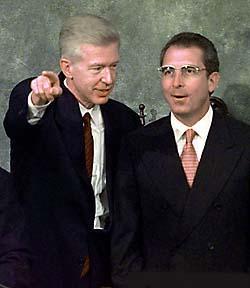
So when Davis took office, almost his first act was to travel to Mexico to meet with President Ernesto Zedillo and pledge friendship as well as win "points south of the border, where California exports about $12 billion in goods annually," according to the Christian Science Monitor.

Zedillo paid a return visit to Sacramento in May 1999 to address a joint session of the state legislature. He was greeted with shouts of "Viva Mexico!"

"This is a symbolic closing of the gap that had developed for the last six years under the previous administration," said Harry Pachon, an expert on Hispanic politics and president of the Claremont Graduate University's Tomas Policy Institute….

"The trip gives Zedillo an opportunity to connect with Mexicans and Mexican-Americans living in California. They send home more international currency than Mexico receives from tourists, " Pachon said.

Fast forward to 2005. Yesterday the leader of the California assembly, Fabian Nunez, a native Spanish speaker who is representative of California's new Latino power, visited Mexico -- and stuck his foot knee deep in controversies of his own making. According to the LA Times Nunez has called on Governor Arnold Schwarzenegger to seal the border, pointing to deaths among desperate people trying to cross and pointing out that Latinos in the US face backlash from whites who fear undocumented immigrants. His call was not popular.

But to many Mexicans, the demand for cheap labor and illegal drugs by Americans on one hand, and the demand to seal the border on the other are at best a contradiction — and at worst, hypocrisy.

One woman told Nunez that this contradiction was captured in a scene of the movie "Crash," which recently opened here: The affluent Sandra Bullock character tells her long-abused Mexican maid: "Want to hear something funny? You're the best friend I have."

Meanwhile, Schwarzenegger, sensing a chance to turn an issue back on Democrats who have tormented him for months, has now announced that he opposes sealing the border.

If social security is the "third rail" of national politics, scorching anyone who touches it, immigration policy is the third rail of California politics. So long as this country looks like wealth and opportunity to hungry people south of the border, while the US wants those people as cheap labor to exploit, large-scale immigration, legal and "illegal," is going to continue. The only actual "solution" to the "problem" would be development in Mexico and Central America that spread wealth created in those countries fairly among their citizens. That would stop the seemingly unstoppable suction from the wealthy north. Since US politicians wouldn't even dare advocate the only "solution" likely to work, the "problem" of people migrating to where they can survive and even thrive is likely to continue and politicians will likely continue to stumble around it.

Assembly Speaker Fabian Nunez and politician Beatriz Paredes stand as the Mexican national anthem is played. (Eduardo Verdugo / AP)

Peace activism site for back to school season


LEAVE MY CHILD ALONE! gives practical advice and support to parents who don't want their kids stalked by military recruiters. Federal education law requires school districts to give the military the names of the potential cannon fodder -- that is, high school students. But parents can opt out for their kids. The site includes a blog that publishes news of the recruiters' tactics. It is sponsored by a wide coalition of peace groups -- good to see them working together.

Friday, August 26, 2005

Iraqi constitution? No comment here


Poor Bush, who once ordered mighty armies into war and tampered with the US Constitution through his Draconian "PATRIOT" act, now is reduced to pleading with a pro-Iranian cleric to please make nice with the ex-Baathists. And he isn't even succeeding in the plea!

From Juan Cole at Informed Comment

Welcome to Lebanon times infinity.

From "Friendly Fire" in comments at Helena Cobban's Just World News.

Wednesday, August 24, 2005

The Morning Retch: Administration hides its own scientific findings

puke_logo
According to the New York Times this morning, Lawrence A. Greenfeld practiced sound science in Bush's Justice Department and lost his job. His offense? He wanted to include in a news release a finding that African Americans and Latinos stopped by the police were significantly more likely to be searched and have force used against them than whites.

The April study by the Justice Department, based on interviews with 80,000 people in 2002, found that white, black and Hispanic drivers nationwide were stopped by the police that year at about the same rate, roughly 9 percent. . . .

Once they were stopped, Hispanic drivers were searched or had their vehicles searched by the police 11.4 percent of the time and blacks 10.2 percent of the time, compared with 3.5 percent for white drivers. Blacks and Hispanics were also subjected to force or the threat of force more often than whites, and the police were much more likely to issue tickets to Hispanics rather than simply giving them a warning, the study found.

There's no surprise in the findings to anyone who lives in a multi-race US city, but the study provides hard evidence that supports legislation such as that promised by Rep. John Conyers Jr. to ban the use of racial or ethnic police profiling.

Apparently some higher ups in the Justice Department didn't want the public to see that evidence, so the study was simply placed online without an announcement amid what statisticians call "an avalanche of studies issued by the government." Greenfield was threatened with dismissal after 23 years of service but now has been shipped off to work in the Bureau of Prisons.

Meanwhile, Bruce Fuller, a professor of education at UC Berkeley, recounts in the Los Angeles Times that Bush's National Literacy Panel developed hard evidence that, lo and behold, bilingual education was helping kids acquire language skills. So the Education Department is stonewalling on releasing the report. Fuller asks:

Why would the administration sideline its own report? It's possible that the bilingual education results weren't what it wanted to hear. "English only" is a rallying cry in the culture wars, and evidence that works against it also works against such Bush allies as English First, which has led the charge against bilingual education.

When the facts don't serve your political agenda, better hide those facts.

Tuesday, August 23, 2005

Pestering your Democratic Congresscritter to represent you against the war

Today a local antiwar group asked my advice on this topic, so I thought I'd share what I recommended more broadly.

Suppose you're an antiwar activist. You live in one of the roughly 190 safe Democratic Congressional districts around the country. You trust that the Democrats in your district overwhelmingly oppose the Iraq war -- in fact many have been against it since long before March 2003; subsequent failures have only confirmed their opinion that Bush's war is a murderous boondoggle. But your Democratic congressperson has not done enough that you have heard of to get the US out of Iraq. What do you do?

Research the record

Find out some basic facts: for starters, how did your Congressperson vote on the Iraq War Resolution in October of 2002 that gave President Bush the green light to start a war? One hundred and twenty-six Dems voted no at that time; you need to know whether you have one of those. You can check here. If you do have one of early naysayers, your Congress member will have a much easier time calling for withdrawal now, unlike a famous Presidential candidate who "voted for it before he voted against it" (and now seems to be for it again.)

Next, it would be a good idea to know whether your Congress member has done anything since then to oppose the war, such as sign on to Rep. Lyn Woolsey's resolution calling for the President to make a plan for immediate withdrawal or Rep. Barbara Lee's resolution declaring that it is not US policy to establish permanent military bases in Iraq. The former had 34 co-sponsors in January 2005; the latter had 43 in June.

Look at your own Congressperson's web site. What does (s)he say about the war, if anything? Think about what you know about your Congressperson's general role in the House -- is (s)he in the leadership, a maverick, invisible?

Finally, do you know who the Congressperson turns to for personal support, for friendship? Congresspeople's personal connections can be significant policy influences; during the 1980s Democratic House Speaker Tip O'Neill was a surprisingly good vote on issues about US policy in Central America because his aunt was a Maryknoll nun with connections to the region.

Planning what to ask of your congressperson

Once you have a sense of the Congress member's positioning, then you should figure out what to ask of your representative:
  • Perhaps you are lucky enough to be represented by one of the few who both voted against the war resolution and supported Woolsey and Lee; if so, thank the member for their leadership! Congresspeople need to know someone is paying attention when they do something right.
  • Many more Democrats are represented by Congress members who voted against war in 2002 and since have kept their heads down; ask them to pick up the antiwar leadership role again -- are they going to let Republican Senator Chuck Hagel lead the antiwar movement in DC? Calls, letters, emails, public meetings can help. Ask them to join as co-sponsors on the Lee and Woolsey resolutions. We'll know the antiwar movement is succeeding when more of these members speak out.
  • With bad luck, you've got a Democratic who is pro-war. Even those come in two kinds: one set that made a wrong bet that the war would be quick and easy; another lot who believed and may still believe Bush's lies about the war. These people should face the entire repertoire of pressure tactics; not only calls and letters, but eruptions of antiwar protest at their public forums and visits from angry constituent groups including veterans if possible, tempered only by a genuine effort to win them over as will have to be done eventually.
And then there are those of us who live in districts represented by Democrats that are not safe seats. This gets complicated; you need to ask them to take antiwar positions, but you may need to try to keep them in office as well because of other issues. My breaking point on this would be if they attack other Democrats for being antiwar, those members aren't worth keeping!