Saturday, March 10, 2018

Saturday scenery: Alemany Boulevard mural project

This wide roadway in the far southern reaches of San Francisco, almost to Daly City, is not a swank or distinguished location. Like much of our working class outskirts, it is not the San Francisco tourists flock to. But there are hidden gems and this is one.

Where there was once a quarter mile of undistinguished wood plank fence, spray can artists have painted a rogues' gallery of characters.

Can't say I can identify this monster, but I don't want to meet it.

Now this guy is more familiar.

The artists brought their political opinions as well as their talents.

All encountered while Walking San Francisco.

Friday, March 09, 2018

A few, not very consequential, thoughts on the Korea front


Traditional media can't seem to stop repeating a tired cliche about the POTUS's decision to talk with North Korea's Kim Jong-un: "No sitting American president has ever met a North Korean leader." So what and about time! Using our words in preference to insults and fists is taught in kindergarten these days; we should be glad when this elementary notion penetrates the Oval Office, however little trust we may have in the current occupant. Presidents should have been talking with North Korean leaders decades ago -- and finding a way to reach a peace treaty on the divided peninsula.

On the other hand, the Trump meets Kim reality show is a charade. Peace in Korea requires peace between the two Koreas and an evolving regional settlement that supersedes the resentments and fears both Koreas hold toward their former colonial masters in Tokyo.

The brilliant actor in the present moment is South Korea's President Moon. He knows what he has to do:

Mr. Trump’s head-spinning decision to accept an invitation to meet with Kim Jong-un, North Korea’s leader, amounts to a remarkable diplomatic coup for Mr. Moon, who engineered the rapprochement in a whirlwind of diplomacy ...Not only has Mr. Moon steered two headstrong, erratic adversaries away from a military conflict that could have been devastating for his nation, he has maneuvered the Trump administration into pursuing negotiations that it has long resisted — but that he and his allies on South Korea’s political left have long pressed for. ... he has gone to great lengths to play to Mr. Trump’s ego, repeatedly thanking the American president for his support and crediting his policies for bringing Mr. Kim to the negotiating table.

Choe Sang-Hun, New York Times, March 9, 2018

In another Times article, Mark Landler writes and/or the NYT copy desk passes on, the phrase, "Since taking power last May, Mr. Moon ..." I think we used to call what new presidents of democracies did "taking office," not "taking power." But I'm an old fogey.

As is so often true these days, a Washington Post reporter seems to have the most cogent observation on the men and their coming meeting:

“The thing that they have in common is that both of them think that they can outsmart the other,” said Ralph Cossa, president of the Honolulu-based Pacific Forum think tank, and a regular interlocutor with North Korean officials. “We’ll have to wait to see who’s right.”

Friday cat blogging

I thought I was going to write a post, but Morty had other ideas.

Thursday, March 08, 2018

What's up with blue Texas?

The verdict from the political pros is in: primary elections in the Lone Star State show progress for Dems, but no blue wave. My Texan friends must soldier on, working to change the mix of who votes. It's a long struggle.

But two contested Democratic Congressional primaries yielded fascinating results. I'd been paying some attention to the campaign in TX-21 (north of San Antonio and a bit of Austin) because an old acquaintance from work against the Afghanistan war had thrown down early to challenge the Republican incumbent. When that congressman retired, the race became a multi-part free-for-all. My guy, Derrick Crowe, missed the run-off, but quickly endorsed the front runner, Mary Wilson. She's a tough one: a lesbian, activist Baptist minister. She faces a May 22 run off against a moderate Dem endorsed by the scientist PAC.

Meanwhile, in the competitive west Texas 23rd district, Gina Ortiz Jones led the primary to take on a potentially vulnerable Republican incumbent.

... if she wins, she would make history as the first lesbian, Iraq War veteran and first-generation Filipina-American to hold a U.S. House seat in Texas. Her hometown district, Texas’ 23rd, has also never been represented by a woman.

Jones, too, will have to win a run off.

Them Democratic Texans seem on the way to nominating themselves some novel and exciting candidates.

I doubt Trump can silence Stormy Daniels

But whatever comes of this, please, please, I don't want to see the dick pics!

Two comments, both to the point.


Wednesday, March 07, 2018

Romero watches over beautiful and suffering El Salvador

Mural in San Francisco's Excelsior district.
It was announced today that Pope Francis had cleared the hurdles for the assassinated archbishop to be declared a saint. Fr. Romero threw in with the poor against their oppressors and died for his courage.

The news will be a cause for rejoicing in the city of Saint Francis, where so many Salvadorans have washed up in the wake of their country's travails -- and where now they wait anxiously to learn whether Donald J. Trump will really expel them from their place of refuge.

If we must have women's history month

... and we must, there's this:
Yes.

Tuesday, March 06, 2018

Sick and surreal


We've gradually come to understand that too many people condemned to death for heinous crimes in this country turned out to be innocent. (One hundred sixty one since 1973 at this writing.) We know that, because the justice system itself is overwhelmingly structured and staffed by white officials, convicted blacks are more likely to get the death penalty than whites; bias remains built in, despite earnest efforts in some areas to correct it. (Ninety-eight percent of District Attorneys in counties that use the death sentence are white.) Increasing numbers of small jurisdictions have decided that seeking death verdicts is too expensive and too prolonged to advance the cause of justice. Because execution is irrevocable, appeals are complex and lengthy. The condemned linger in prison on death row for decades. (California currently holds 746 convicts under sentence of death.)

And so, inevitably, states that still execute (19 states no longer do) find themselves struggling with killing prisoners whose old age has already rendered them infirm or demented. Adam Liptak reports:

The nation’s death rows are starting to look like geriatric wards.

The article goes on to describe how executioners in Ohio and Alabama were unable to find suitable veins into which to inject their fatal poisons in a couple of old men.

The Supreme Court has agreed to hear the case of 67 year-old Vernon Madison, who, thirty years after he was convicted,

has suffered at least two severe strokes, and ... is blind and incontinent. His speech is slurred, and what he says does not always make sense.

He has asked that his mother be told of his strokes, but his mother is dead. He soils himself, saying “no one will let me out to use the bathroom,” though there is a toilet in his cell. He says he plans to move to Florida. He can recite the alphabet, but only to the letter G.

Mr. Madison also insists that he “never went around killing folks.”

Our sick and surreal attachment to killing those who have killed means that next fall our highest court has to decide whether we can execute someone who has lost his marbles to old age.

Who's crazy anyway?

Monday, March 05, 2018

Flying too high


Fascinating. The Motion Picture Academy voted the Oscar for best documentary feature to the Netflix production Icarus, that rarity, something I'd actually seen. And written about. The film tells the story of how Russian doctor Grigory Rodchenkov organized and oversaw the doping at the Sochi Winter Olympics which helped his country's team win an unheard of 13 gold medals. Exposure of that state-sponsored Russian cheating caused the national team to be barred from the recently concluded Korean winter games.

It's not a great movie; in fact it struck me more as an unfinished a first draft of a potential future character study of Rodchenkov than as a completed work. I can only see the Academy's enthusiasm for it an expression of hostility, of our lurking sense in this country that mysterious Russians are messing with us.

But that itself makes for a metaphor which seems apt. Olympic athletes who don't use drugs, who follow the rules, train and compete within national and international structures which are supposed to exclude cheaters and guarantee fairness. But everyone within many sports knows the system is full of corruption, probably rigged against honest competitors.

As we watch a dishonest president melt down while under investigation for election cheating, perhaps we can identify with the athletes who can only watch while seeing cheating from the same source?

Hence an Oscar for Icarus. Let's hope the award helps ensure the safety of the whistle-blower Rodchenkov who lives in fearful exile from Putin's retribution for speaking out.

Photo via LA Times.

Sunday, March 04, 2018

KKK: race and class formation in the 1920s

According to historian Linda Gordon, in The Second Coming of the KKK: The Ku Klux Klan of the 1920s and the American Political Tradition, this iteration of the hooded knights made itself what I always urge on movement groups: throughout middle America, it was The Best Party in Town.

This Klan was national, anchored not in the South but in the middle, what we inaccurately call the "heartland." It was racist, xenophobic, aggressively Protestant Christian, anti-Catholic, anti-immigrant, anti-Semitic, patriarchal, bullying and boosterish -- a club for all that has always been small and mean in our society. Its millions of members and sympathizers were not so much the violent enforcers of white supremacy of the Reconstruction era (at least only infrequently, little as that relative restraint mattered to the few victims tarred and feathered). It was something all too recognizable today: a force aiming to organize politicians and community leaders around its fears and prejudices while venting an unmoored sense of victimization. Numerous elected officials were members, whether from conviction or expedience; the Klan claimed 16 US senators and 75 Congressmen. No U.S. president from Wilson to Hoover breathed a word against the Klan. And like so much of rightwing activity, it was also a profit making scam; its founders incorporated the Klan as a business and grew rich off mass recruitment into their pyramid marketing scheme.

But for its adherents, the Klan offered great fun: family picnics, pseudo-religious rituals, parades, cross burnings, and mass rallies.

Most of Gordon's book is devoted to showing how this Klan both aped and created the culture of white mainstream middle America in those years. Outside the big cities and even there, this seems from our vantage point a narrow world. Until radio and motion pictures nationalized consumer culture, local political orators and local preachers, revival meetings and processions, could assemble followings whose theatrics dominated large communities.

Gordon describes the Klan as representing a moment when both racial and class definitions were in flux.

The category "white" changed over time, especially in the period between the mass migration starting in the 1880s and the 1920s. In the Northeast, for example, the Irish, Italian and eastern European Jewish immigrants were not typically considered white by earlier immigrants; by the 1920s, these newer immigrants had become white. (The Klan could be seen as an oppositional reaction to this expansion of whiteness, by its efforts to limit "right" citizenship to a narrower group.)

... The Klan had a few rich members, but on the whole the rich had little to gain from membership. The very poor could not afford it. "Middling" people by contrast often had much to gain. ... The connections made through Klaverns could lead to jobs, customers, investment opportunities. ... In many areas Klan membership bought prestige ... Klansmen were often ambitious, and not only economically. In bringing community status, Klan membership could not only advantage those on the way up, but also offer compensatory status to those stuck in one level or even on the way down.

... the Klan helped redefine "middle class" so as to bring in men who did manual labor. Its emphasis on patriotism, religious affiliation, temperance, and sexual morality make membership a marker of respectability, and thus helped some working-class members become middle-class. ... (Precisely because respectability was fundamental to building the Klan, when it was ruptured by scandals the Klan went into free fall.)

... anger at displacement, blamed on "aliens," sometimes rested on actual experience but more often on imagination and fear stoked by demagoguery. We know this because the Klan flourished in locations with few "aliens" ...

... reclassifying working-class people as middle class, the Klan contributed to shaping that new, broader class identity...[it claimed] that its "100% Americans" transcended class ...

... The membership evidence demonstrates at the very least that white industrial workers, even those loyal to their unions, had no immunity from bigotry. That blue-collar workers were a minority in the Klan cannot be taken as a sign that their class consciousness make them critical of it. Those workers hostile to the Klan many have been motivated more by ethnic and/or religious identities than by class consciousness, and those who joined may have bene motivated by a bandwagon effect or a desire to hobnob with social superiors. It bears repeating, also, that the cost of Klan membership may have kept out many workers. ...

This reader is tempted to reflect: "it was ever thus." And yet my own reaction to the book makes me uncomfortable. I try not to read history so completely through the lens of my own location in place and time that I forget that "the past is a foreign country; they do things differently there." (L.P. Hartley) Gordon's investigation of the culture of the Klan -- and of the culture the Klan made -- are the guts of this book and will, I think, be its lasting contribution. History is instructive, but does not neatly repeat. This is best read for the cultural history; current politics requires a current focus.

Saturday, March 03, 2018

Saturday scenes: what's that in the birdbath?

Among the odd artifacts along city streets, some of the oddest are various figures in birdbaths. Okay, perhaps this is meant to be a half-shell, but I am sure when there is rain, it functions as a birdbath.

These two are undoubtedly birdbaths, however different their occupants.

This one is just weird.

While this one is almost dainty by comparison, if you like that sort of thing.

The birdbath as planter seems just prosaic.

All observed which Walking San Francisco.

Friday, March 02, 2018

Ad fodder for California Senate race

I can only assume that Diane Feinstein's challenger for the California Senate nomination, Kevin de Leon, will run this moment over and over in his TV ads this spring. How can anyone have served 24 years in the Senate and not acquired the smarts to recognize that she's sitting next to a con man who cannot be relied upon to stick to anything he momentarily promises?

Diane Feinstein has an honorable record on gun control; I doubt that many other Senators have been in the building and found the bodies in a double assassination that decapitated the government entity she was part of. It would be nice if Trump had jumped on the gun control bandwagon the other day. Much of the public has, even Republicans. But our Senator's reaction here is just dopey.

And predictably, Trump has since had his chain yanked by the NRA.

Friday cat blogging

How come, when Morty gives me that look, I always wonder what I did wrong?

Thursday, March 01, 2018

Protesting ICE raids in San Francisco

In response to ICE raids that snatched up 150 people in Northern California this week, protesters on Wednesday took over the block in San Francisco's cavernous stone downtown where the immigration enforcement agency has its local offices. As usual, the raids tore apart families, cruelly and without apparent reason.

Youth march; their time is coming, and the world they will make is not this one.

Yes -- older folk turned out, churches and labor activists. We care too.

But younger folks bring joy in the struggle, along with determination.

The protest was called by Bay Resistance and joined by just about every other resistance group in the Bay.

Wednesday, February 28, 2018

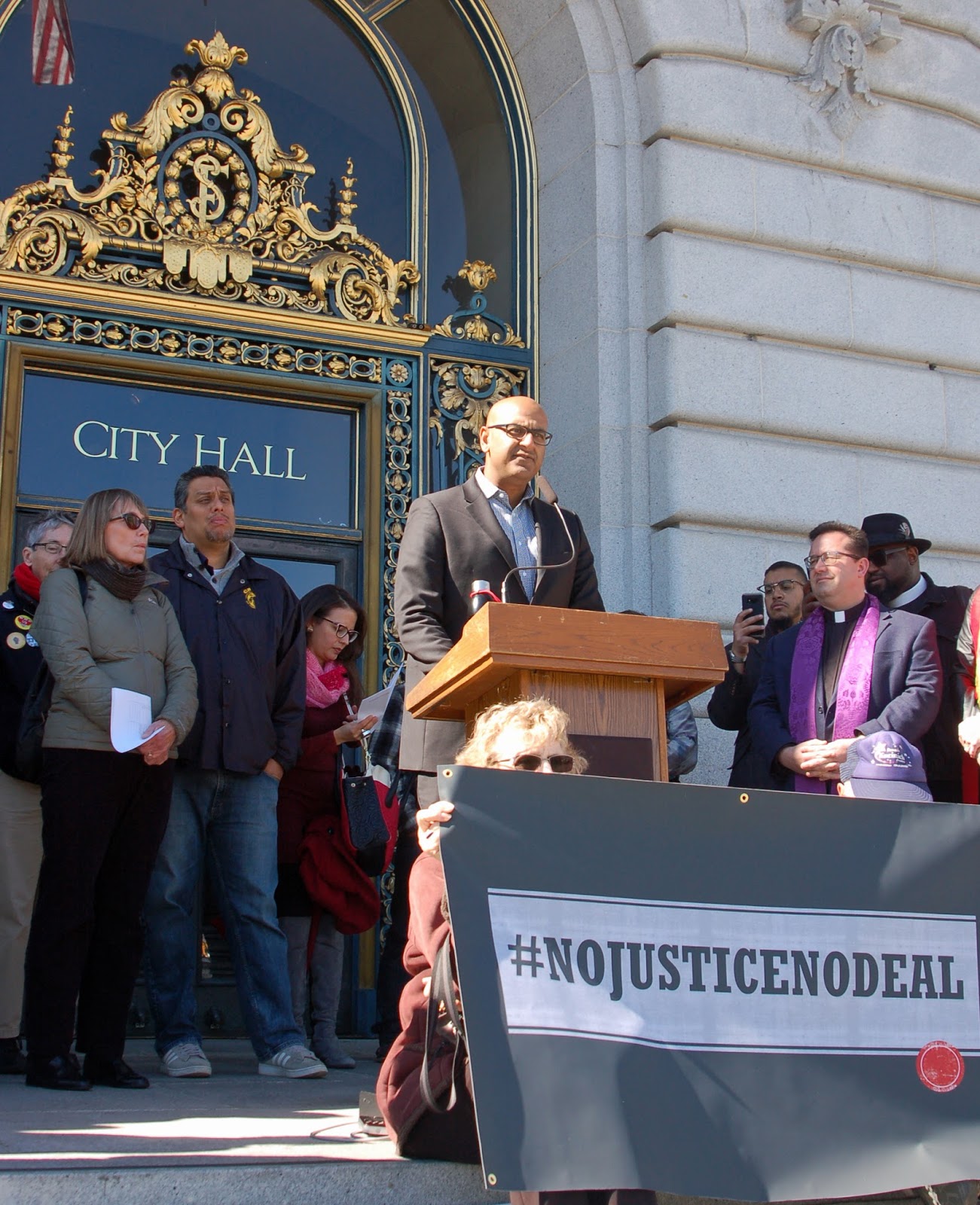
#NoJusticeNoDeal demands an accountable police contract

Roberto Alfaro from HOMEY who works with youth in the Mission has had it with a police union (POA) agreement that frees the SFPD from most oversight and citizen control. The POA's contract with the city is up for renewal and renegotiation. The #NoJusticeNoDeal coalition, speaking on the steps of City Hall yesterday, wants our elected Board of Supervisors to demand a commitment from the POA to honor the city's values by supporting reforms.

John Crew (l), a retired police reform litigator from the ACLU, has been at this work for three decades. He insists:
We, the citizens of this city, are not getting the modern, professional police department we've shown we're willing to pay for. ... The POA is to policing as the NRA is to gun control.
Anand Subramanian (r) from PolicyLink has plenty of reason to know that the POA has been been led by a small group of bullying officials who disdain the City's values while protecting the department's bad actors. Subramanian led the Blue Ribbon Panel whose findings in 2016 led the Justice Department to list hundreds of improvements needed to bring the department in line with law and best practices. (That was back when we had a Justice Department working for justice ...) Deceased Mayor Ed Lee and our new outsider Police Chief William Scott pledged to make changes. The California Attorney General's office has agreed to pick up the oversight task that Jeff Sessions has dropped.

Father Richard Smith and other clergy brought together by Faith in Action Bay Area and PICO California lent their support. All were at pains to explain that the broad #NoJusticeNoDeal coalition is not hostile to unions in general. They do assert though that the POA abuses labor law to prevent lawful oversight. Further, this coalition supports disciplined police officers who are doing a tough job. But they need to see a contract that helps restore trust between community and cops. The current renegotiation provides a rare opportunity for San Franciscans to demand a better deal.

Tuesday, February 27, 2018

Middle America’s mothers and grandmothers are coming

Eminent researchers of social movements, Theda Skocpol (Harvard) and Lara Putnam (University of Pittsburgh), are making some bold predictions. There's no scholarly caution here; they really believe they are seeing a democratic (that's with a small "d") inflection point that will profoundly shift the Democratic party in the next few years.

At the current pace, it seems likely that the pop-up leaders and grassroots groups of 2017 will, by 2019, have repopulated the local layer of the Democratic Party in much of the country. National media misperceptions to the contrary, this will not look like a far-left reinvention of Tea Partiers or a continuation of Bernie 2016. It will look like retired librarians rolling their eyes at the present state of affairs, and then taking charge. ...

This change will come smoothly and cooperatively in some places and through conflict and displacement in others. The change will move farthest and fastest outside of the metropolitan cores where local Democratic Party patronage structures still persist. Purple suburbs, mid-size cities, big towns in red regions—these are the unexpected epicenters of the quake underway. The cumulative result will be local Democratic Party leadership across much of America that is slightly more progressive and much more female than it was, although not much more socio-economically diverse.

Everywhere, the renovated party locals will be passionate about procedural democracy: determined to fight gerrymandering, regulate campaign activities and finance, and expand and guarantee voting rights for all. ...

These researchers' argument in Middle America Reboots Democracy is the product of months of interviews with activists newly energized in the wake of Donald Trump's victory in 2016. Much of the research data that underlies these predictions is from the politically volatile state of Pennsylvania which has just seen its Congressional boundaries redrawn by its courts to break up a Republican gerrymander. Putnam and Skocpol found an emerging horde of newly active, largely white, women at or near retirement age, with the skills, resources, and social confidence to replace, or displace or revitalize an atrophied Democratic party. They make the case that these women are already winning local victories and will only win more and become more central to Democratic politics over the next three years. This is a very hopeful prospect; the case seems plausible. Read it all.
***
For decades, I've been helping local organizations in the communities of color realize that the Democratic Party is porous. If you organize a constituency, the powers-that-be with more cash and historic leadership positions will court you. In California, that actually happens, thanks to diligent work emanating from Los Angeles and the San Francisco Bay. These forces give the California Democratic Party, for all its internal struggles, a breadth and comprehensiveness that the Dems would not otherwise have. The Republican Party in California is near dead, likely to be outnumbered by indies by November..

In the rest of the country the question that will arise is whether the rising white suburban women can find a way to coexist with urban Democratic pols who've had party power to themselves in a season of decline. That's not a simple question. The cities have been bastions of leadership of color. These urban Democrats have been and will remain the power base for communities of color within politics unless residential patterns change a lot. And they are the irreducible foundation on which the Democratic Party depends. There's a challenging road ahead, but the highly pragmatic forces emerging in the 'burbs just might be able to walk it, at least for a few seasons.

To be continued ...

What resisters care about

Vice sponsored a poll of the sort of people who make up "the resistance" to try to find out what matters most to us. (I'd qualify in their sample and if you are reading this, you might too.) They sum it up:

Voting is an American value, and one that faces a frontal assault from the most reactionary forces in our country.

First and foremost, we want people to be able to vote, do be able to participate democratically in deciding the future of this country. This means supporting a raft of reforms at state and federal levels in the mechanics of how citizens establish their eligibility: more automatic voter registration, same day registration, and pre-registration for 16- and 17-year olds when they apply for a driver’s license. All of this should be no-brainers; in our technological environment, the notion that it is hard for states to establish whether individuals live where they claim and are of age is simply laughable.

Other reforms would make voting easier: mail-in ballots, time off for voting on early voting days if people with difficult schedules as in fast food employment need it, and simply more polling places if voting requires such venues. (I have questioned whether mail voting might lower the feeling of participating in a national citizenship ritual which has its own attractions, but we almost certainly are going that way.)

Republicans act as if they know that restricting the vote is a life and death priority for their very unpopular priorities. As conservative pundit David Frum has explained:

The Republican Party has a platform that can’t prevail in democratic competition. ... When highly committed parties strongly believe [in] things that they cannot achieve democratically, they don’t give up on their beliefs — they give up on democracy.

Resisters want to expand voting rights because we believe we are the future. Let's make it so.

Monday, February 26, 2018

Another thought about class

These ladies are far more what the working class in this country looks like than the much discussed notion of "working class" in too much media. They were happy to let me snap their picture as they marched to demand a living wage from Disneyland.

Here's Erik Loomis explaining:

Far too often in our imaginations and in our media, we imagine the working class as a white man, probably with an out of fashion mustache, in a union jacket inside a steel mill. Or some such variation of this.

This has led to the definition of “real workers” and thus “heart of America voters” being the same white guys in Pennsylvania who voted for Trump, as per 10,000 articles since November 2016. This should drive us crazy, but we also need to remember how deep this is in our culture and in our minds.

Take labor history. Even among activists, most labor activism people remember is that of white men. Briefly taking the point that whiteness is fluid out of the equation, it’s almost all white men, in today’s definition of that word: Haymarket, Homestead, Pullman, the IWW, Flint and the CIO. And for that matter, the Hard Hat Riots, which play a way outsized role in liberal memories of labor, considering it was a couple of union locals in a couple of places. But that’s the point–it’s certain types of white men that make up our shared history of the labor movement. ...

The whole post is worth reading. It may be slightly easier to visualize the color-full working class of today in California where political action and relative prosperity have buoyed union activism which is more under siege elsewhere. Or maybe not and I'm just being parochial. Still, this is what the "working class" looks like today!

Sunday, February 25, 2018

Which side are you on? Class analysis meets class stance ...

Joan C. Williams has an insight:

"Class consciousness has been replaced by class cluenessless -- and in some cases even by class callousness."

The weakness of White Working Class: Overcoming Class Cluelessness in America is that it has little more to it than that observation. Yes, many people, in all classes, are oblivious, ignorant, rude, and dismissive toward economic and cultural groups that are not our own. We can be (and all are) assholes sometimes. But that's not what class is about.

Williams does have a definition of "class." She includes under the label "white working class" households with incomes above the bottom 30% and under the top 80% with a median income around $75000 currently. So her picture is of a hierarchy (of whites): there are the poor, the working (WWC), and the professional-managerial elite (PME). The one percent on the very top -- who own us all -- go unmentioned. So okay -- but from there the book is simply a catalogue of the insults that the people in the PME throw at the people on next lower level of that hierarchy. It's a good catalogue, but it reduces the salience of class to scab picking, self-excoriating navel gazing to be practiced by properly abashed elites.

This poster, displayed in every feminist women's bookstore of the 1970s, speaks more usefully about class than Williams little screed. [Yes, it is an anachronism, oblivious to current discourse about white supremacy, but it still presents necessary truths.] In this picture, "class analysis" points to the status in the capitalist economic hierarchy that your income and other resources put you and those like you into. Class is not something that describes you alone, not an individual characteristic. Class is collective, both the home cultural turf and the constricting fate of people like you. Above all, class is involuntary. The "system" (and the system's beneficiaries) nail you into your status there.

This perspective points to the poster's conclusion about the meaning of "class analysis" -- to looking around for who is on the same side of the fence(s). The Williams book enjoins members of the PME to be nicer, less judgmental, more understanding of WWC class cultures. The poster enjoins everyone to throw their weight behind eradicating the injuries of class by picking a side. Now at most times and places, most people will tend to choose first to stand with the side that seems to consist of their nearest and dearest.

But observing that class means there are sides implies the possibility of people picking sides that the existing class hierarchy didn't plan for them. We don't (usually) control our position in the class hierarchy, but once we observe that hierarchy, we can choose our "class stance" -- to choose consciously where to throw our weight in the social push and pull for class advantage and more equality. We can decide that our values (and even our less parochial interests) require undoing some of the injuries of class. Some of the time in some circumstances, people up and down the hierarchy can throw in with people whose lifeways are not just like their own.

There are tried and true principles for such struggles. People with more social power (social capital as academicians revealingly call it these days) have to defer to the people with less or they'll just replicate existing hierarchies. That's no help.

There may be circumstances in which class differences create tough chasms between good people, especially when conservatives have exploited class differences to fan culture wars, as in the domain of gun violence.

But there are plenty of aspects of the struggle for a better life in this country in which people who've decided they want to be on the majority side together against the super rich can align themselves. Think preserving public education for all, working for affordable housing, defending workers' rights and workers' unions.

If the sort of people who read this blog don't like class cluelessness, do something useful -- guilt and navel gazing are just self-reinforcing wallowing.

Saturday, February 24, 2018