Showing posts with label pandemic. Show all posts

Saturday, November 30, 2024

It's still COVID!

When an election turns on very small margins, everyone who thinks they know why a shift in voter preferences happened can plausibly make a case for their opinion. And Donald Trump's victory over the Harris-Walz ticket was small:

Trump’s margins — both in raw votes and in percentages — were small by historical standards, even for the past quarter century, when close elections have been the rule, including the 2000 Florida recount election and Trump’s previous two races in 2016 and 2020. ... PBS
Sure, there was some movement away from Dems everywhere -- but also Dem candidates, especially for the U.S. Senate, did well in even in battleground states and the lower House of Congress remains almost evenly split.

So observers are still largely in "pick your poison" mode for explanations.

And I'm sticking to mine: the experience of COVID and COVID polarization somehow tossed many Americans off-center and we're still addled by a lingering awareness that our trust in how the world works could be upended by a germ -- or something else unknown and unforeseen.

David Wallace-Wells has chronicled how COVID and COVID politics have shaped our memories of living through the pandemic. His account might surprise you:
The story is this. When Covid arrived on American shores, the United States did not have to collapse into Covid partisanship, with citizen turning against citizen and each party vilifying the other as the source of our national misery. Instead, political leaders could have moved forward more or less in unison, navigating epidemiological uncertainties unencumbered by the weight of the culture war.
You may be laughing, but this is actually a pretty good description of what genuinely happened in the spring and summer of 2020, despite how you may remember those days now. Back then, the president was a lightning rod who seemed to polarize the country’s response all by himself, although he had rhetorical help from podcasters and radio hosts, governors and members of local school boards. But at the state and local levels, for many months, red and blue authorities moved in quite close parallel. For the most part, red and blue people did, too. ...
Present divisions came along later, with the development of vaccines (delivered to arms, though not invented, during the Biden term) and the higher mortality, especially in red states, in the pandemic's second year.

And from there, we got to where we are now, with Donald Trump appointing health authorities whose prominence was raised by distress about COVID. Here's David Wallace-Wells again.

[Robert F. Kennedy Jr.] owes his current selection to pandemic backlash and the intuition, in Trump world, that Covid contrarians should be drafted into a broad insurgency against the institutions of science. ... the others named for top public health posts, though not transparent cranks, are also Covid contrarians whose most important qualification for these positions are their crusades against the public health establishment during the pandemic period: Stanford’s Jay Bhattacharya to lead the National Institutes of Health, and Johns Hopkins’s Marty Makary to run the Food and Drug Administration. Dave Weldon, Trump’s pick to oversee the Centers for Disease Control and Prevention, was a vocal vaccine skeptic long before the pandemic.
... Democrats have grown increasingly invested in, and identified with, the management style and worldview of the credentialed elite — with the Republicans, once the party of the country’s establishment, growing a lot more unruly as a party and a coalition.
But there are a few things that are nevertheless strange about what Benjamin Mazer called “The COVID-Revenge Administration” and the way its are united primarily by a “lasting rage” about the initial handling of the pandemic.
The first is that the federal pandemic response was actually supervised by Trump and many of those whom he appointed, the first time around. Americans often tell the story of Covid now as though our pandemic response was run by safetyist liberals in an unreasonable panic. But while Trump was remarkably indifferent to Covid in 2020, he was also, for the entire period we now remember erroneously as “lockdown,” in charge. (Americans often remember that period as stretching for multiple years; in fact, all but one state withdrew its stay-at-home orders within three months.)
The second is that, nearly five years on from the first reported Covid case, it’s not clear to what extent the public as a whole really did hate the country’s initial response to Covid. America exited the pandemic emergency into a period of post-pandemic exhaustion and frustration, one that undoubtedly contributed to public irritation with those liberals many Americans understood to be in charge....
Click to enlarge.Via Kevin Drum
... And the third is that, early in the pandemic, many of the leading Covid contrarians, including some of those now at the top of Trump’s short list, were among the most inaccurate voices making claims about what were then probably the two simplest and most important questions facing anyone trying to right-size the pandemic response. Namely, how bad things could get and how long it might last.
... at the outset, many of the most outspoken contrarians — today claiming vindication, complaining about censorship even after building huge social-media followings during the pandemic, were telling us that the most important thing to know about the pandemic was that it was simply not a big deal.
Over the course of the pandemic, many continued to argue against restrictions, even as they’d lessened considerably, and even as the disease made a mockery of their predictions about its ultimate toll. In time, the American public has in some ways grown more sympathetic — forgetting the panic of the initial months, taking somewhat for granted that the death toll would land near where it did and assessing the wisdom of those mitigation measures as though they had no effect on mortality at all. (As it happens, some research suggests that those measures could’ve saved hundreds of thousands of American lives.)
But to suggest that mitigation was pointless because the measures were ineffective in preventing mass death is functionally the opposite of arguing that it was pointless because so few lives were at stake. ...
“The problem with pandemics is that people want to forget them,” Michael Lewis wrote last spring in the foreword to “We Want Them Infected.” Of course, many people do want to forget, and understandably. But others want to litigate and relitigate and relitigate, and in some ways the imbalance of motives may be a bigger problem than pandemic amnesia itself, allowing those with the sharper critiques to furnish the frameworks that the otherwise indifferent grasp for when trying to make sense of their own experience. ...
We're all a little nuts when it comes to the pandemic and, for the moment, the anti-expertise side of various arguments is getting a turn in the sun. Let's hope we don't come to grief during their ascendancy.

 Dr. Leana S. Wen responded to the questions raised by seeing RFK implanted on top of U.S. health policy in "Should I get my vaccines while I can? Your questions, answered." (gift article) She's not entirely alarmist, but she suggests you make sure your vaccines are up to date if possible by January 20.

Saturday, November 09, 2024

It's the COVID, stupid!

Of course not entirely. And the virus has plenty of enablers and accelerators. But the horrid result of the Presidential election convinces me that pandemic effects are still working through society. 

Mostly we're too close to the election to be very discerning. I took a broad view yesterday in the comments on David Rothkopf's substack effort to understand what the voters have done:

[David] tossed this remark in as a throwaway: "We still do not fully understand or appreciate what a game changer COVID was for our society." I will not be surprised if future historians with more distance suggest this was the central phenomenon in our politics.

COVID proved to us that government could not protect us -- or that it's response was cruel and useless --or somebody was trying to put something over on us. And many more things, all disillusioning.

I have seen surveys somewhere that internal resilience to the COVID shocks was highest among old people, even though we were objectively the most vulnerable. Very young people were worst thrown off-center. The in-betweens, in-between. [Found the study here. Does seem to say what I remembered.]

In the conditions of 2020-2025 America, our political order just wasn't up to a worldwide plague. Much follows from that, much of it more ultimately damaging than the plague itself ...


Before the vote, Patrick Healy ran focus groups for the New York Times:

The worst of the pandemic may feel far away now, but as we look at the Harris versus Trump contest on Tuesday, Covid is the essential prism through which to understand the trajectory of the last three years in America. The pandemic felled Mr. Trump in 2020, bringing out the true autocrat for all to see on Jan. 6, 2021, and fueled his hunger for the second term he felt he was owed. Covid shaped the economy that Mr. Biden tried to revive through policies that proved inflationary. The shocks and aftershocks of the lockdowns and closures set many of our focus group participants on harder paths in life, from schoolchildren to college students to workers to the elderly.

Covid changed and scarred America. Desperation set in for people who thought of themselves as financially stable or middle class. The frustration we heard in our early focus groups in 2022 metastasized into anxiety in 2023 and intensified into anger in 2024. Listening to them, I stopped seeing anxiety and anger as two distinct emotions. They were one and the same by the time the presidential general election began this year.

So many people talked about their lives before and after Covid that it influenced how I saw Mr. Trump’s chances and Mr. Biden’s challenges in this election (and how those challenges, inevitably, shifted onto Ms. Harris). ...

Nowhere in the world following the pandemic where elections genuinely matter have incumbent parties sustained their power as before. Sometimes the deep societal disruption has had results democratically oriented people can applaud. Voters bounced the Tories in Britain resoundingly and replaced the authoritarian party in Poland more narrowly. Even Narendra Modi's Hindu nationalist party which runs not entirely free elections saw its margins decreased. 

Meanwhile, far right parties threw the previous bums out in Italy and Argentina, installing the more and less responsible far right.

Our societies have proved far more fragile than they look. We're enduring animals; we'll right ourselves, more or less. 

But the cost will be great. And there'll be novel challenges.

Wednesday, January 17, 2024

Beautiful, strange, and paradoxical

Lying in bed, savoring the foul taste of paxlovid, I ponder a bit Bill Watterson and John Kascht's The Mysteries. Their visually stunning fable takes a misanthropic view of human progress, human science, human obliviousness. 

It's hard to fault the general theme. The little book is a visual tour de force. I got it from the library and urge you to do the same. (Watterson might be known to you as the creator of "Calvin and Hobbes".)

But right this minute, I'm taking another view. As much as I know the dark side, I'm also inspired by the human ingenuity and determination which gave us vaccines for a novel virus within a year. And now there are also drugs that mitigate COVID. I remember the terror of 2020 -- if you got the disease, you might be a goner. But somehow we had to live (too often dependent on risks to those who could not afford to hunker down at home). So we did, most of us. Here in the Mission, we were organized by community leaders to help each other.

That too is a Mystery. It's a strange and paradoxical universe and humans are a strange and paradoxical part of it.

Tuesday, January 16, 2024

Still feverish, still positive 5 days into COVID ...

but living the good life of a battery powered zombie in this heated vest, a gift from Erudite Partner. Yes, eventually, everything will be battery powered, we hope.

Sick of my current condition, but COVID is apparently not quite through with me. Or many of us this winter. Fortunately I don't feel seriously ill, but still may need to avoid people.

This San Francisco Chronicle article [gift link] describes what seems to be happening in this household. Despite having mild sickness last June and up-to-date shots, the current variant seems to get through. 

Peter Chin-Hong, a UCSF infectious disease expert, said the long duration could be related to the “changing of the guard” of COVID variants. 

“People who had been exposed to XBB in the summer and fall were less protected when JN.1 emerged,” he said. “Strategies people had used to make them NOVIDs (people who have never had COVID) in the past did not work quite as well with the more transmissible JN.1. So that made a whole lot of people susceptible to COVID over a duration of weeks.”

This too will pass.

Tuesday, September 19, 2023

We think inflation is terrible because prices are higher than we remember

I'm usually a fan of Paul Krugman. He's a humane commentator on our condition who often gets reality right. But he made an argument today in his NYTimes newsletter (link may not work as it is a newsletter, but there it is) which completely misses the point of what people are talking about when we complain about inflation.

 
He observes that he gets huge push back when he observes that inflation is coming down. He earnestly discusses the various measures of inflation; there are several and they serve different analytical and policy purposes. He assures the reader that he is not gaming the system when he chooses which measure is relevant in which context. I believe him.
 
Krugman asserts:
The question of what’s happening to inflation is, or should be, a purely technical issue.
But probably most of us don't think any of this makes any sense because we know it requires more of our dollars than it used to once to go about our daily business. I am going to a warehouse store later today; I know that I'll spend 15-20 percent more dollars than I would have in 2019.

The pandemic has left a rift in our consciousness. There was before; there is after. Everything costs more. That's what inflation means in common understanding.

"Inflation" is not whether some measures favored by economists are going up -- and are currently going down. Inflation in every day life means that prices are higher (some much higher) than "before." We simply won't notice the trend line until the disruption is further in the past -- when the meaning of "before" changes. Might that be this year?

I hope so.

Saturday, June 10, 2023

Just what I wanted to see ...

No extra line. No problem.

I've gotten off easy. Will mask among people for another week, but barring rebound, we're done in this household.

Thursday, June 08, 2023

From the pest house ...

First off, I should say that Covid is not being very miserable. Some fevers, a little woozy, but mostly necessary isolation even from the EP who has advanced to a negative test. I yearn to follow.

Click to enlarge.
After some mild bureaucratic obstacle jumping, my Kaiser doctors prescribed paxlovid -- and I just want to share that the drug's packaging is a revelation. Pictured above.

Why don't most drugs come with packaging which embodies the instructions as this does? You just do what it says ... it is even color coded.

I raise that because, right before I caught the Covid, I'd been taking a week long course of an antibiotic as a preventive precaution when having a tooth extracted. You know -- I was prescribed a neat little bottle of 21 pills to be ingested three times a day. And within a couple of days, pre-Covid, I found myself confused: had I really taken the morning dose? Or the midday one? I just did the best I could.

I know that there are specialized pill boxes for this sort of thing. Or I could have created a card to check off the doses as I took them. But wouldn't it be better if the packaging the drug comes in did the trick, easing compliance? 

In particular, Medicare should require drug companies to package all drugs we old timers might take in this instructive way. Just a thought.

Monday, June 05, 2023

Time for a break

I guess it had to happen. Three and one half years in, the virus has established residence in me.

For the moment, I don't feel badly. Just tired. So I isolate so as not to pass it on. And nap.

The Erudite Partner is also down with this, evidently a stowaway from Morocco. 

Regular blogging will return when energy returns.

Friday, May 12, 2023

The toll

Click to enlarge.

I look at this informative map of COVID death densities from the New York Times and I see our US history of inequity and dispossession. Those very dark chunks in Arizona, New Mexico and Montana are traditional native lands, still largely the home of indigenous peoples. That dark smudge in Georgia is the old Black belt where formerly enslaved people still exist in rural poverty. The dark bits in South Texas are the home of impoverished Hispanics who found themselves on the Anglo side of a border imposed in the 1840s. 

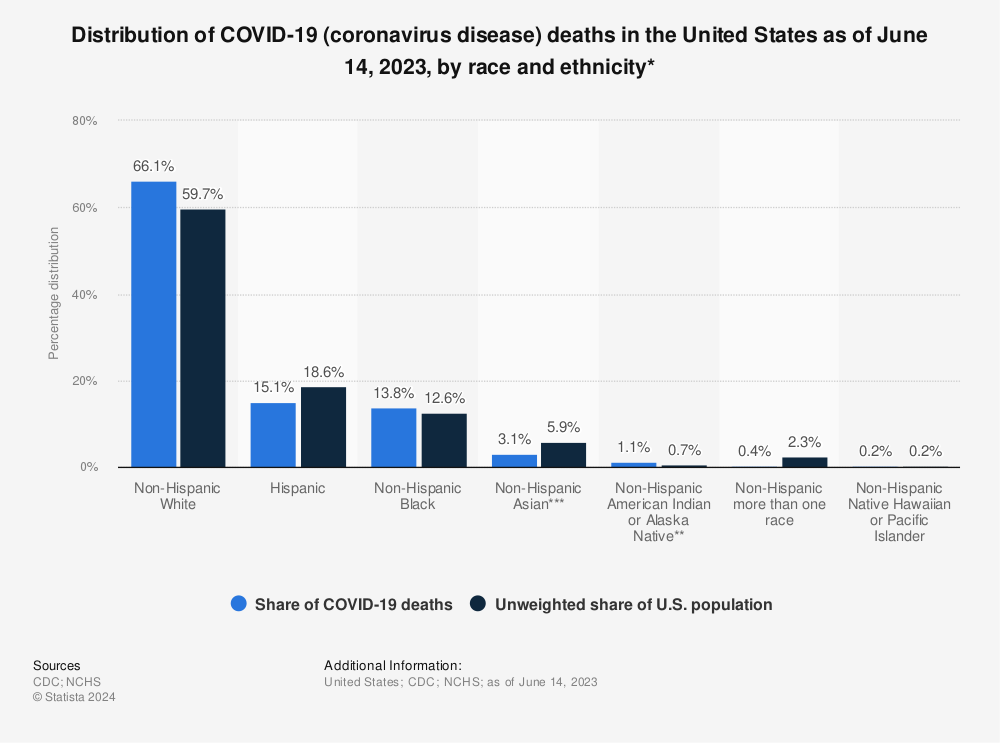
It's still a better deal to be white non-Hispanic, in this country, even though, since most of us are white, we have had the largest raw number of deaths:


Statistic: Distribution of COVID-19 (coronavirus disease) deaths in the United States as of April 26, 2023, by race and ethnicity* | Statista
Find more statistics at Statista

Saturday, March 04, 2023

Vaccination permutations

This graph from Kevin Drum surprised me.

I figured that one of the consequences of our political polarization over COVID vaccines would be that increasing numbers of parents would start resisting medical and educational insistence on vaccinating children, one of the triumphs of modern public health. Kids mostly don't have to suffer from nasty childhood diseases these days. A very significant fraction of the increase in life expectancy over the last century came from more individuals living to age five because of escaping childhood plagues.

But apparently the COVID wars have, if anything, slightly increased vaccine coverage among very young children. Maybe all the noise has increased parental awareness - and possibly even broadened access?

California has decided not to fight the fight over the COVID vaccine in the public schools. The Los Angeles Times explains there are good reasons for educational institutions to opt out of this culture war:

Unlike the other vaccines required for school enrollment in California, the COVID vaccines are unreliable at preventing infection or transmission, providing at best modest protection against infection for only a couple of months. 
In contrast, the vaccines already required for school attendance, such as those for measles, mumps, rubella and polio, reliably prevent outbreaks when local vaccination rates reach a certain threshold. The hepatitis B and varicella (chickenpox) vaccines afford protection against infection for years, diminishing long-term transmission risks. The tetanus vaccine provides only individual protection, but it is administered in combination with vaccines for diphtheria and pertussis, which protect against outbreaks over the long term. 
We never had any evidence that the COVID vaccines would work like vaccines that provide a high degree of lasting protection against infection and transmission, conferring so-called herd immunity.
So I guess this polarizing cartoon was not as clever as it seemed in 2021. We live; we learn.

Saturday, December 03, 2022

Hoping for a good outcome for China's COVID test

Just about every source through which most of us consume international news keeps reminding us that contemporary China is a pretty awful place for human rights (think what seems a genocide of Muslim Uyghurs) and freedoms (think the destruction of democratic elements in Hong Kong and mainland China's nationalist threat to democratic Taiwan).

As Xi Jinping’s Zero COVID strategy appears to be failing, Americans and Europeans might think we have license to gloat. We suffered -- the Chinese can too.

I'm grateful to Adam Tooze for pointing out the conundrums and costs any Chinese government would face as Omicron breaks through and millions of Chinese people have had enough of ongoing tight restrictions.
A dictator’s embarrassment is generally a cause for celebration. But what if it also threatens a national tragedy and a bona fide global problem? ... now, only weeks after Xi’s triumphant party Congress, the zero covid policy is in crisis. The disease is spreading and China’s population is no longer willing to put up with it. ... One must profoundly admire the courage of the protestors and sympathize with the outrage and desperation triggered by successive waves of capricious lockdowns. ...
... [But] what is the policy alternative? The fact that abandoning zero COVID would be a blow to Xi does not make that the right policy. The dilemma facing Beijing goes beyond the question of Xi’s legitimacy. As ludicrous as zero COVID has come to seem, as oppressive and capricious as its intrusions are in the everyday lives of Chinese people, it has saved huge numbers of lives. And if Beijing were to follow the demand to abandon the policy, this would likely result in a public health disaster not just for the CCP but for China.
Omicron is less dangerous than Delta but its infectiousness is extremely high. If the pandemic is allowed to run unchecked, hundreds of millions of people will become infected. Even with a low rate of severe cases, China’s medical system will be placed under impossible strain, not just in a handful of cities as in 2020, but across the country. Hundreds of thousands of vulnerable people, if not more, will likely die.
It bears repeating that though China may be a remarkable economic success story, it is still a middle-income country and its welfare net and health care provision are fragile, especially in the countryside, where hundreds of millions of people still live. ... the figure of between 500,000 and 1.5 million deaths are predicted by most studies would ... be a shattering disaster.
... There are no simple answers. Xi’s regime is weighing huge risks. Anyone who imagines that that can be a matter of indifference to the rest of the world or is tempted to indulge in Schadenfreude has not learned the first lesson taught in February 2020 - what happens in Wuhan does not stay in Wuhan. ...
We adopt obliviousness to the human cost of China's peril at this moment at our own peril -- moral and material. Much as we loathe the Chinese government's abuse of its people, we should be hoping it can find a relatively gentle path forward as the coronavirus escapes the temporary fence the zero covid policy built for the last couple of years.

Tuesday, November 29, 2022

The virus, precautions, and our biases

The current, and most likely continuing, risk profile of coronavirus infections is an invitation to ageism. And since ageism is an unspoken reality of our lives, it's influence cannot be discounted as we learn to live with the virus.

According to S. Matthew Liao, a professor of bioethics, philosophy and public health at New York University

“There’s a bit of ageism, so to speak, attached to it,” he said, adding, “People, even if they are older, they still have as much claim to live as me.”
The ageism in our understanding of the coronavirus isn't just prejudice, though both how we understand evidence and how we respond to risks will necessarily reflect out prejudices. The virus is more deadly to us old folks.

Unlike flu, which impacts both the very young and the very old, the coronavirus appears to put mostly older people at higher risk of severe disease and death. The proportion of deaths among those 65 or older has fluctuated from eight out of 10 in the first few months of the pandemic, to a low of 6 out of 10 when the delta wave struck in the summer of 2021, to a high of 9 out of 10 today.
Last month, people 85 and older represented 41.4 percent of deaths, those 75 to 84 were 30 percent of deaths, and those 65 to 74 were 17.5 percent of deaths, according to a Post analysis. All told, the 65-plus age group accounted for nearly 90 percent of covid deaths in the United States despite being only 16 percent of the population.

The only individual solution is to get fully vaxxed, take precautions that make us comfortable, and stay current with the best information we can find. And it doesn't hurt to advocate and agitate for stronger efforts to protect vulnerable old people who may not have the choices the more privileged among us enjoy.

• • • 

I write this coming off a season of serving as the "COVID officer" to a campaign involving nearly one hundred canvassers. Only one of these people contracted the coronavirus while working with each other every day, and that on the day after the election. We were determined to keep the crew as safe as possible -- for the well-being of individuals, of course, but also because an outbreak could have derailed our program.

UniteHERE can be proud that it chose to do what needed to be done to keep us COVID-free. All of us were required to be vaccinated and boosted. We wore masks indoors, though not religiously. Moreover, material safety precautions included housing everyone in separate units (no roommates on this campaign!) and renting cars for each driver, both expensive expedients which might not have been implemented with no pandemic. 

Being the COVID officer meant receiving the electronic forms everyone had to fill out each day which sought to alert folks if they had any suspicious symptoms. I spent a lot of time talking with canvassers who were plagued by allergic snuffles and providing antigen tests if they wanted them. Also providing fever thermometers.

Despite the precautions, I still think we got lucky. There's still a pandemic going on.

And we weren't all young. We had a canvasser who is 82 ...

Saturday, September 10, 2022

Is it over?

Tonight Erudite Partner and I will get our third COVID boosters. It's been nearly a year; I'm sure we need an immunity upgrade.

Here on the Reno campaign, I'm the COVID safety officer. We are very careful, far more than most people around us. Every canvasser who can drive has their own rented car. Everyone has their own separate lodgings. We ask that all of us wear masks when inside and try to eat outside at restaurants. And, every day, all of us fill out an electronic form that comes to me, examining ourselves for symptoms.

If someone reports possible symptoms, I have them stay home at the motel and visit with a rapid test and a thermometer. So far it's always been allergies and/or exhaustion. We're going as far as we can to keep ourselves COVID-free.

So far so good. No coronaviruses here (nor were there any on the Reno campaign using the same protocols in 2020). Obviously we don't want our folks getting sick, but we are also very aware that a super-spreading event could shut down the whole operation. 

• • •

New York journalist Jill Filipovic had an interesting and quite different reaction to receding coronavirus restrictions than we're having here. 

I am definitely in the relief camp when it comes to lifting Covid restrictions. I’m also generally physically healthy, and I have a relatively high tolerance for risk. At some point, every society has to make cost-benefit decisions, including about health and safety. ...

But it also means an opportunity for straightforward conversations about how we weigh the various costs and benefits of any policy change. And it’s an opportunity to get a little more creative: What worked during the pandemic? What didn’t? What could we try to maximize people’s health and their desire to return to normal?

... [I] chafe at a return-to-normal path that simply tries to recreate Before Times without much thought to how we could integrate the lessons of the past three years as we chart our way forward — when it comes to health and safety, but also work, family, culture, and society. There is ample opportunity here to rethink the way we’re living. It’s a shame our policy-makers largely aren’t taking it.

Certainly the level of careful distancing we're maintaining here isn't appropriate to most lives. But have we learned anything enduring from the precautions of the last few years? All comments welcome.

Tuesday, May 24, 2022

Maybe not healing, but movement toward a different equilibrium

It's so obvious that the experience of the pandemic has left just about everyone spooked and perhaps a little nutty. Pauline Boss's little volume -- The Myth of Closure: Ambiguous Loss in a Time of Pandemic and Change -- speaks directly to a facet of what made the last two years so hard: so often the people who would have formed a support circle for sick people and for surviving loved ones couldn't be present with those who needed them. The horrible paradigmatic case is of couples and families who were kept from even saying goodbye to their dying members at the height of COVID infection fears. But all of us in our own ways lived with losses that couldn't be faced in the social ways we would have once thought only normal.

Boss' career and expertise is in helping people who've experienced the awful trauma which she named "ambiguous loss." In particular, she worked with people who lost family members in the 9/11 attacks on the World Trade Center -- no bodies, no mementoes, just agonizing uncertainty that finally morphed into certainty. Loss of this kind has particular markers.
Ambiguous loss is neither a disorder nor a syndrome, simply a framework to help us understand the complexity and nuances of loss and how to live with it. My focus is on building resilience to live with and thrive despite a loss that can't be clarified. Here, resilience means increasing your tolerance for ambiguity. As a result of the great uncertainty that surrounded the COVID-19 pandemic, the ambiguous loss skyrocketed and left some lasting effects for us to deal with for years to come, as individuals and as a collective. ... 
... Wherever they are, I write for the millions who are still unmoored by their pandemic losses and want to make sense of them. With so many sickened and dead worldwide, we are just now emerging from this great shadow of death. Life will go on, but it will be different. It already is. We won't go back to the way we were because change is both needed and taking place. ... What helps? Letting go of the idea of closure and instead, finding meaning in our losses, thinking both/and about the positive and negative, and finally, risking change by doing something different. ..
In addition to our pandemic losses, Boss insists that in the last few years, many of us have also been trying to absorb heightened awareness of murderous white supremacy and of advancing climate collapse. No wonder as COVID recedes (we hope), many of us nonetheless feel unmoored, a little at sea. And we need to understand, according to this author, that "closure" is a myth.
In the popular vernacular, closure is unfortunately used to describe the ending of the grief that comes after loss. The assumption is that you'll be "over it," done with your sorrow once you have closure. Not true. ... What I have learned is that even with the most extreme cases of loss, having no closure doesn't have to be devastating. ... I saw repeatedly that keeping loved ones present in one's heart and mind, even after they have disappeared or died, helps on to hold the loss and its grief without seeking an absolute ending.  
... the cost of seeking closure is that it's impossible and thus saps our energy and distracts us from seeing other coping options that could lead to more emotional growth and resilience. The benefits of not seeking closure are many. ... without needing closure, we can feel more rooted in this world because we now see more than ourselves in it. We are genetically part of those who have gone before -- and thus part of the human species. With continuity instead of closure, we are not alone.
As most readers of this blog know, I'm not much for psychologizing. But I found Boss' little volume humane, compassionate, and wise. Like most of us, I've felt surrounded by losses in the last couple of disorienting years -- especially by too many deaths (though none from the coronavirus) -- most not marked as we would have in the before times. We need to be gentle with each other. Boss knows that.

Wednesday, May 18, 2022

COVID is becoming a killer of the young

I didn't know this. Apparently over the last year, COVID has been the leading medical cause of death in the United States among people under 55. Not chronic diseases, not suicide, or other gun episodes -- but COVID.

Click to enlarge

According to Inside Medicine:

Many believe that Covid-19 is merely a cold for all young people and a death sentence for a handful of older folks who probably would have died around the same time anyway. 
That is wrong. 
We know there has been extraordinary “excess mortality”—that is more deaths than usual during the pandemic. It’s not just that people dying of cancer happened to have caught Covid in the last weeks of their lives. Rather, people are dying way early—sometimes months, but more often years and decades earlier than they otherwise would have. 
... What surprises many is just how many young and middle-aged adults have died. Nearly 250,000 people under the age of 65 have died of Covid-19 in the United States so far. Around 61,000 of these deaths were in people under the age of 50. 

Those of us 65 and older are 90% fully vaccinated in the United States. Covid can kill vaccinated people, but in the most part, serious outcomes -- deaths -- happen to unvaccinated people, who are largely younger.

• • •

We're very COVID conscious around here at the moment as a household member has tested positive. So far, so good here.

Thursday, April 21, 2022

Another COVID milestone

This is so wrong. In order to score political points, Republicans have been willing to cast public health interventions against the pandemic -- shutdowns, masks, vaccines -- as partisan hoaxes. And the result has been literally deadly to their own voters. 

Philip Bump tells the story with a series of charts:

Thanks in part to President Donald Trump having argued that the virus posed little risk and was soon going to vanish from the United States, Republicans began to express far less concern about being infected. They reported being less likely to take preventive measures against contracting the disease, such as wearing a mask. And, over time, Republican parts of the country began seeing higher rates of mortality than places that voted for Joe Biden in November 2020.

And, inextricably, White Americans — a demographic the vast majority of Republicans are part of — began consistently dying at higher rates than non-Whites.

Black citizens were slow to get on the vaccine bandwagon for all the usually cited reasons, from distrust of the medical authorities to poverty. But Republican sabotage has achieved an improbable result:

While the rate of covid-19 deaths among Black Americans was higher than that for Whites in each of the first 15 months of the pandemic, White Americans started seeing higher rates last September — when the delta variant was hammering red states and as the vaccination divide was really starting to be felt.

It’s likely that this month White Americans will have seen a higher per capita death rate than Black Americans for the first time during the pandemic. That change is clearly attributable in large part to attitudes about masking and vaccination, and those attitudes are attributable to partisanship.

It's downright unAmerican to see racist White politicians set their White followers up to suffer more than Black people. But the current set of GOPer pols have managed it -- and they are killing their dupes.

Thursday, April 14, 2022

A necessary break

So I checked this off Wednesday. And, unlike previous rounds, this shot left me a little woozy. 

Imagine I'll be back Friday.

No line, by the way, just the usual Kaiser efficiency.


Thursday, April 07, 2022

Guns in the home don't make us safer

To many Californians, that's a pretty intuitive notion.  Now there's an exhaustive study using a solid, large data set that supports that conclusion.

California adults who live with a gun owner face twice the risk of death by homicide
Between October 2004 and the end of 2016, adults in the state who didn’t own a gun but took up residence with someone who did were much more likely to die a violent death than people in households without a handgun, researchers from Stanford University found. 
Those who lived with a handgun owner were almost twice as likely to die by homicide as their neighbors without guns, the researchers found. More specifically, adults who lived with the owner of a handgun were almost three times more likely to be killed with a firearm than Californians in households where no handguns were present.
... Among the 866 homicide victims who died in their homes during the period studied, cohabitants of handgun owners were seven times more likely than adults from gun-free homes to have been killed by someone who ostensibly loved them. Rendered into the statistics of public health, the findings suggest that for every 100,000 unarmed adults whose cohabitant acquired a handgun, 4.03 more were killed by a firearm in the ensuing five years than would have been if their households had remained gun-free.
During the pandemic, lot of people sought protection by buying guns. We all felt plenty of fear, much of it free-floating fantasy. But for some, it meant "time to get a firearm."

The same study found no evidence that having a gun in the house protected against attack by strangers.  

Resident women and teenagers, however, were at increased risk of violence in the presence of a gun.

There's got to be a better way to feel safer without genuine dangers.

Thursday, February 10, 2022

On adding more trouble to existing trouble

I can't resist commenting on this news item: Delta Air Lines wants to make disruptive customers eligible for an FBI watch list that keeps suspected terrorists off flights.

Really?? The "no fly" list and the "terrorist watch" lists have been an impenetrable, arbitrary, biased morass since they were expanded in the wake of the 9/11 attacks. The government won't reveal who is on these lists, how a person might get off them -- essentially anything that might uphold a personal "right to travel."

Adding airline customers who act out on flights would only make a dubious instrument that even less creditable and equitable.

Transportation Secretary Pete Buttigieg knows a questionable idea when he encounters one:

“Obviously, there are enormous implications in terms of civil liberties, in terms of how you administer something like that. I mean even when it was over terrorism, it was not a simple thing to set up.”
I understand an airline might want to toss this hot potato off to the feds, but I doubt they'll pick it up. Unless perhaps one of these traveling idiots assaults a powerful Senator. Bashing a flight attendant is one thing; messing with a pol, another thing.

Perhaps Buttigieg's department can work through the Federal Aviation Administration to make it easier for airlines to bring criminal charges against unruly passengers. It's not only good business to keep flights peaceful -- it should also be enforceable law.

Full disclosure: This issue is personal for me. Erudite Partner and I were told at the San Francisco airport in 2002 that we were on the no fly list. Through the ACLU, we sought disclosure about this secret list in a federal suit that dragged on through 2006. The government never revealed why we'd been stopped but neither of us subsequently had additional trouble and the ACLU was awarded court costs in the lawsuit.

Wednesday, January 19, 2022

How stupidly ghoulish can Republican politicians get?

These days, the signal characteristic of the unvaxxed is that that they are Republicans. Racial gaps in vaccination rates have been closing. But GOP leaders thrive on keeping their supporters riled up against public heath measures in the name of "freedom." Being unvaxxed has become a MAGA cult marker.

This is literally killing significant numbers of people in the GOP base. Former New York Times reporter Donald G. McNeil Jr. offers a quantitative estimate of how many votes the vaccine war is costing the party:

As of this week, about 1,800 Americans a day are dying of Covid; the C.D.C. expects that number to rise above 2,600. 
Virtually all are adults. If 95 percent were unvaccinated and we assume that 75 percent of those were Trump supporters, that’s 1,300 to 1,900 of his voters being subtracted from the rolls every single day. 
Donald Trump lost Arizona by a mere 10,000 votes. He lost Georgia by 12,000, He lost Wisconsin by 21,000. He lost Nevada by 33,000. 
Right now, about 60 Arizonans, 36 Georgians, 34 Wisconsinites and 14 Nevadans are dying of Covid each day. Seventy five percent of 95 percent of that would be minus 103 Trump voters per day — just in those four swing states. Week after week. That adds up. 
Also, there is another factor in the equation. Covid is just one cause of overall mortality. 
While Republican state legislatures are working hard to suppress the Democratic vote, an invisible opposing hand is working against them: God’s. 
The top five causes of death in this country, in order, are: heart disease, cancer, Covid, accidents and stroke. They all tend to smite the old, the obese and those who live far away from hospitals, i.e., rural red America.

McNeil attributes Donald Trump's recent half-hearted support for vaccines -- but not mandates -- to  some awareness of these numbers. If we are still too have elections, he needs these voters.

H/t toJVL at The Bulwark for pointing to McNeil.