Sunday, November 24, 2013

Some Bhutanese young people

This young monk was intent on his mission -- I think that was delivering lunch to someone.

This boy insisted I must take his picture, but when I clicked the shutter, his friend seemed more pleased than he did.

We were an unfamiliar distraction, I think.

Adult work for a small person ...

At play outside a temple ... perhaps his relatives were within.


These are middle school students at morning assembly. We were told that one third of Bhutanese are in some kind of schooling and that the country (population ca. 700,000) produces 3000 college graduates annually. It is not clear Bhutan produces a commensurate number of jobs requiring higher education.

Saturday, November 23, 2013

A few Bhutanese ...

Bhutanese are surprisingly willing to let tourists take their pictures. When I asked for permission, I was almost never waved away. This woman had just happily sold me some cloth she had woven; her more reluctant daughter could have hailed from any culture in the world.

This gent was harvesting turnips, for animal feed I think.

She watched us from her doorway ...

He stalked out to get a better look at us ...

Her delight in our appearance was not rare.

This city fellow saw no reason to interrupt his conversation to attend to passing tourists.

Over the next few days I'll be posting a bounty of photos from Bhutan ... tomorrow a selection of beautiful children and young people.

Friday, November 22, 2013

Democracy and filibuster follies


Corey Robin, who teaches political science at Brooklyn College and the CUNY Graduate Center, put the Senate's changes to the filibuster rule in perspective:

… But what does the vote actually mean? As Phil Klinkner explained to me, and as [an] old Washington Post piece confirms, before this vote, senators representing a mere 11% of the population could block all presidential appointments and all legislation.

From now on, senators representing a mere 17% of the population can block most presidential appointments; senators representing 11% can still block all legislation and all Supreme Court nominees.

That is, the U.S. Senate remains a deeply undemocratic institution. It was designed that way, above all to protect those states that insisted on defending their property in human beings -- to defending slavery

Over time more and more democracy has intruded on the U.S. Senate. Only in 1913 did we the people come to be able to vote directly for Senators; until then the members were appointed by often-corrupt state legislatures. I am old enough to remember when the required votes for cloture (getting to a vote) were reduced from 67 to a "mere" 60 in 1975 by a Democratic majority sick of being hamstrung by filibusters.

Yesterday's fix is only a beginning. If we were serious about about democracy, we'd amend the Senate out of existence. Why should a tiny fraction of the population be able to frustrate majorities? That's a real question. Are not elections the proper means to decide the direction of the country?

Another small step for democracy on a long road ...

Friday critter blogging: Bhutan lets sleeping dogs lie


Few sights in Bhutan amazed me more than this one on market day in the town of Paro.


In Bhutan, dogs seem to plunk down wherever they wish and apparently doze contentedly.


Fear seems no part of their experience.

In this, Bhutan is very different from other poor countries where I have visited. In ten days, I only saw a human hit a dog once, apparently because the striker thought the animal might be bothering foreign tourists who had less friendly attitudes toward a stray. The dogs seem well fed. In Thimphu, the capital and only large city, they do bark incessantly at night, but otherwise practice the same contented behavior as their rural cousins. (There appear to have been only a few breed ancestors to these Bhutanese mutts.)

This article suggests that the apparent health and well being of Bhutanese dogs is related to people's adaptation to their equivocal relationship to meat-eating. As devout Buddhists, Bhutanese are ostensibly mostly vegetarians, but in fact they do consume meat. Their dogs conveniently dispose of the associated offal. Or so the article claims. It also reports a humane effort to sterilize 4000 of Thimphu's dogs to reduce the evening cacophony.

Thursday, November 21, 2013

Homecoming, a kludge, and reason to hope


Back on the ground in the USA, I see we are living through a panic about the long delayed launch of what this country has been able of offer as a response to human infirmity. That Obamacare, that unwieldy kludge, is struggling with its own complexity is not surprising. When you promise to preserve a mass of historically accreted work-arounds and pockets of private profit, it is not surprising that you get a mess.

It's worth going the root of why this mess inspires such fanatical resistance. In a nutshell, from Thomas Edsall:
… the Affordable Care Act can be construed as a transfer of benefits from Medicare, which serves an overwhelmingly white population of the elderly – 77 percent of recipients are white — to Obamacare, which will serve a population that is 54.7 percent minority.  Over 10 years, according to the Congressional Budget Office, the Affordable Care Act cuts $455 billion from the Medicare budget in order to help pay for Obamacare.

Those who think that a critical mass of white voters has moved past its resistance to programs shifting tax dollars and other resources from the middle class to poorer minorities merely need to look at the election of 2010, which demonstrated how readily this resistance can be used politically. ….
Yes indeed, a dwindling white majority doesn't want "its taxes" used for "those people." And it can't hear that Medicare changes are designed to squeeze profiteers who drive cost increases, not the patients.

Fortunately, however miserable the interim will be -- and people will suffer unnecessarily during it -- the last few decades in California have showed that betting against the inevitable browning of the United States initiates a political death spiral for the party that chooses that path. Republicans are marginalizing themselves. And good riddance to them! Exclusion, greed and resentment are ugly -- our dark side -- the antithesis of what can make this society exceptionally good.
***
By the way, the country of Bhutan -- a resource-poor Himalayan quasi-monarchy/quasi-democracy where I've just spent ten days -- makes education and medical care free to all Bhutanese. I'm sure there remain issues of imperfect access to these common goods, but this obscure fragment of the back of beyond seems to have a clue about how a well functioning society behaves …

Wednesday, November 20, 2013

Transgender day of remembrance

The Transgender Day of Remembrance serves to memorialize persons murdered because of transphobia. There have been and continue to be far too many valuable human beings whose crime was to be different.


This video is about a survivor whose home is Nepal.

When I was in Nepal in 2010, our tour was treated to a "folkloric dance" performance by a troupe in which I immediately recognized persons who had found a place to live outlawed gender identities. Too often, being in a freak show has been the only recourse for persons whose gender presentation violates community norms.

Neelam has apparently found a place to be within Nepalese culture. That's cause for rejoicing.

This post was queued up before I left for Bhutan.

Tuesday, November 19, 2013

Bhutan: obligatory beer post

You don't go to Bhutan for the beer. But if you go to Bhutan, and you drink beer, try for Red Panda. It is not always available, but the flavor is more robust than the other stuff which is reminiscent of Budweiser.

Leaving Bhutan

When I wrote here that I was going to Bhutan, SF Mike commented

All the best temples with the coolest layouts are at the top of nanny-goat climbs up narrow mountain paths. You should be in heaven, but be careful.

He was on the right track. Here's one of the more accessible locations we scrambled to, a monastery and temple above the town of Paro:

I fly home within the next 24 hours. More pics and a few reflections over the next few weeks when I have less fickle wifi.

Monday, November 18, 2013

A tidbit to ponder: credible threats and credible promises

Steven Walt, a Harvard international relations prof, asks: what does it mean when heads of state, especially our Presidents, insist we must keep use of military force "on the table"?

One of the most common phrases in contemporary foreign-policy discourse is the declaration that the threat to use military force must be kept "on the table." Pundits and policy wonks say this all the time, and so do prominent politicians from both political parties. These days it's most commonly found in discussions about the U.S. relationship with Iran, but that's hardly the only place where we are constantly being reminded about the need to keep our powder dry and our finger on the trigger.

The more I think about it, however, the dumber that expression sounds. Why? Because for the United States, the option of using military force is always on the table, especially when we're dealing with weak states like Iran....

Of course, people do not use this admonition to keep force "on the table" in a serious or sophisticated fashion; it's just an easy way for politicians and pundits to show they're tough-minded and not averse to using the pointed end of the stick. In other words, it's a way to maintain your inside-the-Beltway street cred. But it's really a meaningless phrase, because countries like Iran (and others) are well aware that the option of using force is right there and could be used if U.S. leaders ever decided it would accomplish a genuine positive purpose. ...

Given the many options that America's vast military power creates, the bigger challenge might be figuring out how to convince others that force is off the table. If we want Iran to forgo nuclear weapons, for example, we should try to convince Tehran we're not going to bomb Iran and not going to try to overthrow the government. ...

This one is a classic read the whole thing. What with all the random spying, drone attacks, frequent military adventures, and a tendency to shut down our own government over domestic arguments, how would the United States convince other peoples that this is not a rogue nation and our assurances could trusted? Worth thinking about.

This post was queued up before I left for Bhutan.

Sunday, November 17, 2013

Awe

"Some people, in order to discover God, read books. But there is a great book: the very appearance of created things. Look above you! Look below you! Read it. God, whom you want to discover, never wrote that book with ink. Instead He set before your eyes the things that He had made. Can you ask for a louder voice than that?"
– St. Augustine
I'm not sure where I grabbed that quotation from, but it came to mind when I was taking these pictures in Marin Headlands, despite my discomfort with naming God "He."
click to embiggen


That last one might help you orient what I was seeing. The people were some 400 yards distant.

This post was queued up before I left for Bhutan.

Saturday, November 16, 2013

Saturday scenes and scenery: early morning in Marin Headlands

click to embiggen photos


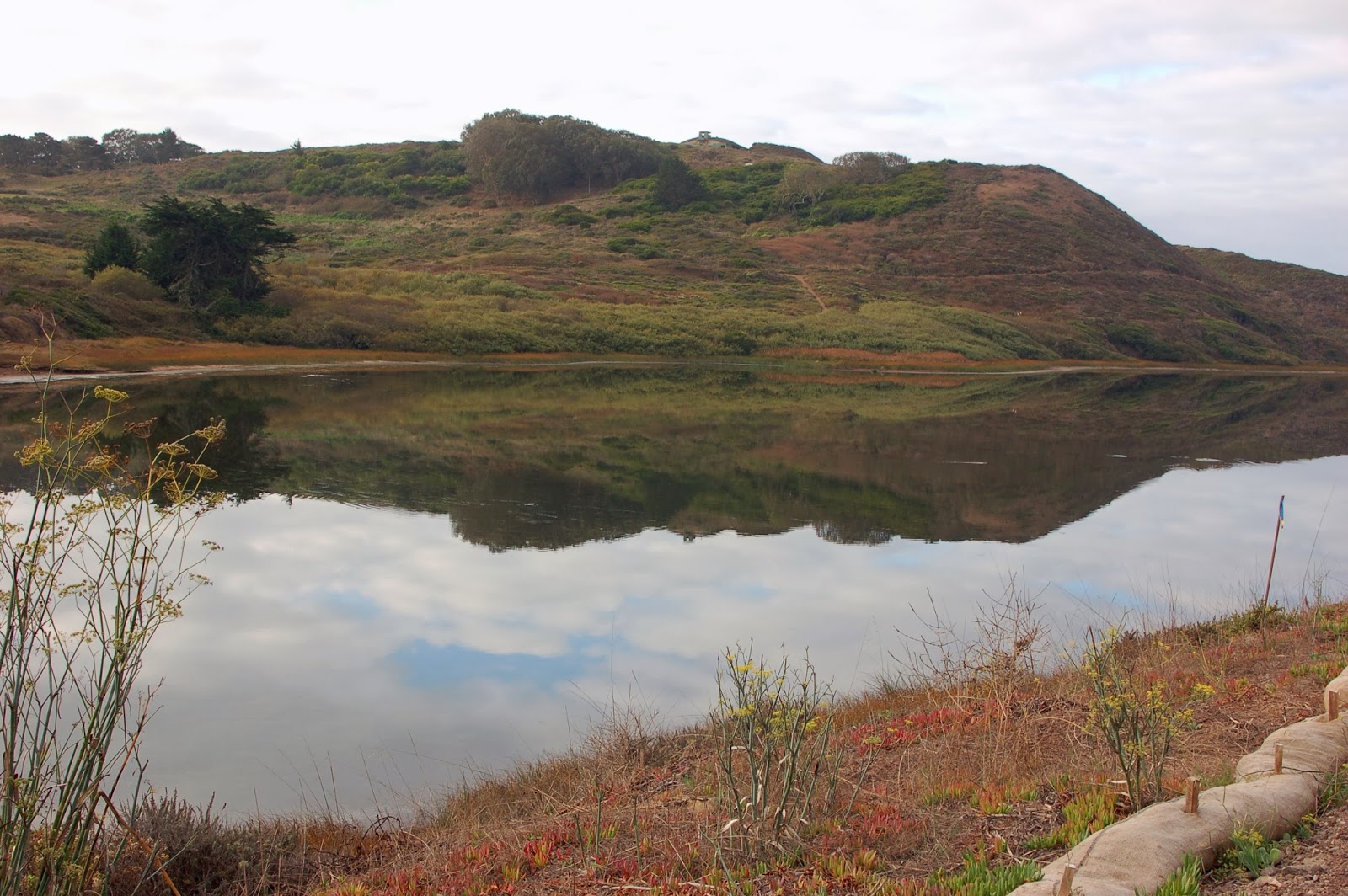
Shot while hiking in training for Bhutan.

This post was queued up before I left for Bhutan.

Friday, November 15, 2013

A tidbit to ponder: hope with the passage of time ... and people

Joyce Appleby is an historian of the United States who brings a long view to our current conundrums. From an interview by Bill Moyers:

BILL MOYERS: Can societies evolve backwards?

JOYCE APPLEBY: I don't think so. ... I mean, one of the fascinating things to me is that we have a political system today, probably only in the last ten years, I don't know, that seems sort of moribund and rigid.

And also, you've got to recognize the element of racism in this. This long sense of a dominant, white male authority in the country and today you have, you know, this racial diversity, you have women in positions of power. I think there's-- that’s why I don't think this is going to last.

BILL MOYERS: So you think-- what's not going to last?

JOYCE APPLEBY: This rigidity. It's not going to last. And this is a terrible thing to say, but I am old person so I can say it. I believe in reform by the grim reaper. I don't think it's going to last because I don't think there’s a rank of young people who are that frightened by the diversity, the demographic diversity and the presence of women and the changes in our society. …

This reminded me of a elder friend, a Quaker, who 30 years ago had great hope that her meeting would eventually accept gay marriage. They operated by consensus, and so far were stymied by the issue. But she knew they'd come around:

"... some people will just have to die."

She didn't live to see, but consider the changes in the last ten years.

This post was queued up before I left for Bhutan.

Thursday, November 14, 2013

If agism is getting to you, watch this!


Many thanks to Ronni Bennett's Time Goes By for the link. If agism is getting you down, you should look in over there!

This post was queued up before I left for Bhutan.

Wednesday, November 13, 2013

The challenge of water in the Anthropocene


Having published last week on an ambitious Bhutanese project to create hydropower from its Himalayan run-off, this overview of what our species is doing with water seemed appropriate for today.

This post was queued up before I left for Bhutan.

Tuesday, November 12, 2013

The Glorious Cause

Unlike other volumes in the Oxford History of America series I've discussed here (including Empire of Liberty: A History of the Early Republic, 1789-1815 and What Hath God Wrought: the transformation of America 1815-1848) Robert Middelkauff's The Glorious Cause: The American Revolution, 1763-1789 is not a social history. Rather its descriptions of how people lived and their political evolution during this period seem almost tacked on to a detailed military history of the war of colonial liberation. As it happens I find this war's battles interesting because of having had a mother who liked to drag her child to visit them, but if that sort of thing is not your interest, this is probably not for you.

What I took away from this was, however, a far better sense of how European 18th century armies were organized -- and of what rebelling colonials had to achieve to create their Continental Army.

In most respects, the British army was a conventional eighteenth century European force trained to fight in the accepted style of the century. In the eighteenth century, before the French Revolution brought its immense changes, war was the preserve of the dynastic state, fought on a small scale for limited purposes. Ordinarily, two groups in society did the fighting -- the aristocracy who provided the officers, and an under class, peasants, vagrants, the dregs who filled the ranks. … The composition of the army required that it be highly trained and harshly disciplined. Vagrants, ignorant peasants, and in many cases foreigners who were dragooned or hired felt neither moral commitment to their rulers nor loyalty to their nation which, in a modem sense, did not exist.

These highly disciplined forces, impressed or mercenary, fired from highly disciplined close order ranks and did their greatest damage to enemies in hand to hand bayonet charges. Colonials came to the struggle unprepared for this kind of warfare. Middlekauff describes General George Washington's task when Congress asked him to lead:

… George Washington admired European military doctrine. … in 1775 he had to find a way to convert what he considered to be the rabble around Boston into an army. …

This was a long struggle. Congress had allowed state militias to sign up men for 90-day periods; many "soldiers" simply wandered in and out of camp. Though colonials were hardy men, they had no training in combat. Two years into the war Washington gratefully accepted the assistance of a German soldier who pretended to a title, the "Baron" Steuben. Steuben proved adept at whipping the disheveled troops encamped at Valley Forge through a terrible winter into some sort of military order, explaining to a European friend:

"In the first place, the genius of this nation is not in the least to be compared with that of the Prussians, Austrians, or French. You say to your soldier, 'Do this,' and he doeth it, but I am obliged to say, 'This is the reason why you ought to do that; and he does it'"

Middlekauff continues:

The corollary to this conclusion is that the American soldiers knew what they were fighting for. They had a sense of the "glorious cause." …

***
In his conclusion, Middlekauff touches on a theme I would have wished were more central to this book:

Men who have more than their lives to lose make one sort of revolution, and those who have only their lives to lose make another. The Virginians, like almost all Americans, were of the first sort. Had they had nothing to lose, they might not have stopped with the disestablishment of the church, they might have destroyed it. They might not have freed access to the land; they might have abolished private property or they might have destroyed small owners. They might have encouraged the slave trade and made slavery even more barbarous. They might have toughened an already tough criminal code. They might not have simply rejected the British constitution, they might have converted constitutionalism into authoritarianism. Nowhere in America were there many men who felt they had nothing to lose; and nowhere did such men seize power.

The sort of questions the history of the American Revolution raises for me are caught in that; this is perhaps the true "American exceptionalism" --the moderation or incompleteness of our founding "revolution," depending on your point of view. These questions deserve more attention than they get in this volume.

This post was queued up before I left for Bhutan.

Monday, November 11, 2013

Bhutan too shares a war memorial

On this Veteran's Day, it seems only fitting to offer a picture from the Druk Wangyal Lhakhang, a memorial to the Bhutanese army's victory over an incursion by Indian insurgents in 2003. One hundred and eight chortens sit atop Dochula Pass at about 10000 feet. The surroundings dwarf the human edifices.

Thoughts to ponder on Veteran's Day

The historian and Vietnam veteran Andrew Bacevich offered some troubling reflections recently in an interview with Phil Donahue.

… [T]he Vietnam War [was a] war that divided the country, a war that in many respects shattered the United States military. And part of the response to that war was that the American people decided to jettison the longstanding tradition of the citizen soldier.

Richard Nixon endorsed that when he ended the draft and declared the creation of an all-volunteer force. And for some considerable period of time, this seemed like a smart move, a good thing for the country. It let citizens off the hook, also gave us highly capable and well-trained and well-disciplined soldiers. What only became evident after the Cold War ended, however was that this new professional army really was no longer America's army. It was Washington's army.

… And Washington began to do with that army whatever they wanted, regardless of whether the people had signed up to the enterprise. And this greater penchant for war I think really reached its zenith after 9/11 with President George W. Bush's decision to invade Iraq, as so many people have said, a country totally uninvolved in 9/11.

And this was the ultimately testing time for this great, professional army of ours. And I'm sorry to say it failed the test. We were supposed to win quickly, economically, easily. We didn't win. And instead, we ended up with a protracted war. Part of a series of post 9/11 wars where -- bringing us to where we are today where Syria may well be yet another one of these wars waged by Washington with its army while the people are left sitting on the sidelines.

PHIL DONAHUE: And making no real sacrifice – was it one percent of our citizens?

ANDREW BACEVICH: Yeah, it's interesting. You know, sort of the inverse of the complaint of the Occupy Movement. You know, the Occupy Movement said there's the one percent of the rich people who are screwing the 99 percent. And when it comes to basic military policy, we have the 99 percent screwing the one percent. It's the one percent who gets sent off to fight these endless wars.

If the army was really "America's army," would Presidents and generals dare send soldiers on unending, unachievable, often morally bankrupt missions? Bacevich doesn't think so.

Are we comfortable enjoying the wealth and power of this country, relying the protection of this one percent army?

Does the wealth and power of the country rely on the power of the U.S. military? Or, perhaps, not so much as we are taught to assume?

I don't have answers, but I think it respects veterans to ask the questions.

This post was queued up before I left for Bhutan.

Sunday, November 10, 2013

Football fun


If I were in San Francisco today, I'd be watching football. Since I'm not, I'll share this delight.

H/t Time Goes By.

This post was queued up before I left for Bhutan.

Saturday, November 09, 2013

Saturday scenes and scenery: San Francisco at dawn

  
click to embiggen these photos


I prepared for Bhutan by hiking and shooting photos in the Marin headlands. This is a view I saw several times. It's hard to imagine a more beautiful city.

This post was queued up before I left for Bhutan.

Friday, November 08, 2013

Friday cat blogging

Once upon a time, not all that long ago, the wool in this garment that Morty is nested on was the coat of a sheep named Edith. The knitter combed Edith's fleece, and carded it, and spun it and created a sweater. I think Mr. Cat has a sense that this perch brings him curiously close to an unfamiliar animal.

This post was queued up before I left for Bhutan.

Thursday, November 07, 2013

A tidbit to chew on: where do the politically committed go?

As Mayor Bloomberg's tenure in New York City reaches an end, Chrystia Freeland makes an observation.

Part of the appeal of plutocratic politics is their power to liberate policy making from the messiness and the deal making of grass-roots and retail politics. In the postwar era, civic engagement was built through a network of community organizations with thousands of monthly-dues-paying members and through the often unseemly patronage networks of old-fashioned party machines, sometimes serving only particular ethnic communities or groups of workers.

The age of plutocracy made it possible to liberate public policy from all of that, and to professionalize it. Instead of going to work as community organizers, or simply taking part in the civic life of their own communities, smart, publicly minded technocrats go to work for plutocrats whose values they share. The technocrats get to focus full time on the policy issues they love, without the tedium of building, rallying — and serving — a permanent mass membership. They can be pretty well paid to boot.

The Democratic political advisers who went from working on behalf of the president or his party to advising the San Francisco billionaire Thomas F. Steyer on his campaign against the Keystone XL pipeline provide a telling example. Twenty years ago, they might have gone to work for the Sierra Club or the Nature Conservancy or run for public office themselves. Today, they are helping to build a pop-up political movement for a plutocrat.

I think she is on to something. In my youth, the politically concerned threw themselves in leftish proto-"revolutionary" struggles and disdained the prosaic practice of U.S. politics. I'm not going to say we were all wrong -- the complacent racist and sexist society of the Vietnam era needed a good shaking. But aside from a few stalwarts, mostly African American community leaders like John L. Lewis, those of us who insisted on maintaining critical distance, on staying "outside" the system, ceded a lot of everyday power to people who didn't share our values.

A subsequent generation of political types, the cohort of the Reagan/Clinton era "free market" era, threw themselves into the sort of non-profit policy advocacy organizations Freeland references. There didn't seem to be anywhere else to be. And her characterization of the allure of plutocrat-funded "pop-up political movements" to contemporary young techies seems apt, if maybe too glib.

Freeland is an accomplished journalist, the author of Plutocrats: The Rise of the New Global Super-Rich and the Fall of Everyone Else, a book that deserves a lot more attention among my progressive friends than I'm aware that it has received. Interestingly, having chronicled the damage the super rich are doing to democracy, Freeland now seems to have joined the political fray herself. A Canadian, she's a a Liberal Party candidate for Parliament. (That positions her as a left liberal, even a socialist, in U.S. terms, though probably merely a solid centrist citizen in her own.)

This post was queued up before I left for Bhutan.

Glimpse of Bangkok


Readers of this blog will not be surprised that, with an innocent day to myself in Bangkok, when I took the train into downtown what I encountered when approaching the famous cultural sites was this scene. All I wanted to do was walk about enough to acclimatize myself to a new timezone and feel this unfamiliar city a bit. Instead I found police, barbed wire and street protests.


The scene felt relatively light-weight, not threatening to participants or bystanders. But I know I don't know enough to get near this kind of thing in somebody else's country, so I ended up walking several miles on side streets to get around the activities. There were thousands of uniformed university students (they all look about 14 in their blue and white costumes) cheerfully milling about.

The protests seems to be an episode in Thailand's ongoing tussles about who should rule and for what purpose. These conflicts led to a military coup against Prime Minister Thaksin Shinawatra in 2006 amid corruption charges. Populist protests of that era were put down with force. The current government has brought a bill to give amnesty to all participants in those events; anti-amnesty crowds seem to be holding the streets. Here's a BBC clip that gives some background. To this bumbling visitor, a bizarre aspect of it all is that the current Prime Minister is the banished former Prime Minister's sister.

Wednesday, November 06, 2013

Warming Wednesdays: Hydropower development in Bhutan


Here's something I doubt I'll see anything of during my trip (see previous post): a national development strategy for Bhutan that builds friendly ties with its gargantuan Indian neighbor -- and provides electricity in a relatively sustainable fashion. Global warming will certainly increase Himalayan run-off in coming years. Presumably these smart mountain survivors are building for flooding as well as exploiting steady flows.

This post was queued up before I left for Bhutan.

Tuesday, November 05, 2013

"Leaving on a jet plane ... "

Tonight I am flying off on a two week trip to Bhutan. In the broad expanse of Central Asia, this tiny country is a narrow sliver of a place, sandwiched between India and China on the south side of the Himalayas. It's population is smaller than San Francisco's -- about 750,000. Its present size, shape, and governance (its monarchy was founded by local and regional consensus in 1907) reflects its history on the edge of first the British empire and then independent India. In recent years, its kings have promoted a democratic turn. It is predominately rural, Buddhist in a form we call "Tibetan", and zealous about preserving its cultural patrimony. According to that useful internet resource, the CIA Factbook, Bhutan is engaging in a
cautious expansion of the tourist sector, encourag[ing] visits by upscale, environmentally conscientious tourists.
That, I suspect, fits the bunch I've signed on with.

So why am I going to Bhutan? There are mountains, and people, and sights I've probably never imagined. Essentially I am going because I can, economically and physically. Neither condition will last forever. Meanwhile, I go and I will try to see and to take pictures. A short trip is not long enough to learn anything very significant about a somewhere new, especially a place with a truly different history and language than my own.

But even a short trip may change me. We'll see.

I may or may not have WiFi some places. If so, I may post at least some pictures. I have lined up some posts here (not every day but often) for the period of the trip … and will be back to regular posting by late November.
  
Click to embiggen.
Post title by John Denver, if anyone wondered.

Monday, November 04, 2013

What if Republican postures are not just "pandering"?

In a post here last week I discussed a poll showing that, for most U.S. Latinos, new immigrants whether legally here or not are just family and neighbors, not some kind of dire threat. Near universal Latino rejection of immigrant bashing has alienated this growing community from the Republican Party.

This newspaper headline (click to embiggen) on a free paper widely distributed in my immigrant neighborhood reinforces what most people already know: the U.S. right is out to get them. No wonder hardly anyone grows up to be a Republican.

A Republican pollster is trying to get his party to wise up:
Freed Steeper, who served as an adviser to both Presidents Bush, told the New York Times in a story published Wednesday that the GOP may continue its struggles in national elections if it keeps up its often derisive rhetoric toward Hispanic voters.

“Racism may be a part of it,” Steeper admitted. “The Republican Party needs to stop pandering to that.”

Steeper then gave Republicans some blunt advice on the matter.

“The Republican Party needs to throw in the towel on the immigration issue," he said.

Sunday, November 03, 2013

"... to promote the general Welfare ..."


These days I'm reading James M. McPherson's Battle Cry of Freedom: The Civil War Era by audiobook. Completing the two long volumes is going to take awhile and I'm sure I'll write more in the future. As a preliminary observation, I have to say that complete frustration of majority democracy by what the Northern states called the "Slave Power" (the slave states in Congress) during the 1850s is too darn reminiscent of recent Republican behavior in Washington. This was the same practice of "rule or ruin" that Abraham Lincoln called out in 1860 at Cooper Union.

McPherson points out that, after Lincoln was elected President, the states clinging to slavery seceded and their new Confederacy needed a governmental structure. They mostly adopted something very like the U.S. Constitution to organize their rump regime. But,

"… some of [their document's] departures from the original were significant. The preamble omitted the general welfare clause…"

The preamble to the U.S. Constitution includes this list of purposes:

… in Order to form a more perfect Union, establish Justice, insure domestic Tranquility, provide for the common defence, promote the general Welfare, and secure the Blessings of Liberty to ourselves and our Posterity, ...

Evidently the U.S. founding generation thought the "general Welfare" function was an important justification for according legitimacy to the new state; the founders of the Confederate rebellion did not.

The behavior of the Confederacy's descendants in the Tea Party seems to agree with the 1861 rebels.

Saturday, November 02, 2013

Save City College of San Francisco!

Students, teachers and friends of embattled City College of San Francisco marched on Halloween, many in costume.


They proclaimed "San Francisco would be spooky without City College!" Indeed it would. A private accreditation board (ACCJC) is trying to close the vital 85,000 student institution. The San Francisco City Attorney has sued that body:
Herrera clams the ACCJC's moves amount to payback for an on-going political disagreement over the mission of the state's community colleges.
Alongside the rally, the "the world's most dangerous tortilla art collective" was briskly heating up free quesadillas on their silk-screened creations.


If the powers-that-be succeed in destroying City College's unique mix of community enrichment, language instruction for newcomers, vocational and trade education, and academic preparation for more traditional institutions, the damage to the city is unthinkable.

Friday, November 01, 2013

San Francisco 2013


I drive by this building site several times a week. I still have not gotten used to the concept.

Friday cat blogging


Morty likes to assist my partner with her Greek homework.