Showing posts with label education. Show all posts

Thursday, March 26, 2026

On the infrastructure of young lives

This week two different US courts found two monster social media platforms -- Meta (Facebook and Instagram) and Google (YouTube) -- liable for encouraging social media addictions in young people. This should shake up these companies which have operated with so much impunity for the consequences of their products. About that, we'll see.

John Della Volpe has been polling young Americans for over 20 years about what shapes their lives. He has explored with them what they think about social media. 

... According to our polling, 71% of young Americans use Instagram, 64% use TikTok, and 54% use Facebook. ... nearly 1 in 3 young Americans blame platforms directly for spreading false information. And when asked what would rebuild trust, 50% say holding both platforms and individuals accountable — the exact legal theory that just prevailed in court. ... 

Platforms have become infrastructure — useful, embedded, but not believed. And the implications extend far beyond tech. ... Gen Z depends on systems they believe are unreliable, run by institutions they believe are unaccountable. That’s not a user problem. That’s a legitimacy problem. ...

The consequences of growing up in, of being natives within, a system they can't believe in are scary and deep They adapt to their environment which is simply the world where they live, but which they cannot trust.

    •    They cross-check everything.
    •    They trust peers over institutions.
    •    They build their own internal filters for what’s real and what isn’t. 
That’s rational behavior in a low-trust system. But at scale, it creates a country where there is no shared baseline — only parallel realities, loosely connected, constantly contested. And that’s where democracy starts to strain..

... They don’t leave the platforms. They can’t. 

... Trust doesn’t disappear all at once. Platforms still work. People still log on. The business model still holds. But something underneath starts to shift.

When people stop believing what institutions say, they respond to authority differently. They question more. They verify more. They rely on each other instead of the system itself. ...

... Platforms can survive without trust. Democracies can’t. 

 • • •

Talking with a parent of teens recently, he observed that his young people weren't very interested in social media as far as he knew -- and they vehemently rejected AI-infused content when they encountered it. Maybe we'll see a generation more discerning than their elders about this stuff? That would be the normal human reaction to a novel technological reality.

Monday, March 09, 2026

Liz Specht –1929-2026

There was a lot of life in those long years: wife and partner to Eddie Specht for over 70 of them, mother to three children in the 1950s, doting on many grandchildren and a great grandchild, faithfully seeking to encounter a living God through an Episcopal path, and abiding as a "deacon of the earth" always.

Emerging from Grosse Pointe, Michigan and Wellesley College, she gave so much in that life: founding a tutoring program for San Francisco Mission District kids that grew up to be Mission Graduates and also an international aid nonprofit, El Porvenir, which works with Nicaraguans to bring clean water to rural Nicaragua. To the last, she was engaged in civic activism with her Mill Valley community.

For many years, Liz and Ed lived on a boat in Alameda, California. You might notice that water was a theme in this life.

Working a winch on a catamaran off Belize in 2004


Riding a pony across a Nicaraguan stream in 2018

Pensive alongside the Mill Valley Cascade in 2025

Out for a short walk at the beginning of March 2026

She was gentle, curious, thoughtful, determined and sometimes fierce. Many loved her; she gave love to many.

Tuesday, February 10, 2026

San Francisco educators on strike

 
You know the rally you are on the way to is going to be large when the BART trains are full of happy people with signs. Such was the case yesterday.
The strike by United Educators of San Francisco brought a happy crowd of public school teachers, students, supporting unionists, and friends to Civic Center Plaza midday yesterday. 
Teachers are on strike for their students ... 
 
For pay and benefits of course ... how are workers who have not somehow acquired stable housing supposed to live and serve students in this absurdly expensive city?
 
They have to fear for the children and their families, even themselves, under a regime striving to Make America White Again.
My Mission neighborhood is full of these signs. For the present at least, many San Franciscans stand with their teachers!

Wednesday, May 28, 2025

On Donald's drive to destroy the production of knowledge

In a statement calling for the defunding of NPR and PBS, the White House complained about a story correctly describing banana slugs as hermaphrodites, describing it as 'woke propaganda.'
For normal Americans, among the minority paying attention, the impulse is repeatedly to ask WHY? Why do Donald Trump, his MAGAs, and his various enablers among Christian nationalists and techno-utopians, want to tear down contemporary American life and civilization? What do they want?

Assuredly there are many answers: racism, sexism, gender rigidity, greed, vengeance, bruised egos, injured ignorance -- all combined in a toxic stew. 

But a common element is a war against science, against knowledge, against the human quest to accumulate scraps of truth. Adam Server describes where the Magats are trying to take us under the title, The New Dark Age. There's wisdom here; a few highlights:

... destroying American universities will also limit the growth of a Democratic-trending constituency—fewer educated voters will translate to fewer Democrats in office. The tech barons supporting Trump have companies that rely on educated workers, but they want submissive toilers, not active citizens who might conceive of their interests as being different from those of their bosses.

A formal education does not immunize anyone against adopting false beliefs, but two things are true: Many of Trump’s supporters have come to see knowledge-producing institutions and the people who work for them as sources of liberal indoctrination that must be brought to heel or destroyed, and they do not want Americans trusting any sources of authority that are not Trump-aligned. ...

Possible sources of alternative information and different visions of possibility must be stamped out.

... Trump’s attack on knowledge will harm not just the so-called [liberal] elites he and his allies are punishing. The long-term price of solidifying their power in this way will be high—perhaps even higher than Trumpism’s wealthy benefactors expect. One obvious cost is the damage to technological, scientific, and social advancement. Another will be the impossibility of self-governance, because a public denied access to empirical reality cannot engage in self-determination as the Founders imagined.
... By destroying knowledge, including the very scholarship that would study the effects of the administration’s policies on society, the Trump administration and its allies can ensure that their looting of the federal government and public goods can never be fully rectified or punished.

A Magat ascendancy threatens to engulf us in profitable hucksterism, the right spot for an RFK Jr.

For Trump and his allies, this large-scale destruction of the knowledge-production process could be quite lucrative in the short term. Some examples of this, such as Musk using his influence to secure himself federal contracts and the administration removing regulations on pollution on behalf of Trump’s oil-industry allies, are obvious. But fewer restraints on business means more corporations getting away with scamming and exploiting their customers, and more money for unscrupulous hucksters like those surrounding the president.
The disappearance of high-quality empirical evidence means not only fewer rebuttals of right-wing dogmas, but also a bigger market for wellness pseudoscience and other scams—such as Kennedy’s imbecilic suggestion to treat the growing measles outbreak in the Southwest with cod-liver oil. America under Trump is rejecting one of the most effective health-care infrastructures in human history and embracing woo-woo nonsense on par with medieval doctors measuring the four humors.

Server's conclusions are dire.

The book burnings of the past had physical limitations; after all, only the books themselves could be destroyed. 

The Trumpist attack on knowledge, by contrast, threatens not just accumulated knowledge, but also the ability to collect such knowledge in the future. Any pursuit of forbidden ideas, after all, might foster political opposition. Better for Americans to be as gullible and easily manipulated as the people who buy brain pills from right-wing podcasts, use ivermectin to treat COVID, or believe that vaccines are “weapons of mass destruction.” 

This purge will dramatically impair the ability to solve problems, prevent disease, design policy, inform the public, and make technological advancements. 

Like the catastrophic loss of knowledge in Western Europe that followed the fall of Rome, it is a self-inflicted calamity. All that matters to Trumpists is that they can reign unchallenged over the ruins.

My summary cannot do this article justice. Read it all (gift).  

Wednesday, May 07, 2025

Genders diverge

In the contemporary USofA, girls and boys take different paths. The following visuals document the different life choices and life trajectories of the two genders.

Only in Vermont are boys keeping up with girls in high school completion. The South is notably weak in getting boys through high school.


It probably should not come as a surprise: Black and Hispanic boys lag behind all others in high school completions, while White boys only graduate at a slightly higher rate than Black girls. Everyone else is way ahead.

When it it comes to college degrees, the gap widens. Since 1980, women students have been increasing their share of BAs and MAs -- can dominance in PhDs and professional degrees be far behind?
The increasing dominance of women in the high school teaching profession may have something to do with whether boys believe completing education is important. Or it may not? But if we're not willing to pay teachers, a picture like this is not surprising. Teaching is hard; we don't pay for it. And you can still get women workers for less ...

I'm all for women getting ahead, but the divergence has to exacerbate the tensions which give us the Know-Nothing MAGA moment.

Sunday, March 16, 2025

Learning from the students -- in Idaho

The school district in West Ada thought it was getting rid of the dread menace of D.E.I. when administrators ordered teacher Sarah Inama to take down a poster reading "Everyone is Welcome Here." This is what followed:


Enjoy. There's learning happening here.

Tuesday, March 11, 2025

Will San Francisco put these families out on the street?

 
On Monday morning, Vilma Arias spoke in front of a Faith in Action's banner outside Flynn Elementary School on Precita Park. She and her working husband and her two children are about to be thrown out of the non-profit shelter where they've lived  -- because the city is seeking to manage its homelessness problem through a revolving wait list. You can live in shelter for 90 days -- then you are out until you can manage to either find housing in this expensive place or overcome the paperwork to get back on the list.

From the neighborhood newspaper, El Tecolote

For the past 10 months, the Honduran mother, her husband and their two young children have lived in a San Francisco family shelter, waiting for a rent subsidy that might help them afford a place of their own. Her husband, who works as a garbage collector, earns just enough to keep them afloat but not enough to pay the city’s sky-high rents.
... She is one of dozens of homeless parents facing evictions this month due to a controversial city policy that limits family shelter stays to 90 days.
... With 318 families on the shelter waitlist, the Department of Homelessness and Supportive Housing (HSH) says the policy is meant to “increase the flow of families” through the shelter system and connect them with long-term housing solutions faster.
Faith in Action took a delegation made up of these families to meet Mayor Daniel Lurie. Nothing came of that.

“[Lurie] told us not to worry,” said FIABA advocate Brenda Córdoba. “We thought that meant he would mobilize, maybe talk to access points about giving all families extensions… but now he’s saying he didn’t commit to anything.”
At first, she said, the meeting with the mayor felt like a breakthrough. But when families reconvened on Tuesday, many still had eviction notices set for the coming week.
... Vilma, who is currently in asylum proceedings, says she’s been struggling to get her shelter to understand her situation. She says she’s seen a disconnect with what the shelter tells her she can do and what she’s required to do to gain another extension. 
“They tell us that we can’t attend meetings because we were on our way out, so we get a warning,” Vilma said. “But then they ask us why we didn’t request a meeting and we get a warning.”
Alyssa Wolf, a social worker at Flynn, spoke about the struggles of San Francisco schools to serve children who are homeless. Schools in the Mission serve a revolving group of 60 to 80 such children every day. The teachers union, United Educators of San Francisco, endorsed the homeless families' demand for stability.
 
After the rally, two families facing eviction were given an extension but it's hard to see any genuine resolution unless the city somehow finds the cash to house these San Francisco residents in urgent need.

Saturday, May 04, 2024

There's an arc to campus protests

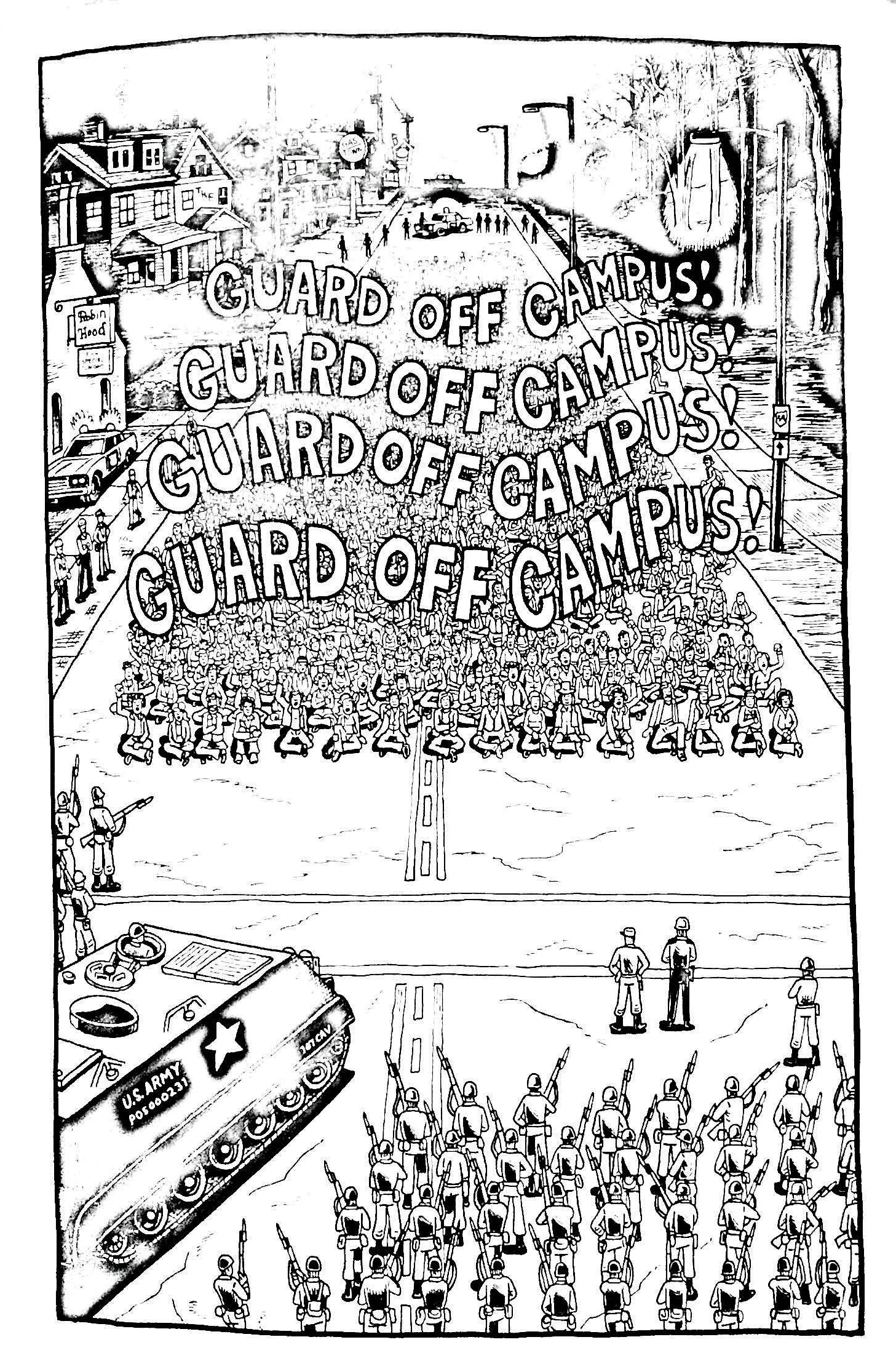
A glance at Derf Backderf's meticulously researched graphic novel Kent State: Four Dead in Ohio seems right on time today.

This artist really did the work, in archives and interviews, to reconstruct the events of the Ohio college massacre on May 4, 1970. A barrage of gun fire from National Guard troops killed four students and maimed more in response to student protests. He tries to portray accurately what students, politicians, cops, and Guardsmen were thinking as the movement against the ongoing Vietnam war both intensified and shifted focus under ham-handed state repression. Overall theme: nobody really knew what they were doing!

Here are a few panels (click to enlarge):
Spring had come and students enjoyed the campus's grassy open lawn.
"Out of the bars and into the streets." During a boisterous evening in town on Friday night, some students interrupted a night of drinking and cruising to take common chants into the streets. The town police department had no idea what to do and bashed heads while intoxicated student rioters smashed store fronts.

The town called in the National Guard. No one seemed to know quite how to act in the aftermath.

Non-campus actors believed all sorts of myths about the mysterious campus activities. What had got into these kids?
For the students, their occupied campus was novel and insulting.

On Monday on campus, a small fraction of students reverted what they had been doing for weeks -- marching in protest. Students had a new target - the occupation of their turf by tired, frustrated, and uncomprehending troops. Many of the Guardsmen despised students they saw as privileged snots.

And so tragedy. A random crew of students were dead; all sides told their own stories. No one was punished. At the time, 58 percent of Americans thought the protesters had it coming to them.

I can highly recommended Backderf's reconstruction of Kent State events, much more detailed and nuanced than what I've offered here.

The book is not a great graphic novel because, for all the artist's efforts, all these characters seem to blend into each other, classic hippies in one stereotype and malevolent pols in another. He could probably have created a clearer visual experience with a lot of editing, but he's determined to report all the available historical strands and the result is not pictures which are easily understood. But this is a terrific effort to tell a complex story.

I got the book from the public library; I hope it is readily available in this moment.

• • •

A few observations from having lived similar events at UC Berkeley during attendance there from 1965-1969 and watching student protests over Gaza today:

• As at Kent State, most students can and do navigate around the edges of passionate protests, going about their lives. They may sympathize, but they are not there. The passionate activists are usually a small minority.
• Repression of campus protests draws a far larger fraction of students (and profs and staff) into the protests, for good and ill. College students, at least back then and likely still, come to think of campus as their place and broadly resent being invaded.
• This can create incentives among a small fraction of protesters to try to create a situation in which cops or others beat protesters' heads. I'm not saying that is all that goes on, but there are always provocateurs, some honest and some not.
• When under attack on campus, it becomes hard for protest leaders to keep the focus on the initial animating issue -- today the call for a Gaza ceasefire and for an end to US complicity in Israel's oppression of Palestinians. If the issue becomes mean cops, the movement is losing.
• Protest leadership demands teaching serious protest discipline. This is hard because the aim is to grow fast. And also, the power of campus protest is attractive moral creativity; apparent rigid automatons chanting only approved messages do not attract.
And we'd be a far worse country if students could never be moved by atrocity. So far, we seem to be that kind of country.

Tuesday, December 12, 2023

Kareem calls bullshit

The media are reporting this morning that Harvard University's board is refusing to be stampeded into firing their recently installed Black president. Kareem Abdul-Jabbar knows racism when he sees it. Here's his opinion of the hue and cry to throw out a Black woman.

Pershing Square CEO Bill Ackman is good at making money. I’m good at making baskets.
Neither one of us is qualified to select the president of Harvard University. Sure, Ackman has a BA and MBA from Harvard, but just because I attended UCLA doesn’t mean I have special insights into the requirements for being president.

Here’s what I do know: Accusing Harvard’s first Black president of being hired only because she was Black is a pretty racist statement. Being Black might have been a consideration in her being hired, but that in no way diminishes her other qualifications.

For example, let’s say I ran a hospital in which all the doctors were White and I needed to hire another doctor. I looked at three candidates, two White and one Black. All are equally qualified. I might then take into consideration that many of our patients are non-White and might feel more comfortable with a Black physician (several studies back this up). Did I hire him because he was Black? Yup, but only because he also met all other qualifications, and having a Black doctor would make us a better hospital.

The enrolled undergraduate and graduate student population of Harvard University is 34% White with the 66% majority of students non-White. [Yes, that surprised me too, so I looked it up. Seems true if you include foreign students as non-White.] Yet, Harvard has never had a Black president before. Coincidence?

So, what’s Ackman’s beef? Well, he heard from someone else that the search committee wanted to hire someone to change the White Wall of presidents. First, he’s formed his opinion based on gossip. Second, even if that was their choice, he’s offered no evidence that she wasn’t as qualified as any other candidate.

Ackman’s real problem with her is that he didn’t like the answers she (and two other university presidents) gave at a congressional hearing when questioned by Rep. Elise Stefanik, whose interrogation technique was akin to asking, “Are you still beating your wife? Yes or no.” I’ll get into the specifics of that story at a later time, but for right now, the question Ackman raised was about Dr. Gay being hired in the first place. He demeaned her with the usual racist rant that she was hired because she was Black. Based on his inability to use logic, perhaps he should return his Harvard diplomas.

This tempest in a teapot isn't really about Israel/Palestine/free speech/antagonistic and overzealous students. It's about what a president of a super-elite institution ought to look like. I assume Dr. Gay has been getting this crap all her life, as has Kareem.

Wednesday, June 21, 2023

We can't have fairness without some affirmative interventions

The notion that using awareness of the injuries inflicted by the American system of racial caste to work to remedy those injuries itself constitutes a form of bigotry is simply nonsense. Evil nonsense, which defies common sense -- and will likely be endorsed this month by our rightwing Supreme Court.

The arguments about affirmative action measures in college admissions are frayed and tired. To the credit of the New York Times, they have published an article [gifted at the link] focused not so much on the policy equity conundrums, but on how affirmative action makes people who have benefited feel.

... A few concluded that the downsides of race-conscious admissions outweighed the benefits. Some spoke of carrying an extra layer of impostor syndrome. Many more grieved the closing of a path that led to rewarding careers and the building of wealth.
Their experience may inform the present, as Americans continue to debate how to define — and align — the principles of fairness and merit, as well as address enduring racial disparities without deepening racial divisions. At least in the immediate future, Black and Hispanic enrollment is expected to plunge.
Mr. [Granderson] Hale, 71, can sympathize with those that want the end of race-conscious admissions. He credits Wesleyan with paving the way to an M.B.A. from the Wharton School and a more comfortable life. But he would prefer to see investments in early education for Black and Hispanic students, who often attend low-performing K-12 schools.
He said he had seen enough of how Black professionals were regarded by their white counterparts to feel that race-conscious admissions had not worked to their overall benefit. “People don’t respect you if they have to let you in,” he said.
That view is not widely shared by Black adults with a bachelor’s degree, who supported the consideration of race and ethnicity in admissions by more than a 2-to-1 margin in a recent poll by the Pew Research Center.
Andrew Brennen, 27, is entering Columbia Law School this fall, perhaps the last class shaped by race-conscious admissions. He has no doubt that given his test scores and grades, being Black played a role in his admission — for which he is unapologetic. Like Mr. Hale, he sees K-12 education as a key to racial justice, and has accepted a scholarship from the NAACP Legal Defense and Educational Fund that commits him to eight years of practicing civil rights law in the South after graduation.
... Mr. Brennen’s family was upper-middle class; his father was a dean at the University of Kentucky law school. But he also grew up in small southern towns, his the only Black family in predominantly white neighborhoods.
As a student at the University of North Carolina at Chapel Hill, he watched protesters fight to keep a Confederate monument on campus and felt guilt, as one of two Black students in a freshman writing class, for “not adequately defending my race” when the topic of affirmative action arose.
Any self-doubt he and others like him feel on elite campuses, he said, stems from a sense of isolation, lack of institutional support and routine displays of racism, not “because our SAT scores aren’t as high as our white peers.’’

Read it all.

Tuesday, April 25, 2023

My experience of Holocaust education

Dara Horn's critique Is Holocaust Education Making Anti-Semitism Worse? got me wondering: how did I learn about the Holocaust? (Previous summary post here.)

And I realized that I actually had encountered Holocaust education in high school in 1963. This, among many other influences, probably helped set my trajectory for the rest of my life. The powers-that-be brought in a woman who was billed, accurately, as "a local author" to speak to a small group -- probably "the current events club." (We had such a thing. Odd to remember.)

This was Gerda Weissmann (later Klein) who lived in Buffalo. Her memoir, All But My Life, is the saga of how she landed in upstate New York.

Gerda Weissmann (later Klein) was born in Bielsko, Poland, on May 8, 1924. Growing up into a middle-class Jewish family, Gerda Weissmann’s life was shattered when she was 15 years old in September 1939. German forces invaded Poland and within a month her brother Artur was taken away by the Nazis never to return. Gerda and her parents were forced into the basement of their family home as it was stripped. Then along with other Jewish residents, they were imprisoned in the Bielsko Ghetto, and some were sent into slave labor. Gerda was eventually separated from her parents, who later died in the concentration camps, while she was sent into a series of slave labor camps at Marzdorf, Landshut and Gruenberg. After barely surviving these, Gerda was forced onto a Death March ending in Volary, Czechoslovakia on May 7, 1945. (Jewish Buffalo History Center)
Ms. Klein had married Kurt Klein, an American soldier who helped liberate this contingent of slave laborers. She committed her life to educating young people about her experience of Nazi genocide and much more, writing nine books "on themes of courage, friendship and love."

Ms. Klein's talk gifted me with a burning desire to know more about the inhumanity we are capable of visiting on each other. I borrowed her book from the local library -- and followed up with additional Holocaust reading, as well as another genre much available at the time, accounts of Stalin's gulag and even the Holodomor in Ukraine. (Note, somehow neither the story of European settlers' genocidal war on native Americans nor the story of American slavery were so available in the public library.) I was a curious young person.

Holocaust education had a profound effect on me. But I need to grant that Horn's article points to conditions that made Holocaust education viable for me. I had great advantages. Jewish people were part of my world.

• Unlike so many US kids now subjected to these course units, there were Jews in my daily life. There had been Jewish kids in my classes since 5th grade. There were a significant number of Jewish kids in my private high school.
• My mother had close Jewish women friends, people she'd worked with on community projects including during World War II.
• The adults I was exposed to were Holocaust-aware, both Jews and also my Protestant co-religionists.
However I should not leave the impression that this environment was devoid of anti-Semitism. In fact, it reeked of socially accepted prejudice against Jews.
• By the time I escaped high school, I had come to recognize that the institution was probably operating with a Jewish quota: there were Jewish students ... but not too many.
• While I was in high school, the large Reform synagogue nearby suffered anti-Semitic vandalism. The attack felt incomprehensible. Classmates felt threatened. I had been taken to tour that building along with classmates, a tour very like the one we sponsored of our Episcopal church. The two didn't feel that different: both were buildings used for slightly exotic purposes that advertised the comfortable class status of their adherents.
• And that goes to the nub of how I encountered Jews in that place and time: most all the families in that school, Christian and Jewish (there was nobody more exotic that I knew of), were performing culturally what was expected from the post-WWII professional American upper middle class. For example, I don't remember anyone being raised by a single mom. The Jewish kids seemed not to want to be seen as "too Jewish." I didn't meet Jews who willingly advertised difference from Christian Americans until I got out of there. The conformist Fifties persisted well into the Sixties in Buffalo.
If overcoming Christian solipsism and anti-Semitism were that challenging for me -- with all those corrective influences -- no wonder Holocaust education is as problematic as Dara Horn portrays it.

Gerda Klein's All But My Life remains available. I'm going to re-read it and may post an update.

Monday, April 24, 2023

Holocaust history as modern American morality play

Dara Horn's rambling essay in the current Atlantic magazine, Is Holocaust Education Making Anti-Semitism Worse? seems to be getting some plaudits and some pushback. That's not surprising; a lot of very earnest people teach in this field, doing their best. And Jewish people and Jewish institutions want and need some force that runs against our current eruptions of Jew-hatred. We all do; very few of us want the Nazis among us to run about unchecked.

When we don't know what else to do, a humane, classically liberal, society defaults to attempting education ... but does it work?

I want to summarize some of Horn's points in this post and follow up with another post about what I can remember about how I learned about the Holocaust many moons ago. That was long before there was such a thing as a formal curricular field, and yet the vaguely Christian institution where I went to high school did offer a chance to learn something about the then-recent Nazi genocide.

Horn introduces her article with a clear assertion:

... The bedrock assumption that has endured for nearly half a century is that learning about the Holocaust inoculates people against anti-Semitism. But it doesn’t. ... I have come to the disturbing conclusion that Holocaust education is incapable of addressing contemporary anti-Semitism.
The article is a kind of travelogue through this apparently burgeoning elementary and high school academic field. Her picture of the endeavor brought me up short:
... Benjamin Vollmer ... has spent years building his school’s Holocaust-education program. He teaches eighth-grade English in Venus, Texas, a rural community with 5,700 residents; his school is majority Hispanic, and most students qualify for free or reduced-price lunch. ...Vollmer is not Jewish—and, as is common for Holocaust educators, he has never had a Jewish student. (Jews are 2.4 percent of the U.S. adult population, according to a 2020 Pew survey.)
My surprise shows my Christian obliviousness. I live now and always have lived in places where Jews are visible citizens. Before recent hyper-affluent times, San Francisco meant frontier opportunity and welcome to misfits who don't quite fit in with mid-America. In 2011, six percent of San Francisco's population was Jewish, likely mostly imports like the rest of us weirdos. In my line of work, I've long noted that well-curated political voter lists attempt to identify who is Jewish; somehow they know Erudite Partner is Jewish, despite her Scots last name. The world notices where the Jews are. And, mostly under wraps, there's plenty of Jew-hating in oh-so-sophisticated Northern California.

San Francisco anti-Semitic graffiti spotted in 2015
Horn explores what might be buoying Holocaust education in mid-American venues where there are no Jews. The answer she gets from teachers is obvious, if you think for a minute: the victims of the Shoah are conveniently dead on another continent some distance in the past.
Why not focus on something more relevant to his students, I asked Vollmer, like the history of immigration or the civil-rights movement? I hadn’t yet appreciated that the absence of Jews was precisely the appeal.“Some topics have been so politicized that it’s too hard to teach them,” he told me. “Making it more historical takes away some of the barriers to talking about it.”
Where there are no living, breathing Jews, a focus on the Holocaust serves as a safe morality play.
The point was to teach morality in a secular society. “Everyone in education, regardless of ethnicity, could agree that Nazism was evil and that the Jews were innocent victims,” [education historian Thomas D.] Fallace wrote, explaining the topic’s appeal. “Thus, teachers used the Holocaust to activate the moral reasoning of their students”—to teach them to be good people.
Horn concludes:
... One problem with using the Holocaust as a morality play is exactly its appeal: It flatters everyone. We can all congratulate ourselves for not committing mass murder. This approach excuses current anti-Semitism by defining anti-Semitism as genocide in the past.
Horn makes a solid case that if we want a society that rejects Jew-hating, we have to start by helping students with some prior questions before we get to anti-Semitism: Who are the Jews? Where did Jews come from? What cultures have Jews lived in? What cultures have Jews created? Only after exploring those questions can educators usefully approach why are Jews objects of hatred? and why have both Christian and secular modern cultures generated anti-Semitism?

She quotes J. E. Wolfson of the Texas Holocaust, Genocide, and Antisemitism Advisory Commission:
... [he] told the teachers that it was important that “anti-Semitism should not be your students’ first introduction to Jews and Judaism.” ... “If you’re teaching about anti-Semitism before you teach about the content of Jewish identity, you’re doing it wrong.”
That seems right to me -- and a lot more politically and culturally demanding than teaching the Holocaust as a distant morality play whose enormity reinforces contemporary innocence.

Horn's essay prompted me to try to recall how I was taught and learned about the Holocaust as a young person of the 1950s and 60s. To be continued ...

Thursday, February 02, 2023

Time for the "College Board" to slink away in disgrace

Popular Info's account of why the College Board caved in to Republican Ron DeSantis' demands that complex content about race and society be excluded from their A.P. African American Studies course needs to go far and wide. 

Turns out this is about the money -- pure corruption in higher ed. 

Following a succinct summary of what DeSantis and other right-wing white supramacists were objecting to, the article explains what gives:

In 2019, the College Board made over $1.1 billion dollars in revenue, according to documents filed with the IRS. Almost half of this revenue came from “AP and Instruction,” and 40% came from “assessments” like SAT exams. 

In 2020, revenue shrunk to $800 million dollars. “AP and Instruction” now constituted the majority of revenue, but “assessments” plummeted by almost half. The reason for this sharp decline is that since the pandemic many universities and colleges have implemented “test-optional” policies. Compared to 2019, when 55% of colleges required test scores, only 4 percent of schools had a testing requirement this past fall. SAT exams are becoming less important. 

As revenue declined, compensation for its top executive increased. [David] Coleman, its CEO, took home more than $2.5 million in compensation in 2020 — over a million more than he had received in 2019. The College Board is technically a non-profit.

These people are just education parasites.

All parts of the higher education-industrial complex are facing a squeeze. The population of college age young people is about to crash. 

In four years, the number of students graduating from high schools across the country will begin a sudden and precipitous decline, due to a rolling demographic aftershock of the Great Recession. Traumatized by uncertainty and unemployment, people decided to stop having kids during that period. But even as we climbed out of the recession, the birth rate kept dropping, and we are now starting to see the consequences on campuses everywhere. Classes will shrink, year after year, for most of the next two decades. People in the higher education industry call it “the enrollment cliff.”

Perhaps the College Board's "assessments" (high stakes tests) once served a purpose. It's no surprise now schools desperate to enroll whoever they can have dropped them. A.P. courses do provide a small enhancement for the subset of students who take them. But wouldn't it be better to promote national educational standards that demand that ALL students have some exposure to Africa African Studies, among the many subjects necessary to contemporary American life? Sure, the same backward looking conservatives would howl -- but they will always howl because their world is passing away.

Wednesday, February 01, 2023

Is this how you were introduced to human history?

Cal Berkeley economic historian Brad DeLong describes history as it was long taught in the Euro-centric world like this:

[T]here was a time in the 1800s when people wanted to tell the Story of Civilization as something like an Olympic-torch relay race:

The flint is struck and the torch lit in the Uruk of Gilgamesh and in Ur of the Chaldees.

It is then passed down to the Pharaohs of Egypt and to the Babylon of Hammurabi.
It winds up in the hands of Kings Dawid and Salomo of Jerusalem. 
The torch is then passed—perhaps through Kurush and the other Loyal-Spirit Great Kings of the Persian Empire—to Athens!
And then on to Rome!
And conquering Rome is then conquered by Jerusalem and Galilee, as the torch is carried forward!
And so on. In the aftermath of the fall of Rome, barbarian invasions and western Christendom then meld themselves into European feudal civilization, which picks up the torch. The torch is handed off to the Renaissance. The Reformation, The Enlightenment rise of representative government and common-law systems: governments that exist to secure people’s natural rights and that derive their just powers from the consent of the governed.
Then the British Industrial Revolution. And on to modern democratic capitalism, or capitalist democracy.

This wasn't exactly what was shoveled at me in high school in the 1960s, but there certainly were strong strains of it. I'm pretty sure that not even Ron DeSantis is promoting exactly this in Florida today -- but I also suspect that the sanitized, white-centric history he wants to enforce derives from this.

If you were exposed to any world history in school, how much did it resemble this description? What has changed? What remains the same?

By the way, DeLong is having none of it:

But this is like picking out pictures of things you like in a photograph and claiming that they are “yours”.

Image via The Guardian.

Thursday, January 05, 2023

What do we need to know?

At the suggestion of a friend, I borrowed from the library a thick volume called The New Dictionary of Cultural Literacy: What Every American Needs to Know. The first edition of the book came out in 1987; the edition I'm looking at came out in 2002. It consists of over 5000 entries for what its editors considered everyday knowledge, from "Abraham and Issac" in the opening section on the (Judeo-Christian) Bible to "Yucca Mountain" in the section on Technology. The book has been a best seller. And a cultural flashpoint in its own way in education policy circles.

Here's how the 2002 edition states its purpose:
In the United States, reading with understanding is based on the kind of background information identified in this book ... From the start, the premise of this dictionary was that true literacy -- reading with comprehension -- requires a lot more than sounding out the words on the page. Those who possess the needed, taken-for-granted knowledge can understand what they read, and those who lack that knowledge cannot. The haves learn ever more from what they read and hear; the have-nots fall further and lose the chance to become participating members of the wider community.
The book's instigator, E. D. Hirsch, was distressed in the early 1980s to learn that community college students in Virginia had no idea who either Robert E. Lee or Ulysses S. Grant might have been or what they had done to shape the place in which they lived. He believed that there was a common American knowledge base which was needed for democratic citizenship and successful adulthood. This insight led first to this dictionary and later to advocacy of a "Common Core" movement in educational practice. Though Hirsch insists he is a "liberal" -- "practically a socialist" -- in education policy circles he has many detractors, usually Democrats, sometimes classroom teachers, who consider his common core project "elitist." Or perhaps limited, or sexist, or racist.

This is not the sort of debate anyone definitively wins.

My interest in issues of common knowledge base is highly practical. Over the years I've learned that a vital prerequisite to running a persuasive get-out-the-vote campaign, such as UniteHERE just managed in Nevada, is enabling door-knockers to explain what the offices are that your candidates are seeking, what those offices do, and what policies the "good" ones might be able to implement. Canvassers have to be able to talk about this stuff fluently -- and very few, regardless of education or economic status, arrive able to do so. Erudite Partner has repeatedly led an appreciated training on "what is a governor -- what is a U.S. Senator." Personal experience carried many of us a long way when it came to talking about reproductive freedoms. But to meet the voters where they had concerns, we had to learn something about housing policies. 

I can sympathize with the impulse to wish that as a society we shared more of a common knowledge base. But we're big and we're different and it's not likely such a thing can be agreed upon universally. However common knowledge can sometimes prove its worth in practice, when we take ourselves out of our bubbles and have to communicate. It's heartening to realize we can do that; democratic survival may depend on it.

Saturday, December 31, 2022

A fan's guide to what is shaping college football bowl games

When I need to restore my soul, I've long watched massive numbers of these made-for-TV college athletic spectacles. There are something like 41 of them this year beginning December 16. Most are pedestrian, but a few are delights. All offer their moments and their quirks. 

But the structures that set the terms for them have changed pretty radically since I last indulged one of these seasonal bowl binges. I thought I'd share some observations and definitions of terms.

Of course, Division 1 NCAA football has long been a business, a Darwinian contest among sports administrators to showcase teams that will excite alumni donors. For decades, that meant attracting promising high school athletes with "scholarships" which rendered them something like indentured peons under all-powerful coaches, subsisting on the favor of their masters (almost all men) -- and perhaps their talent. This might lead to a continued athletic career at the professional level for a very few. And college degrees for about 73 percent of high level players -- slightly higher than their non-athlete peers. These graduation rates are something like 15 percent higher for white players than for black ones.

Legal challenges during last decade have reduced the power of college athletic administrators to keep players in penurious servitude and allowed some direct compensation to athletes from the schools, but even more from booster collectives. But it's the conferences that control the TV money and rake in big bucks.

And it's the NCAA and the conferences that shape post season (bowl) play. Over the next few years, all the accreted anarchic bowls will be sucked into the College Football Playoff National Championship. Forget iconic bowls like the Rose Bowl serving as contests between regions of the country. Which schools play where will be determined by "national standings," not accidents of history. This may make economic sense and even for some less-mismatched, but more exciting, contests, but something is lost.

Something else that has gone bye-the-bye is the expectation that college football players will give their all for their schools in post-season play. Players with strong NFL prospects routinely choose not to risk injury (or have their weaknesses highlighted) by "opting out" of bowl play. Just about every bowl game I have watched this year has begun with a recitation of a list of absentees "preparing for the NFL draft." This is understandable; football is these guys' ticket, not that degree in sports management.

And besides, coaches are doing the same -- jumping to the next job before the post season finishes. This might be one of the most surreal outcomes I've run across:

Wasabi Fenway Bowl - Cincinnati vs. Louisville, December 16
Cincinnati: Head coach Luke Fickell left for Wisconsin and won't coach in the bowl. Kerry Coombs will remain on staff under new coach Scott Satterfield and is the interim head coach for this game. ...  
Louisville: The Cardinals lost coach Scott Satterfield and a couple of assistants to Cincinnati. Deion Branch will work as the team's interim coach for this game. ...

College football players, their peon status newly loosened, play their own game of musical chairs. In theory, the NCAA has long defined eligibility for its athletes as four seasons in their sport, plus a "red shirt" year when they play little or not at all. Teams red-shirt (hold out) players for development or major injuries and sometimes can squeeze an additional year out through administrative legerdemain; this is why I keep hearing of "six year players." Also why one hears that some athletes are in graduate school for academics while still playing undergrad college sports.

And currently the newly implemented "transfer portal" allows college football players to jump from one academic institution to another, perhaps for a better deal, or better TV exposure, or to follow a preferred coach who made a move. The portal is a database of athletes hoping to make a jump. Until this was put in place, transferring students had to sit out a year at their new digs. No longer. The transfer portal rules are somewhat intricate and evolving. Players who have entered the portal can play in bowl games with their old college, but mostly don't. That's another list of opt-outs announced at the beginning of this year's games.

There's a heck of a lot of money in college football and its post-season. And so long as we don't, as a society, conclude that American football is too lethal to continue to attract masses of customers, there'll be young athletes who want in. I will miss the less blatantly commercial version of the college football post-seasion. But the new one will undoubtedly put on a grand show. Guess I'll have to learn all the new rules. It's more fun when I understand them, at least superficially.

Thursday, December 22, 2022

It's the less educated who are fleeing churches

Here's a contemporary oddment that may be unexpected. Vast quantities of ink and pixels are devoted by sociologists and apostles of church growth about the decline of institutional religious participation in US life. But until Daniel Cox passed along this, I hadn't been aware of the divide pictured in this graph. 

Cox equates the education gap with class status.

It has long been presumed, and in some cases feared, that higher education—and the widespread availability of information and knowledge via the Internet—would undermine religious commitments. Actual evidence for this is lacking. While religious doubting has grown in recent years, the most educated Americans show up to services most often. Even as they report less certainty in their religious beliefs, they participate more regularly in worship services. Higher education appears to reinforce regular religious participation.

He equates ongoing religious attendance with family stability (seems likely) and general engagement in community life.

One thing that seems clear is that the decline of churches will likely make inequality worse. College-educated Americans are more active and involved in every sphere of American social and civic life, from book clubs and PTA meetings, to sports leagues and town halls. On average, they have more friends, broader social networks, and more extensive ties to the places where they live. ... Churches offer one way to bridge the gap, but fewer Americans are turning to them.

What this description omits is that the clubby communal culture of institutions which reinforce the class values of the comfortable might be off-putting to the more precariously situated among us. Less education does correlate with less social stability for some people.

I feel abundantly grateful to have happened into a religious institution which knows itself to have a particular vocation to those who have little materially.

Wednesday, December 14, 2022

Soildarity

San Francisco's private Jesuit university -- that's the University of San Francisco -- threw itself a $100,000 holiday party last evening -- and administrative and clerical staff represented by OPEIU Local 29 were on hand to remind guests that the administration is resisting paying a fair cost of living increase to these vital employees after taking advantage of savings from furloughs, benefit concessions, and unfilled positions during the pandemic emergency.

 
The university president, Fr. Paul Fitzgerald, could not escape this friendly welcoming party.
 
Members of campus unions including full time faculty, part-time faculty (that's Erudite Partner's union), and building and grounds workers joined the clerical staff.

Solidarity is beautiful.

Sunday, November 27, 2022

Yet another piece of very good news from the 2022 election

Did you know that Arizona -- otherwise known as home to xenophobic politicians like Kari Lake and former Maricopa County sheriff Joe Arpaio -- just voted for a ballot measure that will allow undocumented students to pay in-state tuition at their public universities? 

The best evidence of Arizona’s shift away from Republican policies was the passage of a ballot measure reinstating the right of undocumented Arizonans to pay in-state tuition at public colleges and universities.

At 2.48 percentage points, the margin of victory for “yes” on Proposition 308 was bigger than the margin that secured the governor’s seat for Democrat Katie Hobbs over Kari Lake and broke 13 years of Republican dominance in Arizona.

How did this victory come to be? As usual, the answer was organizing, combined with building the broadest coalition possible. Dreamers even lined up the Chamber of Commerce for this effort, convincing the business group and moderate Republicans that an educated Arizona Latinx population was in their interest.

A voter-approved in-state tuition ban had made college three times more expensive for the last decade, putting it out of reach for many undocumented students. But Arizona has demonstrated it can move on from a season of fear of the newcomer.

Saturday, August 27, 2022

Credit where credit is due: student debt cancellation

Perry Bacon Jr. explains something the media seldom notes in a column on Joe Biden's decision to forgive much, but not all, of the burden of student debt that weighs down so many young people and their families. He explains in detail how activism won the day. This process was not easy, nor fast. But persistence furthers ...

President Biden’s decision to cancel $10,000 of college debt for virtually all Americans with student debt and $20,000 for Pell Grant recipients was a major victory for activists who have long been pushing for debt cancellation. ...So how did the debt cancellation advocates succeed? Through a combination of grass-roots organizing, smart messaging, the actions of a few politicians and a once-in-a-generation pandemic. 
 ... today’s movement really sprang from the Occupy Wall Street protests of 2011. Activists there rallied around the idea that the U.S. government had bailed out Wall Street after the 2008 financial crisis, but did little for everyday Americans, including young people who had limited job prospects after the Great Recession and tens of thousands of dollars in college debt. ... 
After those protests, activists at first focused on actions that didn’t require major government action, such as buying millions of dollars of student and medical debt from private collectors and then forgiving it. They then pressed the federal government to cancel the loans of people who attended for-profit colleges that had defrauded students by grossly overstating how easily they would get jobs after graduation. They also worked hard to build their coalition beyond the left-wing types who had been part of the Occupy protests. In particular, an organization called the Debt Collective not only helped Americans get their loans canceled but also encouraged debtors to speak to the media and elected officials and to become debt relief activists themselves. 
... The 2020 Democratic primaries were a turning point in the debt relief movement. Competing for left-wing support, Sens. Bernie Sanders (I-Vt.) and Elizabeth Warren (D-Mass.), both rolled out major plans on the issue. Sanders proposed to forgive all student debt; Warren, up to $50,000. 
... Then, the pandemic hit. Amid economic upheaval, congressional Democrats called for a pause on student loan repayments. Somewhat surprisingly, congressional Republicans such as then-Majority Leader Mitch McConnell (R-Ky.) also backed the idea. ...
... in April 2020, Biden was looking to unify the Democratic Party for the general election by wooing liberal and younger Democrats who had backed Warren and Sanders in the Democratic primary. And Trump, his general election opponent, had already taken action on student loans. So Biden called for an immediate forgiveness of $10,000, explicitly citing Warren’s support of that idea, and pledged as president to forgive all debt accrued from public colleges for people making less than $125,000 a year. ... 
...  the cancellation movement kept gaining momentum. More centrist figures in the party, including Senate Majority Leader Charles E. Schumer (D-N.Y.), House Majority Whip James E. Clyburn (D-S.C.) and much of the Congressional Black Caucus, started urging Biden to cancel some student debt, often emphasizing the benefits to Black borrowers in particular. 
By last spring, more than 80 percent of Democratic voters, key leaders throughout the party and basically every prominent Black Democrat were all in favor of canceling at least some student debt. The question became not whether Biden would cancel student loans but when and by how much. It’s still not clear whether Biden really supports debt cancellation or was forced into this week’s step by the force of the movement within his party. In either case, this was a true activist triumph: Within 10 years, the idea went from pipe dream to policy.

Bacon's Washington Post colleague Paul Waldman take a look at who is howling against Biden's decision.

... what’s at the heart of the objections to Biden’s loan forgiveness: Most of those making them are perfectly happy to have the government help some people, just not these people. And if that’s your argument against student loan forgiveness, you haven’t shown why the program is bad; all you’ve done is reveal yourself.