Thursday, June 23, 2016

Teacher lessons

What I decided while reading Dana Goldstein's The Teacher Wars: A History of America's Most Embattled Profession is that perhaps it should be a qualification for high political office to have attended some of our public schools.

That would let me out -- also Trump and perhaps the Prez, though he did go to public kindergarten. HRC, on the other hand, enjoyed a good specimen of the middle class white public education available to the post-World War II generation. (I'm not making an endorsement, just noting a fact.) Perhaps people with power would be a little less mesmerized by the sort of cyclical educational fads that have long washed over public schools if they'd experienced this non-system themselves.

Goldstein chronicles it all: how missionary zeal in the 19th century led to recruitment of unmarried women into teaching -- and locked them into low status and low pay when states realized they were much cheaper than men. How teachers unions have swung back and forth between adopting ruthlessly practical political alliances of convenience with conservative forces or becoming advocates for racial and economic equity, to the point of being called, and sometimes being, "communists".

Having arrived in New York City amid the racial backlash that flared when Black nationalist parents, activists and teachers confronted a largely white labor organization concerned to protect teachers' hard won job protections, I appreciated her narrative of the Ocean Hill-Brownsville conflict of 1968. Right wingers will read this and note the prominence of a meddling Ford Foundation in that community insurrection; many of us will note that racial segregation and unequal schooling are perhaps even more prevalent today as they were then. See Nicole Hannah-Jones on "Choosing a school for my daughter in a segregated city" published just last week.

Another poorly grounded recurrent enthusiasm has gripped public education repeatedly: the idea that somewhere, somehow, there must be people who, if drawn into the teaching profession, would solve all problems. First there were middle class young women shipped to the 19th century west to "civilize" the pioneers. In the middle of the 20th century there was the Teacher Corps, a sort of domestic analogue of the Peace Corps. Lately there has been the controversial Teach for America program out of which came Michelle Rhee who thought she could fire her way to teacher excellence when heading the Washington DC schools -- and ran into a community that supported its teachers. There are no miracles when it comes to bringing and keeping talented teachers into the profession, Goldstein writes:

Underperforming teachers were not hiding some sort of amazing skill set they failed to use either because they were too lazy or were disgruntled about low pay.

Teaching is hard, most people who take up the job realize they can't do it after a year or so, schools are repeatedly "reformed" from various directions -- and some teachers and schools even succeed in enabling students to learn something. They have an easier time doing that in direct proportion to the economic and cultural security of the parents and communities the children come from.

There are no miracles to be achieved by generating massive data sets through over-frequent testing of students either, though that hope also springs up periodically.

Goldstein's book did a terrific job of providing a historical frame within which I can think about education controversies as they fly by. I'm pretty sure that, whatever the schools need, it is not going to come from bystanders like me who never experienced them. It seems clear the schools need more money and an authentic societal commitment to educating all children, not any quick-fix gimmick. But let the people who work in them and the parents whose kids attend them work this out; they don't need foundations, billionaires, entrepreneurs, politicians and con artists. Better public education is hard work. And essential.

Wednesday, June 22, 2016

So many displaced people ...

From The Soufan Group, a summary of a United Nations report:

• A United Nations High Commissioner for Refugees (UNHCR) report released on June 20 showed the highest ever documented number of refugees: 65.3 million people

• The number includes refugees who have fled their home countries, internally displaced persons forced from their homes, and those claiming asylum

• One out of every 113 people on Earth have been forced their homes; such statistics fail to quantify the scope of tragedy and instability stemming from the crisis

• Only 201,400 refugees returned to their home countries in 2015—a highly discouraging sign.

... While the scale of the crisis is global, only a handful of countries are driving the exodus. More than half of the refugees in 2015 came from Syria, Somalia, and Afghanistan. Likewise, the burden of caring for these unprecedented numbers of refugees is concentrated; Turkey, Pakistan, and Lebanon bear most of the burden. Pakistan and Lebanon have dealt with massive numbers of refugees for decades, while Turkey’s experience is more recent and stems from the Syrian civil war. Per capita, Lebanon houses the most refugees by far: 183 refugees per 1,000 residents. The scale of the refugee crisis in Europe is enormous and destabilizing, but it pales in comparison to the endless crisis in the Middle East and parts of Africa.

The British journalist Henry Porter recounted an anecdote to emphasize that it's not only war that has forced people to move.

Walking down a food line on the Greek island of Lesbos during the winter, I was astounded to find young men from Sub-Saharan Africa and as far in the east as Bangladesh. Among them were two agricultural workers from Iran, which struck me as odd because I hadn’t associated their country with the sort of crises that explained the presence of the others in the line.

But once you know about Iran’s climate, it isn’t so surprising. There have been only three years in the last 25 when the country did not record a decline in rainfall. The shortfall has usually been met by using groundwater, but this is drying up. Iran has used 70 percent of its supplies of groundwater in the last 50 years, which means it will have very little to fall back on over the next 20 years.

In the south east of the country, for example, a landscape that was once green with pistachio groves is rapidly becoming barren because the aquifers are running dry. About 15 percent of the pistachio groves in the area have died in the last ten years, and there is absolutely no hope of reversal in that trend.

Quite simply, the water has gone and rains will never replace it.

For once it is not about oil and empire -- this displacement is also about water and climate change.
***
Meanwhile, here in San Francisco, 58 people in the Mission lost their homes in a fire last weekend. There's almost no such thing as finding another place to live in the city. Mission Local has a page explaining how to help.

Tuesday, June 21, 2016

Might the Trump show reveal a truth about campaigning?

Maybe, just maybe, this is going to be the year when the mythology about campaign TV ads in major contests collapses. Political TV ads are mostly a scam to make consultants rich. Marketplace ran a good explanation of this last year:

... if you’re running for office, you tend to do what your consultants tell you to do. And consultants like TV. It’s safe. In many cases, it’s what they’ve always done. And then there’s the money.

“Consultants – they have an incentive to sell TV to their candidates,” said Adam Sheingate, who teaches political science at Johns Hopkins University.

Sheingate decided to look into why we’re still seeing so many campaign ads on TV. His conclusion: “It’s the most lucrative part of the business from the consultants’ perspective. It provides the greatest opportunity to make money.”

Here’s how it works, according to Sheingate. A political candidate hires a consultant. The consultant says, let’s blanket the airwaves. The candidate says, OK. The consultant places the ads with TV stations, and takes a commission – 10 to 15 percent of the cost of the ad. That adds up.

However these ads have remarkably little impact, especially when candidates like Donald Trump and Hillary Clinton already are known quantities to most people. Political scientist Lynn Vavreck lays out what researchers have learned:

A study estimated that most of the impact of an ad in a presidential election is gone within a day or two of its airing (I am one of the authors of this paper). In governor, congressional and Senate elections, the effects last a bit longer: three or four days. Fleeting effects on campaigns have been shown by various authors in the lab; in Canada; in the 2000 and 2004 general elections; in the 2006 midterm elections; in the 2012 general election; and in field experiments in a Texas governor’s primary in 2006 and a general election in 2014.

But she then goes on to argue that candidates can't skip the air wars because ... well because the minuscule effects that have been documented might add up by November. Well maybe ...

But is TV genuinely essential in big races? Vavreck points out that Trump actually was the subject of a lot of positive TV ads during the primary. But right now, he seems to be broke. Maybe he'll create the experiment that proves the TV is just waste in a presidential cycle with well known candidates.

Meanwhile, Hillary Clinton is blanketing the battleground states in the conventional manner.

Every single 2016 presidential TV ad currently airing in a battleground state is either from Hillary Clinton's campaign or the Democratic outside groups supporting her.

The opposition, by contrast, hasn't spent a dime in these same battlegrounds - whether it's Donald Trump's campaign or Republican-leaning Super PACs

That's a real world test of the conventional wisdom if I ever saw one. Trump must be defeated. But if his campaign revealed that a candidate can bring out his base without the airwaves, citizens spared endless repetitions of nonsense would be grateful. Not that I can imagine that consultants would ever admit this.

Ads about candidates and on subjects about which voters know little may be both informative and effective; but much candidate spending is consultant-theft from gullible clients.

Monday, June 20, 2016

Brexit?

For this (or any) Yank, to comment on the Brexit referendum on continuing membership in the European Union that will happen in Britain on June 23 is foolish. It's too easy to slot the conflicting sides into our own political conflicts, even as there are kinships in the panic over immigration and persistent regional differences, missing the texture and complexity of British realities.

Yet the chance that Britain will try to sever itself from Europe is unsettling. In the 20th century, Europe was the font and exporter of global barbarism. (Yes, our own country is working on winning that title for the 21st century.) With exhaustion and the death of empires, Europe became a region of civilization. Its disaggregation can't be a good sign, can it?

Anthony Barnett is writing a book online at Open Democracy titled Blimey, it could be Brexit! which I have found enlightening. Here's how he describes his project:

And here are some nuggets, not in the order Barnett serves them up, that might be thought provoking for people in the States.

He names the signal failure of Britain's recent rulers; both Labor and Conservative governments have squandered the presumption that they rule in the best interests of the majority.

... Iraq irreparably holed the legitimacy of Britain’s current political caste below the waterline, not because they were mistaken, but because the people warned them they were mistaken. On a matter of war and peace – the highest calling of the state – the people were right and the Westminster political elite were wrong. The fundamental assumption on which rests the unwritten basic code of the UK’s operating system is that those who rule us will get it right. Or, if they get it wrong, as they did with appeasement most notably in 1938, they will provide the man and the judgment to correct their course. ...

With that loss of legitimacy, space has opened up for the strains implicit in an "unwritten constitution" within which whatever party rules in Parliament in Westminster can take the country wherever it chooses without much legal check.

... the referendum is a symptom of the unresolved constitutional agony caused by the failure to overcome Britain’s past.

... Here in Anglo-Britain we do not have a state that is answerable to us, the people. We have governments that can be ejected in elections and to that important if blunt extent are answerable. But the state that they run when elected is the most highly centralised of the western world and its powers are not defined or limited by a constitution that places sovereignty in the hands of the people.

Brits have relied on accreted, uncodified, snippets of law and liberty; the European project, meanwhile, is an attempt to define by diplomacy a written legal framework for many national states, accommodating differences but gradually eroding them.

... A multi-national entity like the United Kingdom [consisting of England, Scotland, Wales and Northern Ireland] whose constitution is uncodified is bound to be fundamentally threatened by membership of a larger, multi-national entity that is dedicated to codifying itself. If its membership continues, its constitution will eventually be dissolved by it. The British state’s conventions, informal procedures and lack of defined sovereignty cannot withstand being inside the consolidation of the EU’s processes.

... The European Union, soon to be ten times the size of the UK, by contrast, has a short history of changing its arrangements in as fast and purposive a way as it can, despite its now great size. These are two different constitutional projects. The term sounds odd applied to UK. But it's a mistake to see the British regime, however ancient and pre-democratic it may be, as somehow feudal. On the contrary it emerged from the first modern revolution of 1688, after a regicidal civil war, as a cross-class, capitalist formation committed to development, improvement and money-making, without which it could never have hosted the industrial revolution. Britain remains a purposive country, with an old constitution that seeks to encompass new energies.

This historic Britain, the United Kingdom of Great Britain and Northern Ireland, cannot preserve its inherited constitutional settlement and culture within the European Union. The two are incompatible. This will be so even if the European Union discards the experiment of the Euro and seeks to become, as the phrase goes, a United Europe of States rather than a United States of Europe, which it will be well advised to do.

Barnett faults "the left" for failing to break out of the apologetic frame within which Conservative Prime Minister David Cameron has cast the referendum. Membership in Europe could be positively good not only for Britain's economic health, but even more for equality, diversity, and democracy.

By the left I mean an arc of those who oppose corporate power and its corruptions. It includes some who support Leave ... It stretches from Greens, Lib Dems and liberals (at least those who prefer democracy and liberty to the pure market place) the Scottish National Party and Plaid Cymru [of Wales], through varieties of socialism, labourism and social democrats... Looked at from the conventional, received point of view this is a heteroclite hodgepodge. This is because the received point of view is in the pocket of the system’s vested interests.

... no third option [beyond to Remain reluctantly or to Leave out of reactionary impulses] has caught the public imagination or been given significant media coverage. The main reason for this is that in their hearts too the Labour party and Labour movement also distrust the EU and do not feel European. They too support Remain for instrumental reasons, as a source of rights and other workers gains they feel too feeble to secure through their own strengths. Jeremy Corbyn says he is "about seven to seven and a half" out of 10 for the EU. It is an honest answer and that distinguishes him from the Prime Minister. But as well as being the opposite of inspiring, in the last fortnight of a momentous campaign it exhibtis precisely a relationship of calculated balance of advantage that is anti-EU in spirit....

... in England voters are being asked to choose between two forms of anti-Europeanism. In effect the question on the ballot paper is asking, ‘How antagonistic are you to the EU, a little or a lot?’ It is not surprising that the referendum has revived anti-Europeanism and a desire to Brexit.

In the last week a young Labour member of Parliament was murdered by someone who is apparently a nativist crazy. Jo Cox did inspire through her work with refugees and for the poor. Brits are still shocked by political murder (are we?). Whether this horror jars the result in the referendum where polls show Leave ahead will be seen on Thursday. Barnett intends to finish his book after the vote is taken; whatever the result, the issues he raises won't go away.

Sunday, June 19, 2016

For the record: when the SFPD put Dolores Huerta in the hospital


Dolores Huerta had always been feisty. Alongside Cesar Chavez, she co-founded the movement that became the United Farm Workers union which fought for migrant agricultural workers in California through the 60s and 70s. The UFW was an incubator for Latino organizing in the Golden State, inspiring action far beyond the fields.

Huerta was no stranger to violence. Not only had workers been shot in the course of the UFW's strikes, but she was part of Robert F. Kennedy's party when he was murdered in 1968 in a Los Angeles hotel just hours after winning the California Democratic presidential primary.

In 1988 Huerta was a respected and significant figure in labor, Democratic, and activist politics when she joined a peaceful demonstration in Union Square outside a George H.W. Bush fundraiser. The crowd was noisy, but contained. But San Francisco police chose to charge, using their thrusting batons to fracture Huerta's ribs and rupturing her spleen.

Janice Leber was reporting for radio station KPFA that night and recounted her experiences.

The event was President George Bush's campaign swing through the Golden $tate, and many Bay Area groups were meeting and greeting him San Francisco-style, with nasty signs and slogans. A bunch of union loyalists were carrying "Dukakis for President" signs and chanting, "We Like Mike!" (One fellow started shouting, "We Like Jesse!" which earned him some dirty looks.) ACT-UP was there with their whistles and shouts of "Shame!" A corps of drummers kept up an incessant racket. Food Not Bombs served up wholesome food to all.

In short, it was a typical response to a visit by an incumbent Republican fat cat. [She interviewed Huerta.]

... Then, for some reason I still don't understand, the cops decided it was time to clear the sidewalk. Okay. No problem. 

Oh, except -- problem. There are people in front of me, officer. I'm trying to clear the sidewalk, really I am, but there are people in front of me. And still, more people were pushing against me. The crowd became so compacted I felt I could lift my feet off the ground and I would have remained upright. ...

Eventually I was scraping up against a concrete tree planter. I had nowhere to go, and was still being pushed. As I contemplated my skinned shins I felt a THUD, somebody's elbow HARD in my back. I thought, "Hey man, I know it's crowded but there's no reason to get physical!" I turned to tell the guy behind me just that when I saw that I had been poked hard not by an errant elbow, but by the business end of a billy club.

... The adrenaline rush was still going when I was back home watching the KRON Eleven O'Clock News. Those sneaky bastards. As the cops began their maneuver I had watched them systematically removing TV cameras from the sidewalk area before they began poking the crowd. But Channel 4's cameraman (bless you, dude) snuck back onto the sidewalk while the police were distracted with the crowd. And this one nasty cop got caught on video, doing a number on Dolores Huerta.

And as I watched the news that night, I watched myself. I saw me in my black jacket, with my goofy '88 perm, exactly right next to Dolores Huerta right before she was first struck. I watched myself leaping away in slow-motion as the club descended on her. A lump grew in my throat. That poke on my back …  that cop warmed up on me.

But I was too big, physically. Petite Dolores would be such a better target for one's rage.

Or could it be this guy knew who she was, knew what an effective political fighter she was…?

Regardless of that cop's motives, his actions were inhuman.

As it happens, I was about 10 feet behind Huerta that night and can confirm that the police charge was both unwarranted and seemed intended to injure. Most got away, but some became targets.

The San Francisco Chronicle reported that Mayor Art Agnos watched the police tapes of the event with Police Chief Frank Jordan:

Dolores Huerta, 58-year-old grandmother and union vice-president, was under sedation and in fair condition at San Francisco General Hospital after doctors removed her spleen and treated two fractured ribs. Family and union officials charged that police attacked Huerta during the demonstration....

"I will not tolerate anything that is not part of authorized crowd control tactics," said Agnos, who paid a bedside visit to Huerta, a longtime political ally and friend. After reviewing police tapes with Chief Jordan, Agnos said he identified Huerta in the crowd that was being moved from the front of the hotel to Geary Street. Agnos said he doubted that the 5-foot-2-inch Huerta who weighs 110 pounds, resisted police. "We could see she was being very cooperative, Agnos said, "We could even read her lips, saying 'I'm moving.'"

So what came of this? Huerta lost her spleen and recovered. The city paid her a judgment of $825,000. Agnos was a one term mayor; he was succeeded in office by the Police Chief, Frank Jordan. I have not been able to find a record of what happened to the officers who gave Huerta a beating. In reporting the settlement, the LA Times reported:

Since then, the police force has changed its rules regarding police discipline and crowd control methods.

The Huerta case prompted three internal police investigations, three criminal grand jury inquiries, three supervisors' hearings and three probes by the Office of Citizen Complaints, the city's civilian police watchdog group.

I have to wonder if the officers who beat Huerta retired with their pensions as so many rogue cops have, before and since.

Posts titled "For the record" will appear here occasionally as long as San Franciscans continue to have to struggle to rein in a police department which has killed five civilians in the last two years in circumstances in which officers' justifications for their use of force strain credulity. Alex Nieto, Amilcar Perez Lopez, Mario Woods, Luis Gongora Pat, and Jessica Williams are dead. No officer has been charged or (as far as we know) disciplined. In fact, since 2000, the SFPD has killed 42 civilians; no officers have been charged. A culture of impunity in the SFPD is not new; in the over 40 years I've lived in this city, new cases involving officers mistreating residents have recurred over and over.

Saturday, June 18, 2016

Saturday scenes: San Francisco sidewalks speak

Walking San Francisco has taught me what a strong drive we feel to make our mark on our surroundings. The public sidewalks are prime targets of our itch to get our two cents on record, usually with paint or chalk. But occasionally the opportunity comes along to leave our messages in the concrete itself.

Some messages are upbeat.

Others are merely enduring irritants.

There's a question.

Once upon a time, union concrete finishers left their stamp.

Some leavings are personal ...

... others make a broader appeal.

Underneath our feet, some critters know when the only answer is a nap.

Friday, June 17, 2016

If they want their money, they should clean up their act


Yesterday morning, representatives of community groups working to rein what one activist described as our "racist, rogue, and violent" police department backed up Supervisor John Avalos as he unveiled an ambitious effort to tie dispersal of the agency budget to reforms. Mayor Lee's budget includes $577 million for the cops. A coalition of community groups want to hold back $200 million of that sum pending quarterly reports on better training especially for mental health emergencies, better data collection on use of force incidents, and early intervention to fire officers who use excessive force in their interactions with the public.

If this seems a roundabout way to curb police violence, it is. But the SFPD has lots of friends in high places who count on the cop union, the P.O.A., for political support. Most of our politicians are willing to look the other way when someone else's kid gets shot. It will be a political question whether the backlash from the recent shootings of Alex Nieto, Amilcar Perez Lopez, Mario Woods, Luis Gongora Pat, and Jessica Williams can spur action. Since 2000, the SFPD has killed 40 civilians; no officers have been charged with any crime. San Francisco cops enjoy something close to absolute impunity on the job.

If the Avalos initiative fails to fly, several other reform efforts are also underway, through the Police Commission (the SFPD's supposed -- and usually supine -- oversight board), the D.A.'s office, and several potential amendments to the city charter to bring the department under more control.

Friday cat blogging

I wouldn't say we'd gotten to the peaceable kingdom around here; but both residents have staked out their preferred hidey-holes.

Thursday, June 16, 2016

Wednesday, June 15, 2016

Obama's broken promise

Political scientists tell us we should listen up, because politicians usually do keep their promises.

But sometimes they don't. Reuters is reporting that the Obama administration is giving up on the President's promise to close the Guantanamo prison before he leaves office.
The Obama administration is not pursuing the use of an executive order to shutter the Guantanamo Bay military prison after officials concluded that it would not be a viable strategy, sources familiar with the deliberations said.

The conclusion, reached by administration officials, narrows the already slim chances that President Barack Obama can fulfill his pledge to close the notorious offshore prison before leaving office in January.

Obama is eager to fulfill his 2008 campaign pledge to close the prison and could still choose to use his commander-in-chief powers, but the option is not being actively pursued, the sources said. ... "It was just deemed too difficult to get through all of the hurdles that they would need to get through, and the level of support they were likely to receive on it was thought to be too low to generate such controversy, particularly at a sensitive (time) in an election cycle," the source said.
Sign observed in a San Francisco window.
Sometimes, as in a speech responding to Donald Trump's bullshit after the Orlando massacre, the Prez sounds like the last person remaining who truly believes this country stands for pluralism, liberty, justice and the rule of law rather than ignorance and violence. Watching him, you can believe that.

But when it comes to closing this symbol of imperial overreach, the last true believer is apparently giving up.

The best the administration can do, sources say, will be to reduce the numbers still locked up in our Cuban gulag.

Will the next President fill the place up again?

Tuesday, June 14, 2016

Sad!


Fifty queers dead in Orlando (seems the shooter was at least gay-curious), so Donald picks a fight with a newspaper.

Bwwwaaaaa!!!! all of a sudden, real life isn't about him. Poor neglected baby.

Why we hate the U.S. medical "system"


Writing at Vox, Sarah Kliff recently laid out one of the major reasons why even those people who have good affordable health insurance hate the U.S. medical system:

Patients are the health care system's free labor
... ... The American medical system is expensive; that's no surprise. That medicine can be costly is no shock to pretty much anyone who has visited a doctor.

But American medicine demands another scarce resource from patients, and that is their time. The time it takes to check in on the status of a prescription, to wait for a doctor, to take time away from work to sit on hold and hope that, at some point, someone will pick up the phone. ...

... [This is] the burden patients face in managing the health care system: a massive web of doctors, insurers, pharmacies, and other siloed actors that seem intent on not talking with one another. That unenviable task gets left to the patient, the secret glue that holds the system together.

For me, this feels like a part-time job where the pay is lousy, the hours inconvenient, and the stakes incredibly high. It's up to me to ferry medical records between different providers, to track down a pharmacy that can fill my prescription, and to talk to my insurance when a treatment gets denied to find out why.

She has nailed the common patient experience. Read the whole thing.

Too many medical providers seem oblivious to the demands placed on sick people by the incoherent "system" within which they work. And the sick people are seldom in a position to explode about what they are being put through.

Obamacare has increased access to health insurance for 12.7 million people; reduced medical debt, a common cause of bankruptcy; and freed millions from "job lock," being forced to keep a hated job to maintain insurance coverage. But it has scarcely become more popular for all that; a majority still disapprove of "Obamacare."

Might this resistance to the health law be rooted in the reality that it does little to reduce the "patient labor" that Kliff describes? If accessing the services of the doctor remains painfully demanding, not perhaps of so much cash, but still of unavailable time and attention, no wonder people don't feel that their burdens have been eased.

Kliff's article (and a large part of an installment of the Vox podcast "the Weeds") discusses a possible remedy to this mess, what Obamacare calls "accountable care organizations." But these seem few, far between, and at best unproven alternatives to the existing tangle of medical providers.

Times medical commentator Austin Frakt also reports on the medical tangle:

Considering how much we already pay for health care, you have to wonder why doctors, hospitals and insurance providers so often fail to coordinate their patients’ care.

Your primary care doctor, the hospital you visit and the various specialists you are sent to are typically part of different organizations that do not communicate effectively with one another. Balls get dropped and care suffers. In part, it’s a consequence of siloed medical practice.

That’s why the standard advice for patients who are hospitalized or have complex medical conditions is to monitor their own care. This means tracking what each specialist advises and prescribes, ensuring it gets done and informing other doctors about it. Failure to monitor, communicate and coordinate care increases the chance of errors and omissions that can harm health. ... Complicating matters, you may have to coordinate your own care while you are sick, unless you have help from a loved one.

Yet Frakt goes on to question whether the push for accountable care organizations is really working.

To anyone not embedded in the "system," it would be flat out obvious that what we have is crazy. And it is cruel to those who lack the resources or community support that would enable them to work their way through the maze. That's probably most of us. No wonder Obamacare has never earned a great bump in approval: these were the problems as we experience them -- to this the ACA has not provided relief.
***
It's easy for me to write this because, through sheer luck, for the last 20 years I've been a patient of what is probably the largest, most successful integrated care organization in the country, Kaiser Permanente. If I get sick, I email my doc. If she thinks I should come in, she indicates my choice of appointments based on the severity of the complaint. She has electronic access to all my medical records. If she thinks I need a test, she (or a support staff member) can schedule it right away. She'll get the electronic test results as soon as they emerge from whatever machine took the measurement. If I need a specialist, I get the appointment on the same visit. If she gives me a prescription, I can pick it up in the same building. Should I be passed on to a hospital, I'm put in a Kaiser facility where my records and meds go with me. If it is October or November, I'm offered my free flu shot in the lobby of the building with no waiting! I am freed from all that work Sarah Kliff describes.

Kaiser is not perfect. Nothing is. But for sheer escape from aggravation when afflicted by ordinary ailments, I doubt of it can be beat. This is the standard that would increase general approval of U.S. healthcare. While patients are expected to do all the coordination work, nothing is going to raise satisfaction.

Monday, June 13, 2016

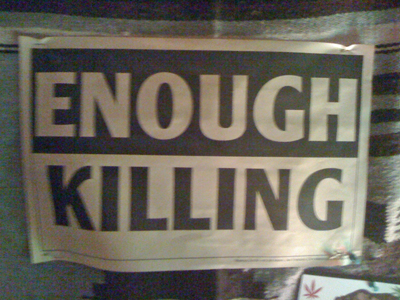
Enough killing


A youngish man, a neighbor, was in church today. He describes his family background as an almost cartoonish representation of the diversity of the USA: the son of a Persian Muslim father and a Polish Catholic mother, he looks gay. As he says, in the summer, he tans deeply and gets called racist names on the street. He embodies so much, it's crazy-making.

In the wake of the massacre in Orlando, he could barely stop crying. He's frightened. He lives with not knowing which of his identities might get him killed.

Folks in our little parish understand this all too easily. Many are survivors of the AIDS epidemic; they've watched their friends drop and wonder why they are still here. Sometimes they still gather to dance.

None of us can know which of our identities might get us killed at any given moment, though being white and older sure reduces risk in this country.

No private individual needs a military assault-type weapon. Those things are built to kill; they are not toys and no one needs to play with them. If we have to repeal the 2nd Amendment, so be it.

We don't need politicians making it worse. You know who I'm talking about. In these times, we need to take care of each other, not posture and pretend to build walls.

Sunday, June 12, 2016

For the record: the SFPD murder of Sheila DeToy

San Franciscans are struggling these days to rein in a police department which has killed five civilians in the last two years in circumstances in which officers' justifications for their use of force strain credulity. Alex Nieto, Amilcar Perez Lopez, Mario Woods, Luis Gongora Pat, and Jessica Williams are dead. No officer has been charged or (as far as we know) disciplined. In fact, since 2000, the SFPD has killed 40 civilians; no officers have been charged. A culture of impunity in the SFPD is not new; in the over 40 years I've lived in this city, new cases involving officers mistreating residents have recurred over and over. Calls for reform seem to achieve little. I plan to write an occasional post "for the record" recalling some of these incidents.

For the story of Sheila DeToy, I'll outsource this to Peter Keane writing in the Chron in 2006:

Seventeen-year-old Sheila Detoy was killed by a San Francisco police officer on May 13, 1998. By all accounts, Sheila was a wonderful young girl. She was still just a child, so she had a child's optimism and dreams.

It is now eight years since she was shot dead by a plainclothes San Francisco police officer as she sat as a passenger in a car pulling out of a driveway. The officer was seeking another passenger in the car, a young man who had not shown up for a court appearance on a drug charge. He fired into the car and the bullet tore through Shiela's neck. She bled to death.

What happened next was horrible in its own right. With a cruelty that defies understanding, a department spokesperson issued an official statement just hours after she was killed. He said: "She was no innocent victim. She was trying to live the hip-hop lifestyle."

This cold, and completely false, characterization of Sheila was repeated in every television, radio and newspaper account of the shooting. It seemed that it was not enough that she was brutally slain. For some reason, her character and reputation had to be massacred along with her. So those who loved Sheila not only had to cope with her ghastly killing, they also had to watch as her memory was publicly trashed.

...Now, eight years after Sheila's death, my prediction is that there will never be a hearing on the charges. When the long, losing route through the courts by the [Police Officers Association] finally plays out and a hearing is ultimately set, the officers involved will simply retire and that will be the end of it. So whatever the truth is about Sheila's killing, it will never be determined by an honest examination of the facts and the evidence.

Keane wrote this eight years after her death. The 1998 District Attorney, Terence Hallinan, quickly exonerated Officer Gregory Breslin who fired the shots. The city paid the DeToy family $505,000 to settle a wrongful death lawsuit. Internal administrative charges against Breslin and other officers involved lumbered along inconclusively for several years, but as far as we know, no cops were disciplined.

What makes the account of Sheila DeToy shooting all the more amazing is that its author, Peter Keane, was not just some reporter, but an appointed Police Commissioner (a member of the board that "oversees" the cops), a nationally recognized legal commentator, and dean of Golden Gate University Law School. Many SFPD officers expect to be exempt from challenge, even by the most "solid citizens." And they apparently are.

Saturday, June 11, 2016

Saturday scenery: San Francisco lions

I've mentioned before that the City by the Bay seems to have been overrun by salesmen for ornamental lions. Never would have known that if I hadn't been Walking San Francisco. Here's a small selection:
Nothing is going to get by this fellow.

On the other hand, this one seems to have dozed off.

That's a more plausible pose for a guardian.

No matter how much of pose you strike, it's hard to be imposing when you are the size of a plaster cherub ...

... or a faux gargoyle.

This big cat looks an awful lot like its domestic feline cousins ...

... while this one might benefit from a good scrubbing.

Friday, June 10, 2016

Introducing a "Long Run for the Long Haul"

If anyone thinks the content around here has become a little thin lately, I agree. You see, this month I am beating my tired old body into shape to undertake a 50K (that's 31 mile) run/walk in July along the trails in Marin County from Bolinas Ridge near Pt. Reyes to the Golden Gate Bridge. That's a lot of up and down, at least 5000 feet I think. And though it is beautiful, conditions are not always so perfect as in the picture.

This is a purely personal endeavor: as long as I've known these trails (30 years or more?) I've wanted to do this. I simply have an inner yen for such things. And I figure, at 69, I better get out there now while I can. Hence much trotting up and down hills and somewhat less writing.

And, since I'm doing this anyway, I might as well make it a fundraiser. Twenty years ago, along with Erudite Partner and with the support of individuals and community organizations across the state, I joined with a little band of determined organizers to found Californians for Justice. Now as then, CFJ works statewide to enhance political skills and leadership from among communities at the margins, mostly of color, mostly young people.

Their work deserves support now.

California is a better place than it was twenty years ago when a predominantly white electorate tried, through racist ballot initiatives, to vote away the emerging majority of color. This horrifying 2016 presidential election dominated by a racist demagogue feels much the way the struggles of the 1990s felt in California. California is far from perfect now: racist police departments still kill with impunity, economic inequality continues to crush too many, the state and local governments favor the haves over the have-nots unless we make them do differently. But the state is better and more promising these days. Groups like CFJ have made it so. We can only hope the rest of the country will catch up.

Please support Californians for Justice in its 20th year through this Long Run for the Long Haul.

Friday cat blogging

Morty and Tokyo are achieving something more like wary coexistence than harmony. He remains offended that someone else has appeared in his domain.

Thursday, June 09, 2016

Introductory linguistics that delighted this opinionated dummy

For anyone who is looking for a truly educational, truly fascinating, truly understandable long read (18 hours in the less expensive audio edition referenced here) I cannot recommend The Story of Human Language in The Great Courses series too highly. This is a clear yet sophisticated introduction to the discipline of linguistics -- just what I'd hope to get if I took an introductory college course in the subject.

Ever wondered how the world's 6000 or so languages can be so different from each other, yet somehow related? That's here, as is plenty of discussion of what is known about how language groups diffused around the globe. Why do some languages seem intricately complex, while others seem to be radically bare-bones? Linguistics has insights into this conundrum. Do you suspect that how people think is somehow conditioned by the structure of the languages they speak? That hypothesis is discussed here too.

The lecturer for this course, Professor John McWhorter who is affiliated with the Manhattan Institute and teaches at Columbia, is as good at conveying difficult concepts in simple terms as any instructor I've ever listened to. Truth be told, I was lousy at attending lecture classes long ago in college; even the professors who got good reviews as lecturers seemed more interested in entertaining than instruction. McWhorter entertains, but he also communicates substance.

It was healthy for me as a proper, silo-ed left-liberal to find myself delightedly learning from McWhorter. You see, before encountering these lectures, he was known to me as a Black critic of Black Lives Matter, who makes an unsupported leap from condemning police violence against Black people to somehow raising up the parallel horror of Black-on-Black violence. (For what it is worth, I think Jill Leovy provides insight on how the absence of a functioning rule of law results in Black people killing each other in some communities.)

McWhorter categorizes himself as a "cranky liberal" who has found a place at a libertarian think tank. It's possible to catch echoes of a style of argumentation he's honed in the academy listening to these lecturers: he oh-so-carefully and reasonably describes intellectual positions he intends to demolish, then carries the credibility he has earned through rationality to knock over what he disagrees with. On linguistic topics, he may be right. I take him with a lot of salt on politics -- but that only makes it more delightful to have found this series so educational.

For a sample of McWhorter's analysis of language development in the context of the current migration flow into Europe, here's an Atlantic article.

Wednesday, June 08, 2016

People on the move -- many languages fetch up In USA

I suppose I should have guessed that something like this would be true, but I'm nonetheless a little surprised. Pew Research has a mildly interesting report on the challenges facing the Census Bureau in designing a 2020 questionnaire suitable for use by residents who speak Arabic. The number of Arabic speakers in country is increasing rapidly.

The number of people ages 5 and older who speak Arabic at home has grown by 29% between 2010 and 2014 to 1.1 million, making it the seventh most commonly spoken non-English language in the U.S. Meanwhile, the number who speak Spanish at home has grown only 6% over the same time period.

A list of languages commonly spoken in this country (derived from a 2011 Census report) reads a lot like a list of how long ago the USA Borg invaded or assimilated their previous habitat (with some variation thanks to voluntary migration).
  • Spanish: "With 37,579,787 speakers, the number of Spanish-speakers in the US has increased by 210 percent since 1980, with the highest concentrations in Los Angeles, New York, Miami and Chicago." Also, of course, in Puerto Rico where a Spanish speaking population are native born citizens.
  • Chinese: "Just about 2,882,497 people speak a Chinese dialect such as Mandarin or Cantonese, an increase of 290 percent!" I've recently learned that linguists insist that Mandarin and Cantonese are separate languages, not dialects. I'll leave that question to that 2,882,497 million of us.
  • Tagalog: This Filipino language has 1.6 million speakers. Most of us have probably forgotten the U.S. ruled the Philippines as a colonial possession, but its natives haven't.
  • Vietnamese: "With an increase of 510 percent since 1980, Vietnamese is the language with the biggest change." First we invade and fight a war, then we assimilate some lucky or unfortunate fraction of the displaced survivors.
  • French: The 1,301,443 French-speakers represent "a 28 percent increase compared to 1980." Fascinating. Are these perhaps West African migrants? Or wandering Quebecois? Somehow I doubt they are European French speakers.
  • German: speakers of this European language have declined by 30 percent since 1980.
  • Korean: another venue for a war past ...
  • And Arabic: "In 1980, there were only 251,409 Arabic speakers on record." It's amazing what empire and war, as well as globalization and people seeking their fortunes, can do.
All those Arabic speakers include embarrassingly few refugees from the mess we've made in such unhappy countries as Iraq, Syria and Yemen, but over time, I'm sure more of them, too, will fetch up in the imperial center.

And that says nothing about the speakers of Central Asian languages -- Persian, Urdu, Pashto, Dari, etc. -- that our military adventures have set on the move.

Tuesday, June 07, 2016