Tuesday, April 02, 2019

Not just science fiction or fantasy ...

Improbable as it may seem, Erudite Partner and I were together at the historic moment of the first Apollo moon landing in 1969. And we shared the same reaction -- not skepticism, but horror: The astronauts landed and the first thing they did was litter!

It turns out that scientists today are deciding that the human refuse, space suit diapers, and shit left behind by our astronauts might provide information about life's endurance and life's spread in a largely hostile universe. Brian Resnick at Vox explains:

... we took microbial life on Earth to the most extreme environment it has ever been in. Which means the human feces — along with bags of urine, food waste, vomit, and other waste in the bags, which also might contain microbial life — on the moon represents a natural, though unintended, experiment.

The question the experiment will answer: How resilient is life in the face of the brutal environment of the moon? And for that matter, if microbes can survive on the moon, can they survive interstellar travel, making them capable of seeding life across the universe, including on places like Mars?

... The question scientists are asking of whether anything is alive in those jett bags, while seemingly silly, may lead to important insights about the extreme conditions life can endure. But it will also speak to our human potential to contaminate celestial bodies — or even seed life on them — when we go exploring. That’s reason enough to go back to the moon and collect some samples.

They are making plans to go back and look through our litter. It is likely physically intact -- though whether any bacterial or other life survives is doubtful.

Whether these NASA plans and hopes can survive the vicissitudes of earth-bound funding and political posturing will remain to be seen.

But the idea of the project is an enchanting spur to our imaginations, as good science ought to be:

Now let’s say an asteroid comes hurtling by, slams into the moon, and projects the Apollo mission poop into the deep reaches of space (an extremely hypothetical situation). Could that seed life in the broader universe? Maybe.

And in that case, could life on Earth have been seeded by some alien astronaut’s feces? “No prevailing theory I’m aware of involves an astronaut’s diaper, but that whole idea is perfectly scientifically plausible,” [NASA scientist Mark] Lupisella says.

Monday, April 01, 2019

A happy consequence of the Trump era?


Young people are not likely to forget the activism they’re learning now, said Ella Robinson, a 16-year-old in Silver Spring, Md. The Trump era has taught her and her fellow students political savvy, she said, as their spontaneous school walkouts have been replaced by organized protests, with permits and tailored messages around issues like gun control and climate change.

“People in my generation are very aware that walkouts can only go so far,” Ms. Robinson said. “Voting needs to happen.”

Emily Badger and Claire Cain Miller, NY Times

Let's hope that's representative. This interesting feature on (mostly white) young political participants for which the line serves as the conclusion seems to say so.

This was absolutely not what my generation (Vietnam/Civil Rights struggles) learned from widespread, equally urgent activism. The System (both political parties) refused to end an immoral, unjust war and slow-walked racial justice; many of the most activist among us turned away from small "d" democratic politics. But neither mass demonstrations nor retreat from politics constructed the world we hoped for.

Go to it, kids!

Sunday, March 31, 2019

We live in the backwash of two very different monks

In Fatal Discord: Erasmus, Luther, and the Fight for the Western Mind, Michael Massing offers a big book on a sprawling topic. An engaging narrative of early modern Europe (ca. 1480-1550), based in the lives of its two protagonists, Massing describes an era in which the sources of social and religious authority and legitimacy were being upended by technological and intellectual novelties on the way to being reassembled with new contours whose forms were still up for grabs.(Seem familiar? It should.)

Massing chose Erasmus and Luther as subjects because they seemed to embody an intellectual dichotomy he wished to explore. He explains in his introduction:
Their rivalry represented the clash of not just two intellectuals but also of two worldviews -- the humanist [Erasmus], embracing the common bonds of humanity and the diversity of cultures and viewpoints within it, and the evangelical [Luther], stressing God's majesty and Christ's divinity and insisting that all recognize those truths as supreme and incontestable. The two schools remain with us today. The conflict between Erasmus and Luther marks a key passage in Western thinking -- the point at which these two fundamental and often conflicting traditions took hold. ...
And right there, you have the reason why I both admire this book and experience it as problematic.

Historians usually try to understand and portray their subjects within those subjects' own terms. Inevitably, historians' perspectives are influenced and shaped by their own times and concerns, but they try to keep themselves out of their stories of their subjects. Massing is doing something else altogether and he knows it.
A journalist by trade, I have approached the subject much as I would a newspaper or magazine assignment. Rather than visit a far-off land, I have I have traveled to a different century ... Journalism, it is said, is the first draft of history; in writing about the Reformation, I am preparing perhaps the five-hundredth. Throughout, though, I have often felt the same surge of excitement I had while reporting a good story.
The result is indeed a terrific story which Massing has given a vivid, erudite, and thought-provoking telling. Yet I can't imagine either Erasmus, Massing's clear hero, or Luther recognizing themselves at all in this book. And that makes me a little queasy.

Nonetheless, I'm thrilled to have gone to the trouble of reading this 900 page opus. I'll just share a short list of insights and oddities I found worth learning and pondering.
  • Travel in Europe including Britain was certainly arduous and the roads hazardous, but it was possible and far less encumbered by borders than at any subsequent time at least until the Schengen area under the European Union. Britain was very much integral to that cultural area.
  • There was one clear career option for a man who wanted to be a scholar: join a monastery. Both men did; both men were poor candidates for a devout religious life for quite different reasons.
  • Today Erasmus might have defined himself as gay; in his own homosocial but not homosexual culture, that was not an option.
  • Today Luther's obsessive existential guilt might have caused him to be diagnosed as severely depressive; instead he irritated his monastic superiors by insisting on more than daily confessions.
  • Both men had their mental furniture blown apart because of the new availability of ancient writings, Christian and Greek. They learned the languages they needed to explore the old in order to invent the new.
  • Without the invention and spread of printing press technology, we would probably have never heard of either of these men.
  • Thanks to printers, Erasmus was probably the first author to live off payments for his books. Copyright had not been invented, but it was worthwhile for a printer to keep a prolific, salable writer on something like a stipend.
  • Luther's printed tracts gained him a popular following that encouraged German princes to protect him from being burned at the stake by popes as his reforming Bohemian predecessor Jan Hus had been.
  • Though modern nations hadn't been invented yet, something like emerging German nationalism helped save Luther's skin. Popular resentment of papal taxes and corruption in German-speaking areas kept Luther safe from heretic hunters.
  • Erasmus shrank from conflict more often than he engaged with his detractors; though Massing treats his intellect as heroic, he was a decidedly unheroic individual.
  • Luther never left behind his origins as a poor boy from a hard-scrabble mining town. He was intemperate, doctrinaire, unreasonable and a bully. But he found something in the Bible that Christianity within the comfort zone of unchallenged European Christendom had lost sight of: the awe-full Godness of God.
  • Both men were habitual, unquestioning, vicious anti-Semites.
Following from Massing's dichotomy, Luther undoubtedly changed Europe's history and his influence went forth along with explorers and conquerors to Europe's far flung colonies. It still remains to be seen whether Erasmus' breadth of human concern, tolerance, and pacifism will ever have its day.

Saturday, March 30, 2019

Life-saving intervention in the Mission

When you step within the restroom at the church where I worship, St. John the Evangelist in the Mission, you encounter this sign. I am so proud of my community for serving as a sponsor to The Gubbio Project, which opens the building for safe sleeping six days a week to a tiny fraction of San Francisco's street-sleeping homeless population. It's not everything, but it is better than cold wet concrete when the Department of Public Works has trashed your tent again.

And now Gubbio has managed to bring in Narcan for people at risk of overdose on opioids. According to the National Institute on Drug Abuse (NIDA):

Naloxone [brand name Narcan] is a medication designed to rapidly reverse opioid overdose. It is an opioid antagonist — meaning that it binds to opioid receptors and can reverse and block the effects of other opioids. It can very quickly restore normal respiration to a person whose breathing has slowed or stopped as a result of overdosing with heroin or prescription opioid pain medications.

Narcan nasal spray does not require medical training and is legal for broad distribution in California. Someone who is overdosing obviously needs additional help including medical, but access to Narcan can mean someone stays alive.

Gubbio explains that their new initiative ...

is now the Mission's ONLY full-time (35+ hours/week) distributor of Naloxone. ... At Gubbio, we are distributing Naloxone to people who use drugs, their loved ones, their friends, and any other possible overdose bystander. We are also providing training on how to identify an overdose and how to administer the Naloxone. We see this new distribution program as a natural extension of our harm reduction principles and practices.

We are happy to bring this life-saving resource to the Mission! Many thanks to The DOPE Project for making this possible!

Friday, March 29, 2019

Working the system


My heart leaped yesterday as I scrolled through the usual collection of emails awaiting the electronic trashcan. (Does anyone find their email more satisfying than annoying?) Here was one to feel good about.

Since the awful day, 9/11/2001, I've kept myself on the alert list of the Council on American-Islamic Relations because I just want to know what's happening for a community so often under siege. Mostly I glance and dump, perhaps noting the latest mosque vandalism or verbal hate incident. But what I saw yesterday made me glad.

It was an announcement for the "fourth annual Muslim Day at the Capital" in Sacramento. This is one way communities come out of the shadows and take their place in our (small "d") democratic system: they meet the people who make the laws and insist they listen.

But what moved me was the legislative agenda for this year's MDAC. California Muslims intend to campaign for three measures:
  • a bill to restore the right to vote to people on parole for a conviction of a felony.
  • AB 392 which would narrow the circumstance in which is legal for police to shoot someone.
  • and a new requirement that California high schools include a one semester Ethnic Studies course in their curriculum.
In choosing to highlight these bills, this community is placing itself solidly among the coalition of those working for change and more justice for all in the state -- and making friends who can be expected to be there if California Muslims need them -- as they too often do when subjected to ignorance and fear from their neighbors.

This is how the system works when it is working ... that is, it requires patient, repeated, sometimes tedious effort. And sometimes you win.

Friday cat blogging

What a beauty!

Encountered while Walking San Francisco.

Thursday, March 28, 2019

Californians turning against the death penalty?


A new Public Policy Institute of California survey finds the highest opposition to executions ever:

Majorities Favor Life Imprisonment over the Death Penalty
In the wake of Newsom’s decision to place a moratorium on the death penalty in California, our survey tracks if residents’ views have shifted over time. When Californians are asked whether the penalty for first-degree murder should be death or life imprisonment with absolutely no possibility of parole, a record-high 62 percent of adults (58% of likely voters) choose life imprisonment. Just 31 percent of adults (38% of likely voters) favor the death penalty. By contrast, California adults were evenly split in 2000 (47% life imprisonment, 49% death penalty).

This result is hard to square with repeated failures to pass anti-death penalty initiatives in 2012 and 2016. An LA Times discussion of the polling history suggests that those measures failed because opponents succeeded in making the vile crimes of vicious men the content of the vote.

Perhaps, but the data also suggests two other possibilities if, as I suspect, the death penalty is really a low salience issue about which most people only reflect sporadically. The survey followed hard on Gov. Gavin's announcement there would be no executions during his term. It's just possible that leadership is efficacious here. New Governor Newsom is probably riding as high in civic esteem as he ever will as he begins his term; at least for the moment, perhaps he has broken through our inattention.

Moreover, the same survey shows opposition to the death penalty becoming a more partisan issue. Seventy-six percent of Democrats oppose executions, while 64 percent of Republicans support the penalty. Since Republicans are a vanishing species these days in the state, partisanship is lending anti-execution campaigns a boost.

Newsom has declared a moratorium, but the death penalty can only be ended legally by popular vote. Perhaps state Democratic legislators will dare take the death penalty to the voters in 2020 when Democratic turnout is likely to be off the charts?

International law is for sissies


Erudite Partner (EP as I call her) is blowing the whistle on these two gents as they carry out the nationalist agenda of "liberating" the United States from international law.

... The story goes back to December 2017, when Fatou Bensouda, the [International Criminal Court] ICC’s chief prosecutor, announced an investigation into the possibility that U.S. military and CIA personnel had committed war crimes during America’s Afghan War or in other countries “that have a nexus to the armed conflict in Afghanistan.” These included some of the countries that hosted the CIA’s so-called black sites, where, in the earlier years of the war on terror, detainees were held incommunicado and tortured. Specifically, the ICC opened an investigation into the possible commission of “war crimes, including torture, cruel treatment, outrages upon personal dignity, rape, and other forms of sexual violence by U.S. armed forces and members of the CIA on the territories of Afghanistan, Poland, Romania, and Lithuania.”

When Bensouda made her announcement, it looked as if at least some Americans might finally be held accountable for crimes committed in the post-9/11 “war on terror” launched to avenge the criminal deaths of 3,000 souls in New York City and Washington, D.C. That never-ending war has seen the United States illegally invade and occupy Iraq; directly kill at least 210,000 civilians (not to mention actual combatants) in Iraq and Afghanistan; torture an unknown number of prisoners; and continue to detain without trial or conviction 39 men at the Guantánamo Bay prison in Cuba. ...

This administration can't allow some furriner to look into the misdeeds of Amurricans ... (though in truth the last administration might not have been so different.) In any case, Pompeo and Bolton are refusing visas to the ICC investigators. Read it all here.

Wednesday, March 27, 2019

Why do GOPers hate people getting access to medical care?


The Trump administration executed an elegant face plant in a shit swamp on Monday, asking a court to kill all aspects of the Affordable Care Act/Obamacare. ALL of it. They want to erase the private insurance markets that cover 15 million Americans, the Medicaid expansion that covers another 15 million, and the protections for people with preexisting conditions, the mandate for contraceptive availability, the option to keep young people up to age 26 on parental coverage, etc.

... the Trump administration’s clear, consistent, and unequivocal position is that millions of people should lose their health insurance and that people should not be protected from discrimination based on their medical history.

Dylan Scott, Vox

As a political stance, this is downright nuts. We just lived through a midterm election largely fought between Democrats who promised to supply more and better access to health care and Republicans who had voted to reduce access. Democrats won almost 9 million more votes nationally than GOPers, netting 41 House seats. Health care was the highest concern of 41 percent of voters according to exit polls; 75 percent of those voters went for the Dems. No other issue area polled over 25 percent.

It would be hard to think of anything less likely to be popular than Republicans trying to kill off health care access for many of us. We like being able to go to a doctor when we need one. More and more of us think medical care is a human right. Do they want to run against that?

Perplexed, I consulted Dr. Google to try to find out what the GOPers' beef really is?

This involved wading through a lot of what I was not seeking. I wasn't looking for Republican "argumentation" in policy debates which usually comes down to the contention that health care access is "a job killer" (nonsense, the sector is a growth opportunity) or it would cost too much (yeah, so do tax breaks for billionaires).

I wasn't looking for talking points or scare stories: remember "death panels"? Nor was I interested in what are essentially complaints about the health care "system" which blame the ACA/Obamacare for inequities and costs that law failed to curb, like rising insurance company co-pays and drug company profiteering. GOPers aren't proposing alternatives; they are trying to kill the existing law.

I was looking for the genuine reasons Republicans hate giving people access to health care.

Here's what I found; honestly it was pretty thin.
  • "Conservatives and libertarians strongly object to the federal government becoming ever more involved in the nation’s health care system. [KHN]" They simply fear government interference in anything as an intrusion on their individual liberty. Suspicion is not completely crazy. But it makes collateral damage in the community -- suffering and death -- hostage to some people's understanding of their personal freedom. The rest of us have a right to contest this assessment.
  • "Conservatives have also decried the act as an unwarranted intrusion into the affairs of private businesses and individuals. [BBC] " More of the same here; these folks probably like driving on roads where all drivers have licensing requirements and obey stop signs -- or maybe they don't. But the rest of us have decided the utility of some rules of the road overrides our individual druthers.
  • "... and then there is the question of who actually deserves health care. .. [some[ warned of the dangers of people getting health care who didn’t work or contribute to their society" [Vox] GOPers live with a terror that someone somewhere will get something for nothing. They feel that possibility demeans their personal struggles. They are doing their best. Is the other guy struggling too?

    And among some white folks, there's too often a suspicion that the undeserving someone somewhere is Black or brown -- somehow Other.
  • Or, just perhaps, conservatives don't accept the premise of health insurance at all. Ed Kilgore tried to explain during an earlier round of this struggle:

    Conservatives have long believed that “third-party” health insurance — health insurance provided by employers or the government — encourages over-utilization of health services and thus is responsible for high rates of medical inflation. And many believe the only legitimate purpose of health insurance should be to cover catastrophic costs, not the routine medical services that people used to pay out-of-pocket in the days before a combination of tax subsidies, collective bargaining, and employer competition made employer-sponsored comprehensive insurance plans common.

    ... They ... fight every feature of the health-care system that involves spreading the risk — and the cost — of poor health, which is the basic function of private as well as “government” health care. It might clear the air and foster a real health-care policy debate if conservatives would just come out and admit they oppose health insurance as we know it. But it does not sound like much of a winning message ...

Maybe the latest politically inexplicable GOPer assault on Obamacare comes down to this: some fraction of the Republican leadership really thinks they are permanent winners in a war of all against all, so "the little people" who need to live in a functioning society can be damned. This would sure explain their infatuation with Donald Trump.

Tuesday, March 26, 2019

More white people noticing the world around us

It's an odd feature of this otherwise dispiriting time that, very gradually, certain truths are drifting into common white knowledge.
Emily Guskin
A record high share of nonblack Americans say the chasm between blacks’ and whites’ standards of living is due to discrimination against blacks, with fewer people blaming lack of will power, according to a long-running national survey released Tuesday.

The biennial General Social Survey found 41 percent of nonblack Americans in 2018 said discrimination was the main reason blacks “have worse jobs, income and housing” on average than white people, up from 30 percent who said this in 2014 and 38 percent in 2016. That level of concern is still far lower than it is with black Americans themselves, among whom 65 percent say discrimination is the main reason for the white-black prosperity gap, up 10 points in the past four years.

... the share of adults who are not black blaming lack of motivation among blacks for racial disparities fell 10 percentage points to 35 percent over the same period. The 2018 survey marks the first time in four decades that more nonblack adults blamed discrimination than lack of motivation among blacks. A still-larger 49 percent of nonblacks faulted the racial gap on a lack of educational opportunities needed to rise out of poverty, a concern up nine points since 2014.
My emphasis. Never say that getting out and screaming truth to the housetops and beyond doesn't matter. Thanks Black Lives Matter for your educational work!

Monday, March 25, 2019

Reminder: Trump asked for Russian help for his lies

... on national TV.

I don't intend to go all conspiracy theorist on this -- but I don't have to. Whatever small bore legal rationales Attorney General Barr has come up with, if soliciting foreign assistance for your political campaign is illegal, the president is a crook. I don't need a Mueller report to show me this, nor should you.

If law is impotent, the people must combine to throw the bums out. That's not the most comfortable way to run a country, but it's still true. Apathy=Death.

Sunday, March 24, 2019

Why do they all lie?

Or to keep it simple, why isn't that old neo-Confederate Jefferson Beauregard Sessions still Attorney General?

Like so many in the Trump orbit, ole Jeff was tripped up by his lies about contacts with Russians. (Thanks Al Franken for getting that ball rolling.) When trying to escape that compromised position, Sessions got sideways with Trump and lost his dream job beating up legally on Blacks and Latinx people. Too bad for ole Jeff.

Every time Russia comes up, they all lie. The Moscow Project catalogued over 100 such lies by the summer of 2018.

Until the Mueller report is released in full -- probably not until and unless Congress really squeezes all these con artists -- we haven't learned why they all lied.

The real question is do we care? The task remains clear: let's throw the bums out in 2020.

Poster is for sale on Amazon.

Martin Barahona, R.I.P.

The retired Anglican bishop of El Salvador and primate of the Iglesia Anglicana de la Region Central de America (IARCA), Martin Barahona, has died at age 75. Fr. Martin navigated rough political and ecclesial waters with grace and friendliness, advocating welcome to all while seeking justice for the poor and oppressed. Shown here on a visit to San Francisco in 2007, he walked the Mission neighborhood, taking in the rough conditions in which migrants from his country found themselves. In particular, he met with Salvadoran women organized in Mujeres Unidas y Activas (MUA) to discuss what sort of education his diocese could carry out in San Salvador to encourage prospective migrants to adopt a realistic view of the trials and difficulties they might encounter if they made the journey.

In 2000, Fr. Martin was one of the founders of Cristosal which works to advance human rights throughout Central America through research, accompaniment of endangered victims, and litigation.

Saturday, March 23, 2019

Spotted in a San Francisco garden

It will all come out when it comes out. Whether whatever it is moves anything will depend on what results always depend on: will we the people make something happen? It's probably worth signing on with Indivisible.

Friday, March 22, 2019

5th Year Alex Nieto Angelversary

Elvira and Refugio Nieto, parents of Alex Nieto who was murdered by San Francisco police officers on Bernal Heights five years ago, look on as Aztec dancers open the commemorative ceremony.
Thanks to tireless community agitation, a city-approved Alex Nieto memorial will be built a short distance up the hill later this year.

Friday cat blogging

Morty is spending a lot of time in his house these days. He's well aware that his cave is a safe place to be when he suspects I want to give him his daily blood pressure pill. He gets it despite hiding. We work these things out.

Thursday, March 21, 2019

Reading 2020 through a study of 2016

Racism done it; what a shock!

Political scientists John Sides, Michael Tesler and Lynn Vavreck document overwhelmingly that the overriding factor which enabled Donald Trump's election was racial anxiety, or as I'd put it, white fragility in a society and culture feeling more and more unfamiliar to some white people by the day. They quote Hillary Clinton's summation approvingly:

... her campaign 'likely contributed to [2016's] heightened racial consciousness.' 'As a result,' she wrote, 'some white voters may have decided I wasn't on their side.'

This is their major, well-documented, take away, but the conclusion was not what has made Identity Crisis The 2016 Presidential Campaign and the Battle for the Meaning of America valuable to me.

If for nothing else, I'd urge interested activists (and others) to consider two points that stood out to me in this book.

Many of us had a completely inadequate understanding in 2016 that any Presidential election after an incumbent from either party has been in office for eight years is going to be something close to a toss-up. I know this was not part of my thinking. After even a successful presidency, there will be pent up grievances and pressures and room for demanding some change. These authors conclude that Obama's strong approval ratings and the good economic conditions probably predicted something like "a 72 percent chance of a Democratic [Clinton] victory -- a real, but hardly definitive, advantage." A lot of us leaped from an intuitive sense that this was the case to a misplaced confidence that Clinton would certainly prevail over the manifestly weak Trump candidacy. Pollsters interpreted their own data in the same light; Nate Silver has maintained plausibly that the polls weren't so much wrong as that too many of us failed to look at them realistically.

Sheer volume of media coverage enabled Trump to dominate the Republican primary race; he just crowded out the rest of them. Trump was such a ratings draw that the TV networks sometimes covered his rallies (circuses of hate, I'd call them) even when nothing was happening. The authors describe the general principles:

... nominations often present a challenging task for voters. There can be lots of candidates, some of whom are familiar only to political cognoscenti. How then is a voter to know which candidates are "good"? Which candidates have adequate experience? Which candidates have beliefs that a voter shares? Which candidates can win the general election? Voters need information to answer these questions, and the news coverage helps to supply it.

... Candidates who meet standards of "newsworthiness" garner coverage. Because news coverage of campaigns typically focuses on the horse race -- which candidates are winning and losing, their campaign strategies, and the like -- candidates will earn more coverage when they raise large sums of money or do unexpectedly well in prediction polls or early primaries and caucuses. News coverage also features events that are novel -- such as when a candidate first announces his or her candidacy -- and episodes that make for good stories, with compelling characters and conflicts. When candidates succeed by any of these metrics, even if they have been largely ignored to that point, they will be suddenly "discovered" by media outlets and, therefore, by the public. Their poll numbers will increase ...

...

Does that description of a primary seem familiar? It should. We're in precisely that phase with the Democratic hopefuls these days. I am reading current 2020 coverage through a lens very much informed by this insight about media influence from Identity Crisis.

For example, here's a snippet this week from Thomas Edsall:

G. Elliott Morris, a political data reporter for the Economist, noted on Twitter that O’Rourke has received more cable news coverage in the five days since his announcement than any other candidate during the full post-announcement week. O’Rourke is on a path to get 180 percent of the coverage received by Bernie Sanders, the previous leader on this measure.

Will this move the polls? Will a lot of media attention bring more? We'll see. FiveThirtyEight has published an informative graphic showing how much coverage each current Dem aspirant received from their kick-off.

Or this from political scientist Brendan Nyhan:

With most candidates’ speeches and rallies generating relatively few headline-worthy sound bites, reporters and commentators often instead turn their focus to theater critic–style assessments of a candidate’s strategy and campaign skills. In its most dangerous form, this form of coverage centers on manufactured narratives about a candidate’s personality. These narratives often center on whether the candidate is “authentic” — a media construction that ignores the reality that all candidate behavior is strategic.

He's on to something there. The journalists need to shape an attention-grabbing story out of whatever politicians offer; they will flock to the off-beat and the bizarre. Then more coverage leads to more coverage ...

A reporter new to covering politics offers some revealing reflections from Iowa on the experience of following candidates in the early stages:

Voters listen to candidates differently from the way reporters do. I can see why people who cover these events regularly start to get cynical or at least start to tune out the message. After hearing it four times, even I could probably repeat Harris’s stump speech by the end of that day. But what I didn’t realize until I got here — and should have, and hope to remember — is that everyone in the crowd is hearing those speeches (and most importantly, those jokes) for the first time. I’ve probably heard Harris say Americans need to base policy on “science fact, not science fiction” about 15 times. But the elderly man in front of me in Ames still chuckled when he heard it Saturday night and elbowed his wife, who did the same.

Out of such as this are winners chosen. Not only this, but very much this. I'm sometimes skeptical of academic political science; is it really science? But I'm finding Identity Crisis very much applicable to our current moment.

Wednesday, March 20, 2019

In honor of the 16th anniversary of George W. Bush's Iraq war ...

... this deserves to be recycled.

EP pointed out today that we weren't even thinking about the anniversary. I pointed out that for those of us in the peace movement who knew better, the U.S. invasion of Iraq in 2003 was a long running catastrophe which we anticipated (and protested), denounced (and protested), and bemoaned (and protested) from a year before "shock and awe" until years later when the people, the media, and the historians pronounced it an immoral clusterfuck.

Our friend Roy Eidelson reminds us that Bush, and Dick Cheney, and authoritarians everywhere understood that fearful people can be made suckers for immoral acts.

Voice or no voice, the people can always be brought to the bidding of the leaders. That is easy. All you have to do is tell them they are being attacked and denounce the pacifists for lack of patriotism and exposing the country to danger. It works the same way in any country. -- Nazi leader Herman Goerring

Eidelson spells out the story in Stoking Fear.

Honoring Huli


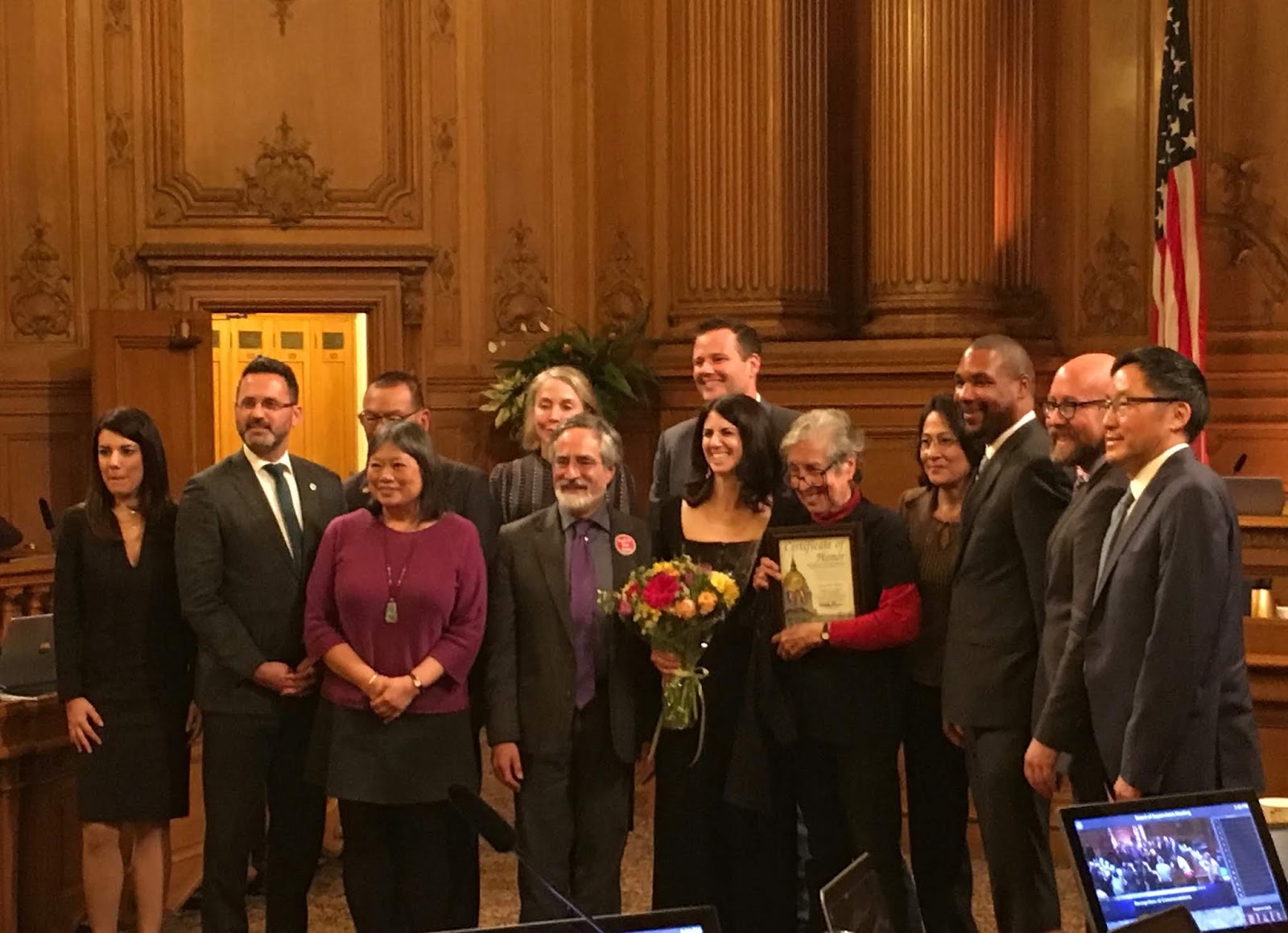
San Francisco District 9 Supervisor Hillary Ronen honored her most cantankerous (and much loved) constituent Giuliana Milanese amidst Women's History Month festivities at City Hall yesterday.

Huli is always there for every working class cause that helps San Francisco remain its unconventional self -- for public education, for affordable housing, for Jobs with Justice. She's worked for every good politician we've had in decades and also for a lot of least-worst ones. Once they are elected, she yells at them.

Who but Huli would wear an "I'm not bossy; I just know what you should be doing" t-shirt to such an occasion? Friends filled the chamber to applaud.

The Board members she cajoles and torments all had to pose for the picture.

Tuesday, March 19, 2019

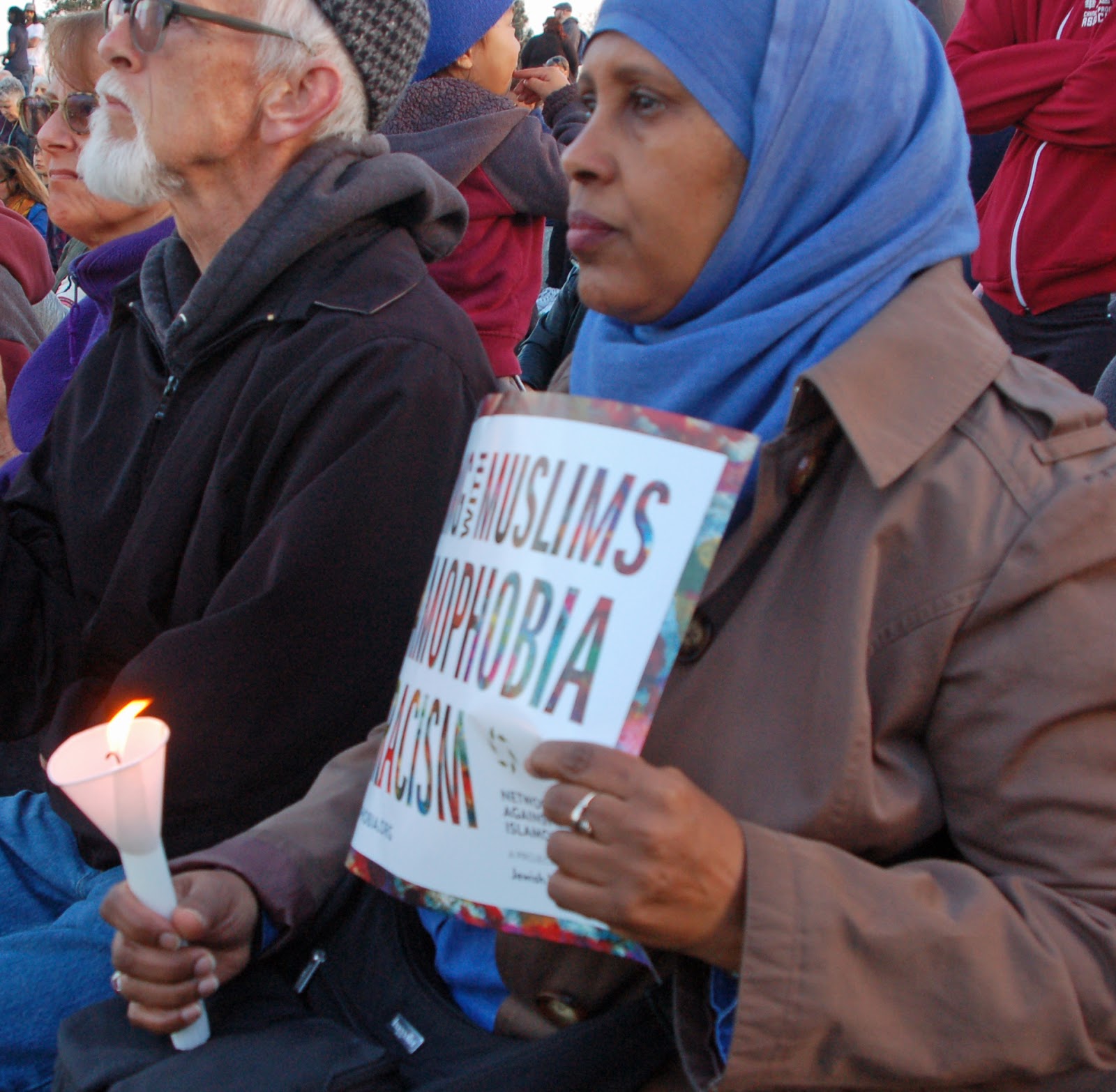
From a vigil for the victims of New Zealand mosque shootings

At the Lake Merritt Amphitheater in Oakland CA, Monday, March 18.

"By doing more, we honor the beloved of god that were lost."