Showing posts with label religion. Show all posts

Sunday, April 19, 2026

Religious follies among American Christian tribes

Of course I've been following with some combination of horror and amusement Donald Trump's foray into demeaning Pope Leo while play acting Jesus. The President is outmatched. 

But hey, this is a political blog, mostly, so I thought I'd pass along two contradictory interpretations of whether the needy Orange Toddler might derive electoral benefit among Catholics from his latest round of religious posturing.

First off, JVL from The Bulwark. He looks at the electoral record and brings receipts: 

... It looks to me like Trump is accelerating the move of Christian nationalists away from Christianity and towards pure Trumpist nationalism—even among Catholics. ... I have said for several years now that my general sense is that American Catholics are walking down the same path that evangelicals trod in the 1990s when they consolidated behind the Republican party and became more of a political bloc than a religious movement.

... Catholic voters have become more Republican over the last eighteen years and this trend accelerated when Donald Trump—the least Christian presidential candidate in history—appeared on the scene.

During that period we saw something similar happen with white evangelical voters, who were +50 R in 2008 but grew to +66 R in 2024.

That 16-point swing looks pretty big. But during the same period, Catholics swung even harder. Catholics went from -9 R in 2008 to +12 R in 2024—a 21-point shift.

A decent and intelligent Catholic himself, he hates what he sees happening in his tribe.

This is what I mean when I say that Catholics look to be on the kind of curve that white evangelicals went on in the ’90s. 
Maybe Catholics will turn away from this road, but I’m not optimistic. If anything, Trump’s open blasphemy seems likely to accelerate the trend by forcing these people to make a choice between the teachings of the Church and the demands of a nationalist political cult. 
From where we sit in 2026, I’ll be surprised if most Trumpist Catholics end up choosing Catholicism in such a showdown. 

At the Tesla Takedown, San Francisco
To my slightly jaundiced eye, JVL is a classic American Catholic of the white sort who used to define Catholic culture in this country and no longer do. 

Aside from the Irish and some Germans who came even earlier, white Catholic immigrants from Europe of the late 19th and 20th were hard working folk who crossed the ocean for a better life. They were often exploited by longer established and richer white mainline Protestants (my tribe) who didn't much want to share. This set of Catholics retained considerable cultural distance from Protestant Americanism; in particular, often had their own schools, sometimes in home country languages, up through World War I. The closing off of immigration between 1922 and 1945, followed by national mobilization in World War II, finally enabled this wave of white migrants to assume a place in the political and cultural center. 

It was time ... some cultural distinctions remained where large white Catholic populations still lived -- fish sticks for school lunch on Friday, anyone? -- but white Catholic America became more and more just ordinary America.

Obviously JVL's got a point about the rather horrible political trajectory of this, most visible, segment of white Catholics -- but these folks are not the only Catholics. 

The sociologist Robert P. Jones thinks the Orange Toddler is too dumb to understand the implications of his religious antics in nationalized elections.

What’s the Political Risk of Trump’s Fight with Pope Leo?

I don’t believe President Trump understands the political risk of picking a fight with Pope Leo XIV. My best guess is that he believes that the unquestioning submission demonstrated by his fawning white evangelical followers exists among all of his Christian followers. But Catholics are not white evangelical Protestants.

While white evangelicals have voted more than 80% for Trump every time he has been on the ballot and have held strongly favorable views of Trump through every controversy and outrage over the last decade, Catholics have been more measured in their support. 

Most notably, there is a strong racial and ethnic divide among Catholics: six in ten white Catholics supporting Trump each time he has been on the ballot, but six in ten Latino Catholics have supported his Democratic opponents.

... If his support falls further, it could be game over for Republican candidates in competitive midterm elections and for the next Republican presidential candidate. While Trump and Republican candidates might be able to weather a 5-10 point drop in support among white evangelical Protestants, given that they largely live in safe deep red districts and states, the GOP would not survive such losses among Catholics—both because of their size and their location. Overall, Catholics comprise 22% of Americans, nearly double the size of white evangelical Protestants (13%). Most importantly, Catholics are much more numerous in swing states ...

In the midterms elections, there are only a handful of competitive races, and they are nearly all in states with significant Catholic populations. For example, the competitive House races are largely confined to Pennsylvania, Michigan, Wisconsin, New York, New Jersey, and Texas. Competitive Senate races are confined to Michigan, Maine, North Caroline, Georgia, Ohio, Alaska, and New Hampshire. ...

In these competitive states for the midterm elections, the Catholic vote looms large... In California and Texas, Hispanic Catholics (reminder: Trump favorability at 25%) outnumber white Catholics by around four to one. ...

Jones, an escapee from a white southern evangelical background, thinks alienating a few white Catholics and a lot of non-white Catholics could be devastating to Republican prospects. Trump's attacks on the pope will exacerbate anti-Trump trends. His analysis is plausible. I guess we'll see.

• • • 

Click to enlarge
Kevin Jones, an ex-evangelical, pastor, and author, writes a truly delicious takedown of current Trump pretensions from within a Bible-centric frame. Do enjoy: 

Meet the original Trump: Herod the Great  ...

... Herod ruled Judea from 37 to 4 BCE. He was not Jewish by lineage; his family was forcibly converted to Judaism not long before Herod’s birth. He held his throne not by popular mandate or ancestral right, but because the Roman Senate appointed him. He was, in every sense, an outsider. Herod was a man whose claim to power was conferred by an empire, not earned by belonging.

Sound like anyone?

To compensate for this legitimacy deficit, Herod did two things simultaneously. First, he built. Relentlessly. Obsessively. He constructed the harbor city of Caesarea from scratch. He erected palace-fortresses across the desert. He raised an artificial mountain (Herodium) and built a palace on top of it to serve as his own monument. And in the ultimate power move, he rebuilt the Jewish Temple in Jerusalem on a scale so staggering that the rabbis later said, “He who has not seen Herod’s Temple has never seen a beautiful building.”

Herod put his name on everything. Caesarea. Herodium. Towers named after his brother, his friend, his wife.

If Herod had access to gold leaf lettering, you’d better believe it would have been on the front of every building.

Second, and this is the part that should make every American Christian sit up straight, Herod weaponized religion. Not because he believed in it, but because he understood that in Judea, religious legitimacy was political legitimacy. You couldn’t rule the Jewish people without the blessing of the religious establishment. And so Herod set out to acquire that blessing … by any means necessary....

There's much more. Don't miss it.

• • •

Have to say as an Episcopalian, it was nice to see the Archbishop of Canterbury sticking up for the Pope in this kerfuffle, even though he may not quite know what to do with support from a girl.

Archbishop of Canterbury backs pope’s calls for peace amid Trump feud 

Wednesday, April 15, 2026

Popes and the big tent

Day in and day out, I continue to be astonished and pleased by how much unity the big tent, anti-Trump and anti-oligarchic forces in our country are managing to achieve. 

Before the arrival of Donald Trump clarified much for many, I found Jennifer Rubin, then writing at the Washington Post, a loathsome Republican-excusing right wing pundit. She has been through some changes. The horror of the moment moves all of us in novel directions. Today Rubin writes prolifically at The Contrarian, using her sharp wit daily to skewer our aspiring dictator and his friends. 

I'll applaud this version of Rubin. Here is a bit from today exploring what for her is likely improbable religious terrain taken up by leaders opposing the inhuman global authoritarian project.

Autocrats Don’t Fare Well Against Faith Leaders

... Pope Leo is as much a problem for Trump as Pope John Paul II was for communist Poland. When a native son (Leo of America, John Paul II of Poland) expresses affection for and understanding of his countrymen in their native language during a time of the oppressive rule, the Pope can form an emotional bond that rises above politics. His message of faith, peace, and love reaches far beyond Catholic churches and compels people to focus on matters and values more profound and compelling than partisanship. A Pope in tune with his flock who promotes a values-based worldview can illuminate an autocrat’s smallness, meanness, and desperation.  ...

... As Catholics recall nearly fifty years later, Pope John Paul II’s visit to Poland in June 1979 helped ignite a movement that would upend the communist regime. ... A year later, Solidarity formed in the Lenin Shipyards in Gdansk to spearhead the anti-communist political movement.

The Polish example reminds us that autocrats resort to bullying, violence, and fear because they cannot obtain people’s affection. Through personal experience with a despotic regime, regular people (whether in Poland in the 1980s or Hungary and the U.S. today) eventually recognize the regime as exploitive, corrupt, and cruel.

... The democracy movement is not a religious community, although faith motivates many in their opposition to ICE, racism, and neglect of the poor. Nevertheless, the pro-democracy movement can and should stay grounded in positive ideals — patriotism, decency, fairness, and empathy. Whether those values emanate from religious faith or humanistic values, once people rediscover a sense of obligation to something higher than themselves, they are more likely to lose fear of the regime, forge a community with other inspired democracy defenders, challenge authority, and view vulgar, crazed leaders as weak and transitory figures.

Democracy advocates should unabashedly denounce Trump in moral terms. Launching a war of choice and threatening genocide is evil. Taking away healthcare and food from the poor to enrich billionaires is wrong. Deporting grandmothers and children is cruel.

When the argument becomes right vs. wrong rather than right vs. left, an amoral, corrupt autocrat is cooked. ...

I might not be so generous toward an institutional church which still fails to appreciate the humanity of women and queers, but I too applaud when the generous and inclusive strain in Catholicism rises to the fore.  And Rubin's frame seems very correct in this moment. The autocrat is just in the wrong for us all.

Wednesday, January 07, 2026

This is about deep story

I was disinclined to give Elaine Pagels' Miracles and Wonder: The Historical Mystery of Jesus a fair shake. I was wrong. I encountered a book that intrigued, broadened, and even fed delight. 

Pagels is a Princeton University historian of religion, an authority on the numerous texts in the Mediterranean world from the decades just before and at the beginning of the Christian era that didn't make it into the official (canonical) version of the Bible. 

Pagels' subject matter is what made me suspicious of her scholarship. This derives from a quirk of my history. When the Dead Sea Scrolls, 3rd century BCE texts uncovered by archeologists in the Judean desert turned up in the 1950s and early '60s, my intellectually curious, historically inclined, mother was for awhile gripped by a sort of fever for the discoveries. Though just an annoying child, I remember feeling there was something a little too credulous in her enthusiasm. Something didn't feel right. The whole accumulated history of the ancient world couldn't be overturned by some bits of clay covered with scratches. That's not how history works; there are no secrets, just complicated, crooked byways to explore. 

It seemed many mid-20th century popular religious writers, encountering the new historical tidbits, lost their bearings. As I studied history more, I wasn't going there. (Mother eventually got over her enthusiasm as well.) 

And I long pigeonholed Pagels as one of those enmeshed in the glamour of poorly grounded novelties. In Miracles and Wonder she's not, at least not much. Instead she muses with restraint on what modern historical interpretation of the times means to thinking about Bible narratives.

... given the opportunity to draw upon a far wider range of sources than those available to many historians in the past, I am excited to return to the questions with which we began: Was Jesus actually a historical person? If so, what kind of person? The answers are not obvious, since our earliest sources are brief, and often contradictory. There are more questions than answers -- many gaps in what can be known. But the evidence confirms that he was, indeed, an actual person; everyone among his contemporaries who mentions him agrees on that, whether they speak of him with reverence or contempt. 
I began this book with other questions too. What was the social and political context of Jesus' life in Judea? How is it that Jesus, who lived thousands of years ago, has not gone the way of other beings, gods and humans, like Zeus or Julius Caesar, who populate our culture's remote past?
The result is a little uneven, but interesting. 

She particularly chases down the notion, found in multiple more or less contemporary sources, that Jesus had a known male parent, one Pantera, a Roman legionnaire, who presumably raped his mother Mary.

... Recognizing the political context of first-century Galilee is necessary, though to understand the gospel stories. What they tell is what the writers knew well: that everyday life in occupied Judea often included violence. Roman writers picture their empire as a civilizing force, but Josephus [a contemporary Jewish historian] depicts first-century Judea as a land in turmoil.  
What has lent credence to the stories of Pantera is what local people knew: that Roman soldiers brutally suppressed any hint of revolt, exploited subject people, and targeted local women with sexual violence. ... 
... As for what actually happened -- divine miracle, human dilemma, or both -- who can say? As I see it, however these various writers interpret Jesus's origin, [gospel authors, canonical or not] all agree on the spiritual truth: that Jesus is "Son of God," and embodies God's presence on earth. 
That is, this is an historian who gets around sticky, messy questions of "what is truth; what really happened?" by defaulting to "does this story inspire?" This is no way to write academic history, but it may be the only way to chronicle actually existing, longstanding religious faiths whose content morphs and grows within history. This is Pagels' method.
My own experience as a historian has made me cautious. We do not know which episodes were made up, and which might be based on actual or visionary experiences. Furthermore I have shown that some scenes that sound like invention are written as metaphor. ... 
... what fascinates me is not only the historical mysteries my book seeks to unravel but the spiritual power that shines through these stories. ... every one of these gospels -- not only those in the New Testament but also the "secret gospels" [non-canonical fragments] -- ends in the most astonishing reversal of all. After Jesus suffers the worst imaginable fate, betrayed by a trusted friend, abandoned by everyone, falsely accused, tortured, and cruelly executed in public, he is raised to glorious new life, reunited with those who love him, and elevated to receive the highest praise in heaven, to reign over a world renewed in justice and peace. 
Hebrew Scriptures set the pattern for such shifts: people enslaved are set free; a shepherd boy named David fells a hostile giant with a slingshot; hungry lions spare Daniel's life; and Jonah emerges alive from the belly of a whale. The point is as clear as a lightening flash: "God can make a way out of no way," transforming what we suffer into joy. I love this about the gospel stories. Is that what keeps the stories of Jesus alive amid the twists and turns of history? As I see it, they give us what we often need most; an out burst of hope.
This is a generous book. We live in a time that needs a lot more generosity. I recommend it less for the truth it reveals than for its spirit. But that ain't nothing.

Saturday, December 06, 2025

An unexpectedly articulate Christian politician

Every once in a while a politician says something so intriguing that I perk up and take notice. (Yes, the contrary is also true: most of them, most of the time, are just boring.)

James Talarico is a young Texas Democratic state legislator who aspires to overcome better known pols and challenge the sitting Republican Senator, John Cornyn, who is up for a fifth re-election next fall. Cornyn is endangered in his own primary by the corrupt far right Texas state Attorney General Ken Paxton. The last Dem nominee for Senate from Texas, Colin Allred, would be expected to clear a large field to take on either of these Republicans. 

But along comes the young guy. Texas Dems will have to decide who suits them. But I find this seminarian turned politican genuinely interesting. He has thoughtful ideas, ideas seldom expressed candidly in politics. 

From an interview Talarico did with The Bulwark's Lauren Egan:  

EGAN: I want to talk about the attack ad from Terry Virts, the former astronaut also running in the Democratic primary, criticizing you for comments made in 2021 against GOP-backed legislation on transgender issues. You talked then about how “God is nonbinary” and that there are “many more than two biological sexes.” I understand that there’s more context to the points you were trying to make. 

But do you regret those comments? Is it something you would say today?

TALARICO: I don’t regret that comment. I realize that I was being deliberately provocative, which sometimes I do, especially when I want to grab people’s attention and communicate something important. 

I understand why those comments raised eyebrows, but theologically speaking, I don’t think that’s a controversial statement. I think most of my fellow Christians would acknowledge that God is beyond gender. In fact, the Apostle Paul says in Galatians that in Christ, there is neither male nor female. So if people have a problem with that sentiment, they should take it up with the Apostle Paul, not me.

... I think in a lot of ways my party is scarred from the last election and scared of its own shadow. We’re all freaking out about what the Republicans are going to say about any given thing. My experience in politics is if you’re genuine, if you’re telling the truth, if you’re connecting with people, that’s what will matter. Don’t worry about what the other side’s gonna throw at you.

... people are starting to get wise about this strategy of people like Ken Paxton and John Cornyn—they run for office riling people up about people’s private parts, about these culture-war issues. And when they get into office, they’re cutting taxes for rich people and raising health care premiums for everybody else.

EGAN: Right. But they got into office in part because they were able to effectively rile people up about these issues. So how do you neutralize that

TALARICO: I think it’s playing into their game and we’re not going to win at that game. We have to change the game. The first words out of my mouth in this campaign and in my launch video were that “politics is not left versus right, it’s top versus bottom.” So it’s completely changing how we understand and how we view politics.

... I started running for this national seat and I went to a bunch of national reporters and every single one of them asked me about trans athletes. Literally none of them asked me about childcare, none of them asked me about health care, education.

Trans athletes are a legit issue, and I’m completely willing to talk about it. But for that to be the only policy topic that any national reporters are asking about—what does that mean? Unfortunately, a lot of our media requires clicks and that is a perverse incentive, because it means the most red-meat, divisive, culture-war stuff is going to get that attention. 

But I think people are ready for someone who’s going to call that broken system out and maybe articulate another path forward of what a different politics could look like, one that’s not built on division.

EGAN: What would you say is the Bible verse that informs your politics the most?

TALARICO: One of my favorite verses [is] Matthew 5:5, which is “the meek will inherit the earth.” I talked earlier about politics being top versus bottom, and our campaign is really not coming at you from the left or from the right. It’s coming at you from the bottom. It is trying to bring working people together across all these divisions—including party, race, gender, and religion—to try to take power back.

If we bet on each other, if we love our neighbors as ourselves, ultimately people without any power can succeed. That’s a promise that’s built on faith, not necessarily on evidence. Because you look around and you’re just like ‘there’s no way you can take on these billionaire, megadonors who own all the media outlets.’ But there’s a promise there, a seed that’s planted in my tradition of betting on the underdog.

Is this a winning message in the Texas that exists in the year 2026? Who knows? I don't believe in commenting much on primaries in states where I am not a resident; local concerns are local concerns and should predominate in a healthy democracy. Maybe Talarico can strike a chord. I certainly like him in this interview, but we'll see how it goes. He seems brave, articulate and thoughtful -- not the norm in a politician. 

Friday, November 14, 2025

Roman Catholic bishops do right by immigrants


As pastors, we the bishops of the United States are bound to our people by ties of communion and compassion in Our Lord Jesus Christ. We are disturbed when we see among our people a climate of fear and anxiety around questions of profiling and immigration enforcement. We are saddened by the state of contemporary debate and the vilification of immigrants. We are concerned about the conditions in detention centers and the lack of access to pastoral care. We lament that some immigrants in the United States have arbitrarily lost their legal status. We are troubled by threats against the sanctity of houses of worship and the special nature of hospitals and schools. We are grieved when we meet parents who fear being detained when taking their children to school and when we try to console family members who have already been separated from their loved ones. ...

... To our immigrant brothers and sisters, we stand with you in your suffering, since, when one member suffers, all suffer (cf. 1 Corinthians 12:26). You are not alone!

We note with gratitude that so many of our clergy, consecrated religious, and lay faithful already accompany and assist immigrants in meeting their basic human needs. We urge all people of good will to continue and expand such efforts. 

We oppose the indiscriminate mass deportation of people. We pray for an end to dehumanizing rhetoric and violence, whether directed at immigrants or at law enforcement. We pray that the Lord may guide the leaders of our nation, and we are grateful for past and present opportunities to dialogue with public and elected officials. In this dialogue, we will continue to advocate for meaningful immigration reform. 

The Roman Catholic hierarchy is not where I am accustomed to look first for affirmation of universal human dignity. 

But the MAGA agenda of deportation and cruelty offends them and most of us. 

Here they speak bravely and broadly for compassion and justice. 

Friday, August 08, 2025

Do these people know how crazy they seem outside their bubble?

I guess we can be assured they don't care.

The Violent Take it by Force: the Christian Movement that is Threatening our Democracy by Matthew D. Taylor.

Once upon a time, in order to do work I hoped to do -- to build a movement of North American citizens in support to the progressive movements in Central American countries in the 1980s -- I needed to navigate an environment that included many little U.S. leftist sects and sect-lets. This sector among us was important to building a broad coalition of resistance to U.S. meddling with the aspirations of Central American peoples. In that movement, you had to be able to tell five varieties of Trotskyists and a few kinds of other Marxists apart. Why did we have to know and work with these often difficult people and forces? Because they were where friends of Central America could start -- though they could not be allowed to prevent the growth of a movement with a wider base of churches, labor unions, community groups and even politicians.

Matthew D. Taylor's description of the New Apostolic Reformation reminds me viscerally of those days. So many obscure but magnetic leaders peddling crackpot beliefs to branching veins of besotted followers! The NAR certainly has an inside track on defining Christian belief and practice for the benefit of our completely unChristian president. (Not so much so for the majority of those Americans who claim to be Christians.) Will they have staying power? Will it matter that, for all their emotionally attractive fantasies and significant institutional base, that they are completely out of touch with realities of planet earth? Will they turn on each other as mad movements usually do? We'll see. 

Taylor summarizes his subject: 
The NAR is organized around a highly networked but loosely affiliated pantheon of charismatic preachers, pastors, celebrities, nonprofit leaders, and international entrepreneurs who understand themselves to be recreating the energy and vitality of the early Christian church. They believe that the church has languished for centuries in feebleness and aimlessness, led by timid pastors and functionary priests -- until now. Now, they believe, in these momentous latter days, God has reinvigorated the church through the Holy Spirit-backed renewed leadership of apostles and prophets. They believe that Christians need to conquer the high places of influence in society and govern from the top down. Engaged in a cosmic spiritual war against the forces of darkness, they believe God has mandated them to use spiritual violence to defeat Satan and then build the Kingdom of God on earth.
It's important to Taylor that this is not just a white movement. Indeed, it's not even just an American movement.

All well and good, but I have a hard time with his assertion:

The NAR, and the broader Independent Charismatic arena in which it operates, offers a very plausible, popular, and even evangelical interpretation of Christianity.

Sure, many nice folks who mean well can read and cite bits of the Bible, but that certainly doesn't, by itself, make them either sane participants in contemporary civilization or exemplars of Christian piety. People claiming to be Christians have been running about for 2000 years; that's long enough to generate plenty of foolishness as well as occasional beauty and transcendence. Taylor provides a schema for understanding contemporary American Christianity which is interesting, but he loses me when he asks me to take his subject matter seriously as an enduring faith. 

Perhaps it is a weird symptom of a democratic society decaying into oligarchy that so many of us are ignorant enough to find solace in following pseudo-religious leaders who lead to Donald Trump. 

If you have need to decode the intricacies of the crackpot strain in contemporary Christianity, this book provides a map. It's ugly terrain, with a heavy dose of grift from the innocent and ignorant thrown in for good measure.

Wednesday, July 23, 2025

Cracks in the wall: church and state

Given the number of breaches of established law by the Trump regime, it would not be surprising if you missed this one: the IRS has freed churches to endorse political candidates. 

Since 1954, something called the Johnson Amendment to the IRS code had prohibited tax exempt religious institutions from taking a partisan side in candidate elections. When working campaigns, we would always assure diffident religious institutions that they could certainly offer a moral opinion on the issues of the day. But directly endorsing a candidate was a no-no. 

Right wing churches complained that the prohibition infringed on both their First Amendment rights of free speech and free exercise of their faith; besides the prohibition on endorsements was rarely enforced. (In the only slightly memorable mainstream instance of attempted application, the IRS did threaten the tax status of All Saints Episcopal Church in Pasadena in 2006 over an anti-Iraq-war sermon by retired Rev. George Regas. That went nowhere.)

Now the Trump regime is getting rid of this theoretical impediment to pastors' electioneering. The legal standard is now: “communications from a house of worship to its congregation in connection with religious services through its usual channels of communication on matters of faith do not run afoul of the Johnson Amendment as properly interpreted.” That means (I think) if it's part of a talk at the church or a sermon, the endorsement is just an intra-family utterance and that's fine.

Like journalistic explorer of the Christian right Sarah Posner, I can't get too exercised about this new IRS dictum: if a religious leader isn't able to convey social values in their preaching that lead congregants toward ethical political choices, there's something wrong with their communication skills. 

In our history, Black pastors have not been squeamish about standing and speaking for political messages. Historian of the Black church Jemar Tisby offers some strong opinions about which political interventions can empower religious communities and which would debase religious messages. 

What Do We Do? 
Pastors and church leaders should resist the temptation to endorse particular political candidates. 
Instead, they should teach their congregations how to think wisely and lovingly about the uses of political power, the call to public justice, and the pursuit of the common good. 
Congregation members have a responsibility, too.

Members of faith communities should pay careful attention to partisanship in the pulpit. They need to be prepared to ask pointed questions about the stance of their leaders on matters of conscience like choosing who to vote for.

And they should be prepared challenge their leaders, or even leave, if the faith community becomes a tool of partisan players. 
All faith communities should speak the truth in love to political leaders about the way power is being deployed in our nation. 
But when the church aligns itself with political power—endorsing candidates, seeking influence, anointing political “kings”—it abandons the self-sacrificial, justice seeking, truth-telling witness modeled by Jesus. 
A church that crowns candidates cannot carry a cross.

• • • 

Meanwhile a focus on what the Trump authorities might do to encourage already politically active white Christian nationalist religious bodies should not distract from what they almost certainly will do by way of the IRS to interfere with legitimate charitable activities. Faithful America passes on a warning: 

...  the chairmen of the Committee on Homeland Security -- Rep. Mark Green and Rep. Josh Brecheen launched an investigation into more than 200 organizations that provide aid to immigrants and refugees. These nonprofit groups -- including many religious organizations like Catholic Charities, the Council on American-Islamic Relations, and Global Refuge -- received a letter demanding to know if they used "taxpayer dollars to facilitate illegal activity." 
While these organizations are not required to respond to the inquiry, Green and Brecheen indicated that the Committee may take unspecified "further measures" if they do not comply. 
These organizations have well-established histories of refugee resettlement and serving immigrant communities -- in other words, of welcoming the strangers. ...
This is the arena in which we need to fight the good fight to keep the state out of our work and for our continued free exercise of the moral imperatives of religion.

Tuesday, July 01, 2025

When freedom seemed possible ...

Does history really have "turning points? The more deeply one looks into it, the less apt that metaphor seems. Human history is a long flow of events, accidents, and choices that could lead in different directions, but which are never entirely dictated by what came before and are uncertain in what future they may portend. 

But, oh, are there moments when something epic seems to have come along!

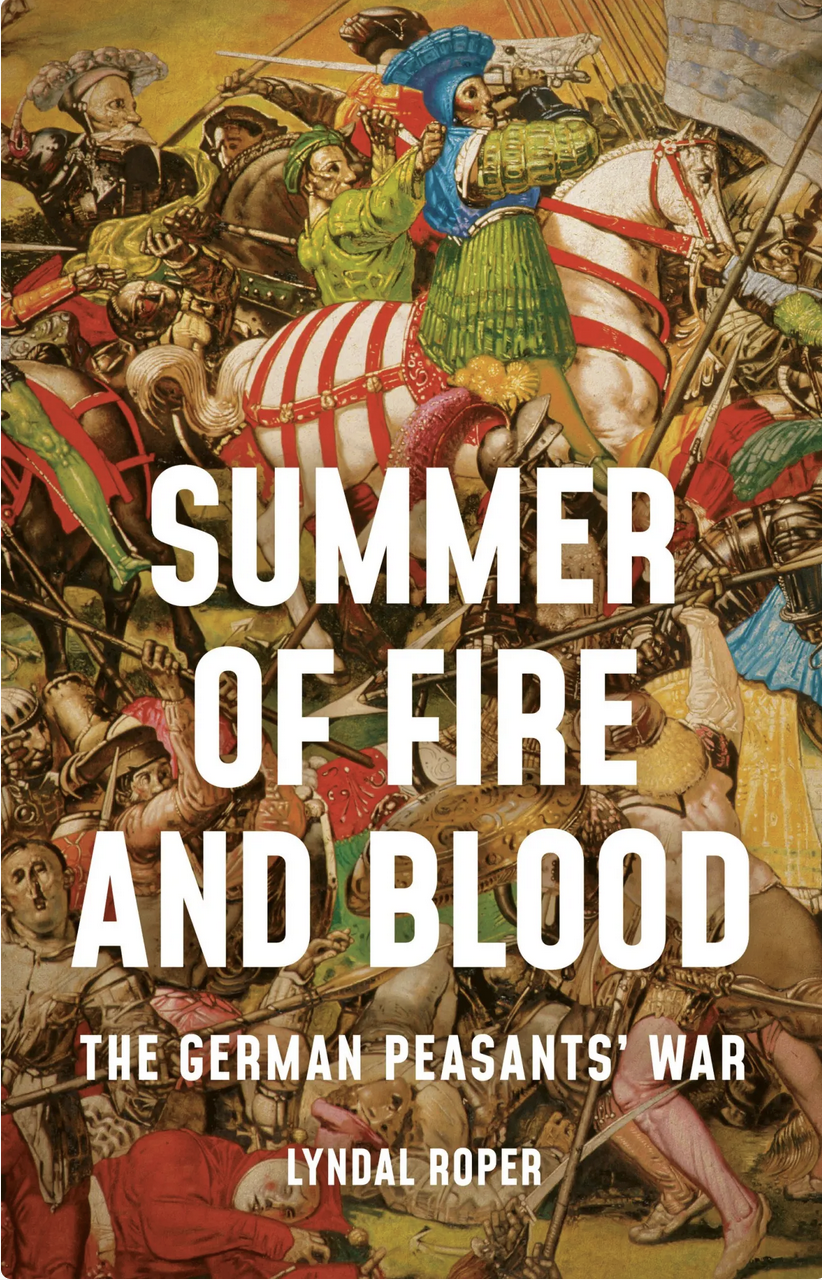
Summer of Fire and Blood: The German Peasants' War by Lyndal Roper, a senior Oxford historian revisits one such moment which, looking backward, we seem to periodically notice and then forget. In 1525, in the wake of Luther's destabilization of Western Christendom, in what is now modern Germany, peasants undertook to overturn feudal society and it looked for a moment as if their marching columns had succeeded. 

The German Peasants' War was the greatest popular uprising in western Europe before the French Revolution. ... Peasants massed in armed bands in one region, then another, and rebellions would break out even in areas far away. At its height it involved well over a hundred thousand people, perhaps many more, who joined with the rebels to bring about a new world of Christian brotherhood. And for several months they won. Authority and rulership collapsed ... People even began to dream of a new order. 

But this moment didn't last. ... The forces of the lords put down the revolt by slaying somewhere between seventy thousand and a hundred thousand peasants. ...

Insofar as the revolt can be said to have had an intellectual inspiration, Martin Luther's Freedom of a Christian published in 1520 served, despite Luther's quick repudiation of these ungoverned rebels. But the peasants, with input from other reforming clergy, created their own manifesto.

For them, freedom mean ending serfdom ... the peasants themselves ... formulated their complaints. The Twelve Articles then became a document that the movement everywhere acknowledged, even when the rebels didn't know exactly what the articles contained, and even though many areas revised them to suit local circumstances. Soon they were printed using the new technology made possible by the invention of moveable type, and they spread all over Germany. You could pick them up and hold them in your hand, point to each demand and the biblical passages that proved their godliness.

... The passions and dreams that drove the movement can seem inchoate, naive, and contradictory. ... this was not a movement driven by the literate few. It was a mass struggle by individuals who risked and lost their lives to try to bring about a new world. ...

The vision that drove them was about humans' relationship to creation. They were angry that lords claimed ownership of natural resources-- the water, the common land, the woods and forests -- when these were God's creation, given to all. They were enraged that the lords had stolen their freedom and claimed to own them when, as Luther showed, Christ had bought us all with his precious blood,"thus the Bible proves that we are free and want to be free." They were incensed by the growing inequality they saw around them ... They wanted men to live as brothers, in mutual obligation, not as lords and serfs. Theirs was an unabashedly male ideal, nourished by bonding amongst the peasant fighters, though that doesn't mean that women didn't support it too. They wanted decisions to be made collectively and to manage natural resources in a way that would respect the environment that God had created. ...

... for most of the war, the peasants were nonviolent; they humiliated but did not kill their lords. They questioned the established order at just the moment when capitalism was expanding and when Europeans were encountering new worlds, but they did not necessarily want to destroy authority of all kinds. Yet the authorities destroyed them, obliterated their movement, and built the structures of the current world on its ashes.

Roper's account of the peasants' brief but unprecedented revolt is detailed and granular. This is fascinating narrative history which for an American needs to be read alongside maps.

• • • 

The peasants' war is a huge historical event which 1) tends to be dropped from most accounts of early modern European history because its implications remain unclear, except that 2) Friedrich Engels brought a tendentious explanation of it to the fore in the context of articulating 19th century socialist thinking.

Roper's conclusion is her contribution to this historiography, to the academic theories and debates about what sort of frame in which to put the eruption. Here are some of those points, quotations from the book unless bracketed:

• ... [the peasants] were angry at how the lords treated them, but explaining the revolt in economic terms is not enough. Many richer peasants and even burghers joined the revolt ... if anything, conditions might have been improving as peasants engaged in markets and a long period of economic upswing continued after the Black Death. 

• ... the Reformation brought a religious transformation that did far more than legitimize or justify previous attacks on the abuses of feudalism; it brought a new vision of freedom, and of relations between human being as the environment. ... as some put it, all of us, rich and poor alike, are Christ's 'aigen,' his 'own', the same word as for serfs. 

• ... Marching together or taking over monasteries and convents allowed peasants to experience together a life of plenitude, where there was enough meat for all and more wine and beer than you could drink, a life of comradeship and brotherhood, not of dour monastic asceticism. These were ideals for which people were willing to fight. ... All could subscribe to the Twelve Articles, even those who did not know its specific contents. ... The rebels hatred of princes and 'top dogs' was now sealed in blood and gone was any reverence for rulers.

• ... the movement was held together by male bonding ... it is hard to know whether women would have felt included in their men's demands though the revolt could not have succeeded without women's support in running the farms and gardens their menfolk had left.

• ... the peasants' failure to bring the large towns in ... the cities were simply too populous, rich, powerful and well-armed to be seriously threatened by a peasant army.

• ... [yet] the peasants flattened the towers of lordship and wiped out the sacred geography of pilgrimage and monasticism. ... the war permanently undermined the power of the lesser nobility ...

• ... the ideas and dreams that had been formed in the war did not disappear but lived on in Anabaptism and in many varieties of radical thought. ... The war's legacy of blood desacralized lordship ... 

It's easy to think and feel that the present moment is another hinge point, a turning of some sort, what with climate change on top of the decay of Western capitalism and democracy. Maybe it is and maybe it isn't. But Roper's volume casts light on a time that felt and perhaps still appears to have been such a moment. I recommend it. 

Monday, June 23, 2025

What's God got to do with it?

Everything for the evangelical, Pentecostal segment of Donald Trump's base which is cheering his extra-Constitutional attack on what he hopes is Iran's nuclear capacity. (Thirty-six hours after, experts aren't so sure he's done the damage he hoped to, but what does expertise matter, anyway, when you are a boy ordering a big bang?)

 
Polling before the strike on Iran showed only 16 percent of us wanted this. This is not like GW Bush's invasion of Iraq which enjoyed majority support for a hot minute in 2003. Now that Trump's done it, YouGov still finds 46 percent opposed, 35 percent in favor of the strikes. And just wait until it all becomes more complicated ...

Diana Butler Bass brings historical perspective to evangelical Christian enthusiasm for the Trump's bombs: 

To his evangelical base, Trump is fulfilling end times prophecies before their eyes. Moving the embassy [to Jerusalem in 2018] was but the first step in reorienting US policy toward prophecy. What is happening right now — with the US joining with Israel in this bombing — is nothing less than God's work, and they believe that they are the recipients of the long-awaited promise of Jesus' return.

... the MAGA "Jesus" and their particular prophecy tradition only dates to the mid-1800s. It was a completely invented theology about 200 years ago.

Yet that theological innovation has been one of the most wildly successful heresies in the history of Christianity in terms of spread and influence — mostly via Pentecostalism, the largest and most sustained global religious movement of the last century.

Modern Pentecostalism began among the poor and dispossessed and was originally influenced by progressive politics. Movements change, however. And partisans often wind up far from where they started.

In the last four decades, Pentecostals fully embraced both prophecy theologies (previously these theologies had been the purview of rather staid evangelicals and fundamentalists — most of whom eschewed Pentecostalism) and nationalist politics. ...

... Trump’s evangelical and Pentecostal supporters — the core of MAGA — are cheering. ... Bombing Iran secures Trump’s status as God’s man, the one sent to fulfill the prophetic promises that lead to the return of Jesus. While the rest of us are trying to discern signs of fascism, many American are discerning the "signs of the times."

We think Hitler. They think Jesus. We think of the innocent suffering. They think of the final judgment. We pray for peace. They believe that the Prince of Peace is returning with a sword. ...

For a deeper dive into this crackpot theology, I recommend Jemar Tisby: Bombs for the Apocalypse? Ted Cruz, Trump, and Evangelical End Times Theology -- How Dispensationalism Drives American Foreign Policy and Military Aggression. This is an accessible easy read, if delving into lunacy can be easy.

Monday, May 26, 2025

Institutional resistance matters and brings assets

In the context of withdrawing from participation in Donald J. Trump's discriminatory refugee program for white Afrikaners, the Most Rev. Sean Rowe, whose elected office of Presiding Bishop makes him the public spokesperson for the institutional Episcopal Church, has called out something vital about the place of churches in the current desperate moment for American democracy.

Graphic by way of Elizabeth Kaeton, Telling Secrets
Churches and other religious institutions are much better situated than much of civil society to repudiate the cruelty and stupidity of DJT and MAGA. At their best, they answer to a different mission than the imperatives of American politics. And they are less dependent financially on a federal government which is being weaponized against both justice and inclusion for all. At least 25 percent of individual "charitable giving" and actual charity still passes through churches in this country; churches have some money to use for the common good.

Church history within civil society is honorable, if spotty. Pre-Civil War abolitionism lived in both Black and white churches. The weak but enduring thread of American principled opposition to our wars has survived on the margins of both Protestant Christianity (Fellowship of Reconciliation) and later, as Catholics entered the American mainstream, in the Vietnam-era Catholic Peace Fellowship with the clerical Berrigan brothers.

The Episcopal Church is often dissed as  "the ruling class at prayer." There's a reason that Bishop Mariann Budde of Washington DC had the chance to call out Trump's threats to so many Americans: the Episcopal Church's so-called National Cathedral screams past riches and power, long attenuated. The building remains a monument to an imperial America; the people of the Episcopal Church (450, 000 weekly attendance in this nation of 340 million) not so much so. Empire was then ... though a good deal of past riches remain.

Previous federal governments have tried to rein in Episcopal churches whose justice mission threatened the authorities; the George W. Bush administration threatened the tax-exempt status of All Saints Pasadena in 2007 for a sermon against the War on Terror. Bunch of trouble makers, that lot!

Part of why Bishops Budde and Rowe can speak out -- and lend moral authority and some material resources to the developing defense against authoritarianism -- is that the people in the pews more or less have their backs. According to right-leaning statistician of US religion Ryan Burge, alone among mainline Christian Protestant denominations, Episcopalians are leaving any past Republican allegiance behind. 

Yes, that even includes the long liberal UCC and Disciples of Christ who seem to have voted in majorities for Trump in 2024. Presbyterians and Lutherans seem pretty evenly split.

Burge concludes:

When you think of the average mainline Protestants, it’s just not accurate to conjure an image of a thirty something pastor wearing a rainbow stole and preaching a sermon about the non-binary nature of the Holy Spirit. Instead, it’s probably a retired school teacher living in a small town in the upper Midwest. And, on average, that person voted for Donald Trump in 2024.

Those of us who live and struggle in these arenas have a lot of work to do -- and important friends.

Sunday, May 04, 2025

When some evangelizing seems a right move

Fred Clark writes The Slackivist where he urges seekers and other ex-evangelicals to  "Test everything; hold fast to what is good." He is as horrified as so many of us are by the dragnet Donald Trump and this ghoulish assistant Stephen Miller are letting loose against migrants.

He recounts the story of the Oklahoma woman and her kids put out half naked in the rain while unidentified agents who trashed their house and stole their money -- all only to realize that the person the agents sought had moved on. (Homeland Security is now claiming lamely there had been human traffickers at the address previously.)

Clark has a suggestion, only a little tongue in cheek, for resistance to this kind of thing:

Doxxing the Secret Police to call them to repentance
The secret police of ICE know they’re the Bad Guys. That’s why they wear masks and don’t carry badges and refuse to give their names.
And so ... it is necessary for us — and for them — to unmask them, to use their names, and to identify them publicly. To make them famous. This is needed to save our freedom and to save their souls.
Refusal by such "agents of the law" to say who they are and who they work for seems to indicate fearfulness ...
... But what are the secret police afraid of? Who are they afraid of? Why are they hiding their faces and their names?

They are afraid of us — of the majority of normal, decent people. And they are hiding their faces and their names because they know that what they are doing is wrong and shameful and bad. They know that they are the Bad Guys in this story. That is as obvious to them as it is to you and so they cannot face you. They cannot do what they are doing and save face, so to do what they are doing they must hide their faces.

So let’s see their faces. And their names.
In asking to see those faces and names, some fear I’m also asking thereby to learn their addresses, which seems to imply a hint of violence or, at least, the threat of such. (“We know where you live” almost always seems to be an implicit threat of violence.) But violence is not at all what I’m suggesting and not at all what I have in mind

Clark has experience meeting people who didn't expect visitors at their houses ...

What I have in mind, rather, is Evangelism Explosion. What I have in mind is what I learned and practiced in youth group at my white fundamentalist Christian church growing up — the spiritual practice my white evangelical tradition shares with the Latter Day Saints and the Jehovah’s Witnesses. I’m talking about door-to-door evangelism.
Most of you reading this have only experienced this from the other side of the door — as the knock-ee rather than as the knock-er. I’ve been on both sides. Neither one is pleasant.
The one positive thing from my experience conducting door-to-door “evangelism” was probably that it made door-to-door political canvassing so much easier for me. Sure, an undecided voter might not welcome a random knock at the door, and, yeah, they might not favor the candidate I’m campaigning for, but even the worst case scenario here isn’t as bad as the essential premise of the conversation you’re trying to have when doing door-to-door evangelism. 
That involves standing on the front porch of a stranger and saying, “Hi. You don’t know me and I don’t know you, but I know you’re a sinner who deserves to suffer for eternity in Hell.”
... you can kick the boy out of evangelicalism but you cannot completely kick the evangelicalism out of the boy. And so when I think about these secret police masking themselves in their shame — when I think about a group that already understands that they are sinners in desperate need of repentance and salvation — I can’t help but think it’s worth giving this a try.
...  the names and addresses of our secret police should also be treated just as all those Evangelism Explosion training sessions taught us to treat the names and addresses of our “unchurched” neighbors.
We should be knocking on their doors.
We should smile and tell them we’re there with the good news of salvation, because even though they are damnable sinners, repentance and redemption are still available. The repentance and redemption they need are still possible. The salvation they already know they need can still be theirs.
After all, they are already admitting to guilty consciences with the masks and gear ...
... The Bad Guys may choose to continue being the Bad Guys, but we cannot allow them to deceive themselves about the fact that that is what they are choosing.
Our “Evangelism Explosion” training taught us more tactful ways of saying that. But still, that’s what we were saying.
Caveat: The political canvassing training I've had nowadays is, perhaps, a little more sophisticated and a little less ham-handed. The model promoted by the union UniteHERE calls on canvassers at the doors to share, empathetically, what motivates them to do anything so odd as knock at the house of a stranger. "I'm here because I'm afraid a Trump administration might screw up my Social Security ..." for example.

But Fred is onto something. Reaching out directly, non-violently, to the consciences of the agents of a rogue state seems a right idea. Probably not simple or easy, but one right approach among many. Takes some courage, but so does everything these days.

Wednesday, April 16, 2025

It's time for religious leaders to emulate Oscar Romero

Bishop Evelio Menjivar, a Salvadoran-born priest, is an auxiliary bishop of The Roman Catholic Archdiocese of Washington, DC. He is the first Central American to serve in such a role in the US Roman Church. 

His Holy Week sermon takes up the theme of Trump's rendition of Kilmer Abrego Garcia and other migrants to a Salvadoran torture prison.

The Church remembers Christ’s suffering, death, and resurrection of Jesus in a spiritual and sacramental way during Holy Week and the Easter Triduum, but some people actually experience the Passion in a tangible and personal way in their very lives. Among them are members of the immigrant and refugee communities today.

... while redemptive suffering is a grace, it would be better still if these injustices and infamies did not happen at all. ... It seems that no one is safe now from arbitrary nullification of his or her protected status, visa, or green card. This has left many terrified that they or their loved ones might be seized and disappear without warning.

... For example, the protected status of refugees and others granted asylum has been arbitrarily terminated without any wrongdoing on their part. Visa-holders and permanent residents have had their legal authorizations revoked and then been grabbed off the street by masked government agents, held incommunicado without access to their attorneys, and imprisoned pending deportation. University scholars and others have also been refused entry or detained at the border after traveling abroad. Even U.S. citizens are viewed with suspicion or subjected to ethnic profiling based entirely on how they look or speak. Those who are naturalized citizens might be wondering if they will be targeted next, whether some pretext might be contrived for secret revocation of their naturalization.

More than a few natural-born Americans are saying they do not recognize their country anymore, but many of us from other lands recognize all too well the terror of people being snatched by secret police and disappeared. We left our former countries precisely to get away from it. Yet, too many people are still remaining silent, perhaps out of fear, forgetting that the Holy Spirit gives us the grace of fortitude to boldly speak out for good. ...

El Salvador gave the America's Archbishop Ă“scar Romero, the 20th century bishop murdered for speaking up for the poor and marginalized. Bishop Menjivar continued: 

When I was growing up in El Salvador, there was a man who was not afraid to speak out. His name was Óscar Romero, archbishop of San Salvador. It seems to me that we need more Óscar Romeros today. We need everyone of good will to follow his lead and demand that the government respect human dignity.
In his last Sunday homily on the day before he was killed, Saint Ă“scar Romero made a special appeal to government agents: “It is time now for you to reclaim your conscience and to obey your conscience rather than the command to sin,” he said. “We want the government to understand well that the reforms are worth nothing if they are stained with so much blood. In the name of God, then, and in the name of this suffering people, whose laments rise up each day more tumultuously toward heaven, I beg you, I beseech you, I order you in the name of God: stop the repression!”
I urge government officers and support staff in the present situation to heed these words which echo through history. It is time now for you to reclaim your conscience. What you are doing is worth nothing if it is stained with unjust cruelty. That is not what America stands for. You too can and should speak out against this terror and infliction of suffering on people. You can refuse to be involved in oppression and these grievous assaults on human rights and dignity.
True, if you do, there may be adverse personal consequences. Saint Ă“scar certainly paid a price for speaking against the state of siege in his country. It might even mean leaving your job, but that is better than being complicit with evil, and it will lead to something even greater. As this holy man said in his last words before his martyrdom, “If we have imbued our work with a sense of great faith, love of God, and hope for humanity, then all our endeavors will lead to the splendid crown that is the sure reward for the work of sowing truth, justice, love, and goodness on earth.”

The One Part of the Body report (download at link) on the impact of the Trump regime's migrant deportation policies gives some numbers about how many are now at risk of being thrown out of the country:

We estimate that, as of the end of 2024, there were more than 10 million Christian immigrants present in the United States who are vulnerable to deportation, including those with no legal status, as well as those with a temporary status or protections that could be withdrawn.

Furthermore, because many of these individuals live in households with U.S. citizens, Lawful Permanent Residents, or others who are generally not subject to deportation, the impact on American Christian households goes well beyond those directly at risk of deportation. We find that nearly 7 million U.S.-citizen Christians live within the same households of those at risk of deportation. Most of these U.S. citizens are spouses or minor children of the immigrant at risk of deportation.

... 80 percent of all of those at risk of deportation are Christians. Sixty-one percent of those at risk of deportation are Catholic, 13 percent are evangelical and 7 percent are adherents to other Christian traditions.

And then there are all the others (non-Christians) and their families who might find themselves victimized by the Trump dragnet.

It is good to see religious authorities speaking out. And they are. Religious institutions are somewhat less vulnerable to threats to their mission than secular institutions. They can't sit the Trump regime out.

Sunday, April 13, 2025

An impassioned sermon for the start of the Christian Holy Week

Nate and Jenny Bacon serve as missionaries with InnerChange (an ecumenical Christian Order among the Poor) in Central America, living in Quetzaltenango, Guatemala.

Nate with family
Nate looked on at developments in his native country this past week and posted this on Facebook:

There is an illuminating window into deeper realities provided by the recent draconian measure of not only cancelling the legal social security cards of immigrants in the US, who are under Temporary Protected Status, but also adding their names to the “DEATH MASTER FILE” previously reserved for…well…dead people. It sends a clear message,

“You are as good as dead to us”.

Jesus said that even if we call our neighbor “Raca” (“empty-head”), we are guilty of committing murder. How much more, when we literally label our immigrant sisters and brothers as “DEAD”?

If we look carefully, we can see that it is the spirit of DEATH that is at work in and through all of this, to turn us against our own flesh and blood, created in the same image and likeness of God.
It is the slippery slope to genocide, and helps explain why we so easily shrug at the dehumanization of our fellow human beings, and even at genocide itself.

Do we want DEATH to be our MASTER?

When we are silent in the face of these acts, or even celebrate them, we enlist ourselves into a group that could be called by the same name: “DEATH MASTER FILE”. Because we have opted for DEATH as our MASTER.

As for me and my family, we choose LIFE, and the AUTHOR of LIFE, and refuse to submit to Death.
And YOU?

Let the most sacred week of the Christian annual cycle begin.

Saturday, March 15, 2025

Lines must be drawn

Crosspurposes: Christianity's broken bargain with democracy by Jonathan Rauch

This is a strange book. Someone -- don't remember who -- must have recommended it. I needed distraction while Democrats were failing us in DC yesterday, so I rushed through it.

Mr. Rauch is at pains, repeatedly, to express his diffidence about commenting on American Christianity -- after all, he's gay, Jewish, and a non-believer in all things religious. And he should be diffident. This book, purportedly about American Christianity, contains nothing about Catholics, nothing about the Black church, nothing about Latino religiosity, and darned little to suggest there are any women in the mix. He gives mainline Protestantism a once-over-lightly, rushing on to center white evangelical Protestantism. (Actually membership in the mostly white mainline denominations is about the same percentage of white Christians as the percentage of white evangelicals; he falls into the common journalistic fallacy of substituting the latter for the whole.)

His impetus for the book seems to be that Rauch has concluded that secular liberalism and some sort of Christianity need each other within American democracy -- and that white evangelical Protestantism has gone off the rails, transforming itself into a regressive political force. Well, duh!

He calls this situation a "cultural trade deficit."
Sometimes Christian America [he means white evangelical Protestantism] and secular America can rub along merely leaving each other alone. But sometimes they come into conflict; and when they do, they have positive obligations to make room for each other. ... Their bargain requires that the Constitution be interpreted in a way that is consistent with the well-being of democratic pluralism. The bargain is implicit, but America depends upon it nonetheless.

... America's demonstration that a country can be both devout and diverse, secular and spiritual, has been a historic achievement and a gift to the world. ... But the religious side has been less and less able to uphold its end of the bargain. ... A result is what I think of as a cultural trade deficit.  
... Look at it this way. Secular liberalism certainly promotes important values: tolerance, lawfulness, civic responsibility, equality, and so forth. But they are primarily procedural values, which orient us to follow certain rules. The legitimacy of those rules must come largely from outside of secular liberalism itself ... in practice, that has meant relying on Christianity to support the civic virtues. So we atheists rely on Christianity to maintain a positive balance of trade: we need it to export more moral values and spiritual authority to the surrounding culture than it imports. If, instead the church is in cultural deficit -- if it becomes a net importer of values from the secular world -- then it becomes morally derivative rather than morally formative. Rather than shaping secular values, it merely reflects them and thus melts into the society around it. ...
Yes -- one subset of Christians has replaced the way of the uppity itinerant peasant murdered by a vicious empire (that's Jesus) with the worship of Emperor Donnie. Many others, Christian and not-Christian, merely try to keep their heads down and wonder what became of values like decency, generosity, honesty and kindness.

Rauch gives an affirmative nod to the bargain Mormon officialdom has made with the existence of LBGT+ people in Utah. It's certainly interesting and better than what passes for a moral order in Texas -- or in the White House. I wish he had talked with someone other than the higher-ups of the Mormon church; at least in days past, LGBT people and anyone who was not a Mormon have often felt repressed where the Church of the Latter Day Saints sets the rules. Yet movement in the direction of pluralism must be good.

A strange book. I find it too confused to recommend -- and I feel confident that the confusion is not mine but Rauch's.

We live in a time when lines are being drawn. Confusion is a luxury. Evil is afoot. On the one side, the billionaires. On the other, everyone else and democracy and equality.  Once upon a time in this country, the moral evil which had to be repudiated was slavery. Today the lie which must be repudiated is that acquiring billions of dollars should give license to a few to rule the many.

That goes for Christians in all our diversity, for believers in other traditions, and for those who find their values through other sources. 

Monday, March 03, 2025

Probably misused, but still righteous

I have to admit I was gobsmacked to encounter several iterations of this photo on Facebook. The picture is of the lighted facade of the church in Washington DC which my Episcopalian comrades presumptuously call the Washington National Cathedral. It's the Protestant denomination's big diocesan church in the capitol, only by custom called "national." Episcopalians aren't "the ruling class at prayer" any longer. 

As far as we can tell, though many Christian nationalists intend to be our ruling class, broad based Christian nationalist attention to humble petition to God for the poor and suffering is pretty muted these days.

Nonetheless, I guess I'm happy to see being passed around what is clearly an affirmation of support for the brave and desperate people of Ukraine under Russian attack. Correct me if I'm wrong, but I think the image derives from an ecumenical prayer service held alongside the Ukrainian ambassador in July 2023.

Anyway, I'm a Christian fully in the camp of supporting Ukrainians in their war for their country and their lives. It has not been simple for me to find myself supporting one side in a war. I've spent a lifetime opposing the wars of the United States empire; I've explored pacifism and find it the better way to live. But not in the case of this conflict. Ukrainians deserve their own country if they want it enough to fight for it and they've shown they do. The Russian invasion is brutal and criminal; it aims at the erasure of a particular history and people. Insofar as the US has been supportive of Ukraine, I think that has been a good use of a tiny fraction of my taxes. 

And I know Donald Trump's infatuation with and capitulation to Russia's strong man is a betrayal of all that is decent in our complex land.

Thursday, February 20, 2025

Agonies in Gaza, Israel, and the USofA

Jewish leaders have turned our commitment to one another into a moral sedative. ... By seeing a Jewish state as forever abused, never the abuser, we deny its capacity for evil. Before October 7, I thought I understood the dangers of this way of thinking. Turns out I had no idea. From Being Jewish After the Destruction of Gaza: A Reckoning
Peter Beinart is a professor of journalism and political science at the Craig Newmark Graduate School of Journalism at CUNY. In the late '90s and early '00s, Beinart was associated with an annoying cluster of bright young intellectuals at The New Republic magazine who eagerly sought to differentiate themselves from the historical liberal traditions of their perch. Their cheerleading for America's invasion of Iraq was boundless -- until that set of fantasies collapsed amid broken American and Iraqi bodies and a broken society.

Of those folks (mostly men I think) Beinart seems the one who truly turned from ignorant, self-important cleverness toward engagement with deeper verities -- in his case through Orthodox Jewish tradition and practice. He has made himself a committed, honest observer of his world. Integrity requires of him to engage with Palestinian truths and living people as well as with his own Jewish community.

This book is his cri de coeur occasioned by the October 7, 2023 Hamas attack, the subsequent Israeli war of extermination against Palestinians in Gaza (and parts of the Palestinian West Bank), and the apparent extinction of a moral compass within his own small-minded and frightened American Jewish community. He surveys the history of Israel forming itself as a Jewish state, Israeli and American attachment to a victimization mindset, the erasure of Palestinian history and lives, and the failure of all parties to see a way forward without genocide.

I am not the intended audience for this book; he's not writing to a loosely-lefty Christian American lesbian. This book speaks neither to my particular struggles nor my particular terrors. Yet I am inspired by his unstinting choice to look directly at awful realities.

Beinart's concludes:
... it’s worth remembering that the Bible considers states—which in its time meant kingdoms—very perilous things. While they may be necessary to avoid chaos, they can easily become instruments of oppression. When the Israelite elders ask the prophet Samuel for a king, God instructs him to both grant their wish and list the many cruelties a monarch will inflict. Kings are most dangerous when they view themselves ...  as inherently holy and thus infallible.
In Jewish tradition, states have no inherent value. States are not created in the image of God; human beings are. States are mere instruments. They can protect human flourishing, or they can destroy it. ... The legitimacy of a Jewish state—like the holiness of the Jewish people—is conditional on how it behaves.
... Treating a state as a god is a very frightening endeavor. It confers upon mortals a level of veneration that we do not deserve and will always abuse.
... To defend Israel, American Jews are harming our community and our country. More than half a century ago, the writer I. F. Stone noted that “Israel is creating a kind of moral schizophrenia in world Jewry.” Jews whose welfare in our own countries “depends on the maintenance of secular, non-racial, pluralistic societies” were championing a Jewish state “in which the ideal is racial and exclusionist.”
And now all humans between the river and the sea will be further afflicted by the antics of our own orange-faced toddler real estate mogul ... what more could go wrong?

Sunday, February 16, 2025

Religious values assaulted by Trump's hate-filled immigration policy

 
The preamble to the legal brief filed last week by religious groups against the Trump administration's decision to invade churches to enforce (contestable) immigration law is readable and short. I've stripped out a lot of citations and added some paragraphing for clarity, but here's the explanation of why they've gone to court.

Plaintiffs in this challenge are 12 national denominational bodies and representatives, 4 regional denominational bodies, and 11 denominational and interdenominational associations, all rooted in the Jewish and Christian faiths. Plaintiffs and their members are Baptist, Brethren, Conservative Jewish, Episcopalian, Evangelical, Mennonite, Quaker, Pentecostal, Presbyterian, Reconstructionist Jewish, Reform Jewish, Unitarian Universalist, United Methodist, Zion Methodist, and more.

They bring this suit unified on a fundamental belief: Every human being, regardless of birthplace, is a child of God worthy of dignity, care, and love.

Welcoming the stranger, or immigrant, is thus a central precept of their faith practices.

The Torah lays out this tenet 36 times, more than any other teaching: “The stranger who resides with you shall be to you as one of your citizens; you shall love them as yourself, for you were strangers in the land of Egypt” (Leviticus 19:34).

In the Gospels, Jesus Christ not only echoes this command, but self-identifies with the stranger: “For I was hungry, and you gave me food, I was thirsty, and you gave me drink, I was a stranger, and you welcomed me” (Matthew 25:35).

Plaintiffs’ religious scripture, teaching, and traditions offer clear, repeated, and irrefutable unanimity on their obligation to embrace, serve, and defend the refugees, asylum seekers, and immigrants in their midst without regard to documentation or legal status.

Recognizing the importance of communal religious practices “to the well-being of people and the communities of which they are a part,” the Department of Homeland Security (“DHS”) for over 30 years substantially restricted immigration enforcement action in or near places of worship. Although DHS has statutory authority to conduct a variety of enforcement actions—such as conducting stops and interrogations, serving process and other orders, and executing immigration arrests and raids without judicial warrant—DHS’s longstanding “sensitive locations” (or “protected areas”) policy provided that Immigration and Customs Enforcement (“ICE”) and Customs and Border Protection (“CBP”) would do so at or near places of worship only under exigent circumstances or with prior written, high-level supervisory approval.

On January 20, 2025, DHS abruptly reversed course and rescinded the sensitive locations policy. Disavowing the need for any “bright line rules regarding where our immigration laws are permitted to be enforced,” the Rescission Memo instead directs ICE and CBP officers to “use [their] discretion along with a healthy dose of common sense” in deciding whether to conduct immigration enforcement actions at places of worship, during religious ceremonies, and at other sensitive locations. DHS’s website features a news article stating that ICE agents understand the rescission “to free them up to go after more illegal immigrants.”

The rescission reflects President Donald Trump’s goal of deporting all immigrants in the United States without lawful status during his current four-year term. To accomplish this, President Trump’s “border czar” Tom Homan explained, DHS will conduct immigration enforcement actions “across the country, uninhibited by any prior administration guidelines.”

Federal officials have confirmed that the target of these enforcement actions will include undocumented immigrants with no criminal record. Over the first week of the current Trump Administration, ICE arrested over 4,500 people, including nearly 1,000 people in a Sunday “immigration enforcement blitz.”

At least one of these enforcement actions occurred at a church in Georgia during worship service. According to news coverage, an usher standing in the church entrance saw a group of ICE agents outside and locked the door. The agents said that they were there to arrest Wilson Velásquez, who had traveled to the United States from Honduras with his wife and three children in 2022.

Immediately after crossing the border, they turned themselves in to U.S. authorities and requested asylum. They were given a court date and then released after federal agents cinched a GPS-tracking monitor on Velásquez’s ankle.

After settling in suburban Atlanta, the family joined a Pentecostal church where they worshipped several times a week and helped with music. They were listening to the pastor’s sermon when ICE agents arrived to arrest Velásquez. Although Velásquez had attended all his required check-ins at an Atlanta ICE office and had a court date scheduled to present his asylum case to a judge, ICE agents arrested him anyway, explaining that they were simply “looking for people with ankle bracelets.” The pastor, Luis Ortiz, tried to reassure his congregation, but he “could see the fear and tears on their faces.”

Plaintiffs’ congregations and members face an imminent risk of similar immigration enforcement actions at their places of worship. Consistent with their call to welcome and serve all people, many have undocumented congregants and many offer social service ministries— such as food and clothing pantries, English as a Second Language (“ESL”) classes, legal assistance, and job training services—at their churches and synagogues that serve undocumented people.

An immigration enforcement action during worship services, ministry work, or other congregational activities would be devastating to their religious practice. It would shatter the consecrated space of sanctuary, thwart communal worship, and undermine the social service outreach that is central to religious expression and spiritual practice for Plaintiffs’ congregations and members.

The rescission of the sensitive locations policy is already substantially burdening the religious exercise of Plaintiffs’ congregations and members. Congregations are experiencing decreases in worship attendance and social services participation due to fear of immigration enforcement action. For the vulnerable congregants who continue to attend worship services, congregations must choose between either exposing them to arrest or undertaking security measures that are in direct tension with their religious duties of welcome and hospitality.
Likewise, the choice that congregations currently face between discontinuing social service ministries or putting undocumented participants at risk of arrest is no choice at all: Either way, congregations are forced to violate their religious duty to serve and protect their immigrant neighbors.

The brief goes on to assert that the administration's declaration of intent and ICE's actions prevent their free exercise of the dictates of their religion under the under the Religious Freedom Restoration Act (“RFRA”) and the First Amendment.

The rightwing in the United States makes much of their devotion to freedom of religious belief and practice. Often this feels like an effort to impose unpopular values on non-believers, as when they seek to suppress neutral historical and scientific information and education. 

Here religious groups demand to be allowed to exercise and affirm their core values of welcome and broad inclusion of all humans as enjoined by their understanding of their religious traditions.

Sides have been drawn.