Showing posts with label Latin America. Show all posts

Thursday, March 13, 2025

Latinos in the USofA

If Kamala Harris had narrowly won the presidency, we'd be talking vigorously about this book, trying to understand why some Latinos shifted their party preferences in the vote. Since the Donald sneaked narrowly through to commit his ungoverned mayhem on the nation, most of us will likely miss it. But we shouldn't.

Defectors: The Rise of the Latino Far Right and What It Means for America by Paola Ramos is a lucid and affecting dissection of the fraction of the Latino electorate that has been drawn to Trump. Ramos, like her father Jorge Ramos, is a serious journalist. She's not spit balling when she delves into why some American Latinos are attracted to the right. The book is generous and fascinating, bolstered by the personal stories of her subjects who are her neighbors and more and more of ours.

Ramos explores three facets of Latino experience in this country: tribalism, traditionalism, and trauma.

Tribalism refers to the common trope in communities who experience exclusion from the "national mainstream," versions of "I want to identify with and as one of Them," however folks see the ruling class. Hence we get the life story of a Latino Border Patrol agent who succeeds indeed -- and then receives a nasty surprise about his own origin story. Traditionalism is represented by the Bronx beauty parlor owner who fears the Anglo society around her and looks to Trump to protect her. (No knock on hairdressers: I go to such a person to get clipped and she's very clear about which side of the class divide she and most of her Latino customers are on.)

The section on trauma did the most to open my thinking to what my neighbors bring with them from south of the border. The contemporary media environment enables them to subsist on the home country news in a way past immigrants might not have. During the pandemic, many imbibed Russian propaganda and disinformation that we seldom saw in English language sources. English speakers took in plenty of nonsense; new immigrants and Spanish speakers got an extra dose while shut away from the virus.

Ramos interrogates the history of Simon Bolivar, the hero leader of the overthrow of Spanish rule in the southern continent. His legacy is mixed.
Two things can be true at once. Simon Bolivar could have been both a liberator and an authoritarian caudillo. He could be a hero to some, an enemy to others. That seems a recurring story in Latin American history and politics, strongmen achieving "democracy" by way of authoritarianism. Or, rather, their own distorted version of democracy. ...
Democracies in Latin America are haunted by the shadows of strongmen. ...[For example] Nayib Bukele [in El Salvador] is simply the latest iteration of this dark legacy. ... Millions of people love Bukele. Millions of people want Bukele. They look up to him, not just in Latin America, but also in the United States.
She goes on:
For many Latinos, the purpose of being in the U.S. is to heal. To run away and escape from these wounds of the past. Yet the United States has a long history of exploiting the political trauma many Latinos carry -- particularly those fleeing communism and violence -- to score political points. ... American administrations have leveraged that pain, exacerbated it, and carefully weaponized it to their advantage. I thought about everyone who has been featured in this book ... So many of them don't appear to have healed from their wounds. ...
... America's foreign policy created fertile grounds for the steady rise of authoritarianism, not just in Latin America, but in our own backyard. It all comes full circle.
Ramos concludes:
The image America has of us doesn't necessarily translate into the image many Latinos have of themselves. Americans may see us as minorities, but many feel like the majority. They may see uses immigrants, but many feel like border vigilantes on the inside. They may see us as Black, but many feel white. They may see us as Indigenous, but many feel like Spaniards. They may see us as liberal on paper, but many feel conservative in their hearts. They may see us as people who value democratic ideals, but many yearn for the authoritarian strongman. The path toward finding ourselves in this country has never been linear. In our quest to find belonging in America, many Latinos are quietly oscillating between identities, spaces, and stories that are often disconnected and at odds with each other.
Latinos in this country are our future. That coming into demographic might has meant one trajectory in California and a different one in Florida. But what does it really mean? Ramos provides glimpses. There will be more.

• • •

For what it is worth -- not much but there will the more to come -- Latinos are rapidly becoming disillusioned by the Trump regime's record on "Jobs and the Economy" according to the YouGov/Economist poll. In January Hispanics gave Trump a favorable 41-36 rating; but late February, they were registering 32-58 disapproval. That's a -31 point swing in a month!

Sunday, January 27, 2019

Rant: can we practice solidarity without bullshit?

Neighbors and friends gathered on Friday night in the 'hood to protest U.S. intervention in Venezuela. Goodness knows, there's plenty to protest. The Trump administration has appointed Elliott Abrams, a tired old miscreant who was deep in Ronald Reagan's Iran-Contra law breaking, to superintend its policy. Nobody should rest easy when a nationalist U.S. regime starts threatening to intervene in favor of "democracy" or "human rights" in a country south of the border. The record is long and brutal; see for example Before Venezuela, US had long involvement in Latin America.

But just because the U.S. is up to its old imperial tricks doesn't mean that leftists, anti-interventionists, and peace loving folks should blind themselves to realities on the ground in Venezuela. The testimony of the smarter investigative media and too many Venezuelans is loud and summed up well by Joshua Alvarez :

Nicolas Maduro’s reign of power in Venezuela is illegitimate. Not only was his latest election to the presidency stolen, he’s presiding over a failed state that is harming its own citizens and causing South America’s own gigantic refugee crisis.

Maduro claimed to have "won" the presidency in an election in May 2018 with

68 percent of the vote despite having an approval rating of just 21 percent.

I could see Trump emulating that one.

Deceased president Hugo Chavez legitimately won the support of many of of the poorest Venezuelans by sharing some the country's oil wealth with inmates of Caracas' slums. The U.S. and our oil companies hated him, but he was a smart left populist who knew how to play on nation pride. He may not have built a sustainable economy and polity, but a good-size section of the people believed he was trying against subversion from a bourgeoisie abetted by the Yankees. The opposition was split by its own rivalries and never convinced Venezuelans that it was out for the nation instead of the U.S. and its own class interests. Maduro, Chavez' designated successor, has been unable to either pick up his mantle or run the country effectively. Venezuelans are getting out if they can.

So what does all this mean for leftists in San Francisco? Friday's little rally should have been at the very least a defensible moral statement against U.S. imperial actions.

Instead, the speakers I heard (briefly) were simply idiotic. We can't allow ourselves to be trapped in a tired template that defaults to "the enemy of my enemy is my friend." We wouldn't support ordinary Venezuelans by supporting Trump administration "diplomacy"; that's easy. But Maduro's rule is not something that decent progressives can applaud either. (And certainly we get nothing by using a rally against intervention in Venezuela to rail against the faults of the Obama administration or Democrats in general. Focus, folks!)

The collective efforts of Latin American countries, which are already bearing the brunt of the refugee crisis, offer the best hope for a less violent, more popular resolution for a people who've lived dashed hopes and gross impoverishment. There may be no good outcome in sight, but sure as ever it won't come because North Americans make fools of themselves about other peoples' struggles.

Friday, January 30, 2015

Central America needs more benign neglect


I can only note with horror that Joe Biden is spinning an Administration plan to turn its attention to Central America. Say it ain't so Joe! Not that tired trope again!

The United States' preoccupation with wars of empire in west and central Asia over that last 15 years has allowed our southern neighbors to get on with developing their own governments and resources. By and large, they are one hell of lot more peaceful and their people live significantly better than back when when Ronnie Reagan and the Reps were obsessing over the red tide rising south of the border, threatening to overrun Harlingen, TX.

Having seen our butts kicked further afield, Joe seems to be promoting a turn to afflict the south again. He's offering to help with "security," with policing. Last time around that meant death squads in El Salvador and genocide against the native population in Guatemala.

He wants to encourage "transparent and fair" legal systems. Hey, we could do with a little of that here at home: how about stopping with the leak prosecutions, reining in the NSA spooks, and prosecuting US war criminals responsible of torture and aggressive war in the last decade? That would encourage lawfulness elsewhere.

He wants Central American economies to attract international investment. Curious. Last I noticed they had. The cash (and the risk taking) are just not coming from the United States. Nicaragua found a Chinese backer for its alternative to the Panama Canal. The project may be an ecological and human disaster, but hey, it's their disaster.

If we want to help Central America, we can stop being a market for drugs. The drug war is a sickness here that fuels many horrors for the neighbors.

Monday, March 11, 2013

Hugo Chavez celebrated in the Mission

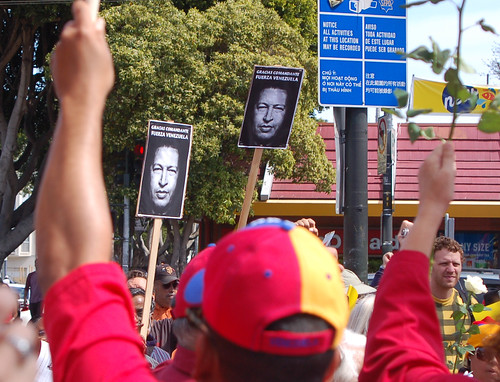
1chavez head on fence.jpg
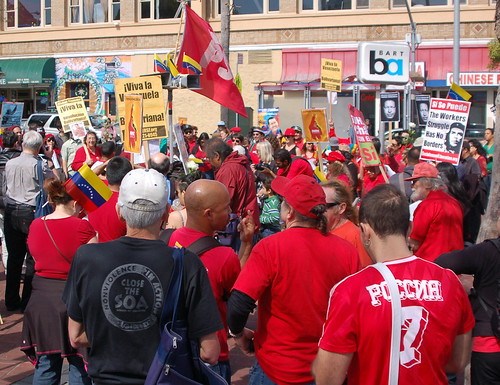
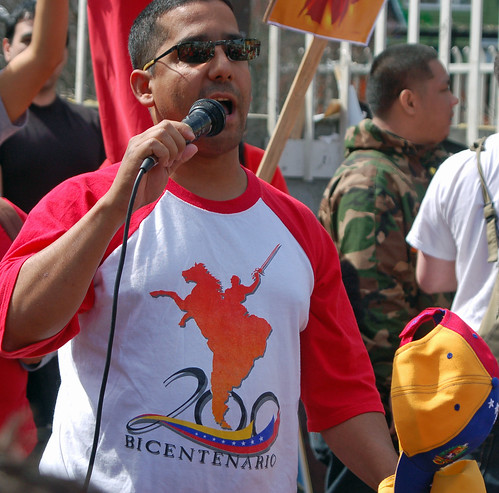
San Francisco's left gathered at 24th and Mission on Sunday afternoon to mourn and honor deceased Venezuelan President Hugo Chavez.

2crowd shot.jpg
Old and young were there, including many from the Latino immigrant left.

3bolivarian bicentenury.jpg
I never knew quite what I thought of Hugo Chavez. I loved it when he jerked pretentious Northamericans around, accused George W. of being a sulpher-emitting "Satan," presented Obama with a copy of Eduardo Galeano's Open Veins of Latin America. Much of Latin America has finally thrown off U.S. economic and political domination in the last decade -- Chavez led the way. Majorities of Venezuelans elected him repeatedly. How was I to evaluate what he was doing?

I'll let the right -- Bloomberg Businessweek -- describe his accomplishments.

Chávez’s most enduring and positive legacy is his shattering of Venezuela’s peaceful coexistence with poverty, inequality, and social exclusion. He was not the first political leader who placed the poor at the center of the national conversation. Nor was he the first to use a spike in oil revenue to help the poor. But none of his predecessors did it so aggressively and with such a passionate sense of urgency as Chávez did. And no one was more successful in planting this priority into the nation’s psyche and even exporting it to neighboring countries and beyond. Moreover, his ability to make the poor feel that one of them was in charge has no precedent.

Another positive aspect of his legacy is that he ended the widespread political indifference and apathy nurtured over decades by a system dominated by decaying and out-of-touch political parties. The political awakening of the nation sparked by Chávez has engulfed people in the barrios, workers, university students, the middle class, and, unfortunately, even the military.

4chavez heads raised high.jpg
But charismatic leaders, leaders whose proud bluster seems too often to lead back to their personal vision and central importance, undermine genuine participatory democracy. I have friends who know Venezuela well who lament the violent crime and chronic corruption in Caracas. Chavez's Venezuela is a very hard place to live and work for most everyone, despite all the oil wealth and the political excitement.

I'll let the left -- Greg Grandin in the Nation -- recite some of Chavez' faults.

Chávez was a strongman. He packed the courts, hounded the corporate media, legislated by decree and pretty much did away with any effective system of institutional checks or balances.

But Grandin still assesses Hugo Chavez as a uniquely inspiring figure for all his faults. Millions of Venezuelans and their friends around the world agree. This is not something to quarrel with or to discount.