Showing posts with label Nepal. Show all posts

Wednesday, April 09, 2025

Breathing a little easier

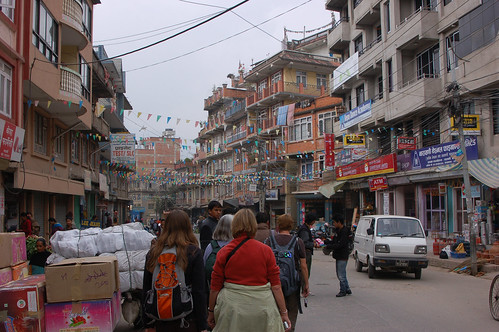
Even two decades ago, the gray haze over Kathmandu obscured the magnificent views of the surrounding mountain ranges. The valley is prone to temperature inversions, meaning warmer air at higher altitudes traps airborne pollution. It was hard to breath while trudging about and dodging exhaust-belching mini-buses and trucks even in 2006 when I took this picture out a hotel window.

According to Bill McKibben via The Guardian, Nepal is doing as well as anywhere replacing its fossil fuel fog with less polluting electric vehicles. 

A heartening report from Kathmandu, one of the world’s smokiest cities, shows that the Nepali capital is rapidly cleaning its air as electric minibuses and cars start to dominate the local scence

More than 70% of four-wheeled passenger vehicles – largely cars and minibuses – imported into Nepal last year were electric, one of the highest rates in the world. The figure reflects a remarkable growth in the use of electric vehicles (EVs), which saw the country import more than 13,000 between July 2023 and 2024, up from about 250 in 2020-21.

Nepal’s government has set ambitious targets for wider take-up of EVs, with the aim that 90% of all private-vehicle sales and 60% of all four-wheeled public passenger vehicle sales will be electric by 2030.

Makes sense. Nepal produces abundant, clean, hydroelectric power as water runs off the Himalayas. 

Chinese made BYD vehicles are available to Nepalese buyers. Great to see.

Thursday, May 27, 2021

What happens in India ...

... doesn't stay in India. 

A view of Katmandu. Lovely, but no place to be in a pandemic.

At least that's what occurred to me when I saw via the BBC that:

Nepali health officials say the current daily positivity rate is nearly 50%, meaning that one in two people are testing positive for Covid.

There's a lot of back and forth between India and Nepal, a lot of itinerant laborers. Those of us who've visited the country may think of it as the exotic gateway to the Himalayas, but interchange with the Indian colossus to the south keeps the economy afloat. It's not a place with much effective government; the emerging Covid crisis has brought down the most recent one. And it's not a place with much health infrastructure. When I got pneumonia in Katmandu, I felt mighty lucky to go a British clinic.

The international aid agency Mercy Corps has workers on the ground:

“In March, as few as 70 people a day tested positive for COVID-19 in Nepal. Today, this number is more than 100 times higher - a daily record of 9,070 cases were recorded on Thursday - and is overwhelming Nepal’s fragile health structures.

"The communities we are working with are petrified. They have seen their friends and family members in India fall ill, many tragically dying, and now are seeing the very same situation hit Nepal as some 400,000 migrant workers return home with no money in their pockets and the virus spreads rapidly. ...

"Nepal’s medical system is weaker than India’s, reliant on India for crucial supplies like oxygen cylinders, which India itself is short of now. Nepali hospitals are already running out of beds, and caseloads are expected to continue to rise. Less than 10% of people have received at least one vaccine dose, and Nepal is entirely dependent on other countries such as India to deliver vaccines. ..."

Nepalis are a tough people; they have to be. Around here in the U.S., we can begin to believe we're coming out of this coronavirus shit show ... but so much of the world is just now seeing the disease take off.

Friday, May 13, 2016

It's a big, complicated world, especially for women

A few years ago, I had the privilege of joining in an all-women's trekking trip in Nepal. We didn't go any higher than 12,700 feet or climb any mountain. But we did walk in the Sherpa region of the Khumbu Valley just below Mount Everest. It was high enough and rough enough to give me great respect for and considerable trepidation about those high places.

Our leader was Lhakpa Diki Sherpa pictured here. She was obviously a very esteemed athlete, the Nepalese women's mountain running champion. She had represented her country in several European races. We naturally gasped in her wake, though she simply led us carefully and competently. It was hard to suss out just what her relationship was to the porters and other guides (male) with the group. She was shy when speaking perfectly adequate English.

Her ambition, if something better didn't come along as a consequence of her athletic prowess, was to go to the capital in Kathmandu and study bookkeeping/accounting so she could always have a job. It seemed a small bore ambition for such an exceptional woman, but it was what she could see ahead.

I thought about Lhapka Diki when I read the extraordinary story in Outside of the first Nepalese woman to summit Everest and make it down alive. Lhakpa Sherpa (Sherpa names are limited) went back and climbed the big rock five more times. Yet today, she's an obscure in-home health care worker and 7-Eleven cashier in Hartford, Connecticut, raising her two children as a single woman.

Notions about women's roles, the strange and often ugly conjunction between Sherpa talent for heights and Western mountaineers who depend on the Sherpas, the Nepalese culture, and global migration make Lhakpa Sherpa's story a window on our times. Highly recommended.

When I travel, I try to remember that I am not culturally equipped to see the whole of what is going on. My interaction with Lhakpa Diki was of that sort.

Thursday, June 11, 2015

Nepal since the quakes

I have traveled in search of mountains. Among the many places I've been lucky enough to put down a toe, something about Nepal and its people seeped into me especially deeply. In gratitude from a world away, I continue to try to see the aftermath of the violent earthquakes of April 25, 26 and May 12.

Anagha Neelakantan, writing at the International Crisis Group blog, describes the disaster:
Nepal’s people live a constant struggle to accumulate some insulation from the hardships and arbitrariness of life. They contend with a challenging landscape of hills, high mountains and plains threatened by dangerous rivers, capricious weather, an immutable bureaucracy and treacherous politics. It often takes just a little thing to tip the balance against survival. ...

... So far, over 8,500 people are known to have died and close to 18,000 injured. About a fifth of Nepal’s 28 million people have been affected, with hundreds of thousands still enduring unimaginable suffering. Thirty of Nepal’s 75 districts were hit, 16 of them severely. About 600,000 homes have been destroyed, and tens of thousands more rendered uninhabitable, leaving some three million people without a roof over their heads. Over one million people may end up being displaced.
Neelakantan was deputy director of the Crisis Group’s Asia program until 2013. Previously she worked for the United Nations Mission in Nepal and as a political analyst, becoming executive editor at the Nepali Times. In a place where foreigners are easily bewildered even as we are delighted, she knows what she is seeing. Some of her observations:
... there are already sharply divergent narratives about the earthquake and the response to it. These accounts reflect some of the faultlines in Nepali politics, governance and society, and in international engagement with Nepal. The complex politics surrounding the response to the earthquake will influence how much people suffer and for how long. They will also determine whether the enormous reconstruction effort needed in the affected part of the country will bring the country together, or return Nepal to the politics of partisanship and bitter polarisation.

One narrative, often embraced by some internationals, has the government as the bad guy: slow, incompetent, power-hungry and criminal, thus incapable of leading the reconstruction. From a Nepali perspective, internationals are often seen as unaccountable and un-transparent, expensive, and disrespectful of Nepali expertise and sovereignty. ...

... It is deeply ingrained in the psyches of internationals and many professional Nepalis that the way to fix grave problems in Nepal is by treating them as the subject of development projects. So reconstruction efforts after a natural disaster, for example, or compensation for war victims, are treated just the same as if they were programs in maternal health or sanitation and hygiene. Yet clearly, a natural disaster on this scale needs a response that is more robust, transparent and creative. Replicating often inefficient and overly complicated habits from the development world is one of the worst things that could happen to the reconstruction efforts, even if it is perhaps inevitable.

Nepal’s development industry, by which I mean international agencies and NGOs, as well as Nepali NGOs, the government and bureaucracy, is sclerotic and often inefficient. This is not to say it does not ever work; it obviously does, in some ways. Yet it also sometimes creates or entrenches dynamics of inequity or resentment. The development industry is by now fused with the Nepali state by such great mutual dependency that a rupture of any significance seems unlikely. ... All sides bear responsibility for the storied corruption of the sector and, at the worst of times, insensitivity to what could trigger new conflict.

Donor agencies are far from innocent in this grubby picture, despite holier-than-thou criticism of the government of Nepal and Nepali partners: their programming often ignores history; they are so enamoured of comparative experience and international best practice that they can miss the reality right in front of them; they privilege “expert”(read foreign) knowledge over “local”perspectives; they play favourites; and at their worst, they count the lives of internationals as having greater value than of Nepalis. Like their Nepali counterparts, their perspective is grievously Kathmandu-centric. ... [Kathmandu is the capitol and only large city, over 4 million people.]

... The tussle between Kathmandu and internationals is only part of the story. Politics, in the form of party politics, became an increasingly formalised part of the development projects following the peace deal. In the districts, “all-party mechanisms” became a way for parties to divide up the spoils of the development budget as a way to keep the peace at the local level. Similar mechanisms are being put in place for relief distribution. While in some areas they appear to be functioning reasonably so far, there have been reports from other areas that the distribution of relief has been politicised to the point of endangering lives. ...
Nepalis achieved a tenuous national peace after a decade of civil war in 2006. But institutions of government are still "under construction." Will they be able to rise to and constrain the challenges of this massive disaster?

Overlooking Kathmandu, 2010
And will Nature compound the human agony? The annual monsoon rains will soon drench Nepal. Accordingly to Accuweather:
... the wettest period stretches from the end of June to the beginning of September, a nearly three-month chunk of the year where storms bring unsafe conditions to those without a proper form of shelter.

During monsoon season, up to 80 percent of the yearly average rain will fall. With this year expected to align with average rainfall totals, Kathmandu could receive more than 40 inches of rain in less than four months."

[According to Tim Osburn of Shelterbox,] in some cases... villages sitting in higher elevations could see a landslide start a mere half mile up the terrain. At that point, there's nothing else to do.

"They've spent a lot of time and energy getting temporary shelters up," Osburn said. "But when standing up to a monsoonal rain, you could see the work going right down a hill after one of those."
World Policy reports that only 22 percent of the international appeal for the Nepal disaster has been funded.

Personally, I've contributed via Oxfam America and Mercy Corps, in both cases because they had programs in the country before this emergency. I can't swear these are good channels for aid, but I make the guess they are better than newcomers without experience. The Nepalis need us to do what we can.
Fields outside Kathmandu. Did they slide? Will they wash away? Or fill with displaced migrants?

Monday, April 27, 2015

Kathmandu on my mind

I sit in San Francisco where the earth has been known to shake and think about Nepal. This is the Boudhanath Stupa as it looked when I visited in 2010. It is a world heritage site, very much a place of spiritual power. There are reports that the earthquake damaged the spire above the eyes and some of the adjacent buildings and smaller stupas.

This shot shows the tower that is reported damaged.

These worshipers circumambulated continuously. I remember thinking that I wondered whether the brick buildings surrounding the stupa could survive a quake. The space is cramped. The few available pictures on the news don't answer that question.

This was Patan Durbar Square in 2010. The taller brick buildings on the right are now piles of rubble. The stupa on the left seems to have survived the quake. I took this picture at midday, roughly the time the earthquake struck.

Patan was a busy place.

This construction worker was tying steel reinforcement on a new building, exactly the sort of construction that a city located on a fault requires. Note that he is doing the work in flip-flops. OSHA would not approve.

The Nepalese are tough and resilient. They have to be. Essentially there is no government, only erratic electricity, hardly any roads. It will be weeks before there is a full picture of what happened to people outside the big city, closer to the epicenter of the quake.

Mercy Corps seems to be on the ground in Kathmandu with local staff. So is Oxfam.

Wednesday, November 20, 2013

Transgender day of remembrance

The Transgender Day of Remembrance serves to memorialize persons murdered because of transphobia. There have been and continue to be far too many valuable human beings whose crime was to be different.


This video is about a survivor whose home is Nepal.

When I was in Nepal in 2010, our tour was treated to a "folkloric dance" performance by a troupe in which I immediately recognized persons who had found a place to live outlawed gender identities. Too often, being in a freak show has been the only recourse for persons whose gender presentation violates community norms.

Neelam has apparently found a place to be within Nepalese culture. That's cause for rejoicing.

This post was queued up before I left for Bhutan.

Tuesday, July 26, 2011

Rays of effing sunshine: she lives in Kathmandu chronicling climbs and climbers

street with prayer flags copy.jpg

An article from Outside Magazine tells the tale of 87 year old Elizabeth Hawley:

...Hawley hasn't climbed a mountain in her life. She has interviewed, documented, and, when necessary, investigated nearly every expedition coming through Kathmandu since the country opened its doors to outsiders in the mid 1950s. She's also acted as an archival historian, collecting trip reports from as far back as 1905.

And that's a volunteer job: she gets paid for some admin work for the foundation started by mountaineer Edmund Hillary, the Himalayan Trust, and writes a few articles.

And she's clearly one awesome, smart, funny and ferocious lady. Go read about her and check out the pictures.

Photo is of Kathmandu street scene, November 2010

I don't want to just gripe here all the time. I do after all, quite frequently, encounter things and people that delight me. Hence this feature: occasional posts labeled "rays of effing sunshine."

Wednesday, March 09, 2011

On Ash Wednesday, thinking about eternity

On this day when the Christian world is reminded in the Ash Wednesday liturgy that "you are dust and to dust you shall return," this photo seems to the point.
where-bodies-burned.jpg
In Katmandu, walking through the city, one literally breathes the ash of bodies being cremated in accord with Hindu and Buddhist practice. The smoke on the left of is rising from the crematoria. In these belief systems, the soul of the dead person is being released on the way to its reincarnation in accord with the laws of karma.
***
In the cultures of the post-Christian world, awareness that we die is entangled with our various understandings of "eternity." Carlos Eire, a Yale University historian of religion, sorts out some of how our beliefs came to be in an interesting Very Brief History of Eternity.

His historical exposition gave me a timeline about eternity that I hadn't had previously. For medieval people, eternity was immanent, right there in proximity to human life, in shrines, in relics of saints, in churches, in the very cosmology shown the visible sky, the heavens. The Protestant Reformation, initiated by Luther in response to the abuse of eternity because the Church seemed to put a monetary price on admission to heaven, desacralized the world, making room for science. And science just about did away with the notion of eternity as heaven itself.

The Copernican revolution was not only a conceptual paradigm shift but also a spatial and dimensional one. ... Before the Copernican revolution in astronomy, heaven was a location, and therefore also eternity: just another place, conceived of much in the same way as we now conceIve of the orbits of the planets in our solar system. This older heaven thus shared a boundary with the physical universe and with time.

...The telescope made this old heaven vanish like a puff of smoke. Banished from physics, heaven went into exile in metaphysics, a location that Immanuel Kant (1724-1804) would soon unmask as an imaginary island. And since nearly all of the educated elites would agree with Kant on this point, metaphysics, too, vanished like another puff of smoke.

... if the new invention of the telescope and new mathematical calculations could prove that the Bible and all the churches were mistaken about the visible universe, why not also doubt their reliability about things unseen, such as eternity, and the hereafter? Among the first to take issue with Christian notions of an eternal afterlife were thinkers heavily influenced by the new science... such as John Locke, John Toland, and Isaac Newton in the British Isles, Pierre Bayle in France, and Gottfried Wilhelm Leibniz in Germany.

But if science had disproved heaven, what did the inescapable reality of human death mean? Perhaps nothing.

Nothing is a little much for human beings to put up with. Not too surprisingly, a western culture that cannot believe in eternity spawns such oddities as belief in ghosts, ouija boards and visiting aliens. But that stuff scratches the surface of our emotional response. In this country, most people claim to believe in God and some kind of eternity. But our intellectual environment implants a contrary reality.

Ghosts, recycled lives, and suburban cemeteries were not the only by-products of the death of eternity. That loss also gave rise to an existential dread so pervasive that it could be taken for granted by all within Western culture. And this dread is the ether in which we still live and move and have our being; it is as inescapable and as necessary as the air we breathe. ...

Eternity is out of the question, simply because it cannot be squared with reason or sensory input. Eternity is the most certain of uncertainties. At least eternity for us human beings. The stuff of which the universe is made may be eternal--and it may not--but we most certainly are not. It matters little that we may be the finest stuff in the universe, maybe even the consciousness of the universe itself. Each and every one of us is as much a candidate for extinction as every trilobite and dinosaur or all our forebears and descendants. It matters little whether one is a genius or a dimwit, righteous or depraved. All of us are the offspring of nothingness.

It may be painful to admit it, our sages seem to say, but terminal temporality is our common lot: nonexistence trumps existence, as far as every individual is concerned. And perhaps the entire cosmos as well. The dark abyss of nothingness that preceded our birth is no different, perhaps, from that which preceded the Big Bang. ...

And yet it seems built into human DNA to seek meaning in preference to accepting nothingness. I rather like that about us.

I think Professor Eire might agree. He's not the sort of author I turn to often -- a conservative Catholic with a doctrinaire streak -- but his history made my cosmos a little bigger and that feels like a good, whether eternity is "true" or not.

Our location within this contemporary "existential dread" is, I think, the context in which our species confronts radical climate change and global warming. Ash Wednesday too belongs quite properly within the "Warming Wednesday" series I'm posting these days.

Thursday, January 13, 2011

Nepal: federalism ahead?


Political graffiti in Kathmandu. I'm sure there was much more, but this was iconography a tourist could recognize, though not necessarily understand.

When one visits other peoples' countries as a tourist, it is sensible to avoid questioning people about their local politics. That's not at all my instinct; I'm too habitually attuned to the push and pull of power in communities not to frame questions. But, of course, I am also too ignorant on a short visit to be able to see and engage with whatever is going on from the local perspective.

So I asked no questions about politics during my brief visit to Nepal in November, even though I knew the country had recently emerged from civil war, had no current central government, and was in a process of writing a constitution.

Today the International Crisis Group issued one of its sober briefing papers on Nepal. ICG represents the more enlightened factions of Western internationalism, sometimes acting as a slightly abashed apologist for American and European hegemony, but also often wise to on-the-ground realities in countries not bathed in a Western media spotlight.

Here are some excerpts from the executive summary of the new Nepal report:

Nepal: Identity Politics and Federalism

Federal restructuring of the state has emerged as a major demand of ethnic and regional activists in Nepal. The debate about it is extremely politicised. Federalism is not simply the decentralisation of political power; it has become a powerful symbol for a wider agenda of inclusion, which encompasses other institutional reforms to guarantee ethnic proportional representation and a redefinition of Nepali nationalism to recognise the country’s ethnic and cultural diversity.

Activists demand the introduction of reservations to guarantee proportional representation of marginalised groups in government and administration. They want provinces to be named after the most numerous ethnic and regional groups and boundaries drawn to make them dominant minorities. Some claim to be indigenous to these regions and demand preferential rights to natural resources and agradhikar -- priority entitlement to political leadership positions in the future provinces.

Ethnic and regional demands were important parts of the Maoist agenda during the civil war; in eastern Nepal, much of their support depended on it. State restructuring became a central component of the 2006 peace deal. ...

Backtracking on federalism is politically impossible. ... deferring crucial decisions, or stalling the constitutional process altogether, could be tempting for those opposed to change. The assumption that the Maoists have both the most to gain and the most to lose from the constitutional process could lend wider appeal to the idea. The risks are hard to calculate. Ethnic and regionalist groups, already suspicious of the major parties’ commitment to federalism, threaten protests and ultimately violent resistance should it not come. Their eyes are on the 28 May 2011 deadline for the promulgation of the new constitution. ...Activists are getting frustrated and the mood is becoming more militant. With an issue to rally around they are likely to coalesce; a politicised population would easily be mobilised for protest movements, should federalism not come.

Not all want federalism. Popular opposition to ethnic federalism in particular is substantial, by virtue of its association with identity politics. Many Brahmins and Chhetris, the dominant caste groups, fear they will lose out from the introduction of ethnic quotas and federal restructuring. But organised resistance is limited and fragmented.

...The structure emerging from the Constituent Assembly, federal but with a strong centre, offers a feasible compromise.
I have no way of knowing whether this is an accurate rendering of the situation. Federalism often seems a mixed blessing in our own country; does it really make sense that so many laws differ between states and that so many responsibilities are so uneasily shared by 50 state governments with the national government? Nepal only has about 35 million inhabitants, though it's people speak 92 separate languages at home and presumably also therefore possess many different cultures.

I can't pretend to understand anything much about Nepal, but I can sure wish this beautiful, hospitable country well as it approaches the deadline for its new constitution.

Saturday, December 25, 2010

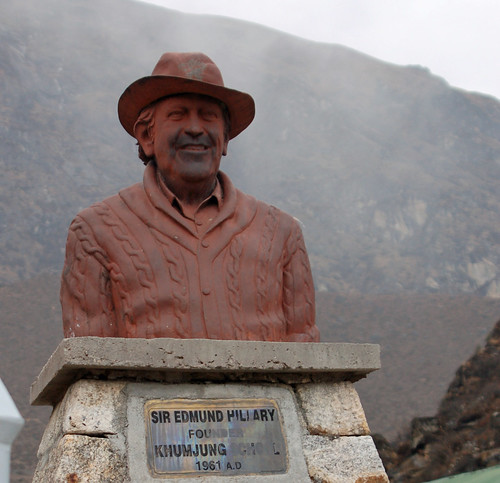
Sir Edmund Hillary on what lasts in a long life

1hillary statue copy.jpg
Before I visited Nepal and trekked in the Everest region, I knew little about the later life of Sir Edmund Hillary, the New Zealander, who, with the Sherpa Tenzing Norgay, first summited the world's highest mountain in 1953. Hillary died in 2008 at 88. I was glad to find in Kathmandu a dog-eared copy of Hillary's late-in-life autobiography View from the Summit and read it on the way home.

I'm just old enough to have a vague memory of the news of the two men's triumph on the mountain, all mixed up with the coronation of Elizabeth II, the first TV broadcast I remember. It took this book to make me aware of the complicated nationalist, post-colonial political ramifications that engulfed the returning climbers. It had been desperately important to Tenzing that a Sherpa should be one of the first people to reach the summit; on their return, he was pressed by Nepalese to sign a statement that the accomplishment was primarily his doing, while Hillary tried hard to credit both men. Hillary describes himself as an innocent, hyper-fit, somewhat sheltered, bee-keeper in those days, oblivious to the excitement their reaching Everest's peak would create.

Strangely enough, hearing it stated over the BBC made me realise positively almost for the first time what an achievement it had been. I had innocently thought that it would be of interest to mountaineers, but not particularly to anyone else -- but I was being proved very wrong. ...

Nationalist aspirations then ran into unpleasant realities of several sorts. Though Tenzing was fiercely proud of his Sherpa heritage, he actually lived in and was a citizen of India, and did not much identify as Nepalese. Meanwhile, the Brits, still harking back to empire, thoughtlessly gave more of their kudos to Hillary. Thanks to Tenzing's wife's insistence (Sherpa women don't keep mum), his family accompanied Tenzing to England for the excitement, but Hillary got the starring role. In later years, Hillary claims to have been aware something was wrong (racist) about this.

... A small stool was placed in front of the Queen, I knelt on it, a short be-jewelled sword was put in her hand, she touched me lightly on each shoulder and said, "Arise, Sir Edmund." Whether I wanted it or not, I was now a knight and expected to behave as one. It was quite a change from my early days as a bee farmer in New Zealand.

There was only one thing on this great occasion that made me feel slightly uncomfortable. It would have been nice if Tenzing had received a knighthood too. He was given the George Medal, the highest civilian award for bravery in Britain, but in view of his great contribution to the expedition it would not have been unreasonable for him to have received he same decoration as I did. After all, I could hardly be regarded as knightly material in those days either.

As Hillary explains in the autobiography, for the rest of his life, he was always viewed in the role of the conqueror of Everest. At first, he used his celebrity to win leadership of a New Zealand expedition to the Antarctic. Later he and his family spent summers camping in U.S. national parks as gear-testers and celebrity endorsers for Sears Roebuck. He organized a jet boat expedition that travelled the length of the River Ganges in India and eventually served as New Zealand's ambassador to that country.

But none of that was what he set his heart on. Rather rapidly, whatever the extraordinary physiological anomaly was that enabled him to acclimatize relatively easily to high altitudes as a young man deserted him. Quite a lot of the book is about Hillary hiking or being carried down from high Himalayan places with severe cerebral edema. The heights had turned on him.

He was well aware who took care of him.

... Mingma, and the other Sherpas he recruited to build and climb with us, tough and competent themselves in their mountain environment, never really believed we could cope on our own. They would try and ensure we 'sahibs' carried only light loads, and would worry if we were going any distance without Sherpa guidance.

I sure get that! I had the same sense that the Sherpas and other mountain people we met in the Khumbu region thought we'd die if left to our own devices. When I came down with pneumonia, they did anxiously assist me. This care felt willing, not in any way either servile or like a necessity to promote tourism: they simply understood themselves to be capable of living in these places and we were not, so we must be cared for.

So, beginning in the early 1960s, Hillary took up the work of his later life, raising funds and building hospitals and school in the remote Everest region.
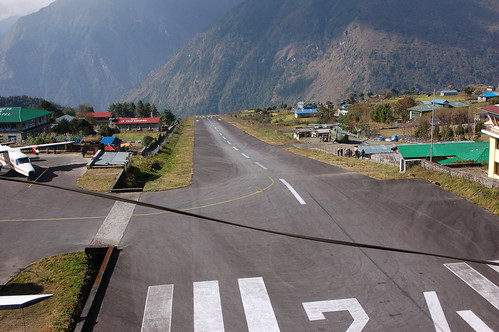
1lukla landing strip copy.jpg
The regional airport at Lukla was his project. Before it was built, people and supplies had to travel on foot for two weeks over a 15000 foot pass to reach the area.

I was still energetic but no longer the lead climber. I was the planner and organiser and ran the whole operation. We built a hospital at Kunde ... In response to petitions from local villages we constructed half a dozen new schools. We built a number of bridges over foaming mountain rivers and brought fresh water to villages with plastic pipes. To save carrying hundreds of loads on men's backs for the seventeen-day walk from Kathmandu, I decided to try and find another suitable site for an airfield.

... Jim [Wilson, Hillary's co-worker] had a rather amazing experience. He was approached by a group of farmers from the small village of Lukla, which was located in a small tributary valley at 9,000 feet. They had some land for sale and thought it would be suitable for an airfield. They even suggested that the wind always blew in the right direction! How hill people who knew nothing about airfields could possibly make this sort of judgement I do not know. but when we went up to Lukla we agreed that they were right. And best of all we wouldn't be destroying a lot of arable land. One third was in rough pasture, one third in heavy scrub and the last third in terraced potato fields. It certainly wasn't flat, the rise from bottom to top was over a hundred feet, but this wouldn't be a problem to a STOL (short take-off or landing) aircraft. Even the negotiations for the land were relatively easy. I purchased it on behalf of the Nepalese government. for a total of $635 -- quite a substantial sum in that area in those days. ...

Altogether I had paid out just over $2,000 for land and labour. ...Lukla quickly became the busiest mountain airfield in Nepal and the gateway to Everest.

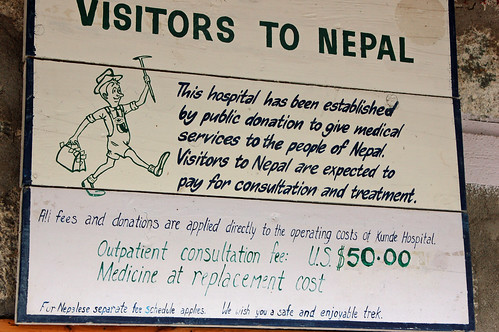
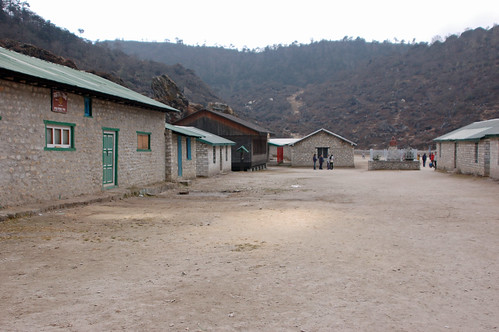
We visited the hospital built at Kunde.
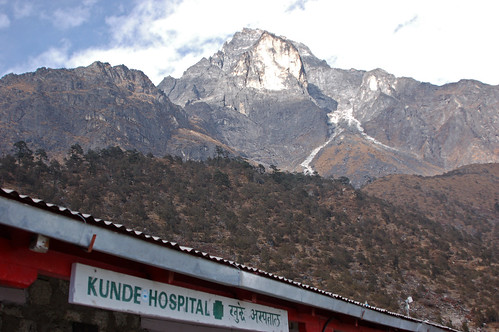
2kunde hosptial-peak in rear copy.jpg

3kunde fee schedule copy.jpg
Their fee schedule made a lot of sense to me.
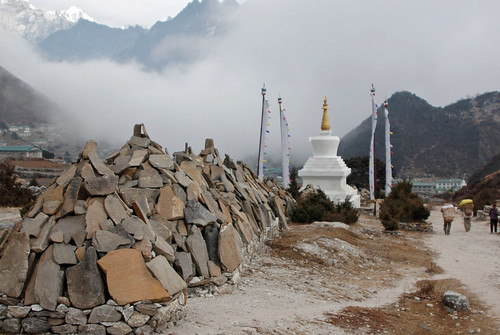
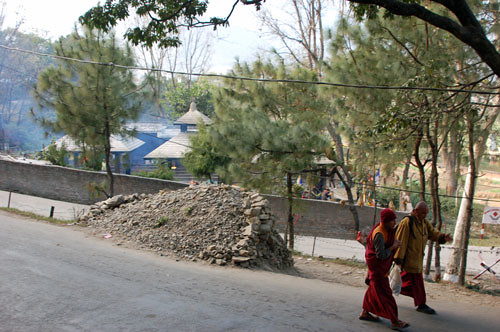
4stupa copy.jpg
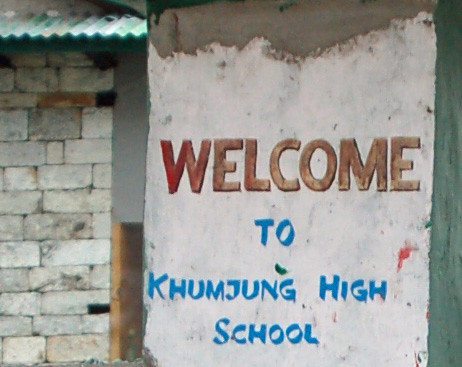
From the hospital, we walked on down to the regional high school at Khumjung, another project built because of Hillary's work with international climbing groups and philanthropic institutions.
5welcome highschool copy.jpg
Sign on the entrance arch.

6school yard copy.jpg
The wide school yard easily accommodates several hundred studens.
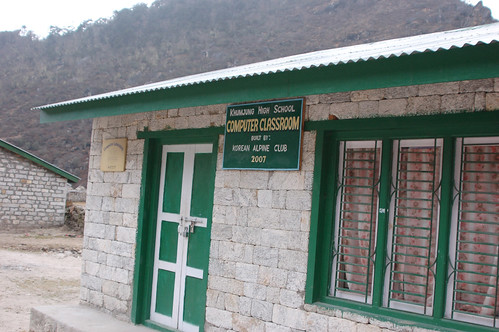
7computer classroom-koreans copy.jpg
Korean climbers had contributed the most recent building.
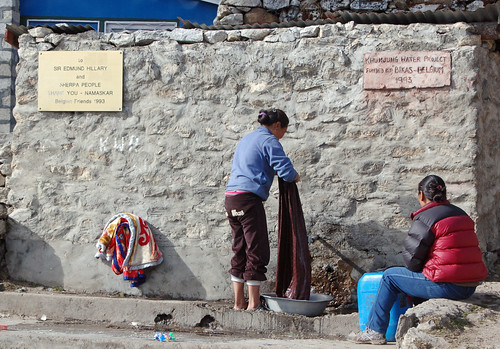
8water tap, hillary, laundry copy.jpg
Back in Khumjung village proper, women washing clothes can thank the Hillary projects for running water.

I liked Khumjung the most of the places we visited on our trek. It seemed prosperous, enjoying some of the fruits of modernization, yet very much a town where Sherpa culture survived the relatively small trekker influx and thrived. Tourism and indigenous cultures often throw up ugly by-products, including a sense of mutual exploitation. In Khumjung, perhaps I missed things, but I didn't feel that common tension.

Sir Edmund Hillary was completely clear on what he valued most in his life.

It is interesting in these days, when I have a warm relationship with all the people of Nepal, to look back on the Everest era when I was largely resented by the Nepalese and I wasn't particularly enthusiastic about them either. ...

Achievements are important and I have revelled in a number of good adventures, but far more worthwhile are the tasks I have been able to carry out for my friends in the Himalayas. They too have been great challenges in a different way -- building mountain airfields and schools, hospitals and clinics, and renewing remote Buddhist monasteries. These are the projects that I will always remember.

Friday, December 17, 2010

Friday critter blogging:
The denizens of Swayambhunath

1our-party-mounting-the-steps.jpg
On the top of a hill in Kathmandu sits Swayambhunath, often called the monkey temple. Visitors and pilgrims climb hundreds of steps to reach the Tibetan Buddhist stupa at the top.

2swimming-pool-for-monkey.jpg
It's made abundantly clear whose home we are entering.

3temple-resident-copy.jpg
We were warned not to feed the locals or try to eat while ascending. The monkeys demand offerings and take what they can get.

4temple-resident4-excited-copy.jpg
They chatter constantly and move fast.

5temple-resident3-copy.jpg
With a face like that, it's hard not to think we might be related to this primate, though I have no idea whether such notions inform Newar Buddhism's veneration of the monkeys.

6temple-resident-5-copy.jpg
This guy was as at home among the human artifacts as in the trees.

My pictures misrepresent the scene in that I did not capture the pack action of the monkeys. They dash about in a mob, asserting their rights to the site.

Monday, December 13, 2010

Nepal: people, mostly photographed unawares

Before I end my Nepal trip posts, here's one last big one that is simply pictures of people we encountered, many of them children or older people. As with the post showing Nepalese working, I've divided these into those from the Everest region trek and those from Kathmandu.

In the highlands
1smiling woman! copy.jpg
She seemed to enjoy watching the world go by.

2child checks shoe copy.jpg
I think she was on her way to school.

3very small cowherd copy.jpg
Maybe this should have gone up among the pictures of people working, but I couldn't be sure who was herding who.

4sherpa-tough looking copy.jpg
A Sherpa (I think) in Khumjung village.

5shadow sherpa copy.jpg
This helpful gentleman was always nearby during the trek, though I never figured out how he fit in. I thought of him as the "shadow Sherpa." Here he sits in front of the Sherpa hospital in Kunde.

Slideshow with more people pictures here.

In Kathmandu
6old woman looks at camera copy.jpg
I'm afraid she was unhappy to realize I'd caught her on camera. That's a dilemma for travel photography. Obviously people don't go about their lives for you to snap pictures of them. But if you alert them to fact you are shooting, you risk that people will pose and cease to look as they really do. I sometimes ask politely, but more often just try to be unobtrusive.

7pilgrims, probably Indian:hindu copy.jpg
One solution is to take your pictures while people are posing for others. These Indian pilgrims at Swayambhunath were being recorded by their relatives ...

8tibetan pilgrims at buddha in Kathmandu copy.jpg
... as were these Tibetan women. I hope some of them snapped our group of out-of-place North Americans!

9child-very cute copy.jpg
Some children love to pose.

10woman washing dishes copy.jpg
And some people are just too busy with the morning dishes to much care about a bevy of passing tourists.

More pictures of people here.

Sunday, December 12, 2010

Nepal: hard workers

Because Nepalese work outdoors commonly, even in Kathmandu, in some ways it is easier to catch them at it than it would be us. In this post, I've separated pictures of people working between the Everest region trek and in Kathmandu.

Workers in the highlands:
1porter w basket load! copy.jpg
There are donkeys and yaks on the dirt path, but mostly there are people, playing the role we'd fill with Mack trucks.

2woman with kerosene cans copy.jpg
This young woman is carrying empty kerosene containers downhill to be refilled. No individual or beast could bear all those bottles if they were full.

3face of a porter copy.jpg
This gentleman's face suggests a lot of years carrying a lot of loads.

4porters! copy.jpg
These cheerful young men were our porters, sunning themselves after a very short day. We were a good gig with relatively little baggage.

5building women hammering stones copy.jpg
Building sites we passed were a reminder that labor is cheap in Nepal. These women are chipping away at stones to make them more rectangular for inclusion in walls.

6women (hotel workers) on roof w laundry copy.jpg
These hotel workers in Namche Bazaar seem to be taking a break after completing the laundry. They reminded me of folks I am acquainted with at home.

Slideshow of workers in the Everest trek region is here.

Working in Kathmandu
7women fruit and veg vendors close copy.jpg
In the city, people sell each other the goods of life.

8butcher, close up copy.jpg
Want meat for dinner? The butcher will cut it for you, fresh ...

9customer waiting for cut of meat copy.jpg
...while you wait.

10vendors of votive candles and prayer flags copy.jpg
At temples, various offerings are available for purchase.

11painter at world on temple decorations copy.jpg
Artists refresh the paint on monuments and religious sites. This seemed to be underway at most places we visited.

12working with steel on building site copy.jpg
This was a modern building site using good quality materials, but I doubt OSHA would approve this guy's footgear.

13breaking up ground wide copy.jpg
Within a short walk from central Kathmandu, one comes to planted fields where agricultural methods look to have endured for centuries.

City workers slideshow.

Disclaimer re what a tourist can see.