Showing posts with label social security. Show all posts

Thursday, August 14, 2025

On the birthday of Social Security

Historian Heather Cox Richardson explains what the people of these United States won 90 years ago.
On August 14, 1935, President Franklin Delano Roosevelt signed the Social Security Act into law. ... The Social Security Act established a federal system of old-age benefits; unemployment insurance; aid to homeless, dependent, and neglected children; funds to promote maternal and child welfare; and public health services. It was a sweeping reworking of the relationship between the government and its citizens, using the power of taxation to pool funds to provide a basic social safety net. 

The current Trump regime is out to destroy the system, of course. More for their billionaire buddies, less for the people. They are also striving to reduce the workforce that keeps our safety net, such as it is, functioning.

So some of the people turned out at the Federal Building in San Francisco to say "no"!

Solidarity mattered in 1935 and it matters today.

Thursday, March 20, 2025

Stupid, destructive, and utterly unrealistic: that's our Prez say the economists!

Why are Trump, along with Musk and his Muskrats, breaking government and the institutions that make this country a somewhat livable place? Seems crazy.

A couple of our most significant economic thinkers took up the puzzle in the last few days. Short answer: yes, the Trump regime is crazy -- and vile too.

Adam Tooze is the preeminent English language economic historian of the 20th and 21st century world capitalist system. (I have written about his highly accessible books here, here, here and here.) He does the work to engage what passes for economic theory claimed by Trump's intellectual apologists and wrecking appointees. 

I began to wonder whether this search for a rational wing in Trump’s economic policy is not, in fact, a step towards sane-washing and whether this sane-washing is not driven by some engrained mainstream framings of America’s problems that react in sympathy with the Trump administration’s rhetoric of crisis and victimization even if they are out of sympathy with the Trump administration in general.
Is there a real and important continuity of problems in America’s political economy that at least parts of the new Trump administration are trying to address, thus forming a continuity with the Biden team and Trump 1.0?
Or is the shellshocked commentariat of 2025 in the grip of a kind of Stockholm Syndrome in which our own inner fears lead us to engage with our captors in a way which denies the actual reality of being hurled into a mad house? Call it Mar-a-Lago (Accord) Syndrome.

... we are all struggling to find some kind of rational purchase on the unhinged situation created by the Trump administration.

Turns out, after serious engagement with some Trump apologists, that he finds "no there there" in Gertrude Stein's memorable formulation. 

The Stockholm syndrome element kicks in when we come to the original framing of the problem: The belief that something must be done. Once you are convinced that “something must be done”, you become vulnerable to someone hawking a big plan to “do things”.

Why do sane people in contemporary America believe that “something must be done”? Ignoring the reflexive element of crisis by which Trump himself is the main reason something must be done, which renders one susceptible to any big idea that might fix Trump (even if elements of that “fix” are shared with analysis offered by the Trump camp itself) etc etc, there are two main schools of thought:

• 1. American deindustrialization and class balance. ...

• 2. American debt....

Both arguments 1. and 2. are well known. Both are also contentious. No reader of Chartbook will be surprised to hear that I find both 1. and 2. unconvincing. But that is not my point here. My point is that if you do believe either 1. or 2. you need to be on your guard against Mar-A-Lago syndrome.

Even if you disapprove of the Trumpites style and lawlessness, you may be tempted to take at their word the more reasonable members of the highjack team who insist that they offer a dramatic and comprehensive plan to address the crisis you also believe in, leading you to lose track of the fact that … they are highjackers and they are holding you hostage!

By buying into the reality of underlying problem that Mar-A-Lago claims to be addressing you run the risk of overemphasizing the rational element in Trump 2.0.

Tooze simply finds no rational element.

None of us really knows where this clown car is headed and what drives it on its crazy course. It seems like a mystery even to many on board. Quite reasonably we look for elements of rationality. We ask: who inside MAGA 2.0 is thinking and what are their thoughts? We then relate that to our own efforts to diagnose America’s history and the history of the world economy. ...
... To historically minded people it is appealing for obvious reasons. But it puts us at risk of is underestimating the radicalism of the break marked by the Trump administration. In search of historical context we miss what is most historically significant. We avoid facing the conclusion that the vision of a Mar-a-Lago Accord may have more in common with grift, a protection racket or a facelift pandering to the ignorant vanity of an old man than with economic policy as we have hitherto known it.
Faced with Trump, the risk is that conventional realism is a form of escapism.

You can read the entire Tooze argument here. 

Paul Krugman, former NY Times columnist and Nobel Prize for economics recipient, comes to similar conclusions, even more pithily expressed. In trying to understand the Trump/Musk vandalism in government, he sees no plan -- just the wounded egos of ignorant men.

My guess, instead, is that it’s an ego thing, that Social Security has become to Musk what Canada has become to Donald Trump. Both men at one point said something stupid, something that would have turned them into laughingstocks if there weren’t so much fear in the air. But both men have been unable to let go, doubling down in what amounts to an attempt to redeem their initial foolishness.

In case you’ve forgotten, back in December, when Justin Trudeau visited Mar-a-Lago, Trump taunted him by suggesting that Canada become a U.S. state, calling him “Governor Trudeau.” Some people suggested that it was meant as a joke, but it would be more accurate to call it a dominance display.

Trump's chief of staff listens to him threaten to annex Canada
But once Trump realized how ridiculous the performance made him look, he refused to let go. Instead, annexing Canada seems to have become a fundamental plank of Trump’s foreign policy, with his demands getting ever more insistent the more obvious it becomes that Canadians loathe the idea.

Since then, Musk has replicated his insecure co-president and put Social Security under the gun:

Musk’s big blooper was his claim that millions of dead people are receiving Social Security checks. This claim probably reflected the failure of young Musk staffers — what Dudek called the “DOGE kids” — to understand how the SSA’s databases work, combined with a complete lack of common sense. I mean, if there really were huge numbers of dead people receiving Social Security payments, don’t you think someone else would have noticed?

In a normal political environment, getting something that big that wrong would have destroyed Musk’s credibility and led to his permanent exile from any role in setting policy. But this is America in 2025, so Trump amplified the already-refuted claim when addressing Congress, and Musk seems more powerful than ever.

Furthermore, Musk refuses to give up his Social Security smears, making the completely implausible claim that fraudulent use of Social Security numbers accounts for 10 percent of federal spending. And I’d argue that that the plan to effectively cut off many disabled Americans is best seen as part of a desperate effort to find or pretend to find Social Security fraud, retroactively justifying Musk’s big mistake.

Still, does the plan have to be this cruel to the most vulnerable Americans? As I see it, the cruelty is a feature, not a bug.

... It's hard to escape the sense that DOGE staffers are actually enjoying this. And why not? We’re mostly talking about poorly socialized young men suddenly given the power to ruin other people’s lives, taking their cues from a leader who has declared that “the fundamental weakness of Western society is empathy.” So why should we be surprised that the DOGE kids’ rampage through the government looks more and more like a remake of Lord of the Flies?

Krugman read Tooze's screed and agrees

Look, I understand that it’s more fun to write an article about the supposed emergence of a new economic philosophy than to write yet another article about how ignorant men are, once again, saying stupid things. And I guess some journalists are uncomfortable at the thought that people with great power to shape policy have no idea (or rather nothing but false ideas) what they’re doing. 

But trying to put an intellectual gloss on Trumpist international economic policy is sanewashing that misinforms readers rather than helping their understanding.

... My point is that Trump believes many blatantly false things that suit his prejudices. Why imagine that he and his courtiers have sophisticated ideas and a deep strategy when it comes to international economics?

On the surface, Trump’s trade policy looks stupid and destructive. Dig deeper, and you discover that this first impression was completely valid. Trying to pretend otherwise is just misinforming readers.

We don't have to be overawed because these guys are considered some of the best academia has to offer in their field. They care about being understood and they have given us the goods: Trump's economic antics are stupid and cruel, without any rationality beyond grift and grievance. 

Monday, February 13, 2023

For the record: Social Security on trial again

Since we are condemned by Republican crazies to spend another season defending Social Security from tinkering that could devastate people who depend on the program, a little more awareness of how the program actually works might be helpful.

By way of Josh Marshall:
Social Security and Medicare are funded (almost entirely) by a payroll tax of approximately 15% on wage and salary income up to a statutory cap, which currently stands at $160,200. That is tax is split between the employer and the employee. That funds the two programs. A couple generations ago, Congress increased the tax to build up a surplus to pay for the benefits of the baby boom generation. That’s the “trust fund”. Social Security “lent” that extra money to the rest of the federal government, i.e., it purchased government bonds. Eventually that Trust Fund will run out of bonds to cash in. The current estimate is that that will happen in the mid-2030s. This is when Social Security supposedly become ‘insolvent”.
But that’s a meaningless term. The federal government has to pay its promised benefits and if they can’t all be paid by out of payroll taxes the remainder can and will be paid out of general revenues. This was actually the assumption about what would eventually happen back when the program was founded almost a century ago. ...
This doesn’t mean it’s a non-issue. It means there will be funding gap and that’s just a budgetary issue to be resolved. It’s not ‘insolvent’. That’s just scare talk. Now, how can the funding gap be resolved? You could just pay the remainder out of general revenue (the general tax base of income, corporate, capital gains and other taxes that are not tied to any specific program). ...

The aging of the baby boom generation does stress the system; when we arrived in the 1950s needing more kindergartens, our sheer numbers stressed the public school system too. This is a repeat of a phenomenon that our numbers have repeatedly triggered over the decades. And any sane politician who acts surprised is lying.

Marshall goes on to delve into the weeds a bit (and his take is interesting), but those of us who need the Social Security we worked for can stay focused on the main point rather than the details.

The money exists to pay what Americans earned in our working years. If the government needs money, the answer is get it from people who have it, not to nickel and dime people who don't. Raise taxes on rich people and corporations -- that's where the money is.

Wednesday, June 16, 2021

Just what is security, anyway?

Erudite Partner is at it again: 

The Real Welfare Cheats Are War Profiteers

We’re squabbling over Social Security, while the government lavishes infinitely more money on the arms industry.

There's a lot right about this Biden administration, but like all governments since World War II, it takes for granted that the weapons budget must go up, up, up -- and how to pay for Social Security should be a recurring conundrum.

Tuesday, June 01, 2021

A usable past for resisting market dependency

Freedom from the Market: America’s Fight to Liberate Itself from the Grip of the Invisible Hand by Mike Konczal (co-director of the Roosevelt Institute think-tank) aims to overthrow the account of our economic history that has ruled "mainstream" politics since the Reagan Administration. The way we have been enjoined to think is a lie; we are remembering our past falsely.
For two centuries, Americans have been fighting for freedom from the market. Their stories provide a powerful legacy to draw from and build upon. ... 
People have used markets for trading and exchange for centuries. What is unique today is how the economy has been restructured to extend and accelerate our reliance on markets into all aspects of society. ... The things we need to lead our lives are forced into markets where we are compelled to obtain them, at the mercy of private, profit-seeking actors and our own ability to pay. Many of our needs are left unmet or poorly provided for by the market -- from health care to retirement security to providing for children -- and more suffering is the result. ... 
This book argues that true freedom requires keeping us free from the market. In some places this will require the government to provide key services directly and universally, rather than requiring citizens to rely on the marketplace. These services include social insurance, education, and health care, among others. Elsewhere it will mean suppressing the extent of the market, such as the number of hours we work or the ability of businesses to discriminate against their customers. The form this takes will depend on the contingency of everything from technology to the aspect of our life in question. But in all cases, market dependency is a profound state of unfreedom, and freedom requires checks and hard boundaries on the ways markets exist in our society and in our lives.
Konczal makes a series of critiques of market dependency; what follows are are my opinionated, simplified summaries of his points:
• the market distributes necessary goods like health care and access to education unfairly -- and anti-socially
• the market doesn't provide incentives to businesses to produce what won't be profitable -- such as health insurance to sick and old people
• market dynamics allow businesses to structure employment for their convenience and profit, leaving workers only the "freedom" to take it or leave it
• market dependency means people are only valuable if we turn a profit for some entity -- other social goods can be ignored or rendered invisible
• market dependency can't survive without using the state to reinforce its power, so those who own the markets need to own the state.
The book consists of short chapters describing the history of struggles in this country about who got to own the lands being stolen from native peoples, who rules workers in workplaces, how the New Deal managed to provide a framework for collective social security within a still-ascendant white supremacy, how public daycare was invented for the World War II war effort and trashed afterward, the ongoing struggle for universal health care provision, and for public education for all. 

It is simply and clearly written. For a work of political and economic history and theory, it is delightfully approachable.

Konczal concludes:

... The story told here, about how freedom requires keeping us free from the market, is capable of short-circuiting [the Trumpian] far-right threat. A genuine movement to check the market through public action needs to be broad and welcoming, rather than walled off and for the few. Universal social insurance, free public programs, economic security, and power for workers are the things that ensure broad prosperity -- they succeed because they work. ... 
To succeed we need to harness and build on the proud legacy created by two hundred years of battles to carve out a free space beyond the confines of the market. Battles for the future of our country and society are not won on arguments about market failures, on the balance sheets of accountants, or on narrowly tailored, incremental solutions. They are won on arguments about freedom. ...
It strikes me that the folks making policy in the Biden administration are listening. The book is an easy, worthwhile read.

Thursday, September 17, 2020

Don't ignore what Donald says on Social Security and Medicare

The gushing fire hose of Trump's bluster and stupidity makes it hard to catch every lunatic notion he throws out. We've all learned not to be sure he even knows what he is saying -- or could understand it if he did.

But his recent attacks on the funding arrangements for Social Security and Medicare deserve our full attention. Here's Michael Tomasky explaining what you could easily have missed since it seems absolutely unthinkable [my emphasis]: 

Trump not long ago called for permanent elimination of the payroll tax. The payroll tax of course funds both Social Security and Medicare.  ... Trump will end Social Security. Period. Either it will collapse, or financing it and Medicare out of the general treasury will absolutely strafe other functions of government. Social Security pays out more than a trillion dollars every year in benefits, and Medicare costs around $750 billion a year; by contrast, entire non-defense discretionary spending, which is basically all domestic spending on education and the environment and everything, is $660 billion.

 You can do the math as easily as I can. If the federal government suddenly has to finance $1.75 trillion out of the general treasury, it will stop cleaning rivers, building highways, caring for veterans, and a hundred other things that people actually care about. 

But that isn’t even the main point. The main point is that it’s more likely that Social Security and Medicare will just die with their funding source gone. After Trump made his announcement, the Social Security Administration’s chief actuary wrote that if the payroll tax is eliminated, the fund will go broke in 2023. That’s three years. From now.

Republicans in the Senate have been refusing to pass another stimulus bill to care for people out of work, even while 860,000 more people sought unemployment benefits last week. We don't have an economy; we have a human emergency as people who want to work can't because of the spread of the virus. Senators don't seem to care -- maybe they will be if they get fired by the voters in November. The Democrats in the House sent them a plan to help us in May. But from the Republicans, nothing.

Come on Colorado, Arizona, Maine, North Carolina, South Carolina, Iowa, Georgia, and Montana voters. Replace your Republican Senators. You have a chance to elect new Senators and win a Senate that cares.

Thursday, June 25, 2015

Agist junk mail rant

I get mail. Not just email, either. Some of it provides employment to the letter carriers of the US Postal Service. I don't mind that; they need those union jobs.

Recently I received this oddly shaped gargantuan envelope. The New Yorker is included in the picture for size.

On the envelope was a personalized message.

There was a return envelope which will go back today, by snail mail, to "Max Richtman" with this note.

Dear Mr. Richtman,
I am fully in sympathy with the proclaimed goals of the "National Committee to Preserve Social Security and Medicare. These vital, earned, benefits are one of our country's great achievements. In too many respects, we in the United States do not seem to know that the only legitimate purpose of a country is to care for its citizens. All of us, not just the one percent.

Any politician who threatens these programs will be hearing directly from me as well as finding me supporting any worthy challenger. This is bottom line stuff. In fact, most politicians I support already back extending Social Security rather than cutting it.

But YOU are NOT going to get from me your petition and a donation, a "membership renewal." Your outfit has repeatedly sent me expensive direct mail packages designed to scare money out of older citizens. These communications treat us as credulous suckers.

To have any chance of getting money from me, you would have to explain that your efforts are part of a political strategy for extending Social Security and for protecting Medicare by extending a single payer system to ALL residents of the country. We need that sort of leadership from Washington advocacy outfits, not creepy direct mail appeals.

And you would reach me through modern communication media. I'm sure you have my email address. True, I won't get it if my filters decide you are sending spam because you fill the letter with attachments and other frills, but that is your problem. Stop wasting trees on junk mail. And please remove me from you direct mail list.

Indeed, sincerely,
One annoyed elder!

I do not expect this to stop the flow ... but I've tried.

Friday, April 17, 2015

Has the man ever worked?

No surprises here, but after successful #fightfor15 rallies this week, it is probably worth getting this out:
Jeb Bush thinks that if big companies have to pay workers more money, inequality will increase and most people will become poorer. If you can believe that, I've got a nice bridge for sale ...

He also wants to raise the retirement age at which we can collect our Social Security.

H/t Horsesass.org for the vid.

Tuesday, December 31, 2013

The world can no longer afford old people


That blog headline states the message of an Associated Press story proliferating around the world as we enter 2014. Make no mistake -- there are real social strains that flow from the world's longer life spans and from growing global inequality that funnels wealth to the top of the pyramid, but that is not what articles like these are about. Articles exploring the terrible burden elders place on our societies are ideological propaganda, much like the endless din of stories about the horrors of the "national debt." They serve to soften us up for shredding whatever collective responsibility we have taken for old people.

Over the next week or so, I'm going to write a series of posts about various elements of this elder bashing campaign.

Here's a prime example: a judicial decision last month allowed the bankrupt city of Detroit to cut and escape its obligations to its retired workers. People who work for government routinely accept lower wages for the security of better benefits, including pensions. Lots of cities and states neglected to pay into pension funds adequately. Now they want to escape the consequences of mismanagement by breaking their promise to older people who can't fight back.

James Surowiecki, in the New Yorker, has provided a cogent summary of the situation.

Tis the season for taking retirement benefits away from public workers. …

… politicians often just let pension contributions slide, passing the bill on to future taxpayers. … Governments also got in the habit of promising workers higher pensions in the future so that they would accept lower wages in the present. To make matters worse, whenever pension funds looked especially robust public employees lobbied for higher pensions, and politicians were all too willing to grant them. ...

Everyone pushed off the day of reckoning, with no real thought for the taxpayers who would eventually have to foot the bill. Now that that day has arrived, you can see why governments want to claw back some of the benefits that were handed out. But this would be unjust: state and city employees worked for those benefits—teaching kids, policing the streets, and so on—and they often did so for lower wages than they would have accepted with no promise of a pension. Governments should live up to their obligations, but we can’t let them make irresponsible promises again. The temptation to defer expenditure is intrinsically hard for politicians to resist. We need reforms to control costs and to insure that governments actually pay their bills.

Go read it all.

Surowiecki has some ideas for future remedies that don't consist of screwing old people. All government workers should fall under the Social Security system -- for historical reasons, some now do not. Moreover a federal law could mandate that whatever pension obligation any unit of government should take on, it must pay into the pension fund every year, come hell, depressed taxes, or high water. Corporations are subject to such a law; their obligations receive federal insurance in return.

Instead cities, states and other units of government can be expected to spend 2014 and decades beyond trying to to wriggle out of what they promised their former employees.

Thursday, October 10, 2013

Scene from the government shutdown

Jim DeMint of the Heritage Foundation -- an alpha specimen of a Washington DC "wacko bird," -- describes the partial shutdown his Republican House pals have inflicted on the country as merely a "temporary slowdown in government operations."

Don't try to tell that to the old gentleman we met yesterday outside the local Social Security Administration office. He was gaping at this sign taped to the glass door.
He spoke only halting English. Since Spanish translation didn't seem to aid communication, I suspected he was of Filipino origin.

"They are supposed to be open." He kept trying to see some activity behind the glass.

The suggestion that a computer might answer his question might as well have been words in Chinese or Russian.

We all eventually wandered off.

Tuesday, April 09, 2013

Obama in idiot mode again

I suppose I should write something about the Prez plumping down for unnecessary Social Security cuts by way of changing how inflation is measured.

My thoughts are simple: the man is a political idiot. He wanted to be a transformative figure and being the first Black man elected President gave him a huge leg up on the project. But he has never apparently understood that policy options that satisfy "experts" and mollify centrist opinion mongers merely make a President mediocre. Transformative Presidents build the political force to sustain their achievements.

Abraham Lincoln is generally thought the country's greatest President. His policy choices saved the integrity of the country and ended slavery -- that's greatness alright. But we forget that he accomplished this while somehow building a new political party out of northern businessmen, urban workers, small farmers on the frontier -- and the unruly, noisy chorus of moralist abolitionists. He knew he needed the absolutists, even if they were the most fractious bit of the potential ruling coalition. And somehow he held all these tendencies together, won the war, and won the future by launching the 13th, 14th, and 15th amendments to the Constitution. Now that's transformative. (See here and here.)

Obama simply doesn't seem to understand that nothing he does -- Obamacare, any "grand fiscal bargain" -- will survive if he doesn't leave behind an organized constituency (a Party) to defend his policies. Maybe if Obamacare ever gets off the ground it will develop a constituency, but a Rube Goldberg machine like this seems more likely to be picked apart before people form any attachment too it. The "there that is there" is too opaque. And by abetting Republicans at picking away at the structure of Social Security -- that's what chained CPI does -- he's throwing away whatever allegiance his Party commands as the defender of middle class citizens. (Another Democrat, Bill Clinton, kicked poor women under the bus a couple of decades ago.) Sure, he might even achieve some slight of hand that means that the cuts aren't as harmful as they seem on first glance -- the former Obama budget director is peddling this line today. But he's putting himself and his party on record against the fundamental wish most citizens have of government -- that it provide some basic security. This is a prescription for seeing even the good he's done washed away in his wake. The spectacle is sad and infuriating because the people need to the government to do its job. That's why we have it. And watching Obama fumble the politics is getting boring; we saw all this in the 2011 debt ceiling debacle. Nothing much has changed.
***
Interestingly, the often irritating Ezra Klein at the Washington Post pointed out on Friday what a President building a legacy would be fighting for.
Today, Social Security provides 37 percent of the income for all Americans over 65, and about 80 percent of the income for seniors in the bottom half of the income distribution. …

In a report for the New American Foundation, Michael Lind, Steven Hill, Robert Hiltonsmith and Joshua Freedman survey [the] data and conclude that the ongoing debate over how to cut Social Security is all wrong: We need to make Social Security much more generous.

…It has become common in Washington for wonks and politicians alike to lament the public’s resistance to cutting Medicare and Social Security. But that resistance is there for a reason: These programs work extraordinarily well. Social Security has been wildly successful at raising living standards for the elderly, even as other forms of retirement savings have grown shakier. Medicare is cheaper than private health insurance, and has seen its costs grow more slowly, to boot. We’ve gotten so used to thinking of our entitlement programs as problems to be solved, we’re missing all the problems they can solve.
We're thrown back to the truism: if (organized) people lead, maybe the leaders will follow.

Tuesday, February 12, 2013

Not the change we voted for

The President's spokesman says he'd be willing to cut Social Security benefits. The Prez wants his "big deal" on the budget and deficit. And apparently he's willing to screw old people to get it.

From Monday's press briefing:

Q    What about reducing the annual cost of living increases for Social Security recipients?

     MR. CARNEY:  Again, as part of a big deal, part of a comprehensive package that reduces our deficit and achieves that $4-trillion goal that was set out by so many people in and outside of government a number of years ago, he would consider that the hard choice that includes the so-called chain CPI, in fact, he put that on the table in his proposal, but not in a cherry-picked or piecemeal way.  That’s got to be part of a comprehensive package that asks that the burden be shared; that we don’t, as some in Congress want, ask seniors to bear the burden of further deficit reduction alone, or middle-class families who are struggling to send their kids to college, or parents of children who are disabled who rely on programs to help them get through. …

     Q    But I just want to be clear what you said at the beginning of that answer, which is the President --

     MR. CARNEY:  It is not our --

     Q    -- as part of an overall balanced approach, he does not rule out effectively reducing benefits for Social Security recipients?

     MR. CARNEY:  He has put forward a technical change as part of a big deal -- and it’s on the table -- that he put forward to the Speaker of the House.  The Speaker of the House, by the way, walked away from that deal even though it met the Republicans halfway on revenues and halfway on spending cuts and included some tough decisions by the President on entitlements.  The Speaker walked away from that deal.
     
But as part of that deal, the technical change in the so-called CPI is possible in his own offer as part of a big deal.

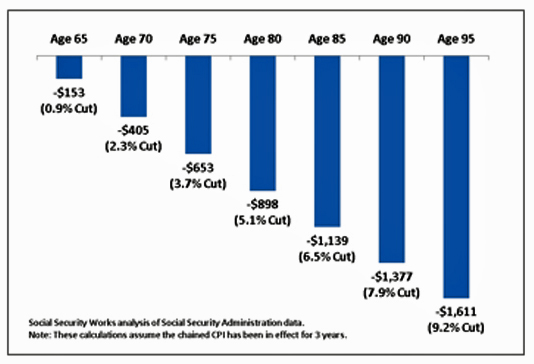
What would so-called chained-CPI do?
Bold Progressives offers a picture.

Besides using "technical" obfuscation to disquise a cut to benefits, cutting Social Security is an injustice. Social Security does not add a dime to the deficit. This idea is a myth propagated by people who don't want to pay taxes for things they do like, such as wars and the Border Patrol.

The Prez is buying a crock here.

Monday, January 14, 2013

What to do about Social Security?


It's all a lie: the idea that there's something terribly wrong with Social Security, and that paying for it is putting the country in hock, and that it won't be there for young people anyway is just propaganda from the system's enemies. Remember the Republican prescription for health care reform: just die. The same goes for growing old without sufficient income.

Social Security is fully funded by our past taxes through 2033 (2012 estimate) and will be funded longer if the economy ever recovers and more people start paying in. Even if nothing is done about projected shortfalls (that may or may not be of the scale estimated) the system can pay 75 percent of benefits through 2086.

But there's a possible significant tweak that seldom gets discussed but ought to be the first direction to look to ensure Social Security remains solvent. We can raise the cap on the amount of income on which we pay SS taxes. Nicholas Beaudrot explained this so succinctly and clearly that it seems worthwhile to pass along here.

Social Security is paid for through payroll taxes. For every $1 of wages or salary, $0.062 is withheld as social security, so the worker only sees $0.938 today (though they'll get paid back, in essence, through Social Security wages when they retire). But, this only applies to the first $110,000 or so in income, though that threshold is adjusted every year for inflation. Historically, the payroll tax cap has meant that about 90% of income is subject to social security taxes, but the explosion in inequality over the past generation means that the tax covers only about 84% of income. Taxing the first $200,000 or so in income would get us back to the historical 90% threshold while still mostly preserving the "you get out what you get in" nature of Social Security, which is a big reason for the program's political stability.

If politicians aren't open to raising the cap, they aren't interested in fixing the system. They just are pretending to worry about budgets and debt in order to gut supports for old people. I'd make raising the cap a litmus test for all of them.

Monday, December 31, 2012

A nice fantasy for the New Year

Obama pops the cork.jpg
As I write, the "fiscal cliff" talks seem to have collapsed. Maybe those guys in Washington will put them together again, maybe not. I can't bring myself to care.

The realities of the situation remain the same: government has certain necessary tasks that it must perform for the common good. We argue about what those tasks are, but in the last election the majority of the people rendered some clear direction:
  • The government should support job creation in every way possible;
  • The economy should be made to work for ordinary people, not just for vulture capitalists;
  • Elders should retain access to affordable health care through Medicare and there should be no cuts Social Security;
  • Education should be accessible to young people who want it.
  • We expect government to provide a safety net for people who have been crushed by an under-regulated economic system that privileges greed.
  • No more dumb wars.
All these items except the last cost money. Roughly speaking, the policy of President Obama and the Democrats is to get the money for the government to do its job from the people who have the money -- that is, from rich people. It is the policy of the Republicans to put the government out of business. We rejected the latter option.

For the moment, the Prez and his fractious Democratic partners seem to be hanging tough, sticking up for the people who put them in office. The fantasy is that Dems will stay the course. The degree to which they do so will depend on how much heat they feel from constituents. We can't let up on them -- that's my fantasy for the New Year.

Friday, December 21, 2012

Move-On is moving


President Obama -- stand up for people who need Social Security, Medicare, and I'll add Medicaid!

This is a tough ad. Let's help get it out there.

Wednesday, December 19, 2012

What Barack Obama's pet accounting gimmick would do to us

CPIchartlarge-web.jpg
Here's the answer in one chart; the fine print points out this starts from the "Chained CPI" standard being in place for three years. So if you are, say, currently 62 and plan to take Social Security at 65, this is your future.

Why is Obama willing to give this to obstructionist Republicans? Damned if I know. If he does give it in the course of current fiscal negotiations, he better explain the truth: both Democrats and Republicans are signing on to force 90 year old ladies to get by on cat food.

Tuesday, December 11, 2012

Urgent messages for a December evening

elders want country back.jpg
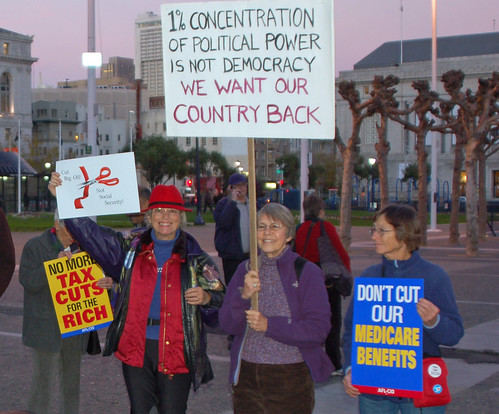
A small group of citizens assembled on Monday night in San Francisco Civic Center to wave signs urging our Congressional representatives to shun the austerity bluff, tax the rich, protect Social Security and Medicare … that is, do what we elect them to do. The event was called by the AFL-CIO, Move-On, our faithful single payer agitators among others. It drew about 100 people, most of them old enough to have a personal stake in the safety net for elders.

2 louis vitale:tim paulsen
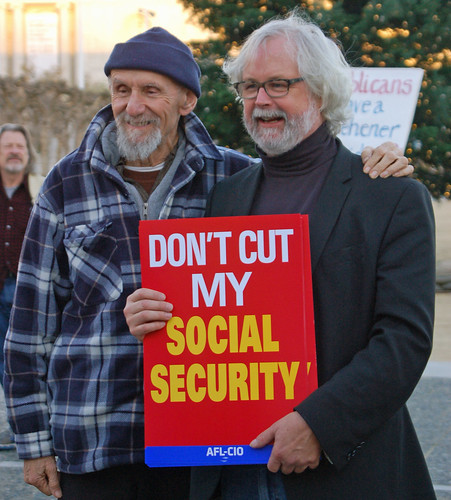
Fr. Louis Vitale, who spends too many of his days in prison for impeding US wars, posed with Tim Paulson, Executive Director of the San Francisco Labor Council.

3singing-Dems-elections matter
Several singers formed a small chorus.

4be brave-don'tcave-sad
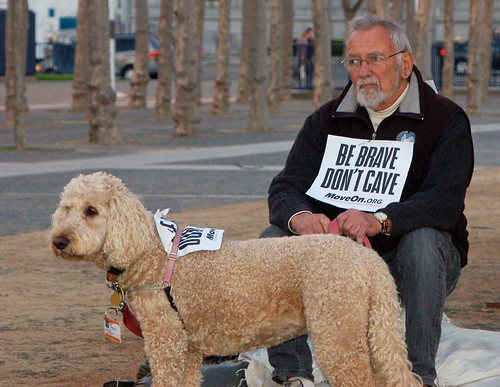
Watching our rulers dither, it's hard not to fear they'll let us down -- again. This gentleman and his dog expressed a common sentiment: Don't Cave! It's easier to be upbeat when the sun shines.

Tuesday, November 27, 2012

Strengthen Social Security: don't cut it!


With the New York Times leading off today with an article about how nasty liberals won't let the newly re-elected Prez slash Social Security and medical programs for the poor in order to please the plutocrats, I guess it is time to trot out this excellent video. Short, snappy and true. (H/t TGB.)

Now we reach the long part of the political cycle in which the voters who put these bums in office have to loudly and persistently remind Democratic officeholders why we put them there: to use government to promote the general welfare. At least that's what the Constitution says. What's so complicated about that? Not welfare for oligarchs, but the common good of all of us, most of whom need a little help sometimes.

What's difficult is that, after an 18 month election season which pummeled those of us who engaged to a pulp, we have to get back out there and scream bloody murder to prevent the politicians we elect from forgetting their job.

In the 1960s, we said we wanted "participatory democracy." And this sounds like a desirable thing. But we weren't always ready to do the unglamorous work of building and controlling the institutional props that make winning the general welfare possible. There were good reasons many chose to "drop out": being forced to fight and die in a pointless imperial war while observing the gender and racial hypocrisy of our elders prompted an understandable withdrawal. But the result was that for a generation the deal-makers and the careerists hollowed out the institutions in which progressive democracy is practiced: the unions, the think tanks, the Democratic Party.

The emerging majority -- what pundits are calling the "Obama coalition" including the young, the colored, the well-educated -- are taking back those institutions and building new ones. But winning and keeping a place in the push and pull of citizenship is a perpetual fight. The prospects for enduring victories remain tenuous.

The plutocrats don't rest (and they can always hire willing servants.) We can savor our wins but dropping out is not an option.

Friday, December 30, 2011

This is what a political opening seized looks like: New Deal history

At this time of year, I'm always tempted to announce the book I've enjoyed, or admired, or learned most from over the past year. Some years, I resist this silly temptation, but today I won't. My "Best Book" for 2011 was Stanford historian David M. Kennedy's Freedom from Fear: The American People in Depression and War, 1929-1945.

Thinking about possible choices, I was a little surprised to realize that several grand historical surveys had made the greatest impression on me. This is not how history is supposed to be written by "serious" historians; most academic history digs into a niche in past time, striving for accurate description of details we can never fully know, often getting lost in minutia. Grand sweeping tomes seem excessively ambitious, a dangerously pretentious over-reach. One of the attractions of Kennedy's book is that he dared to chronicle such a long and episodically diverging period and got away with it. At the very least, it would have been possible to envision quite separate volumes about domestic concerns from 1929-39 and the World War II years that followed. But he makes them feel a single epoch, just as they were lived. I was often awed by how gracefully he wove in all the themes that a contemporary historian wants to be sure to include -- women's experience, the implications on events of the country's historic racism, the tiny gay minority who occasionally stuck their heads up in this period. This is not easy as the records were created and left by others.
***
Over time I'll pull other tidbits from Kennedy's opus to try to get perspective on our own times, but right now I want to share the most significant insight I took away from this volume: Franklin Delano Roosevelt's New Deal program was not only an effort to restore employment to pre-Depression levels; he was out to change and stabilize the country's economic and political realities much more broadly. Here's Kennedy explaining:

Why did [Roosevelt] reject Roy Howard's [a newspaper chain owner] counsel that "there can be no real recovery until the fears of business have been allayed" and instead insist on gratuitously provoking business and thickening its anxiety? Those questions elude easy answers if… one assumes that economic recovery was Roosevelt's highest priority. But if one recognizes that lasting social reform and durable political realignment were at least equally important items on Roosevelt's agenda, then some of the mystery lifts.

I report that and think -- well, isn't that obvious? No it is not. Neither Barack Obama nor his critics seem to be responding to the Lesser Depression with this level of ambition. The 2009 stimulus and subsequent muddled economic pump-priming are aimed at restoring the status quo from before the bubble of the 00s, not rebuilding something stronger, fairer and better. Pressures -- the 99 percent movement and acknowledgment of rising inequality -- are mounting, but there's no sign that elites yet feel they have no choice but to encourage a new plateau of stability.

It's worth following Kennedy's description of how Roosevelt moved from plugging holes as banks collapsed in the first days of his administration to pushing through a program for long term economic stability. A significant feature was something we're not even considering these day: there was a great mass of people for whom the Depression was nothing new, just as the Lesser Depression is today, though since Bill Clinton we've learned not to even mention the perennially poor. Eleanor Roosevelt's reporter friend was sent out to chronicle life in the country outside the bright lights of the big cities -- Washington could do with some of that today.

As Lorena Hickok's travels progressed, she gradually came to acknowledge the sobering reality that for many Americans the Great Depression brought times only a little harder than usual. … The "old poor" were among the Depression's most ravaged victims, but it was not the Depression that had impoverished them. They were the "one-third of a nation" that Franklin Roosevelt would describe in 1937 as chronically "ill-housed, ill-clad, ill-nourished." By suddenly threatening to push millions of other Americans into their wretched condition, the Depression pried open a narrow window of political opportunity to do something at last on behalf of that long-suffering one third, and in the process to redefine the very character of America.

It took elites awhile, as it has since the financial panic of 2009, to understand that this wasn't just a temporary economic hiccup.

[The President's advisor Harry] Hopkins himself was soon speaking of workers who had passed into "an occupational oblivion from which they will never be rescued by private industry. . . . Until the time comes, if it ever comes," he argued, "when industry and business can absorb all able-bodied workers -- and that time seems to grow more distant with improvements in management and technology -- we shall have with us large numbers of the unemployed. Intelligent people have long since left behind them," Hopkins continued, "the notion that. . . the unemployed will disappear as dramatically as they made their appearance after 1929. . . . For them a security program is the only answer."

In response to gathering pressure from the left (LaFollete, Sinclair Lewis, unions and Communists) and the right (Father Coughlin and Huey Long) Roosevelt pushed through what we think of as the New Deal in the second two years of his first term.

The unifying design of that program took different forms in different sectors of the nation's life, but the overall pattern of the Second New Deal taking shape in 1935 was becoming clear. In the social realm, the dominant motif was security; in the economic realm, regulation (which was security by another name); and in the physical realm, planned development. In all those domains the common objective was stability. No other aspiration more deeply informed the Second New Deal, and no other achievement better represented the New Deal's lasting legacy. Roosevelt now sought not simply recovery, nor merely relief, nor even the perpetual economic growth that would constitute a later generation's social and political holy grail. Roosevelt sought instead a new framework for American life, something "totally other" than what had gone before…, something that would permit the steadying hand of "that organized control we call government" to sustain balance and equity and orderliness throughout American society. Roosevelt's dream was the old progressive dream of wringing order out of chaos, seeking mastery rather than accepting drift, imparting to ordinary Americans at least some measure of the kind of predictability to their lives that was the birthright of the Roosevelts and the class of patrician squires to which they belonged. …It was a dream now brought within reach of realization by that same Depression and by the sense of possibility and the political fluidity it induced.

Will the country ever get there again?
***

"Honorable mentions" for 2011's "best book":
Paris 1919
Empire of Liberty
In hard times, history comforts. Somehow our forbears muddled through; we might too.

Friday, December 16, 2011

Social Security at risk: now and then

Yesterday the New York Times published an unusually lucid description of the danger to the Social Security program that lurks in the plan to extend last year's emergency cut in the payroll tax. People who care about old people having enough to eat need to understand what's going on.

Critics predict one extension will lead to another as politicians balk at raising taxes to their former level, especially if unemployment remains high.

“Imagine that next December the unemployment rate is 8 percent and a year later it’s 7.4 percent,” said Robert Reischauer, a former director of the Congressional Budget Office who is one of two public trustees for Social Security. “We’ll still be trying to stimulate employment and terminating the payroll tax holiday will be a big hit on most families, one that will hurt job growth.”

Democrats fear that repeated extensions would disrupt the link that President Franklin Delano Roosevelt forged to lock in support for Social Security: with workers taxed for their benefits, politicians would not cut them. And Republicans object that transferring general revenues to Social Security to offset the tax cut makes the program more like welfare, and worsens the federal budget deficit.

Politics aside, the bottom line is that a temporary tax cut is inconsequential to Social Security’s long-term health, from an accounting perspective. The threat remains the financial pressure of an aging population.

Social Security is essentially a pay-as-you-go system, with payroll taxes from workers flowing back out to retirees, survivors and the disabled. Last year, before the tax cut, the system for the first time since 1983 collected less in taxes than it paid out to 55 million beneficiaries — $49 billion less.

The program’s operating deficits will grow as more of the 78 million baby boomers become eligible. But trust fund reserves built up over years of annual surpluses will not run out until 2036, when tax revenues will cover three-quarters of benefits, trustees project.

***
David M. Kennedy's monumental history of our country in the middle of the last century, Freedom from Fear: The American People in Depression and War, 1929-1945, makes it all too clear that winning and keeping a Social Security program for elders has always been a struggle. His description of the legislative history put me in mind of the contemporary fight over Obamacare.

No other New Deal measure proved more lastingly consequential or more emblematic of the very meaning of the New Deal. Nor did any other better reveal the tangled skein of human needs, economic calculations, idealistic visions, political pressures, partisan maneuverings, actuarial projections, and constitutional constraints out of which Roosevelt was obliged to weave his reform program. Tortuously threading each of those filaments through the needle of the legislative process, Roosevelt began with the Social Security Act to knit the fabric of the modern welfare state. It would in the end be a peculiar garment, one that could have been fashioned only in America and perhaps only in the circumstances of the Depression era.

If we weren't watching Republicans challenge what looks like an inadequate, jerry-built new health insurance reform law in the Supreme Court, we wouldn't be able to imagine how much the shape of the 1935 law was set by trying to avoid having the plan declared unconstitutional.

Taking his own measure of "the prejudices of our people," Roosevelt clearly intended to establish his social security system not as a civil right but as a property right. That was the American way. The contributory requirement enormously complicated the planners' task. "What in the world," [Thomas] Eliot [the staff attorney writing the bill] asked himself, "could be devised to carry out the president's wish for a contributory old age insurance program that would pass judicial muster?" The president's insistence that workers themselves should contribute to their own individual old-age pension accounts through a payroll tax seemed to offer an open invitation to judicial nullification.

The result was intrinsically regressive: for the people who could least afford it, those with the lowest wages, Social Security taxes amounted to the highest percentage bite out of their take home pay. That discrepancy lingers today in the cap on the amount of income taxed for Social Security; people earning over about $108000 annually stop paying into the fund at that amount. The rest of us pay on every dollar of wages. Roosevelt understood he was creating a less than fair system.

"No dole," Roosevelt emphasized, "mustn't have a dole." "No money out of the Treasury," he declared on another occasion. He understood as clearly as any the inequity and economic dysfunctionality of the contributory payroll tax, but he understood equally those "legislative habits" and "prejudices" about which [Labor Secretary Frances] Perkins had reminded the CES. "I guess you're right on the economics," Roosevelt explained to another critic some years later, "but those taxes were never a problem of economics. They are politics all the way through. We put those payroll contributions there so as to give the contributors a legal, moral, and political right to collect their pensions and their unemployment benefits. With those taxes in there, no damn politician can ever scrap my social security program."

The political history of Social Security is instructive and fascinating. The issue of maintaining our legal, moral and political right to old age assistance from the federal government is still alive today as Republicans repeatedly float plans to hand our security over the Wall Street.