Showing posts with label state violence. Show all posts

Wednesday, March 29, 2023

Police protect and serve themselves and their institutions


The Los Angeles Times has produced a devastating report about how police are trained to interrogate family members of people they have killed, looking for derogatory information that will defend against, or lower payouts, in any wrongful death lawsuit.

Here's just one example among many the report includes:

Julie and Rick Perez unwittingly offered up a golden statement when a detective from the Richmond Police Department and an investigator from the district attorney’s office knocked on their door at 4:20 one morning in 2014. A few hours earlier, an officer in the Bay Area city had fatally shot their son.

When Julie Perez asked if her son was in trouble, the investigator said, “I’m going to get to that in a second,” according to a recording of the encounter first published by KQED.

The investigator launched into a series of questions about their son. Did he use drugs? Did they have a good relationship? Did he have problems with the police? Did he have “demons to conquer?” Unknown to Julie and Rick Perez, the investigator and the detective were secretly recording their responses.

“We’re not trying to trick you or nothing,” the investigator told the increasingly agitated parents.

“I hope he’s not in big trouble, and I wish you guys would get to the punch line,” Rick Perez said 10 minutes into the interview.

“I don’t know how to say this,” the investigator said.

Rick Perez finished his sentence: “You guys shot him.” 

When the couple filed a lawsuit, it became clear that the city intended to defend itself by focusing heavily on what they and other family members had disclosed to investigators. The thought of having their family’s worst secrets and darkest moments spilled in open court was a factor in the family’s decision to settle with the city for $850,000. 

It turns out, cops-in-training are taught that their first job, after an officer kills someone, is to extract whatever they can from friends and relatives that would be derogatory about the dead person. There's a company, Lexipol, which many California departments contract with for training, that specializes in getting this message across. A former cop and lawyer named Bruce Praet teaches new officers how to avoid responsibility. 

In an online training seminar reviewed by The Times, Praet instructs detectives to approach a mom before she learns her son has just been killed by police: “You got about five, 10, 30 minutes to get out there before word gets back on the street — that bad guy is either in the hospital, dead, jail, whatever.”
... In one seminar highlighted by [Joanna Schwartz, a UCLA law professor], Praet recommended that officers who use force against people in mental health crises should describe them in their reports as appearing to be on drugs because “jurors don’t like druggies.”
In another seminar, Praet showed off a police photograph of a man who had just been mauled by a police dog. He noted with approval how the police photographer had posed the man with his arm draped over the police dog while smiling and flashing a gang sign. “That was Exhibit One in the lawsuit, guys.”
Ninety-five percent of California law enforcement agencies use Lexipol for training according to the Times.

Departments that choose to train officers this way make the case for "defund the police." This isn't about safety for the community; it's about safety for cops. Ban contracts with Lexipol.

Sunday, May 31, 2020

The anger doesn't go away; nor do the outraged

Solidarity or prudence? Hard to know. Valencia Street was already fully boarded up by the coronavirus, but the slogan is new as of this morning, May 31.

I like to think that my neighbors by and large understand the righteous anger of protest against police impunity. But I also remember that five years ago, our own police department carried out a public execution of a cowering black man by firing squad. No officer suffered any consequences.

It feels strange not to be out among the people in the streets. This is the first occasion since 1965 when I haven't at least cautiously run in the fringes of what is called "civil unrest." But I'm too old, too slow, and too scared of COVID-19 this time. I don't like this, but it's okay. There are plenty of young people striving to be heard. We don't listen as a society until forced to -- and there are almost always too many casualties when demanding the attention of people whose power can make a difference. Some of what we do is dumb, but that too is part of the long struggle.

Stay safe out there.

Thursday, July 18, 2019

Offshoring our concentration camps

The Trump administration would like to turn Guatemala into an open air prison for Central American asylum seekers. Johnathan Blitzer explained at the New Yorker that:

... the Trump Administration is expected to announce a major immigration deal, known as a safe-third-country agreement, with Guatemala. For weeks, there have been reports that negotiations were under way between the two countries, but, until now, none of the details were official. According to a draft of the agreement obtained by The New Yorker, asylum seekers from any country who either show up at U.S. ports of entry or are apprehended while crossing between ports of entry could be sent to seek asylum in Guatemala instead.

We have such an agreement with Canada -- asylum seekers who somehow get to Canada are deemed to be in a safe country and so are almost always ineligible to apply for asylum in the United States.

But Guatemala?

In addition to the fact that many of the current wave of asylum seekers are running away from danger in Guatemala, that country is designated as very dangerous indeed according to the U.S. State Department's own travel advisory system.

Violent crime, such as armed robbery and murder, is common. Gang activity, such as extortion, violent street crime, and narcotics trafficking, is widespread. Local police may lack the resources to respond effectively to serious criminal incidents. 

The whole country is labeled "Level 2: Exercise Increased Caution." As for the capital city and airport, it's even worse: "Level 3: Reconsider Travel."

Now obviously, no U.S. court would approve such a travesty of justice as allowing this phony "safe country" designation to stop asylum claims by migrants at the border?

Perhaps so. But people better versed in the law than I at Rational Security assert that the determination of whether a country is really "safe" is reserved under U.S. statutes to the sole authority of the Attorney General. And we have ample evidence that the current Attorney General is a Trump toady.

The Israelis have Gaza for their open air prison for Palestinians; apparently we're aiming to replicate that in Guatemala.

And the administration aims to coerce Mexico into another phony "safe-country" deal. Will Mexican nationalists resist? They often have in the past, but we'll see.

Sunday, March 17, 2019

More in response to the Christchurch massacre


Christopher Dickey, a veteran foreign and war correspondent, is The Daily Beast’s World News Editor. Located in Paris, which has suffered so much terrorism, he brings a clear-eyed perspective to the atrocity in New Zealand.

At the end of the day, and as difficult as the task may be, the war on white nationalist terrorism must be fought as a war of law enforcement and a war of ideas.

Police and prosecutors loyal to democratic values have to pursue investigations into white nationalist groups with the same zeal that has been applied to radical Muslim terrorist organizations.

Voters in Western nations have to understand that the fellow travelers of white nationalist terrorism are not acceptable participants in modern democracies, and vote them out, or see that they are prosecuted, or both.

The Daily Beast

This is both true and very difficult to take in for people of the liberal left who are accustomed to having to struggle to contain "law enforcement" authorities who too often use their access to force to terrorize and oppress vulnerable communities. Even here in oh-so-progressive San Francisco, vile racist and homophobic texts among police officers have emerged into public view. "Officer Friendly" is hard to imagine. But we need her.

To contain the lawlessness of white nationalism, we need active counter-intelligence, cops, and courts. That means demanding that law enforcement come through for democracy. It means supporting whatever law-respecting professionals exist in that system who understand their job is protect all the people, not just the white ones. There isn't any other way. (And by the way, this is also what some of us said and thought in the awful wake of 9/11. That would have made for a safer world.)

As for the "war of ideas" -- that's harder for me to think through. White nationalism doesn't strike me as having any intellectual content except fear, transparent misinformation, and gooble-de-gook created by bigots to disguise how vacuous are their prejudices. I'm not going to invest brain cells in understanding the fables of some French novelist who is selling "replacement" of the white race by Muslims (presumably African?) or those of flim-flam man Steve Bannon. There's no there there.

All this makes me glad that somebody somewhere, including EP, is teaching students to think critically. Kudos to all teachers who do that vital work day after day.

Wednesday, August 09, 2017

It's all about fighting for LIFE

Sometimes we activist oldsters wonder who is going to carry the load as we drift off into retirement. Our friend Renee Bracey Sherman is sure doing the job, struggling for justice on multiple fronts and bringing struggles -- women, black people, male people -- together. We can trust her to her to carry the work beyond what her courtesy aunties had yet been able to envision. In today's New York Times, she's published a stinging, truthful opinion piece:

The Right to (Black) Life
... If we choose to have an abortion, we are cast as villains by anti-abortion campaigns that tap into the trauma of our country’s racial history. Outside of clinics, I often hear protesters shout racial slurs and say things like “unborn black lives matter” when black people walk past them.

This isn’t new. Anti-abortion activists have long said that the most dangerous place for a black child is in the womb. They believe that abortion, not police brutality, is the civil rights issue of our time.

But we are stereotyped and called welfare queens if we choose to continue a pregnancy we cannot afford. In addition, black women are ostracized for having children “too young” and for having kids that society deems “illegitimate.”

Then, regardless of the life we provide for our children, if they are killed by police officers, our parenting decisions will inevitably be criticized.

From conception until death, damned if we do and damned if we don’t. ...

Read it all.

Sunday, May 28, 2017

Too much violence ...

Last Friday night, the motley community of people who have invested themselves in seeking some sanction for the San Francisco police officers who killed young Guatemalan immigrant Amilcar Perez Lopez with six shots to the back gathered on Folsom Street near where he was shot. Perez Lopez died on the 26th of February 2015; we plan to return to the site every 26th of the month for the foreseeable future. If we achieve nothing else, we will remember that, despite the thumb in their favor on the law's scale, cops should not be empowered to kill just because they get heated or maybe feel afraid. Police impunity is simply wrong and shouldn't require commissions, and investigatory bodies, and debates about procedures, and all the paraphernalia of bureaucracy for our city leaders to take a stand against police killings. And it's obvious the color of who continues to die by police bullets; the Mission has seen three police shootings of Latinos in the last three years.

Saturday morning I woke to the news that an angry white man spouting hate on a Portland commuter train had killed two men and injured another who had interrupted his threats to two young women of color, one of whom was wearing a hijab. Presumably the killer was somehow nuts -- he apparently tried to commit suicide by cop by taunting police who surrounded him after the crime. But the killer lives and is in jail facing charges and psych eval today. Apparently he was known to Portland police as a white supremacist and neo-Nazi enthusiast who had threatened violence at demonstrations.

To my surprise, I was heartened by seeing this video of the Portland police spokesperson explaining the little they knew last night about the crime on the train. Unlike our cops, he's not some defensive, awkward commander decked out with medals and weapons who speaks only stilted legalese. I don't know if Portland police have practiced acting like humans when confronted by trauma, but I do know that our cops could take some lessons in communicating. Watch a few minutes if intrigued.
The Portland horror felt close to home. Not long after the election, one of EP's students reported that she'd been riding on BART when a man started harassing a woman wearing a hijab. That student sat down next to the victim and then got off the train with her, even though neither was at their intended stop. It feels as if the violence is all around, as if demons had been loosed.

And then there's the Republican congressman from Montana who responded to a question about the effects of the GOP Trumpcare bill by body-slamming a reporter ...

Meanwhile, sage military reporter Thomas Ricks is book touring Churchill and Orwell: The Fight for Freedom. (Will write about this soon enough.) He told the Foreign Policy podcast that these times remind him of the 1850s when this country, unable to resolve its conflict over slavery within the Constitutional governing structure, drifted from violent outbreak to greater violent episode as prelude to civil war. I've explored this parallel before. Ricks went on to point out that police are killing nearly 1000 people each year; this statistic was collected by the Washington Post. Though numerically most of the dead are white, Blacks are 2.5 times more likely to be shot by police, considering Blacks 13 percent share of the whole population.

For a country ostensibly at "peace," there's a lot of violent death happening here ...

Sunday, February 12, 2017

Organizing with grit, integrity, and vision


The PICO National Network of faith-based community organizations, which claims a presence in 150 cities and 17 states, has a Live Free component that has been building local struggles against mass incarceration and violence inflicted on communities of color.

By happy accident, I found myself in a Live Free convening last week. In anxious times, it was great to be among tough, experienced, determined new friends working in directions which we all need.


These folks aspire to be a "prophetic resistance." We were treated to a reflection by Doran Schrantz from ISAIAH in Minnesota that dared to ask what "moral genius," if any, might reside in these Disunited States. She proposed:

  • "Moral genius" means never to pretend to reconcile what cannot be reconciled. There can be "no exceptions. Democracy cannot be reconciled with white supremacy. You cannot build a free people on lies."
  • Moral citizenship is about picking up "the bedraggled promise of freedom, of equality."
  • Moral citizenship demands that we "root out every practice/law/etc that asserts that some are more equal than others.
  • We have inherited this contradiction: we have to decide to live with being Americans and accept that we live within the American contradiction. Our hands are going to be dirty. But there is only the complicated struggle of collective action.

PICO has not always been known for "playing well with others" -- for being willing to work cooperatively alongside other community actors. In today's broad resistance moment, leaders and organizers stressed that going it alone would not be enough, even though coalition can be hard, scary.
  • "We are not living in the same kind of organizing environment as before. It doesn't feel like a democracy anymore. Organizing will be different."
  • "We have to build a bigger tent ..."
  • "Organizing works. Does it make room for new people? Does it have room to learn? Nimble is good."
  • "We can no longer win by ourselves ..."

Taking the fight into the electoral arena was considered essential. "Political involvement is not optional." That's tough to sell when people don't believe they can make a difference, but what else is organizing for but to help people find their power?


"Some of us have been made for this time... Be the storm ... Raise up our own prophets of resistance." "Our faith has to exceed our belief ..."

All of these admonitions speak to me.

Quotations are my hasty notes, as accurate as I could make them.

Monday, July 18, 2016

James Lawson describes bringing a nonviolent struggle for justice to scale

We need this after the last two weeks and the probable next two weeks with the GOPers in Cleveland -- and who knows where else? Violence is the air we breathe and is the force that crushes so many in this United States of faltering imperial and capitalist dominance. Yet smart, disciplined, and hope-filled non-violent struggle is also the peoples' antidote to the daily poison.

In 2010, the School of Authentic Journalism brought Reverend Lawson to the Autonomous University of the Yucatan in southern Mexico to share his experience building the non-violent Nashville civil rights movement with Mexican and other international campaigners. His hearers testify that he both educated and inspired.

Sunday, July 10, 2016

Toxic times, part 2

There's a lot of nonsense in published reactions to the violence of the last week. A commentator has to be really graceful to say anything helpful. New York Times columnist Charles Blow has accomplished this feat in A Week from Hell. He's both personal and a little olympian.
I feel numb, and anguished and heartbroken, and I fear that I am far from alone.

... Will the people who can see clearly that there is no such thing as selective, discriminatory, exclusionary outrage and grieving when lives are taken, be heard above those who see every tragedy as a plus or minus for a cumulative argument?

Will the people who see both the protests over police killings and the killings of police officers as fundamentally about the value of life rise above those who see political opportunity in this arms race of atrocities?

... The moment any person comes to accept as justifiable an act of violence upon another — whether physical, spiritual or otherwise — that person has already lost the moral battle, even if he is currently winning the somatic one.
It's an excellent column. Charles Blow knows about violence. He's not some ivory tower moralist. The column is totally worth reading.

But can we really think about the violence that permeates our everyday life without mentioning the violence of our perpetual wars on other people's countries? That has to be part of this conversation. We inflict death and destruction on human bodies every day -- "over there," wherever "over there" is at a particular moment.
Tomahawk missile strikes. US Navy photo.

Saturday, July 09, 2016

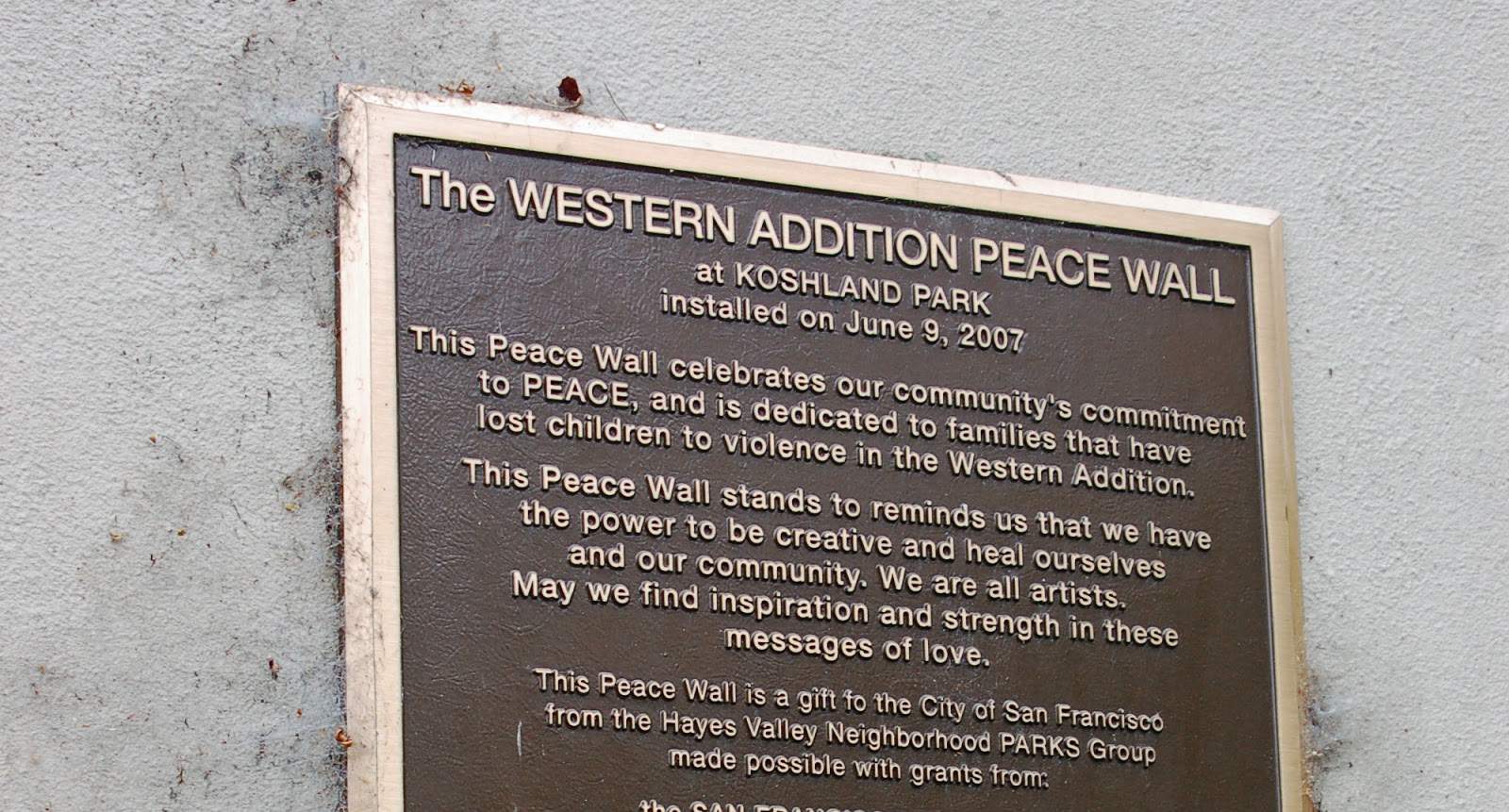
Saturday scenery: Western Addition peace park

After this week that saw the police killings of Alton Sterling in Louisiana and Philando Castile in Minnesota capped by the sniper shootings of five Dallas cops working a peaceful anti-police violence procession, here's how one San Francisco neighborhood responded to local violence in the last decade.

Community residents got grants to design tiles in memory of children lost to violence in this gentrifying enclave next to some of the city's least picturesque public housing.

Some of the resulting "art" seems trite.

But some tiles are challenging ...

... some topical ...

... some childish in the best sense.

Girls Scouts from the Chinese-American school contributed.

Several hundred feet of retaining wall carry the tiles.

There's nothing easy about peace.

All encountered while Walking San Francisco.


Sunday, June 26, 2016

Cross currents

San Francisco pols led by Mayor Ed Lee make a quick exit when booed off the stage at the Trans March. Photo from Mission Local which has the full story.
Some disturbed character (self-hater, terrorist, nutcase, frustrated male, who knows?) massacres 49 queers in an Orlando dance bar -- I guess it might be a good year to show up for the community at the San Francisco Gay Pride parade.

But the parade is just a corporate extravaganza, an opportunity for Google, Facebook, Apple et al. to showcase "liberalism" while they continue to overwhelm the city in all its quirky diversity.

But the parade theme this year is "For Racial And Economic Justice" -- the committee did something right for once.

But in the name of security, police and FBI are surrounding the events with metal detectors and snipers on roofs.

And Black Lives Matter Bay Area, St. James Infirmary, and TGI Justice Project have pulled out of the festivities -- those cops kill poor people of color, after all.

But the Soul of Pride contingent organized by folks from Justice for Mario Woods is calling for all the anti-police violence campaigners from Justice for Alex Nieto, Justice for Amilcar Perez Lopez, Justice for Luis Gongora Pat, and Justice for Jessica Williams to come along to inject the stories of these murdered San Franciscans into the parade ...

What's an old dyke to do?

I have probably worked 15 Gay Pride parades in my time: selling books, collecting signatures on political petitions, distributing propaganda, shouting out for Chelsea Manning ...

I think I'll give the big annual festival a rest this year. The cross currents are too many.

Thursday, June 02, 2016

Our occupying army and the community it fails to serve

A police chief is out, but San Francisco still has a police force that, over the last two years, has shot five people of color, (3 Latino men; 1 Black man, 1 Black woman) in circumstances that look like wanton murder. No officers have been brought to trial or even disciplined internally (as far as we are allowed to know -- see below.) In two other, separate, cases, racist text messages between officers have come to light. Something is rotten in the SFPD; the mayor can make promises, but words won't cut it. This militarized force acts like a hostile occupying army, instead of as protectors of the public safety.

And so, citizens have to keep up the pressure. Here Daniel English from Faith in Action and Fr. Richard Smith of Saint John Episcopal Church deliver a banner and signs to the ongoing Wednesday evening vigil outside the Mission police station. Activists and neighbors are demanding that District Attorney George Gascon bring the officers who shot Amilcar Perez Lopez to trial. Despite the autopsy evidence that Amilcar died from six shots in the back, the hope for a trial of the shooters seems a long shot. Since 2000, the SFPD has killed 40 civilians; no officers have been charged.
***
Meanwhile family members of the dead, their friends, and their communities are struggling to assert detailed demands for police reform that will have meaningful impact and a chance at success. With five recent victims, multiple political authorities at the city level with some jurisdiction over the police, and calls for outside investigations by both the state Attorney General and the federal Department of Justice, winning policy improvements seems a complex business that will probably proceed by fits and starts, if at all. The Police Officers Association stonewalls reforms. Cops feel under siege; perhaps they might be more secure if policy demanded they de-escalate rather than dominate.
***
Meanwhile, at the state level, craven Democrats (and most Republicans, but hey, this is California where Dems run the legislature) deep-sixed a police transparency bill that would have pried information about police encounters with citizens from secretive departments. The pols were scared to buck the police unions in defense of their constituents. It's worth contemplating the sort of information the bill sought to order departments to release -- and which aggrieved Californians are still barred from asking for from law enforcement agencies. Had this become law, citizens might have sought:

(A) A record related to the investigation or assessment of any use of force by a peace officer that is likely to or does cause death or serious bodily injury, including, but not limited to, the discharge of a firearm, use of an electronic control weapon or conducted energy device, and any strike with an impact weapon to a person’s head.

(B) A record related to any finding by a law enforcement agency or oversight agency that a peace officer or custodial officer engaged in sexual assault, an excessive use of force, an unjustified search, detention or arrest, racial or identity profiling, as defined in subdivision (e) of Section 13519.4, discrimination or unequal treatment on the basis of race, color, ethnicity, national origin, age, religion, gender identity or expression, sexual orientation, or mental or physical disability, or any other violation of the legal rights of a member of the public.

(C) A record related to any finding by a law enforcement agency of job-related dishonesty by a peace officer or custodial officer, including, but not limited to, perjury, false statements, filing false reports, or destruction or concealment of evidence.

If sworn "peace" officers are going to engage in these practices, it does seem we ought to know about it. In theory, they work for us. But apparently not.

Friday, May 20, 2016

NY Times fail

The New York Times duly headlines the forced resignation of San Francisco Police Chief Greg Suhr today. Nice that they notice the doings on the far left coast, I guess. But apparently their reporter has no sources more contemporary than former Mayor Willie Brown who left office in 2004 and his tame preacher sidekick, the Rev. Amos Brown.

Get a grip Timesman ... there are plenty of Black activists in San Francisco with more immediate, informed commentary on the rogue police department. And if you were paying attention, you'd know that the SFPD is just as trigger happy when encountering Latinos in the gentrifying Mission as Blacks in the Bayview.

Thursday, May 19, 2016

San Francisco's ineffectual mayor is "very uneasy"

A 27 year old Black woman is dead, shot by his police department in the Bayview this morning. She was driving a car they identified as stolen. When chased, she seems to have crashed the car. First accounts do not suggest that she did anything to threaten officers. The story will undoubtedly expand and may shift when investigated. In the absence of criminal charges against the shooters, it is impossible to tell which accounts of these shootings are truthful. This is the fifth shooting of a "suspect" of color who was in no position to harm officers in the last two years.

SFPD chief, Greg Suhr, will be called up upon again to perform his role as community punching bag for his trigger happy cops. The picture is from his last such performance, after the police killed Luis Gongoro Pat in April.

UPDATE: Suhr resigns. Lee claimed credit -- but would not promise a nationwide search for a professional replacement. Kudos to all who put pressure on the city. But we can't stop pushing.

Friday, April 22, 2016

People the city doesn't want are refusing to be silenced

On April 7, officers of the San Francisco Police Department shot and killed Luis Gongora-Pat, a resident of a tent encampment where people were living on the street in the Mission. Mayor Ed Lee responded to this outrage by calling for "sweeps" -- forcible destruction of the tents and belongings of homeless people all over the city. In the days after the Gongora's death, police harassed and dispersed witnesses and his neighbors from the encampment.

On Thursday, people with experience living on the streets spoke out in Clarion Alley on the city's ongoing effort to push them out of sight and mind.

Bilal Ali, Human Rights organizer for the SF Coalition on Homelessness explained:

Homeless and street-based San Franciscans have been surviving these ongoing sweeps for months and in some cases years. ... the city is continuing this failed police of displacement rather than listening to us homeless people as we state the logical solution to the growing crisis which is housing. Luis Gongora would still be alive had he been inside. Bottom-line.

Mike Lee brought news of sweeps in Berkeley where he lives on the street and is running for Mayor. He's an impressive orator.

Here seen laughing with a friend, Elaine (l), has been enduring street sweeps since 2010. She reminded listeners:

... we have forgotten what America is supposed to be about ... we're supposed to be about loving each other. ... give us a home and we'll show what love is about.

According to the Coalition on Homelessness, the city has only 1300 shelter beds, less than one bed for every five homeless people. And a shelter is not a home ...

Across Valencia Street, activist hunger strikers demanding that Chief Greg Suhr be fired set up camp in front of the Mission Police Station.

Monday, April 18, 2016

Help needed from the community

How about some help for the family of Luis Gongora-Pat, shot by the San Francisco Police Department last week? Justice4AlexNieto has set up a fundraising site.

They explain the need:

We have family authorization to carry out this fundraising effort. There are only two online donation efforts authorized: this one and a gofundme campaign by Asociación Mayab. We will continue to work closely with the family in San Francisco on preferred ways for support.

Funds will go towards:
- Financial support for the widow and children of Luis Demetrio Góngora-Pat
- An Oree Original Justice 4 Our Lives image $300
- One or two banners with artwork and flyers $100-200
- An initial t-shirt order $100
- Cost of setting up wordpress website for Justice4LuisGóngora $100

Mr. Gongoro's family has arrived from Mexico with the assistance of the Mexican government. That government has already sent a letter to the SFPD asking for a thorough investigation and for police to adopt alternatives to using lethal force. Today Luis' cousin sat in on a meeting with a sympathetic Supervisor and staff at City Hall, while other family members were working with the Mexican consulate.

The SFPD has to stop shooting first and stonewalling afterward.

Friday, April 15, 2016

Murder in black L.A.

A cinematic book that mostly shares the police view of Black-on-Black murder in Los Angeles might seen an odd choice for a reader struggling to respond to an epidemic of police shootings of Black and Latino men in my own city. But Jill Leovy's Ghettoside: a true story of murder in America is gritty reporting, worth reading even if from within a skeptical frame.

The title is what homicide cops call the Watts or South Central sections of the city. For ambitious officers, it is a career sink, a swamp of futility from which to escape as fast as possible. The homicide squad is even worse for ambitious cops; most murders are never solved, witnesses won't cooperate, and there aren't even proper desks and computers for the overburdened officers. Journalist Jill Leovy embedded with these officers for a decade and reports what she saw. Her book has the makings of a conventional TV cop show, following heroic detectives who overcome obstacles to get their man (or sometimes tragically not.)

And yet, Leovy is a diligent and thoughtful reporter of ghastly realities. She recounts the bottomless grief of mothers of the murdered; the precarious existence of scared young men on hard streets where being in a gang might seem a life preserver, till it isn't; and the gross stupidity and indifference of downtown law enforcement leaders, politicians, and the media that simply ignore ninety percent of killings of Black men. Her detective exemplars call most of the rest of their department "40 percenters" -- time servers willing to accept that only that fraction of murders lead to an arrest. They react in disgust when an outbreak of gang violence causes the brass briefly to flood their neighborhood with uniformed patrol cars, and to conduct hundreds of stop and searches and parole and probation checks -- but to make no arrests nor stop the murders. The emergency even forced detectives into their unaccustomed "ill-fitting blue uniforms."

Detectives disliked looking like patrol officers, since people were then less likely to talk to them. The uniforms added to the sense that the neighborhood was under siege, but did nothing to insert justice into it. The spectacle of Rick Gordon, one of the city's most effective investigators, compelled to play the role of blue scarecrow at the very moment when his craft mattered most was a microcosm of how police had long functioned in the United States: preoccupied with control and prevention, obsessed with nuisance crime, and lax when it came to answering for black lives.

I couldn't help but recall this description when standing amid a room full of blue-clad officers in the SFPD meeting on Wednesday where our cops tried to impose their story on their killing of Luis Gongora.

Leovy offers an historical explanation for how South L.A. became a killing ground where so many young Black men shoot each other. When Black people flocked to southern California in the Great Migration, the white convention of treating their communities as outside the rule of law came along with them.

Criminal law in the United States has always displayed a tendency to go through the motions. ... But where things got really bad was in the South. In that region's long, painful history of caste domination and counterrevolution lurks every factor that counters the formation of a state monopoly on violence. ... After the Civil War and Reconstruction, ex-Confederates murdered their way to control again ...

White conservatives favored legal systems that looked the part, but still achieved their racist intent -- a "winking" system that, by design, just went through the motions. Southern legal institutions appeared to observe constitutional due process, but real power was held outside the law. Getting away with murder was key to the white-supremacy project. Impunity is a stencil of law; it outlines a shadow system....

For blacks, this system meant being killable. Blacks were "shot down for nothing" by whites. But that was not all. They murdered each other too -- in fields, labor camps, and at Saturday night gatherings where there was "just so much killing going on." Their rates of death by homicide were similar to -- and at times higher than -- what they would be decades later in northern inner cities. ...

White people "had the law," to quote a curious phrase that crops up in historic sources. Black people didn't. Formal law impinged on them only for purposes of control, not protection. Small crimes were crushed, big ones indulged -- so long as the victims were black. ...

It might not seem self-evident that impunity for white violence against blacks would engender black-on-black murder. But when people are stripped of legal protection and placed in desperate straits, they are more, not less, likely to turn on each other. Lawless settings are terrifying; if people can do whatever they like to each other, there are always enough bullies to make it ugly. ... Beyond this, white people saw to it that solidarity among black people was kept at a minimum. ... For people of all colors, the South was stew of factors that produce homicide ... A flood of black migrants, schooled by the lawless South, swept into cities such as Los Angeles. They brought with them their high homicide rates and their tendency for legal self-help. The police they met were not unlike those back home. LAPD officers shot and killed many people and were free with their fists ...

But L.A. cops were different in important ways: there were more of them and they were a lot more intrusive. ... Southern black migrants were used to police who ignored them. But these cops were ever-present, hounding them with aggravating "preventive" tactics. [In the 1980s and beyond] the pendulum swung. ... Get tough policies became political winners. ...Since it is not the harshness of punishment but its swiftness and certainty that deters crime, black people still had good reason to feel unprotected. Murderers still went free, while the new crime suppression tactics bore more than a passing resemblance to the old Southern wink. ... Segregation, economic isolation, and the flawed workings of American criminal justice created the same conditions anew. ...

Having explicated this, Leovy sums it up as the thoughts of one of her cops: "the system looks busy, but it didn't do its job."

Ghettoside is a deep dive into the Los Angeles Leovy describes in this historical frame. For its immediacy and compassion for victims and shooters alike, it's worth reading. But I did wonder -- might maintaining a violent cage within which blacks will kill each other be the real job? The question seems obvious but unasked here.

Thursday, April 14, 2016

Still waiting for George Gascon

Wednesday evening a few supporters of Justice4AmilcarPerezLopez stood watch outside the Mission Police Station, to remind the District Attorney that we are still waiting for him to charge the two police officers who put six bullets in the young Guatemalan's back. We'll be back every Wednesday from 6-7pm until we hear from the D.A.

Wednesday, April 13, 2016

Many words, no news, or apology for police shooting

At midday on Wednesday, San Francisco Police Chief Greg Suhr posed with his departmental racial window dressing while answering most questions about the police killing of Luis Gongoro with a mumbled "I don't know..." The 45-dear old dead man was represented by his picture.

Community members were not appeased. In view of the short notice and difficult hour of the meeting, it is surprising that much of anyone turned up. Local District Supervisor (councilmember equivalent) David Campos pointed out that the cops had not even bothered to notify his office of the event.

Adriana Camarena from the Justice4AlexNieto coalition asked a series of pointed questions, most of which Suhr had no answer for.

Fr. Richard Smith of the Justice4AmilcarPerezLopez coalition repeated the implausible stories the police have told about that killing, most disproved by the autopsy showing the young Guatemalan died from six shots in the back. "How can we believe you on this case?"

John Crew, long affiliated with the ACLU's Police Practices Project, pointed out that policies supposed to curb unjustified use of force by officers had long since been adopted -- but somehow these shootings keep happening.

How many more will have to die before San Franciscans throw out these police thugs and the politicians who command and enable them?

Somebody, somewhere, stop them before they kill again

What to do when calling the police risks summoning a gang that shoots first and investigates, badly, later? That's the situation of San Franciscans these days. The SFPD has shot four men -- 3 Latino, 1 Black -- in the last two years. If any of these men had any weapon at all, and that's disputed by witnesses, they were no match and no danger to cops with rifles and pistols. But they are dead by police bullets.

This morning at City Hall, Public Defender Jeff Adachi called on California Attorney General Kamala Harris to take enough time off from campaigning for the US Senate to carry out a full civil rights investigation of the SFPD, in light of racist text messages among officers and a "pattern and practice" of disparate treatment of black and Latino residents.

Adachi insisted: "the system is working just as it is designed" to clear out poor residents of color for the new tech gentry. The gent in the gray suit watching from behind Adachi is District Attorney George Gascon who has, to date, failed to find any cause of legal action against any of the officers involved in the four killings.