Sunday, September 11, 2011

Enough killing

A time to reflect.jpg
My ATM tells me it's a day to reflect. Since we've learned of late that the banks are our masters, I'll comply.

On September 11, 2001, the accepted numbers for deaths are:
  • 246 on the four planes (includes hijackers)
  • 2606 in the World Trade Center towers
  • 125 at the Pentagon.
And then, we went to war in Afghanistan and things get a little harder to count. According to iCasualties
  • 1762 U.S. soldiers have died there and nearby
  • and 948 other NATO troops.
Nobody (except their relatives) much bothers to count dead Afghans. The U.S. and the Taliban accuse each other of causing most of the deaths. In 2009, Harvard professor Stephen Walt guessed civilian deaths numbered between 12000 and 32000. The rate of killing of civilians has only risen in the two years since.

And then, for no reason that had anything to do with the attacks of 9/11, but because unscrupulous men took advantage our impulse to seek revenge, we charged off the invade and occupy Iraq. Again according to iCasualties,
  • 4475 U.S. troops have died in Iraq
  • as well as 318 from allied forces.
There have been several international efforts to quantify Iraqi deaths subsequent to our invasion. There are vast discrepancies between the totals various researchers arrived at. Their estimates range from 150000 to about 1.5 million. The wide variation stems, in part, from whether we should count infants and elders who would have survived if the occupation hadn't led to the destruction of the Iraqi state's health, sanitation and other modern infrastructure. The invasion and occupation provided the spark for an Iraqi civil war; the lower figures disclaim responsibility for what we touched off.

There's somewhat less argument about the human displacement that followed on the invasion: more than one million Iraqis left the country and several million more became internal refugees. Very few of these people will ever be made whole.

Oh yeah -- this long orgy of revenge and death cost the United States several trillion dollars in debt and now we're arguing about how much to cut into the safety net for veterans, the poor and old people. The United States has indulged its worst self in a low dishonest decade. Enough killing already!

enough killing.jpg
My partner and I gave away these signs to anyone who would take one in the days after 9/11. I still see one every once in awhile.

Saturday, September 10, 2011

9/11 remembrance weekend

Who has a more immediate sense of the lessons of 9/11 than New Yorkers?


What keeps New Yorkers together? Maybe "... being too busy to care about being closed minded ..."

"Being tolerant isn't always easy, but it is right ..."


It's going to be a long weekend of flag waving and posturing, but I prefer to listen to these people.

Friday, September 09, 2011

Residue of 9/11

closed-paper-sign.jpg
Bathrooms are still locked in the parts of the Bay Area Rapid Transit system that run underground. Might be a bomb in there. No trash cans are allowed on train platforms either.

Osama bin Laden's murderous made-for-TV-movie has left us a more fearful, suspicious and generally ignorantly anxious society.

Successive administrations -- this doesn't seem to be a matter of political party -- have manipulated our anxiety to undermine our expectations of personal freedom under transparent, fairly applied laws.

September 11 was tragic in many ways, and it marked the beginning of the greatest decline in democracy in our country since the Japanese internment during World War II and the Red Scare of the 1950s.

It was the day we began to let fear erode our belief in our own system of government, with all its checks and balances and laws and treaties. Playing on that fear, our government began to operate outside the law and in the process destroyed many more lives than those lost in the attack.

Vincent Warren, Center for Constitutional Rights

We're in the international assassination business now.

Targeted killing poses an even graver threat to human rights and the international rule of law because the government claims the unchecked authority to impose an extrajudicial death sentence on people located far from any battlefield. In an actual war, the government's use of lethal force may be lawful, of course, but outside that context, the intentional killing of a civilian without prior judicial process is illegal, except in the narrowest and most extraordinary circumstances – as a last resort to prevent concrete, specific and imminent threats that are likely to cause death or serious physical injury.

Under the targeted killing programme begun by the Bush administration and vastly expanded by the Obama administration, the government now compiles secret "kill lists" of people who remain on those lists for months at a time – and so, by definition, cannot always pose "imminent" threats. And it has refused to disclose the legal criteria it uses to make its targeted killing decisions. There is no way for the American public or the world to know whether the targeted killing programme is lawful, let alone whether the people our government kills truly present an imminent threat to our nation. We do know, though, that in the decade since 9/11, the government has repeatedly labelled people as terrorists – including at Guantánamo – only for us to find out later, or for a court to find, that the government's evidence was exaggerated, wrong, or nonexistent.

Hina Shamsi, ACLU attorney, in the U.K. Guardian

In the words of an ACLU report Reclaiming Our Liberties (also linked in the sidebar for reference), successive administrations have stoked "the fear of terrorism to divide Americans by religion, race, and belief" -- must be those dangerous Muslims and creepy immigrants that are undermining our living standards.

Coupled with rapidly evolving and improving technology of surveillance and social control, we can only wonder when and under what perceived threat elites might advance from collecting our email, selling our data we give them on social networks, and surveilling our shopping behavior to using their more advanced toys to ensure "stability" -- that is, to forcibly further lock in their continued unchallenged enjoyment of inequitable wealth and power. They stole it fair and square and they aim to keep it.
***
Against all this, it's nice to hear an occasional voice of sanity, in this case from a BART director suggesting maybe it's time to reopen the bathrooms.

... Tom Radulovich said it’s time to rethink what he termed a “bit of an overreaction." Radulovich said that security has just become a convenient excuse for keeping them closed.

“Reading between the lines, it’s just that they don't want to pay to clean them,” said Radulovich. “I think that’s the real story, so they’re hiding behind this ‘Osama is going to use them to kill people.'”

Bay Citizen

This is one way fightback starts. Ridicule is often harder to contain than protest.

no-banos.jpg

Thursday, September 08, 2011

On effectual political pandering

When the President announced last month that immigration authorities should shift their enforcement priorities toward deportation only of people considered a security or public safety threat, it seemed a step toward a saner, more humane policy.

Obama_Latinos_Gallup_9-6.gif
It also seemed like a good idea for the President's re-election campaign, since he was losing the trust of Latinos who see their relatives and friends arbitrarily kicked out of the country. The chart shows the gradual fall in the President's approval among Latinos. He's sitting well under 50 percent, a cumulative fall of about 15 points in the last year.

The shift in immigration enforcement policy seemed designed to shore up Obama's re-election numbers and that's fine. That's what applied pressure is supposed to get people in a democracy. The bums don't like the idea of being thrown out.

But of course there's a bureaucracy involved, not to mention thousands of immigration cops whose practices and attitudes may not be quite so malleable as those of politicians. And so, lo and behold, cruel and unnecessary deportations are still the story for too many people.

[Roxann] Lara, originally from Delicias, Chihuahua, is five months pregnant and the mother of two U.S. citizen children. She is in the country illegally because she overstayed a visa. Her attorney says she’s the “poster child” for leniency under the June directive.

Instead, Lara was detained and processed by immigration authorities in Anthony, N.M., last week after she admitted to having expired documents when local police and U.S. Border Patrol agents came to the door looking for her sister.

It means the “left hand isn’t aware of what the right hand is doing,” said Carlos Spector, Lara’s El Paso-based attorney. "I think it’s important to note that this [directive] has not reached the lowest levels of ICE ... because [Border Patrol agents] are still picking up pregnant women."

...In Lara's case, Agent Ramiro Cordero said, the Border Patrol "did exactly what we were supposed to do. If the courts grant that person some type of legal document, then the system works." ...

Texas Tribune, September 7, 2012

Markos Moulitsas, proprietor of the Daily Kos political blog, who is decidedly not a poor immigrant scratching a living anonymously, explained why a cruel immigration policy cuts so deeply among Latinos, even those who are well established and politically active citizens.

Every time someone rails against immigrants, it's an attack on our very self-identity as Americans, it's an attack on our families, and it's an attack on our broader community. While jobs may impact the community more directly, rationally speaking, immigration hits us at an emotional level.

Elsewhere Moulitsas called the President's immigration shift "the good kind of political pandering." That's apt. Obama needs Latino support and he has to offer something to get it. But words without action aren't going to cut it.

The entire nation is likely to be having similar thoughts when Obama talks about the economy and jobs tonight.

On Rick Perry and Superman


That undocumented immigrant was actually a refugee seeking asylum, but we know how that would have gone. "Send him back," too many would scream, "he just wants to rob us!"

Let's hope the 2012 campaign is punctuated by many such eruptions of creative commentary.

Wednesday, September 07, 2011

Warming Wednesdays: it's about values


I continue to be bemused by Republicans' refusal to believe the findings of climate science that something drastic is changing on the planet and that human beings are causing those changes. The Times cataloged the more extreme variations on this denial today:

The most vocal denier is Rick Perry, the Texas governor and longtime friend of the oil industry, who insists that climate change is an unproven theory created by “a substantial number of scientists who have manipulated data so that they will have dollars rolling into their projects.”

... The others flatly repudiate the science. Ron Paul of Texas calls global warming “the greatest hoax I think that has been around for many, many years.” Michele Bachmann of Minnesota once said that carbon dioxide was nothing to fear because it is a “natural byproduct of nature” and has complained of “manufactured science.” Rick Santorum, a former senator from Pennsylvania, has called climate change “a beautifully concocted scheme” that is “just an excuse for more government control of your life.”

Romney may -- or may not -- be a little better; the man apparently wants to be President so badly that he'll say whatever listeners seem to want. Huntsman is irrelevant, as no Republican voters like him, just the media.

So where in the world do these people -- and "the base" they cater too -- come from? Someone named Oran Switzer provided a theory at the Dot Earth blog:

There is not one climate dispute. There are two, and the solutions are not the same. First, we need to separate the two. The science debate does not work in politics. If you study the conservative approach to climate change policy long enough, the implication that they are trying to participate in a scientific conversation starts to fade away and you realize the underlying logic they are using actually starts from the conclusion that regulation and government intervention are bad and proceeds to the premise that there is no real problem with climate change, at which point, they pick around for snippets to support their premise. This allows them to make big, bold, statements about their identity and character and values rather than wallowing around in overly-precise, overly-pedantic language and data.

The center-left in the U.S. has a persistent problem with this dynamic because they see every situation where they have a factual advantage as proof of their superiority and then they proceed to hammer people with logic while ignoring the repeated lessons of political strategy. The debate needs to start with values! Science has no values. Science only describes the physical world.

To win the scientific debate about climate change, we just… oh wait, we already did. But to win the political debate, we need to spend less time on the details of the scientific debate and much more on the underlying values — the costs to humanity, society, and the economy of extreme weather, local floods, local droughts, freshwater scarcity, infectious disease, food security, coastline loss, biodiversity loss, etc., etc. It sounds backwards since the political challengers are denying the possibility of those dangers, one might think we need to respond to their challenge.

We do not. That’s what science is for.

Oh, I see. They have lousy values -- selfishness, greed that takes no thought for tomorrow, and a phony confidence in individual security (perhaps hugging their Glock?) that makes them believe the moon is made of green cheese and the seas aren't rising?

I've just probably provided an example of how not to talk about climate change denial. As Switzer says, we already have won the climate change debate. What we haven't won is much deeper. Our society has messed up values. We are all dependent on an economic system that thrives on "greed is good" and "devil take the hindmost." Greed can contribute to some kinds of positive changes: insurance companies will demand better seawalls; less carbon-intensive energy solutions that profit their inventors will come on line as we deplete existing resources.

But what's really missing is a general understanding that, unavoidably, we're all in this together. We don't have to like it. We just have to live with it. Very few of us here in the world's richest capitalist nation find it natural to know that. But we need to learn.

Tuesday, September 06, 2011

Not with a bang, but a whimper ....


U.S. Embassy in Bagdhad

A little good news for a change.

Obama to dramatically reduce troops in Iraq
The Obama administration "has decided to drop the number of U.S. troops in Iraq at the end of the year down to 3,000, marking a major downgrade in force strength," Fox News reports.

"Senior commanders are said to be livid at the decision, which has already been signed off by Defense Secretary Leon Panetta. The generals on the ground had requested that the number of troops remaining in Iraq at the end of the year reach about 27,000."

Political Wire

Oh I know -- they all should be leaving. And we're probably aiming to leave tens of thousands of spooks and contractors, but somehow I think the Iraqis can deal with them. Other countries do. And we owe reparations for trashing Iraqi society that we'll never pay. But this is good news, a right path taken where the U.S. has been doing wrong for eight long years.

***
Bill Keller, former oped writer and later executive editor at the New York Times has a wordy and self-serving pseudo-apology in today's paper for his enthusiasm for the Bush Administration's excellent Iraq adventure. He still doesn't admit that there were lots of people around who, if the Times had looked beyond official sources, could have told him that there were no weapons of mass destruction and Saddam Hussein presented no threat to the United States. Maybe they were always going to brush off an individual like former weapons inspector Scott Ritter who worked diligently to try to get their attention. But Keller and Co. might have attended to the eminent Swedish diplomat Hans Blix in charge of the United Nations inspection agency. And then there were dissenters in the U.S. military like Army General Eric Shinseki. But no -- even Keller admits he and his other "liberal hawk" buddies were "a little drugged by testosterone." Too bad for Iraqis ...

***
An article by a former Republican Congressional staffer Mike Lofgren, "Goodbye to all that: reflections of a GOP operative who left the cult," is getting a lot of play around the blogosphere today. It's a scary picture of a political party so mad with power lust that it is willing to tear down our democracy while defending the super rich. One of Lofgren's core observations is getting a lot less play than other parts, but it is totally relevant to the aggressive war on Iraq. He is very aware of how war profiteering drives a lot of Washington's military obsessions. But he wants us to understand that there's more:

They worship at the altar of Mars. ...

Take away the cash nexus and there still remains a psychological predisposition toward war and militarism on the part of the GOP. This undoubtedly arises from a neurotic need to demonstrate toughness and dovetails perfectly with the belligerent tough-guy pose one constantly hears on right-wing talk radio. Militarism springs from the same psychological deficit that requires an endless series of enemies, both foreign and domestic.

The results of the last decade of unbridled militarism and the Democrats' cowardly refusal to reverse it, have been disastrous both strategically and fiscally. It has made the United States less prosperous, less secure and less free. Unfortunately, the militarism and the promiscuous intervention it gives rise to are only likely to abate when the Treasury is exhausted, just as it happened to the Dutch Republic and the British Empire.

The future he foresees here -- a broken United States financially and spiritually -- may look better for much of the world than what we've lately lived. But the citizens of this country have to understand that it won't be a smooth ride on the way to bankruptcy. How low we go and how badly our rulers will behave will be determined to some extent by the strength of whatever political movements can be built for democracy, against militarism, and for international equity. Yes, we still need a peace movement, even when it seems as if no one is listening.

What's to love about cities? And why Republicans hate them

ozview!.jpg
Cities are full of people who don't look like most Republicans. Here's a stark reminder of the demographic facts:

WASHINGTON — Minorities accounted for 98 percent of the population growth in the nation’s largest metropolitan areas over the past decade, according to a new report, as the country’s white population continued to stagnate, and in many places, decline.

Hispanics and Asians led population growth in the country’s 100 largest metropolitan areas over the past decade, growing by 41 percent and 43 percent respectively. The population of blacks grew by 12 percent, and the aging white population was largely flat, increasing by less than 1 percent.

... In large metropolitan areas, the white population represented 57 percent of the total in 2010, down from 71 percent in 1990. Whites accounted for a bigger share in smaller cities, at 73 percent, and in rural areas, at 80 percent, Dr. Frey said. In all, the white population shrank in 42 out of the top 100 cities. ...

New York Times, August 31, 2011

But cities are the country's economic engines. Cities are where people can live, and live well, while free to develop in all our very individual avenues. Yes, free! Economist Ryan Avent explains how dense cities offer opportunities that can't develop smaller places:

What is it exactly that dense cities are doing? Consider a simple example. Suppose that within a population one person in 100 develops a taste for Vietnamese cuisine, and suppose that a Vietnamese restaurant needs a customer base of 1,000 people to operate profitably. In a city of 10,000 residents, there aren’t enough people to support a Vietnamese restaurant. The only restaurants that can operate profitably are those appealing to considerably more than one in 100 people — restaurants offering less daring fare. In a city of 10,000 people, there is little room for specialization, and less for experimentation.

A city of one million people, by contrast, can support multiple Vietnamese restaurants. Not only will this larger city enjoy a specialty cuisine unavailable in less populous places, but its ability to support multiple producers of this cuisine allows for competition, improving the price and quality.

A city with multiple Vietnamese restaurants may attract sellers of the fresh ingredients used in Vietnamese cooking, who then invest in distribution of those products in the larger city. This, in turn, attracts the sort of discerning eaters who favor authentic, high-quality Vietnamese food, reinforcing the concentration of Vietnamese eateries. The larger market facilitates competition, which again boosts quality and reduces prices. This is good for consumers. But competition also means better service from suppliers and growth in the consumer market, which is good for the restaurants. The result is a stronger, more productive and higher-quality microeconomy than in the city of 100,000, where only one Vietnamese restaurant can survive, or the town of 10,000, where there is none at all.

It's not just Vietnamese restaurants. It's about all the different interests, projects and activities that each of us chooses to pursue -- cities make it possible for us to devote ourselves to following our enthusiasms. The internet is great for meeting like-minded others, but cities are where we can find live communities of interest.

A search for room to spread out was in the DNA this country as settlers spread across the continent, eventually occupying it all. I too can feel the pull of open spaces; I instinctively head for the hills when I need to recharge. But cities are where life abounds. We need to treasure them!

Monday, September 05, 2011

Labor Day


"They said, we are not important workers."

Here's an offering for the day. If labor is to make a comeback, it will be led by workers like these, workers who have no choice but to struggle as if their lives depend on it, because their lives do. And they can find friends who know they are important workers because we all are.

When we imagine a union member these days, we think of a teacher, a nurse's aide, maybe an electrician. All these people would be far worse off without their unions, getting lower wages and few or no benefits, and be subject to arbitrary bosses. But these are not the kind of folks who made unionism in the United States possible.

police-officer-with-bodies-of-Triangle-fire-victims-at-feet-looking-up-at-workers-poised-to-jump-from-the-upper-floors-of-the-burning-Asch-Building.jpg

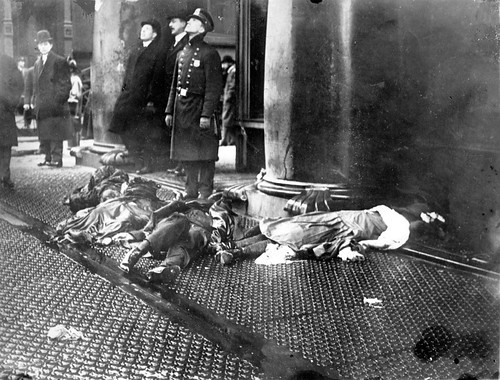
September 11, 2001 was not the first time New York City saw trapped people leap to their deaths from a burning building. Here, in 1911, police officers look up at the fire while standing beside of the bodies of young, mostly immigrant, working women who have jumped from the 8th, 9th and 10th floors of the Asch Building which housed the Triangle Shirtwaist Factory. Management had locked the stairwells and exits to prevent theft by workers.

For the very existence of labor unions, we have to thank people who worked in the late 19th and early 20th century under what we consider horrific conditions, whose bosses literally didn't care whether they lived or died -- miners, steel fabricators, women in the sewing sweat shops. For a little while in the middle of the last century, their victories and the union structure they built made possible the emergence of a middle class. Because of their struggles and the norms they established, many of us won better working conditions, better housing, educational opportunity and a chance at a secure retirement if we lived long enough. We even got weekends off from work.

As we all know, rich financial magnates and their Republican allies want to shove the middle class back to the bottom rather than pay their fair share of taxes in a decent, more equitable society. And today's labor movement is a prime subject of their attack, often seeming weak, unimaginative and even just plain timid. Under constant presure, it's all existing unions can do to try to hold on to scraps for their current members.

If labor is to make a comeback, the impetus will have to come, once again, from unexpected and neglected outsiders to society, the excluded workers.

Many of us don't notice these people unless we make an effort to look for them. Who is staffing the car wash, washing the dishes in the back of the restaurant, changing beds in the hotel, emptying garbage for that private contractor the city hired? Like the ancestors of the current middle class, they are often immigrants, "different," "foreign," and considered racially apart.

The threatened current middle class' best chance of survival requires making common cause with these folks: we need their grit, their determination, their hope for a better future. We're tired, but they are rising because they know that solidarity can evoke the good in people. That's what Labor Day is all about.

Sunday, September 04, 2011

A tale of a horrible murder, two children, and a jury

The "facts" of the case seemed all too simple. Prosecutors and defendant's lawyers agreed on this much:

[Brian] McInerney was 14 when he walked into a morning computer lab at E.O. Green Junior High, pulled a .22-caliber handgun from his backpack, put the gun to Larry King's head and pulled the trigger twice. King was 15.

L A Times, 9/2/011

Despite the agreed facts, jurors couldn't agree on what the killing meant. Seven jurors thought this was a case of voluntary manslaughter -- a crime of impulsive passion; five that this was murder, either first-degree (premeditated; hate motivated) or second-degree (still murder, but less culpable). A mistrial, meaning the possibility of another trial, was declared.

The slain boy, Larry King, was gay and not shy about flaunting it. In fact, he sounds like many a teenage boy whose new feelings of potency make him ready to get in the face of his schoolmates. The defense brought testimony about this before the jury.

In the months before the shooting, King began wearing makeup and women's spike-heeled boots and seemed to relish making boys squirm with comments such as "I know you want me," teachers said.

Larry King wouldn't or couldn't play by the rules that gay boys are supposed to hide their feelings. This evidence was used by the defense to appeal to whatever horror might exist in the jurors at publicly expressed gay sexuality.

I have to ask, would the jurors have been as horrified if some football jock claimed his right to comment on female classmates and taunt them with how much he wanted to get in their pants? Though I can imagine as a girl wanting to do it, I don't think that sort of affront would give a girl a right to shoot the offender.

I'm a huge fan of juries. It doesn't always work this way, but I think they often bring wisdom from life experience to the circumstances they are shown -- wisdom that is invisible to the practitioners of criminal "justice." See for example this.


This case -- if news accounts are fairly accurate, always an "if" -- seems to have become a contest between prosecution and defense as to who was a child. The prosecution insisted that the shooter be tried as an adult; after all, if he'd been found guilty as a juvenile, he'd be free by age 25. Yet the crime had the elements of premeditation and the shooter also possessed hate literature. The defense, properly doing their job, humanized the killer as the victim himself of a violent home.

Most adults are easily distressed by how early in life kids come into their sexual feelings. We've forgotten or repressed that period when we were tossed about like flotsam by our hormones. If the members of the jury were straight -- were they? the news coverage doesn't say and we shy away from such questions -- gay hormonally-induced stupidity can seem alien, maybe diabolic, certainly threatening. For some, a Larry King can't have been a child. Children don't express those feelings.

On the other hand, children don't hide a gun in their back pack and slip past security in order to shoot a classmate in the back of the head. At least I am not ready to think that is childish behavior.It's hard for me to consider Brian McInerney a child.

The prosecutors were probably unwise to try the shooter as an adult, no matter how much some gay rights advocates, including me, would have felt that Larry King was being done an injustice by the short sentence that was all he could receive in the juvenile court. There's a reason that we used to have juvenile justice system that tried to do something besides just lock criminals up and throw away the key. Kids just aren't adults, yet.

Though I don't like the success of what amounts to a homophobic "gay panic" defense in this trial, I think I'm willing to admit that the jury did it's best with the choices they had. They needed better options. That's not the children's job -- that's our job.

Saturday, September 03, 2011

Saturday scenes and scenery: Candlestick Point State Recreation Area

1candlestick point from away.jpg
Would you believe that spit of land is within San Francisco's city limits? It's Candlestick Point, out behind the aging football stadium. Though I've lived here nearly 40 years, I'd never been there until I learned that it was one of the 70 state parks slated for closure because California Republicans refuse to pay taxes to maintain the state's well-being.

2candlestick point sra sign.jpg
It's not a very developed place as the motley typography on the entrance sign reveals.

3gull with water!.jpg
Not surprisingly, there are shorebirds.

4egret.jpg
A lone egret stalks an inlet.

5squirrel.jpg
Mostly the ground squirrels seem shy. They haven't learned to beg from picnickers.

6feeding squirrels!.jpg
That is, they were shy until they met this guy. He played the pied-piper of squirrel-land on his walk.

7picnic site w:windbreak.jpg
The park has breathtaking picnic sites -- note each comes with a windbreak. Candlestick Point is where a sort of wind tunnel from the ocean blows across the peninsula's narrowest point.

8board sailer launches.jpg
The prevailing semi-gale is just right for the board sailers who launch here -- drivers can see in them surfing the Bay when driving Rte. 101.

9returning from fishing!.jpg
Many people are here to fish in the Bay, toting their gear in carts. I don't know why they wanted the masks, though I would not be surprised if at times the adjacent garbage company facility puts out a stink.

10pier with fishing poles.jpg
At the far end of the point, there's a newish and much used fishing pier.

11fishing along shore!.jpg
Others fish from the steep shore.

12harbor seal head.jpg
This fellow was hanging out near the pier, perhaps waiting for someone's rejects.

13orchestra sign.jpg
Inland, there's an interesting musical installation.

14orchestra drums.jpg
Some of the "drums' have interesting tones.

15sunbathing!.jpg
The north side of the point is remarkably sheltered. Who'd have thought you could do this within sight of the old Hunters Point Naval Shipyard?

The park closures will begin this fall. People will still get in, of course, but I have to wonder what corporations are salivating over this land, especially once the football stadium moves to Santa Clara.

Friday, September 02, 2011

School responds to budget cuts

sheep2.jpg
You have to admire the ingenuity.

In Carlisle, Pennsylvania, students at two local schools will be greeted this fall by something unusual on the grounds: sheep. Rather than spend money on cutting grass, the Carlisle School District has brought in 7 Romney sheep to tend the fields. “They’ve done a good job so far,” says Superintendent John Friend.

The sheep come free of charge, since they belong to the principal of the middle school. Friend estimates that they will save the district about $15,000 this year in mowing costs. That makes up for only a small amount of the district’s $2 million reduction in state support following what has been described as Pennsylvania’s deepest education budget cuts in a generation.

Stateline

Cuts, cuts, everywhere cuts -- in education, they amount to cutting the future.

If you have any interest in the future of higher education in this country, I cannot recommend too highly The Washington Monthly's college features. There's a lot to read; the features are totally worth exploring.

Thursday, September 01, 2011

Bertrand Russell: hero of war resistance

This book introduced me to the story of a person whose heroism I'd never before appreciated -- heroes are rare enough to be very prized finds indeed.

Adam Hochschild's To End All Wars: A Story of Loyalty and Rebellion, 1914-1918 recounts the swath of horror World War I cut through British culture, British families and every aspect of British life. He weaves together the stories of ordinary and extraordinary people -- grieving relatives, trade unionists, politicians, soldiers, socialists, and imperialists -- to give readers a human-scale sense of the war's enormity.

It's not easy for us to take in the sheer awfulness it all. Every World War I historian I read tries to convey the horror and they all seem daunted. Here's a sample from Hochschild's summary description:

For more than three years the armies on the Western Front were virtually locked in place, burrowed into trenches with dugouts sometimes 40 feet below ground, periodically emerging for terrible battles that gained at best a few miles of muddy, shell-blasted wasteland.

The destructiveness of those battles still seems beyond belief. In addition to the dead, on the first day of the Somme offensive another 36,000 British troops were wounded. The magnitude of slaughter in the war's entire span was beyond anything in European experience: more than 35 percent of all German men who were between the ages of 19 and 22 when the fighting broke out, for example, were killed in the next four and a half years, and many of the remainder grievously wounded. For France, the total was proportionately even higher: one half of all Frenchmen aged 20 to 32 at the war's outbreak were dead when it was over.

... British stonemasons in Belgium were still at work carving the names of their nation's missing onto memorials when the Germans invaded for the next war, more than 20 years later. Cities and towns in the armies' path were reduced to jagged rubble, forests and farms to charred ruins. "This is not war," a wounded soldier among Britain's Indian troops wrote home from Europe. "It is the ending of the world."

While this madness raged on the continent, in Britain, there remained a (very) few who resisted the war fever. At the war's outset, most people set aside any qualms. Perhaps most surprisingly, socialist trade unionists who had been proclaiming working class solidarity across borders quickly signed up for the national fight as did advocates for "votes for women" who had been throwing rocks at the Prime Minister's residence shortly before.

The prominent Cambridge academic philosopher and mathematician Bertrand Russell kept a perspective on the nationalist delirium.

Over the more than four years of fighting to come, he never yielded in his belief that "this war is trivial, for all its vastness. No great principle is at stake, no great human purpose is involved on either side. . . . , The English and French say they are fighting in defense of democracy, but they do not wish their words to be heard in Petrograd or Calcutta."

For his pains, he and the little band of war resisters with whom he collaborated were subjected first to ostracism, then verbal and physical attack, and finally imprisonment. Anyone who resisted the national impulse to take revenge in the days immediately after 9/11 will recognize this description of the environment they found themselves in:

... Antiwar beliefs were severely tested by the mass patriotic hysteria of the war's first months. "One by one, the people with whom one had been in the habit of agreeing politically went over to the side of the war," as Russell put it, "and as yet the exceptional people . . . had not yet found each other." How hard it was, he wrote, to resist "when the whole nation is in a state of violent collective excitement. As much effort was required to avoid sharing this excitement as would have been needed to stand out against the extreme of hunger or sexual passion, and there was the same feeling of going against instinct."

What's fascinating about Hochschild's account of the role of this eminent man was the extent to which he was willing not just to be a spokesman, but to share the work of building what seems to have been pretty efficient resistance under extremely difficult circumstances.

... the longer the war went on, the more it was militarizing Britain in Germany's image, while killing and maiming men by the millions and making certain an embittered and dangerous postwar world. He not only lent his enormous prestige to the No-Conscription Fellowship; for much of the war his thick shock of graying hair was a familiar sight at the NCF headquarters each day, for he became the group's acting chairman when its head went to prison for refusing the call-up. He attended the courts-martial of COs, visited them in prison, and devoted hours to the most mundane office tasks, writing numerous "Dear Comrade" letters to branches around the country, signed "Fraternally Yours, Bertrand Russell."

And he made clear to all that he was as willing to sacrifice his freedom for what he believed as were the younger men and women around him. When the government began prosecuting people for distributing an NCF leaflet, he immediately wrote to the Times: "Six men have been condemned to varying terms of imprisonment with hard labour for distributing this leaflet. I wish to make it known that I am the author of this leaflet, and that if anyone is to be prosecuted, I am the person primarily responsible." For this he was fined £100 (which he refused to pay, forcing the authorities to seize some of his property), dismissed from his post at Cambridge, and denied a passport for a trip to lecture at Harvard. ...

... Believing -- correctly -- that sooner or later most of its leaders would be arrested, the NCF set up a "shadow" structure... If any officer was jailed, someone else, designated in advance, would automatically take his or her job. Similarly, wrote one member, "in various secret places, buried in an orchard in Surrey, or locked in an unsuspecting city merchant's safe, or at the back of the bookshelf in the house of a remote sympathiser . . . were duplicates of every document likely to be seized." These included a daily bulletin on the numbers of men arrested, courtmartialed, and imprisoned, and file cards showing the whereabouts of every CO. Any instance of their mistreatment was recorded and turned over to one of the small band of sympathetic MPs willing to ask questions in the House of Commons. Communications were often in code: if a telegram said that a meeting was to be at Manchester, it in fact meant Newcastle. ...

I knew that it was my business to protest, however futile protest might be," wrote Russell decades later. " I felt that for the honour of human nature those who were not swept off their feet should show that they stood firm."

Of course, the war protesters couldn't stop that war -- or any of our subsequent wars. Though millions of men in the French army staged a brief mutiny and the Russian tzar was overthrown while his army melted away, the war ground on. Hochschild reflects on the resisters' all too minor part in the tapestry he weaves for us:

I wish theirs was a victorious story, but it is not. Unlike, say, witch-burning, slavery, and apartheid, which were once taken for granted and are now officially outlawed, war is still with us. Uniforms, parades, and martial music continue to cast their allure, and the appeal of high technology has been added to that; throughout the world boys and men still dream of military glory as much as they did a century ago.

Yes -- and no. There are suggestive arguments that we live in a world in which war is far less frequent, widespread and legitimate than in the past. We do momentarily see the U.S. empire becoming less willing to endure U.S. casualties and to spend unlimited treasure on world dominance than in the recent past.

Just as World War I set many terrible developments in motion at the beginning of the last century, the British resisters to the "Great War" created a template for future anti-war movements. Adam Hochschild's volume brings both these figures and their antagonists to life.

Wednesday, August 31, 2011

Warming Wednesdays: where to find political muscle for the climate?


Enthusiastic consumers of national news (are there still any such people?) may have heard about the civil disobedience campaign being mounted by opponents of the $7 billion Keystone XL pipeline. The project would bring tar sands oil from Canada to Gulf of Mexico refineries. Protesters worry about leaks and pollution -- but what this is really about is that, as we humans adopt more and more destructive technical means to extract every last drop of oil while we use up the last of the earth's black gold, we are likely condemning the planet to warming on an unknown scale through release of carbon dioxide into the atmosphere. As I write, hundreds have been arrested in front of the White House while demanding that President Obama not approve the pipeline. (Full disclosure: one of them is a young almost-relative and we are damn proud of her!)

By raising the profile of the issue, climate change activists are attempting to use the same strategy that advocates for a more humane immigration policy adopted with some success in getting the administration to use its executive power to stop deporting highly desirable and innocent undocumented people. (A dissection of that strategic coup here.) That is, they are trying to show Obama's political handlers that there will be a cost in support in 2012 if he ignores their concerns.

... "The decision-making authority is solely the president's," Michael Brune, executive director of the Sierra Club, told other environmental groups on a Thursday conference call, according to Bloomberg. "It will be increasingly difficult to mobilize the environmental base and to mobilize in particular young people to volunteer, to knock on thousands of doors, to put in 16-hour days, to donate money when they don't think the president is showing the courage to stand up to big polluters."

TPM

I devoutly wish that I thought this was going to work, but I doubt it. Immigration activists were able to demonstrate that Obama was losing support among potential Latino voters; they consequently won at least the appearance of action.

The problem for environmental activists is that the constituency that is aroused about climate change consists largely of people who always vote. And, when faced with the intense scientific know-nothingism that exudes from Republicans these days, they mostly just won't resist voting for Obama, regardless of how disappointing they may find him. It's vaguely comforting having a president who knows the world is round, even if he won't take on the energy interests. Groups like the Sierra Club and the League of Conservation Voters do have some capacity to field volunteer election workers, but the Obama campaign found their own volunteers last time around and may still think they can do without such constituency groups in 2012. They may even be right.

Dave Roberts who writes at Grist has offered some very sharp observations about the climate change movement's political weakness.

A big part of the problem is precisely that climate efforts so far have been almost entirely driven by liberal elites. It's been an extremely intellectualized, top-down sort of undertaking ... what you need is a renewed left with genuine grassroots muscle, the ability to threaten politicians' reelections, and lots of money to deploy. You need a left that is greater than the sum of its siloed constituent parts, so that climate is no longer the sole province of "the environmental movement," gender equality no longer the sole province of "feminism," worker welfare no longer the sole province of "labor," etc. -- some good old-fashioned solidarity.

... the decline of the left's power is closely connected to the decline of institutions that used to create leftists and give them a sense of common purpose. I'd put two in particular foremost among them: unions and liberal churches. It's unions that brought people together -- in the real world, not in chat rooms -- and trained them to think and act as part of a political force devoted to the welfare of ordinary people against the iniquities of the rich and powerful. And it's liberal churches that brought people together -- in three-dimensional space, not on Twitter -- to convince them that there is a genuine moral imperative to fight for the interests of the dispossessed and disadvantaged.

... Ultimately climate action is about overturning the status quo and defending the powerless (including future generations) against the depredations of the powerful. It's a liberal undertaking. It relies on the strength of liberalism, in the U.S. and globally, which has proven itself frustratingly weak in recent years, particularly on economic issues (and climate is very much an economic issue).

If we are to keep the planet habitable for a human population anywhere near the present size, that's the way we are going to have to think. The climate needs a left capable of mass scale based on respect for diversity expressed as solidarity.

Despite every other legitimate concern, we cannot ignore that our economic and social system is rapidly making the planet less habitable. So I will be posting "Warming Wednesdays" -- reminders of that inconvenient truth.

Monday, August 29, 2011

Where are elders going to live?

Over at Time Goes By, one of my periodic "Gay and Gray" columns is up today. If you are interested in likely futures for gay elders -- and all of us, gay and straight should be --go take a look.

While casting about for material for these columns, I read Dudley Clendinen's A Place Called Canterbury: Tales of the New Old Age in America, about his mother's last years living in an assisted living institution in Tampa, Florida. Clendinen came to my attention on the occasion of his moving and dignified description in the New York Times of his own descent into neuro-muscular failure due to A.L.S. -- Lou Gehrig's disease. Clendinen, a former national correspondent and editorial writer for the paper, also happens to be gay, though neither of these writings that delve into human intimacies make a point of that identity.

Canterbury is fascinating; if any reader is at all interested in assisted living communities or has friends living in them, I can highly recommend it. Clendinen spent long periods in residence; the product is indeed "tales" of ongoing life drifting toward death. Some stories are sure to delight and illuminate some corners we might not expect access to: relations with and among the staff; sexual outlets; how this community experienced and recovered from 9/11. It is full of gentle but wise observations; here's a sample:

There were, of course, many widows available to talk to one another about widowhood -- which usually meant talking about their late husbands. This was almost always a subject the talker enjoyed more than the listener. Most widows came to realize, after a while, that other people, by and large, didn't find their dead husbands that interesting. (Most of them had dead husbands of their own, after all.) Once they realized that, they moved on to other topics.

Enjoy.

In order to write this book, Clendinen begins with an extraordinarily lucid description of what exists in the way of housing options for elders. Here he is a straight-up journalist doing a terrific job of exposition. I'm taking the liberty of passing on excerpts from it here because I know how well it contextualized these possibilities for me and I hope it might do the same for others.

The place I knew from childhood where old people sometimes went to live was the "Old PeopIe's Home." A quiet, old-fashioned exercise in noblesse oblige, originally founded in the 1890s, and now simply called the Home, it was by the 1950s, when I began to visit there, a rambling old stucco building of two or three stories, with high ceilings, individual or shared rooms, a dining room with ceiling fans, big overhanging trees, and deep shaded porches lined with rocking chairs, in which gently sat poor old white ladies in cotton dresses, and a few bent old white men in cotton pants. You had to be able to pay something to get in, and something a month, but like the local Children's Home, it was a nonprofit, subsidized institution, supported and run by a group of business -- and religious people -- Episcopalians, Baptists, Catholics, Methodists, and Jews -- for a certain class of the elderly in need. ...

The low-rent housing for the elderly that began to be constructed in Baltimore, where l now live, and then in cities across the country in the late 1960s and the 1970s, often took the form of plain, or brick-faced, concrete buildings of ten to fifteen floors, with two hundred or more modest studio and one-bedroom apartments in each. Sponsored by churches or synagogues, community organizations, unions that wanted to provide housing for retired workers, or other groups willing to create nonprofit corporations to take advantage of the low-interest, long-term federal loans being offered under the Section 202 program, that housing now exists in almost every city and town in America. Most cities have a number of buildings. The rents are kept below market rates, and the basic requirements for admission are that the applicants be sixty-two which doesn't sound old anymore -- and be able to pay the rent. The apartments were intended for the low- or modest-income elderly: widows, retired blue-collar or public service workers, people living on fixed incomes or in reduced circumstances. It was essentially the same economic class that had been served by the Home, and places like it -- of which there were not enough -- before the federal government got involved.

There was another Great Society program created in the 1960s called Section 8, designed to subsidize housing for the poor, ages eighteen and up. Those who qualify and are at least sixty-two often live in designated apartments in the Section 202 buildings, with most of their rent paid by the government.

Regardless of whether the government considers them poor or not, the main, and often only, source of income for many of the older people living in those buildings seems to be Social Security. ... They are basic apartment buildings with small residential spaces, some nice group spaces, but little support structure, and an aging population of residents who, if they live long enough, will have to move to nursing homes for the help they will need each day -- in bathing, dressing, cleaning, cooking, eating, and taking the right medicines at the right times.

The nursing homes to which they will go are the ones that take Medicaid -- the federal/state program that pays for nursing care for the elderly poor. To qualify for Medicaid, someone has to demonstrate essentially no assets and low income. Then he or she pays all but a few dollars of that income each month toward the nursing home bill, and Medicaid pays whatever its formula allows as the balance. ...

The cost of nursing home care is a giant part of the federal Medicaid budget, which itself takes a huge bite out of the whole federal budget. But the Medicaid formula, which differs state by state in how much it will pay, almost always pays less per month than high quality nursing care actually costs, regardless of where the nursing home is. For that reason, commercial, for-profit nursing homes that accept Medicaid patients are less well staffed and equipped -- in order to make a profit -- than nursing homes that can charge more because they do not accept Medicaid. In other words, the quality of care in facilities that accept Medicaid is less than in those that charge more, to a more affluent clientele. That shouldn't surprise. The retail cost of top-flight individual nursing care can be astronomical.

Canterbury and other nonprofit life-care facilities were created to offer comfortable living and good nursing care by yet another formula. It was one designed to serve not the poor ... or the shabby genteel ... but the middle class ... at a price that they could afford when they entered and that would not impoverish them in the end. The equation on which life-care facilities are based is an actuarial bet -- a gamble. It doesn't matter at what age over sixty-two a person wants to enter, but new residents have to be able to walk through the front doors on their own power. No wheelchairs. They have to have enough money to afford the sizable down payment due when they come in, and enough income for the fee they contract to pay each month. The down payment buys them no equity, so if they die soon, they lose. Their estates get back some, but less and less for the first two years, and then none. But if they live long, they win, especially if they end up in the nursing wing, because the nursing care costs no more -- except for the extra meals, pills, and nursing supplies -- than the monthly apartment fee.

Most people aren't going to this last kind of facility, but I appreciated the clarity of this explanation.

It's not clear to me what the new federal health reform law will mean to these arrangements, although apparently existing nursing homes are complaining that they'll be required to offer their employees health insurance. I'm unsympathetic. We ought to be able to do better than to expect elder care to be solely the work of the underpaid and uninsured.

What "experts" fail to understand

uninsured&ACA.jpg

An in-house description of a new Kaiser Family Foundation survey expresses "a real surprise" that nearly half of those currently without health insurance don't think the Affordable Care Act (ACA), known to detractors as Obamacare, will do anything for them.

We know from survey after survey that the uninsured want insurance coverage. And we know that the main reason they don’t have it is that they cannot afford it. Experts who have advocated for expanded coverage for decades probably envision the uninsured sitting around the kitchen table anxiously awaiting the implementation of coverage expansions under the ACA. But surprisingly, only three in ten of the uninsured say the ACA will help them get health care.

These "experts" just don't get it. Even if you tell people over and over that there will be insurance and subsidies to help them pay for it, folks who live close to the economic margin (or under it) won't believe you. All they've ever experienced with the dribs and drabs of insurance they may have occasionally had was that there were expensive deductibles and co-pays. Or insurers refused to pay if they tried to use the "insurance." And all they can imagine from the ACA is perhaps another bureaucratic mountain they'll be expected to surmount, complete with ugly insinuations that they are "failures" because they need help.

Plus, they listen the political noise and figure that, even if this thing someday comes into existence, the cheapskates in power will nickel and dime it to death, perpetually shifting costs from government to them. After all, if they've had any experience with state-run health programs like CHIP (federal children's health) or Medicaid, they've lived how that works.

Anyone who expects poor people to have confidence in a government program that doesn't exist yet is living in an ivory tower.

Now give them some experience of something that works for them and they'll fight tooth and nail to keep it -- just look how most of us feel about Social Security and Medicare. But that trust comes from experience. No wonder the party of NO taxes for the rich needs to kill Obamacare before it lives. If it's benefits become tangible, it will be lively indeed.

A puzzle

split-tree-web.jpg
Have you ever let your mind wander, wondering what happened to a tree early in its life, with the result that it grew like this?

I have.

Sunday, August 28, 2011

A stubborn man stepped out for justice

With the east coast under water and the dedication of the MLK memorial postponed, this is less timely than it might have been ... but here it is.

I won't really know until I see it, but I think I like the new Martin Luther King Jr. memorial on the National Mall in Washington.

There are a lot of people who say I ought not to like it. The right thinks it is an example of totalitarian communist iconography. Feeding that thought, the artist selected by the private U.S. memorial foundation that raised the money for the project is Lei Yixin, a 57-year-old master sculptor from Changsha in Hunan province. He's done admiring figures of Mao, among others. U.S. artists and some African Americans thought the commission should have gone to an African American artist. The stonemasons union was appropriately horrified to learn that the sculptor imported not only Chinese granite but also Chinese workers whose pay arrangements seem dicey. Apparently during the planning the younger members of the King family caused a stink by demanding to be paid for the use of King's words carved in stone.

1Martin-Luther-King-Memorial-panorama.jpg
But I saw a picture of this panorama and instantly thought -- "the arc of justice is long -- and a man stepped forward to speed things up on the way to freedom!" Apparently the official metaphor is that "hope came out of a mountain of despair" so I guess I wasn't far off.

3king face.jpg
I had feared that any memorial would dilute the strength of King, would "domesticate, disinfect, deodorize, sanitize, and make [him] safe" in the language of Cornel West. I guess not. This figure is stubborn, determined, uncompromising.

After all, Dr. King had to be one tough guy. He not only led the movement for legal civil rights and racial equality in the south, he took the movement north to confront racial hypocrisy. He also denounced the Democratic party's Vietnam War. He was killed while supporting striking garbage collectors and organizing a Poor People's Campaign. As Adam Server summarizes, King was

a man of the left certainly, but not a man of the Democratic Party ...

He wasn't widely popular with a lot of U.S. people when he died and he wouldn't be popular now if he were around.

I like it that he looks a little annoyed in the new statue. I'm sure he'd find a lot to be annoyed about these days. I'm amazed that such a figure ever got implanted on the Mall.

Saturday, August 27, 2011

Saturday scenes and scenery: water over the dock

water patterns1.jpg
As the East Cost waits for Hurricane Irene, how about some photos of more tranquil waters, albeit water where no sea ought to be?

waterpatterns2.jpg
On this day in this August, an exceptionally high tide rose over the working dock at Menemsha Harbor on Martha's Vineyard.

waterpatterns3.jpg
Locals call it a "moon tide" -- apparently the phenomenon is not unheard of, though it certainly calls into question the viability of these maritime facilities with rising ocean levels.

working vessels.jpg
The dock on the left of this photo with the gas pumps, taken on a more normal summer day, is one of several that was covered by the "moon tide."

Friday, August 26, 2011

Go on, feed the fish


Click on the light blue water, repeatedly if you like, and watch them scarf down the food. For some reason, I find watching this absorbing.

Busy today; will blog tomorrow.

H/t Telling Secrets for the fish.