Thursday, December 06, 2012

Violence and efficient mass organization combined

I needed a long reading project concurrent with the recent campaign, so I dove into Richard J. Evans' The Coming of the Third Reich. This volume is the first of three; I'll write about the other two as I (slowly) work my way through them.

Evans is a Brit, a professor of history at Cambridge. An interesting preface explains why he felt an exhaustive narrative history of the mid-20th century German rogue state was needed. He served as an expert witness in the 1996 libel trial in which historian David Irving sued historian Deborah Lipstadt and Penguin Books for writing that Irving was a Holocaust denier (the court concluded he was). Evans discovered in that work that a new general account might help. He also seems irritated that for English speakers the paradigmatic account of Hitler's Germany remains William L. Shirer's Rise and Fall of the Third Reich. He explains:

...the number of broad, general, large-scale histories of Nazi Germany that have been written for a general audience can be counted on the fingers of one hand.

The first of these, and by far the most successful, was William L. Shirer's The Rise and Fall of the Third Reich, published in 1960. Shirer's book has probably sold millions of copies in the four decades or more since its appearance. … There are good reasons for the book's success. Shirer was an American journalist who reported from Nazi Germany until the United States entered the war in December, 1941, and he had a journalist's eye for the telling detail and the illuminating incident. His book is full of human interest, with many arresting quotations from the actors in the drama, and it is written with all the flair and style of a seasoned reporter's dispatches from the front. Yet it was universally panned by professional historians. …

The emigre German scholar Klaus Epstein spoke for many when he pointed out that Shirer's book presented an 'unbelievably crude' account of German history, making it all seem to lead up inevitably to the Nazi seizure of power. It had 'glaring gaps' in its coverage. …even in 1960 it was 'in no way abreast of current scholarship dealing with the Nazi period'. …For all its virtues, therefore, Shirer's book cannot really deliver a history of Nazi Germany that meets the demands of the early twenty-first-century reader.

It does seem that Evans is distressed that Shirer managed to make his account so gripping that it has endured. He also finds Shirer morally judgmental and intentional chooses not to emulate him in this. I think I am an admirer for Shirer's history of the Third Reich precisely because of the visceral outrage he incorporates in his narrative.

But these quibbles certainly don't mean that I didn't get a lot out of Evans first volume. He describes its purpose:

Understanding how and why the Nazis came to power is as important today as it ever was, perhaps, as memory fades, even more so. We need to get into the minds of the Nazis themselves. We need to discover why their opponents failed to stop them. …The story of how Germany, a stable and modern country, in less than a single lifetime led Europe into moral, physical and cultural ruin and despair is a story that has sobering lessons for us all; lessons, again, which it is for the reader to take from this book, not for the writer to give.

What stands out for me from Evans' account of Hitler's rise is the centrality of violence -- assaults on opponents, rioting, intimidating mass marches -- employed by many factions in Weimar German politics. Defeat in World War I and the economic pain that followed left ripe ground for the growth of intolerance. He shows that as early as the 1920s, what had been a pervasive cultural anti-semitism was transformed in this unstable context into a foundation that would underlie the Nazi project of mass extermination.

It was not just an unprecedented willingness to translate vehement prejudice into violent action that broadly distinguished post-I9I8 antisemitism from its prewar counterpart. While the overwhelming majority of Germans still rejected the use of physical force against Jews during the Weimar Republic, the language of antisemitism became embedded in mainstream political discourse as never before. The 'stab-in-the-back', the 'November traitors', the 'Jewish Republic', the 'Jewish-Bolshevik conspiracy' to undermine Germany -- all these and many similar demagogic slogans could be regularly read in the papers, whether as expressions of editorial opinion or m reporting of political incidents, speeches and trials. They could be heard day after day in legislative assemblies, where the rhetoric of the Nationalists, the second largest party after the Social Democrats during the middle years of the Republic, was shot through with antisemitic phrases. …The sensibility of many Germans was so blunted by this tide of antisemitic rhetoric that they failed to recognize that there was anything exceptional about a new political movement that emerged after the end of the war …

The Great War had left behind a substantial cohort of damaged ex-combatants (and younger siblings who envied their "heroic" older "brothers") who knew no way to be in society except as warriors. A Columbia sociologist, Theodore Abels, persuaded the Nazi Party to back his collecting the personal stories of many original Nazi movement members, especially the para-military brownshirts who intimidated and fought other Germans with other political allegiances. Their motivations don't seem to have been very ideological.

Among ordinary Party activists in the I920s and early I930s, the most important aspect of Nazi ideology was its emphasis on social solidarity -- the concept of the organic racial community of all Germans -- followed at some distance by extreme nationalism and the cult of Hitler. Antisemitism, by contrast, was of significance only for a minority, and for a good proportion of these it was only incidental. … Men often came to the paramilitary wing of the Nazi Party after serving at the front in 1914-18, then becoming involved in far-right organizations such as the Thule Society or the Free Corps. …Violence was like a drug for such men …

"The terror of police and government against us', as one stormtrooper put it, was another source of resentment against the Republic. Such men were outraged that they should be arrested for beating up or killing people they considered to be Germany's enemies, and blamed the prison sentences they sometimes had to suffer on the 'Marxist judicial authorities' and the 'corruption' of the Weimar Republic.'

…It is difficult to grasp the full extent of the stormtroopers' fanaticism and hatred unless we accept that they often did feel they were making sacrifices for their cause. …The Nazi Party depended on such commitment; much of its power and dynamism came from the fact that it was not dependent on big business as the 'bourgeois' parties and the Social Democrats to varying degrees were, still less on the secret subsidies of a foreign power, along the lines of the Moscow-financed Communists.

In addition to their violent, fanatical base the Nazi leaders seem to have excelled at organizing party activities -- a quality that seldom goes with ideological lunacy and celebration of violence. The Party generated groups and projects in all sectors of German life. It was very good at running electoral campaigns, at spreading propaganda, and mobilizing voters.

All this mass organization meant that in 1933, when the politicians of the Weimar Republic -- a collapsing state structure that had long since ceded any allegiance to democracy and the rule of law -- gave over power to Hitler as Chancellor, the Nazi Party was organized to take over the functions of a government that had lost its legitimacy. Nazi organizations quickly took over the police, "cleansed" the government bureaucracy and educational institutions of Jews and political opponents, and generally dominated public life in all its aspects. Evans makes it clear that they could accomplish this as quickly and completely as they did because they combined an enthusiastic use of violence with efficient mass organization. It required both to install the Third Reich, the Nazi dictatorship.

As a student of history and politics, I still am amazed that this incendiary combination of forces could emerge in a large, rich, modern state. Evans is right: this is a sobering narrative.

Wednesday, December 05, 2012

Warming Wednesdays: climate talks in Qatar


Did you know that one of those periodic world climate meetings took place last week at Doha in Qatar. Probably not. It's not as if U.S. media had paid much attention.

Go ahead; watch this Al Jazeera video of the very controlled protest allowed by local authorities at the meeting venue. I found the "whole world watching" display very heartening. We're all in this together, though the effects so temperature increases will strike the poorest and weakest most. (H/t Juan Cole.)

You also probably will not be surprised to read that much news from climate researchers is discouraging. We're still hooked on energy processes that belch carbon.

Emissions continue to grow so rapidly that an international goal of limiting the ultimate warming of the planet to 3.6 degrees Fahrenheit, established three years ago, is on the verge of becoming unattainable, said researchers affiliated with the Global Carbon Project.

…The new figures show that emissions are falling, slowly, in some of the most advanced countries, including the United States. That apparently reflects a combination of economic weakness, the transfer of some manufacturing to developing countries and conscious efforts to limit emissions, like the renewable power targets that many American states have set. The boom in the natural gas supply from hydraulic fracturing is also a factor, since natural gas is supplanting coal at many power stations, leading to lower emissions.

But the decline of emissions in the developed countries is more than matched by continued growth in developing countries like China and India, the new figures show. Coal, the dirtiest and most carbon-intensive fossil fuel, is growing fastest, with coal-related emissions leaping more than 5 percent in 2011, compared with the previous year.

“If we’re going to run the world on coal, we’re in deep trouble,” said Gregg H. Marland, a scientist at Appalachian State University who has tracked emissions for decades.

New York Times, Dec. 2, 2012

Washington Post columnist Eugene Robinson put that trouble into everyday language.

…What results have two decades’ worth of international climate confabs produced? By the World Bank’s reckoning, even if the nations of the world meet the pledges they have made to reduce carbon emissions, we’re still likely to see warming of more than 3 degrees Celsius — 5.4 degrees Fahrenheit — by 2100. And if the pledges are not met, which seems a reasonable assumption, there is a 40 percent chance that by the turn of the next century, temperature rise will reach the disaster benchmark of 4 degrees Celsius.

That passage does something we don't usually see. These discussions are ordinarily couched in numerical language of science -- and most of us can't translate Celsius into Fahrenheit without access to Google (guess this is why we all need our smartphones…)

Clearly, if President Obama wants to be remembered for his long game, he can't let another four years go by without trying to turn the United States toward leadership on climate change. We've made some progress toward reducing emissions. We need to make as much more as we can, since what we put out today, in human terms, essentially alters the climate forever.

Our brains and our institutions are not good at thinking about "forever," but we have no choice.

Despite every other legitimate concern, we cannot ignore that our economic and social system is rapidly making the planet less habitable. So I will be posting "Warming Wednesdays" -- unpleasant reminders of an inconvenient truth.

Tuesday, December 04, 2012

This shit really does still go on


US evangelicals have helped inflame native Ugandan anxiety about their native LGBT population who are emerging from the shadows in our more open global society.

Now there is a bill in the Uganda parliament that would not only criminalize LGBT people, but perhaps make gays subject to execution.

Political Research Associates has done vital work on the links to homegrown U.S. bigots.

For two days in early March 2009, Ugandans flocked to the Kampala Triangle Hotel for the Family Life Network's "Seminar on Exposing the Homosexuals' Agenda." The seminar's very title revealed its claim: LGBT people and activists are engaged in a well thought-out plan to take over the world. The U.S. culture wars had come to Africa with a vengeance.

To put on the conference, the Uganda-based Family Life Network – led by Stephen Langa with the goal of "restoring" traditional family values and morals in Uganda – teamed with two U.S. hatemongers from the Christian Right, Holocaust revisionist Scott Lively and Dan Schmierer of the ex-gay group Exodus International. Vocal opposition in international circles did not stop the country's high profile religious leaders, parliamentarians, police officers, teachers, and concerned parents from attending. Indeed, parliamentary action to wage war on gays was on the conference agenda. It was not enough that homosexuality is illegal in Uganda ...

Read the rest of Zambian Anglican priest Kapya Kaoma's report here.

This U.S. export is very much our business!

Myopia moment


Any blogging today will have to wait. I'm off to get my eyes examined and expect dilated pupils will linger all morning if not all day.

Apparently this is age-appropriate behavior. For more interesting graphic depictions of how our consumer behavior changes over time, check out this Business Insider article. H/t Andrew Sullivan.

Monday, December 03, 2012

"Handguns do not enhance our safety."

Sportswriter Jason Whitlock writes for FOXSports. He came there from covering the Kansas City Chiefs.

Here's some of Whitlock's reaction to the news that KC linebacker Jovan Belcher had shot the mother of their child, then blown out his own brains at the team facility on Saturday.

… We’ve come to accept our insanity. We’d prefer to avoid seriously reflecting upon the absurdity of the prevailing notion that the second amendment somehow enhances our liberty rather than threatens it.

How many young people have to die senselessly? How many lives have to be ruined before we realize the right to bear arms doesn’t protect us from a government equipped with stealth bombers, predator drones, tanks and nuclear weapons?

Our current gun culture simply ensures that more and more domestic disputes will end in the ultimate tragedy, and that more convenience-store confrontations over loud music coming from a car will leave more teenage boys bloodied and dead.

In the coming days, Belcher’s actions will be analyzed through the lens of concussions and head injuries. Who knows? Maybe brain damage triggered his violent overreaction to a fight with his girlfriend. What I believe is, if he didn’t possess/own a gun, he and Kasandra Perkins would both be alive today.

That is the message I wish Chiefs players, professional athletes and all of us would focus on Sunday and moving forward. Handguns do not enhance our safety. They exacerbate our flaws, tempt us to escalate arguments, and bait us into embracing confrontation rather than avoiding it

FOXSport.com

Almost as a amazing as Whitlock's plea for gun sanity is that I know about the column because commentator Bob Costas read an excerpt at halftime on NBC's Sunday Night Football.

I doubt if any of this will faze the fanatics who run the National Rifle Association and the thousands of legitimate gun owners who fall for the paranoid fantasies that fill the NRA's coffers. But we can hope ...

Sunday, December 02, 2012

Advent 2012


The Christian season of "waiting in hope" for the Light begins today. I've always felt in harmony with this season -- though I often wonder whether it would have the same resonance if I lived in the southern hemisphere where daylight is lengthening, instead of waning.

I've just emerged from a different sort of much prolonged "advent" and so has the country. Waiting in hopeful and anxious anticipation is the normal condition of people who engage deeply with elections. This last contest seemed to stretch on forever.

Unlike most of life, there is a fixed date on which the anticipated and feared decision will be made. In the run up, there is an enormous amount that should and must be done, more than can be done. But then Election Day comes and it is over. Thud.

If your candidate or your proposition wins, there is joy and relief. There probably should be terror; for with victory comes responsibility that cannot be entirely fulfilled. You tamed it; you are now responsible. But you get to enjoy the victory for a bit, before feeling the responsibility.

If you lose, it is just over. You can analyze at length, but if you were doing your job, you already know why, at this time, your fellow citizens made other choices. Some people recently weren't doing their jobs. You shouldn't be able to tease out much new from the returns. Later, someone with more distance may have insights, but those are not likely to be immediate.

As readers of this blog know, I come into this Christian Advent having just lived through a nasty thud. My fellow Californians were not ready to replace the death penalty, to choose a different path to satisfy our hope to live under a fair and functioning legal regime. When I look at the long trajectory of our understanding of punishment, safety and justice, I know I should remain confident that we'll move away from the death penalty. The campaign successfully implanted an understanding that relying on execution to deliver "justice" costs too much, suffers from systemic impediments that can't and won't be fixed, and always risks killing the wrong person. But for now, we're just not quite ready to give up the idea there's some magic "justice" to be grasped by giving a death sentence to a terrible offender.

So today I wait in hope for the return of the Light -- literally as I listen to a Pacific storm howling outside, metaphorically for the rebirth of the hope that Good comes among as, as poor and weak as we are. Hope is not a mood; hope is a virtue. Like all virtues. it must be practiced to form and deepen it. After a loss, I need a blessed Advent this year, to begin to renew, not hope itself, but strength for the practice of hope which is the struggle for justice. It will come. It always does.

Saturday, December 01, 2012

Saturday scenes and scenery: election residue

It's all over but the fading signage and lingering bumperstickers.

lgbt barack.jpg
The self-deprecating Barack makes an attractive image here on a sprightly red VW.

mormon over moron close.jpg
Captured through the slightly soiled front window of a BMV.

noObama2012.jpg
Someone disappointed lives here.

mitt is mean.jpg
New York Times columnist Susan Collins provided a public service by repeatedly reinforcing the story of Seamus' bad ride.

Friday, November 30, 2012

A peace movement accomplishment


The Senate did something good on Thursday -- and we, the people, made it happen.

The Senate adopted an amendment to the FY2013 National Defense Authorization Act (NDAA) offered by Senators Jeff Merkley (D-OR) and Rand Paul (R-KY) stating support for an accelerated transition and drawdown in Afghanistan. That's voting the people's will: as far back as last April sixty percent of us wanted out, including 65 percent of those who planned to vote for Obama and 59 percent of "independents." Heck, even 49 percent of those who planned to vote for Romney wanted out.

Thursday's vote was the first majority vote ever in either the House or the Senate calling for an end to the war in Afghanistan, according to PeaceAction West.

No -- this vote doesn't mean the U.S. will actually be leaving very soon. Ultimately, that's up to the President. He's set the end of 2014 as the date. But what it does do is strengthen Obama's hand when generals and American-exceptionalist imperial enthusiasts come up with demands for huge "residual" forces to stay behind.

Will the peace movement be ready to claim this as our victory? I hope so. No, it's not what we want. If some of us had our way, the U.S. never would have gone blundering into Afghanistan in the first place. And most all of us have said "enough already" for about 10 years now. But our military and hawks can't admit the U.S. has lost a war against Central Asian tribesmen, so the dying goes on. For years, that's all the Afghanistan conflict has been about: saving face. And for years the peace movement has worked to inform and persuade our fellow citizens about what a complete piece of shit the whole enterprise was.

Obama's deal is that the U.S. will name the date for our departure and those who need it can keep lying about what they've achieved. (Nothing good.) The peace movement would like the U.S. state to swear off invading other people's countries, but we aren't going to get that.

But we have to learn to value what we can win and that's withdrawal of U.S. forces from Afghanistan. Oh sure, there will be more face saving "agreements" and we'll send in the spooks -- but that isn't going to prove much. Doubt me? -- look at Iraq.

The peace movement's job is to stop these arrogant fools from starting the next war.

Thursday, November 29, 2012

In honor of the U.N. General Assembly vote recognizing Palestine's observer status

Here's a simple primer on the struggle most people in the United States wish they could ignore. It's short and surprisingly cogent.


Through out history, when governments have failed to push for justice, people just like you, like us, have taken the lead and won! Now it is the Palestinians turn for freedom and justice.

Jewish Voice for Peace

The United States put itself on the wrong side of justice, again, on Thursday by voting against the upgrade in the status of Palestine.

For people in the United States, we've got a huge job to do, turning around our cowed politicians who underwrite every Israeli atrocity.

Fiscal cliff follies

Okay -- a little about the fearsome "fiscal cliff".

The so-called "fiscal cliff" is an imaginary disaster of invented by politicians of both parties to cover up the fact that they are allowing themselves to be diverted from doing their jobs. There is no "fiscal cliff". There is only the perpetual unwillingness of rich people -- the 1 percent -- to contribute their fair share to the common good.

If the government needs money to do its job -- to "provide for the common defense and promote the general welfare" according to the Constitution -- it should get money from where the money is. And where's that? In the hands of the 1 percent. Tax 'em. If they won't pay, denounce them for the parasites they are.

The rest is all hoohah, obfuscation in the service of socially irresponsible greed.

Today the Prez sent his supporters a letter asking them to tell him what they'd do with $2K next year if he manages to keep the fearsome bogeyman -- that's the fiscal cliff -- from taking it away from them. Nice, but irrelevant. People need to be banging on the government to do its job -- to ensure the solvency of necessary programs like Social Security, Medicare, and Medicaid. If that requires upsetting the 1 percent, screw 'em.

Here's how a brave President deals with this kind of phony "crisis":
On the monument to that President in Washington is this sentence:

The test of our progress is not whether we add more to the abundance of those who have much; it is whether we provide for those who have too little.

Would that the current incumbent would show a little of that spirit.

Wednesday, November 28, 2012

Warming Wednesdays: Climate change, cities and politics

Those of seeking to make the point that we humans are inexorably altering the planet's climate sure got some help from Hurricane Sandy. There's nothing like having a megastorm make a direct hit on the nation's largest city where the media is clustered to make an impression.

Edward Glaeser, an economics professor at Harvard University, who studies urban centers teased out some of the implications of city vulnerability to rising seas in a Bloomberg View column.

The world’s urban agglomerations are often particularly vulnerable to natural and man-made disaster, yet they are also especially well-suited to defend their space. … For most of human history, water-borne transport has been vastly cheaper than movement over land. To reduce transport costs, we built our cities on waterways.

… It is also far easier to imagine building sea walls to protect the geographically limited area around cities than to cover a sprawling coastline. I am no civil engineer and have no opinion on whether New York City should protect itself with massive walls or with less- expensive, less-imposing defenses, but the city needs to shield itself, and sea walls provide that barrier. The Dutch Delta Program has spent billions to protect the Netherlands, largely successfully.

… [Dutch water-risk expert Jeroen Aerts] suggests a $17 billion solution with three great walls, and says that an extra $15 billion might be required in added coastline protection. Aerts’s total of $32 billion would be roughly half the city’s annual budget. But the costs of Hurricane Sandy also ran in the tens of billions. If the alternative is giving up on lower Manhattan, which has hundreds of billions of dollars’ worth of property and infrastructure, the price looks downright cheap.

… Who should pay for these defenses? The protected property owners, of course. There is no reason why New York should look to the federal government in Washington for this spending. The city has the money to pay the bill, and it should champion the principle that we only build sea walls or other barriers when the people who are protected pay for them. This helps ensure that the benefits justify the costs. We don’t want to go further down a path where every hamlet on the Eastern seaboard feels it has a right to federally financed storm protection.

I do not have the expertise to judge whether Glaeser's and Aerts' specific prescription is the right one, but that last bit points to a set of issues raised by climate disasters that all of us in this democracy need to get some grip on. Glaeser is right: "every hamlet on the Eastern seaboard" will try to demand protection and the costs will force choices to be made. And we make our choices through a complex political system that privileges wealth and inertia over scientific expertise and efficient use of scarce resources.

Because our system is organized around money influence and choke points, one of the patterns revealed by the recent election will greatly impact how we respond to climate change. Cities are Democratic Party turf, demographically and especially ideologically. The Republican's Veep candidate may have thought he was pointing out the otherness of the people who so viscerally rejected him, but he spoke a truth: Ryan Sees Urban Vote as Reason G.O.P. Lost.

New York Times graphic

Cities are ideologically Democratic; we urban folks know from experience that we need one another.

… where people live densely together, [cities] require policies and an ideology that Republicans lately have not offered.

Some of the anger from cities this election season rightly pointed out that Republican Party leaders go out of their way to mock them. They denigrate urban ideas and populations because this has repeatedly proven an effective way to gin up enthusiasm among their base…

As the Republican Party has moved further to the right, it has increasingly become the party of fierce individualism, of "I built that" and you take care of yourself. Cities, on the other hand, are fundamentally about the shared commons. If you live in a city and you think government – and other people – should stay out of your life, how will you get to work in the morning? Who will police your neighborhood? Where will you find a public park when your building has no back yard? …

… The real urban challenge for conservatives going forward will be to pull back from an ideology that leaves little room for the concept of "public good," and that treats all public spending as if it were equally wasteful. Cities do demand, by definition, a greater role for government than a small rural town on the prairie. But the return on investment can also be much higher…

The Atlantic Cities, November 15, 2012

Insofar as there's been a tendency to conflate concern over climate change with historic conservation societies and back-to-the-land movements, we are looking in the wrong direction. Dealing with the threats of global warming is going to depend ideologically on urban experience and urban values. At present those are strongly clustered in the Democratic Party. We've got a huge distance to go before we actualize the force implicit in that observation, but it sure shows where we need to work. Educating urban populations about the dangers and opportunities involved in averting the worst and mitigating the rest of human-caused climate change makes good strategic sense. Are we doing it?

Despite every other legitimate concern, we cannot ignore that our economic and social system is rapidly making the planet less habitable. So I will be posting "Warming Wednesdays" -- unpleasant reminders of an inconvenient truth.

Tuesday, November 27, 2012

Strengthen Social Security: don't cut it!


With the New York Times leading off today with an article about how nasty liberals won't let the newly re-elected Prez slash Social Security and medical programs for the poor in order to please the plutocrats, I guess it is time to trot out this excellent video. Short, snappy and true. (H/t TGB.)

Now we reach the long part of the political cycle in which the voters who put these bums in office have to loudly and persistently remind Democratic officeholders why we put them there: to use government to promote the general welfare. At least that's what the Constitution says. What's so complicated about that? Not welfare for oligarchs, but the common good of all of us, most of whom need a little help sometimes.

What's difficult is that, after an 18 month election season which pummeled those of us who engaged to a pulp, we have to get back out there and scream bloody murder to prevent the politicians we elect from forgetting their job.

In the 1960s, we said we wanted "participatory democracy." And this sounds like a desirable thing. But we weren't always ready to do the unglamorous work of building and controlling the institutional props that make winning the general welfare possible. There were good reasons many chose to "drop out": being forced to fight and die in a pointless imperial war while observing the gender and racial hypocrisy of our elders prompted an understandable withdrawal. But the result was that for a generation the deal-makers and the careerists hollowed out the institutions in which progressive democracy is practiced: the unions, the think tanks, the Democratic Party.

The emerging majority -- what pundits are calling the "Obama coalition" including the young, the colored, the well-educated -- are taking back those institutions and building new ones. But winning and keeping a place in the push and pull of citizenship is a perpetual fight. The prospects for enduring victories remain tenuous.

The plutocrats don't rest (and they can always hire willing servants.) We can savor our wins but dropping out is not an option.

Monday, November 26, 2012

How to handle our propaganda media


Fox was operating as a wing of the Republican party ...

We need more people who are willing to interact with "news" media this way. You have to know your facts and be confident about it -- and you have to be willing to be barred from some outlets.

I just bought Ricks' latest book and will eventually write about it here. His blog is always worth exploring.

More interlude

Still out of commission with an injured back. Gotta stop falling while running. This interesting tincture, applied topically, seems to give some relief. Maybe this is a placebo effect, but I'll take it.

This new (to me) brand of beer definitely raised the standard on a long cross-country flight yesterday. I suppose it is a product of Anheuser-Busch InBev or MillerCoors like most every readily available brew, but unlike their usual stuff, it has some flavor. Some.

Back to blogging when then my back cooperates.

Saturday, November 24, 2012

Cedric Brown, RIP

Our friend Cedric Brown died this week. At least we assume he died. Just before leaving town last Tuesday night we received a call from the intensive care unit at San Francisco General Hospital. Did we know a Cedric Brown?

Well, yes, in a way …

The hospital was looking for a Cedric Brown's next of kin or anyone who should be notified that he was dying. We asked whether he was still conscious, but they said they'd made him comfortable and unconscious with heavy doses of morphine and this time he wasn't going to make it. We didn't go to see him, but rushed to catch our plane.

We weren't kin, but I wasn't surprised my number had turned up in his records. We'd known Cedric, a homeless gay man living with Crohn's disease and HIV, for about a decade. He would turn up periodically at our door, begging for help, usually, at least ostensibly, to buy his latest medicine. The various stop gap expedients available to people without money or health insurance would get him repeatedly admitted to hospitals when near death. But then he'd be tossed out, unable to pay for the drugs, or the adult diapers, or the lotions for his erupting skin -- and still homeless.

Because Cedric was an appealing guy, not a drug user or obnoxious, he had a small army of social workers and acquaintances who kept him afloat, more or less. For whatever reason, probably because of his sexual orientation, he'd lost contact with any blood family. Before he got sick, he traded on his good looks for survival. After he got sick, social service agencies repeatedly placed him in housing -- but something always went wrong. One place, he brought in a forbidden hotplate so he could make meals for his friends on the same corridor. When one day he left it on and fell asleep, causing a small fire, he got thrown out of that place, though everyone felt terrible about it.

People often felt terrible about Cedric. But there never seemed to be anything adequate to change his situation.

Usually Cedric lost his housing because he had had yet another emergency room episode and, after a short stay in a ward, he'd be "too sick" for his past housing.

I wasn't always kind to Cedric. He was an inconvenient acquaintance. And the relationship with a person who needs you so desperately materially is seldom comfortable. Sure, his need meant that his professions of friendship couldn't be taken entirely at face value. But at the very least, I think it is fair to say we grew accustomed to each other and felt a kind of fondness, beyond the irritation and the insatiable need.

The world as it is didn't work for Cedric. That's the world's loss. Insofar as I'm able to believe the dead persist somehow, somewhere, beyond this location in time and space, I hope he is in a better place. He never deserved to have it as bad as he had it in this life. Rest in peace, Cedric Brown.

Friday, November 23, 2012

Luck and good comfort


Still immobilized by back injury, though now on the other side of the country, sitting in front an open fire in a New England evening. Good drugs preclude deep thoughts.

But if you need any more pointers to what to be thankful for this season, may I suggest these from Stephen Walt? Worth remembering what luck we enjoy.

Thursday, November 22, 2012

Reason to give thanks

Happy Thanksgiving holiday to all and especially to these folks:
We weren't quite a majority this year, but an awful lot of us got the picture: the death penalty is an expensive, broken waste of resources that always risks executing innocent persons.

I give thanks for all who delivered this message and all who heard.

Wednesday, November 21, 2012

Warming Wednesdays: once upon a time it got cold in November


Via NASA:

The global average surface temperature in 2011 was the ninth warmest since 1880. The finding sustains a trend that has seen the 21st century experience nine of the 10 warmest years in the modern meteorological record. NASA's Goddard Institute for Space Studies (GISS) in New York released an analysis of how temperatures around the globe in 2011 compared to the average global temperature from the mid-20th century. The comparison shows how Earth continues to experience higher temperatures than several decades ago. The average temperature around the globe in 2011 was 0.92 degrees F (0.51 C) higher than the mid-20th century baseline.

Bloomberg BusinessWeek points out:

... Sandy demonstrated once again that those who will suffer the most from increasingly common extreme weather events are poor people. Even though the storm’s tail only clipped the island of Haiti, Hurricane Sandy killed 52 people there, left 200,000 people homeless, and destroyed 70 percent of the crops in the south of the country. There is flooding across the country, making the lives of the 370,000 people still living in temporary shelters after the 2010 earthquake even more precarious. Haiti’s population is about half that of New York City’s metro area, yet even a glancing blow from Sandy carried a higher death toll in the Caribbean nation than did the direct hit on the Big Apple.

Current rates of global mortality from natural disasters amply demonstrate that being poor makes people far more vulnerable to the impact of climate change. Just in the past year, flooding killed 140 in the Niger Delta and left hundreds homeless, 66 dead in Manila and 440,000 in evacuation centers across the Philippines, 100 dead in northeastern India with 2 million people forced from their homes—and that’s a partial list. More broadly, around 90 percent of the 60,000 people who die in natural disasters each year die in the developing world.

That’s because surviving natural disasters is expensive. The best disaster resilience strategies involve paying for infrastructure—from sea walls to all-weather roads to irrigation systems—and solidly constructed buildings, alongside quality public services such as fire fighting, police, and ambulances. And withstanding a catastrophe requires being able to afford food and medicine even if prices for such goods rise in times of scarcity. ...

In rich countries, insurance companies have an interest in resilience strategies. Their business model requires an acceptible balance between risk and massive loss. Will they force our political systems to act in response to climate change? This seems like a more likely bet than counting on our political systems. That's not a good sign for democratic societies.

Despite every other legitimate concern, we cannot ignore that our economic and social system is rapidly making the planet less habitable. So I will be posting "Warming Wednesdays" -- unpleasant reminders of an inconvenient truth.

Tuesday, November 20, 2012

Noted

"For them this is just some place. For us, this is our home."

Because I'm spending a couple of days sitting on an ice bag in front of the tube watching football, I've been hearing that a lot.

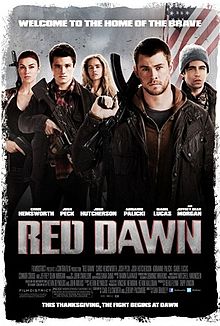
It is the tag line for the trailer for a teenage shoot-em up action thriller that opens this week. Here's the premise:

Spokane, Washington becomes the initial target of a foreign invasion. Under enemy occupation, the town's citizens are taken prisoner. A group of young people, calling themselves 'The Wolverines' (after their high school mascot), band together in the surrounding woods. There, they train and organize themselves into a group of guerrilla fighters in order to liberate their town."

I guess this one won't be playing in Gaza. Might confuse the inmates of Israel's open air prison.