Saturday, November 10, 2007

A religious enemy

Where would we be without an enemy? Certainly not willing to throw away our wealth, creative energy, and historic appreciation of the rule of law for a mess of "homeland security" and military boondoggles.

U.S. Republicans are working hard to create a properly dangerous foe out of the 1.5 billion adherents of Islam. Obviously there are terrorists in the world who trumpet that they are Muslims -- just as there are terrorists who claim to be Christians and terrorists who claim to be patriots. (Remember Eric Rudolph and Timothy McVeigh?)

Interestingly, people in the United States have proved somewhat resistant to taking up a crusade against the people of one of the world's largest religions. We require manipulation.

Pollsters and communications advisers to congressional Republicans are urging lawmakers not to follow President Bush's lead when it comes to talking about terrorists and the threat they pose to the nation.

While Bush has lightened up on using the word "Islamic" in front of terrorists, the advisers said on background that the word should always be used because Americans believe that "Islamics" are those who act on terrorist threats. Words to avoid are "Muslim," "extremist," and "radicals."

One adviser, who was part of two closed-door briefings by the consultants to GOP congressional members and aides over the past two weeks, said most Americans polled are not threatened by "Muslims" and that the words "extremist" and "radical" conjure up an image of people who make threats but don't follow through with them. "People believe terrorists act, so we should be using that instead of extremist or radicals. Calling the threat 'an Islamic terrorist' or 'al Qaeda' works better than 'Muslim radical,' " said the consultant.

Looks like this effort is making headway in some pretty scary places.

Jamil Dakwar of the ACLU has been observing the recent proceedings in Guantanamo at which one of the administration's newfangled "military commissions" found that Omar Ahmed Khadr is indeed an "unlawful military combatant." Despite numerous obstacles thrown up by the government, defense lawyers did have a chance to question the military judge, Army Col. Peter Brownback, about his impartiality.

Col. Brownback also gave an unusual answer when he was asked what he knows about al-Qaeda. He said: "al-Qaeda is an organization or a group dedicated to the spread of Islam."

Sure sounds like Col. Brownback has been slugging the koolaid -- apparently al-Qaeda = Islam; Islam = terrorism. I sure wouldn't want someone so confused and credulous as my judge. But our rulers think a guy this ignorant is highly qualified.

Friday, November 09, 2007

Long live the Doggies


The dogs were out for a ride on Valencia Street the other day. I have no idea why.

These three 7 foot high dog heads are relics of the Doggie Diner fast food restaurants that thrived back when we hadn't yet figured out that our car culture and cheap fatty meals were sure to kill us. The local chain was founded in 1949. One of these dog heads on a pole looked out from each location. When the chain failed in the 1980s, most of the heads were either destroyed or snapped up by collectors -- these must be some of those.


After dedicated struggle by preservationists, the last dog head was planted out by Ocean Beach on the median strip of Sloat Blvd. at 45th Avenue. I imagine that tourists take it for something to do with the Zoo across the street.


If those tourists care to look closely, they'll find this plaque at the base of the dog's pole. From the plaque, I learned the Doggie Diners were union shops. All the more reason to mourn that innocent era.

I've always liked the dog heads so I'm glad that Ocean Beach neighbors managed to preserve this monument to another time.

Thursday, November 08, 2007

Republican election gimmick


Darrell Issa thinks I'm an idiot. He sent me a letter. He wants my support for an idea...

Issa is the Southern California Republican Congressman who made a fortune selling car alarms after beating charges of car theft. As a politician, his claim to fame is that he bankrolled the petitions that led to the recall of Democratic Governor Gray Davis. He thought he might have a shot at being Governor himself, but was upstaged by the Terminator.

Now he is fronting for round two of the Republican party's effort to dredge some electoral votes out of the true blue state of California. That strange anachronism, the Electoral College mandated by the Constitution (remember that document?), consists of electors pledged to support the candidate who gets a majority of the state's votes. That's going to be pretty much any Democrat here, and the catch is large -- 55 electoral votes out of 538. Now the Constitution doesn't say that those votes have to be allocated on a winner take-all basis -- the state could change how they get elected. We could decide by an initiative that electors should be allocated on the basis of which candidate won in each Congressional district.

Republicans would love that. You see, California's Democratic legislators and governor began this decade by passing a redistricting that amounted to an incumbent protection plan. We get turnover in our Congressional delegation when incumbents die, or retire, or go to prison -- but not because the voters replace them (Richard Pombo in 2006, excepted) All our districts were drawn to be one-party fiefdoms and there is no reason to think they'd perform differently in the 2008 Presidential vote. So if we passed an initiative to choose electors by Congressional District, we'd be handing the Republicans 20 electors.

Not my idea of a good thing. Issa's envelope gives the game away -- an unattractive picture of Hillary Clinton was supposed to entice me to open it.

Democrats call this election gimmick the "Dirty Tricks" initiative. Some out of state Giuliani backers were pushing it several months ago, but that effort tanked. Now Issa has taken it up -- with this direct mail component that I just received. Other Democrats have also marveled at receiving this solicitation. Issa's outfit must have used a list of frequent voters for the mailing.

Polls report the "Dirty Tricks" plan is already under 50 percent. Democrats will hammer it into the ground if it makes the June ballot, though having to do that will be costly and wasteful.

Progressive attempts to rig the system to get results we like better with less effort strike me as mostly naïve, set-ups for unintended consequences. This Republican plan is just sleazy.

Wonder if Issa thinks fronting for it will boost his candidacy for Governor, after Arnold is finally out of the way?

Wednesday, November 07, 2007

What did we know? When did we know it?


Recently Sahar, an Iraqi who writes from Baghdad for McClatchy News Service reflected on a trip to the U.S.

...I came home with a better understanding of what areas need to be covered for the regular American to better understand the situation in Iraq.

I was greatly surprised that most people didn't have an inkling of what Iraq is - was. I would have thought that as the U.S was at war in Iraq, the regular American would have some idea of what Iraq had, and thus would be better equipped to assess the loss that resulted from this war - but I found that not very many people - amongst those that I met, at least, had any clear idea of the Iraqi society, and what the war has cost the country, in terms of how it affected our education system, our healthcare, services and infrastructure. And although they were aware of the statistics of the casualties lost as a result of the collapse in the security system, the figures were so high as to become surreal - they acknowledged them in their minds but couldn't actually feel them in their hearts.

Each and every person I met was compassionate and supportive - so much so that I am at a loss - if people felt like that, why isn't there an outcry so loud that policy makers have no choice but to stop and listen??

Why indeed? That is the question peace movement activists chew over endlessly. After all, at this point 60 to 70 percent of U.S. citizens want us out of Iraq -- why aren't we able to demand an end to our war more effectively?

In a commentary on books by Iraq vets, Michael Massing has some interesting suggestions about how the U.S. public filters information about Iraq that help explain the paradoxes Sahar encountered.

...the public remains ill-informed about many key aspects of the war. This is due less to any restrictions imposed by the government, or to any official management of language or image, than to controls imposed by the public itself. Americans -- reluctant to confront certain raw realities of the war -- have placed strong filters and screens on the facts and images they receive. This is particularly true regarding the conduct of U.S. troops in the field. The U.S. military in Iraq is an occupation army, and like most such forces, it has engaged in many troubling acts. With American men and women putting their lives at risk in a very hostile environment, however, the American public has little appetite for news about such acts, and so it sets limits on what it is willing to hear about them. The Press -- ever attuned to public sensitivities -- will, on occasion, test those limits, but generally respects them. The result is an unstated, unconscious, but nonetheless potent co-conspiracy between the public and the press to muffle some important truths about the war. In a disturbing twist on the Orwellian nightmare, the American people have become their own thought police, purging the news of unwanted and unwelcome features with an efficiency that government censors and military flacks can only envy. ...

... the Iraq war, like most wars, is a savage, pitiless affair in which American soldiers have been forced to do many un-American things. Most Americans prefer not to confront this. They want to be able to maintain their belief that Americans are an exceptionally virtuous, freedom-loving people and that their soldiers are a uniquely compassionate, well-meaning force. Any assertions to the contrary can rouse the beast, and the press, well aware of this, tends to tread warily around it. ...

... The books by Iraqi vets are filled with expressions of disbelief and rage at the lack of interest ordinary Americans show for what they've had to endure on the battlefield. ...

... In his reflections on politics and language, Orwell operated on the assumption that people want to know the truth. Often, though, they don't. ... The public has become its own collective Ministry of Truth -- a reality that, in many ways, is even more chilling than the one Orwell envisioned.

Strange times we live in, when we can both know and not know so completely. Filters cannot however, in the end, shield us from the karmic consequences of responsibility sloughed off.

Tuesday, November 06, 2007

Election day, 2007:
a moment for ranked choice voting


Today's San Francisco election is such a bore that I never got around to marking my "vote by mail" ballot. I'll have to drop it at a polling place.

We face the usual array of propositions. I wrote about the most important -- "Yes on A; No on H" -- previously.

But this election is notable for me mostly because, for the first time, I'll actually be using the "ranked choice voting" system we adopted in 2002 and implemented in 2004. Instead of simply electing the candidate who gets the most votes (even if their total is under 50 percent) or going on to a run off between the top two candidates, we get to list our first, second and third choices. Here's a pretty good description of how it works:

... ranked-choice voting is a series of mini-elections based on voters' one-time marking of their first, second and third choices. Should no candidate get more than 50 percent of the vote after the first-choice selections are tallied, the lowest vote-getter is eliminated. (In the past, there would have been a runoff election weeks later between the two top vote-getters.)

Now, a software program will review the second-choice picks of voters whose first preference was eliminated. Those votes are added to the tallies of the remaining candidates. The computer does another count and the process repeats itself until a candidate passes the 50 percent mark and is the winner.

Why haven't I used my ranking option before? Because I think it as a voting system designed for elections that don't matter. We have no real contest today about who is going to be elected -- no serous candidate was willing to take on our incumbent mayor. Gavin (the empty pretty boy) Newsom is never getting my vote, so I can play on this ballot by marking three of his 12 challengers. But it is all a bit of a farce, just the right time for an insubstantial gimmick like "ranked choice voting."

Let me be a little more serious here. Proponents of ranked choice or "instant runoff" voting seem to say three things about the merits of the system, only one of which makes the slightest sense to me.
  • Instant run offs save the city bundles of money we used to spend during the era when we treated November elections as a primary and required someone to get over 50 percent in a two person contest a month later. This claim is absolutely true. And as someone who worked in some of those run offs, I can testify that it is miserably difficult to keep a campaign going through Thanksgiving and almost into the Christmas season as we used to have to do. So I don't miss that long slog.
  • Some argue that ranked choice voting ensures that the winner gets elected with 50 percent of the vote. I say, so what? If this only happens because the winner picked up a lot of second and/or third choice votes, it doesn't mean that the majority of voters got the candidate they wanted. Such a victory seems no more legitimate to me than a victory with 42 percent when a majority of voters spread their votes among three or four other candidates. There's a species of innumeracy at work here that attributes magic efficacy to a formula that renders a 50 percent plus one victory, but doesn't force a candidate to win a true majority vote.
  • Finally, I've heard ranked choice voting enthusiasts, including candidates, say that the system reduces negative campaigning -- candidates have to hope to pick up some second and third choices from their opponents, so they can't risk alienating those voters by drawing a strong contrast between themselves and others in the race. Gimme a break -- democratic elections are not popularity contests for president of the Eighth Grade. They are the arena in which citizens of a democracy fight out, through proxies, the issues that determine the shape of our lives. We often disagree and have different interests. Making nice is not nearly so important as really debating those conflicts.
Ranked choice voting has appealed to progressives as somehow "cleaner" or "nicer" than good old, ordinary, messy ugly politics. But it is just a gimmick -- we'll get from democracy exactly what we put into the fight for the sort of city and society we believe in. No voting gimmick is going to bring out more poor and working people to demand their officials represent their interests -- that takes laborious, frustrating, base-building organizing, not a bright shiny voting system.

In particular, I fear this election is going to show us just how valuable those mayoral run offs in 1999 (Ammiano challenging Brown) and 2003 (Gonzales almost knocking off Newsom) were to San Francisco progressives. In 2000 and 2004, progressive candidates captured most of the Board of Supervisor seats we could ever hope to win. The experience gained and the coalitions assembled in the mayoral run offs the year before set the stage for those victories, even though our candidates lost. We'll be entering 2008 without that experience -- and with Newsom's handlers sitting on a huge war chest to aim at Board seats opened by term limits.

The progressive dream of a magic bullet to make winning elections easier attracted many to ranked choice voting. Magical thinking has been a contributing factor (among many, most more directly about money and power) in a weakening of progressive San Francisco politics.

Monday, November 05, 2007

What's the deal?


Detail from a mural in Mexico City.

Editor - Theodore Roosevelt gave us the Square Deal, Franklin Roosevelt the New Deal, and Harry Truman the Fair Deal. George W. Bush's presidency should be remembered in history as the Ordeal.
BOB SILLS, Castro Valley

San Francisco Chronicle
November 5, 2007

So long as Bush is not remembered as imitating this guy...


Update: November 6, 2007
Seems Juan Cole has been thinking along these lines as well.

If Bush and Cheney are ever tempted into extreme measures in the United States, Musharraf has provided a template for how it would unfold. Maintain you are moving against terrorists and extremists, but actually move against the rule of law. [Barnett] Rubin has accepted the suggested term of "lawfare" to describe this kind of warfare by executive order.

Call me crazy, but I wonder about our future.

Sunday, November 04, 2007

More on St. Luke's hospital closure


The sad looking woman in the photo above was staffing a table at 24th Street and Mission on last Friday, offering health information from California Pacific Medical Center (CPMC)/Sutter Health. Her health outreach materials were all in Spanish. A questionnaire sought opinions on what services were most important to passersby -- and offered, among other options, information about St. Lukes Hospital.

But only two weeks ago CPMC announced that it was shutting down the money losing St. Luke's facility in the Mission. Opponents of the closure quickly discovered unearthed evidence that the impact of CPMC's plan would be to dump most of their Black, Brown and charity care patients. CPMC wants to build yet another North of Market Street hospital on Cathedral Hill, while leaving the South of Market area entirely to the care of the over-crowded, under-funded county hospital.

Was CPMC perhaps stung by disclosure of the racial and class impact of its plans? This young woman didn't know -- she had not been told that St. Lukes Hospital, which she was for all practical purposes promoting, was about to be closed. Her job was to invite Mission residents to a health fair -- a health fair to take place miles across town in the well-off Marina district.

She was very nice -- and I thought she was being misused.

***
On Sunday, a St. Luke's emergency room doctor, Marc A. Snyder, wrote the Chronicle, about CPMC's planned closure:

As an emergency physician who has practiced at St. Luke's Hospital for 25 years, I have concerns about some of the comments made about the plans for ambulatory care at St. Luke's. ...

The notion that 85 percent of our emergency department's patients could be handled by an urgent care center is ludicrous. Our department does have an urgent care area, staffed by a physician assistant 12 hours a day, but 80 percent of our patients are triaged to the acute side.

We have only seven rooms, but three have two patients each, separated by a curtain. Despite these 10 beds, we still frequently have two or three additional sick patients on gurneys in the hallway, a dangerous situation of overcrowding linked most commonly to ambulance diversion from San Francisco General Hospital (18 percent of the time). ...

The plan to close St. Luke's in 2009 will leave San Francisco with one overcrowded hospital South of Market. I don't think that this is a smart plan for the future of acute health care in the City.

St. Luke's is receiving the overflow from the country hospital emergency room. Where would those people go if St. Luke's is closed?

The San Francisco Health Commission will be holding a hearing about CPMC's plan to close St. Luke's on November 13, 3 PM, 101 Grove St., Room 300. The Saving St. Luke's Blog will have updates.

Saturday, November 03, 2007

Dia de los Muertos, San Francisco


SFMike was right. Killed off by too much of a good thing in the Castro, the spirit of Halloween was all over in the Mission District last night at the Dia de los Muertos (Day of the Dead) procession.

Unusually warm late fall weather (no fog!) on a Friday night drew an enormous, friendly crowd to this Aztec-themed parade.


I'd forgotten how pleasant it was to be part of a happy crowd at night. People had worked on expressing themselves in semi-traditional costumes.


There were wonderful sights and sounds -- and it could seem a little scary.


Face painting was available.


And many in white-face were having a great time ...


... as were the many undead taking to the streets.


The police were friendly, but seemed a little confused by the crowds. I hope this annual procession has not outgrown the capacity of the neighborhood to accommodate the visitors. I overheard a couple of blonde women working their way through the crowds on 24th Street commenting: "I wouldn't want this in my neighborhood." We're not there yet, not even close.

One of the many hole-in-the-wall Mexican eateries on the street advertised "Special menu for Dia de los Muertos" -- chile rellenos $10.00. The dead are a boon to this community.

I left pretty early and later heard sirens; hope nothing too bad was going on.

This morning the SF Chronicle reports that some Castro merchants are having second thoughts about what they lose by closing down Halloween in the gay Mecca.

"I'm not shutting down the neighborhood again," [Supervisor Bevan] Dufty said Friday, acknowledging that the city's request cost some owners tens of thousands of dollars in revenue.

Hey Dufty -- unless this celebration gets super huge, we''re happy to have the party over here in the 'hood!

Friday, November 02, 2007

Who lives ... who dies

The Feast of All Souls celebrated at church last night and the Mission District celebration of the Day of the Dead that I'll attend tonight both remind me to reflect on those who have died. I keep coming back to an awareness that we -- contemporary people in the rich parts of the world -- live with an expectation about who lives that would seem extremely foreign (and happy) to most of humans during in history. That is, when a child is born, we assume the baby will live.

Not so until very recent human history. An interesting survey of the history of infant (under 1 year) and child (under 5 years) mortality reports:

In 1661, John Graunt examined English bills of mortality and concluded that "one third of all that were ever quick, die under five years old."

... Before 1850, infant deaths were commonly accepted as a part of everyday life, a reflection of the natural order in which the strong outlived the weak. In the latter half of the century, however, families began to value children as more than an economic resource, and infant deaths no longer seemed acceptable. Reformers believed that all children deserved to be protected from the ravages of poverty and unsanitary living conditions.
... Far from being a natural state of affairs, the high urban death rate reflected a society's moral standing.

According to the same article, as late as 1911, the United States had an infant mortality rate of 135 infant deaths per 1000 live births. Only three countries today, Angola, Afghanistan, and Mozambique, exceed that rate of infant deaths.

Kul C. Gautam of UNICEF puts contemporary child mortality rates [pdf] in perspective:

The association between poverty and child mortality has long been recognized. Indeed U5MR [under age 5 mortality rate] is often an excellent proxy indicator for the measurement of poverty. Over 90 percent of the world’s child deaths occur in 60 countries – all of which are low income or least developed countries, or the poorest areas of middle-income countries. ... These same countries also account for the vast majority of maternal deaths, malnutrition and lack of safe drinking water and sanitation.

Gautam points out that the UN Millennium Development Goals, not only by directly working for children's health, but also by empowering women and improving sanitation, amount to a map for reducing deaths among children.
***
Last summer I visited a cemetery where many of my ancestors are buried. What struck me, that I had not properly noticed before, was how many of the headstones marked the graves of children who never grew to adulthood. The grieving parents erected quite elaborate monuments. Here are some of them:


The parents of the Bemis infant twins above not only listed them on the large family monument, but also set up their own little stones, below.


Arthur and Charlotte were my mother's siblings, born and died before she was born.


My Aunt Steva's child never even received a name.


Even in the middle of the last century. ...And today...

America may be the world’s superpower, but its survival rate for newborn babies ranks near the bottom among modern nations, better only than Latvia.

Among 33 industrialized nations, the United States is tied with Hungary, Malta, Poland and Slovakia with a death rate of nearly 5 per 1,000 babies, according to a new report. Latvia’s rate is 6 per 1,000. ...

The U.S. ranking is driven partly by racial and income health care disparities.

Associated Press
May 9, 2006


Thursday, November 01, 2007

Pain


A friend of mine is suffering terrible pain in a hospital nearby today. In fact the hospital is inflicting this pain on her, though the medical personnel certainly bear her no ill will. You see, she's one of a class of people that the U.S. healthcare "system" routinely fails.

Oddly enough, her problem is not a simple matter of lack of access. She gets to doctors and into hospitals when she needs to -- but what happens then sometimes only makes her suffering worse.

Ten years ago, she was in a terrible auto accident; in addition to being thrown head first through a windshield, she broke multiple bones. After months in hospitals, she emerged with greatly reduced mobility and chronic pain. Other ailments followed in a downward spiral. And the pain never went away.

Naturally she lost all ability to earn a living and found herself on federal and state disability. She is very good at being poor, at finding what services exist, at cutting through bureaucracies, at making friends who will help and at demanding that she get whatever she can from medical providers. She works very hard at being poor.

She currently has an infection that won't heal. She tried calling her primary care doctor. She couldn't get a response. She got herself to an outpatient clinic. The prescription offered didn't work. Finally, after weeks, she dragged herself to a university medical center's emergency room. The ER took her in, recognized the severity of her infection and admitted her.

But, although she has a case record with this medical facility that is literally 2 feet high when printed out, the doctors are treating the infection but not the pain. They refuse to believe that she might, habitually, under her personal doctor's orders, take such high doses of pain medicine that any of the rest of us would drop dead if we ingested it. But she does. And she needs it. That medicine is what keeps her on a moderately even keel.

Today my friend is suffering, needlessly, in one of the best medical facilities in San Francisco. The doctors -- all new to her case of course -- will not allow her to have her normal dosage of pain medicine. She says this "cure" is worse than the infection that sent her to the hospital in the first place.

Apparently this kind of doctor and hospital inflicted pain is not uncommon. Jane Brody, the fitness and health editor of the New York Times had a similar problem after knee surgery. She suffered horrible on-going pain -- and her doctors hadn't a clue what to do for her. Some tidbits from her story (my emphasis):

Pain management is not generally taught as a part of medical education, not even to residents in orthopedic surgery. As a result, most doctors are clueless or unnecessarily cautious about treating pain, especially chronic pain like that caused by incurable neurological or muscular disorders. ...

... I complained about the severity of my pain, which had me crying for several hours a day [yes -- sounds like my friend] ...

When, at seven weeks after surgery, I spoke to Dr. [Jennifer P.] Schneider, a Tucson-based specialist in pain management and addiction medicine, she chastised me for not being more insistent about getting adequate pain relief. The trouble is, when you're experiencing intense pain, it's hard to be proactive about anything.

I know now from speaking with several doctors who routinely treat chronic pain patients that my story is hardly unique. Millions of people suffer needlessly year after year because their doctors do not know how to treat pain properly and don't refer patients to doctors who do know.

Many doctors are afraid to prescribe narcotic drugs like oxycodone, fearing they will create addiction problems. But that in fact rarely happens to chronic pain patients who don't have a history of addiction....

Furthermore, undertreatment of pain can actually cause a chronic problem when the nervous system changes in response to continuing pain signals. Nerves can become permanently hypersensitive to painful and nonpainful stimuli, like touch or vibration. With chronically undertreated pain, the painful area can also spread well beyond the original injured site...[yes-- that is my friend; the barest touch hurts her.]

"The way to prevent this undesirable outcome is to avoid repeated pain signals," Dr. Schneider said. ...

Surgeons may know a great deal about cutting, repairing and sewing up, but they are not experts on pain control, though I think they should be. I know of an orthopedic surgeon in New Jersey who won't see his knee replacement patients for two months after surgery because he doesn't want to see them when they're suffering. ...

First and foremost, patients need to be proactive and insist on the help they need. If patients are not able to do this for themselves, an advocate should do it for them.

Second, every person with prolonged or chronic pain should become educated about the huge range of medications, therapies and complementary remedies available to treat pain.

Good advice and I sure hope I can take it if I need it. But what good is that advice to a poor, severely disabled woman caught in the impersonal wringer of a medical center that neither respects nor believes her?

Wednesday, October 31, 2007

Torture: our peculiar peccadillo?


Pools used for water torture preserved in the museum of the Guardia Nacional in Leon, Nicaragua. The Nicaraguan dictatorship that used these facilities was overthrown by a populist revolution in 1979. The U.S. spent the next ten years working to overthrow that revolution.

As we contemplate the confirmation process for an Attorney General nominee who cannot bring himself to repudiate U.S. use of torture, it is worth taking a step back and attending to how the world sees torture and the United States' place in the international effort to encourage respect for human rights.

We can't pretend the U.S. doesn't have history of practicing torture. As Tom Engelhardt has pointed out

It wasn't, of course, that the U.S. had never imprisoned anyone abroad and certainly not that the U.S. had never used torture abroad. Water-boarding, for instance, was first employed by U.S. soldiers in the Philippine Insurrection at the dawn of the previous century; torture was widely used and taught by CIA and other American operatives in Vietnam in the 1960s and 1970s, as well as in Latin America in the 1970s and 1980s, and elsewhere. But American presidents didn't then see the bragging rights in such acts...

...the top officials of the Bush administration believed torture to be the royal road to their ultimate dream of unconstrained power...

The United Nations has an official whose job is to wander the world, visiting prisons and detention centers and issuing reports when mistreatment is alleged. He carries the unwieldy title of "Special Rapporteur on torture and other cruel, inhuman or degrading treatment or punishment." The incumbent rapporteur, Manfred Nowak, is an Austrian human rights lawyer. As he explained to Der Spiegel, being the U.N.'s man on the torture beat is a pretty ghastly job.

in the Nigerian city of Lagos, where the United Nations special rapporteur on torture and his team carried out a surprise inspection of a police station that had given itself the rather lofty title of a detention center. "I've never seen anything like it," Nowak says. "Between 100 and 120 severely tortured people crowded closely together. Three women among them, and children too -- the oldest aged 14. Men with untreated gunshot wounds and limbs that were literally rotting -- a common torture method in Nigeria."

No one was expecting him when he showed up at the police headquarters in Amman on the last day of his visit to Jordan. He ordered a secret cell to be opened. Behind the door lay a prisoner "in a terrible condition." He had been suspended above the ground by his wrists, which had been tied behind his back -- a classic torture method dating back to the Middle Ages. "He could no longer stand, walk or anything," Nowak says. "In these types of cases, emotional distance is impossible. You're fully involved." ...

But, as a European, he is most distressed by the behavior of the countries he identifies with:

Torture is still "considered a peccadillo," he says, adding that this is now the case "even in developed countries." ...

Ever since former US Secretary of Defense Donald Rumsfeld authorized the use of so-called "enhanced interrogation" techniques in Abu Ghraib, "the United States has lost its moral leadership and authority," Nowak believes. "Today, when the Bush administration criticizes other countries for their human rights abuses, no one takes them seriously anymore."

But Europe has not succeeded in taking the place of the United States as the "driving force when it comes to human rights," the lawyer says. On the contrary, he believes the European Union is "seriously tarnished." European governments' cooperation with the CIA in the war on terror and their denial of secret detainee renditions and prison camps has weakened the EU, according to Nowak.

On occasion, Nowak has been even more pointed in his criticism of the United State's adoption of torture. This week he released his findings that torture is routine and widespread in Sri Lanka -- and emphasized how U.S. practices lend support to torture regimes.

The United States's willingness to resort to harsh interrogation techniques in its so-called war on terror undermined human rights and the international ban on torture, a United Nations spokesman says. ...

"I am very concerned about the undermining of the absolute prohibition of torture by interrogation methods themselves in Abu Grahib, in Guantanamo Bay and others, but also by rendition and the whole CIA secret places of detention. All that is really undermining the international rule of law in general and human rights but also the prohibition of torture," said Mr Nowak.

"(Other countries) say why are you criticising us if the US, the most democratic country with the oldest history of human rights, if they are torturing you should first go there. It has a negative effect because the US is a very powerful and important country and many other countries take the US as a model."

Sydney [Australia] Morning Herald
October 30, 2007

I'm afraid the answer to the question Nowak can't answer is that U.S. adoption of torture signals that it should no longer claim to be "democratic country."

We can hold all the elections we want, but if the people can't reign in the torturers -- if the people will not or can not lay down a moral and legal line that defines torture as intrinsically unconscionable, criminal -- our "democratic" model is definitively useless and dead.

Tuesday, October 30, 2007

A time of crime

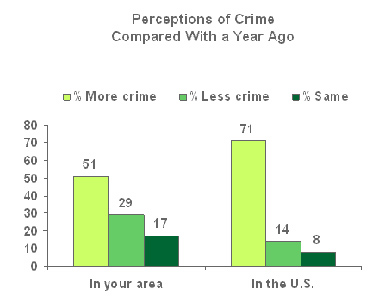
The Gallup opinion research outfit reports a paradox:

more-crime-national.jpg
Fully 71 percent of us think crime is rising nationally and slightly over half are sure that it rising locally.

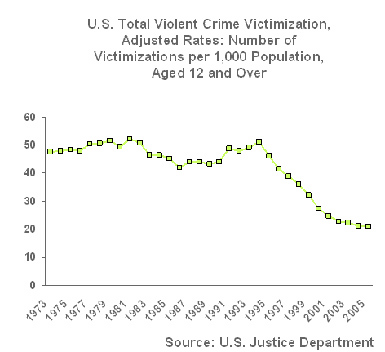
crime-rate-falls.jpg
Meanwhile the Department of Justice reports that violent crime has been declining for ten years.

What's up? Gallup opines

Americans' pessimism about crime may reflect an overly negative interpretation on their part of the fact that the decline in crime has tapered off. It could possibly reflect a real increase in media attention to crime on the local and national news. Or it could reflect Americans' broader dissatisfaction with the way things are going in the country, a sentiment that extends from ratings of President Bush and Congress to the economy, as well as to their satisfaction with the direction of the country more generally.

I don't think Gallup is doing anything more grounded than indulging in speculation in those suggestions, so I'll offer a few of my own.
  • When CSI and imitators have been the preponderant content of evening entertainment for several years, is it surprising that folks believe there must be criminals under their beds?
  • When local TV news has reduced its content to traffic accidents, fires and murders, perhaps it is to be expected that people think violence is rising.
  • When the mere presence of an immigrant low wage work force is considered a crime by many people, does the growing visibility and ubiquity of immigrants lead to a belief in rising crime?
  • When local media outlets crusade for prosecution of nuisance offenses so as to lock homeless people up out of sight, is it any wonder that people feel surrounded by crime?
  • When young people in poor neighborhoods really do have to fear encountering gun play on the way to school, it's no accident that they and their parents fear rising crime.
  • When the U.S. government invades countries without legal justification, when the Republican party's entire campaign strategy is to hype fear of terrorists, is it any wonder that people think criminality is increasing?
We are living a lawless place and time -- and we know it. And we don't like it. Politics is, among other things, an argument about what a law respecting society would look like.

Hat tip to Chris Kromm at Facing South for pointing out this survey.

Monday, October 29, 2007

Barack Obama is not brave

Back in 1970's three visionary African American women, Gloria T. Hull, Patricia Bell Scott, and Barbara Smith, published a ground-breaking anthology titled: All the Women are White, All the Blacks are Men, But Some of Us Are Brave: Black Women's Studies. That title vividly illustrates how people who live inside multiple identities all of which are concurrently struggling for their rightful dignity and place can find themselves erased from all directions.

Seeking to endear himself to black evangelicals, Obama has enthusiasticly endorsed of the "inspirational talent" of an "ex-gay" African American gospel singer. Evidently his campaign didn't include any black, gay, Christians though such people certainly exist. If Obama and his people actually knew such individuals, if they had listened to such individuals, they'd have had a harder time adding up constituencies and trying to buy a sector by offering token representation. Human realities are too complex for such stereotyping -- and nothing pains and infuriates any of us more than having our lived identities thoughtlessly erased.

I have no doubt that Obama is not personally homophobic, whatever than means. But his campaign practices a mechanical adding and subtracting of identity constituencies that is certainly not any kind of "new, post-partisan politics." And in this instance, the politics of the campaign were homophobic, especially toward black, Christian LGBT people.

And on an old politics note (courtesy of Pam Spaulding), what were Obama's people thinking when they headlined a performer who hailed Bush at the 2004 Republican convention?

No, Obama is not brave. The recent South Carolina fiasco can more accurately be called "stupid."

Healthcare racism: Scrubbing Sutter white


On October 19, Sutter Health/California Pacific Medical Center (CPMC) announced it would shut down in-patient care at St. Luke's Hospital in the Mission district of San Francisco. At a city Supervisor's hearing last Thursday, the profitable hospital corporation was the object of withering criticism from doctors, community members and elected officials.

Supervisor Tom Ammiano delivered a [sharp] rebuke, accusing hospital officials of dispensing snake oil and failing to provide adequate charity care to the poor and uninsured.

The California Nurses Association, which represents nurses at St. Luke's, has unearthed statistics from the Office of Statewide Health
Planning and Development
showing that the effect of closing St. Luke's would be, quite simply, getting CPMC out of the business of caring for Black and Brown people.

  • 40 percent of in-patient hospital discharges at St. Luke's are Hispanic patients - compared to just 1 percent of CPMC discharges.
  • 54 percent of emergency room visits at St. Luke's are Hispanic or African-American patients - compared to just 8 percent of ER visits at CPMC.
Not too surprisingly, the data CNA presents also show that, in comparison to CPMC's facilities in the north and west of the city, St. Luke's patients are far more likely to be on Medi-Cal than private insurance plans and far more likely to live in the Mission and adjoining Bayview districts.

Sutter/CPMC is trying to dump its money-losing poor Black and Brown patients. How much longer will we tolerate profiteering in "healthcare"?

Saturday, October 27, 2007

Skeletons came out of closet ...


...at today's peace march in San Francisco. Immunity for the telecommunications companies was not popular with the antiwar crowd. Neither were spineless, Bush-enabling Democrats.

Friday, October 26, 2007

Friday cat blogging:
Kittens against impending homelessness

My neighbors are being forced out of their home of the last twenty years. Theirs is a commonplace San Francisco situation. The building is old; the former owner was ancient (really, over 100); the tenants never asked for any upgrades or even repairs; and their rents, stabilized by inertia and legal limits on increases, gradually fell way below what the market would bear. When the landlady died, the heirs looked at this piece of San Francisco property and said to themselves "goldmine -- but only if we can get rid of the tenants." The tenants have some legal protections, but over the next year or so, through tortuous legal processes that may eventually lead to cash payments, they are going to be booted out.

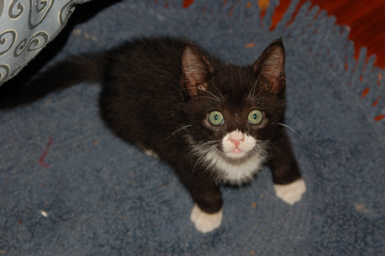
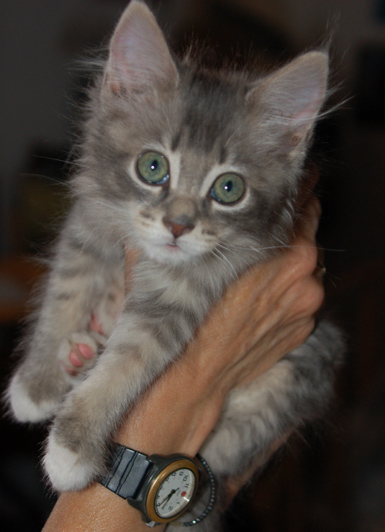
So how did one of the tenants respond to the prospect of losing her home? She became a "foster parent" to homeless kittens. Her task is to spend six weeks loving and handling the offspring of feral cats for Animal Control so that the kittens become ready for adoption. How about these charmers?

3kitten.jpg

1kitten.jpg

2kitten.jpg

Not the worst companions when faced with the loss of your home.

Thursday, October 25, 2007

Volunteering: for pay and/or for community


Volunteers in Florida during the 2004 election.

This week the New York Times published a very interesting article, "For Love and a Little Money." Here's the author's conclusion in a nutshell; we are becoming a culture of:

paid volunteerism. The phrase may sound oxymoronic, but an ever-growing number of retirees and nonprofit executives say it is an apt description of the way modern retirees view nonprofit work. And while no one has gathered statistics on the tendency, experts say there is a good chance that the automatic link between doing good and working for nothing has been permanently severed.

A lot of reporter Claudia H. Deutsch's observations seem astute and worth sharing.

  • "Even a small check is a symbol that what they are doing really makes a difference," said Ben Rosen, a management professor at the University of North Carolina's Kenan-Flagler Business School. Mr. Freedman thinks that is particularly true of women. "Volunteer work used to be considered women's work, so it is not surprising that career women reject the concept," he said.
  • Greg O'Neill, director of the National Academy on an Aging Society, suggests yet another reason: paid workers are less likely to be assigned to licking stamps or ladling soup.
  • "Savvy people have learned that they are used more intelligently when they are paid."
  • Many retirees have learned, to their irritation, that what they give free is discounted as fluff. Ten years ago, Fabianne Wolff Gershon, now a retired public relations executive, did a pro bono marketing plan for a local botanical garden. It was never carried out. "I made a mental note: If they had paid for the report, they would have taken it seriously," Ms. Gershon said.
  • There is, of course, a potential downside to the trend. Once payment becomes the norm, fewer people are likely to volunteer their services free — which could be a problem in a budget crisis. ...[And] "attaching payment to a job turns it into work."
Deutsch is writing, largely, about retired, economically comfortable, older "volunteers". These folks are no dummies.

Something similar goes on in "youth leadership development." To be sure about this, yesterday I checked with a friend whose nonprofit organizes young people to do political advocacy; he reports, yes, foundations, are willing and consider it customary to fund stipends for participants in youth programs. (My friend would want me to mention this practice is not universal; his group works with scores of young "leaders" who are unpaid.) So the "link between doing good and working for nothing" is under strain there too.

What does this trend mean for political campaigns? A great deal I think. Democracy depends on citizen participation, but media and professional campaign consultants treat campaigns as spectator sports. Not surprisingly, so do most citizens. In many circumstances, recruiting campaign volunteers can feel like pulling teeth. Once we get them, we need to make sure we treat them respectfully and enable them to feel their work was useful. And then the money issue comes in.

For some years now, I've been training community groups on how activate their memberships in political campaigns. Many of these groups are hesitant about electoral work, fearing that elections distract them from their own priorities and place them in an arena that's unfamiliar and corrupt. Most of these groups work with low-income people. For training, I've come up with an exercise in which trainees are asked to develop a skit illustrating their response to a situation I've actually seen in a campaign. I've got quite a few situations, but recently I've always included this one:

You've done your planning, you know your organizational goals for this election, members have been recruited and trained, and THEN you confront this situation:

You've been out talking with voters for a couple of weeks. Your members are learning to doorknock effectively about your election issues. Suddenly "Canvass/Victory in 2008" is offering $200 a day to your members to canvas for them. Not surprisingly, many of your members who need the money want to go get paid instead of working on your organization's canvass. What do you do?

To be honest, groups don't usually come up with very creative responses to this hypothetical situation. There aren't a lot.

And yet historically political activity that changes the national trajectory has come down to people acting out of some combination of passionate belief and personal necessity. Votes for women, racial equality under law, gay rights -- these things were not won by paid volunteers and campaign consultants. Not only won't the revolution be televised -- it won't pay most of its activists either. In our consumer society, we need to cultivate an understanding that the most vital social activities are those we do "for nothing," for preservation and extension of the hope for community.

Wednesday, October 24, 2007

Holy Land Foundation trial:
Jury opts for acquittals, maybe


Juries fascinate me. I'm frequently -- yearly -- called for jury duty and remain certain I'll never be seated. But even my short exposure to a succession of jury examinations has convinced me that there is something about the experience that can, sometimes, bring out the best in us as citizens. I've told the story of one such episode here.

On Monday, a federal jury in Dallas reported out numerous acquittals and several failures to reach a verdict in the trial of the Holy Land Foundation and its executives on various charges of funding terrorism. The Texas-based Muslim foundation had been under federal investigation for many years -- some of the charges dated back to before the Palestinian Hamas movement that allegedly benefited from the charithad even been declared a terrorist organization. None of the charges suggested Holy Land's contributions paid for guns and bombs; they paid for clinics and schools, but that propped up "terrorism."
For a few moments in the courtroom, it seemed that the jurors had resoundingly rejected the government's theory of guilt -- and then some jurors protested that they hadn't voted as they indicated on the signed jury statement. The judge declared a mistrial and the feds say they'll try again.

So what came out of this bizarre trial and its aftermath? There are a lot of different points of view. I've compiled some here.

"I think it is a huge defeat for the government," said David Cole, a Georgetown University law professor specializing in 1st Amendment cases and terrorism prosecutions.

"They spent almost 15 years investigating this group, seized all their records and had extensive wiretapping and yet could not obtain a single conviction on charges of supporting a terrorist organization."

Los Angeles Times
October 23, 2007

Dennis Lormel, who created the FBI's Terrorist Financing Operations Section and is now a terrorism consultant, said the collapse of the trial is a blow, but far from a death knell for similar cases.

"Obviously, it's a disappointment," he said. "But this should have no effect on the overall war on terror or terrorism financing. Regardless of the guilt or innocence, that charity was used to provide Hamas with funding. The government already won in this case, in that this charity's assets were frozen and that kept them from sending more money. At trial, your standard is different, and they didn't prove it beyond a reasonable doubt."

... Counterterrorism expert Fred Burton, vice president for counterterrorism and corporate security at Austin-based Stratfor, a private intelligence firm, said it's best to view the prosecution as part of a disruption strategy. The verdict didn't come out as hoped, but "you have in essence tied this organization up in knots for a long time."

Dallas Morning News
October 23, 2007

The decision is "a stunning setback for the government, there's no other way of looking at it," said Matthew D. Orwig, a partner at Sonnenschein Nath & Rosenthal here who was, until recently, United States attorney for the Eastern District of Texas.

"This is a message, a two-by-four in the middle of the forehead," said Mr. Orwig, who was appointed by President Bush and served on the United States attorney general's advisory subcommittee on terrorism and national security. "If this doesn't get their attention, they are just in complete denial," he said of Justice Department officials, who he said might not have recognized how difficult such cases are to prosecute.

New York Times
October 23, 2007

"This case shows that we have not done our homework," said Karen Greenberg, executive director of New York University's Center for Law and Security. "It's conveying an impression to the American people that we don't know how to do this." ...

Studies by the NYU center over the six years to September 2007 found that of 619 defendants in federal cases potentially involving terrorism, 196 were indicted on actual terrorism charges.

Greenberg said this relatively small share indicated prosecutors were either chasing the wrong suspects or using the wrong laws. ...

Of the 196 terrorism defendants, 62 have been convicted, according to NYU center figures. Only one case, the conviction last year of Pakistani immigrant Shahawar Martin Siraj for planning to bomb a New York subway station, involved the archetypal terrorism scenario of a suspected clandestine cell seeking to carry out an attack on U.S. soil, the center said.

Reuters
October 23, 2007

The government's case was a sweeping, if ultimately unpersuasive, indictment of a charity organization that had been under scrutiny for about 14 years. It was also a legal stretch from the start. The indictment essentially conceded that the money HLF donated was used to build hospitals and aid the poor, yet it accused the charity and its officers and fund-raisers of aiding a terrorist organization by helping it spread its ideology and recruit members. Translation: Even those who support good works are guilty of terrorism if the good works make the terrorists look good.

... the jury utterly rejected the essence of the government's theory of prosecution. A brief review of similar cases, however, suggests that the case is far from over. The government is unlikely to find in the verdict a reason to question its approach, or to hesitate to bring these sorts of cases in the future. The reality of federal criminal prosecution is that even when juries are deeply skeptical of government overreaching, in the end, the relentless might of the government almost always leaves those it prosecutes bankrupt and incarcerated....

David Feige
Slate

All praise to God, this trial is the biggest trial against a Muslim charity in the history of the US, and today I feel that there is hope people are still capable of thinking and utilizing their god gifted talents of analyzing the facts and not playing with the lives of innocent people who are just being wrongfully charged for helping orphans and widows.

Dr. Asma Salam
Texas Civil Rights Review

One Holy Land Foundation case juror told The Associated Press, "I thought they were not guilty across the board. Juror William Neal added that the case "was strung together with macaroni noodles. There was so little evidence." He said the government "really used fear" to try to sway the jury.

This was a classic case of guilt by association and a political vendetta against American citizens to carry out the agenda of a special interest group -- the Israel lobby.

Parvez Ahmed,
Tracy Press,
October 24, 2007

The United States of America, for all of its current and past ignominious trampling on the rights of the weak (whether or not we want to own up to that truth) still has a paradigm of value hidden in our collective memory (or at least in our deepest desires) to look to for guidance. It is a paradigm of equality and liberty that very few of us ever really experience, equality and liberty whose very names were penned by a man who owned slaves; equality and liberty in the name of which our ancestors drove indigenous peoples from their lands; equality and liberty in the name of which, in our lifetime, we insisted that our brothers and sisters of Japanese ancestry be herded up and sent off to desert camps; equality and liberty in the name of which many now hold Muslim Americans and Arab Americans in suspicion and hatred. But they are equality and liberty that are larger than our weakness, equality and liberty that are stronger than our prejudices, equality and liberty that will last longer than our selfishness, our fear, and our pride.

We are still growing into the equality and liberty that Mr. Jefferson said we hold to be self-evident (if they are so obvious, why are they so amorphous as to disappear when we need them most?). Mr. Jefferson wrote better than he knew or acted, and we read his words better than we understand or fulfill.

But once in awhile, in spite of ourselves, a glimpse of equality and liberty breaks through. It may be in the unsatisfactory verdict of "mistrial." It may appear at a moment when the "system" seems to have broken down. It may be, no, it almost certainly will be, in a situation over which we think control is lost.

Harold Knight
THE ENEMY SHALL NOT OUTWIT HIM
A blog that has followed the trial

I'm neither as encouraged as Mr. Knight nor as pessimistic as Mr. Feige at the trial's outcome. But I am reminded that "it's never over til it is over."