Showing posts with label Nicaragua. Show all posts

Monday, March 09, 2026

Liz Specht –1929-2026

There was a lot of life in those long years: wife and partner to Eddie Specht for over 70 of them, mother to three children in the 1950s, doting on many grandchildren and a great grandchild, faithfully seeking to encounter a living God through an Episcopal path, and abiding as a "deacon of the earth" always.

Emerging from Grosse Pointe, Michigan and Wellesley College, she gave so much in that life: founding a tutoring program for San Francisco Mission District kids that grew up to be Mission Graduates and also an international aid nonprofit, El Porvenir, which works with Nicaraguans to bring clean water to rural Nicaragua. To the last, she was engaged in civic activism with her Mill Valley community.

For many years, Liz and Ed lived on a boat in Alameda, California. You might notice that water was a theme in this life.

Working a winch on a catamaran off Belize in 2004


Riding a pony across a Nicaraguan stream in 2018

Pensive alongside the Mill Valley Cascade in 2025

Out for a short walk at the beginning of March 2026

She was gentle, curious, thoughtful, determined and sometimes fierce. Many loved her; she gave love to many.

Tuesday, May 28, 2024

We can help with this!

 
Can you imagine being a young woman who is just getting her first period -- and there is no running water in your home or anywhere nearby? Far too many rural Nicaraguans live like that. El Porvenir helps such communities to help themselves -- digging wells, building water systems, improving watersheds. 
On May 28th, we celebrate Menstrual Hygiene Day, a day dedicated to dispelling myths and misconceptions that affect the lives of many girls in Nicaraguan communities. Our menstrual hygiene program includes conducting workshops, giving talks in schools, and setting up school hygiene corners (areas in the classroom with hygiene products like soap, toilet paper, and pads.) Our program aims to dismantle these barriers so girls can learn about menstrual hygiene and lead healthier lives.
 You can help. Please contribute today.

Friday, March 22, 2024

World Water Day

Like too much of the planet, a combination of oligarchic rapacity -- rich families cutting timber and grazing life stock, mostly -- and climate warming has destroyed half of Nicaragua's forests over the last 50 years. Rural people compound environmental damage as they scour the land for firewood to fuel wood burning cook stoves.

Without healthy forests, clean water becomes more scarce, trickling away as run off. Communities are left with less arable fields and simply less water to sustain lives.

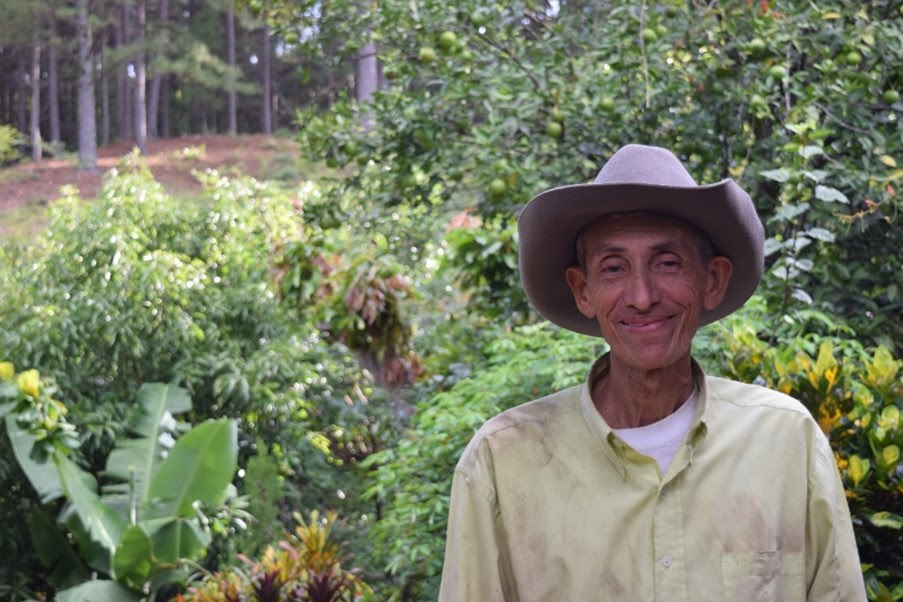
Pastor and his family now practice agroforestry, have orchards, and set up a local seed bank. "...We see that as the future for our children so they will have good land to work on.”

El Porvenir has been helping rural Nicaraguans improve their access to clean water since 1990. Where once that work consisted in digging more and deeper wells, today much of the organization's effort has turned to helping communities preserve sustainable water sources by improving whole watersheds.

What's that mean? Mostly, it means smart planting and tending of young trees. Healthier forests help improve adjacent crop yields. Conservation preserves water sources for future generations.

You can help improve Nicaraguan watersheds and the lives of rural communities with any contribution to El Porvenir's watershed improvements campaign.

Tuesday, October 10, 2023

Making a big difference where even a little helps a lot

The Nicaraguan town of Comoapa is only a couple of hours drive from the capital city of Managua, but you don't have to look far to see that many of the benefits of modern life are few and far between. Last week members of the board of the water and sanitation organization El Porvenir had the chance to see a tidbit of what our diligent local staff are accomplishing alongside the local people at one site.

 
Students and staff of the Josefa Toledo school gave us a warm welcome.
 
Thanks to our help and the community's efforts, they now have brand new, sustainable, latrines -- one each for boys, girls, and staff.

 
The inspirational mural on the doors was their idea. These young people are being taught to love and preserve their beautiful countryside.
 
What visit from faraway strangers would be complete without some folkloric dances?

The mission of El Porvenir is inspiring:
We believe all people deserve clean water, safe sanitation, and the knowledge to sustain it for the generations to follow. We partner with the people of Nicaragua to build a better future for themselves through the sustainable development of Water, Sanitation, and Hygiene (WASH) education projects.
We also take it a step further with our watershed management program, which promotes water flow, increases food security, and reduces the impact of climate change.
Clean drinking water for all Nicaraguans—no matter how remote or how bad the road is—is at the core of everything we do, now and into the FUTURE.

Sunday, December 11, 2022

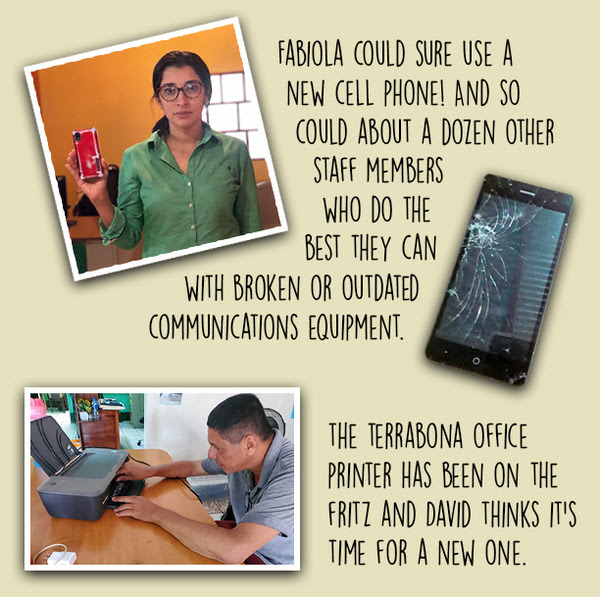
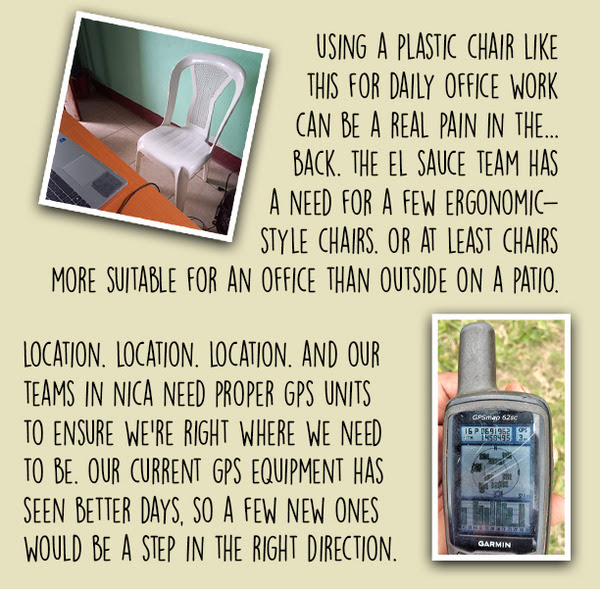
Specific requests for the season of giving

As so many friends who see these posts know, I'm a longtime supporter of El Porvenir, a grassroots partnership between rural Nicaraguans and North Americans (and others) working to bring comprehensive clean water projects to the countryside.

This year, in this daunting season of fund appeals, the Nicaraguan staff (which is most all the staff) shared what they really need for Christmas.

* * *
* * *
 
I promise you that your donations go a long way in a country where people fix, repair, and carry on despite poverty and isolation from the world economy. El Porvenir offers many ways for those of us more fortunate to assist Nicaraguans. Let's get these hard working folks what they need.

Friday, August 05, 2022

Nicaraguans also want a better future

 
For today I'll be thinking not about winning our campaign to keep Nevada blue, but about another vital project: helping Nicaraguans help themselves to improve water quality and sanitation in the kind of communities you find at the ends of the roads in the countryside. El Porvenir is having its annual board retreat. 
 
Via Zoom, as we do these things these days.

Take a look at the video. Any donation you make to El Porvenir goes right to aiding the people you see in this short film.

Monday, October 04, 2021

What El Porvenir works to end ...

Picking up the daily water supply is a long and arduous job for rural women in Nicaragua. Their lives don't have to be that hard. Go along on this woman's daily task in this video -- and then visit El Porvenir to help out!

Monday, November 16, 2020

Praying for Nicaraguans under the storm

This hurricane, like the last, is crashing through the Atlantic coast of that suffering country -- and on into the rest of Central America. Nicaragua is thought to be responsible for .2 percent of global carbon emissions, but currently is on the wrong end of a less and less stable climate.

Sunday, October 11, 2020

Water is the strangest thing on earth ... and throughout the universe

Really. Watch this from the BBC.

Science journalist Alok Jha marvels:

"all of the water on earth is alien ... the water arrived from asteroids and comets from the edges of space..."

"did you know that hot water freezes faster than cold? ..."

"we now know there's water on the moon, on Mars, on Pluto .."

Humans cannot live without water. Sixty percent of our bodies are water. 

Our science can observe water, but as Mr. Jha explains, does not understand water.

Indigenous peoples know that water is life.

That's why I'm proud to serve as a member of the board of El Porvenir which assists rural Nicaraguans bringing clean water to their isolated rural communities.

Wednesday, August 12, 2020

An appointment

No, not Kamala Harris as Joe Biden's V.P. I'll get to that I'm sure.

Rather, it's seems worth noting that the Trump regime has moved that nasty old cold warrior Elliott Abrams from its project of overthrowing Venezuela's government to its project of overthrowing Iran's government. 

Abrams should feel right at home working with and against Iran. In the late 1980's he was knee deep in the Reagan Administration's illegal plot to trade arms to Iran in return for cash to pay a right wing force to attack Nicaragua's then-leftist elected government. (Confusingly, Nicaragua now has an oppressive regime headed by the same tinpot caudillo, but that was then and this is now and Nicaragua remains on the USA's enemy list.) Abrams was convicted for lying to Congress; this country used to penalize its crooks. The crackpot Iran-Contra scheme was a foreshadowing of the private dealing and grifting that Republicans substitute for government when they get the power to do so.

Jason Rezaian of the Washington Post who knows more than a thing or two about Iran, having been held hostage in Iranian prisons for a couple of years during the Obama administration. He has a conclusion about U.S. policy toward Iran under Trump -- and also some suggestions should the world be so fortunate as to win a Biden administration. 

After decades of punitive measures directed at Iran under the still unfulfilled promise of defanging the Islamic Republic, the Iranian people deserve better from the U.S. government. And so do Americans. ... [Trump's last envoy] managed to play a role in worsening the lives of average Iranians, in part by promoting measures such as indiscriminate economic sanctions and travel bans. ...

If former vice president Joe Biden wins in November, he will have a chance to alter our current collision course with Iran. Biden would inherit a situation in which the United States enjoys significant leverage over Tehran, and he will have foreign policy advisers with years of experience working on these issues. He should take advantage of both, conditioning any concessions on real change that improves the lots of average Iranians. After all the harm we have caused them with nothing positive to show for it, the United States owes that to the Iranian people. ...

Not surprisingly, Rezaian also thinks a better U.S. government could do better at aiding any of our citizens so unfortunate as to be imprisoned in Iran.

Tuesday, May 05, 2020

Let's pitch in for 1800 hand washing stations in rural Nicaragua

For thirty years, El Porvenir has been helping Nicaraguans help themselves dig communal wells, build sustainable latrines, and teach sanitation and health in schools. Who might be better placed to provide the materials and support for home hand washing facilities in the midst of the pandemic?

We've all learned that frequent hand washing can help keep us safe. Let's aid Nicaraguan families with the buckets and soap they need to do the same. This is cheap, easy, and a little goes a long way.

We've partnered with One Days Wages to match some of the costs. You can contribute at that link -- or directly through El Porvenir.

Monday, October 14, 2019

Nicaraguan communities building a sustainable future

So a well-run North American non-profit organization can assist Nicaraguans by funding improvements in water access and sanitation in remote communities. But what makes those gains stick? The key to sustainability is community ownership and management of the new resources.

This weekend we, El Porvenir board members, visited a new pumping station we had helped a community build.

The murals the community chose to decorate the facility tell a story of hope in the future:
Trees preserve water and the land.

And you don't cut them down.

Apollinaire Sosa is the operator of the facility; the job of ensuring that water flows is his.

He's the fellow who gets to turn the blue wrench.

Elizabeth Torres acts as the community treasurer: she makes sure that the 145 families (over 500 people) served by the metered system pay their monthly assessments. The community is proud that their water system has established that everybody pays and they have built up a reserve fund of over $1000 for any mechanical emergencies.

This is what the future can look like.

Saturday, October 12, 2019

Saturday scenes: Nicaragua site visits

El Porvenir partners with the people of rural Nicaragua to bring clean water, safe sanitation, and tools to sustain their land for future generations. Where better to assist this work than in schools? Yesterday we, board members, were driven around to three schools in the Terrabona region.

At Las Joyas:
Students hung on the fence, curious about their North American visitors.

The organization has provided an elegant handwashing station. The neighborhood has decorated it ...

... and teachers amplify the message that clean hands reduce sickness.

The students performed their festive dance with their visitors.

At a nearby pre-school:
More dancing and some enthusiastic drummers ...

... and three squeaky clean latrines, lovingly painted by parents.

The children had made the girls' stall their own; their teacher displayed their toilet paper holder made from a recycled plastic bleach bottle.

At another school we were feted with skits created for Indigenous People's Day:
Besides getting to dress up, kids acted out the story of how invading Spaniards set native people against each other -- the boys got to "bang-bang" very happily.

Students displayed their native foods and plants ...

... while proud mothers watched.

Next post will be about the community-wide pumping and water delivery system which El Porvenir has enabled the community to build and manage.

Friday, October 11, 2019

Friday cat blogging

For Morty's fans, here he is, looking somewhat diminished and perhaps shaken by his 9 day adventure away from home. We're giving him an appetite stimulant. He lost at least a pound and half; he's a very bony fellow these days. Thanks to the E.P. for the photo.

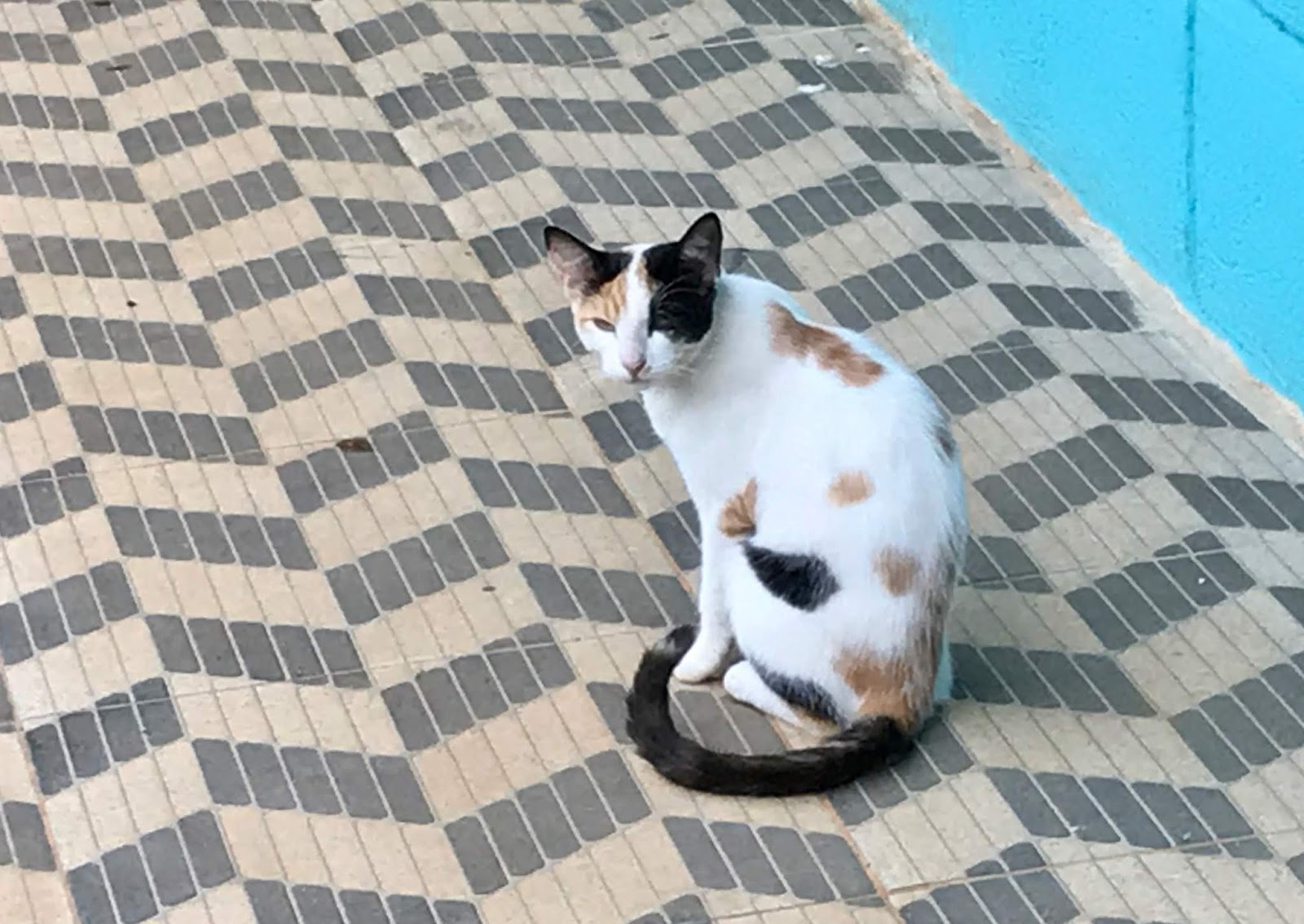
So who's this, you may ask. I don't have a name. I met her Thursday afternoon in Managua, Nicaragua, where I'm visiting for a long weekend with the board of the water and sanitation organization El Porvenir. More over the next few days I am sure.

Monday, September 16, 2019

Watershed restoration to mitigate climate pain

Today's post consists of excerpts from a longer article, Land Mismanagement and Climate Change: The Impact on Rural Nicaragua, co-authored by Jenna Saldana, Director of U.S. Operations, El Porvenir; Dick Whitmore, Emeritus Board Member, El Porvenir, Retired Forest Engineer, Watershed Consultant; and Mark Sullivan, El Porvenir Supporter and Volunteer. The full text is available at the link. Full disclosure: I'm proud to serve on the board of this righteous NGO.

Water is life. But, across Nicaragua, rampant deforestation for cattle, agriculture, and timber extraction is resulting in less water. Streams that once flowed year round are now seasonally dry. Community wells are drying up in deforested communities in the northern and central regions of the country, leaving villagers without a source of water. The situation is dire and watershed restoration is essential to save the future of water in Nicaragua.

... Nicaragua has been a minor contributor to global climate change yet will be significantly impacted due to location, coastal borders, and dependence on agriculture. On a global index, Nicaragua is ranked fourth most likely to suffer from extreme weather events.

General trends that can be predicted confidently due to climate change are the following:
  • rising temperatures
  • increasing drought in Central America (10-20% predicted reduction in rainfall)

  • less stable growing conditions for crops resulting in lower yields

  • increase in extreme weather events

  • rising sea level, inundation of coastal communities, and the salinization of wells in coastal areas

What is El Porvenir doing to increase water and food security? El Porvenir’s watershed restoration program seeks to conserve existing forests and restore degraded areas throughout Nicaragua in order to increase food and water resiliency. To accomplish our goal of improving land use and mitigating climate change to promote water and food security, we are actively engaged in the following watershed rehabilitation practices, many of which have been used for generations:
  1. Strategic reforestation ...
  2. Construction of terraces and other water conservation infrastructure ...
  3. Construction of vented, fuel-efficient stoves that use 60% less firewood than typical cook stoves ...
  4. Coordination with local government...
  5. Educating residents on the economic and environmental benefits of climate change mitigation...
  6. Creation of a model watershed that uses all of the above practices to show people from other communities how their watershed could flourish...
  7. [Fostering the] willingness of the community to create a vision and work together to achieve it.
None of this would be possible without the work and cash contributions of thousands of North Americans who've learned to work in solidarity with poor Nicaraguans' struggle to better their lives. You can help.

Covering Climate Now is a project of hundreds of media outlets working together this week as the U.N. meets about climate dangers, without the U.S. government, but with and for the peoples of the world.

Saturday, December 29, 2018

In this city, Central America is not far away

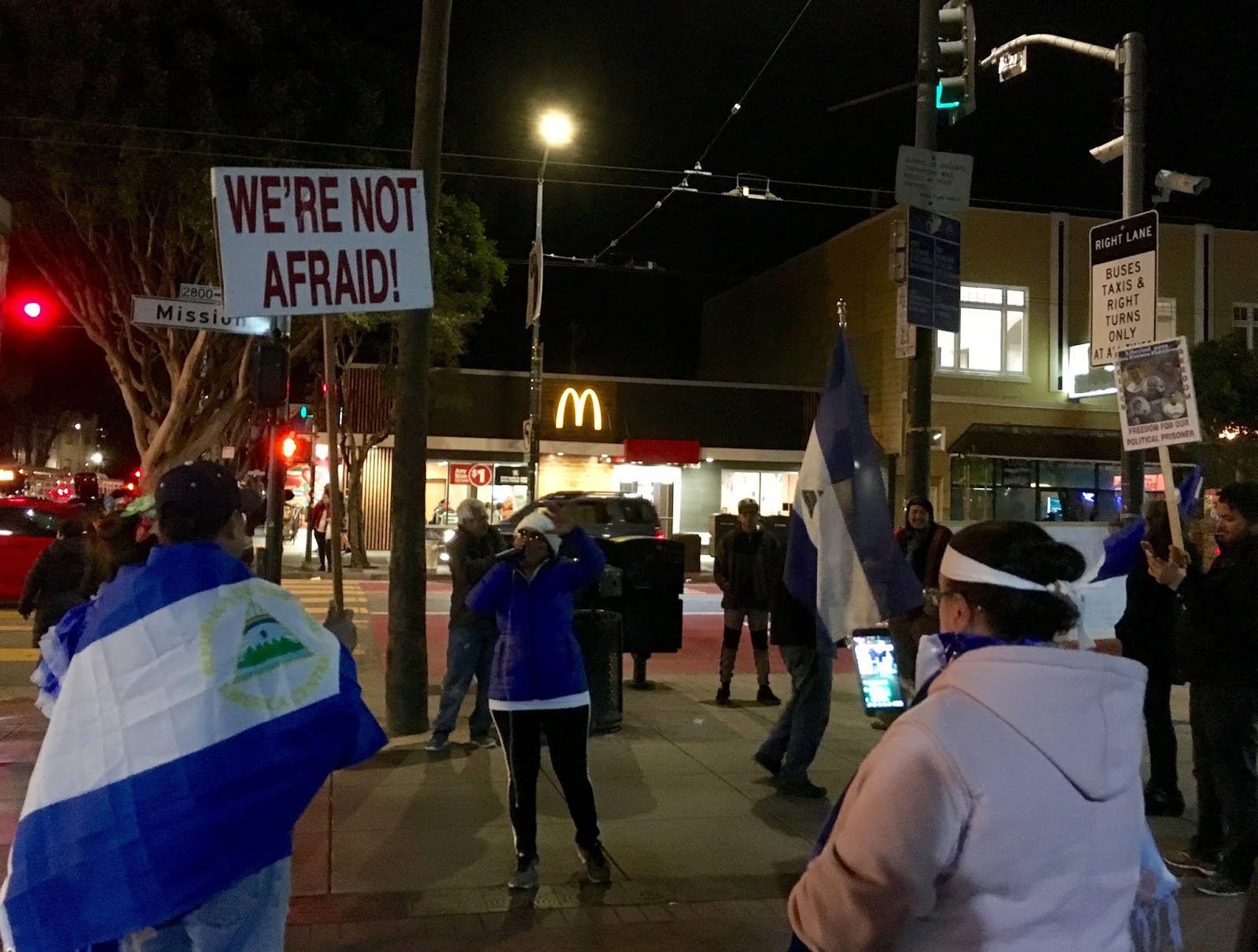
In San Francisco's Mission District, many nights a small crowd of Nicaraguans bears witness to violence and struggle in their country of origin.

Confused about what's happening in that little Central American country which has at times felt so close and so dear for so many here? You might download "Nicaragua and the Battle over Memory and History" from historian Myrna Santiago. She places the 2018 uprising against the Ortega-Murillo government in the Nicaraguan historical context:

... What is clear, however, is that this opposition movement is homegrown, massive, and fully precedented in Nicaraguan history. Where it will go is difficult to predict right at the moment, but no Nicaraguan, from the right or the left, and much less those who would wrestle the history and meaning of Sandinismo from Daniel Ortega and Rosario Murillo, are about to surrender.

In light of that reality, what Americans ought to do is to follow the example the Nicaraguan people are setting for us and recover another piece of history: the Hands-off Nicaragua movement, whose proud membership included Mark Twain. Or, if you like, the solidarity with the people of Nicaragua movement because it should be, as it will be, the Nicaraguans who decide what to do about their government.

And so, Nicaraguans in this city gather and dance in the transit plaza.

Tuesday, December 18, 2018

From Nicaragua, keeping on in the midst of troubles

Whatever else is happening in their nation, rural Nicaraguans still need sources of clean water and toilets -- and will build them if we help. El Porvenir has been doing this work of over 25 years and persists still.

The rest of this post is a letter from Rob Bell, El Porvenir executive director, describing how the work goes on. Emphasis mine.

Nicaragua continues to have some uncertainty, and Nicaraguans are nervous about the future. Experts predict that the economy will continue to contract in 2019. However, in spite of the socio-political situation, El Porvenir continues to work on water, sanitation, hygiene education, and watershed restoration projects. We can continue our work because of the good relationships we’ve built with community members over the last 28 years.

We are coordinating efforts with Nicaraguan government institutions and have partnerships with local governments: the Waslala Mayor’s Office just made a significant contribution to support projects there. El Porvenir is always a neutral party and avoids politics.

We are working with RASNIC, the Nicaraguan Water and Sanitation Network; currently we are helping to coordinate the NicaraguaSAN Forum, a conference focused on sanitation solutions.

Some of the areas where we work present more challenges than others. San Lorenzo has seen more emigration to places like Costa Rica; this makes it harder for families to contribute financially and with labor to projects.

We are working with the National Police, letting them know where we’ll be and when we’ll be giving workshops, chats, and trainings. Attendance at these events has dropped because people are nervous about being seen in groups that could be perceived as political. We let the police know about our activities for the security of attendees and for our staff.

We work to improve the health of rural Nicaraguans through clean water projects and remain committed to continue working on water, sanitation, hygiene education, and watershed restoration.

Above: Staff member Lester Gonzalez in a newly constructed and proudly decorated latrine

We need your support to continue this life-changing and life-saving work. Please make your gift today at El Porvenir.

Thank you for making our work possible. With your ongoing support, we will empower even more Nicaraguans to better their lives.

In gratitude,
Rob Bell
Executive Director

Sunday, October 14, 2018

Climate change will wreak havoc in Nicaragua

We wouldn't be responsible board members of El Porvenir if we tried to design a five year strategic plan without recognizing the effects of climate change on the Nicaraguan countryside where we partner with communities to bring in clean water and work to improve watersheds. Unhappily, Central America and Nicaragua in particular are going to get some of the worst of what fossil fuel profits have wrought. Our member Dr. Richard Gammon, a University of Washington climate scientist, brought us up to date on the new IPCC report's dire scenarios.

Extreme weather isn't the half.

Many poor Nicaraguans are small farmers, scratching out a living on marginal lands. Cycles of drought and periodic torrential rain destroy crops. Warming means that crops that need cooler temperatures will have to be planted higher uphill, an adaptation that will only be available to large land owners.

Higher temperatures will decrease yields from corn (and Dr. Gammon added wheat is vulnerable as well.) Staple food prices will rise.

Meanwhile forests that are already directly stressed by illegal logging and encroachment form hungry farmers will be further threatened by drought and wildfires. The Nicaraguan government's weak response to a massive wildfire in the Indio Maiz biological reserve was one of the triggers of the country's current political unrest. Healthy forests are essential to preserving ground water resources as well as absorbing excess atmospheric carbon.

Extreme heat in and of itself will become dangerous to human activity out of doors. When day temperatures around 40C (104F) become the norm in conditions of high humidity, human beings risk their lives performing strenuous work.

Climate scientists predict as many as 300 such high heat days a year in Central America within this century as global temperatures rise.

Learning more about these threats to long suffering Nicaragua has only redoubled our commitment at El Porvenir to our water projects and particularly to our pilot efforts to make water resources more resilient through watershed improvement. Communities working with North American partners can do much to protect themselves. We can and must help.

Saturday, October 13, 2018

Because everyone should have privacy on the toilet ...

and a place to wash their hands afterward.

The kids in this video explain about their school's new latrines and hand washing stations.

In the middle of this crazy season, I'm spending a weekend at the annual face-to-face El Porvenir board meeting, building a strategic plan to continue our work of over 25 years partnering with rural Nicaraguans to bring clean water to their communities.

Sunday, July 15, 2018

Freedom is a forever struggle

Katia Cardenal sang for her country, her people, and for the earth at La Pena in Berkeley last night to a packed house of Nicaraguans and friends. Banners listing the names of victims of the government's current violence against its own people hung on the stage.

Nicaragua is in trouble and danger, as are we at home. Yet Nicaraguans dance to celebrate. The demand of the peoples for justice, freedom, dignity and peace is never more than temporarily set aside or crushed; it changes form and breaks out again. Few know that better than our Central American neighbors.