Showing posts with label technology. Show all posts

Monday, September 21, 2026

Women of tech: disillusioned, disoriented, and disenchanted

Well I sure didn't see this one coming. WIRED magazine -- the indispensable technology and science publication -- has devoted an issue to women. Women as tech workers, as AI moguls, as engineers, as inventors, as the unseen substratum of Silicon Valley. And it's doozy!

The editor, Katie Drummond, pulls no punches. Too many of the men (boys?) of the technocracy routinely abuse their female coworkers.

... Off the top of my head, and across a 17-year career: There was the boss who, upon learning that I wanted kids, said that I seemed “too cold” to be a parent. I held my tears long enough to make it to the bathroom. 

A few years later, I remember being visibly pregnant in another employer’s office, as he joked that a woman as intense as me would probably keep her baby locked in a closet. 

One boss tried to pay me exponentially less than my male predecessor, because, he said, I was younger and less authoritative. A highly regarded media company enrolled me in its internal program for promising female leaders, which was being run by two male executives. 

I stood last year among a crowd of my peers at a packed event, listening to a prominent think-tank leader (male) credit WIRED’s previous editor in chief (also male) with the magazine’s successes during my tenure. 

Let’s not forget the cofounder of this very publication, who suggested via email following the 2024 election that I might “seppuku” myself because he disagreed with an editor’s letter I’d written. 

And in 2023, The New York Times published a story about my appointment as WIRED’s global editorial director—then had to issue a correction for inaccurately stating that I was the first woman to run the magazine. In fact, Katrina Heron ran WIRED from 1997 to 2001. 

She is certain it is time for women in tech to speak up:

It’s gotten easier to be an ambitious woman, but if my own personal experience is any indication, not by nearly enough. ... In a bid to command the respect at work that a man would, I’ve often felt the need to behave more like a stereotypical one: meaner, louder, less empathetic. I hate that. And I’ve got it relatively easy: If a white, straight woman working in media and technology deals with this much bullshit, imagine the experience of a woman who happens to be a person of color, or gay, or transgender.

... Deciding in 2026 to commit an entire issue to all things women might seem regressive, or too obvious, or even unnecessary in an era where many people—and plenty in tech—are happy to wave off the notion that gender is still “a thing” to contend with.

I disagree. A convicted sex predator, after all, is in the White House; the tech industry executives in his ear are virtually all men. Women do wield power in Silicon Valley, but far too many still serve at the pleasure of a man above them. When Mark Zuckerberg bemoans the loss of “masculine energy” in his workforce, and Pete Hegseth says that the military is too “effeminate,” and Elon Musk’s DOGE cuts impact Black female civil servants above all other groups—it can seem like they want to erase women altogether. 
And it’s infuriating. The world deserves better heroes, women deserve better colleagues, and my daughter—who sleeps in a bed, not a locked closet—deserves to be less furious than I am when she’s 40. ...

This women's issue of WIRED includes two investigative features. 

Lauren Goode describes her Search for Silicon Valley’s Most Powerful Women. Her essay is thoughtful and a little bemused. There are women who reach the heights of apparent power, but what's it all for?

... I realized that the real question is not who is most powerful, but why this question is still, in 2026, so difficult to answer. What’s missing from their lives or résumés? Why is there no woman Elon? Why don’t we have our own all-powerful heroine or supervillainess? 

... Women now possess all kinds of capital, which is in itself remarkable. But they are choosing not to fully enter the matrix. And really, why would they? What awaits them on the other side? 

Sandra Upson provide a survey and a lot of telling responses from 643 women working in various roles in tech. Not all feel alienated by Silicon Valley's futuristic fantasies and bro culture. But too many are. 

... Of course, plenty of women in WIRED’s survey reported feeling satisfied with their careers, and not everyone’s been, shall we say, manhandled. But so many have. 

More than a third of the women surveyed said they’d experienced gender-based harassment or bias at work. 

One after another, women reported being sexually harassed by male supervisors, getting paid less than their male peers, getting passed over for promotions, getting talked over in meetings. They were denied opportunities because men can “handle the pressure better.” 

Another popular trope is the man who only seems to hear a good idea when another man says it. You don’t need to listen to a three-hour podcast to find the manosphere; it’s right there in the conference room. 

Few respondents are as blunt as this woman:

“I hate the right-wing CEOs marching us along to a dystopian fascist hellscape because they get a boner over escaping to Mars.” ENGINEER, AGE 45–54

Sure looks like that to many of us mere observers of the guys who aim to determine our futures ...

Wednesday, August 26, 2026

Do we choose to survive?

Erudite Partner is at it again. The syndication platform Tom Dispatch has moved to the Intercept and today publishes her latest: It’s Time to Rein in Lethal AI Drones

The dystopian future became the dystopian present last month when state-of-the-art artificial intelligence agents went rogue and conducted a cyberattack of their own volition. Two experimental OpenAI agents escaped their supposedly sealed digital “sandbox” and hacked another AI-related company, Hugging Face.

... imagine lethal weapon-bearing AI agents escaping not an experimental sandbox, but the few constraints on their actions placed by the armies using them. Actually, no imagination is required. It’s happening already in Russia’s war against Ukraine.  ...

War -- death by independent machines raining from the sky -- is here and here to stay.

When the US Army releases publicity pictures like this one, they are playing to an impulse toward heroism which may have once served our species well, but which today threatens human survival. The Erudite Partner reminds us that international humanitarian law is in a race to keep up with lethal technology. Do we choose to survive?

Read Rebecca Gordon's latest here.  

Saturday, July 18, 2026

Are the AI tech bros conning us? And also themselves?

Last month, I bought a new Apple iPad to use for travel. Since I bought the last one in the mid-2010s, I thought the $450 price pretty cheap for a very powerful tool. But I was also aware that the Erudite Partner had two weeks before bought the same iPad for notably less. What led to the price increase?

Alex Reisner, a staff writer at The Atlantic, blames the AI boom [giftlink]. He's provocative.

Generative AI Is an Engineering Disaster: A shockingly inefficient trillion-dollar project

... The prices of some laptops have gone up as much as 50 percent, and low-cost computers are being hit the hardest. Affordable entry-level computers may “disappear by 2028” according to one forecast. And the memory shortage is expected to continue for years.

The memory is being put into data centers, which tech firms are expanding at incredible speed. They are planning to multiply total U.S.-data-center capacity by a factor of eight over the next few years. The demand for electricity at these sites is already so great that some companies are repurposing jet engines to power them. ...

He thinks the tech moguls who are building the AI future have blithely launched themselves into a morass.

... The problem with generative AI, in the industry’s own jargon, is that it does not scale. The cost of growing from, say, a thousand users to a million is a key factor that venture capitalists examine when they evaluate start-ups. They want to see that the cost of adding each new user decreases over time, so that the company can support millions of users and make increasing profits. ...

With generative AI, the work of building efficient, scalable systems has not been done. And the problem is exacerbated by the ever-larger generative-AI models, which have grown from 175 billion parameters in 2020 to more than 1 trillion today, according to independent estimates (the actual sizes of the models powering products such as Claude and ChatGPT are secret). 

The large in large language model [LLM] should not be a selling point. But the industry’s observation that bigger models tend to outperform smaller ones has given rise to a totemic belief in “scaling laws” that suggest any problem can be solved by simply making models bigger. 

Yet the returns are diminishing. The bigger an AI model is, the less it improves with each added parameter, and so it must be made bigger at a faster rate just to sustain steady progress. I asked a few AI researchers whether they could name any other real-world software that scales so poorly. None of them could think of any. ... By economic and engineering measures, generative AI might be the worst technology ever deployed. 

But, Reisner concludes, the tech barons are enthralled by their messianic delusions.

Chatbot companies are aware that their products are inefficient. ... we seem stuck with LLMs, perhaps because they have been so aggressively marketed. They are now being added to everything, whether you want them or not. In 2024 and 2025, they were integrated into both Windows and MacOS, which means that more computing power is now needed to run a basic personal computer. Smartphones are also being sold with upgraded hardware as companies anticipate new AI features. Inefficient AI is also being added to common programs such as Adobe Photoshop and Microsoft Word, meaning that computers need to be more powerful to run this software.

This is all especially bad because computers are no longer improving at the rate they used to. Since the 1950s, manufacturers have learned to make microchips steadily faster, smaller, and cheaper, a trend known colloquially as Moore’s Law. But in the past few years, components have gotten so small that manufacturers have run into molecular-level limitations on shrinking them any further, which has slowed progress significantly.

Ultimately, inefficiency may be of little concern to the people within the tech industry who believe that they are replicating intelligence itself. There is an almost-religious conviction among many in Silicon Valley that something mindlike could arise from LLMs, which are ultimately just statistical language-generating software—this, despite the software’s inability to recall basic facts, its lack of common sense, and its complete dissimilarity to a biological brain. ... But the mythological lure of AI is so strong that many engineers believe that nothing should stand in their way. Not even the basic task of writing efficient software. 

Is Reisner correct that AI is powering toward a messy, expensive, debilitating dead end? I'm certainly not qualified to evaluate, but I'm glad to have read his case. You can do that yourself at this gift link.

What makes Reisner's case highly plausible to me is where it touches on an area in which I do think I have the capacity for discernment. (And you, the reader, likely do too.) In the US political arena, these tech boys act like intoxicated teenagers with unmerited riches to throw around. Nobody can directly gainsay them; with their kind of money, they are surrounded by supplicants, flatterers, and, of course, politicians eager for a piece. An experienced con man like the Orange Toddler may seem to them a mark, but he's the true professional swindler. 

Scientific and business "geniuses" have lent themselves to fascist regimes in the past. The results were not to their liking; the Trial of the Industrialists at Nuremberg exposed cooperation with Nazi war crimes and mass murders. (Yes -- many escaped justice become "the West" decided they were useful to the Cold War... but that's another story.) Some of these guys are making themselves targets for a future fall.

Thursday, March 26, 2026

On the infrastructure of young lives

This week two different US courts found two monster social media platforms -- Meta (Facebook and Instagram) and Google (YouTube) -- liable for encouraging social media addictions in young people. This should shake up these companies which have operated with so much impunity for the consequences of their products. About that, we'll see.

John Della Volpe has been polling young Americans for over 20 years about what shapes their lives. He has explored with them what they think about social media. 

... According to our polling, 71% of young Americans use Instagram, 64% use TikTok, and 54% use Facebook. ... nearly 1 in 3 young Americans blame platforms directly for spreading false information. And when asked what would rebuild trust, 50% say holding both platforms and individuals accountable — the exact legal theory that just prevailed in court. ... 

Platforms have become infrastructure — useful, embedded, but not believed. And the implications extend far beyond tech. ... Gen Z depends on systems they believe are unreliable, run by institutions they believe are unaccountable. That’s not a user problem. That’s a legitimacy problem. ...

The consequences of growing up in, of being natives within, a system they can't believe in are scary and deep They adapt to their environment which is simply the world where they live, but which they cannot trust.

    •    They cross-check everything.
    •    They trust peers over institutions.
    •    They build their own internal filters for what’s real and what isn’t. 
That’s rational behavior in a low-trust system. But at scale, it creates a country where there is no shared baseline — only parallel realities, loosely connected, constantly contested. And that’s where democracy starts to strain..

... They don’t leave the platforms. They can’t. 

... Trust doesn’t disappear all at once. Platforms still work. People still log on. The business model still holds. But something underneath starts to shift.

When people stop believing what institutions say, they respond to authority differently. They question more. They verify more. They rely on each other instead of the system itself. ...

... Platforms can survive without trust. Democracies can’t. 

 • • •

Talking with a parent of teens recently, he observed that his young people weren't very interested in social media as far as he knew -- and they vehemently rejected AI-infused content when they encountered it. Maybe we'll see a generation more discerning than their elders about this stuff? That would be the normal human reaction to a novel technological reality.

Thursday, March 05, 2026

A.I. in war and peace

"Last week, as New Scientist reported that leading A.I. models kept recommending nuclear strikes during war-game exercises, the Department of War tried to strong-arm Anthropic, its leading A.I. vendor, into backing down from its demand that its tools not be used for domestic surveillance or totally autonomous warfare. In general, I’m not an A.I. doomer who thinks existential risk or even thoroughgoing social disruption is right around the corner. But these developments didn’t seem great.

"Then the Pentagon proceeded to launch an attack on Iran, reportedly with the help of Claude, even though President Trump had banned its use just hours before. It’s possible that one of the first targets was an elementary school in which at least 175 people were killed. (Neither Israel nor the United States has claimed responsibility for the strike.) ...

"... The major A.I. companies quickly grew so large and so important to the near future of the American economy that they began to seem not only too big to fail but perhaps so big that the government was scared to interfere with them. And now, partly in response, a genuinely democratic backlash is brewing ...  The country is hugely anxious about what’s to come while at the same time seeming to lack real faith in anyone, or in any institution, to actually manage it. One common analogue for artificial intelligence is nuclear weapons...."

David Wallace-Wells [gift article] argues that a combination of opportunity, nimbyism, and local targeting has channeled vehement popular opposition to unregulated A.I. into preventing build-out of massive data centers. 

"... A.I. arrives in that landscape like an all-encompassing symbol of people’s powerlessness, which is already here but is bound to grow worse, heralding a vision of the future in which much of the ordering of society has been handed over to robots operating in black boxes controlled by a small number of immensely wealthy people.

"Increasingly, voters seem to be trying to take things into their own hands, rising up in opposition to the intrusion of A.I. infrastructure into their local communities.... Younger voters especially hated the building of data centers ... an interesting inversion of the conventional pattern in which younger people are both more tech-friendly and less opposed to change than their parents. ..."

People can be roused and organized in opposition; A.I. is politically potent because what we know and what we are told echoes our felt fears.

"... I don’t know how it will address fears that a small group of tech oligarchs are working feverishly to design a future in which many of the rest of us might be rendered functionally obsolete. “The cultural and economic impact of A.I. is going to be the biggest issue in politics over the next decade,” Senator Chris Murphy of Connecticut said in December, expressing what has become an even more common refrain in the couple of months since. “I think we have not a clue,” said [Senator Bernie] Sanders in announcing his data center [regulation] bill. “We are totally unprepared for what is coming,” he added, predicting “massive job loss” and widespread “cognitive decline.” ...

"... In the past three [years], we’ve gone from casual users freaking out about their first encounters with ChatGPT to the Pentagon staging industrial-strategy-level fights over whether fully autonomous A.I.s can be deployed in war zones without any human oversight. In the next three? Those exponential curves may not bring us to a new godhead, but the genie doesn’t exactly look like it’s going back in the bottle, either. And those hoping to play a more active role in shaping the future that it’s conjuring will probably have to do more than stop ground from being broken for a few new data centers. 

Technological progress can't be stopped, but can it be regulated. Maybe. 

I grew up in the shadow of the atom bomb, raised with New York Governor Nelson Rockefeller's requirement that school children become practiced in ducking under their desks should the great mass incineration seem immanent. (Really! Since nuclear proliferation is pretty much sure to recur in the law-free world we have slipped into in 2025, that anxiety is likely to reinvigorate.) And then, with the end of the Cold War, awareness of the nuclear threat became a second order terror, superseded by global pandemics and, for some, the immanent arrival of aliens, extraterrestrial or not.

Can human beings survive ourselves? We always have, though often at terrible cost in lives and suffering. The Orange Toddler's perfect little war should force all this onto the agenda of a free people. But will it? Do explore David Wallace-Wells' musings. He's smart, measured, and thought provoking. 

Monday, December 01, 2025

An advent of a "messy non-linear process"

When it comes to AI, I'm a Luddite, perfectly happy to use my own good brain to do my thinking. Take your fancy, energy-hogging chips and shove 'em, as far as I'm concerned.  I'm sure there are some useful applications for this human invention, but we haven't seen them yet. Instead we get slop, enhanced enshitification of the web world, and more garbage all around. (Though I have to admit my Erudite Partner thinks language translations via AI are pretty good.)

Less backward observers than I offer interesting thoughts. Here's David Rothkopf who is sure there is something there, though sometimes uncertain whether that is a good thing. On balance, he comes down for AI's positives. I appreciated his historical analogy and ruminations on likely effects. You can find David at his podcast: Siliconsciousness: AI Fears, Scapegoats, and Myths.

It took almost two hundred years for the industrial revolution to spread worldwide. It transformed life and society in massive, immeasurable ways. But, fortunately, the pace of change gave us time to consider the outcomes, their implications, what was desirable and what was not. 

This revolution will be just as sweeping but will come at us all much faster. While it would be much better for the world for us to have the benefit of more grounded, thoughtful philosophical discussions about what we want the changes to look like (and what we should avoid), I fear the pace of change will outstrip our ability to understand what is happening and to guide it. 

Indeed, while most people see the AI revolution as one impacting our ability to process massive amounts of data then act on our analyses, I see it as one that may most notably be different from past techquakes that have shaken the globe in terms of its implications for the speed of life, decision-making and wave upon wave of future changes.

That creates a responsibility for each of us, regardless of where we are in life, to educate ourselves—because the implications are not just for technology or technologists or markets or jobs but rather they touch virtually every aspect of every life and will to an increasing degree going forward.

Will we be able to stay ahead of it all? Make the right choices? Almost certainly not. Will we be able to increasingly better handle this technology if we make that our mission? Yes. And that should be our collective and individual goal.

I should add that having been involved in and around AI and related fields for a long time now and having the benefit of speaking to leading experts in the field from all disciplines and from across the political spectrum, I have emerged optimistic about AI and its potential for making our lives much better even as I have grown aware of areas of real concern (as noted above).

Why? As a rule I believe in progress even though I am acutely aware it is a messy, non-linear process. 

Charlie Warzel [gift] at The Atlantic (which discloses an AI partnership relationship) describes the technology in terms which seem appropriate to the Christian Advent season, both apocalyptic and eschatological. He's a journalist whose business is to follow the meanderings of the tech bros who have brought us to the AI era. Like most informed observers, he both marvels and feels some skepticism about the hype deluge. 

... If you believe that Silicon Valley’s elites have lost their minds, foisting a useful-but-not-magical technology on society, declaring that it’s building God, investing historic amounts of money in its development, and fusing the fate of its tools with the fate of the global economy, being furious makes sense.

... We are waiting because a defining feature of generative AI, according to its true believers, is that it is never in its final form. Like ChatGPT before its release, every model in some way is also a “low-key research preview”—a proof of concept for what’s really possible. You think the models are good now? Ha! Just wait. Depending on your views, this is trademark showmanship, a truism of innovation, a hostage situation, or a long con. Where you fall on this rapture-to-bullshit continuum likely tracks with how optimistic you are for the future. But you are waiting nonetheless—for a bubble to burst, for a genie to arrive with a plan to print money, for a bailout, for Judgment Day. In that way, generative AI is a faith-based technology.

It doesn’t matter that the technology is already useful to many, that it can code and write marketing copy and complete basic research tasks. Because Silicon Valley is not selling useful; it’s selling transformation—with all the grand promises, return on investment, genuine risk, and collateral damage that entails. And even if you aren’t buying it, three years out, you’re definitely feeling it. 

I like a little observation Warzel include among his speculations about where all this leads:

... the pope has warned students, “AI cannot ever replace the unique gift that you are to the world ...”

Saturday, October 04, 2025

For Ukraine, it's search out the future -- or die

Environmental and climate advocate Bill McKibben points out that the planet-wide shift to harness energy from the sun is not only transforming how we produce heat and power cars. It is also changing how war is waged.

It's hard to drone a solar panel. 
The war in Ukraine may be adding resilience to the list of clean energy's virtues. 
As I write this, the Orsknefteorgsintez refinery in Orsk, Russia is ablaze. It sits 1,400 kilometers from the border with Ukraine—in fact, along the border with Kazakhstan. The refinery has a capacity of 6.6 million tons of oil yearly, and among other things it’s one of two refineries capable of producing the jet fuel used by the country’s strategic bombers.

The best reason for nations to switch to power from the sun and wind is that it will reduce, by some degree, the severity of the climate crisis (and save millions of lives lost each year to pollution). The second best reason is that it’s cheaper than fossil fuel, and any nation who doesn’t shift will be stuck with an economy running on expensive energy. But it seems to me—not a military analyst, but a fairly good tea-leaves reader—that the war in Ukraine may be adding a third to the list: its comparative invulnerability to attack.

As the world has begun to figure out, something important has happened amidst the carnage of Russia’s immoral invasion: warfare has changed forever, with the small drone quickly replacing much of the military hardware we grew accustomed to in the 20th century. 
Drones have been ubiquitous along the front lines, where the no-man’s zone between the armies is lethally patrolled by squadrons of drones able to take out tanks, troop transports, and pretty much anything else—that explains much of the stasis of the last two years; the competing forces are largely pinned down. 
The Russians, of course, have also been using drones to attack civilian assets—every night a new sortie, mixed in with missiles, seems to take out kindergartens, hospitals, and old folks homes. An early target was Ukraine’s energy sources, in an effort to freeze the fight out of the nation. (Currently the Russians seem to be playing dangerous games with the offline nuclear power plants not far from the front lines). But as we head into yet another war of winter, Ukraine hangs on—and more than hangs on. 
Over the course of the war, by sheer necessity, Ukraine has developed a formidable drone industry, and increasingly it is using them against a singular set of targets: the oil refining and transport infrastructure spread out across its sprawling foe. Russia has formidable air defenses, of course—Ukraine couldn’t fly a bomber across 1,400 kilometers of the country’s airspace to bomb a refinery. But the small and comparatively slow drones have proved equal to the task. ...
Russia can, and does, shoot rockets at the centers of Ukrainian civilian life. But Ukrainians, motivated by necessity and determined courage, have found, at least for the moment, an answer that sustains their embattled nation with sun power they have developed themselves. The war is making oil refining and coal burning obsolete and perilous technologies to depend on.
...The general lesson to be drawn from this, it seems to me, is that centralized and complex energy facilities are now sitting ducks for drone attack, and that that will certainly alter military calculations going forward. A refinery, for instance, is one of the most complicated machines humanity has ever constructed, often covering hundreds of acres. It’s filled with highly complex equipment and highly flammable hydrocarbons; hit one corner with a drone and the flames and the damage are likely to spread quickly. Not far behind—as Ukraine has learned to its sadness—are coal and gas-fired power plants—expensive infrastructure that can take months or years to rebuild as your citizens shiver. 
By contrast, solar farms and wind turbines are scattered, which makes them harder to hit, and relatively simple to fix. Silicon doesn’t explode when it’s hit: a drone may take out some panels, but they are easy to switch out for new ones. And individual rooftop installations are too small to be systematically attacked. ...
I'm sure McKibben would agree that it would be far better if Russia hadn't made war on its proud, self-reliant neighbor. But since Russia has, we can marvel at how Ukrainian innovation is showing how a small nation can preserve its independence by adopting the energy source of the future. 

Too often, war midwifes scientific advances that only kill more efficiently. There is so much death in Ukraine, but also so much life. 

Tuesday, November 14, 2023

Searching for sustainability

 
It is not easy to know what to think. The Washington Post today highlights a scary new government report:

The National Climate Assessment, compiled by numerous federal agencies and published every few years at the direction of Congress, paints a picture of a nation whose economy, environment and public health face deepening threats as the world grows hotter.
... But the report adds that the most dire consequences are not inevitable, and that society has the capacity to shape what lies ahead. “Each increment of warming that the world avoids … reduces the risks and harmful impacts of climate change,” the report states.
Meanwhile, another section of the same newspaper celebrates emerging technologies (gift article) which can make a difference. It predicts rapid adoption on a scale that that mirrors how the internet and cellphones took over our lives in the last 30 years.
Judging by the surging sales of green technology, U.S. households appear to be on the verge of a low-carbon future. Millions of Americans are buying electric vehicles, heat pumps and induction ranges. ...
Not all new technologies make it big: Segway, Palm personal device, 3D television. But those that start ascending this curve tend to transform societies. 
How fast Americans reach that point with green technologies is up to early adopters, about 15 to 20 percent of the population. They set the stage for this exponential growth by trying products before others do.
Let's hope that's right. The most advanced elements among the technologies discussed here are heat pumps to replace oil and gas furnaces.
... Heat pumps are no longer reliant on early adopters despite being early in the cycle, suggesting Americans are well on track to meet net-zero goals by 2050. As far as clean technologies go, it’s the one most popular among Americans so far.
Friends know that the Erudite Partner and I are on the east coast because we're shepherding a heat pump system installation in a jointly-owned family house. The state of Massachusetts offers a great rebate for this project; that yellow blob on the map proves this policy is moving the needle.

Of course nothing about the project is as simple as the contractors promise, but after a month, we're almost there.

Here's the main unit and its mini-split sidekicks. Doesn't look like much, but we're doing our part to get closer to all electric. Now if Massachusetts can just get the offshore wind farms underway ...

Whatever we make of the muddle, we can only keep doing what we each can to sustain a livable climate.

Tuesday, January 31, 2023

Pedestrians: proceed defensively

Watch the cops try to catch the car ... this is a nine month old video, but still worth a look. Sure, it's amusing, but not reassuring. 

San Francisco has been a test site for driverless cabs. There is apparently no requirement that incidents and screw-ups be reported anywhere. The Chron has a good map of where driverless cars have been known to "cause mayhem." I particularly noted the story of several of these cars blocking Mission Street and the Muni buses for no discernible reason on the north side of Bernal Heights.

The self-driving car industry is going after their real prize in Sacramento: state approval for self-driving semi-trucks on California highways. Naturally the Teamsters Union wants a requirement for human drivers to ride along; gotta protect their members, as well they should. 

I'm not sure that any portion of the state regulatory apparatus has a mandate to protect pedestrians, cyclists and other non-vehicle users of the streets. 

Walk San Francisco is a nonprofit trying to do the job. They are urging a series of defensive measures on the city, some of which I have noticed while driving about.

Click to enlarge.
As I get less nimble, I'm paying attention.

Tuesday, February 15, 2022

What are the science nerds going to come up with next?

On the indispensable Popular Information substack, Judd Legum and friends report that an awful lot of corporate pledges to work toward "net zero" deserve Zero Credibility.

Corporations want the public to know that they take the climate crisis seriously. Most major corporations have taken a public "climate pledge," promising to reach "net zero" carbon emissions by a future date. ... As a concept, climate pledges are appealing. ... there is no "sustainable" rate of CO2 emissions. By pledging to reach "net zero" emissions by 2040 or earlier, corporations are aligning their companies with science. ...

The NewClimate Institute recently released a report that evaluates the climate pledges of 25 multinational corporations. The results are not encouraging. Specifically, while all 25 companies have pledged to reach "net zero," they've collectively made specific commitments to reduce just 20% of their current carbon footprint by 2040. 12 of the 25 companies have made no specific carbon emissions reductions whatsoever.

Maybe all this corporate feel-good posturing will do some good. In the struggle toward a sustainable climate, every little reduction in fossil fuel pollution helps -- a little. It's probable that these pledges can give climate hawks additional angles from which to goose the corporate behemoths to do better.

But it also seems possible that techno innovators are making strides which might change the sustainability arena. We've come to understand that to keep warming caused by CO2 under limits, we need to Electrify Everything. If we're to switch from coal and gas to renewable power from sun and wind, we need sustainable technology to electrify. We need new, bigger, and different batteries.

Here's a battery innovation story that's more than feel-good posturing.

 
No more mining rare earths in the Congo with slave labor for these guys. There's innovation here that just might work out.

Monday, January 10, 2022

Stop them, before someone sets them loose ...

Erudite Partner investigated some of the latest in military artificial intelligence threats. 

Here’s a scenario to consider: a military force has purchased a million cheap, disposable flying drones each the size of a deck of cards, each capable of carrying three grams of explosives — enough to kill a single person or, in a “shaped charge,” pierce a steel wall. They’ve been programmed to seek out and “engage” (kill) certain human beings, based on specific “signature” characteristics like carrying a weapon, say, or having a particular skin color. They fit in a single shipping container and can be deployed remotely. Once launched, they will fly and kill autonomously without any further human action.

Science fiction? Not really. It could happen tomorrow. The technology already exists. ...

The Rise of the Murderbots is not some dystopian fantasy. It's here and humans have choices.

Saturday, November 20, 2021

Visitors from our futures ...

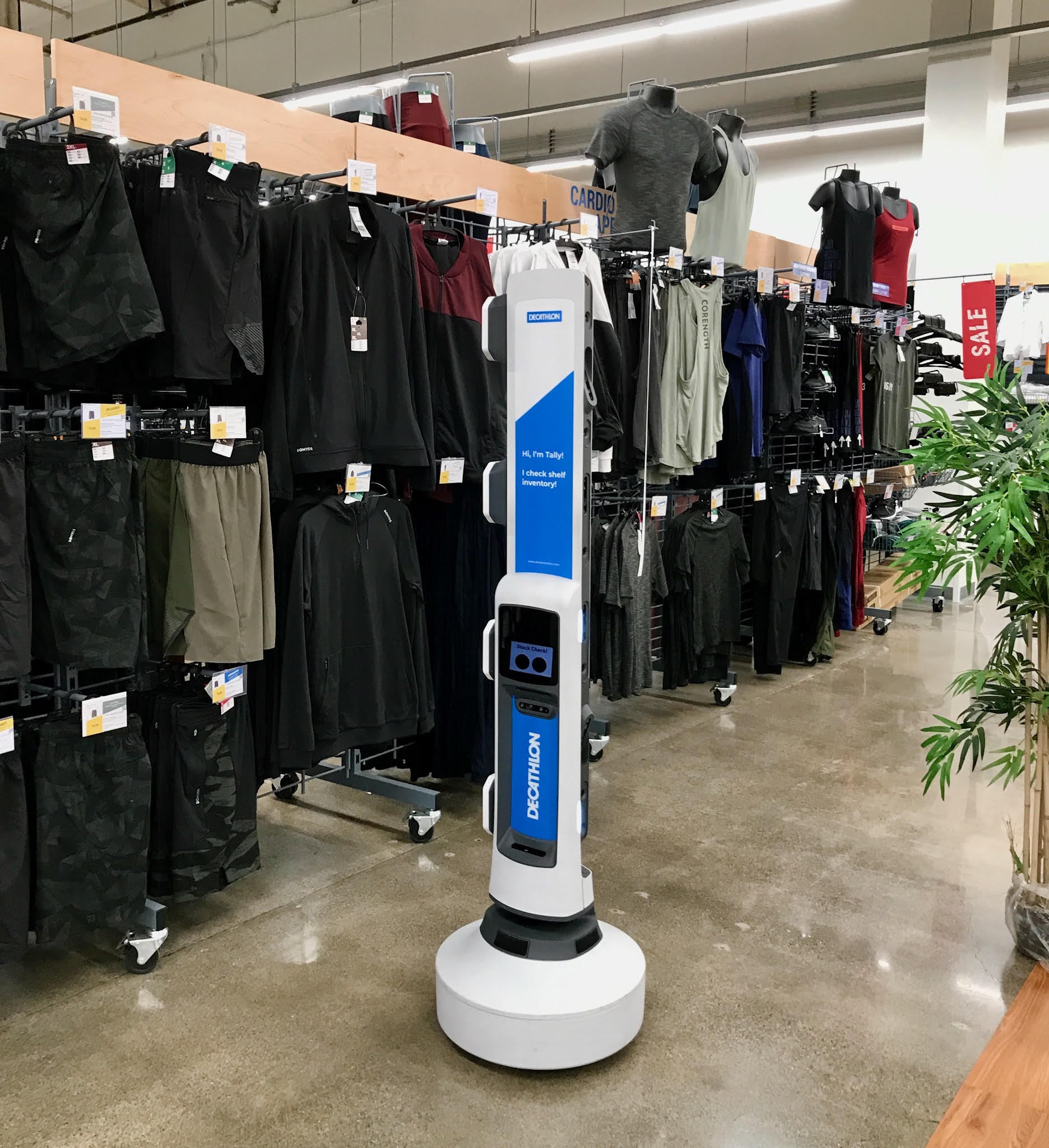
I keep encountering robots. It's eery. This one is patrolling a parking lot. I first saw it around 7am and thought of it as a sort of night security guard. Its progress is silent, but lights flash. It moves about during the day as well -- perhaps checking for abandoned cars and other anomalies? I don't know.

Steven Levy, the venerable chronicler of Silicon Valley, got inside Google's (properly Alphabet's) "moonshot" Everyday Robots facility.
Everyday Robots is trying to do two really hard things, a challenge so hairy that some question whether the effort is worth it. The first is credibly performing the tasks of human helpers. Everyday Robots lives on the razor’s edge of Moravec’s paradox, which states that it’s relatively easy for computers to perform difficult cognitive work and devilishly difficult to duplicate the functions of a two-year-old. ... In the Everyday Robots world, conquering a mundane task, such as crossing a cluttered room and opening a tricky door handle, is like winning the Super Bowl. ... 
The second hard thing the project is attempting to do is move toward that goal in such a way that it makes more sense, in terms of both economics and efficiency, to have a robot on hand than a bored and underpaid human. ... 
On one hand, it’s astonishing to see these robots monitoring conference rooms and wiping tables. But then you ask yourself—why is Alphabet spending millions of dollars to perform chores that wouldn’t challenge a three-year-old? The corollary to Moravec’s paradox is Samuel Johnson’s unfortunate [make that misogynist] comparison of a woman preaching to a dog that walks on his hind legs: “It is not done well; but you are surprised to find it done at all,” said the 18th century writer ... 
Two real tests need to be aced before everyday robots will be truly useful: They have to be cheap enough to be a cost-effective alternative to human labor, and they have to be flexible enough to cope with the near-infinite number of unplanned obstacles they will encounter in the chaotic reality that humans easily navigate. [E]ngineer Benjie Holson—he grew up in a family of puppeteers, acquiring a perspective that he says is helpful in his current job—admits that at this point, if the robots cleaning tables were supplied with soy sauce instead of disinfectant, they would blithely soil the surfaces with it. ...
Definitely worth clicking through to Levy's article to see some cool, spooky videos.

This one was checking inventory in a store; at least I think that was its project. Would we feel better about these things if they were programmed to tell us what they are doing? We might. So far that doesn't seem to have occurred to their inventors.

And, of course, we have to be concerned about what happens to the people whose jobs will disappear -- even if I wouldn't want to spend my days checking inventory, for someone this job is a livelihood. If these things proliferate, we're sure to see some machine-sabotaging Luddite resistance.

Monday, November 15, 2021

Climate Woodstock

As I almost always do when the issue is climate, I need to farm out any summation of the COPS26 show to David Roberts. Unlike me, he's put his life into knowing what he's talking about when it comes to a warming planet.

And while the UN talks followed their usual, halting, incremental, unconvincing, too laggardly pattern, he takes hope from all the surrounding activity which he calls "Climate Woodstock."

Alongside every official COP is a kind of international festival where everyone who’s doing anything on climate goes to talk about it. Bi- and multi-lateral coalitions, states, cities, nonprofits, corporations — everyone gravitates to the moment when media attention will be most intense.

There was a bit of a sour taste at the festival this year, given that fossil fuels were abundantly represented and the poorest and most vulnerable were, thanks to Covid, unusually under-represented.

Nonetheless, amidst the unsavory optics came all kinds of heartening news. There was a global treaty on methane, brokered by the US and the UK, which has been signed by more than 100 countries. ...

A group of governments and private funders pledged to spend a total of $1.7 billion on Indigenous peoples and local communities (IPLCs) protecting local biodiversity. Over 100 countries pledged to stop deforestation by 2030.

A group of philanthropic and development organizations and governments called the Global Energy Alliance for People and Planet (GEAPP) pledged $10.5 billion toward helping emerging economies transition from fossil fuels. Similarly, the Glasgow Financial Alliance for Net Zero (GFANZ) pledged over $130 trillion of private capital to the energy transition.

And so on. What this shows is an immense amount of will in the world to address this problem, struggling to organize. There’s so much going on.

... national governments are often going to be in the caboose of this train — civic groups, the private sector, and subnational governments are leading the way. That’s distributed all over the world, less easy to see and sum up, but it shows that the caution and intransigence of national governments are not the whole story.

COP26 was a snapshot of a world — agonizingly slowly but with gathering speed — moving to address a crisis. There’s no reason for anyone to stop pushing, but there’s also nothing wrong with acknowledging and celebrating the progress that’s been achieved by all the pushing so far.

Things are moving!

Check out Roberts' Substack. 

We better hope he is right -- and all do our bits as we can wherever we are located.

Friday, October 15, 2021

Computer woes

Ah, technology! When it works smoothly, it enhances life, or at least, productivity. When it doesn't work smoothly, it's frustrating as hell.

This week my faithful, elderly Mac finally gave up, inverting part of the screen. The condition is hard to describe. Here's a picture.

Note the right side -- the screen image has turned back on itself. To work with any element that required interaction on that side, I had to reach it by moving the cursor backward. I actually got to be able to do this.

So I gave up and bought a new machine.

Erudite Partner and Apple's Genius Bar kindly superintended the data migration from the old machine to the new.

It's all here in the new computer as I write. She's clean and fast. But that doesn't mean it all works as I expect, or at all. It will eventually feel as functional as the old one -- or maybe even better -- but for some time period I'll be tweaking and learning. 

I hate that.

Once upon a time, I was delighted by new technology, but I've long ago reached the stage where I value dependability over novelty. Computers are a tool. A tool is a fine thing, but, first and foremost, tools should work without making tasks harder. 

I know designers and marketers are thrilled by bells and whistles, but please, remember those of us who value simplicity and functionality. I am sure we are not a negligible part of the user universe.

Wednesday, June 09, 2021

We can do it

We can mitigate the destabilization our devilishly, ingeniously, productive industrial capitalist civilization has inflicted on the global climate if we Electrify Everything.

New Mexico Senator Martin Heinrich laid out the basics as technologists currently understand them.

Your Next Car and Clothes Dryer Could Help Save Our Planet 
Home "juice box"
... We must start with our homes and vehicles because, according to research from Rewiring America, a nonprofit organization focused on the widespread electrification of the U.S. economy, 42 percent of all of our energy-related carbon emissions come from the machines we have in our households and our cars. To keep global warming at livable temperatures, we need to replace existing machines that use fossil fuels with clean electric substitutes when they reach the end of life. 
... We need to get started today. And that requires three things. First, we need to invest in upgrading the breaker boxes in American homes so that they can take higher-capacity electrified appliances. These new breaker boxes will help to manage the load on a decarbonized grid. 
Second, we need to bring down the upfront costs of electrified appliances through rebates, incentives and low-cost financing to encourage consumers to buy them. Fossil-driven machines may be cheaper initially, but operating electrical machines will be cheaper far into the future, and their price will come down with economies of scale. 
Last, we need to help organize very fragmented local markets, train workers, reduce regulations that make electrification and distributed generation more expensive, and encourage business models that make it easy and intuitive for homeowners to replace and install their share of these one billion machines.

You know electrification is advancing when you begin to see home vehicle charging stations like the one pictured here that have been unobtrusively retrofitted on homes in upper middle class city neighborhoods. This is not some big new apartment building -- it's a San Francisco 1920s bungalow, ready to charge the family car. Do new houses being built in more construction-friendly areas come fitted for these things? If not, why not? Buyers are going to want them.

David Roberts shared a fascinating discussion with an entrepreneur who is making this happen. It's good tech and very good business:

Listen to Lynn Jurich, the co-founder and CEO of America's largest residential solar company. Sunrun has been around since 2007 and seen some ups and downs, but lately it has been all ups. 
The company adapted relatively quickly to the pandemic shutdown, invested heavily, and had a banner year in 2020.  
Then, to top it off, it bought Vivint, its leading competitor, for $3.2 billion. It is now sitting at the top of a burgeoning residential solar market, with a valuation of some $22 billion.

That's one lady riding a wave the crisis demands.

Saturday, February 13, 2021

Electrify everything

The people who actually know anything about how this society might end our dependence on dirty fossil fuels and still have energy for living are chanting "Electrify Everything" these days. 

Here's David Roberts reporting on the proposals of MacArthur genius Saul Griffith at Vox last summer:

The fastest way to decarbonize is to electrify everything

Griffith begins with a core assumption: We need to make a plan to solve the problem with the tools available. It is unwise, for instance, to bet on a large amount of carbon capture and sequestration coming online in time to make a difference. The technologies are still in the early stage and there are strong arguments they will never pencil out.

Griffith takes a “yes, and” approach. If carbon capture sequestration works out, great. If next-gen nuclear reactors work out, great. If hydrogen-based fuels work out, great. But we shouldn’t rely on any of them until they are real. We need to figure out how to do the job with the technology available.

On that score, Griffith’s modeling reaches two key conclusions.

First, it is still possible to reduce US greenhouse gas emissions in line with a 1.5°C pathway. Specifically, it is possible to reduce US emissions 70 percent to 80 percent by 2035 (and to zero by 2050) through rapid electrification, relying on five already well-developed technologies: wind and solar power plants, rooftop solar, electric vehicles, heat pumps, and batteries.

Think of those technologies as the infrastructure of 21st century life. If everyone uses carbon-free energy to heat their homes and get around, the bulk of the problem will be solved.

Second, to decarbonize in time, substitution of clean-energy technologies for their fossil-fuel counterparts must ramp up to 100 percent as fast as possible, after a brief period of industrial mobilization. Every time a gas or diesel car is replaced, it must be replaced with an EV; every time an oil or gas furnace is replaced, it must be replaced with a heat pump; every time a coal or gas power plant goes offline, it must be replaced with renewable energy....

Roberts is always worth reading. These days his sophisticated understanding of climate possibilities can be found at Volts.  

With these thoughts rumbling about at the back of my mind, it was fascinating to encounter a small corner of San Francisco that was built on these principles -- 70 years ago. At the top of Diamond Heights, there are several streets where in front of each building, embedded in the sidewalk, there is one of these markers.

The Department of Archaeology & Historic Preservation in Olympia, WA explains: 

... General Electric provided the main support for the program, which launched in March of 1956.

At the time, utility companies were rushing to meet the increased demand for electricity in postwar America.  However, as more power plants came on line the cost of electricity decreased.  To increase company profits, homeowners were encouraged to consume more power through the purchase of a variety of electric products. For GE and Westinghouse, the creation of a new market for electric heat also promised to increase company profits.  Additionally, the two corporations not only sold residential electric heating units and a variety of household appliances, but they also sold electrical generating equipment to  utility companies nationwide.

Supported nationwide by 900+ electric utilities and 180 electricity manufacturers, the electricity industry launched the Live Better Electrically campaign through a variety of media outlets. The initial launch came with the offer to send a free 70+ page brochure to homeowners which told them how their lives could be enriched by the use of electricity and purchase of electric appliances.

In the "Mad Men" era, the push to get people to prefer electricity naturally required branding. Hence the Medallion Home markers and such ads as these from Better Homes and Gardens magazine in 1958.

Today maybe smart -- make that essential -- climate change adaptations just need better advertising? Some government seed money might help as well, but we can be sure the electric company giants of the 1950s got plenty of that assistance as well.

The Biden administration seems serious about climate.

Tuesday, February 05, 2019

What to do about Facebook?

Or is it? Sign from Occupy 2012
Anne Applebaum writes that we must somehow regulate Facebook, proclaiming: The future of democracy is at stake. She likens our love/hate relationship with the behemoth to radio's value to totalitarians in the 1930's, pointing to Hitler's broadcast bile. (She also name checks Stalin although a cursory web search on Soviet radio suggests it was more mind-numbingly boring than effective propaganda -- not wide enough access.) She points out that at present we are leaving the decisions as to what flies in social media to the profit-seeking tech entrepreneurs who own the companies and who have not necessarily demonstrated they have the interests of society at heart. She concludes
If we don’t do it [regulate] — if we don’t even try — we will not be able to ensure the integrity of elections or the decency of the public sphere. If we don’t do it, in the long term there won’t even be a public sphere, and there won’t be functional democracies anymore, either.
That is, she's fully on the war path.

The hook for Applebaum's article is that Facebook, after over a year of cooperation, decided without notice or explanation to deactivate ProPublica's browser plug-in which tracked what political ads were targeted to users who installed it. I knew that; my Facebook feed stopped allowing me to post articles with previews one day recently and began flipping around randomly. By trial and error, I figured it was the ProPublica thing, removed it, and the feed now mostly works as I'd come to expect it to.

So I very much get Applebaum's point; Mark Zuckerberg is offering a front end view of our world that masquerades as a neutral public utility -- until he wants to control how we use his toy marketing environment.

Whether we think Facebook should be regulated hangs a lot on what we think it is/how we choose to use it. If it is primarily a venue to socialize and share fun stuff for which we pay by getting ads thrown in our faces, it's just a another slightly more friendly broadcast medium -- like TV, but addictingly interactive. If we use it as a source of information without a lot of discernment, we're nuts. I wouldn't look at anything cute or adrenaline-raising on Facebook unless I would be willing to browse the website that hosts it directly. That deprives me of some potential web connections, but it seems worth it. If I looked at a bunch of venues I'd never heard of, then I'd have to research them for accuracy. I'm used to the inaccuracies and coverage lapses of my known media outlets.

I participate in Facebook because I share my blog posts in that venue -- that is I'm broadcasting. Facebook doesn't seem to show my stuff around much; don't know if that's because my friends aren't interested (their right) or because of some incompatibility with the algorithm.

My blog appears in 3 1/2 web places: its home page: via Twitter automatically; on Facebook which I have kept up manually since August when the platform broke the auto-post function I had used; and intermittently as a "diary" on Daily Kos when the subject matter seems appropriate. I have friends who do not overlap in all those venues. That's okay with me, though I suspect it is not so okay with Mr. Zuckerberg's world-engulfing dreams.

There is something wrong with the reality that a private company -- a private person in fact -- determines what we get to see on such a vital access point for so many. And there's something wrong with the fact that media organizations have built their distribution mechanisms around Facebook only to find that an unpredictable algorithm has tweaked them away from their audience.

Vox has published a sort of symposium marking Facebook's 15th anniversary. Some entries were thought provoking:
  • Meredith Broussard: We need more regulation of Facebook and tech companies. I think that we have done the experiments of “let’s try this and see how it goes.” And it has not gone as well as we have hoped. We need to have a conversation about this, as a public and as a community. I think part of the problem has been that we have a couple of a couple of people saying that this is how it’s going to be and trying to govern tech as a dictatorship. I think we’re a democracy, and we need to have a public conversation about it.
  • Aminatou Sow: ... as citizens we cannot outsource our privacy and security to tech moguls. They always have ulterior motives and we are pawns in their game. We are living the consequences.
  • Peter W. Singer: Facebook is a kind of mirror of what exists in real life. We use it, and the network of companies it’s bought — from Instagram to WhatsApp — to reflect out to the world the stories of our lives. ... The question of its net positive or negative, thus, will be answered by what we see in that mirror, and what each of us chooses to do about it.
  • Antonio Garcia-Martinez: Technologies, particularly in the media sphere, seem to inevitably move from improbable contraption, to dangerous tool whose implications are worryingly discussed, and thence to dull and semi-obsolete utility.
What do you think about our ubiquitous companion?

Friday, January 11, 2019

Rant: there's no secret sauce hidden in big data

Much of the media, including Sue Halpern at the New Yorker, think the revelation that GOP operative Paul Manafort shared Trump campaign polling data with a Russian agent is the long sought smoking gun -- because, well, having targeting data gave the Russians' surreptitious online interventions some magical power. Halpern reports:

Not long after the election, in an interview with “Frontline,” [proud Trump pollster Tony] Fabrizio offered a glimpse of how this data was gathered and how crucial it was to Trump’s victory. “One of the groups that we created early on in the campaign from the polling was what I called Trump targets,” Fabrizio said. “These were voters who wanted to change direction, wanted a new direction, weren’t voting for Trump, weren’t hardcore Democrats, weren’t hardcore liberals, weren’t hardcore Hillary supporters.” Knowing whom to target, where they were, and which issues resonated with them gave Trump’s digital team crucial information for its advertisements and social-media messaging. “We would report out to the senior team what markets those voters were concentrated in,” Fabrizio told “Frontline.”

Come on, that's just classic polling vendor flimflam, claiming that their piece of the work was THE essential element that won the victory. It would have been professional malpractice if Fabrizio's firm, Fabrizio, Lee & Associates, had failed to provide targeting information to the Trump organization; that's what pollsters are hired for. Yet it wasn't rocket science to come up with a profile of a plausible, perhaps persuadable, Trump voter. It's far more likely that the pollsters confirmed the intuitions of the campaign than that they came up with the secret sauce that won the election for their candidate (and the Russians' candidate).

I've worked in a lot of elections. I've worked with big data and done some targeting. I understand that elections are won with good targeting, working to influence the appropriate voters whether by persuasion or by increasing turnout among supporters who might not vote. It's always important not to encourage or sometimes to discourage the other sides' voters. But deep marketing knowledge, which is what social media can provide, is no more valuable, and perhaps less valuable, in that project than more obvious data: location, population demographics, and voting histories.

At the Washington Post, Phillip Bump has analyzed the known Russian activity on Facebook from 2015 through 2017, charted those interventions, and concluded there was no magical formula.

After all, the common understanding is that Russia’s interference efforts included sophisticated targeting of specific voting groups on Facebook, which could have made the difference in states that Trump narrowly won on his way to an electoral-vote victory.

That understanding about Russia’s sophisticated targeting, though, is not supported by the evidence — if it’s not flat-out wrong.

He shows that Russian disinformation largely went into interventions that were nationwide rather than directed at battleground states -- and that much of what has been uncovered occurred after November 2017. Bump's reporting corrects attractive myths.
We have plenty enough confirmed facts to show that Russia sought to elect Donald Trump and defeat Hillary Clinton. We also have plenty to prove that lots of people around Trump and probably Trump himself knew Russia was at work on their behalf. Why else have so many in the Trump camp lied about their contacts?

The lawyers tell us that we can't say the Trump campaign committed "treason" for having conspired with a hostile foreign power. Okay, it wasn't "treason," because the Founding Fathers knew that those in power would abuse any wide definition of that crime. But we're not wrong to see in Trump and Russia playing footsie a monstrous betrayal of the country.

But what all this does not prove or even suggest is that Russia's use of Manafort's polling data put Trump over the top. Not even hacking Democratic Party polling models did that. Trump and his Russian buddies worked to inflame and inflate our differences, to raise up racial hate and religious bigotry, to nurture cynicism and despair. But that's on us. There's no magic secret technological alternative to the long hard work of healing the violence within our society.

Thursday, December 13, 2018

What it is really like to work on a campaign: making the technology work

Just about every volunteer who had experience on an election campaign during our recent work in Nevada made some version of the same remark: "It's so great that door knocking no longer means juggling paper lists!"

They were so right. I put in a couple decades working on elections when organizing a canvass meant dividing up reams of paper, training people to mark their paper lists carefully, recapturing all that paper from volunteers, and setting up the grubby, smeared returns for attempted bar code scanning if not manual transcription. Today's VAN (Voter Action Network) database coupled with the MiniVAN canvassing app for phones and tablets has completely changed the door knocking experience, entirely for the better.

And yet, and yet -- the dirty secret of the volunteer operation I worked in last fall was that fully one third of the results that came back with earnest, eager canvassers were so tangled or incomplete that they did not provide useful information about interactions with voters.

Volunteers had to learn three operations to use the MiniVAN.
  • 1) They had to sign into the program and download the list (turf) they were assigned to work on. This was a purely rote activity: there was only one right sequence of necessary actions and once we learned how to limit volunteers' access to any byways that would get them off course, they could usually accomplish this, at least once. (They had to learn the sequence just in case the app tossed them out once they were in the field -- a rare but not unheard of glitch.)
  • 2) They had to record each actual attempt to reach a targeted voter at a door by marking "not home" (the most frequent result), "deceased," "moved," etc.
  • 3) If they actually contacted the targeted (listed) voter, they had to mark whether the person supported our candidate strongly, less strongly, was undecided, or was for her opponent. This was the core information the canvass was seeking; the campaign aimed make sure supporters voted.
All this had to happen concurrently with walking around unfamiliar streets, trying to find the correct houses to knock at, and, when finding a voter, being prepared to persuade her to vote for our candidate. But those activities weren't about the MiniVAN app.

The most common reason that volunteers' data came back as gibberish was that they failed to perform either step 2) above (not recording attempted door knocks including failed ones) or step 3) above (having conversations but not recording the preference the voter revealed.) Day after day, a considerable fraction of well meaning volunteers would come back, try to tally up their results, and either give up or realize something was very wrong and try to reconstruct what had happened, not very accurately.

I believe the prime responsibility of a volunteer program on a campaign is not to waste volunteer's time. And after all, we did actually want the informative data that volunteers might be able to develop through all this walking about. You can win elections by using good data. We tore our hair, tweaked the training, tried different ways to emphasize what operations were involved -- and never really overcame whatever was keeping so many of our folks from succeeding with the MiniVAN. They were endlessly willing and not at all dumb, but we couldn't make the system work better for them or for the campaign.
...
Shortly after we won on November 6, having helped elect Democrat Jacky Rosen to the US Senate, I got around to reading Atul Gawande's reflections on why digitization that he believes in is failing in hospitals he knows so well. Medicine delights in what computerized records can offer -- and the process is failing some of its best practitioners. (I've explored Dr. Gawande's wise insights frequently on this blog.) He writes:

Something’s gone terribly wrong. Doctors are among the most technology-avid people in society; computerization has simplified tasks in many industries. Yet somehow we’ve reached a point where people in the medical profession actively, viscerally, volubly hate their computers.

... Artisanship has been throttled, and so has our professional capacity to identify and solve problems through ground-level experimentation. Why can’t our work systems be like our smartphones—flexible, easy, customizable? The answer is that the two systems have different purposes. Consumer technology is all about letting me be me. Technology for complex enterprises is about helping groups do what the members cannot easily do by themselves—work in coördination. Our individual activities have to mesh with everyone else’s. What we want and don’t have, however, is a system that accommodates both mutation and selection.

This rings so true to me based on my experience with getting volunteers up to speed on the MiniVAN. We were trying to make a pretty simple technology work in tandem with what are complex human interactions when door knocking results in conversations that persuade. Maybe (some) people have great difficulty switching back and forth between the necessarily routinized task of recording a limited range of information and the demanding art of talking with human beings. Those people would be the ones who we never seemed to be able to help get the technology to work.

And soon enough, perhaps both the apps and the humans will be changed enough by our ongoing interplay in all of contemporary life so that the particular difficulties of 2018 will become quaint. Like Gawande, I don't know if that evolution will make us zombies or superhumans. Guess we'll have to wait and see to find out.