Tuesday, November 20, 2012

Noted

"For them this is just some place. For us, this is our home."

Because I'm spending a couple of days sitting on an ice bag in front of the tube watching football, I've been hearing that a lot.

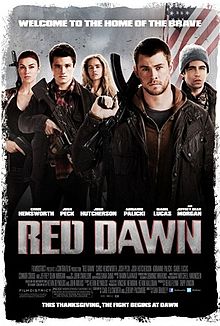
It is the tag line for the trailer for a teenage shoot-em up action thriller that opens this week. Here's the premise:

Spokane, Washington becomes the initial target of a foreign invasion. Under enemy occupation, the town's citizens are taken prisoner. A group of young people, calling themselves 'The Wolverines' (after their high school mascot), band together in the surrounding woods. There, they train and organize themselves into a group of guerrilla fighters in order to liberate their town."

I guess this one won't be playing in Gaza. Might confuse the inmates of Israel's open air prison.

Monday, November 19, 2012

Interlude


No deep thoughts today. I'm sitting on a bag of ice, waiting for the pain in my back to subside. Note to self: when running on muddy trails, do not land on an innocent appearing pine cone. The little monster can slide; then you can slide... Thump...

Getting back in shape after a long campaign will be delayed until healing occurs.

Sunday, November 18, 2012

Legislating against intoxicants; snotty history

In the wake of an election in which voters in two states sought to legalize marijuana, it's just plain weird to find the Washington Monthly promoting a muddled article warning that monopolistic beer breweries are conspiring to make drunks of us all and urging regulated inefficiency. I'm sure that Anheuser-Busch InBev and MillerCoors will jack up prices and reduce variety to nothing but tasteless warm piss if they can get away with it, but this article didn't help me form a convincing picture of how that might happen. And it's hard in the current libertarian enthusiasm for intoxicants to imagine regulation reducing alcohol consumption. That's just not where we are at these days. If anything, maybe we are finally getting around to looking for a better metaphor for the problems of substance abuse than the drug "war" and might be ready to stop creating casualties.
***
Daniel Okrent's Last Call: the Rise and Fall of Prohibition tells the story of a previous round of wrestling with the problems caused by intoxicants that led to the only amendment to the U.S. constitution ever enacted (1920) -- and then quickly repealed (1933). The story is fascinating and Okrent tells it with authority. Okrent used to be the New York Times' "public editor" during the era when the paper was struggling with its responsibility for allowing itself to be used as a conduit for Bush administration war propaganda. He's better at writing popular history than he seemed at dealing with murderous disinformation that exploited "journalistic" conventions.

But though I enjoyed the amusing story of a bygone era, I found this a troubling book. The cause of temperance -- outlawing booze -- was a classic social movement. An ungainly coalition of feminists, fundamentalists and nativists strove to use the political system to rid the country of what they thought -- for divergent reasons -- was a monstrous evil. This led to bizarre assemblages of strange bedfellows, such as the Ku Klux Klan supporting women's suffrage: women were expected to vote to outlaw drink which would strike at Jews, Catholics and other foreigners who were stealing the country from its rightful white male founders. Besides, all good Southerners "knew" that Black men would laze around drunk on the streets leering at white women if white manhood didn't stop them. (Some evil memes have great staying power.) On the other hand, the corporate barons who eventually funded the cause of repeal were led by Pierre Du Pont who wanted to legalize liquor so as to tax it heavily; such an excise tax would enable his class to do away with the new income and inheritance taxes that were cutting into his profits from a chemical empire built on weapons sales to the belligerents in World War I.

As I was carried along by Okrent's story, I realized he had somehow written a long account in which he encountered NO attractive people. Everyone on either side of the liquor debate comes across as ignorant, and/or bigoted, and/or self-serving. The story of Prohibition in his telling is all villains and no heroes. The kindest treatment that Okrent gives to any of them is to portray them as helpless obsessives.

The result is a book whose essential message is that vast social movements that change the country are the terrain of fools and/or charlatans. Now Prohibition certainly proved a terrible mistake. But is that all there is? I don't believe it; some of those people on one or the other side of liquor restriction must have had better motives that those.

Okrent comes off as an historian all too true to his background as a Very Serious Person calling balls and strikes at the Very Serious Newspaper of Record -- above and superior to the fray of movement politics. This is unattractive and, for me, undermined an interesting account of how citizens of this country worked out their wishes in a particular arena of passion and prejudice. These ebbs and flows are very much what life in a democracy is all about. Democrats (small "d") don't turn up their noses at them.
Saturday, November 17, 2012

Saturday scenes and scenery: Street potpouri

Been looking around; here's some of what I see:

bike is pipe bomb.jpg
Have we calmed down enough so we don't cringe, seeing that? Should we?

artists moving.jpg
Sometimes the difference between a moving van and mural is hard to discern.

fall colors.JPG
Who says trees don't change colors in autumn in Cali? Did ICA plant these varieties for this effect or did they just get lucky?

Public art.JPG
Public art. What to do when all the offerings are gone?

looming sky!.jpg
Possibilities in an urban landscape.

Friday, November 16, 2012

A bridge builder


Howard Wallace on a picket line at dawn in 2008.
The longtime labor and LGBT activist died Thursday at 76. He spanned the divide between the gay community and the labor movement when such an alliance was novel, almost unthinkable.

In the 1970s, Coors Brewing, then a family-owned company in Colorado, broke a strike by bringing in replacement workers and winning a certification election against its Teamster employees. The labor movement called for a boycott of their beer. Concurrently the company was fighting discrimination suits from Latino workers and family members were funding conservative causes including opposition to gay rights.

Wallace brought the Coors boycott to the San Francisco gay community and soon queers were demanding "Coors out of the bars!"

The AFL-CIO called off its boycott in 1987 and Coors -- now a multi-national corporation -- made itself a highly visible funder to LGBT events.

Howard Wallace devoted his life to building the labor power and gay liberation as overlapping movements in San Francisco. We're the better for his devotion to this community. More tributes to Howard here.

Thursday, November 15, 2012

Still clueless and entitled


I guess he actually thinks he's good for something. Mitt Romney I mean. Here he goes blaming the people for choosing good government and the general welfare over his magnificent offer of his leadership:

Mitt Romney told his top donors Wednesday that his loss to President Obama was a disappointing result that neither he nor his top aides had expected, but said he believed his team ran a “superb” campaign with “no drama,” and attributed his rival’s victory to “the gifts” the administration had given to blacks, Hispanics and young voters during Obama’s first term.

Obama, Romney argued, had been “very generous” to blacks, Hispanics and young voters. He cited as motivating factors to young voters the administration’s plan for partial forgiveness of college loan interest and the extension of health coverage for students on their parents’ insurance plans well into their 20s. Free contraception coverage under Obama’s healthcare plan, he added, gave an extra incentive to college-age women to back the president.

Romney argued that Obama’s healthcare plan’s promise of coverage “in perpetuity” was “highly motivational” to those voters making $25,000 to $35,000 who might not have been covered, as well as to African American and Hispanic voters. Pivoting to immigration, Romney said the Obama campaign’s efforts to paint him as “anti-immigrant” had been effective and that the administration’s promise to offer what he called “amnesty” to the children of illegal immigrants had helped turn out Hispanic voters in record numbers.

LA Times

Earth to Mitt -- it turned out most of us didn't want you. You had nothing to offer to the majority of the people. Your only accomplishment has been making yourself rich by destroying other peoples' livelihoods and bilking deluded donors. Go hang out with your car elevator and shut up. It's over.
***
UPDATE:
My Congresscritter gets Mitt. H/t Garance Franke-Ruta.

Wednesday, November 14, 2012

A decade of visions, victories, follies and fun

Despite working intensively on the Prop. 34 campaign for the last year, I did actually read and think about a few books during that long season. What I didn't have was the mental and emotional energy to comment on them here. But look out: I'm about to make up for that omission while I continue to digest the lessons of the campaign.

Ten Years that Shook the City: San Francisco 1968-1978, an anthology by several dozen authors, worked exceptionally well for reading when exhausted; it's a multifaceted story of our fascinating city broken into bite size chunks. I lived San Francisco's Seventies so much of the terrain was familiar. It's easy to be nostalgic about a time of such energy, invention and sense that we could build the world anew -- or maybe my friends and I were just naive. But living was cheap and innovation abounded. There was much that seems ugly in retrospect: the People's Temple role in the city culminating in mass murder/suicide in particular. But the novel notion of gay freedom took center stage (and many of us needed all the liberation we could get!), the Mission wrestled with its Latin identity and many people experimented with alternative ways of making a living besides working for "the man."

And there are accomplishments that continue to set the tone of the city. I've written elsewhere about how San Bruno Mountain was preserved as open space because of some crazy environmentalists of that time. But this, from political activist Calvin Welch just floored me. Pretty much of anyone middle class and poorer who remains in San Francisco owes their ability to stay to the struggles of that era.

The existence of the community housing movement by 1977 would so influence the district-elected Board of Supervisors that in 1979 they passed San Francisco's Rent Stabilization and Arbitration ordinance, which by 2008 covered some 170,000 rental units. By 2008 an additional nearly 2,000 units of inclusionary housing (permanently affordable units) have been developed, also as a result of the advocacy of the community-based housing movement.

These 198,000 units of price-controlled housing constitute some 54% of San Francisco's entire housing stock. No such permanently "price-protected" housing existed in 1968 outside of the relative handful of public housing units which made up less than 1% of the housing stock. Over half of the City's housing remains within reach for most of its residents solely because of the struggles, events, victories, and setbacks of the decade of community organizing between 1968 and 1978.

Take that Downtown financial barons! We still believe and struggle for a city that should belong to its working people, not just socialites and financiers.

Tuesday, November 13, 2012

Of social arsonists and voters

One of the privileges of working on the recent ballot measure campaign to end California's death sentences was the occasion to meet people who'd labored in those vineyards more years than I've been alive. As I limp toward being an elder myself, I become increasingly grateful for those who have gone before.

One of these elders passed along a copy of a little booklet assembled from the sayings of one of the people who had inspired him -- Axioms for Organizers by Fred Ross Sr., the legendary mentor to Cesar Chavez. A downloadable version is available at the link. The aphoristic contents are full of tips and truths. Here are a few samples that particularly strike me:

An organizer is a leader who does not lead but gets behind the people and pushes.

90% of organizing is follow-up.

Good organizers never give up – they get the opposition to do that.

How can you move others unless you are moved yourself?

An organizer tries to turn each person she meets into a temporary organizer.

Reminding is the essence of organizing.

When you find “live-wires” put them to work immediately. Find something they can do –any little thing –get them started and ready to do more,or you’ll lose them for the cause.

A good organizer is a social arsonist who goes around setting people on fire.

All true and all very much what I've experienced the work of organizing to be about.

I am reminded that organizing purists disdain electoral campaigns precisely because too many of them violate their notion of true organizing. An election is not about setting hopes ablaze or unleashing the untapped potential rabble-rousers inside many of us. Elections are about wide, shallow, time-limited mobilization that harnesses the power implicit, if underutilized, in voting. But people who successfully use the electoral arena to break new ground are building on a foundation of social mobilization that came out of past organizing.

One of my friends and mentors likes to quote another United Farm Workers Union stalwart, the Rev. Jim Drake, on this:

No good organizing is ever lost.

That seems to be true. Times and seasons flow back and forth between periods of deep organizing that changes people and sets them on new trajectories and moments of simply turning out (turning up?) that actualize the potential energy that organizing assembled. We need both.

Monday, November 12, 2012

The Forever War: why are so many U.S. soldiers killing themselves?

120927-A-0461H-044
SGT Ruth Knowlton stands watch as vehicles passes through Salang Tunnel. (U.S. Army photo by Sgt. Christopher Harper)

For the Veteran's Day holiday, consider this from Timothy Burke, an historian at Swarthmore College, posted to his blog Easily Distracted:

… why [are] Americans are not talking more about whether it is the wars we’re involved in and the sociopolitical context of post-9/11 service that are significantly to blame for this trend. I recognize that serving military, leaders and rank-and-file alike, cannot raise this point without violating the principle of civilian control. “Ours is not to question why”. So when the military sets out to ask, “What can we do about suicide rates”, they can’t raise or even consider the rejoinder, “Don’t send soldiers to be occupiers, don’t fight counter-insurgency wars unless you absolutely must, don’t ask soldiers to be nation-builders, don’t purposefully imagine your wars as endless and without hope of final victory.” If the military turns to experts and pays them for advice, they can’t purchase a product which includes even a discussion of those points.

Which is why it falls to Americans, both citizens and leaders, to step up to the plate and have the conversation that our serving military can’t have. Occupation under the best of circumstances is a peculiarly stressful mission for militaries. It’s much worse when some proportion, maybe most, of the populations in occupied territories hate or resent their occupiers, and worse again when the occupiers don’t know the local languages, don’t understand the local cultures, and have few if any points of historical connection to the places or people where they are deployed.

… A soldier enlisting today knows that whomever wins in November, we will still be fighting the Global War on Terror in terms which have deviated very little from their initial post-9/11 envisioning. A soldier enlisting today knows that there are many people inside the Beltway who are actively spoiling for a war with Iran, and anyone who has seen military service since 9/11 has to guess at some of the probable contours and consequences of such a conflict. Even before actually seeing service in a GWOT theater, serving military might begin to feel the emotional consequences of this knowledge, particularly if they’re training with or coming to know soldiers and their families who have already endured deployment. We are in a forever war now and there is virtually no one in political leadership who holds out even a faint hope that we might think otherwise about the uses of our military and our role in the world.

…Our current soldiers can’t look around and feel they are part of a universal fellowship, a shared sacrifice. They don’t see their whole hometowns there with them. Their units aren’t made up of the scrappy street kid from Brooklyn, the WASP from Boston, the surfer dude from California, the professor’s son from Ann Arbor, the guy whose dad made a fortune in railroad shipping. The US military is really our last, best meritocracy, one of the few American institutions that’s become more egalitarian and fair over time. It’s a model in many ways for the social aspirations that we’ve trashed and lost and forgotten. Inside its boundaries, that is. But outside? Our military is also professionalized and apart. It’s not a mirror of America any longer. It’s not even that most of us don’t serve or imagine serving. It’s that people don’t care much at all about what the military does or endures, beyond increasingly hollow and ritualistic appreciations for our “soldiers abroad”.

…Historians with a long view might recognize the evolving contours of this situation. It rarely turns out well when a society with imperial commitments makes heavy use of an increasingly professionalized, socially detached military with a warrior ethos and a high degree of skill who feel that their suffering is unappreciated and unrewarded. …

My emphasis. The whole thing is even better (and more coherent) than these excerpts. Go read it all.

Sunday, November 11, 2012

11 am on 11/11 -- the Armistice finally comes

So ended what contemporaries called "The Great War" and what European and U.S. historians call World War I. (What do historians who don't work in a Eurocentric tradition call this bloody folly? I don't know.) The scarcely readable text on the burial marker reads "the last Boche (German) shell -- a dud." The little German (or possibly Frenchman?) receiving a British Tommy's helmet and a smoke sure looks underfed.

The paradigmatic war of the last century began in popular enthusiasm for guns and glory, slogged without unequivocal resolution through trenches of mud and mass slaughter, and ended (perhaps paused) on at 11:00am/11/11 with European civilization in shreds and the seeds of further violence deeply sown among peoples bloodied and deranged.

The first World War produced some of history's first combat footage. Here's one of the better samples I was able to turn up.

The Great War all seems so long ago -- but both my parents were alive and easily old enough to remember that war. It gave shape to what historian Eric Hobsbawm called "short 20th century" from 1914-1989. Current upheavals in the Arab world take place within boundaries set without consent of the governed in a settlement imposed by its victors. The echoes are still with us.

In the United States, thousands of miles away and with millions less killed in that conflict, it is easy to forget. We call November 11 "Veterans Day" (not "Armistice Day" as in Britain or "Remembrance Day" as in Canada) and cheer for soldiers in fatigues at football games.

I still believe understanding World War I matters for building peace in this time and have written extensively about it: here, here, here, here, here, and here.

Saturday, November 10, 2012

Saturday scenes and scenery: Wowser meets a cousin!

wowser & cousin.jpg
For nearly two years now, I've driven a car that turns heads. Wowser, as our house-partner named her, is a pretty unique color. Ford seems to have painted very few of them in this shade. In those two years, I think I've seen one other.

Until, not so long ago, one turned up parked on our very street. A relative? Must be.
***
Still too pooped from the election to attempt substance. But that will come.

Friday, November 09, 2012

Friday cat blogging

morty eyes a visitor.JPG
The visitor wants to be friendly. But Morty is stand-offish. Does this foolish creature properly understand who is boss around here?

Morty knows.JPG
He accepts proper homage when humbly delivered.

Thursday, November 08, 2012

Voting obstacles got to go

As I sat yesterday with my Prop. 34 comrades kicking around the defeat (there'll be more here about that campaign eventually, but not yet), I found myself blurting something I didn't expect: "I could imagine throwing myself into the struggle for voting rights in the next few years ..."

Uh-oh. I've said things like that before and, at least I as remember it, sometimes that has led to long term, arduous commitments. It is not clear to me what that means, except that I know that this struggle needs a lot more than just lawyers. Like everything meaningful in a democracy, it needs broad citizen engagement. So expect further exploration of voting practices, processes and possibilities here for awhile.

Here's a data set from Tuesday:
Four years ago patterns were similar.

More than eight in 10 voters said their polling places were very well run; seven in 10 said poll workers performed excellently; and less than 1% rated their service as "poor."

Black voters, however, reported waiting in lines for an average of 29 minutes to vote on Election Day and 43 minutes to cast ballots before Election Day, as 34 states allow. That was more than twice the average wait for others: 13 minutes on Election Day and 20 minutes when voting early.

Something happening here ...

When I had the privilege of providing technical assistance to left poltiical parties learning how to contest elections in El Salvador, these very sharp folks had a concise description for the procedural hurdles their constituents encountered in trying to vote. They called registration snafus and apparent infrastructural failures "strategic incompetence" by the right-wing rulers.

I suspect this country needs national standards to root out local electoral strategic incompetence by whoever the powers-may-be at any given moment.


Wednesday, November 07, 2012

A lovely election except in my little corner of the world


Here's the new Senator from Massachusetts, telling it like it is.

And here's the new lesbian Senator from Wisconsin -- who'd have thought such a person would ever exist?
“There will not be a magic day when we wake up and it’s now O.K. to express ourselves publicly. We make that day by doing things publicly until it’s simply the way things are.”Tammy Baldwin from Queers in History

Who were the voters who made this day?

The exit polls show the white share of the electorate declining to just 72 percent, 2 points lower than 2008. African American turnout held at 13 percent, while the Hispanic share of the electorate reached 10 percent--up from 8 percent in 2008. The exit polls also show Obama winning Latino voters by an even larger margin than he did in 2008, 69-29.

Nate Cohn

That's the country we're stumbling toward. I like it here. The struggle to end the death penalty will go on, though California was not ready for Prop. 34 this year.

Lots more to come, but for today, I'm ready for my first day in a year not being obsessed about a future election.

Monday, November 05, 2012

Identity politics


Since I read this by Tom Scocca in Slate over the weekend, I've thought that I should comment on it.

There is a real, airtight bubble in this election, but it's not Obama's. As a middle-aged white man, in fact, I'm breaching it. White people—white men in particular—are for Mitt Romney. White men are supporting Mitt Romney to the exclusion of logic or common sense, in defiance of normal Americans. Without this narrow, tribal appeal, Romney's candidacy would simply not be viable. Most kinds of Americans see no reason to vote for him.

This fact is obfuscated because white people control the political media. So we get the Washington Post reporting that the election is "more polarized along racial lines than any other contest since 1988"...

Polarization would mean that various races were mutually pulling apart, toward their favored candidates. "Minorities" is not a race (nor, you may have noticed, is "women"). Minorities and women are the people standing still, while white men run away from them.

…White people don't like to believe that they practice identity politics. The defining part of being white in America is the assumption that, as a white person, you are a regular, individual human being. Other demographic groups set themselves apart, to pursue their distinctive identities and interests and agendas. Whiteness, to white people, is the American default. …

But in truth, I couldn't think of anything to say.

If you live in California, this sad development is simply obvious. We went over this hump back in the late 1990s and we know we aren't going back. The local Republican Party has become a strange, distorted white rump faction, unable to attract more than a third of the electorate. The rest of us are trying to figure out how to restore the state they broke on the way out the door. I tend to believe we'll get there, though it is going to be tough. We need to restore the democratic power to tax by simple majorities, rebuild our once great infrastructure and educational system, and turn from fear to hope. We're trying -- in particular, note that even today's hobbled California has launched several initiatives to recognize and combat with the threat of climate change, more than we can say for much of the nation.

Let's give Chris Rock the last word on this:


H/t Digby for the cartoon. H/t to Annie Laurie at Balloon Juice for Chris.

Sunday, November 04, 2012

Malign malarky of racial essentialism persists

On Friday, the the New York Times printed an obituary for psychologist Arthur R. Jensen. Though the kerfuffle is little remembered these days, I knew that name. When I was an undergrad at Berkeley in the 1960s, Jensen advanced the theory that scores on IQ tests showed that African Americans were intellectually inferior to whites. Or at least many of us thought that was the implication of his work.

You didn't have to be a genius, then or now, to recognize what hooey that assertion is. The only thing IQ tests measure is the ability to score well on IQ tests. If a test yields consistently different results across different populations, the object of study should be the test, not the population.

I had thought that respectable scientists outside such intellectual backwaters as the Heritage Foundation had noticed this. The much mourned Stephen Jay Gould eloquently demolished such drivel in The Mismeasure of Man.

But apparently educational psychologists remain mesmerized by and convinced that their tests prove something. At the very end of a long obituary, the Times saw fit to include incisive criticism of the malign malarky Jensen came to stand for:

“Socioeconomic status turns out to be the best predictor of your I.Q. score,” Sonja C. Grover, an educational psychologist at Lakehead University in Ontario, said on Wednesday. “Socioeconomic status has to do with your quality of schooling, the quality of the teachers that you’re exposed to. Many people who do poorly on an I.Q. test have a very poor fund of general knowledge, but it doesn’t mean that they’re not intelligent.”

A 1981 book by Professor Grover, “The Cognitive Basis of the Intellect,” was written as a response to Professor Jensen’s book “Bias in Mental Testing” (1980). In that book, he argued that it is possible to construct tests of general intelligence that are free of cultural bias, which in turn makes it possible to isolate heredity as a wellspring of intellect.

But in focusing on the link between genetics and intellectual ability, Professor Grover said on Wednesday, Professor Jensen’s work has sweeping, and potentially grave, implications.

“It was irrelevant and not particularly useful to suggest, as those who endorse Jensen have, that Jensen was just holding a politically incorrect point of view and that’s why he was being criticized,” she said. “His studies and his influence would have a dramatic effect on the perception that people have about minority groups and their potential, and even their right to a quality education.”

She added: “In no way am I suggesting that he wasn’t completely well intentioned. But I would make the point that you cannot separate social science from human rights, regardless of what side of the fence you’re on.”

Hear, hear!

I'm sure Professor Jensen was a perfectly nice human being to people in his world. But his theories have supported vicious undermining of the educational struggles of disadvantaged people.

Saturday, November 03, 2012

This is the march for our time


There will be other struggles in the future, but this is today's. Off to walk a precinct ...

Friday, November 02, 2012

Death penalty: "All cost and no benefit"


According to today's San Francisco Chronicle:

Death-penalty measure's support jumps
A ballot measure to repeal California's death penalty and replace it with life in prison without parole has gained support in the last week and leads by 45 to 38 percent among likely voters in the final Field Poll before Tuesday's election

The poll, conducted Oct. 25-30, was the first to show a lead for Proposition 34, which had trailed 42 to 45 percent in the last survey in mid-September. Polling also found that a majority agreed with one of Prop. 34's major premises - that the death penalty is more expensive than life without parole - and a plurality said innocent people are executed "too often."

Some other recent statewide polls have reported Prop. 34 trailing by as much as seven percentage points. But Field Poll director Mark DiCamillo said his organization's new survey was more up-to-date and found that the measure's margin of support had widened by six percentage points in a single week. …

…Yes on 34 campaign director Natasha Minsker said the poll results indicate voters are getting the message.

"When they hear our message and they hear the facts, they are much more likely to support the initiative," she said. "I think it really shows that the voters are learning the death penalty is all cost and no benefit."

… Sponsors of Prop. 34 have stressed the severity of a life sentence with no hope of release and made the cost of the death penalty their leading issue - $130 million a year more than a life-without-parole system, according to the Legislature's fiscal analyst, a figure that opponents dispute.

The new Field Poll found, for the first time, that a strong majority - 53 to 31 percent - agreed that the death penalty was more expensive than life without parole, a question that produced an even split a year ago.

Off to get out the vote.

Thursday, November 01, 2012

So get out there and vote!


Thoughtful posts have been few around here for the last little bit of time and they'll only get fewer as I work to get out the vote over the next few days. I'm not the only one; I was a little astonished to step over this graffiti on the sidewalk last night on the way to pick up Chinese food. Somebody with a spray paint can is on the same track. Not the most targeted effort, but pointing the right direction.