Wednesday, February 05, 2020

On enthusiasm

The emerging Iowa primary semi-results have tempted me into committing punditry -- that is, poorly moored speculation on partial observations. Take this with a big grain of salt or skip if you don't want it.

Karen Tumulty of the Washington Post highlights that, whatever the end result, the Iowa caucuses did not produce the elevated turnout that Sanders, in particular, was predicting. The 170,000 people voting didn't come near the 240,000 that turned out in the simpler, more Democratic leaning, year of 2008.
Even as the Iowa Democratic Party was trying to sort out the chaos in its reporting system, a party official announced that turnout was “on pace” with what they had seen in 2016.

In other words, it was mediocre. About 170,000 people participated in the 2016 Iowa Democratic caucuses, far short of the unprecedented 240,000 voters who turned out in 2008 and launched Barack Obama on his way to the White House.
Oops. But what does that mean?

I'd say it indicates a lack of voter enthusiasm of some sort -- in particular a lack of enthusiasm for those candidates, Biden and Klobuchar, who were supposed to be the "sensible" choices. The total would have been much higher if their voters had thought they had to turn out, even if it didn't change the final results. Biden's polls said he had a lot of such voters in his camp, but evidently they were no shows. They didn't think it was worth going through the hassle (about which they are all fully alerted) to caucus? Apparently so.

This makes me think about what I have learned over many years about the salience and content of enthusiasm in elections.

No doubt about it: you always want to be on the more enthusiastic team. You will feel the excitement while turning out voters on Election Day, though sometimes not so much during the long slogging weeks before.
What we wish the electorate would feel -- in another season.
Voters are moved by two different sets of emotions and both can drive turnout. One is hopeful promise. Primaries are usually the arena for inspiration; rather than what is, strong primary candidates strive to offer what could be. Looks like Buttigieg, Sanders and Warren won the night with this one.

Voters are also moved by fear. Fear is what we'll be up against in November: the terror of another term of Trump's cruelty, greed, and -- yes -- carnage aimed at those with the least defenses. Fear can be paralyzing, but it can also drive voter action. It's no fun, but it can spur movement.

Iowa seems to have brought out those who could find energy for hope in a muddled field. The general election will be different. It will be a referendum on Trump. That's what we have to win. And all the polling says we can win, if we work smart and very, very hard.

UPDATE: It's gratifying to see my theory of the low turnout confirmed by one of the Wapo's better reporters: "[Biden's] candidacy has lacked a spark of enthusiasm, whether that’s defined as vision or energy or fight." Here's hoping Dems can manage to nominate someone who creates enthusiasm!

Tuesday, February 04, 2020

On to Nevada


With the Iowa Democratic Party having royally screwed up its caucus process, many eyes turn to Nevada which apparently bought the same tallying app giving at least some of the problems. (I'd bet much was poor volunteer training -- training is hard, verging on impossible in a short space of time.) The Nevada caucus will come along February 22; besides Nevada, only North Dakota and Wyoming still use caucuses rather than primary balloting to choose their delegates. Can this party do a better job?

Naturally the Nevada Independent is on the story.

The statement released by the party was short, but its message was simple: What happens in Iowa, stays in Iowa. ... Even former Senate Democratic Leader Harry Reid chimed on the matter in a tweet Tuesday afternoon.

“In Nevada, we have built the best state party operation in the country,” Reid said. “I am 100% confident that what happened in Iowa will not happen in Nevada.”

... the party’s executive director, Alana Mounce, in an interview with The Nevada Independent last week, detailed some of the security precautions and preventive steps that the party is taking to ensure the integrity of the caucus process. ... The party has also established a number of backup processes, should the technology it plans to rely on fail. For instance, Democrats will be checked in at their caucus sites via a tablet, but each precinct will also have a paper copy of the Democratic voter file to cross reference. ...

With the apps, precinct chairs are supposed to, at some point before Caucus Day, connect to the internet to download the early vote data for their precinct. Party officials say the data will not be accessible by the precinct chair until the caucus’s noon start time and they have reached the appropriate step in the caucus process for it to be disclosed. The number of early voters for that precinct, for instance, will be available at the start of the caucus, but the precinct chair will not be able to see who they caucused for until it’s time to enter the results of the first alignment.

Should the precinct chair not be able to access that early vote data, party officials say there will be a hotline they can call to receive that information and calculate the results manually. Precinct chairs will also be able to call in the results of their caucus should the app malfunction. Nevada has more than 2,000 Caucus Day precincts this year, where Iowa had about 1,100. ...

There's plenty more and it is all complicated and demanding of volunteers. But what struck me was that huge number of precincts. That's a heck of a lot of volunteers that need training. Hope the state party succeeds!

Monday, February 03, 2020

Looking ahead in Iowa

As the seemingly endless Democratic primary begins to yield results tonight, anxious people need to remember that which candidate emerges on top, both in Iowa and beyond, is not the only deciding factor in who will win the 2020 election. Polling consistently finds that nearly 50 percent of us want Donald Trump gone. In order for Trump to win against these numbers, he has to win ALL the small sliver of persuadable voters in exactly the right swing states. Any of the top candidates has a plausible shot at preventing that if we can unite and do the work.

The primary is a tussle over what should be our positive priorities for the next four years and beyond. These disputes are important. They have revealed that many of us are ready for some radical changes. But the general election in November will be a referendum on Donald Trump who was never ready for anything but cruelty and larceny.

And millions of activists, many newcomers to electoral politics, are gearing up to prevent Trump's re-election and achieve much more. Doubt this? Explore the story of these Iowa activists who have organized themselves over the last three years. They are looking way beyond today's primary.

“We are not going to stop until Republicans don’t even want to run candidates here,” said [Mary] McAdams, 54, a molecular geneticist turned singer-songwriter with a fondness for alliterative phrases. “We are going to make this place too blue to bother.”

... Even as Iowa Democrats focus on their first-in-the-nation presidential nominating contest on Monday, with many still undecided and anguishing over their choice, activists are trying not to lose sight of a longer-term political goal: staging a political takeover.

.... On this night, McAdams’s “Ankeny Army” was composed of those relative newcomers. Here was Kelsie Goodman, a 35-year-old high school assistant principal who had returned home because “there were so many more options in this area than there had been before.” She was proud to be from a state that was the first in the Midwest to legalize same-sex marriage, a place that helped to springboard the candidacy of the first black president. But as her state was slowly diversifying, she had become concerned that Trump was empowering voters who resented those very distinctions.

Next to her was Amy Tagliareni, a 49-year-old administrator of a small nonprofit and a mother of a middle-schooler. She had moved to the state in 2008 but had never voted in a primary until 2018. She voted for Hillary Clinton in the 2016 general election but felt she needed to become more active because so many middle-class white women like her had voted Republican or chosen not to vote at all.

The two women were representative of the people who were fueling the activism in Ankeny: young professionals and mothers with older children. They were horrified most by what they saw as the Trump administration’s poor treatment of the vulnerable — separating immigrant families, restricting food stamps, banning refugees — and were desperate to post some wins. So they decided to play hard. ...

[McAdams's] crusade started with a desire to remove Trump, but it was also about herself. After the great unsettling of 2016, she realized she hadn’t taken stock of her neighborhood, which had grown so much that she could hardly recognize it. ... She asked volunteers to knock on doors. If they did not want to knock on doors, she asked them to make phone calls. If they did not feel comfortable making phone calls, they could write postcards. If not postcards, she’d ask volunteers to drive so others could knock on doors.

As they set out to find registered Democrats, McAdams saw an Ankeny beyond its stereotype. There were trailer parks, and residents there said they couldn’t afford rising rents. Middle-class-looking homes had sunken ceilings and no hot water inside.

They drove through neighborhoods of Bosnian refugees and met black and South Asian families who had moved for better jobs. Even as the city’s median income continued to rise, the suburbs had become more diverse and more stratified.

“We just never noticed it because we were too damn busy,” McAdams said. ...

“We are a family now,” McAdams said. “And I’ve got more best friends and sisters and brothers than I did three years ago. I’d be damned if I lost contact with them after 2018. Nothing is stopping us now because we are a family, and Donald Trump is still president.”

It's not likely that this cluster of energy can turn all of Iowa blue in this cycle. They are building for a longer future. But as David Atkins explains

... The boring reality is that a realignment is taking shape in which the exurban professional class and white working class increasingly vote for their prejudices over their economics but are declining in numbers ... [E]ducated suburbanites, young people and people of color rapidly align with the Democratic Party, on behalf of both moderate and leftist candidates depending in large part on the district.

There are a lot of reasons why the United States was vulnerable to electing an unfit, dictatorial narcissist. The capitulation of Republican elites to unconstrained greed and fear was one reason. But too many economically comfortable, mostly white, citizens also had become complacent in the dream of a democracy that was making itself better, if gradually. Trump was a terrible shock. These suburban activists -- the majority seem to be women -- aren't stopping. They are a vital slice of the Democratic coalition and their work is a good part of why we can win in November.

Sunday, February 02, 2020

The subversive weapon of the Reformation: musical propaganda

The reference to a "weapon" is appropriate when describing the "bitterness and savagery" that characterized violent struggle between Catholics loyal to popes and insurgent Reformed Christians -- those in today's terms "Calvinists" and in France "Huguenots" -- in the mid-16th century. And the story, as told in Diarmaid MacCulloch's The Reformation: A History, of what served as popular weaponry is surprising to a modern ear.

He writes that French Huguenot belief grew exponentially in mid-century despite practical and political obstacles created by Catholic rulers.

How had such a rapid expansion taken place? Public preaching had not been possible on a significant scale to spread the message in France; there had not been enough ministers and limited opportunities to gather to listen to sermons. Books played a major part, but the two central texts, the Bible and Calvin's Institutes, were bulky and expensive and could not have had a major circulation in the years of persecution before 1560 ...

The explanation for ... mass lay activism may lie in the one text which the Reformed found perfectly conveyed their message across all barriers of social status and literacy. This was the Psalter, the book of 150 Psalms, translated into French verse, set to music and published in unobtrusive pocket-size editions ... [the psalms] were deployed in Reformed Protestantism in this metrical form to articulate the hope, fear, joy and fury of the new movement. ...

The metrical psalm was the perfect vehicle for turning the Protestant message into a mass movement capable of embracing the illiterate alongside the literate. What better than the very words of the Bible as sung by hero-King David? The psalms were easily memorized, so that an incriminating printed text could rapidly be dispensed with. ...

The words of a particular psalm could be associated with a particular melody; even to hum the tune spoke of the words of the psalm behind it, and was an act of Protestant subversion. A mood could be summoned up in an instant: Psalm 68 led a crowd into battle, Psalm 124 led to victory, Psalm 115 scorned dumb and blind idols and made the perfect accompaniment for smashing up church interiors. The psalms could be sung in worship or in the market-place; instantly they marked out the singer as a Protestant, and equally instantly united a Protestant crowd in ecstatic companionship ...

It's interesting to think about popular music used today for political signaling.
  • The civil rights movement of the 1950s and '60s was still using the psalms as mediated through the African-American spiritual tradition, for example Psalm 1:3 -- "like a tree planted by the water, we shall not be moved ..."
  • Early hip-hop pioneers like Tupac and Michael Franti provided such unifying, expressive compositions.
  • So did that forgotten niche genre "women's music" -- more honestly called "lesbian music" -- by artists like Chris Williamson and Ferron.
  • In the current political campaigns, candidates frame their entrances with distinctive "walk up" songs: Elizabeth Warren uses Dolly Parton's "9 to 5" while Bernie comes on to John Lennon's "Power to the People."
  • President Trump has done his best to appropriate Bruce Springsteen's "Born in the USA" despite the artist's protests; Springsteen responded with “That’s What Makes Us Great.”
Sometimes the music can assemble and grow the chorus.

North Beach is rooting for a favorite son


Go 49ers!

Encountered while Walking San Francisco.

Saturday, February 01, 2020

For your Super Bowl weekend

That's Hard Rock stadium, the Miami venue for the big game, as it is likely to look quite frequently in the next few years. Grist spells out the prospects:

... Floods are inundating low-lying cities like Miami even on sunny days.

A new report from Climate Central — an organization that analyzes how climate change affects the public — shows that Hard Rock Stadium, between 4 and 6 feet above sea level, is likely to experience some of this flooding in the coming century. It’s not just the football field that’s at risk of getting swamped by climate change. Local roads, the stadium’s $135 million training facility, the tennis center, and parking lots will face higher odds of being submerged.

... The Hard Rock Stadium property has at the very least, a 1 percent chance of being submerged by rising seas every year by 2070 if the world continues emitting greenhouse gases business-as-usual. By 2090, the risk of the stadium experiencing serious flooding each year rises to 10 percent.

Remember, this is likely an underestimate...

...
Meanwhile, the National Football League continues to strive to erase its most socially useful recent player according to Samer Kalaf. Kalaf denounces the league for trying to substitute an anodyne advertising campaign for Colin Kaepernick's fierce protest against police killings of black and brown men.

Inspire Change is a shameless strategy for Commissioner Roger Goodell and the league’s owners to pretend that they not only supported the movement to bring attention to police violence and systemic oppression all along, but that they were really the progenitors of the whole idea. Any player who accepts the deal on these rotten terms is welcome. The painfully obvious tell is that former San Francisco 49ers quarterback Colin Kaepernick is nowhere to be found — not in the Inspire Change materials, not as part of the Players Coalition, of which [Anquan] Boldin is a co-founder, and not on an NFL roster, as his former team plays the Kansas City Chiefs for the title Sunday.

Kalaf is certainly right about what the NFL is trying to get away with. But they are playing with fire here -- highlighting police violence now matter how hypocritically can lead to unexpected results. And I don't think we can be disrespecting former 49er Anquan Boldin's real pain over the killing of his cousin by a Florida cop. Sure -- the powers-that-be will co-opt and pollute anything to hold on to their power. But it's time to stop the killings.

Meanwhile -- GO 49ERS!

Friday, January 31, 2020

Do you go out for Indian food?

Political scientist Lynn Vavreck passes along that your dining habits can serve as a clue to which Democratic Party presidential aspirants might thrill you -- and most certainly whether you ever viewed Donald Trump with more than a passing disdain.

The more likely that people were to experience other cultures probably unfamiliar to them — through travel or food — the more likely they were to vote for Mr. Obama [in 2008], even controlling for things like income, education, personality, racial attitudes and city living.

This orientation toward the world also helped differentiate people who supported Donald J. Trump from those who supported any of the 16 other candidates in the Republican primary in 2016. Voters who had been to Europe, Australia, Canada or Mexico or had eaten at an Indian restaurant were less likely to choose Mr. Trump by 10 to 12 percentage points beyond the differences explained by other factors like the ones mentioned above.

... Of course, it’s not that eating Indian food leads a person to support one Democratic candidate over another — that’s silly. (And there are voters for whom Indian food is the taste of home.) But a voter’s orientation toward the world is related to candidate choice, and it turns out that eating in restaurants that celebrate less familiar cultures is one way to measure where people think they are more connected: to those around them locally or to people farther afield.

Which Democrats will prevail this primary season — the cosmopolitans or the local-focused? Something to consider the next time you eat out.

This bit of polling wisdom doesn't tell us the political leanings of people like so many around here who get their Indian food via DoorDash or other delivery options. Is this perhaps another bit to tech disruption, this time skewing political analytics?
...
It's hard to feel lighthearted on the eve of the Democratic primary going serious in the Iowa caucuses while watching GOPer Senators betray the country and Constitution they took an oath to uphold. Nothing to do but keep working for a better country in whatever arenas, via whatever means we have. We never know where friction will save a life or a spark may catch.

Friday cat blogging:out on the street


This is, despite quiet cul-de-sacs, a big city. Not a lot of cats wander freely among its human, canine, and automobile hazards. But this old fellow looks to have been through it all and still claims his bit of sidewalk.


Most sidewalk cats are far more wary.


What piercing eyes you have!

All encountered in one unrepresentative precinct while Walking San Francisco.


Thursday, January 30, 2020

He claimed to be a builder


One more lie. A section of Trump's border wall -- steel bollards and all -- blew over into Mexicali yesterday. High winds and weak concrete caused the failure.

Let's make more wind, human wind.

Wednesday, January 29, 2020

A ritual hazing ...

When San Franciscans elect prosecutors who the city establishment and most especially the police union fear will be less than completely hostile to offenders, they pounce early and hard to discipline the new official.

Senator Kamala Harris could testify to this. In 2004, as the newly elected D.A., she did what she'd run saying she'd do -- she refused to demand the death penalty for David Hill -- a young criminal who had killed a cop. (No, not the other way around -- cop kills citizen -- as has happened too frequently in recent years.) She instead asked a sentence of life without parole. This was treason to her detractors. The police union, the victim's family, the local media, and Senator Dianne Feinstein all went ballistic. They could not accept the possibility that justice could be done without the death penalty.

Now newly elected District Attorney Chesa Boudin is receiving the outrage treatment for his decision to put charges against a suspect on hold while his office investigates the entirety of the circumstances in which this defendant is charged with attacking cops who then shot him. The charges could come back if they seem warranted. The cops who shot the guy (with the result he has had his leg amputated) can't very well serve as witnesses until their own conduct has been evaluated, can they? A fair-minded observer might think so. But the city establishment is horrified.

I think it is fair to say that Harris learned her lesson; to advance politically she needed to avoid stirring up such a hornet's nest again -- and she didn't in her subsequent career. She continued to "oppose the death penalty" but avoided any chance to do anything about it either while D.A. or from her later perch as state Attorney General. I didn't follow her career in law enforcement closely; some progressives in the legal world were rabid about what they saw as her failures to advance justice when she ran for president.

Somehow I don't think Chesa Boudin will learn to back off after the current howling in some city quarters. He ran against precisely the unequal justice he has seen in the system as public defender. He doesn't seem to want to give either cops or crooks an unfair break -- something which some who have been accustomed to special treatment will experience with shock. And so far there's no suggestion Boudin is using the D.A. office as a platform from which to leap to a higher office. He seems to actually want the job he just won. San Franciscans can hope he'll make a success of it.

Tuesday, January 28, 2020

Virus on the loose

Kaiser Permanente is on the ball -- I was not surprised to notice Monday that they are apparently on the lookout for infected travelers and imported viruses. Such as the Wuhan coronavirus, I expect. I see that the CDC is now urging U.S. citizens to avoid all nonessential travel to China. Let's hope the Trump administration doesn't somehow get this public health measure mixed up with its trade war -- or use it to scare silly people silly. Trump was all in with scare mongering during the West African ebola outbreak a few years back.

Meanwhile, it's encouraging to learn that somewhere in the depths of the executive branch, there are still scientists who seem to be responding professionally to the appearance of a dangerous new respiratory virus.

The CDC is growing samples of the novel coronavirus so researchers can develop medical countermeasures and better understand how the latest SARS-like virus has spread, the agency’s respiratory disease director said. ...

“We are growing the virus in cell culture, which is necessary for further studies, including the additional genetic characterizations,” Nancy Messonnier, director of the Centers for Disease Control and Prevention’s National Center for Immunization and Respiratory Diseases, said during a Monday telephone press briefing.

Those sample viruses will allow companies like Gilead Sciences Inc. and AbbVie Inc. that are pursuing potential treatments to see if those drugs can work. It’s not immediately clear how long it will take the CDC to isolate the virus.

“Once isolated, the virus will be available in the BEI resources repository, which is an NIH resource that supplies organisms and reagents to the broad community of microbiology and infectious disease researchers,” she said.

Bloomberg Law

Let's hope these folks can remain unpolluted by politics or panic.

Monday, January 27, 2020

Overview: where to work to help to defeat Trump in 2020

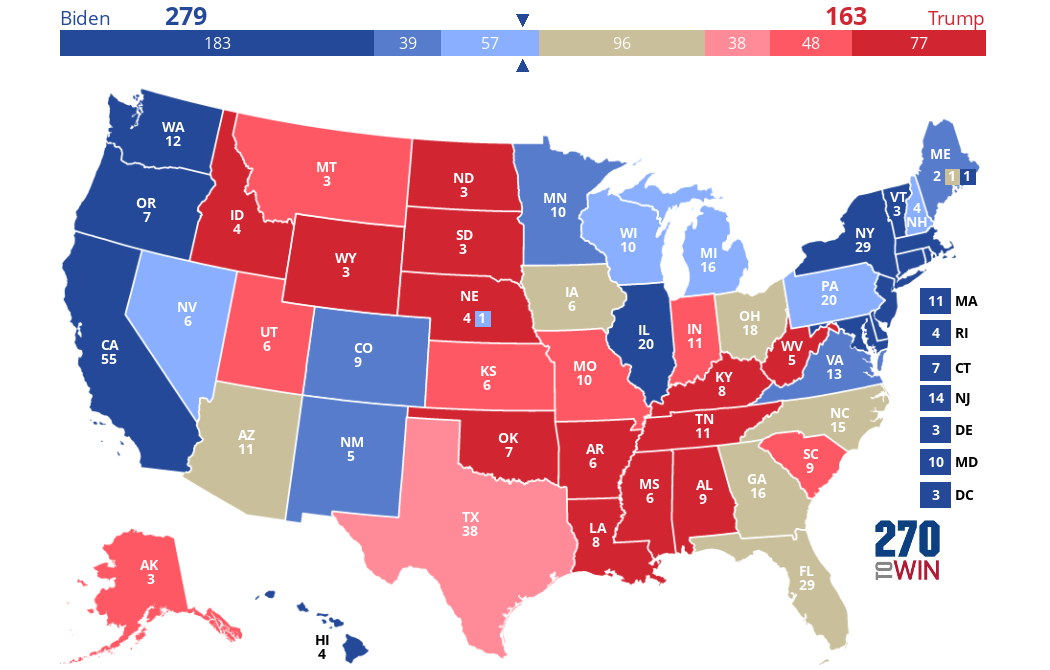
I'm doing a little analytical work for the Seed the Vote project of the EveryDayPeople PAC which aims to send San Francisco Bay Area volunteers to work on getting out the vote next November in Arizona and Nevada. This has made me realize that a general overview of where in the entire country progressive people who want to dump Trump can do the most good might be useful to some folks.

As we saw again to our sorrow in 2016, who gets to be President is not determined by who wins the most votes. The winner is determined by who captures the most electoral votes, state by state. Each state has the same number of electoral votes as its total number of Senators (2) and Congresscritters (variable by population). Except in Nebraska and Maine which throw Congressional district splits into the equation, whoever wins the state gets all the electoral votes in the Electoral College. So, for example, win California and you win 55 votes; win Vermont and you win 3 votes. It takes 270 electoral votes to win the presidency.


Click the map to create your own at 270toWin.com

There are a lot of states where it is dead obvious which party is going to win the electoral votes next fall. History says Democrats start with 248, the dark blue states where huge numbers of people live.

There are three states where the Trump campaign thinks it might be able to turn past defeat into victory in 2020 -- and where progressives need to make sure our voters know the election matters:
  • Virginia
  • Colorado
  • New Mexico.
And there are several states whose past history suggests they are likely to go for the Democratic nominee -- but where progressives would be crazy to let down our guard. All these need volunteer help from people voting in other, uncompetitive states. In that category I'd put
  • Michigan (won by Trump in 2016)
  • New Hampshire
  • Minnesota
  • Nevada.
There are two states where winning for any Democrat in 2020 looks like a huge stretch -- but where building base and increasing the reach and diversity of who votes looks as if it might be a worthwhile investment in a more progressive future:
  • Georgia
  • Texas.
Finally there are the five "swing states" that Democrats, Republicans, and all the pundits agree are up for grabs:
  • Florida
  • North Carolina
  • Pennsylvania
  • Wisconsin
  • Arizona.
To end the Trump era and win the space to struggle for a better, more equal, more humane, and more just United States, we have to win some of these last five. (There are several possible combinations.) This will not be easy but the 2018 showed what aroused people can do if we work hard enough. There will be many organizations in the field looking to put volunteers to work. Find one that has a plan and let's do it!

Sunday, January 26, 2020

The Reformation: Islamophobia and a slavery past

It's usually my practice, when writing about books here, to hold off until I finish them. That seems a fair, even prudent, idea. But it doesn't feel necessary, or wise, to follow this course with Diarmaid MacCulloch's enormous 2004 volume The Reformation: A History. This book is erudite; and long. This book is wide-ranging; and long. The book is opinionated; and long. This book is held up as masterful historic writing; and long. This book is gripping to me; and long.

As I said, it's long. I am reading the audio edition, all 36 hours of it and can highly recommend it. As of today, I only have 18 more hours to go. Some familiarity with maps of Europe and major historical markers help; as I usually feel when reading sprawling histories, I don't quite have enough background to take everything in. But who does, besides MacCulloch? Interestingly and happily in a scholarly text, the narrator is a woman. The only stumbling block I've encountered is her high British pronunciations -- we Yanks sometimes render historical names and places quite differently in speech and it takes a moment to decode.

MacCulloch tells the story of the multiple facets and formations that arose from the splintering of western Christendom. There's the magisterial Reformation (roughly the denominational ancestors of what we call mainline Protestantism); the Tridentine Roman Catholic Reformation which was as thoroughgoing in its way as the breakaways; the Anglican Reformation which was a national horse of another color; and radical reformations -- Anabaptists, Hutterites, Unitarians, etc. -- which went off in their own directions.

What I am going to do as I read along is periodically share bits that leap out at me. I hope they seem interesting to others.

MacCulloch begins by insisting that the story of early modern Europe's religious upheaval cannot be appreciated without being aware that reformers and orthodox alike were scared near out of their wits.

The biggest fear for western Christendom around 1500 was the prospect that it might disappear altogether. ... By the 16th century that destiny lay with the Ottoman Turks. The Ottoman Sultans had created an Islamic empire-building enterprise designed for conquest. They advanced inexorably out of Asia Minor, completing their absorption of the Byzantine empire when they captured Constantinople in 1453, and for a decade from the late 1510s they hugely expanded their territories ...

While far away in north Germany in 1516-17 Luther brooded on his campaign against indulgences, the Sultan overran the territories of fellow Muslims in Egypt and Syria ...

Then it was the turn of the Latins... The Turks occupied and wrecked the royal [Hungarian] capital Buda, whose palace castle was a show piece of Renaissance art as spectacular as anything in Italy and home to one of Europe's most distinguished and up-to-date libraries. This was the first loss in the heartland of Latin Christendom: might the Turks overrun everything?

... In southeastern Europe, ... the Turks were a real and present source of terror to all ranks in society ... Popular suspicions grew that the nobility did not have their hearts in the task of defending Europe ...

The fear which this Islamic aggression engendered in Europe was an essential background to the Reformation, convincing many on both sides that God's anger was poised to strike down the Christian world, and so making it all the more essential to please God by affirming the right form of Christian belief against other Christians. ...

Living under threat of annihilation doesn't make humans better people, then or now. I have to wonder if a visceral fear of Islamic invasion, long more conventional in Europe than in the U.S. (at least before the 9/11 attacks), doesn't include a dim ancestral echo of the true clash of civilizations half a millennium ago.

Part of that clash was a flourishing trade in capture and sale of enslaved people -- a commerce which ran in a direction white residents of the western hemisphere may find unexpected:

Even when the activities of the Ottoman fleet were curbed after the battle of Lepanto in 1571, north African corsairs systematically raided the Mediterranean coast of Europe to acquire slave labour; in fact they ranged as far as Ireland and even Iceland, kidnapping men, women and children. Modern historians examining contemporary comment produce reliable estimates that Islamic raiders enslaved about a million western Christian Europeans between 1530 and 1640 ... Large areas of Mediterranean coastline were abandoned for safer inland regions, or their people lived in perpetual dread of what might appear on the horizon ...

The modern condemnation of buying and selling people is just that: "modern." We humans make structures of society which accord with our moral first principles. So these matter.

More to come about The Reformation.

Saturday, January 25, 2020

From my clutter to your consideration: found thoughts

I have so many topics I would want to write about but never will have time to research properly. So some Saturdays I've decided I'll post some annotated links.

CalMatters has created a simple checklist evaluating measures that California might take to respond to the fact that our economy is throwing people out of their homes and onto the streets. I wasn't inclined to be sympathetic to such a listicle, but find this thought-provoking and instructive. Take a look.

I often repeat a recurring rant about how we aren't going to combat climate chaos through individual behavioral tweaks. Carbon pollution is society-wide and needs society-wide solutions. Here's an article which documents how individual action --a crackpot, but emotionally comforting, idea -- came to infest late-20th century U.S. environmental consciousness.

And if you want to feel better, read this pitch from an articulate trail running coach about why his athletes and community should be working to save our environmental laws from the Trump administration's giveaways to the polluters.

Friday, January 24, 2020

Friday cat blogging

There he sits, giving us a look. What a lovely fellow!

Guaranteeing rights

The last time in U.S. political history when a substantial fraction of the people were screaming that the Constitution had enabled monstrous evil was immediately prior to the Civil War. The abolitionist William Lloyd Garrison famously called our basic document "a Covenant with Death, an Agreement with Hell" because it countenanced slavery. And so, eventually, conflicting passions broke the system and the nation fought a Civil War which killed 620,000 combatants. And then the victors set about fixing the Constitution.

Historian Eric Foner's The Second Founding is the story of how a radical Congress (in those days, the radicals were Republicans) set about remaking our basic law to guarantee civil equality of the races -- and how the next generation and a conservative Supreme Court set about subverting the new edifice the Civil War generation had built. Foner is the author of an exhaustive history of the Reconstruction era (1863-1877) which I've explored here, here, and here. His current book focuses on the Constitutional changes -- the 13th, 14th, and 15th Amendments -- which their authors believed would put the evil which they had just overthrown behind them forever.

It didn't work out that way.
  • The 13th Amendment outlawed "involuntary servitude," "except as a punishment for crime" -- an exception that the states of the former Confederacy used to entrap Black citizens in "neo-Slavery" using "vagrancy" laws and other phony offenses. The ill-effects of that Constitutional phrase continue today in our disenfranchisement and discrimination against people with criminal records.
  • The 14th Amendment guaranteed equality and citizenship to anyone born here. The courts fairly quickly allowed segregation laws to gut this promise of equal treatment, though the same courts rapidly became very solicitous of the "due process" for those favored phony "legal persons," big corporations.
  • The 15th Amendment gave black men the vote, but the same courts allowed states to hedge the franchise with poll taxes, literacy tests, and other restrictions, gutting the franchise.

Congress built further interpretation and implementation into the amendments. But this ran the risk that their purposes could be defeated by narrow judicial construction or congressional inaction.

All these amendments promised that Congress could make the laws needed to realize their intent, but a combination of lack of political will and unfriendly courts prevented that from happening until, partially, the Civil Rights struggle of the 1950s and '60s. I take from that experience that the meaning of law will always be somewhat dependent on how much we're willing to agitate for in the streets -- plus doing all that other stuff like educating ourselves and voting.

Foner has provided a short, very accessible treatment of the legal aspect of Reconstruction in this book. In the current moment, when Republicans believe, accurately, that they can't win numerical majorities for their policy preferences, and so must game the Constitutional system, this is history we can't ignore. Foner is not despairing.

Rights can be gained, and rights can be taken away. A century and a half after the end of slavery, the project of equal citizenship remains unfinished. ... And because the ideals of freedom, equality, and democracy are always contested, our understanding of the Reconstruction amendments will forever be a work in progress. So long as the legacy of slavery and Jim Crow continue to plague our society, we can expect Americans to return to the nation's second founding and find there new meanings for our fractious and troubled times.

Thursday, January 23, 2020

Prosecute them!


This strikes me as bold. Elizabeth Warren proposed Tuesday that, as soon as she is inaugurated as President, she'll set up a task force to investigate and, if necessary, prosecute corruption and crimes by the outgoing Trump administration.

Establish a Justice Department Task Force to investigate corruption during the Trump administration and to hold government officials accountable for illegal activity. Donald Trump has run the most corrupt administration in history. He was impeached for withholding foreign aid in an effort to try to benefit his re-election campaign. He has enriched himself and his business through the power of his office. And there are public reports of potentially illegal corruption in every corner of his administration.

If we are to move forward to restore public confidence in government and deter future wrongdoing, we cannot simply sweep this corruption under the rug in a new administration. That’s why I will direct the Justice Department to establish a task force to investigate violations by Trump administration officials of federal bribery laws, insider trading laws, and other anti-corruption and public integrity laws, and give that task force independent authority to pursue any substantiated criminal and civil violations. I have also committed to establishing a task force to investigate accusations of serious violations by immigration officials during the Trump era. 

Wow! If she were to be able to make this happen, the GOPers would charge political revenge. But, after all, they do seem to commit all sorts of crimes, casually and habitually. So prosecute 'em!

This is what the Obama administration failed to do after Wall Street hot shots crashed the global economy in 2008. No one went to jail for peddling phony paper investments that trashed the whole system. We are still living with the fall out of that dumb, and possibly corrupt, administration decision. Nothing ensures cynicism and indifference toward democratic government more than watching crooks walk free while ordinary people suffer. ... And then the crooks got even richer.

Warren is saying no to this very concretely and we can assume the billionaire boys will fight her even harder. Will other Dem aspirants make the same pledge?

TPM pushed her on possible limits to her approach:

... a Warren campaign aide emphasized to TPM the limits in scope of the task force.

“The plan calls for a DOJ task force with independent authority and a limited scope to look at specific current laws that were broken: Federal bribery laws, insider trading laws, and other anti-corruption and public integrity laws,” the aide said. “It will investigate independently and prosecute or not prosecute as they see fit.”

The aide added that the proposal is not about “political rivals” but “restoring the rule of law.

“The best way to turn the page on Trump-era corruption is for people who broke the law to be held accountable so that future officials — including in a Warren Administration — will know that violating the public trust and breaking anti-corruption and public integrity laws will come with consequences.”

I couldn't agree more, but she's going to take a lot of shit for this one.

Wednesday, January 22, 2020

Hillary Clinton: please just shut up


It's not about you. I don't care if you don't like Bernie and especially his (apparently young and male) intemperate followers.

The 2020 campaign is about dumping Trump. There are millions of us prepared to work our butts off even if the Democratic electorate saddles the effort with an uninspiring "moderate" or old white man.

You can stuff your ego and get with the job. Yes, I know, that's been your life. Struggle is long; that's why they call it struggle.
...
Yes, I know, she's backed off her original bull-bleep. But I expect better of her and her tribe.
...
I was just cleaning out my stash of Hillary Clinton images and damned if I didn't have to use one again.
...
This abbreviated post is the consequence of having lost a couple of hours, along with the hard working E.P., trying to get our calendars to sync. They never did. I'm as mad at Google and Apple as at Hillary. Not yet a good day.

Tuesday, January 21, 2020

Without grounding in human rights, there is no ground to rise from

Last week I had the chance to attend a talk by Noah Bullock, director of Cristosal, on his organization's work in El Salvador, Guatemala, and Honduras. Cristosal works across the Northern Triangle of Central America to monitor forced displacement by physical and sexual extortion and violence, to create models for humanitarian, psychological, and legal assistance to victims of human rights violations, and to demonstrate effective strategies for sustainable, community-based victim protection and support.

What's that boilerplate mean? Cristosal is currently assisting litigation for recognition of and compensation to the survivors of the El Mozote massacre and other war crimes of decades past within the legal institutions of the Salvadoran state. This effort strengthens what should be foundations of reliable rule of law in that violent country. Today, all these countries suffer from oligarchic gangster governments which do not provide security to their people. Chronic violence and the nonexistence of effective state institutions that might protect people in their homes drive migration both within these countries and out of the countries. Cristosal has been instrumental in supporting local initiatives to recognize the rights of citizens to live in their home places in peace and without fear.

And, since these Central American countries come nowhere near providing their people the security they have a right to expect from law enforcement, Cristosal -- where it can -- provides immediate protection to move people out of danger. Moreover, they are attempting to show that people displaced by violence can be reintegrated into new communities where they'll be safe and can live in peace. This is not simple -- it's not as if anyone anywhere really wants an influx of traumatized newcomers; that sentiment is not unique to the U.S. Before Trump came along, the USAID funded some of these initiatives but nowadays the US government likes the gangster status quo. As in so many policy areas, our government acts as if it hopes all those annoying Spanish-speaking poor people would just die where they are.

Cristosal is well known in El Salvador and the rest of Central America for its work; the organization is demanding that governments and all of us take human rights as inviolable and worth defending.

I did not come up as a leftish activist in a time when human rights were at the top of our minds. In the decades of the struggle within the United States for African-American civil rights, during the heady rush of decolonization across the globe, and of the struggle against imperial resistance to national freedoms, we thought that some form of revolution was the way to justice. The suffering people would (and should) rise up and replace the bums in power. Unhappily, the track record of 20th century revolutions has not been that good. We thought "human rights" was something some First World liberals tried to impose on the world after they won their anti-fascist war in 1945 -- a good thing, but peripheral to the real conflict of classes and races.

Meanwhile, it was activists in what we then called the Third World -- developing countries as we'd probably call them now -- who occasionally reminded enthusiastic North Americans that international institutions like the the United Nations and the World Court should be guarantors of human rights, of human decency. They knew something about permanent struggle and the need for institutional bulwarks of freedom that we thought we could skip over.

On the Cristosal website, Noah Bullock explains how a nice young man from Montana who landed in El Salvador in 2005 (and stayed), understands the centrality of human rights law and concepts in the long arc toward justice and freedom.

“Human rights were taught to me as a historical process, and every generation has to be able to understand human rights and violations in their own time.

"Our moment has changed significantly from when these frameworks were established, so we are challenged now to find ways to apply these same principles in programming to address our moment’s greatest challenges of displacement by violence, poverty, and inequality.”

I am appending here a short film (10 minutes) that tells a story of Central American violence as lived by some of its victims. It has been shown more than 10 times on Salvadoran television -- and that legislature recently enacted a law purporting to guarantee that police should protect citizens. They neglected to append any funding though ... And so the struggle continues ...

Monday, January 20, 2020

Celebrating engagement


Battered, bruised, but still striving toward the beloved community. We are fortunate that Dr. King has inspired this day to acknowledge this necessity.