Since the start of the [current] 119th Congress, five members of the House—four Democrats and one Republican—have died. Several others have missed significant periods of work because of illnesses that either remain mysterious or have been revealed by the president as being quite serious.
In recent history, the deadliest session of Congress was the 117th, which took place in 2021–2023, when seven lawmakers died. With five deaths among the ranks, the 119th Congress is among the deadliest since then; the 115th Congress also had five deaths during its two-year span.
According to an analysis from Slate, 16 lawmakers have died in office in the past decade, which is greater than any stretch of three consecutive Congresses since the new millennium.
Replacement by mortality seems an extreme way to achieve generational transition.
Congress is old. The nation is in general not young; our median age is about 40, half younger, half older. Perhaps that's why we seem to have an enduring tolerance for politicians who have long reached their sell-by date.
Congresscritters of both parties take extended absences for health reasons. Republican Tom Kean Jr. who apparently has been absent for months is only 57. Maybe he's got a good excuse, but he's not saying. Meanwhile "Representative Frederica S. Wilson, 83, a Florida Democrat, has been absent from the Capitol for over a month." Apparently she had an eye ailment and apparently she is running for reelection. Despite Florida redistricting which favors Republicans, her Miami district remains a safe D seat, so expect her to be around for awhile.
Re-electing an 83 year old doesn't suggest dynamism. I'm grateful my Congresscritter Nancy Pelosi, 86, has decided to hang it up. Over her many years in office, I'd describe her as growing in wisdom.
Despite the impression one gets that Congress is stuffed with old people, the tilt toward the old has very slightly moderated in the last four years. The Pew Research Center reports:
The median age of voting members of the House of Representatives is now 57.5 years. That’s down from 57.9 at the start of the 118th Congress (2023-25), 58.9 in the 117th Congress (2021-23), 58.0 in the 116th (2019-21) and 58.4 in the 115th (2017-19).
The Senate, following the death or retirement of some of its oldest members, has reversed its aging trend. The new Senate’s median age is 64.7 years, down from 65.3 at the start of the previous Congress.
The median age of the Senate had previously risen for three Congresses
in a row: from 62.4 (115th) to 63.6 (116th), to 64.8 (117th) and to 65.3
(118th).
I'm a boomer, but I'm well aware that the time for the political dominance of my generation is so over. Last year New York Times Opinion published this delicious jeremiad against our monopolization of the power and wealth. I can't figure out how to embed the video here, but click this link for an experience.
And now for some observations from somebody else's elections. Britain has just come through a round of local votes and the results seem to imply big changes in how that country's democracy might function in the next decade.
... Millions of Britons voted in elections to Parliaments in Scotland and Wales, and to municipalities in England. And they delivered a damning verdict on [Prime Minister] Starmer’s governing Labour Party. ... [Labour is analogous to our Democratic Party; it has a large majority of the seats in Parliament which means its elected leader runs the government.]
The main victor on Thursday was the right-wing populist Reform U.K. party [Britain's MAGA], which gained more than 1,400 seats on municipal councils across England. The party took seats from the Conservative Party and from Labour and consolidated its status as the dominant party of Britain’s political right. But the left-wing Green Party also made gains at the expense of Labour.
The results shattered the grip on power long held by Labour and the Conservative [Party], and signaled a new political landscape in which at least seven parties are vying for votes across Britain.
Although this complicated set of local elections won't mean the end of the central Labour government for now, clearly something's stirring -- and even looking from the US, this seems to mark a significant political shakeup -- something bigger than the fact that Starmer seems a literally unappealing leader.
The British left-wing political blog Another Angry Voice, by Thomas G. Clark, has lots to say about the apparent crack up in British politics, one section of which might seem highly familiar to us in the U.S.
What did we learn from the 2026 elections?... Demographics
This topic always provokes fury from the "not all boomers" brigade, but it’s absolutely undeniable now.
The biggest determining factor in how people used to vote in the 20th Century was social class. The biggest determining factor in how people vote these days is age.
If only the votes of working age people were counted, the results would be very different, with the Greens, Labour, and the Lib-Dems faring dramatically better.
If only pensioners votes were counted, we’d be looking at even more massive Reform gains.
... The working age population want some hope; and affordable housing; and decent wages; and workers rights; and investment economics. The boomers want a [radical fascist Nigel] Farage-style demolition job on the last remnants of the post-war [welfare state]settlement. You know, the mixed economy economic conditions that made them the richest generation ever.
Their parents’ generation fought in WWII to stop the extreme-right, now they’re absolutely gagging for the extreme-right to tear down the last remnants of the post-war legacy that their parents’ generation left them.
It’s not all of them, but it’s a huge percentage of them. ...
Makes me wonder how much of the strength of MAGA can similarly be largely attributed to Donald Trump's (and my) age cohort.
The Pew Research Center provides some suggestive data from 2024. They explicitly include both people who are willing to say they identify with a US political party and also those whose lean toward one or the other; lots of voters claim independence, but actually possess a persistent lean as a consequence of the system offering election after election with only two choices.
Age, generational cohorts and party identification
Today, age is strongly associated with partisanship – and this pattern has been in place for more than a decade.
The Democratic Party holds a substantial edge among younger voters, while the Republican Party has the advantage among the oldest groups. • About two-thirds of voters ages 18 to 24 (66%) associate with the Democratic Party, compared with 34% who align with the GOP. • There is a similarly large gap in the partisan affiliation of voters ages 25 to 29 (64% are Democrats or lean that way vs. 32% for Republicans). • Voters in their 30s also tilt Democratic, though to a lesser extent: 55% are Democrats or Democratic leaners, 42% are Republicans or Republican leaners.
Neither party has a significant edge over the other among voters in their 40s and 50s: • Half of voters in their 40s associate with the Democratic Party, and 47% are affiliated with the Republican Party. • The shares are reversed among voters in their 50s: 50% align with the Republicans, 47% with the Democrats.
Among voters ages 60 and older, the GOP holds a clear advantage: • Republican alignment is 10 percentage points higher than Democratic alignment (53% vs. 43%) among voters in their 60s. • Voters ages 70 to 79 are slightly more likely to be aligned with the GOP (51%) than the Democratic Party (46%). [Might this slight counter trend show we were 1960s rebels once?] • About six-in-ten voters 80 and older (58%) identify with or lean toward the GOP, while 39% associate with the Democratic Party.
As some Brits might say, we too have a boomer problem ... Since older people are more likely to vote than young people, these differences have powerful consequences.
My cohort of progressive boomers do our bit by working to encourage the younger folks to participate!
As I look at the presidential race, I wonder if I'm seeing an emerging majority coalition that has been inching its way into being for all the decades of my active election experience. We've come a long way.
The country clearly exists in a moment of flux, in which, as Obama observed at the Democratic convention last week, we are fully testing the idea that a democracy built on pluralism can succeed.
But part of the surge in enthusiasm for Harris’s candidacy is clearly rooted in her overtly representing the diversity of America. Conservative White Americans often see America’s non-White population as a unified entity colluding to strip the power of Whites.
The shift from Biden to Harris at the top of the Democratic ticket allowed for a shift in strategy, too, from treating Trump as an opposing force to treating him as a historic outlier. Waving off Trump as “weird” has a knock-on effect, uniting those opposed to Trump’s candidacy and politics as the true inheritors of the American tradition.
... It may be that Trump helped bring to fruition the political shift predicted with Obama’s 2008 victory. His win proved to be a potent organizing force for White conservatives.
The election of another Black president in the face of that force, an election powered by a coalition strengthened by opposition to Trump, might in fact turn the page that began being written 15 years ago. It is a page, though, that has appeared in American history books multiple times before.
This reminded me of observations I made in early 2008, while watching the Hilary Clinton/Barack Obama primary.
It looks to me as though the Obama candidacy is trying to birth a national coalition which, like the Democratic one in California, doesn't quite have a secure demographic base though such a base seems visible on the horizon. This coalition must, at present, attract enough support outside its obvious members to win an election. Naturally, its leading edge is young voters, folks who live closer to that diverse and difficult demographic future older folks can envision but do not so nearly inhabit.
As Historian Bruce J. Schulman [original link is dead, unfortunately] of Boston University notes, Obama is not the first to try this. In addition to RFK, it's only fair to mention Jesse Jackson in 1988 -- at the end of 2008, will Obama have exceeded Jackson's total of wins in 11 states? ...
A long-term national progressive coalition must somehow hold together most African Americans, most Latinos, probably the majority of various Asian-origin voters, and enough whites, probably predominantly female, to make a majority. ...
Republican overreach, robbing women of our control over our bodies, has hastened the movement of many white women into this coalition. And these white women definitely vote, as do Black women.
On the other hand, it's taken long enough to get here that more and more Latinos and Asian-origin voters are beginning to vote as other immigrants have learned to before them: making electoral choices divided more on their class position in the new country than by ethnic affinities. Think Italians or Irish moving beyond hyphenated status. That's too a kind of American progress but it adds to today's progressive challenges.
But in a general way, the potential Democratic Party coalition visible in 2008, and in California fifteen years before that, may finally be coming to fruition nationally in Kamala Harris' candidacy, if we can push this candidate over the finish line.
MAGA backlash replicates birtherism in response to Obama and California reactionary nativism of the 1990s and before. Anyone else remember when California was Ronald Reagan's launch pad based on bashing hippie students?
Coalition pluralism was the challenge in 2008; it's still the challenge today. But it can happen. It's no accident that today a Californian leads a Democratic ticket capable of confirming the possibly of a new way forward.
Kevin Munger points out: "Harris’s nomination locks in another Boomer presidency."
I hadn't quite thought of it that way. As a product of the leading edge of the Boomers (b. 1947) I don't find it automatic to locate myself in the same age cohort as someone who missed the '50s and most of the '60s. But demographic wizards say all of us born between 1946 and 1964 (including Harris) are out of the same population bulge which first led to a need for new kindergartens and grade schools and now is leading to increased worry about funding Social Security.
Despite being a Boomer, you may have noticed that she’s the young, exciting candidate.
Yes, the generational cutoff points are arbitrary, 19 is too many
years to define a coherent generation. But the far more important fact
is that Biden and Trump are really quite old.
The
echoes of the Baby Boom structure our political, economic and cultural
reality. Our country’s age pyramid is just what our country is.
It is a crucial but oddly politically inert fact that at both the
mass and elite level, our country is far older than it has ever been
before. ...
It’s our electoral institutions [that] cause the US to have such
astronomically old leaders. The two-party system, lax campaign and
especially campaign finance laws, and the primary system tilt the
process heavily in favor of people with time, money and political
interest — which, in our society, tends to be older people.
Combine this
with the Baby Boom and you get the current situation, playing out in
slow motion, a demographic wave not crashing but seeping into and
drowning our politics.
... A media-theoretic aside: television has demonstrated its continued
dominance of the media ecosystem. The 2024 Biden-Trump debate is —
without exaggeration — one of the most important media events in modern
history. ...
He goes on to delve into the history of recent elections when there was a substantial difference in ages between candidates (younger won) and the "unmet demand for younger politicians appealing to younger voters."
We Boomers got to give way someday ... but by once again, somehow, presenting the country with the apparently young candidate in Kamala Harris, we are imprinting yet another generation of young voters with what Munger has named "Boomer Ballast." This has been very good for Democrats for decades.
This is too good not to share. The New York Times' polling geek Nate Cohn responded to a reader email:
I’m 79, and women my age remember when abortion was illegal. Many of us either had a back-alley abortion, or had friends who had one. We are determined that neither our daughters nor our granddaughters have to experience this. Many of the elderly men I know still vote for Republicans. But watch out: We outlive you! — Mary Leonhardt
You may be partly joking, Mary, but this is probably a minor reason Democrats do a bit better among older voters than people might guess!
Why? American women, who tend to support Democrats, live almost six years longer on average than men. Women make up 55 percent of registered voters over age 65 — including 58 percent of those over age 80 — according to data from L2, a political data firm. In comparison, women are 52 percent of registered voters under 65.
I know all of this is a little morbid, but longevity strikes me as an underexplored dimension of electoral trends nowadays. We know higher life expectancy is correlated with socioeconomic status and tends to be higher in Democratic-leaning areas. Could this be a factor in why Democrats are performing better among older voters than usually thought? I think so.
As Cohn points out, old men too live longer in more prosperous areas where there are more Democrats. Kind of makes you suspect there's a correlation between (better) functioning social systems, sane politics, and longevity.
Daniel Cox passes along that among adherents to the Church of Jesus Christ of the Latter-Day Saints, though nearly all are consistent Republicans, Donald Trump is less and less popular.
More than half (51 percent) of Latter-day Saints express
negative views of the former president. They are also twice as likely to
have a very unfavorable than a very favorable opinion of him. By way of
comparison, two-thirds (67 percent) of white evangelical Protestants
have favorable views of Trump. In a head-to-head match-up with Biden, less than half (48 percent) of Latter-day Saints say they would vote for Trump ...
... More than anything else, what differentiates Latter-day Saints
from white evangelical Protestants is their commitment to cultural
pluralism and political tolerance. Sixty-one percent of Latter-day
Saints say that America’s increasing racial and ethnic diversity is a
good thing for society, a view shared by only 36 percent of white
evangelical Protestants. Nearly two-thirds (66 percent) of church
members believe the US should encourage more diversity as it fosters
tolerance and understanding. Most white evangelicals reject this view.
... Roughly two-thirds of Mormons believe that Muslims (68 percent) and Jews
(65 percent) face a lot of discrimination in the US, while less than
half of white evangelicals say this is true (46 percent and 45 percent,
respectively). In fact, there is only one religious group that most
white evangelicals believe experiences a lot of discrimination in
America: Christians.
But change is happening, even here:
Latter-day Saints remain a Republican constituency with conservative
views on a host of issues from abortion to gay rights. There’s been some
deterioration of Republican affiliation in the post-Trump era, but it
remains modest. Gallup polls show 62 percent of church members are
Republican or lean towards the Republican Party, down from 69 percent in
2016.
Click to enlarge
Generational patterns suggest this drop may just be the beginning. In his Substack, Ryan Burge argues that a “seismic shift”
is occurring in the politics of young Latter-day Saints. Young members
are far less conservative and committed to the GOP than older members.
Burge notes that less than half now identify as Republican.
The theme I'm calling "generational sea change" (more here and more here) is that, quite simply, Republicans have lost the country's culture. Some are aggrieved and angry, many are just confused, and young people ask, "what's this all about?" Change is coming ...
Looking at polling about the attitudes of young citizens is to realize we're sailing into a different world. And there is reason to hope that world is a better, more benign, democratic (small "d") place. Really.
For more than two decades, I’ve been embedded in the land of young
Americans. First millennials, and now Gen Z with an eye on Gen Alpha.
From my perch since 2000 as polling director at Harvard Kennedy School’s
Institute of Politics, at SocialSphere,
and as the dad of a few Zoomers and one Zillennial — I spend most of my
time talking with, surveying, and thinking about young Americans.
Gen Z is in the midst of the best job market in their lifetime — and also most of the lifetimes of their parents and grandparents. The youth (16-24) unemployment rate is 7.5% — the lowest at any point since the Eisenhower administration. Among Gen Zers between 20 and 24 years old, the unemployment rate is 6%; it is only 5.3% among young women.
Click to enlarge
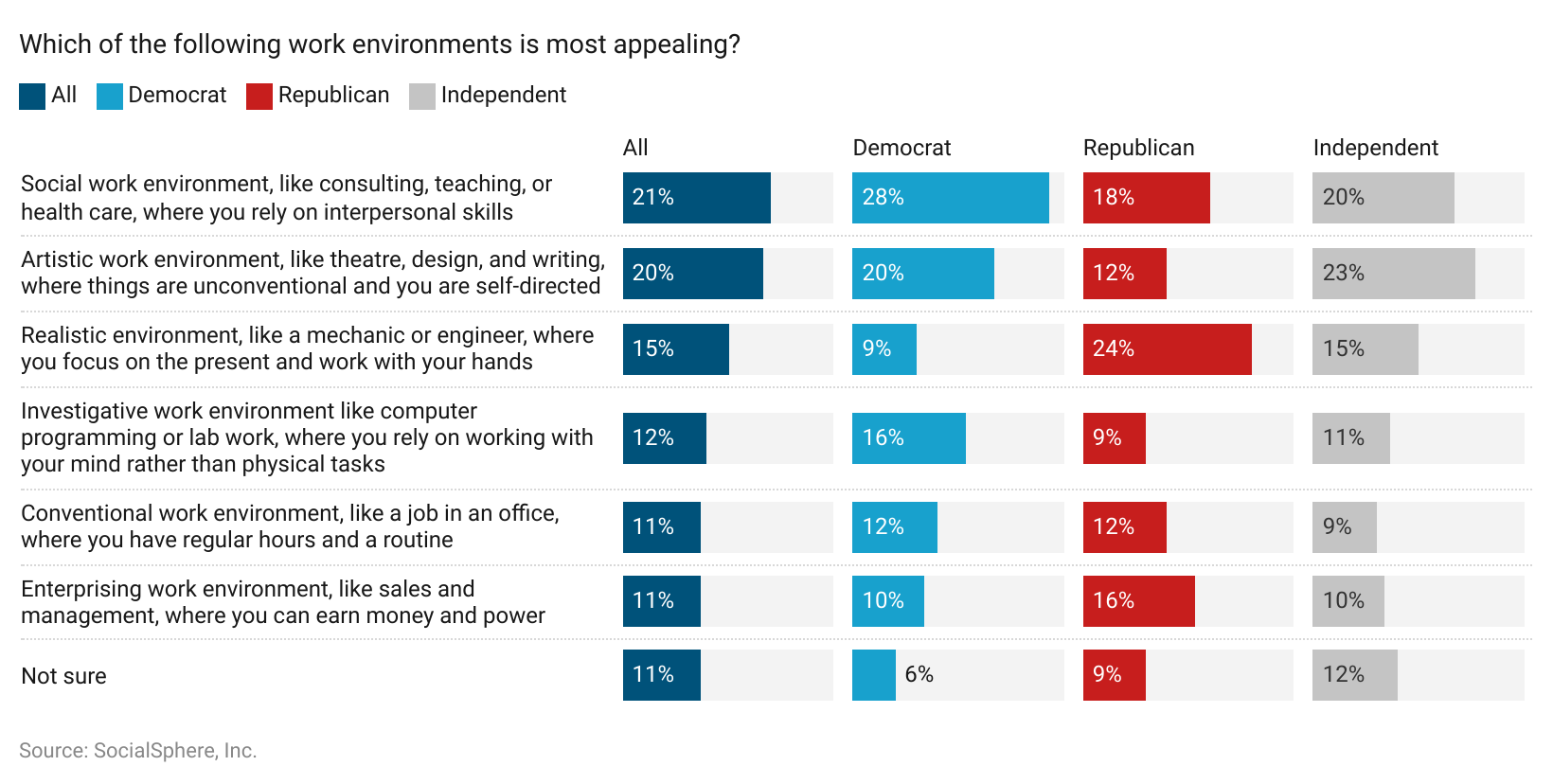
Gen Z seeks unconventional, self-directed work environments Currently, over half of Zoomers between 15 and 25 are working part-time or full-time jobs (52%) – with nearly a quarter (23%) working more than one job. Living up to their own standards, nearly two-thirds (62%) have found roles that leave them fulfilled.
Very few Zoomers that we interacted with over the last year showed an interest in the jobs that their parents once or currently hold. Gen Z is witnessing the regrets of their parents playing out in near real-time, sacrificing family time and personal fulfillment for a work culture where the rewards are reaped by only a few.
Only about one-in-ten Zoomers aspire to a “conventional work environment,” we found that far more find conditions with “social” (21%) or “self-directed” and “unconventional” (20%) elements appealing.
I read this and I am reminded of my own early Boomer cohort which came of age in the late 1960s. We had NO interest in joining the conformist work culture of many of our parents who had happily traded the struggles of the Depression and WWII for calm and consumption. We aspired to make something better, more meaningful -- and in the context of general prosperity, we did change the country -- and did make life somewhat freer for communities of color, women and queers. Sure we had many failings, but the culture never reverted and the MAGAs are still pissed off about it.
Wonder what the Zoomers will do?
Item: This is less general, but something very interesting is happening in California voter registrations. Demographic change -- becoming a "majority/minority" state where no ethnicity amounts to over 50 percent -- facilitated the state turning heavily Democratic (capital "D") around 2000.
This shift did not include newly engaged voters enthusiastically signing up as Dems. In fact, the fraction that chose "independent" has grown ever since. The traditional political party divisions did not appeal.
But, unexpectedly to me, the increase in independent registrations seems to have peaked or even declined among young people, according to the LA Times.
Voter registration data in many states also has shown an increase in independents, although there’s intriguing data from California suggesting that trend may have started to turn around.
After decades of steady increase, the share of Californians registering as nonpartisan peaked in 2018 at 28%. It has dropped since by 5 points, with the biggest declines coming among young voters. Among voters younger than 35, the share registered as nonpartisan is the lowest it’s been since 2006, according to analysis by Eric McGhee of the Public Policy Institute of California.
... Party polarization has been strong for years, but since the Trump era, “it’s entered into a whole other gear,” [McGhee] said. “I wonder if that hasn’t changed how people think about the parties” and made the option of sitting outside the party system feel less attractive.
I'm not such an unfaltering Democrat that I'm jumping for joy about this -- but I've long accepted that, if you want to play, you have to get in the game. New registrants, mostly young, seem to be coming to play.
This old queer feminist never thought I'd see this.
White House national security spokesman John Kirby on
Monday passionately defended the Pentagon’s policy of paid leave and
travel reimbursement for abortions, calling it the right thing to do for
Americans who volunteer to serve in the U.S. military.
... “It can have an extremely, extremely significant impact on our
recruiting and our retention,” he added. “It’s just the right darn thing
to do for people who raise their hand and agree to serve in the
military.”
... “When you sign up and you make that contract, you have every right to
expect that the organization — in this case, the military — is going to
take care of you and they’re going to take care of your family. And
make sure that you can serve with dignity and respect no matter who you
are or who you love or how you worship or don’t,” he said.
“Our policies, whether they’re diversity, inclusion, and equity or
whether they’re about transgender individuals who qualify physically and
mentally to serve to be able to do it with dignity,” he added. “Or
whether it’s about female service members, one in five, or female family
members being able to count on the kinds of health care and reproductive
care specifically that they need to serve.”
If you are going to have an all-volunteer army, you have to pay attention to the attitudes of the generation you are trying to recruit. The US military knows this. Most likely life in the military isn't as welcoming of the culture of young people as Mr. Kirby might insist, but reality forces change and improvements.
Pollster Celinda Lake and filmmaker Mac Heller (gift article) explain a great deal about how Gen Z coming of age will change us all.
Gen Z voters say their motivation is not a party or candidate. It is,
instead, strong passion on one or more issues — a much more
policy-driven approach than the more partisan voting behavior of their
elders. ...
For
Republicans, the message is obvious: Listen to the voices of this
soon-to-be-dominant group of voters as you formulate your policies on
climate, abortion, guns, health care, inclusion and everything else.
Unlike some older voters, they are listening to what you say — and to
how you say it. Change your language and style from the unmitigated
male id of “Never Back Down” and “Where Woke Goes to Die” to words of
community, stewardship, sharing and collaboration. That’s the new
patriotism, and young voters believe that approach will solve problems
more effectively than what they’ve seen over the past two decades. ...
There
are stark messages for Democrats too. Meet young voters where they are:
on social media, not cable news. Make your messages short, funny and
somehow sarcastic yet authentic and earnest at the same time. Your focus
should be issues first, issues second, candidates third and party
identity never.
This is the United States that is ... and the country we are becoming. Kind of scary the military understands this before so many politicians, but I am thankful for any clear sightedness this embattled nation can muster.
At The New Republic, editor Michael Tomasky offers a barnburner of an exploration of why Donald Trump in 2023 is even more of a danger to this country than he was in 2016. Simply put, Trump has become the pure incarnation of white cultural despair. Defeat has scrubbed away any vestige of his carnival performer's charm, however phony it might always have been.
Concurrently, Tomasky explores succinctly the demographic realities that are pulling the foundation from under Trump and his MAGA Republicans, leaving them so angry and confused. We no longer live in the America I was born into or even the world of my midlife in Reagan's time. Nor do a great many of us live in MAGA world. Another country is possible ... and largely already here. And therein lies the hope that should buoy a refashioned Democratic, pro-democracy, political party.
Yes, times have changed. Not in every way for the better. But in terms
of broad cultural attitudes, Americans are far more open-minded today
than they were in Reagan’s time. Gallup started
asking people about same-sex marriage in 1996 (it didn’t even register
as an issue in the ’80s). In 1996, respondents were opposed by 68 to 27
percent. By 2022, that had flipped
almost precisely on its head, with 71 percent in favor and 28 percent
opposed. The turning point came in 2011, and the number has basically
climbed ever since. ...
The country is dramatically different. In 1985, the United States was 78 percent white (non-Hispanic white, that is, according to the Census Bureau), 12 percent Black, 7 percent Hispanic, and just under 3 percent Other (Asian Americans were still just “Others” then). In 2020, the country was 58 percent non-Hispanic white, 19 percent Hispanic, still 12 percent Black, 6 percent Asian, and about 3 percent Native American.
In 1985, 19 percent of Americans had completed four or more years of college. In 2021, that number was doubled—23.5 percent had four-year degrees and 14.4 percent had graduate degrees, for a total of nearly 38 percent.
In 1984, 76 percent of Americans lived in metropolitan areas; the share of those living in urban areas had nudged up to 80 percent in 2020.
In 1980, the share of the U.S. population that was foreign-born was around 6 percent; in 2021, it was 13.6 percent. Finally, in 1990, households headed by married couples made up 55 percent of all households; in 2022, that was down to 47 percent.
Now let’s turn to religion. According to Pew, throughout the 1980s, about 90 percent of Americans were
Christian. The 1990s saw a fairly steep decline down to around 80
percent. This century, the erosion has been less sharp, but it’s been
steady—the number who said they were Christian dropped to 63 percent in
2021. The number who said they were religious but named another religion
has increased slightly from 1972, from 5 to 7 percent. And the number
saying they were religiously unaffiliated has zoomed from 5 percent to
29 percent. Young people are abandoning religious belief at high rates. ...
I like this country better. From where I sit, there are somewhat less people who want to erase my existence. And a lot more people who are exploring what it all means. We can confidently assert that Trump is out of touch with who most of us are.
Tomasky translates, very concretely, what all this happy change means to our politics. We can feel it; this essay gives words and structure to intuitions. Highly recommended.
A twitter comment from a Helen Kennedy has me reflecting:
I think Dobbs is this generation’s Iraq war. The first time a right is taken away is searing.
There's something in that. Mostly we just live our lives. But external events can jar us into extremely enduring political alignments.
For my generation, early Boomers, that event was the immoral, futile war in Vietnam -- and the military draft. War bad; pols who constrain war, good. (The Democrats were weak reeds here until years later.)
There may be citizens for whom the fall of the Berlin Wall and the collapse of the Soviet Russian empire had similar valence. But is what is experienced as a distant triumph of similar enduring weight to what is felt as moral injury? That's an honest question. I don't know.
For sure, G W Bush's Iraq war scarred a generation. "Bush Lied; Millions Died!" went the chant. Only partially accurate, but heartfelt.
And now, Dobbs/abortion prohibition on top of Donald Trump, MAGA racial and gender hatefulness, climate denial, and guns galore ... these are generational moral injuries to many young people coming up these days.
Given a means to say "no", they will throng to it. The Washington Post provides a granular account of how young people were organized to vote in the recent judge election, giving WisDems an astonishing winning margin for their candidate.
“The
incredibly personal threat posed by the Wisconsin abortion ban…meant
that in an election that normally has almost no resonance among young
people, in this election, campus wards were packed,” [Ben] Wikler [Democratic Party chair ] said. But
more broadly, the issues of democracy and personal freedoms also brought
students out in big numbers.
“This
generation of young people are primed to participate in the electoral
process,” Mike Tate, [lead organizer,] said. “They simply need to know how to do it.”
Democrats flooded state campuses with local student organizers who tabled daily -- only moving inside when temperatures dropped below 35. They made sure students planned for the election, knowing when, where, and how to cast their ballots. Many new voters need information and support with these simple mechanics; there's a fear to be overcome of somehow doing it wrong or embarrassing themselves.
All this organizing was cheap -- at least in election terms. The two candidates together spent $37 million on campaigns -- mostly TV ads. The Democratic campus organizing cost just $1 million.
Would that the entire Democratic Party would join WisDems in recognizing that diligent organizing, especially among young citizens, is where our future can be ensured.
Gavin Newsom has never been one of my favorite politicians. I've mostly thought that he's just a pretty face.
That old San Francisco crook Willie Brown implanted Gavin on the city; he pranced, preened and touted flimsy progressive bonafides while afflicting the poor and homeless. His mayoral tenure included plenty of flash, but no sign of judgement. After all, in those days he was married to the woman who is now Trump Jr.'s main squeeze, Kimberly Guilfoyle; no kidding ...
When he decamped to Sacramento to spend eight years as Jerry Brown's lieutenant governor/understudy, we didn't have to hear so much from him; that's not a high profile office. I am willing to admit he hasn't been a disastrous governor once he moved up the ladder. Maybe he learned something from watching Jerry.
But now that he's completed that ascent, he's running around the country tweaking the MAGAs on their Confederate turf, once more the flashy huckster we first knew him as. As a San Franciscan, it's kind of fun to watch -- and hard to take seriously.
But I think pundit Mike Madrid may be on to something in a Los Angeles Times commentary. Newsom is making himself useful in the struggle to preserve progressive democracy.
Newsom’s new tactical offensive — most recently an appearance last week in Sarasota, Fla., to highlight conservative efforts to limit education — marks the end of the “When they go low, we go high” brand of politics popularized by former First Lady Michelle Obama during the early days of the Trump era. Democrats believed that the vulgarization of the public square was beneath them, and that mindset was a losing tactic. The political reality is that the high-minded ideal doesn’t work if you allow your opposition to choose the battleground.
... Newsom’s unapologetic embrace of such broadly popular social issues as same-sex marriage and the legalization of marijuana and the nation’s most progressive positions on gun control and reproductive rights gives the country’s largest blue state governor the bully pulpit to drive Democrats in a new direction.
While Biden is wisely focused on inflation and the war in Ukraine, Newsom has picked up the issues that animate the necessary coalitions to win elections. ...
... For decades, Republicans have looked to Democratic cultural excess for success at the ballot box, but considerable demographic, social and technological change has transformed the traditional terms of political engagement. Simply put, American culture today is not what it was 30 years ago.
I doubt very much that Gavin Newsom is going to lead Democrats to a promised land of renewed government that works for justice, equity, and kindness. He's been around too long and his brand is too complex.
That fight will be led by a new generation of champions. Greg Sargent and Paul Waldman catalogue some of them; you can find more in Jessica Valenti's invaluable Abortion, Every Day. Obviously this includes the two Tennessee Justins who didn't know they were supposed to shut up around their white elders; parents and other adult supporters of trans kids like Nebraska State Senator Megan Hunt and Michigan State Senator Mallory McMorrow; brave advocates for reproductive rights such as Idaho Rep. Lauren Necochea.
The road ahead is hard for these emerging leaders, but let's honor their fight for all our lives in a terrible moment of profound promise.
What [political scientists Andrew Gelman, Yair Ghitza, and Jonathan Auerbach] found was that the formation of presidential voting preferences was most heavily centered on the period from age 14 to 24. “At the height of their influence, around the age of 18,” they write, political “events are nearly three times as meaningful [in forming voting preferences] as those later in life.”
Thinking of my own time in that decisive age bracket, what was formed in me was not only presidential voting patterns (I have voted consistently for Democrats including first in the ghastly Nixon-Humphrey election of 1968) but even more a suspicion of the warlike and other dishonest pretensions of authorities. As Mr. Bump would I think agree, my generation broke patterns of conventional conformity that had characterized the 1950s for many Americans. He focuses on the sheer size of the boomer demographic elephant (born 1946-1964), which over and over demanded novelties from the society. In material terms, that meant so many more kindergartens and schools. But our arrival also meant cultural earthquakes. Reading Bump, I found myself wondering constantly about how current events of my early boomer youth shaped the society which struggled with our sheer numbers.
So, lately I've been reading histories of the U.S. Indochina imperial adventure as well as turning to more contemporary journalistic accounts from that time period. In particular, I turned to David Halberstam's The Best and Brightest, that war journalist's 1973 opus trying to explain contemporaneously the Vietnam imperial horror show and the collective folly of leaders.
That book was written in the midst of the national discovery that something about American culture had changed massively, something concurrent with the arrival into adulthood of the first wave of the enormous boomer generation, but before such an observation was simply a commonplace. So I cannot help but be arrested by Halberstam's attempt to describe what was going on among the young all around him. The times they were a-changing in Bob Dylan's lyric that captured the ethos.
Now in 1964 the cracks in the concrete were beginning to show in a variety of places, and the coming of the war would heighten the very restlessness which was just beginning to emerge. Hollywood of course had always supported the Cold War; at best a movie like High Noon was an oblique criticism of the McCarthy period. But generally certain things were sacred, and Hollywood seemed to be particularly good at grinding out films on the Strategic Air Command.
In early 1964 nothing seemed to symbolize better the conflicting forces and changes of attitude, the new and the old, than the appearance of Stanley Kubrick’s movie Dr. Strangelove, and the review of it by Bosley Crowther in the New York Times. The Kubrick film was an important bench mark; it attacked not so much the other side as the total mindlessness of nuclear war, portraying how the irrational had become the rational. It was wild black humor at its best, and it touched some very sensitive nerve ends. But Crowther, who knew where the line should be drawn, was appalled and called it a sick joke: “I am troubled by the feeling which runs all through the film, of discredit and even contempt for our whole defense establishment, up to and even including the hypothetical commander in chief. It is all right to show the general who starts this wild foray as a Communist-hating madman convinced that a Red conspiracy is fluoridating our water in order to pollute our precious body fluids . . . But when virtually everybody turns up stupid or insane—or what is worse, psychopathic—I want to know what this picture proves . . .”
(Significantly, as the change of values intensified in the middle and late sixties, there would be almost a complete turnover in the critics for all the major publications, such as the Times, the Washington Post, Newsweek and Time. The older reviewers would be moved aside and younger, more radical critics quickly promoted in film, books and the theater. Traditional outlooks still marked those publications’ political attitudes and reporting, but publishers, realizing that times were changing, had accommodated in their cultural sections; the result was that sometimes a paper like the Times seemed to have a split personality; its political reporters hailing what its critics shunned.)
In 1964 Lenny Bruce, who a few years later would become a major cultural hero, was being prosecuted by the District Attorney’s office. Bruce would lose the case, but what he stood for—the essential change in attitude—would win. Bruce was saying that individual foul epithets were not obscene; it was the tolerance of all kinds of inhumanity by people in power which was genuinely obscene. His definition of obscenity was rapidly gaining acceptance. He was by no means simply a popular nightclub comedian; he was linked to the same broad assault on the society’s attitudes that Kubrick was part of.
There were other political reflections. Young whites went to Mississippi that summer to attack segregation, but they made it clear that they were attacking the entire structure of American life and that Mississippi was merely the most visible part. Their activity led to the formation of the Mississippi Freedom Democratic party, which caused the one sour note as far as [President Lyndon] Johnson was concerned at the convention. There they were quickly put down, but what the Freedom Democrats symbolized politically, deep and abiding dissent from the processes and an unwillingness to compromise on terms dictated by the existing power structure, would live and grow. By 1968 many of the people who had helped put them down at the 1964 convention were with them, and the Democratic party itself seemed threatened.
Philip Bump's The Aftermath seems in the context of Halberstam's observations a strange book. It includes only three mentions of Vietnam, those tangential rather than substantive. Civil rights gets a few more mentions, nine in total. These social upheavals were the fabric of the lives of at least half the young boomers -- had they no consequence for our subsequent trajectories? That seems impossible.
Bump's real subject is where might the current emerging generations take us that surviving boomers will find novel. We boomers should finally be superseded by millennials as the largest block in the electorate in 2024. Younger Americans are different, very different from boomer old people. Here are some teasers from Bump's demographic explorations of the contemporary transitional scene:
• Whites are generally older than the population overall because younger Americans are less likely to be White … But this is a development that has occurred within the boomers’ lifetimes. In 1920, there wasn’t a significant gap in race between the oldest and youngest: the youngest tenth of the population was about 89 percent White while the oldest tenth was about 93 percent White. By 1970 that hadn’t changed much. In 2020, though, the oldest tenth was only about 77 percent White — and the youngest tenth was more than half non - White. This intertwines with the fact that the baby boom arrived during a period of restriction on migration to the United States.
• ... Whichever direction the arrow points, it is generally the case that boomers are White and Whites are Republican and Republicans are often boomers. None of these statements is uniformly true, certainly, but the Venn diagram of the three has a lot of overlap. Seven in 10 boomers are White. Fifty-three percent of Whites in 2019 were Republican or Republican leaning. Fifty-six percent of Republicans in 2019 were aged 50 or over.
• ... America’s non-White population is now mostly not Black.
• The poles of Whiteness are sturdy. Everything else is more fragile.
Bump looks at possible "aftermaths" in terms of the evolutions of various states:
• Sociologist Richard Alba pointed to California as it was a place “where Whites are already a population minority.” The state has already seen an “influx of people from new groups into the leadership,” he continued, “but Whites are also still extremely important in the leadership of the state. At least in many parts of the country, there’s going to be — you know, I use the word ‘mainstream,’ there’ll be a mainstream. It’ll be much more diverse than today but Whites will still be very important players in that mainstream. It’s going to be a continuation of what we have today.”
• Since Republicans “see very clearly that they cannot expect to keep dominating going forward if this country is a democracy,” the historian Thomas Zimmer told me, “they are very blatantly and openly trying to restrict the electorate, restrict American democracy in a way that will result in a sort of a stable conservative minority rule. Something like Wisconsin, basically. Where you only get forty percent of the vote, but forty percent of the vote might be enough to stay [in power].
• With its balance of disparate regions, from the deeply conservative Panhandle — essentially an extension of the Deep South — to the urban, Democratic region around Miami, [Florida] includes an unusual geographic diversity. But there is a key way in which it’s an outlier, one that certainly affects its politics and is obviously pertinent to this discussion: it is old. … Since older voters skew more Republican and more White, that suggests an influence on state politics that other places won’t share. Though, of course, the America of the future will be similarly older and those older Americans still more densely White than younger generations. So is Florida an aberration, or is it a preview?
I experienced Bump's book as a fascinating assemblage of largely undigested demographic insights. Perhaps he thinks it violates a journalist's code to extrapolate or draw conclusions from his data? Or maybe the magnitude of the changes he summarizes just overwhelm his explanatory powers. His data show that we are undergoing a generational transition as far reaching and wrenching as the one I lived in my high boomer youth. Bump passes along observations from a diverse collection of political scientists and sociologists. But he resists pulling it all together.
If, like me, you thrive on data, this is a wonderful collection. But if you wonder what our current generational transition means, this is just a beginning and we know that we will continue to drown in divergent efforts to shape our understanding of what we are living through. Just as my elders had to in the 1960s, but all moving so much faster ...
Here's an interesting discussion of why Michigan and Ohio, states which might seem similar, have diverged politically since 2016. In that year, both voted for Donald Trump. By 2022, Michigan elected Democrats to state offices across the board, while Ohio elected Republicans to the U.S. Senate and statewide. The latter is now considered a solid "red state," while Michigan looks solidly "blue."
These are apparently demographically similar places, with only small differences:
Michigan and Ohio have similar white populations, 78% and 80%, respectively; Black populations, 14% and 12%; bachelor’s degree recipients, both 18%; people over 65, both 17%; median household incomes, both $59,000 in 2020 dollars; and workers belonging to unions, 13% and 12%.
The study's authors go on to discuss whether perhaps different voting laws shape different electorates. Michigan has put in place automatic voter registration through the DMV and election day registration. Ohio makes potential voters sign up a month in advance. Michigan's easier voting laws may make for increased participation.
According to the Michigan secretary of state’s official election results, there were 4.5 million total votes in the gubernatorial election, the highest office contested in 2022. Meanwhile in Ohio, the secretary of state reported 4.2 million total official votes cast for governor. ... The total number of voters in Ohio dropped by 295,466 between 2018 and 2022.
Well - maybe. But I have reservations, based having worked the election in Nevada in 2022. Under a Democratic governor and legislature, both elected in 2018, that state put in place election laws that do everything possible to make voting easy. Every Nevadan got a ballot in the mail, could mail it in or vote it in person as much as two weeks before election day, or register on election day if somehow they'd missed out on the mailing or at the DMV.
And Nevada remained its deeply divided self in 2022, replacing its Democratic governor with a Republican, and re-electing a Democratic U.S. Senator, both by razor thin margins.
So very easy voting in Nevada (easier than in Michigan I think) wasn't enough to shape the partisan outcome.
The authors of the Michigan/Ohio comparison note one considerable discrepancy between but don't discuss it much:
Ohio voters were less likely to reside in a union household – 21% to 27% – and were much more likely to identify as Republicans, 41% to 32%.
Did the labor movement in Michigan get out the vote?
From what I saw in Nevada, it was the massive commitment of the hospitality union -- Culinary/UniteHERE -- to electing the Democrat that saved Senator Catherine Cortez Masto. Union membership in Nevada is not so different than in the other two states, between 11 and 12%. But a determined, high functioning union sector can make a difference in outcomes. And, so far, union membership does keep a lot of Nevadans identifying as Democrats.
Perhaps unions in Ohio, despite their nominal membership, are not doing the work of communicating the advantages of Democratic governance to their people. Or maybe, their members have irrevocably soured on messages from these unions. These study authors conclude that whatever is going on, it may not be irrevocable --"... writing off Ohio as a noncompetitive state may be premature." Democratic U.S. Senator Sherrod Brown will be testing this out in 2024.
The New York Time's Max Fisher has summarized some recent scholarly research on the effectiveness of mass protest all over the world in the last decade -- and for an inveterate believer in taking to the streets, the results are not encouraging.
... Mass protests like the ones in Iran, whose participants have cited economic hardships, political repression and corruption, were once considered such a powerful force that even the strongest autocrat might not survive their rise. But their odds of success have plummeted worldwide, research finds.
Such movements are today more likely to fail than they were at any other point since at least the 1930s, according to a data set managed by Harvard University researchers.
... This sharp and relatively recent shift may mark the end of a decades-long era when so-called people power represented a major force for democracy’s spread.
... Throughout most of the 20th century, mass protests grew both more common and more likely to succeed, in many cases helping to topple autocrats or bring about greater democracy.
By the early 2000s, two in three protest movements demanding systemic change ultimately succeeded, according to the Harvard data. In retrospect, it was a high-water mark.
Around that decade’s midpoint, the trend began to reverse. ... “Nonviolent campaigns are seeing their lowest success rates in more than a century,” Erica Chenoweth, a political scientist who oversees the protest-tracking project, wrote in a recent paper
Researchers find that, in sharply divided societies like ours, those divisions can offer leverage points that bolster repressive authorities.
Polarized societies, in moments of turmoil, become likelier to split over mass protests. This can bolster even despised governments, helping them to cast protesters as representing a narrow interest group rather than the citizenry as a whole.
I suppose that's what the MAGA people think is happening to them when they are prosecuted for violently invading the U.S. Capitol.
No study of any contemporary phenomenon would be complete without throwing some shade -- rightly or wrongly -- at our social media lives.
In earlier eras, activists might spend months or years building the organizational structures and real-world ties necessary to launch a mass protest. This also made movements durable, instilling discipline and chains of command.
Social media allows would-be protesters to skip those steps, spurring one another to action with as little as a viral post. The result is rallies that put thousands or millions of bodies in the street overnight — but that often fizzle just as quickly.
Without that traditional activist infrastructure, social media protests are less equipped to endure government repression. Leaderless, they more easily fracture and struggle to coordinate strategically.
This seems to me accurate -- but incomplete. These viral incitements only catch fire when the social preparation exists. It still takes absorbing a certain consciousness to get people off the sofas and that is seldom the work of an instant. Even the filmed murder of George Floyd could not have ignited mass protests without half a decade of consciousness raising by Black Lives Matter activists. It all seems sudden and unpredictable to much of the comfortable mainstream -- until it seems obvious and unstoppable.
This study of protests does remark on one strength of street actions which past researchers might easily have overlooked.
... Because women in any country come from all walks of life, their participation can transcend social or demographic divides associated with polarization. Observers also tend to see movements as more legitimate when women are visibly involved, research finds. ...
In the Atlantic, political analyst Ronald Brownstein, writing about the midterm races in the highly polarized state of Georgia, may have got wind of a social development which could partially explain the eclipse of street protests. Mass protests have always found the bodies willing to put themselves at risk among young people. What if a generation of young people is actively experimenting with a different path to make itself heard?
More young adults may vote in 2022 simply because so many of them registered and voted in 2018 and 2020. One reason for that is structural: “There are more young people on the voter rolls because of the [2018 and 2020] elections, which is a huge boost, because it means they are more likely to be contacted by parties and organizations,” and those contacts increase the likelihood of people voting, Abby Kiesa, Circle’s deputy director, told me.
The other key reason is attitudinal: Higher youth turnout may mean that not only is voting becoming a habit for those who have already done it; it is also becoming more expected among the 18-year-olds who age into the electorate every two years (more than 8 million of them since 2020, Circle projects). At the AME event, for instance, Kendeius Mitchell, a disability-claims manager, told me that youth engagement in Georgia is feeding on itself.
“Just having it around so much in the conversation now is making people take accountability,” he said.
John Della Volpe, the director of polling at the Harvard Kennedy School Institute of Politics, sees the same trend in the institute’s national surveys. “Voting … could be becoming a part of this new generation and how they think,” he told me.
Have we really spawned a generation that thinks social progress comes through voting? That would be novel to a boomer like me. There are some signs of it. Brownstein is an acute observer.
Though I have no doubt that the women and men of this age cohort, if blocked, will take to the streets like their parents and grandparents. These things are cyclical but youth will make its own future.
Thanks to Matt Yglesias (@mattyglesias) for this interesting data point:
Responses suggested several possible reasons for this trend.
There's the obvious: Republicans, especially since the rise of the Donald, have made themselves the party of male anger. Screaming misogyny and abortion bans are off-putting and liberals claim to point to a happier future for young women.
Democrats are speaking quite directly to this trend. In an upstate New York House race in which the vote is August 23, aspiring Congressman Democrat Pat Ryan is running this ad.
As a veteran of the unsuccessful struggle in the mid-1990s to preserve access for the young Californians designated by the ungainly label "under-represented minorities (URM)" to the UC education system, I'm always interested when the system releases its annual break down of its incoming classes. The Los Angeles Times summarizes:
In a revised playbook guiding University of California admissions, the system’s nine undergraduate campuses accepted a record number of California first-year students for fall 2022, while significantly narrowing entry to out-of-state and international applicants amid widespread demands to preserve coveted seats for state residents, according to preliminary data released Wednesday. ... Offers to out-of-state applicants declined by 19%, or 5,359 students, and those to international students decreased by 12.2%, or 2,442 students.
Campuses also set records for diversity, as students from underrepresented racial and ethnic groups increased to 43.8% of the admitted first-year class. For the third straight year, Latinos were the largest ethnic group at 37.3%, followed by Asian Americans at 35%, white students at 18.6% and Black students at 5.7%. Overall, both applications and admission offers increased for Latino, Asian American, Black and Native American students and declined among white and Pacific Islander students.
... About 47% of admitted California first-year students are low-income, and 44% would be the first in their families to earn a bachelor’s degree.
It was pretty clear in the years after 1996 when California's voters outlawed affirmative action by way of Prop. 209 that diversity plummeted, especially at the premier campuses.
In what some media insisted on calling a "majority-minority" state, that's a problem. And the California higher ed system has adopted a series of expedients to try to admit classes whose demographic make up looked more like the state's. It guaranteed admission to the top four percent of high school grads -- without reference to other criteria, a program called "Eligibility in the Local Context (ELC)". That increased the percentage of URM by about 3.5%. Some campuses adopted "holistic review" of applicants which partially mitigated URM declines. (Source.)
And now, the system is cutting back on tuition-paying out-of-state and foreign student admissions, whose numbers were close 25 percent in the years of lean California budgets for higher ed. The money had to come from someone ... or so the UC bureaucracy acted.
As a consequence, admittances are looking more like the people of the state. Yes, the system still doesn't welcome Black students in their proportion to the population. And there are still distortions at the prestige campuses. But over all, good for California higher ed.
There's another simple reason why California higher ed is getting more diverse. Look who is graduating from California high schools these days:
While I'm on campaign in Nevada, there will probably be more of these occasional lists of links to provoking commentary. Some annotated by me.
David Frum reacts to the January 6 hearings: But if there is one lesson to take from the Trump years, it’s not the cynical Twitter joke “LOL nothing matters.” The lesson is that everything mattered: every act of conscience, every act of honest reporting, every denial of the Big Lie, every ballot. ... if or when you read somebody saying today, tomorrow, or at any time during these hearings that the hearings failed to accomplish something important, keep in mind: That will only be true if you let it be true.Yes, what we do matters. That's so hard to believe because nothing we do pans out right away -- or almost nothing. But choosing to do what we can changes us and what the future can look like. Or so I believe.
Juliette Kayyem on what knocking down Trump looks like: ... most of the committee’s witnesses against the former president are or were members of Team Trump or the GOP. Look at them, the committee is saying—there is a way out. ... longtime Trump skeptics aren’t the committee’s target audience. The message to his remaining supporters is: Trump has peaked. His best days are behind him. You won’t be the first to take the off-ramp, but you don’t want to be the last. ... If the former president ends up a rich, lonely man who can no longer fill a stadium, begging a dwindling number of radical adherents for attention while his children grift off his name, then America will have won. Nice image. And with the Atlanta indictments, we might get more. But the strain of Christian nationalist terrorism in some of the old, white, Republican constituency will be with us, even after Trump.
Retired Chicago journalist Mark Jacob: Let’s look at the characteristics of fascism and whether they define MAGA Republicanism. There’s a cult of personality. Check. There’s demonization of “outsiders” as a threat to the culture’s survival. Check. There’s the mindset that political opponents pose such a danger that stopping them justifies all means necessary, including lying and cheating. Check. There’s propaganda overwhelming or extinguishing journalism. Check. There’s coercion of businesses to force submission to the autocrat’s wishes. See Disney and Ron DeSantis. There’s social regimentation. See the efforts to roll back rights for women and LGBTQ people and impose Christian values in a country that’s supposed to have separation of church and state. Fascism also means there’s a drumbeat of violent rhetoric and corresponding violent actions. See January 6, 2021. He's scared by the GOPers. So am I.
Rayne at Emptywheel: There will be a change as the nation becomes less white because this country’s potential is a true liberal democracy in which each citizen has the vote. The question is whether change to realize the fullness of potential comes with increasing violence or not. The GOP is fine with more violence because any resulting deaths are more likely to support their grip on power by diminishing their opposition. Survivor wisdom.
Historian Thomas Zimmer wonders: ... is it possible to establish a stable multiracial, pluralistic democracy? Such a political, social and cultural order has indeed never existed. There have been several stable, fairly liberal democracies – but either they have been culturally and ethnically homogeneous to begin with; or there has always been a pretty clearly defined ruling group: a white man’s democracy, a racial caste democracy, a “herrenvolk” democracy. A truly multiracial, pluralistic democracy in which an individual’s status was not determined to a significant degree by race, gender, or religion? I don’t think that’s ever been achieved anywhere. It’s a vision that reactionaries abhor – to them, it would be the end of “western civilization”. And they are determined to fight back by whatever means necessary. Building a stable multiracial, pluralistic democracy is our generation's challenge, our wildly expanded version of what Abraham Lincoln asked almost 160 years ago: "Now we are engaged in a great civil war, testing whether that nation, or any nation so conceived and so dedicated, can long endure." We can hope that struggle doesn't descend into greater violence.
Carlos Lozada: The justices sound just like the rest of us, even though their battles matter so much more. ... Consider the logic: Because the right to an abortion was not part of the American tradition back when women lacked political power, it cannot be a constitutional right today. And it need not be a constitutional right today because women, deprived of the right, at least still have the power to ask for it back. The Supremes are not offering wisdom; they are revealing what they care about and what they don't like. They don't like empowered women. Yes, that includes Barrett.
Jessica Valenti: Civility isn’t important, morality is. And Republicans want to focus on the former because they have none of the latter. They hope that by focusing on politeness—and painting understandable fury as improper or hysterical— Americans will forget just how unscrupulous and immoral they are. The only acceptable response to what’s happening in this country right now is constant and prolonged rage. The kind of anger that doesn’t give a fuck about politeness or ‘politics’—the kind of outrage that understands the power of unruliness.
Matt Yglesias:
But I think the evidence is pretty clear and unambiguous that
large-scale protest marches and demonstrations are an effective means of
changing the political situation. People often invoke the idea of
“organizing” in a non-specific way, but I think that time spent
specifically on organizing protests — on getting permits, picking days,
encouraging friends to attend, getting snacks and water together,
volunteering to drive people or host people when travel is needed — is
time very well spent. Matt is often an annoying troll, but as a
well-nigh professional campaigner and organizer, I cannot agree more.
It's the people who participate, even in the mundane work, who change themselves and make change possible for others.
Real journalism: “The harsh reality is we don’t have trans elders because they didn’t survive,” they said. Actually,
I'm fortunate enough to know a few trans elders. But I also know these
are special survivors who didn't know whether they could survive.
Perry Bacon Jr: The most important contest in American politics is, of course, between the Democrats and the Republicans. But the Democrats are having a far more interesting and consequential intraparty fight than the Republicans, who are increasingly all Trump-like. On the Democratic side, there is a real divide: Does the party want a few more AOCs, particularly in very blue areas, or more-traditional Democrats in basically every seat? Primaries provide an arena in which we figure out what kind of future we are struggling for.
Audra J. Wolfe: Is Nuclear Power Just Too Dangerous? A survey of the world’s worst nuclear disasters highlights the catastrophic consequences of technical hubris. Some days it seems as if you can't ask this question if you are properly alarmed about climate catastrophe. But events like the Russians clomping through radioactive Chernobyl are a reminder of some implications.
Seth Masket at Mischiefs of Fortune: Religiosity is highly statistically significant and is positively related to gun violence. The more religious a state, the more gun deaths it has. This doesn't prove a causal relationship, but it also really doesn't support the idea that increased faith will reduce shootings. (Also, the idea that shootings came into the classroom because we drove God out is a particularly monstrous claim, however the mechanism is supposed to work, portraying God as either callous or vicious or homicidal.) Plain talk from a political scientist.
This little BLM group on Martha's Vineyard meets every summer Sunday to honor people who have been harmed or killed by police or the criminal justice system. This is what local organizing for justice looks like. Here, Dana remembers the people killed by a white Supremacist in a Buffalo supermarket.
And in more heartening news from Heather Cox Richardson: "former president Jimmy Carter and Rosalynn Carter celebrated their 76th wedding anniversary [July 8]. Theirs is the longest presidential marriage in our history. They were married in Plains, Georgia on this date in 1946."