Saturday, January 21, 2006

On the verge of Alito, anti-choice meets pro-choice in San Francisco

1AA-onesupremejusticeatatim
Today, thousands of anti-abortion marchers, predominantly white suburbanites, were bussed into San Francisco by Roman Catholic churches. Hundreds of San Francisco and East Bay pro-choice activists greeted them as they walked several miles along the edge of the city. It was a surreal intersection, to say the least. If women's freedom were not at stake, it might have been almost funny. As it was, the scene was sad and frightening. The two groups could not have looked more different. This was contemporary culture clash on display. Here are a few images from the anti-abortion side. (Further reflections follow the pictures; scroll down if interested.)
2AA-onmessage
This was how the anti-abortion folks wanted to appear: led by bright, clean-cut, mostly white young women. And they did have some; the front row was full of them.
3AA-whiteguyonprogram
After that, this guy was a more common sort.
4AA-marchers
This set were more or less on message.
5AA-offmessage
While this woman probably didn't carry the message organizers sought.
6AA-offmessage2
And this guy certainly was off message

Then there were those who protested what seemed to them (and to me) an invasion from another country.
7PC-crowdscene
The anti-choice folks certainly had no monopoly on young women. 8PC-youdecidewhenIdead
Pro-choice women, too, believe this is an issue of life and death.
9PC-gals
Without buses, pro-choice women straggled in, but they came.
10PC-oldtimers
The pro-choice people weren't all young.
11PC-energeticprotesters
Many had a lot of energy! This really is about our lives.
12PC-midagewomenwatching
They weren't all countercultural either. This pair could have fit in with the anti-abortion women -- well, maybe not.
13marchthrougauntlet
After much milling around, the anti-choice march proceeded down the Embarcadero, separated from protesters by a police gauntlet.
14PC-codepinkjumpsin
The good women of Code Pink jumped into the street in front of the anti-abortion march briefly, but were chased out of the street by the SFPD, as were several anarchist groups at various points on the march. I saw no arrests or even any confrontations that verged on violence by either side. (They may have happened; this was a big, spread out event.)

It took the anti-abortion march several hours to make its way to Marina Green. Pro-choice protesters left them for a speakout in Aquatic Park.

Reflections

Watching this clash of cultures, I was reminded of an essay from a recent American Prospect. According to Garance Franke-Ruta, working class folks in the U.S., a group that includes many who believe themselves "middle class," feel victimized by "the onslaught of the new nihilistic, macho, libertarian lawlessness unleashed by an economy that pits every man against his fellows." The right, embodied in the Republican Party, encourages them to fight back against insults from authoritarian corporate management and increasing economic insecurity by asserting "traditional values."

Here's the money quote:

... in today's society, traditional values have become aspirational. Lower-income individuals simply live in a much more disrupted society, with higher divorce rates, more single moms, more abortions, and more interpersonal and interfamily strife, than do the middle- and upper-middle class people they want to be like. It should come as no surprise that the politics of reaction is strongest where there is most to react to. People in states like Massachusetts, for example, which has very high per capita incomes and the lowest divorce rate in the country, are relatively unconcerned about gay marriage, while those in Southern states with much higher poverty, divorce, and single-parenthood rates feel the family to be threatened because family life is, in fact, much less stable in their communities. In such environments, where there are few paths to social solidarity and a great deal of social disruption, the church frequently steps into the breach, further exacerbating the fight.

Looking at the anti-choice marchers today, I felt I was looking in the faces of folks who were ripe to blame social disruption in their lives on the big, bad city and its unruly inhabitants. San Franciscans don't look like the anti-abortion marchers (even if they also don't look like many of the pro-choice protesters.)

Both crowds today were predominantly white. Both had a significant number of quite young people, though I'd say the anti-choice set had more teenagers (members of "Respect Life" clubs at Catholic high schools?) while the pro-choice young folks seem to consist more of young 20s, living independently of their families. Both had a sprinkling of older people. The huge difference between them was the presence among the anti-choice of lots of white men in middle age. These men's expectations for their lives and roles have been torn apart by social and economic forces they cannot control. They are ripe to be led against someone.

Their churches lead them against women's freedom. Several contingents apparently had been taught that mumbling continual "Hail Marys" would prevent contamination as they passed protesters. As a Christian believer, it was painful to watch folks praying the rosary as an incantation against other people who believe differently. This is not my faith. (Okay, I might was well say it: I'm not wild for abortion, but I figure that after millenia of old guys making the rules, we need at least a few hundred years of women's autonomy before we can sort out the ethics related to giving birth.)

Two young lesbians told me of having been set on by a man who wanted to exorcize Satan from them. I wasn't surprised.
15aAA-exorcist- 15AA-guysincollars
Meanwhile the pro-choice demonstrators, many of them, are refuges from the world of the anti-choice. I actually heard two discussing how they had "recovered from religion." They are intentional city folks; many are gay; many look at U.S. society and "just say no." They have no truck with Christianity that they think of as either unfounded nonsense or the stalking horse of fascism. One final sign said it all for me:
16PC-warprotester

Anti-abortion ads on Bay Area subway

I had read about them but I didn't actually see them, that I know of, until this week.

On my way to not be on the jury (more when I get through with "jury duty" if the experience is interesting), across the subway car, about 8 feet away, I noticed the image at the left. It was just about as legible at that distance as it is here.

Naturally, I leaped to the conclusion it was an ad for an aerobics class.

Then I remembered the Chronicle story. Oh, it was the forced pregnancy people at work again.

Wonder what they think they are doing putting these up in the SF Bay Area where their point of view is marginal to say the least? They claim the ads are an "effective pro-life educational tool in our area, too." Doubt it, since they are illegible. This kind of advocacy advertising mostly serves to confirm to the faithful that they are not alone. The faithful know perfectly well that in this area, on this issue, they are alone.

The ads have managed to piss off some pro-choice women. Some have complained to Bay Area Rapid Transit for running them. That's silly -- we may need to pump up progressives about something some day; we need BART on record as allowing issue ads.

Oh the other hand, if some women are offended by the arrogance of a bunch of old Catholic guys in skirts trying to tell them what to do with their bodies, I imagine the signs won't survive very long. And the Chron confirms this has been the case. The forced pregnancy people are complaining about not getting value for their ad money. Try another city, guys.

Friday, January 20, 2006

Weapons of Influence: Friendship and Liking


"The motorcycle slipped; no, I didn't have a license."
Like him or loathe him?

(Part 6 of a series of posts exploring Influence: The Psychology of Persuasion by Robert Cialdini. Part 1; Part 2;Part 3; Part 4;Part 5.Part 6.)

Professor Cialdini calls this compliance trigger "the friendly thief." It will surprise no one that this discussion will quickly get to fundraising techniques and political candidates.

We all know we are more likely to do things for friends, even things we don't want to do. And so, we have the political "house party." It goes like this: you send out 100 invitations to friends and acquaintances, make follow up calls to reinforce the invitation, get 12 people to come to the "party," speechify and feed, and they give 10 checks to your candidate or cause. Some more checks come in the mail. You will have raised approximately $1000, plus or minus. This works pretty much mechanically. (If interested in a book of fundraising recipes for this and much more, see here.)

The house party is the compliance trigger known as "friendship" in practice.

Another common variant is the political email that asks you to send on their spiel to people you know. I got two of these today about the Alito confirmation fight. Then there are the outfits that want to use your friendships to build their network. This one came today from a fledgling nonprofit (one I like by the way):

We're getting ready to send out our annual report. This year we're stepping it up a notch and putting it out as a newsletter. We're writing to you to ask a favor. We want to build up our base of donors even bigger this year and we want to get this newsletter out to people who would be excited about the work we do.

Are there people you know who we should send the newsletter to this year? People who you think would want to know about our work and people who might donate money to help us expand our work. People in your family, at your job, in your spiritual community or political network?

Smart question, and no, I didn't respond, but I'm a pretty hard nut. Some good people did, undoubtedly, and any leads will help the new nonprofit.

Cialdini wants us to know that the reliability of our response to these compliance triggers goes way beyond merely accommodating friends. We consistently will go out of our way to respond favorably to those we like -- but what determines "liking"?

The professor names physical attractiveness as a prime cause of "liking." He is disconcerted by its power:

Certain of the consequences of this unconscious assumption that "good looking equals good" scare me. For example, a study [in 1976] of the Canadian federal elections found that attractive candidates received more than two and a half times as many votes as unattractive candidates. ...[V]oters do not realize their bias. In fact 73 percent of Canadian voters surveyed denied in the strongest possible terms that their votes had been influenced by physical appearance.

This finding raises the further question of who finds who attractive. There may have been enough homogeneity in the Canadian population in the 1970s to skip over this issue, but that certainly isn't the case in contemporary U.S. electorates. For example, I find Arnold Schwarzenegger repulsive. And I was first convinced that Judge Roberts would be bad news when I saw a picture of his smug, upper class white guy mug. Others' criteria for attractiveness undoubtedly differ.

Apparently something else that reliably triggers "liking" is the provision of food. Seriously. Cialdini reports an experiment:

Using what he termed the "luncheon technique," [Gregory Razran] found that his subjects became fonder of the people and things they experienced while they were eating. ...Razran's subjects were presented with some political statements they had rated once before. And the end of the experiment, after all the political statements had been presented, Razran found that only certain of them had gained in approval -- those that had been shown while food was being eaten. ...[T]he subjects could not remember which of the statements they had seen during the food service.

Yikes, maybe candidates should be buying dinner hour TV instead of prime time? Actually, what is important in this is that the compliance trigger, associating pleasant sensations with unrelated arguments, works without our conscious knowledge or assent.

The professor takes his explication of the "liking" principle further. Because we know intuitively that being liked carries influence, we attach ourselves to those we consider likeable. The obvious example is the rabid attachment sports fans can feel toward "their" winning teams.

An interesting example of this crops up in political polling. In order to understand how people are likely to vote, pollsters often ask whether and how they voted in the past. The replies often yield claims that would point to higher participation and more votes for the winners than actually occurred. We know the real numbers; the election in question is over. Mystery Pollster explains:

The reason why some respondents falsely report past voting is something social scientists call "social discomfort." Some people are so embarrassed by not voting that they cannot admit it to a stranger on the telephone. For the same reasons, some respondents will avoid admitting they voted for the losing candidate. Combine overreporting and a reluctance to admit a Gore vote, and four years later, Gore's tiny popular vote victory turns into a retrospective Bush landslide.


. . .

The compliance weapons described in Influence: The Psychology of Persuasion are deeply embedded in our psyches. As I've tried to show throughout these posts, in addition to being means by which we are manipulated, they are behaviors that mostly serve us well. What I find upsetting about thinking about them is not that I am subject to such triggers. It does worry me that the necessary defenses against automatic compliance that I throw up will reduce the trust with which I interact and drive me away from community with others. Bowling alone comes to feel a rational way to try to preserve autonomy.

Friday Cat Blogging
I am not cute


See also Cat Haiku, number 15.

Thursday, January 19, 2006

Acquitted but still jailed


Sameeh Hammoudeh, 42. Born in the West Bank, he was a teaching assistant and doctoral student at the University of South Florida and a director at the Islamic Academy of Florida. SP Times photo.

This doesn't seem right. The St. Petersburg Times reports:

Although a jury acquitted Sameeh Hammoudeh of terrorism charges, immigration officials are not convinced.

They want to keep him in jail, and on Wednesday a U.S. immigration judge denied him bail.

"Hammoudeh is being held because (immigration) still believes he has ties to terrorism," said Pam McCullough, a spokeswoman for U.S. Immigration and Customs Enforcement.
...
McCullough acknowledged Hammoudeh's acquittal but said immigration officials don't agree with the jury's unanimous decision.
...
On Hammoudeh's legal limbo, [attorney Bill] Moffitt said, "A man who's acquitted can't find his way out of prison? Welcome to the war against terrorism."

Apparently "innocent" doesn't mean "innocent."

The guy is a not a citizen and will eventually be deported on an unrelated tax evasion conviction. When it comes to mere residents, apparently the judgment of the U.S. Immigration and Customs Enforcement service overrules all other law. Hammoudeh was acquitted of being a fundraiser for Islamic Jihad.

Guess we shouldn't surprised, since ICE is a branch of Homeland Security which is a branch of an executive branch led by a Preznit who holds that he makes up the law as he goes along. All for our wellbeing, of course.

UPDATE: On January 23, the St. Petersburg Times reports that Sameeh Hammoudeh and his family will be "removed" to Jordan this week. He muses: "Even if you are acquitted, the government is like wild wolves picking at you -- this in a country with people full of love and mercy." The entire story is worth reading, full of incidents in which U.S. authorities acted like fascist automatons and ordinary citizens of all backgrounds demonstrated their concern for legality and justice.

Wednesday, January 18, 2006

Weapons of Influence: Scarcity


An Ambivalent Images photo

(Part 6 of a series of posts exploring Influence: The Psychology of Persuasion by Robert Cialdini. Part 1; Part 2;Part 3;Part 4;Part 5.)

When Cialdini names "scarcity" a weapon of influence, a compliance trigger, he is not talking about starvation. He is referring to the fact for most of us, most of the time, "opportunities seem more valuable to us when their availability is limited."

What is going on? As with the other weapons of influence, we're applying shortcut reasoning to avoid having to expend energy making choices:

...Because we know that the things that are difficult to possess are typically better than those that are easy to possess, we can often use an item's availability to help us quickly and correctly decide on its quality. ...

[Additionally,] as opportunities become less available, we lose freedoms; and we hate to lose the freedoms we already have....So, when increasing scarcity...interferes with our prior access to some item, we will react against the interference by wanting and trying to possess the item more than before.

The notion embedded in this that "freedom" equals the "opportunity to possess" certainly describes our capitalist culture of greed and maximized consumption of material goods. Cialdini insists he is describing a behavior pattern that governs our actions well beyond getting and spending.

He gives two interesting examples of how laws regulating people's behavior inspire scarcity-triggered responses. The city of Kennesaw, Georgia, passed an ordinance requiring residents to own a gun; local gun sales soared. But the buyers were not residents! They were out-of-towners attracted by the publicity about the law. Kennesaw citizens who had opposed the gun law remained quietly, but Cialdini says "massively," noncompliant. They weren't going to let some City Council make them own a gun.

Likewise, when Miami banned sale and possession of phosphate-based detergents, residents took to smuggling in supplies and hoarding. When their attitudes were surveyed and compared with those of people in Tampa where phosphate products were both readily available and legal, Miami residents also thought that phosphate containing products were gentler, more effective in cold water, better whiteners, more powerful on stains, and poured better.

I guess I now know why my Mother's generation was so insistent on the cocktail before dinner; they'd grown up under Prohibition.

A political consequence of the scarcity trigger is that people will react strongly against what they perceive as "censorship," if they perceive a denial of their freedom to hear all sides. The scarcity trigger encourages them to demand more of the "prohibited" speech. Intelligent design advocates peddle their creationist bilge as suppressed free speech. Holocaust deniers do the same.

Similarly, if the response to a political attack, however false or weak, can be framed as an effort to suppress speech, the attackers will be more than halfway to winning an audience. The Republican slime machine trades on this; think Swift-Boaters liars. We fiercely defend our right to be exposed to truth -- and lies.

Smart politicians and other manipulators work at not triggering the scarcity trigger. So the President defends his warrantless NSA wiretaps as only touching a few very "bad people" (by inference just Muslims) hoping the majority won't worry about his breaking the FISA law. Bush ran head on into the scarcity trigger when trying to privatize Social Security last year; people will fight tooth and nail for what they believe they already are entitled to.

Cialdini suggests that we can fight off the sellers of goods we don't want who invoke the scarcity trigger by learning to recognize our sensations when manipulated. When we feel an unfamiliar "arousal" as well as the desire for something we hadn't previously wanted, we should examine whether we are being had. How do we learn to recognize when politicians are similarly arousing our desire for freedom or security in order to use that desire against our better aspirations?

Why is Cory Maye on death row?

I've put a new button on the sidebar. When one has a blog and hears about simple injustices that just might be corrected if enough people knew, one feels one must do these things. This points to a story about small town police in Mississippi acting as a SWAT team, a confused father shooting at intruders, a local jury putting the black killer of the white police chief's son on death row, and, most recently, the town firing the public defender who is representing that defendant. The man has no criminal record, and police rather tellingly changed their story about drugs (rather, traces of drugs) in his possession at the time of the raid. It is ugly and not really very murky.

There is a nice effort to sort out truth from fiction here from Radley Balko.

Tuesday, January 17, 2006

War with Iran?


It is hard to believe that some mistakes are innocent.

Iran lifted its ban on CNN on Tuesday after the U.S. network apologized over mistranslating comments by President Mahmoud Ahmadinejad.

Iran imposed a ban on the network and its reporters Monday after CNN misquoted the president as speaking of developing "nuclear weapons" when he actually referred to "nuclear energy."
...
In its apology, Atlanta-based CNN said Monday it had "quoted Mahmoud Ahmadinejad as saying that Iran has the right to build nuclear weapons.

"In fact, he said that Iran has the right to nuclear energy. He added that 'a nation that has civilization does not need nuclear weapons and our nation does not need them.'


Yahoo pointed to this story at CBC Arts Online from New Brunswick, Canada. Not the most prominent place for what seems an important piece of news. A little more digging did reveal that U.S. media is carrying it, but pretty obscurely.

Lots of people have laid out all sorts of good reasons why the U.S. is in no position to attempt another preemptive war. One such here. All this is probably true, but entirely too many wars have begun with stumbling and bumbling in the past.

UPDATE: I can't resist adding one more trenchant comment on Iran from Simon Jenkins in the UK Guardian:


Iran is a serious country, not another two-bit post-imperial rogue waiting to be slapped about the head by a white man.

Read the rest.

Monday, January 16, 2006

Weapons of Influence: Social validation


The owners of opera houses in Paris in the 1820s would hire "claquers" to applaud enthusiastically. A company called the Italian Claquers put this advertisement into the Musical Times newspaper, advertising their rates for various kinds of applause.

(Part 5 of a series of posts exploring Influence: The Psychology of Persuasion by Robert Cialdini. Part 1; Part 2;Part 3; Part 4.)

We're all suckers some of the time. And many of those times it happens because we feel uncertain, look around, see what others are doing, and do the same. Cialdini reminds us that looking for what he calls "social validation" or "social proof" may lead us astray, but as with all the compliance triggers he discusses, this instinct can be helpful to us in times of uncertainty.

Usually, when a lot of people are doing something, it is the right thing to do. ...the problem comes when we begin responding to social proof in such a mindless and reflexive fashion that we can be fooled by partial or fake evidence.

His examples of minor occasions when we are manipulated by social validation includes joining in with sitcom laugh tracks, being moved to tip by the bartender who displays a jar full of dollars, and emulating the lists of donors thanked during pledgathons.

Following our instinct to base our behavior on social proof can however lead to genuinely bad consequences. Cialdini discusses the notorious case of the 1964 murder of Catherine Genovese: "for more than half an hour, thirty eight respectable, law-abiding citizens in Queens watched a killer stalk and stab a woman in three separate attacks." Why didn't anyone intervene or at least call the police? Newspapers agonized over the question for weeks, accusing urban society of becoming newly "cold" or apathetic. Social psychologists propose a different explanation: Genovese got no help because, in a confusing situation, all thirty eight witness thought first, someone else is doing something, and second, since I don't see or hear others intervening, I must be misconstruing that woman's screams, she must not need help. The search for social validation in an unfamiliar and threatening situation froze the observers.

Cialdini describes finding himself at risk in such a situation: after an auto accident in a busy intersection in which both he and the other driver were injured, cars began to simply pull around their stopped vehicles. He roused himself, although bloody and disoriented, to point to particular drivers saying "You! Call the police;" "You! Call an ambulance." etc. He reports that "not only was [their] help rapid and solicitous, it was infectious. After drivers entering the intersection from the other direction saw cars stopping for me, they stopped and began tending the other driver." Understanding how to use the instinct most of us have to do what we see others doing got the professor and the other driver to the hospital promptly.

Following the prompting of social proof can also get people killed. Cialdini ascribes the willingness of 910 members of the Reverend Jim Jones' Peoples Temple to commit mass suicide in its Guyana colony in 1978 to their isolation in an environment where their only mooring was the behavior of other members.

So where do we see the weapon of social proof in contemporary politics? Everywhere. President Dubya only appears before audiences that have been carefully screened to remove skeptics and hecklers -- the resulting "film at 11" reinforces the false notion that everyone loves GWB. Pollsters churn out their results; candidates who show any promise in the polls run to potential donors with "proof" they are a good investment. Meanwhile, out at doors in neighborhoods, political field volunteers try to get across to reluctant voters that "everyone" is turning out for their candidate.

All this stuff works. A great deal of doing practical electoral organizing consists of using various techniques to help people believe "everyone is on board." The term for this is momentum. We make it. I sometimes teach this stuff for a living. Here are a few of the simple tricks I try to pass on:
  • Everyone working on the campaign wears a button or sticker at all times; this serves to remind everyone they meet that something is happening. And they give away or sell those buttons and stickers to everyone they encounter to magnify the effect.
  • You always collect as many names of sympathizers as possible. The tip about that is: on every sign-in list, petition, or whatever device you use to collect those names, fill in the first line on every page with all the information you want. All subsequent signers will fill it in fully, just like the first one.
  • You may be tempted not to call important people or big donors on your list when recruiting volunteers. Don't give in to that. They (probably) won't come out and work with you, but they carry a lot of weight with others; they are dispensers of social proof. A remark from one of them that such and such campaign called to ask me to work last night can get you additional volunteers or donors.
  • If there are more volunteers than can be used for targeted outreach to voters, do send them to public places to wave signs, blow horns, or whatever gets them noticed. This seems wacky, but once again, you are making living social proof for your message.
We all do it. Electoral organizing often amounts to "applied social validation."

Sunday, January 15, 2006

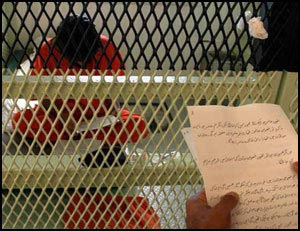
A peek into the Gitmo gulag


Defense Department photo

Brad Wizner, an ACLU lawyer, has been blogging from the U.S. prison at Guantanamo where he has been observing Bush's "military tribunals" as a human rights monitor. His writing gives a very immediate sense of this strange place, full of the trappings of law but containing no sign of any actual justice.

Here's a sample about the appearance of Ali Hamza Ahmad Sulayman al Bahlul who refused to cooperate with the proceedings:

Al Bahlul ... declared: "With these nine causes, I am boycotting all sessions, even if I am forced to be present." He lifted the paper that he had been scribbling on. "I will raise this paper, and this word is 'boycott.' I am boycotting every session. This boycott is the result of circumstances that I believe, and it doesn't matter if you believe them." Then, in English, he repeated the word "boycott" three times.

[Presiding Officer Peter] Brownback asked al Bahlul if he could make a copy of the "boycott" sign for the record. Al Bahlul said yes, but first he signed and dated it, and wrote "boycott" in English beneath the Arabic. (Later, when a Canadian journalist asked Commission staff if the press could obtain a copy of the sheet, he was told that it might be possible only after security personnel had reviewed it to ensure the absence of "subliminal messages.") "Please, before you boycott," said Brownback, "can I ask you one more thing?" Al Bahlul put his hands in front of his face, then removed his headset.

Despite his refusal, al Bahlul was assigned a military lawyer. That lawyer immediately attempted to have himself removed for the case on the grounds that his client did not want him as counsel. Legal ethics forbade him to play that role against his client's instructions. The court did not allow him to withdraw.

This episode points to one of Wizner's core observations on these bizarre proceedings. He writes:

Even in a terribly flawed legal system like this one, a skilled and dedicated defense lawyer can transform the nature of the proceeding. That's why the Administration attempted for so long to keep any lawyers from coming here. All of the defense lawyers who participated this week, military and civilian, are fighters, and they won't just throw up their hands at the injustice of the rules. The Administration may yet get the outcomes it wants -- after all, it selects the Commission members and makes the rules -- but it won't get the trials that it wants. The defense lawyers will make sure of that.

Since we seem to be living through a slow motion coup by the authoritarians in the executive, this sort of resistance based on professional tradition is important. It is not enough to break their power, but any friction in the system improves our chances of living to fight another day.

Wizner is also quite fascinating on what Gitmo is like as an environment for the U.S. forces stationed there. Like many prisons, but even more so because it is intentionally walled off from the mainland, it is also a controlled, brainwashing environment for its working class. Like any other military post, it is well supplied with McDonalds and Subways, as well as some better class restaurants and bars, much frequented. The troops have been given a reinforcing mantra:

The motto of the Joint Task Force Guantanamo -- the troops responsible for detention and interrogation operations here -- is "Honor Bound to Defend Freedom." When JTF members salute each other on the base, it's common for one to say "Honor Bound," and the second to reply "To Defend Freedom." This is jarring at first, then routine; one senses that the recitation has become rote even for the some of the troops, who occasionally mumble the words as they walk past each other. To much of the world, hearing "Guantanamo" and "freedom" so closely associated must sound ironic, but I got the sense that most troops here believe in the mission, even though they're not responsible for the policy decisions that brought them here.

Arbeit Macht Frei had already used up its punch, I guess -- besides, there is no indication that anything will ever set either inmates or jailers free.

Do read all about it at the ACLU blog. Thanks to Just World News for pointing me to Wizner.

Saturday, January 14, 2006

Pondering Iraq


After three years of carnage and national disgrace, we still know next to nothing about Iraq.

From Brian Conley writing at Alive in Baghdad:

...The idea of a civil war in Iraq between Shiites and Sunnis continues to belie the deep entrenchment of inter-marriage and the diverse nature of Iraq. In fact, the New York Times article quoted above even quotes a Sunni fighter who opposed Al Qaeda when their “sectarian war against Shiites clashed with his loyalty to a Shiite relative of his the group had kidnapped and tortured.”

I met few Iraqis who couldn't tell me about their relatives from an opposing sect, whether it was a Sunni woman married to a Shi’a husband, or vice versa, or a shi'a whose cousin was a Kurdish Sunni, this is a common refrain in Iraq. The division along religious and tribal lines was certainly beginning in the more desperate final years of the twentieth century in Iraq, however they were deeply exascerbated by the complete destruction of Iraq’s social fabric during the United States occupation and the ongoing war in Iraq."
By parroting the line that Iraq has deep-rooted "ethnic and religious tensions" the media works to absolve the United States of guilt as Iraq apparently spirals toward a civil war.

There's much more, informed, nuanced, thoughtful and questioning. From the point of view of the anti-war movement, the situation is simple: our job is to get the U.S. out of there. But if we want to know a little more about "there," this is helpful.

Also helpful is Salam Adil's history lesson on the why U.S.-supported Iraqi secularists have proved to have so little traction in their country. Writing on his blog, Asterism Adil explains his perspective:

In 1958 a group of military officers brought down the monarchy and so doing started a revolution in which the whole government of Iraq was rebuilt from the ground up. Much like the aftermath of this war. The significance lies with the broad response of the parties and the people. Without any foreign intervention the people did not start destroying their country or killing each other in a civil war. The parties formed a new government, agreed a new constitution and nationalised the oil industry to create a truly independent Iraq. The people, in their masses backed the Communist party - not the religious parties or the tribal parties or the nationalists.

And there lies the seeds of the fantasy that the pro-American secularists have built around themselves. They believe simply by being secular the people will once again flock around them.

The other problem is that certain elite Iraqi secular politicians have always felt the need to be a client for a more powerful state. After 1958, the Communist leaders returned to Iraq from exile in the USSR and were given power on a plate. They never had to earn it from the people - never really understood what power was about or why they earned it. The Communists could have taken control of Iraq in 1963 but, after an order from the Soviet Union, they did not. Following the coup which brought the Saddam's Baathists into power, the Communist party agreed, again at the behest of the Soviet Union, to serve in Saddam's government. When Saddam had finished with them of them he had them rounded up and executed. With the fall of the USSR the Communists simply transferred allegiance to America....

There's more, opinionated, and worth considering.

Friday, January 13, 2006

Weapons of Influence: Authority


Probably.

(Part 4 of a series of posts exploring Influence: The Psychology of Persuasion by Robert Cialdini. Part 1; Part 2;Part 3.)

Cialdini summarizes what he is his talking about like this:
  • Authority. People are more willing to follow the directions or recommendations of a communicator to whom they attribute relevant authority or expertise.
Concern about how authority works on us is certainly current, given ongoing revelations that we have an administration that encourages law-breaking, violation of civil rights, and torture of perceived enemies.

This author is clearly distressed by the consequences when people follow authority by rote. He describes at length the notorious Milgram experiment which revealed that most randomly selected subjects would "harm" another person if urged on by an authority. He also looks at the case of the train crew that followed an order to mow down protester Brian Willson, cutting off his legs -- and then sued Willson for causing them mental anguish by failing to get out of the way. But as with all the compliance triggers, this one exists because it serves useful social purposes:

Conforming to the dictates of authority figures has always had genuine practical advantages....Early on, these people (for example, parents, teachers) knew more than we did, and we found their advice beneficial....As adults, the same benefits persist for the same reasons, though the authority figures now appear as employers, judges, and government leaders. Because their positions speak of superior access to information and power, it makes great sense to comply with the wishes of properly constituted authorities. It makes so much sense, in fact, that we often do so when it makes no sense at all.

That's blunt.

Many of Cialdini's examples of when we comply with authority are much more ordinary than issues of torture or military orders. For example, we are swayed to buy products that carry "a doctor's" endorsement, even if we suspect the pitchman is really an actor or well paid for his opinion. We even accord medical people authority in politics: Bill Frist trades on his status as a physician -- if you look at his Senate website, you'll notice he hangs an "M.D." after his name. Presumably polling says we credit doctors above Majority Leaders.

Progressives appeal to medical authority too. One of the most successful campaigns I've worked on in recent years used the former Surgeon General Dr. C. Everett Koop as our spokesman. For all our complaints about health care, we trust doctors on subjects we don't know much about.

The blogosphere is full of folks who like to think we're immune to following authorities blindly, but I think we could do with some self-examination about how we choose to grant authority to particular people. A personal example: I know I don't know squat about Iraqi society -- until the U.S. decided to screw up the place, I'd barely thought about it. (I try to know about a lot of stuff -- there are practical limits to how much I can consider...yada yada yada.) So I tend to believe what Juan Cole tells me about developments in that unfortunate country. But what if he is wrong? Well, I can hope that someone else who knows something will call him out. And now that he has comments turned on, maybe correctives will turn up there. But mostly I have to monitor a din of opinions around the sphere and hope to notice if something significant starts breaking in. It takes a lot of work to try to avoid just going along once I accept the premise that someone is an authority.

Cialdini's proposed counterweight to the authority compliance trigger is simple: we need to learn to ask ourselves: "is this authority truly an expert?" That would often weed out actors pitching junk and maybe even a Majority Leader pontificating about judges.

The professor then suggests a second question, "how truthful can we expect the expert to be here?" Is a compliance professional/salesman/expert/authority aiming to trick us? The necessity to ask this question constantly is yet another reason more and more us approach community interaction cautiously or even infrequently.

Thursday, January 12, 2006

Nomination, humiliation and ignorance


Maybe this is why we're threatened with a lying, white-male solipsist as a Supreme?

Only 59 percent of Florida adults surveyed by Harris Interactive for the Florida Bar could name the three branches of government (legislative, executive and judicial). Other popular answers included local, state and federal (18 percent), and republican, democrat and independent (16 percent).

Questions about the meaning of the terms "separation of powers" and "checks and balances" also yielded low percentages of correct answers, 46 percent and 61 percent, respectively, the Bar said. Yahoo.

I wonder how 2 percent more got the "checks and balances" right than could name the branches of government? Oh well...

Civic ignorance certainly isn't confined to Florida. Most people are not engaged with the Alito nomination because they either don't understand what the Supreme Court does or they fear that they'll feel stupid if they try to understand what the nomination means. The one certain thing most folks learn from schooling is to fear humiliation for not knowing the answer.

If enough people are kept ignorant or choose to rest in ignorance, democracy is impossible. Obviously that is in the interests of those who already hold power.

Hat tip to Facing South.

Dead tree tidbit: Left Business Observer


I spent too much of today trapped in the holding pen for prospective jurors at the Superior Court of the City and County of San Francisco. No blogging about it yet; there is some infinitesimally remote possibility I could end up on a jury, so it would be improper.

But in the intervals as we were herded from room to room, I did get a lot of reading done, some of it worth sharing here. Doug Henwood's Left Business Observer is a lot more interesting than its rudimentary web site might suggest. In Issue #112, I particularly enjoyed Henwood's bemused observations on the strange moment the Bush regime has led us into. Here is a sample:

For those of us who cut our teeth on the power-structure studies of William Domhoff...it's been quite a surprise to watch the Bush administration in action. Though it should have known better, it started a pointless war that's put U.S. power and prestige at severe risk, and it's driven the government's accounts deep into the red, and it's financed both reckless adventures with huge gobs of money borrowed from abroad. A serious ruling class might have reined them in long ago, but our elite has been too narcoticized by its tax cuts --your average millionaire got a $60,000 break, more than the pretax income of the average household -- to complain. ...And since the Dems serve a dual role, as the "popular" party and as the party of an alternative elite, their dithering reflects a crisis at the upper levels of our society, as well as the disorganization at the lower levels.

Interesting. You won't find Henwood's stuff online; you might find it worthwhile to subscribe to his print newsletter.

Wednesday, January 11, 2006

The puzzle of Cesar Chavez and the United Farm Workers Union


Cesar Chavez at a Coachella Rally, 1975 © Carlos Legerrette; from the archives of the Farmworker Movement Documentation Project.

The LA Times is publishing an intentionally disturbing series on the heritage of Cesar Chavez and the union he founded, the United Farm Workers Union. The tenor of pieces is caught in the first headline: "The UFW betrays its legacy..." I believe this reporting is mostly true, in the sense of being factual. However, is the LA Times indictment of the United Farm Work Union fair? That, I am not so sure about. Here's my take on the series and the paradoxes it points to.

The first article charges that the contemporary UFW represents very few farmworkers. Today the UFW seems more interested in promoting the deceased union founder's name and raising money through direct mail appeals than in organizing the people in the fields. The second explores the web of interlocking nonprofit enterprises run by Chavez' successors, mostly relatives. The third tells the story of the blow ups within the union in the mid-1970s after it had partially won a legal structure within which to unionize California agriculture. Chavez believed his leadership was being challenged by a series of organizers and farmworkers. Many who had devoted years to La Causa were forced out; the LAT reporter dates the decline of the union from these episodes.

In the interest of full disclosure, I should say I worked for the UFW twice, briefly, first on the grape boycott in Boston in 1970-1971 and again in New York City in 1972. Later, when located in California, I reported on the UFW for various alternative and religious media through much of the 1970s and volunteered on the San Mateo County boycott. I was never anywhere near the center of the union/movement, just a peripheral staffer, supporter and observer.

Yet the gist of what the LA Times reports rings true -- but not as the whole story. Here's how I see it: in the 1960s and 70s, Cesar Chavez' United Farm Workers Union was a stirring, seething locus of social creativity, bound together by its founder's charisma. It was a multi-headed beast, providing structure and meaning to very different tendencies and constituencies.
  • Most obviously, it was a labor union, organizing to win better wages and working conditions for agricultural workers.
  • True to Chavez's roots in community organizing, it engaged whole communities with the struggle of the farmworkers for justice, especially settled Latinos who had escaped the migrant labor stream and put down roots in rural California.
  • It ran a network of social services, clinics, a credit union, a gas station and more.
  • It pioneered a creative tactic, the grape boycott, that carried what could have been a local California struggle to cities across the country and world, engaging literally millions with the well-being of farmworkers.
  • The farmworkers' movement served as a catalyst and rallying point for the struggle for Brown people's civil rights in whole Southwest.
  • It was also a beacon for Latino and Chicano cultural nationalism as a formerly muzzled segment of the population articulated its identity.
  • The UFW attracted a stream of earnest, mostly white, mostly middle class, progressive people who learned class consciousness and organizing skills from the farmworkers and went on to work in labor, politics and communities all over the country.
  • The movement incorporated the workers' Roman Catholic spirituality, marching to victory behind the Virgin of Guadalupe.
  • Chavez also urged a philosophy of self-sacrificial non-violence, drawing on many traditions including those of Gandhi and Jesus.
  • And I'm sure that other veterans of the movement could and would suggest more things the UFW was to its many adherents.
Nobody straddled all these tendencies but Cesar Chavez himself. Not surprisingly, as the movement grew, tensions between devoted workers who emphasized different parts of this complex package within the movement only increased.

I wasn't around for "the purges" of the late 1970s (some described in the third LA Times article) but the centrifugal forces in the movement were obvious well before that era. As the UFW both grew more powerful and met ever more ferocious, organized resistance from the corporate agriculture, it is not at all surprising to me that it could not contain all its potentialities. As early as the spring of 1973, I saw workers picketing their own union headquarters in Coachella to protest arrogant local leadership. And I certainly saw for many years a UFW culture that treated speaking about any of the strains within this extraordinary movement as a form of treason.

Over the last few years, Leroy Chatfield, one of the early pillars of the organization, has re-contacted over 1000 of the people who worked for the UFW between 1962 and 1993. He solicited reminiscences, collected songs and pictures, and began an email discussion list -- all to capture for history some of the knowledge and passion among these veterans. Much of this material is available on the web at the Farmworker Movement Documentation Project. Chatfield won wide participation by scrupulous refusal to tamper with any voices: "All primary source accounts have been included, and none... have been edited for content, length, voice, or tone." Unfortunately this unedited inclusivity makes the collection is a bit hard to navigate; it simply presents all the collected essays in a rough chronological form, leaving it to the interested browser to sort through its remarkable riches.

For many participants, the Documentation project provided a stimulus to mull over the issues raised by the LA Times articles: what was the UFW? Why was it so important in the lives of so many? Did it succeed or fail? What was its core? Why are farmworkers still unorganized and vulnerable to exploitation? The stories and answers are many; I haven't begun to read them all but anyone interested in going deeper can find much here.

I want to offer some thoughts from one of the essays in the collection as a counterpoint to the LA Times. It is easy, years after the fact observing the remnants of this once vibrant movement, to condemn much about it. But that fails catch what drew so many to give so much. Jim Holland was the building contractor for Chavez at the UFW's first headquarters in Delano from 1965 to 1967. Like many, he left other work to join Cesar, was changed by doing so, and moved on to other justice struggles. (Full disclosure: Holland later taught me the rudiments of construction in the 1970s.) He tries to make sense of this life changing experience:

Of course, from the first meeting, I was tremendously impressed with Cesar and I remained tremendously impressed until the day he died. ... [T]here were people who felt I was so taken with Cesar and the struggle that I felt he could do no wrong. They were right. Certain doubts came later.

Cesar Chavez was a great man. He was a human being and therefore not perfect, but he was a great man. The only one I ever met.

I have recently...wondered why I felt so strongly, so clearly, that Cesar was a great man. There were two reasons. First, his complete commitment. We all know that the struggle was his whole life. Everything. In the years following my full-time employment by the farmworkers’ union, I came to know the leaders of a number of low-income groups. Several of them had Saul Alinsky connections. ... None of them came close to Cesar in terms of commitment or overall stature. The other truly outstanding characteristic of Cesar was his absolute incorruptibility. Many--not all--of these guys were easily bought off by money, status, or any of the other temptations we all experience. Not Cesar.

Probably inevitably, Chavez' multifaceted movement didn't last, but the ripples he set off are still running outward from his work.

UPDATE: The final part of the LA Times series appeared today. It is not really about the UFW. Rather, it celebrates the story and hopes of Eliseo Medina who, coming from a background in the UFW, oversees Service Employees International Union operations in 17 states in the South and Southwest. The reporter clearly believes that Medina represents a new kind of leader for new times, one who can organize a movement as vibrant and creative as the UFW was thirty years ago. Low-wage workers certainly need such a movement just as much today as in Delano in 1962.

Monday, January 09, 2006

No fly list to apply in extra-terrestrial space


Careful. He might be a terrorist.

The BBC reports that the US Federal Aviation Administration is afraid a space tourist will turn out to be a terrorist. Companies wanting to take customers to space for fun and profit are urged to screen them against the US no fly list.

The Federal Aviation Administration (FAA) is attempting to regulate the commercial space industry... It has recommended security checks similar to those for airline passengers. The FAA also suggests space tourism companies check the global "no-fly" list, from the US Homeland Security Department, to exclude potential terrorists.

Well, yes, best to be prepared for anything.

A libelous fable
Just suppose, one of Bush's billionaire buddies began to have doubts about the quality of his life. He'd had an okay life, stopping by his father's construction company once in awhile, using daddy's jets to party in New York, Washington, and, London. But after awhile, bimbos and booze get tired. His friend George urged him to get a grip on life; George prayed for him. Our billionaire meets a great preacher; with the preacher's help, he finds God. He's a changed man. George teaches him to ride a mountain bike.

Then he decides, since he's renewed his rotten life, he should do something really big. He'll be one of the first to take advantage of Sir Richard Branson's Virgin Galactic space tours. He trains his body. He studies rocketry.

But wait, the FAA says the company can't take him to space, some trouble about a list. He appeals to friend George. The order comes back from the king (they put the monarchy in the Constitution in 2008) "Let my friend fly!" So Virgin Galactic proudly launches their passenger, for a mere payment of $200,000.

And our billionaire is thrilled by weightlessness; he's inspired; he's close to his God. He knifes the crewmen with the blade he always hides in his boot. He aims the rocket right at the White House. "I'll show my brothers I'm a big man. Wheee! God is great!" screamed Yousef Bin Laden as he launched his space vehicle at George's blasphemous residence.


Well, probably not. But the fable probably has about the probability of Virgin Galactic finding a customer who wants to use its rocket for a terror attack. People with that kind of money are seldom that idealistic, though they can certainly be bat-shit crazy.

Did anyone else notice that the FAA's regulations seem to assume that the U.S. owns space?

Weapons of Influence: Consistency and Commitment


(Part 3 of a series of posts exploring Influence: The Psychology of Persuasion by Robert Cialdini. Part 1; Part 2.)

Professor Cialdini calls these compliance triggers "the hobgoblins of the mind." They are powerful motivators.

We all fool ourselves from time to time in order to keep our thoughts and beliefs consistent with what we have already done or decided. ... In most circumstances, consistency is valued and adaptive. ...The person whose beliefs, words, and deeds don't match may be seen as indecisive, confused, two-faced, or even mentally ill. On the other side, a high degree of consistency is normally associated with personal and intellectual strength.

It's pretty easy to figure out which side of that dichotomy we want to put ourselves on.

But automatic consistency can be a trap. Once we've adopted an opinion, we'll come up with reasons to stay with it rather than risk painful re-evaluation. To take the obvious example, liberals marvel at the loyalty of Bush supporters as their guy blunders from failure to criminality. But how many of us, when John Kerry's nomination became a fact, struggled to believe that he was not just some boring establishment stiff?

As anyone who has ever mobilized people for action knows, the consistency trigger begins to work after people make an initial commitment. Cialdini reports some ingenious experiments that support this. I particularly enjoyed the story of the folks living in an affluent neighborhood who were set up by an enterprising researcher. He sent students door to door, asking that they put up a 3"x3" sticker that read "Be a safe driver." Most did.

Three weeks later he sent back another student with a different ask -- would they place a large public service billboard on their lawns? "To get an idea of just how the sign would look, they were shown a photograph depicting an attractive house, the view of which was almost completely obscured by a very large, poorly lettered sign reading DRIVE CAREFULLY." Fully 76 percent of those who had put up the sticker agreed to have the thing on their lawns! Putting up the sticker had implanted the idea of themselves as people who were active campaigners for public good and they now eagerly complied to preserve that self image.

Cialdini is frightened by the power that the weapons of consistency and commitment can exercise.

It scares me enough that I am rarely willing to sign a petition anymore, even for a position I support. Such an action has the potential to influence not only my future behavior, but also my self-image in ways I may not want. And once a person's self-image is altered, all sorts of subtle advantages become available to someone who wants to exploit that new image.

I think this insight somewhat dates this book; since the 1960s when this behavioral research was done, many of us have become much more reluctant to make the small commitment that can trap us into a larger one. One obvious example is that many less of us will respond to pollsters at all. We fear, with some reason, that we are just being pushed. (Interestingly, Cialdini reports research that showed that just getting a statement from interviewees that they would cast a ballot measurably raised the likelihood they would subsequently vote.) Armed with our gut sense we might be being suckered, it is no wonder, as Robert Putnam showed in Bowling Alone, we have become less willing to engage in civic activity.

What about the "flake factor"?

As a person who has organized electoral field operations (voter identification and turn out) for years, I have seen the consistency and commitment triggers both succeed and fail.

I've seen a few campaigns where minimal outreach attracted huge numbers of willing, mostly reliable volunteer workers: Clinton in 1992; the campaign against California Prop. 187 in 1994; Ammiano for Mayor in 1999; Kerry against Bush in 2004. In these instances, even the administrative inefficiency and downright incompetent management that usually characterizes political campaigns didn't drive them away.

On the other hand, I've seen campaigns that had close to a 100 percent "flake factor"; nobody who said they would volunteer ever showed up. The first campaign to pass domestic partner rights in San Francisco in 1989 was like that. It was not that people didn't commit to volunteering; we'd phone all week and have long lists of committed volunteers on Friday, but no one would show for weekend precinct walks. This seems to completely contradict Cialdini's research.

I think what was going on is that there is a "political class" of persons whose self image is that they do political work, so they are easy to sign up for campaigns. They are the regulars. From the organizers' point of view, the trouble is they know they are the regulars and so they rather easily can be distracted from actually working. Even if they don't show, their self image is not tarnished by flaking. This is especially so if they don't feel personally attached to the candidate or campaign. (This was profoundly the case with the 1989 domestic partnership fight; most of the gay community was not sold on the concept.)

On the other hand, people who are not campaign regulars do change themselves when they make a commitment to political work. And so, unless we abuse them and burn them out, the consistency trigger does its work on them with great power.

Saturday, January 07, 2006

Dangerous Canadian?
Yet another no-fly list episode


Off limits.

I bet these people know what it is to feel terror.

According to the Toronto Star, Sami Kahil, a Canadian citizen, was arrested and jailed in Mexico last Thursday. Kahil, who is of Lebanese origin, has owned a shoe store in Scarborough, Ontario, for twenty years. His offense? Flying over the United States on his way to a Mexican vacation with his family. Apparently his name matches one on the U.S. no fly list.

As required by the U.S. Transportation Security Agency, the charter airline carrying Kahil from Toronto to Acapulco reported its passenger list after take-off. U.S. authorities reacted:

NORAD then provided both air and ground monitoring of the flight, Mike Kucharek, NORAD chief of media relations, told the Toronto Star last night. That means either F-15s or F-16s accompanied the flight while over U.S. airspace.

On landing, Mexican immigration police grabbed up the family, two adults and their children, 8 and 6 years old, questioned them for several hours, and took mug shots. Finally they released the wife, Rima Masri and the children.

After her release, Masri was horrified to discover that Canadian authorities had not been notified. She flew back to Canada with the children and contacted her Member of Parliament and Canada Foreign Affairs. On Saturday, January 7, authorities arranged for Royal Canadian Mounted Police offices to fly Mr. Kahil back to Canada in a private airplane that did not cross over the U.S.

The biggest relief came for [Masri] when she learned that her husband would be escorted by the RCMP rather than U.S. air marshals. She said she was terrified that the marshals would take him somewhere and that he would just disappear. Toronto Globe and Mail

Most people in the U.S. may have forgotten what happened to Maher Arar but Canadians of Arab origin certainly haven't.

Masri points out that among Arabic speakers: "The name Sami Kahil is like saying Joe Blow or John Smith." She insists "they've got the wrong guy."

The U.S. Department of Homeland Security was not apologetic. "This is an excellent example of the information sharing that we need with good allies," said spokesperson Brian Doyle. "I can assure you that if your name is on a U.S. no-fly list, it is not put there in any willy-nilly fashion. " Given the number of people who've been put on the no fly list for no discernable reason, that claim is hard to believe. (See here and here for a few examples.)

Apparently the U.S. government demands not only the right to disrupt the lives (and perhaps render for torture) foreign individuals, but also the right to enlist neighboring countries in this literally tyrannical activity. This expensive little episode is nothing new. For many months, the U.S, has been demanding lists of passengers on flights between Canadian cities because these pass over or close to U.S. borders. We're really not the sort of place that makes a good neighbor.

Weapons of Influence: Reciprocation


Note Joe Lieberman in the front row.

(Part 2 of a series of posts exploring Influence: The Psychology of Persuasion by Robert Cialdini. Part 1 is here.)

If someone does a favor for you, you'll probably try to return it. You'll feel obliged. As an experiment, a behavioral researcher sent Christmas cards to a group of complete strangers. Back came a flood of reciprocating cards, though none of the people sending the cards knew the researcher. The rule of reciprocity is a very strong compliance trigger.

Professor Cialdini insists

[H]uman societies derive a truly significant competitive advantage from the reciprocity rule, and consequently they make sure their members are trained to comply with and believe in it. Each of us has been taught to live up to the rule and each of us knows about the social sanctions. . . applied to anyone who violates it. ... Because there is general distaste for those who take and make no effort to give in return, we will often go to great lengths to avoid being considered one of their number.

When we feel indebted, we'll act against our own interests to escape our disapproval of ourselves for breaking the reciprocity rule.

We feel obligated to give back even if we never ask for the favor. That is, someone else can initiate a relationship of obligation without our asking for it. Charities that send us free labels printed with our names and addresses count on this. So do homeless people who wash our car windows while we fill our gas tanks. We will sometimes try to stop the disquieting tickle caused by indebtedness by doing foolish or dangerous things, such as lending our cars to people we know are bad drivers. (I know; I lost a car that way.)

Skilled negotiators use the reciprocity trigger to get their way. Their opening move may be to try to sell you a very expensive product or ask for an oversize sum as a donation; when they back down from their initial gambit, you feel you have been given a favor and become willing to spend more than you ever planned. When the reciprocity trigger sends you down this compliance path a couple of remarkable things follow, both counterintuitive: 1) although you've been manipulated, you feel you had a responsible part in making the agreement and want to fulfill it; and 2) you are likely to get satisfaction from whatever you agreed to.

So how does the reciprocity rule work in our political environment? Often it is pretty darn straight up. Jack Abramoff didn't funnel all that money to Republican pols for nothing. Recipients act as accomplices in a reciprocity transaction, even if they can say they never laid eyes on the lobbyist. E. J. Dionne makes this point:

Scott McClellan, the White House press secretary, insisted on Wednesday that Bush does not know Abramoff personally.... According to an Oct. 15, 2003, story in Roll Call, Abramoff was one of a half-dozen lobbyists who raised $100,000 for Bush's 2000 campaign. When Bush was battling Al Gore's efforts to recount Florida's votes, Abramoff was there with the maximum $5,000 contribution.... The administration, in turn, was open to Abramoff. As National Journal reported in its April 20, 2002, issue, "Last summer, in an effort to raise the visibility of his Indian clients, Abramoff helped arrange a White House get-together on tax issues with President Bush for top Indian leaders..."

And so it goes.

But more complex applications of the reciprocity rule are even more interesting. Joe Lieberman's repeated betrayal of his own party seems to follow from compliance with the reciprocity trigger. Republicans sometimes treat him as a "better Democrat," a "serious" Senator. He laps it up. In this persona of chummy collegiality, he signed off on Bush's Iraq war and feels bound by the reciprocity rule to keep on supporting his intellectual and moral lapse despite all evidence, insisting famously: "the war in Iraq is a task of high justice and necessity."

Lieberman also provides an interesting example of a Democrat trying to use the reciprocity trigger to divide Republicans. In an environmental hearing early in the Bush era,

Lieberman had harsh words for the Bush administration, but was sympathetic to [EPA Secretary Christine Todd] Whitman, whom he characterized as a lone environmental voice waging a ''fierce battle'' within an anti-environmental administration. Whitman declined to accept the compliment. ''I wouldn't characterize anything as a fierce battle, but as a vibrant discussion,'' she said.

Apparently she's made of tougher stuff than Joe. It is interesting to observe though, that being a sucker for reciprocity himself, he turns to it, apparently instinctively, as a weapon of influence.

The social/psychological rule requiring "good people" to return "favors" plays out on a far wider scale than just influencing the choices made by individuals. For conservatives, liberals are "bad people," "traitors," because we don't seem to understand that we have an obligation to support our country "right or wrong." Their feeling of unexamined obligation has been triggered -- how can we not respond properly? To ask questions or have reservations about our country's conduct is to deny our indebtedness. Were we not properly taught to repay our debts?

Poor people, needy people, are also seen by conservatives as violating the reciprocity rule: they are moochers, taking but not giving. They can pay their debt, at least in part, by obsequious acknowledgement of favors from the privileged. But if poor people insist they deserve better, they break a major, usually unarticulated, social taboo.

Though Ciardini goes to considerable length to show that we are all sometimes patsies for the reciprocation trigger, he says we don't have to let automatic response rule our actions. The answer is not only to follow our contrarian instincts, to throw away the unwanted address labels or to push away the homeless window washer. It is also to recognize the offerings, address labels, cleaner windows, or approval of our status (like Lieberman) as what they are: efforts to create obligation.

To engage in this sort of arrangement with another is not to be exploited by that person through the rule for reciprocation. Quite the contrary, it is to participate fairly in the 'honored network of obligation' that has served us so well, both individually and societally, since the dawn of humanity. However, if the initial favor turns out to be a device, a trick, an artifice designed specifically to stimulate our compliance with a larger return favor, that is a different story. Our partner is not a benefactor but a profiteer.

That is, insincere favors create no obligation. Sadly, surrounded by so many con games, we all must become more and more practiced at making that crucial distinction. This is not good for us, but neither is being taken for suckers by our better instincts.

Friday, January 06, 2006

Serve your country -- get grounded


Will Daddy be able to get on the plane?

You know all those vets coming back from the Iraq and Afghan wars with Post Traumatic Stress Disorder? They'll be thrilled to learn that they have been fighting for the right of the Transportation Security Administration to ban them from airplanes. That's right -- a new (?) category is being added to the no fly list.

According to Congressional Quarterly:

A Nov. 15 notice put out by the Transportation Security Administration (TSA), . . . states TSA is looking for contractors to add a number of new databases for screening passengers and airport workers.

Up first are the files of the Defense Department (DoD) and Veterans Administration (VA), which the TSA says it wants scoured for “mental defectives.” . . .

The New England Journal of Medicine also reported in 2004 that “15.6 percent to 17.1 percent of returning soldiers from Iraq exhibited signs of anxiety, major depression or other mental health problems.”

Just to complicate things, the Veterans Administration says it has no "mental defective" category -- unless maybe it does.

Yesterday I heard Tom Blanton of the National Security Archive speaking with Terry Gross on NPR about how the Bush administration has worked to gut the Freedom of Information Act. He explained that the largest category of FOIA requests was from vets trying to get their service records -- apparently veterans have to fight for years to correct incomplete and incorrect personnel information. Now they'll have one more impediment to normal life to worry about on coming home.

Hat tip to Suburban Guerilla for the latest no fly info.