Friday, December 09, 2005

The guy knows the ropes


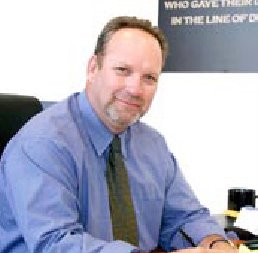
Gary Delagnes of the San Francisco Police Officers Asssociation

This is yet another post in which I'll bring some history to bear on current events. I see this morning that San Francisco's finest have once again been caught doing what they too often do best: spreading their racist, sexist and homophobic attitudes out for all to see. The SF Chron reports that in addition to the offensive video clips found on an officer's web site yesterday, the Christmas party film project also included scenes of "a black officer eating from a dog bowl and one of an Asian officer having difficulty riding a bicycle." Nice fun and games those SFPD boys get into out in the Bayview, San Francisco's last poor and gang-ridden Black neighborhood.

The local story broke into the NY Times which reports that, in addition admitting that video was "stupid and immature,"

Mr. [Gary] Delagnes of the [SFPD] union bemoaned the fact that "every lefty in San Francisco is going to love this."

It is not surprising that Delagnes worries over the ammunition this latest police escapade will provide to critics of the SFPD's more material faults, like occasionally shooting suspects. Before Delagnes attained his current eminence in the police union, he was at the center of quite a few shenanigans himself, racking up as many as 100 conduct complaints during his active duty career. (San Francisco doesn't adjudicate citizen complaints; it buries them in paper work, so there is no way of knowing how many of these were justified.)

His best know escapade rivaled the current brouhaha. How's this for an example of mature police conduct?

During San Francisco riots in 1992 over the Rodney King jury verdict in Los Angeles, [Police Chief Richard] Hongisto had hundreds of people jailed. In the wake of those arrests, the Bay Times gay newspaper ran a suggestive illustration of Hongisto with the headline, "Dick's Cool New Tool: Martial Law.'' Police Officer Gary Delagnes and other officers responded by grabbing more than 2,000 copies of the newspaper off news racks.

Hongisto was fired; Delagnes continued his rise in the department. He knows the guys he defends from his current perch; he has always been one of the boys.

Thursday, December 08, 2005

Jury deliberations

olivernorthnewsprintsm sami.al-arian-sm
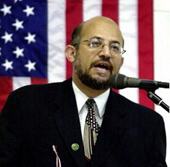
Yesterday a jury in Tampa, Florida acquitted Dr. Sami Al-Arian on 8 of 17 charges involving supporting Palestinian Islamic Jihad. They were deadlocked on the other counts. Jurors have since said that a majority favored a complete acquittal.

Al-Arian is a stateless Palestinian who has lived in the U.S. since 1975 and had taught computer science at the University of South Florida. He was a prominent spokesman for justice for Palestinians in both popular and academic venues, playing host to visiting foreign Arab and Islamic leaders and collecting for Palestinian charities.

These activities led the Immigration and Naturalization Service to put his citizenship application on hold in the mid-1990s. After 9/11, he came under more suspicion. In particular, Bill O'Reilly of Fox News claimed his academic activities were a front for Palestinian terrorism. In February 2003, Attorney General Ashcroft trumpeted indictment of Al-Arian and others as leaders of Islamic Jihad. Al-Arian insisted he had done nothing more than speak up forcefully for his people. The government jailed Al-Arian, mostly in isolation, for two years. And now, though a jury has largely exonerated him, he will at best be deported or perhaps held in indefinite confinement.

The fog of accusations, fear and distortion around the case is thick. Florida politics is mixed up with Middle Eastern politics. I don't claim to know much about it. But I was fascinated by what the jurors who acquitted Al-Arian had to say about their deliberations:

"Usually, there were 10 of us for acquittal on the charges, sometimes nine of us," said Ron, a juror from Pasco County who did not want his last name used. … "Of course, we hate terrorism," said Ron. "But the evidence making these guys terrorists just wasn't there."…

Jurors say they were strongly affected by the jury instructions. In particular, they kept returning to these words: "Our law does not criminalize beliefs or mere membership in an organization. A person who is in sympathy with the legitimate aim of an organization but does not intend to accomplish that aim by a resort to illegal activity is not punished for adherence to lawful purposes of speech."…

"The evidence wasn't there to put a guilty verdict on it," said Juror 112, a 40-year-old truck driver from Lakeland named Todd.

"People assume. They assume guilt," said Todd. "People really need to think about things before they make a decision. You really need to get the facts first. I sat in that room for six months. Until you've sat through something like this . . . you cannot sit in your car or at your house and determine guilt."

Jury service sometimes evokes extraordinary capacities for serious thought and responsible discernment in the most ordinary citizens.

In 1987 I was called for Federal jury service. Like most people, I was not happy about this -- I expected tedium and wasted time, as I can't imagine the prosecutor or defense attorney who'd risk putting me on a jury. But I dutifully showed up and sat through an hour or so lecture from a court official on the importance of a good faith, honest and sincere effort to carry out the task we might be given. Then the two hundred or so of us were left in a room furnished like a high school cafeteria (I remember the same orange plastic chairs and tables) to wait to be called into court. There was nothing to do but watch a bank of televisions.

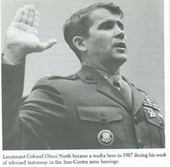
On the tube, a ramrod straight Marine was swearing to "tell the whole truth." It was Lieutenant Colonel Oliver North testifying before the Iran-Contra congressional investigating committee. He was a picture of uprightness, explaining how he'd organized a secret army of "freedom fighters" using every kind of ruse to hide from Congress -- and carried out his Commander in Chief's implied, though never explicit, instructions. After all, laundering money and trading arms for hostages was "defending freedom."

The tangled tale of illegal acts and lies to cover them made me feel ill. But I figured North looked the part of a good guy; his "sincere" pose was probably playing well with most people. And when I got outside the Federal Building and read more about his testimony, it was clear he was going over well.

But for the next 3 days, I had to go back to the jury room, to sit in front of those televised hearings. Gradually, little circles of strangers began to talk with each other. And something amazing was happening -- we were all thinking like jurors, not a TV audience. People began to comment: "he looks good, but I don't trust him"; "does he really think he has a right to break the law?"; "they think they are above the law because they are in the government." In that room, Oliver North was convicted, while in most of the U.S. he successfully played the role of hero.

And then, we, the prospective jurors, were all excused, never finding out what happened to the case we'd been brought in for.

A gift wins friends:
how simple can you get?


On Tuesday, Venezuelan and U.S. officials helped pump the first delivery of heating oil into a building in the Bronx. Photo Credit: By Rick Maiman -- Bloomberg News

This is just too perfect; President Hugo Chavez of Venezuela knows how to make friends. The U.S. government wants the populist leader gone, but his constituents fought off a coup attempt in 2002 and voted in a parliament to his taste just last week.

Now he is selling heating oil from his country's ample stock cheaply to nonprofits that serve poor residents in the U.S. Northeast. The gesture is popular reports the WaPo:

NEW YORK -- A green Citgo tanker truck chugged up a hill with a grim view of tenement buildings, elevated subways and treeless sidewalks to deliver Venezuelan heating oil, a "humanitarian" gift from Venezuelan President Hugo Chavez.

Moments before the orange-gloved worker snaked the hose to a Bronx tenement, Eartha Ferguson, a manager and resident of a low-income building, said: "I call it a gift of survival. It comes at a good time, a very needed time."
…
"The government should have done it," said Shirley Manuel, 52, a tenants' rights activist, wrapped up tightly in her wheelchair. "This is their country, this is their people -- they should be taking care of their own."

Rep. Jose E. Serrano (D-N.Y.), who brokered the oil deal, brushed aside suggestions that Chavez was playing petro politics. "To those who say this is to score political points," he told a shivering crowd when the first oil arrived, "I invite any American corporation that wants to score points with my community to start this afternoon."

The Venezuelan leader knows the maxim every teacher tries to impart to aspiring writers "Show, Don't Tell." If you want us to believe governments can serve the poor as well as the rich, show us.

This is not the only time I've seen a regime the U.S. government opposed woo U.S. citizens with generosity. When I visited Cuba in 1988 with a scraggly band of lefties, the Cubans offered to fix up our teeth for free, knowing full well that dental insurance was out of the question for most. The power of the gesture was less in the value of the offer itself (though for some it was a great gift) than in the recognition of our likely situation and needs in our country. We felt seen, just like Shirley Manuel.

Wednesday, December 07, 2005

Why would you want a union?

union-yes2
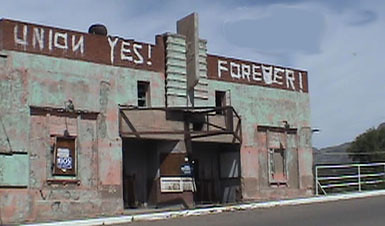
So few of us now belong to a labor organization that most of us probably don't even ask ourselves that question. If we do, we may think a union is just something that takes a bite out of our paychecks but never does anything else. Sometimes that may even be true, but not always.

Today I got a nice reminder of why having a union might be a real benefit. My partner is a "freeway flyer." That is, she makes a living by teaching as "adjunct faculty" at various colleges. "Adjunct faculty" is fancy language for a temp worker -- she gets no benefits and no guaranteed contracts. But one of the places she works does require her to be part of a faculty union.

Yesterday she taught her last class of the semester; today she got a note from her union rep:

In case you are interested, here is information regarding unemployment.

All part-time faculty are entitled to collect unemployment benefits based upon legal precedence set forth in the Cervisi case that was litigated by the CFT local at City College of San Francisco over a decade ago.

There are two key elements to demonstrate your legal right to collect benefits. You have been laid off due to "LACK OF WORK". In other words, there are no more classes to teach. Thus, you are legally unemployed. It doesn't matter if the employer still owes you money. You are unemployed after you finish teaching your last class.

The possibility of reemployment is "CONTINGENT UPON ENROLLMENT". While you may think it probable that you will be re-employed, technically, and thus, legally, you have NO GUARANTEED CONTRACT to be re-employed.

Semester after semester, part-timers' classes are cancelled due to lack of enrollment, so apply for the unemployment insurance benefit that you have paid for in your payroll deductions. To do so, go to ….

Now my partner is an adult; she knows this -- but all of us could use often use someone to remind us that we have rights and should use them.

I can't stop thinking about them


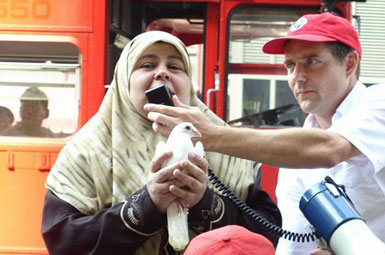
James Loney, one of the four Christian Peacemakers kidnapped in Iraq, doing what peacemakers must do: giving voice to the voiceless, in this case the wife of an Iraqi detainee. Photo source.

We can only wait, hope and pray that those who have seized these men will release them unharmed.

Their team continues the work in this statement about the kidnapping:

We believe there needs to be a force that counters all the resentment, the fear, the intimidation felt by the Iraqi people. We are trying to be that force: to speak for justice, to advocate for the human rights of Iraqis, to look at an Iraqi face and say: my brother, my sister,

Perhaps you [the kidnappers] are men who only want to raise the issue of illegal detention. We don't know what you may have endured.

We never can know what others have suffered; we can only control what we do ourselves.

Often the interventions of the "nonviolent" seem to me shallow, self-indulgent. It can be very easy for comfortable citizens of the superpower to "give up violence" while enjoying all the benefits of our country's wealth and power.

But then there are those who really do it, like these brave men. I don't know how it works, but I observe over and over that there is a power in the lives of those who willingly risk their safety and survival for the good of others. Our culture may scorn this notion, but that can't reduce its efficacy.

You can leave messages of support to the families of the kidnapped men here. I keep musing on the job that someone must be doing at that site, screening out the vitriol that undoubtedly will mix with expressions of love and hope. I guess the CPT folks might say that when we unleash the hatred of war, we bring it home with us.

Tuesday, December 06, 2005

President in free fall


Watch him get bounced around here. If he starts to get stuck, you can help keep him going by dragging with your mouse. Hat tip to sastreman.

Monday, December 05, 2005

Left of center comes out to vote


A line forms at a polling place in Caracas, Venezuela. Photo Credit: By Howard Yanes -- Reuters

Major U.S. newspaper were full of stories today about what happens when an aroused people decide they want more than just a return to the center.

From the WaPo:

[I]n the city's poor neighborhoods, where Chavez enjoys broad support, … lines of voters remained throughout the day at the high school where Chavez later cast his vote, many of them dressed in red, a color that has become a symbol of support for his government. Voters there said they believe the election was fair and dismissed the [opposition] boycott as a failed stunt to avoid embarrassing losses.

The NYT also reported on the collapse of the right wing parties:

"Chávez would have annihilated them [even if they had not boycotted,]" Alberto Garrido, a critic of the government and an author of several books about the president, said by phone from Caracas. "… There are people in the opposition, but the opposition leadership is in tumult, without a strategy. Tomorrow, Monday, they will not know what to do."

With polls indicating that government candidates would crush them in the election, opposition leaders had for weeks threatened to pull out. They accused electoral authorities of using digital fingerprint machines at polling sites that would permit the government to determine how individuals had voted. Last Monday, in a decision brokered by the Organization of American States, the National Electoral Council announced that it would not use the machines.

But to the surprise of election monitors, opposition parties began announcing their withdrawal on Tuesday,…

"The main objection was the digital fingerprint machine, which was removed, and now their line is we don' t trust the system, there must be another trick there," said José Miguel Vivanco, the Americas director of Human Rights Watch, which has been harshly critical of Mr. Chávez.

"It's really hard to understand what exactly the political opposition leadership has in mind," he said. "But certainly it is not going to help them to present themselves as victims that deserve solidarity from the international community. With these kinds of tactics I don't think they'll gain any ground."

Now I'm not going to claim to know anything deep about Venezuela. Chávez may very well be a demagogue of the first order, but clearly a majority of the people think his populism gives them a better deal than the opposition so applauded by the U.S. Because Venezuela has oil wealth, there is some surplus which Chávez can use to improve the condition of the poor majority. What else is a government for?

Off Center -- does anyone care?

Off Center: The Republican Revolution and the Erosion of American Democracy
by Jacob S. Hacker and Paul Pierson


This Yale Press book is insightful, well argued, but not quite what I was looking for.

The subject is domestic politics. The elephant in the living room, U.S. wars around the world promoted through lies and waged by executive fiat, is not even in the picture.

The authors, academic political scientists, argue that, since winning the House of Representative in 1994, Republicans have overthrown the checks and balances thought to constrain U.S. politics. They have successfully enacted a rightwing agenda that ensures that the ability of government to ameliorate "free market" inequities is gone. Actual policies led by tax giveaways to the rich and new heights of unscrupulous manipulation of civic ignorance, disengagement, and prejudice have built a durable barrier to any challenge to their rule.

If you want to know how rightwingers do it, Hacker and Pierson are absolutely worth studying. They are particularly good on the parliamentary ruses, such as rogue "conference committees" and holding votes open, which enable Republican leaders to both overcome and give cover to their own centrist members.

They are perfectly clear about the right's deformation of the system in service of the wealthy:

Over the past thirty years, American politics has become more money-centered at exactly the same time that American society has become more unequal. The resources and organizational heft of the well off and hyperconservative have exploded. But the organizational resources of middle-income Americans -- from labor unions to mass-membership groups -- have atrophied. …

In 2000, more than 40 percent of those in the bottom of the income spectrum reported that they did not vote, compared with just 13 percent of those in the top third.

The ballot box offers no easy cure. Money talks, the rest of us limp.

The blogger and historian Stirling Newberry has a memorable name for this system: "Representative plutocracy -- the money goes to politicians to represent it to the voters."

Having asserted and proved that the U.S. political system is broken, Hacker and Pierson's prescriptions for a fix seem weak: they suggest longer term political calculations, reform of Congressional procedures, more transparency in government. Those are all worthy projects, but a little feeble in the face of a brutal power grab by determined oligarchs.

Perhaps the weakness of their countermeasures derives from their analytical premise: this is a book about subversion of U.S. constitutional arrangements that have reined in radicalism of right and left, that once empowered "the center." What the heck is "the center?" For those who feel trapped on either side, it is looks like an unpleasant quagmire of immobility. Given that historic constraints on rightward movement have been broken, what would inspire people to take up the difficult, painful political struggle to turn the state in a new direction? Moving politics toward a mythical middle will not supply mass motivation for change.

Most people, those left of center anyway, engage with politics out of necessity, not inclination. They want the state to make sure they have a chance in life. Since the folks with money start with advantages, they want the state to balance the scales. They don't give a hoot about "the center." They don't understand why a country this rich can't do a better job of taking care of its citizens. They don't understand why the U.S. should send young people to get killed in wars that no one will explain to them. Those are the kind of motivations that change political trajectories -- I assume Hacker and Pierson know that, but one of the ways we're currently "off center" is that no one with a respectable platform is supposed to say so.

Sunday, December 04, 2005

Who dares write stuff like this?

The situation in which [former New Orleans] residents find themselves is an extreme example of a trend underway for a quarter-century, a shift of economic risk from business and government to working families, and an increasing reliance on free markets to manage society's problems.

Safety nets such as unemployment compensation, employer-provided healthcare insurance and pensions, and, recently, effective disaster relief have been reeled in or removed. Increasingly, families from the working poor to the affluent are left largely to buy and sell their own way to safety even when their individual efforts seem utterly outgunned…

Some leftist rag? No.

The author is LA Times reporter Peter G. Gosselin who writes regularly on economics as lived by ordinary people. Such reporting is pretty darn rare in mainstream media. In the fall of 2004 he wrote an extraordinary three part series discussing the question: "why so many families report being financially less secure even as the nation has grown more prosperous?" If, like most of us, you missed it, go back and look. To its credit, the paper is keeping this older material accessible on its website.

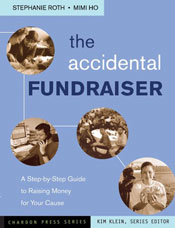
The Accidental Fundraiser

This is a shameless plug. Two friends of mine have written a how-to book about ways to raise money and I'm excited about it. Suppose you've just learned that you made the mistake of not going to the meeting and were appointed to put on your group's annual fundraising effort? Or your child's school sends a note that it will no longer provide craft project materials and you've been talking with other parents about how lousy the school board is? Or your poor parish church needs a new furnace, pronto, before everyone stops coming to sit through another sermon while freezing.

The Accidental Fundraiser: A Step-by-Step Guide to Raising Money for Your Cause is addressed to you. Stephanie Roth and Mimi Ho have provided everything you need to decide what strategy will likely work in your situation. They then provide exhaustive planning tools, work sheets, sample flyers, and good advice to get you through the job.

This isn't about the big stuff, about grants for thousands of dollars or government money that will sustain a large program or campaign. This is about fundraising at human scale, about the tips and tricks through which we dredge out $1000-5000 from networks of friends and acquaintances. Sure, on some level, we're just passing around the same five dollars. And also, we are too often compensating for the failure of governments, local as well as national, to do their job of caring for the general welfare. But though these small efforts we are also building and sustaining communities; Roth and Ho know this and celebrate it.

Even better, if you feel stuck with managing a fundraising project, doing it with Roth and Ho won't make you feel like you have entered an alien universe of nonprofit bureaucrats. They sprinkle very concrete stories from small progressive projects all through the book: you meet bike activists, anti-big box store campaigners, gay health advocates and rural organizers that you wouldn't mind knowing outside a book.

I've decided to give The Accidental Fundraiser (along with a small sum) to some of the organizations that hit me up at this season. Maybe we can have more interesting fundraisers next year.

Saturday, December 03, 2005

Snippets from headlines


Photo by Justin Sullivan

All from today's WaPo:

Agency Calls for Troops, Reporting Threats of Violence

Former Secretary of Homeland Security Calls for More Training

Feb. 4 Elections… Are Postponed

Residents… [may] … not stay in the area, which still lacks electricity.

Workers…have been advised against wearing clothing with the agency logo in public.

No, not Baghdad -- New Orleans.

Friday, December 02, 2005

Airline security panic abating?
No-Fly List update


The regional carrier Cape Air is proud of its painted planes.

My own travails with the Transportation Security Agency seem to be over. I fly these days with no more hassle than any other traveler who is white and U.S. born. And we learn today that the TSA is going to change its strategy for smoking out "terrorists," adding more random pat downs and permitting nail files on flights. Just maybe some of the more irrational aspects of our airline "security" panic are receding.

Nice -- but these changes don't address the "no-fly list," that apparently arbitrary, and still secret, roster of those someone in government wants to subject to special scrutiny or prevent from flying. For the last several months, an Irish-born Cape Air commercial pilot, Robert Gray, has been barred from doing his job because, according to the Cape Cod Times, the TSA says he is a "threat to aviation or national security." The agency refused to state why. Gray sued the TSA, not surprisingly. "Court documents appear to validate his claim of never having supported any 'terrorist or other illegal activity'; in fact, Gray has never been arrested, nor has he had any prior involvement with the criminal justice system." The ACLU is trying to settle the case out of court.

The government would probably be wise to settle. Here's what Bruce Schneier, who The Economist calls a "security guru," a member of the government's own Secure Flight Working Group on Privacy and Security, has to say about these lists:

[The TSA screeners] check travelers against the 30,000 to 40,000 names on the government's No-Fly list, and another 30,000 to 40,000 on its Selectee list. They're bizarre lists… Who are these people, anyway?

The truth is, nobody knows. The lists come from the Terrorist Screening Database, a hodgepodge compiled in haste from a variety of sources, with no clear rules about who should be on it or how to get off it. …

The program has been a complete failure, resulting in exactly zero terrorists caught. And even worse, thousands (or more) have been denied the ability to fly, even though they've done nothing wrong.

If that sounds harsh, Schneier is even tougher on programs which would pre-clear some travelers, for a price, to fly without much scrutiny. He claims that creating any loopholes will simply give a smart terrorist a new way to slip through a crack:

It may be counterintuitive, but we are all safer if enhanced screening is truly random, and not based on an error-filled database or a cursory background check….

Exactly two things have made airline travel safer since 9/11: reinforcement of cockpit doors, and passengers who now know that they may have to fight back. Everything else -- Secure Flight and Trusted Traveler included -- is security theater. We would all be a lot safer if, instead, we implemented enhanced baggage security -- both ensuring that a passenger's bags don't fly unless he does, and explosives screening for all baggage -- as well as background checks and increased screening for airport employees.

Then we could take all the money we save and apply it to intelligence, investigation and emergency response. These are security measures that pay dividends regardless of what the terrorists are planning next, whether it's the movie plot threat of the moment, or something entirely different.

Maybe as panic recedes we can also re-examine our rush to "profile" the potential terrorists. As Schneier says, racial, ethnic, and religious profiles simply encourage anyone who seriously aims to do harm to recruit against conventional stereotypes.

UPDATE: January 24. 2006 -- According to the Cape Times, "Robert W.G.M. Gray, the Irish-born Cape Air pilot who sued the federal government to get off its no-fly list, could return to the cockpit as soon as tomorrow, according to an airline representative....What persuaded federal officials to remove Gray from the list remains a mystery, as do the specific reasons he was initially considered a security threat."

Why am I not reassured about the state of our civil liberties?

U.S. propaganda in Iraq:
Who is the target?

The story was broken by the LA Times a couple of days ago that U.S. tax dollars are paying a PR firm to place feel good stories in the Iraqi press. As far as I can tell, most of the commentary is missing the point. (Laura Rozen is an important exception.) What we have here is reversion to the "low intensity conflict" style of operations that predominated in U.S. overseas adventures in the 1980s.

What is "low intensity conflict"? It is certainly not "low intensity" for those on the receiving end. Rather, it is a military doctrine that recognizes that:

"The roots of insurgencies are not military in origin," [Reagan's] Secretary of the Army John Mrsh explained, "nor will they be military in resolution." Source.

When the U.S. military could not impose its will through force of arms in Central America, it turned to "total war at the grass-roots level." Death squads, destruction of civilian infrastructure, secret bombing, and spreading endless lies were the order of the day then, and have become so once again as the U.S. loses even the feeble grip it won in Iraq through Rumsfeld's invasion-lite.

The U.S. public doesn't want to sacrifice to fight an imperial war. So the Iraqis get "low intensity conflict." The U.S. public gets the psych-ops treatment. The Administration had to lie its way into the Iraq invasion; as its rationales have collapsed, it has had to more and more to adopt tactics of stealth and dissimulation to keep the war going.

Though most of the follow-up stories have failed to highlight this, the original LAT story contained the real nugget about our PR exploits, deeply buried:

U.S. law forbids the military from carrying out psychological operations or planting propaganda through American media outlets. Yet several officials said that given the globalization of media driven by the Internet and the 24-hour news cycle, the Pentagon's efforts were carried out with the knowledge that coverage in the foreign press inevitably "bleeds" into the Western media and influences coverage in U.S. news outlets.

"There is no longer any way to separate foreign media from domestic media. Those neat lines don't exist anymore," said one private contractor who does information operations work for the Pentagon.

Iraqis don't have to look to their "free press" to find out who makes their lives miserable; the target of this operation is right here among the credulous in the USofA.

Thursday, December 01, 2005

Beltway gasbag on display


Richard Cohen is a racist windbag. How else to interpret this:

Iraq is not Washington, D.C., I know. (It's probably better managed.)

Sure, score on the pathetic hamstrung government of this 80% Black city lorded over by the same rapacious thugs who led the U.S. into Iraq. And pat yourself on the back for noticing that the Iraq adventure is FUBAR.

Sickening.

Iraq war's Nixonion phase entered


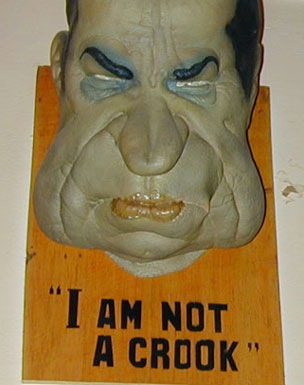
The 37th President hangs on a bar wall in Cusco, Peru.
My goodness this is moving along quickly -- the progress of our "Vietnam on steroids" experiment, I mean. Yesterday the Preznit announced that we are now deeply into the Nixonian stage, attempting victory through Iraqization. Sure, that's a nice fantasy. Reporters don't even pretend to believe this stuff:

Bush, in his speech at the U.S. Naval Academy, spoke of progress toward independence, of land restored to Iraqi control, of gains in stability and democracy, and of the "skill and courage" of newly trained Iraqi security forces.

But on the streets of Baghdad, such optimistic rhetoric contrasts sharply with the thunder of suicide bombs, the scream of ambulance sirens, the roar of racing police cars bearing men with masks and machine guns, and the grim daily reports of assassinations, murders and hostage-taking.

It took mainstream media awhile to print this obvious truth, but I guess better late than never.

Today I took part in an interesting exchange about the political implications of the current Nixonian moment in which commenters highlighted a quite specific lesson:

  • The GOP has [a] problem… absence of a noisy Vietnam-style antiwar movement to deflect the blame onto.
  • Without a bunch of scruffy hippies as the face of the calls for a phased withdrawal, the Nixon strategy won't work.
That is, the longstanding rightwing line that any impediment to U.S. imperial ambitions must take the form of an unpatriotic "stab in the back" just won't fly at present. A grizzled ex-Marine, Congressman Murtha, has become the face of opposition to the war.

That seems right, but, I think, points to what has been a central obstacle to building a mass, engaged antiwar movement in the Iraq invasion era: there is simply no force to support. In the Vietnam era, many opposed to the war came to support Vietnamese nationalist aspirations; in Iraq there are no good guys. Antiwar folks are left to say "a pox on all your houses" and "let them all alone." Some of the most potent symbols antiwar folks have been able to offer have been military families unhappy with the war and the bereaved Cindy Sheehan. Their work has certainly brought home the "leave them all alone" message in reference to beleaguered U.S. grunts.

Yet the kind of people who will risk disapproval (and worse) from their fellow citizens to build an antiwar movement don't want to simply be naysayers. They are precisely those among us who hang on to the hope that "another world is possible." A few of the bravest become Christian Peacemakers and risk their lives. Let us hope that those currently being held captive get out alive.

But if that sort of action is what it takes to make a potent antiwar movement, the bar is too high. Most people will never be heroes. So the antiwar movement has been left to chip away at the edges of the national consciousness, supporting little vigils and occasionally larger marches, pestering Congresspeople, advocating for more truthful media coverage of the ongoing disaster.

The current Nixonian moment seals the story; the U.S. will leave Iraq. If the Bushies are true to their trajectory (and they are far less competent than the Nixon guys), the U.S. will leave with its tail between its legs. The difference will be that people here will pay a far greater price as U.S. power and wealth cannot cushion the pain of peak oil, genuine economic competition, and climate collapse.

Wednesday, November 30, 2005

Where are they now?
Neil Bush and Boris Berezovsky


Bush, left; Berezovsky, right

This morning my partner and I were commiserating in a languid way over the decline of U.S. democracy -- asking ourselves if we'd ever get rid of the Bush dynasty? Do we face Jeb in the future? Wonder what the twins will do with themselves if they ever have to stop partying? Finally she asked, "whatever happened to Neil?"

For me, Neil is a vaguely-remembered name in a Gulf War I era chant. We proclaimed support for the unfortunate troops sent out to play in George I's excellent adventure with the message: "Send George Bush; send Dan Quayle; send Neil Bush when he gets out of jail." The current President's younger brother was a prominent beneficiary of the looting of a savings and loans company in the 1980s. According to the Wikipedia, though he avoided charges in the Silverado S&L fraud case "Bush was fined $50,000 as a consequence of his actions and he was restricted from undertaking future banking activity."

Haven't heard much of him since -- guess they have him under wraps. Still I wasn't surprised to run across this Jefferson Morley item -- apparently Neil is now a running buddy of Boris Berezovsky, post-Soviet Russia's first billionaire who used his access to the Chechen mafia and friendship with the ruler Boris Yeltsin to snap up state assets in the early 1990s. He later fell out with present Russian President Putin and had to decamp to Britain where he enjoys protection from extradition on fraud charges. A reporter for Forbes magazine who wrote that Berezovsky had rivals murdered turned up murdered himself in Moscow in 2004.

This lovely character apparently joined the less flamboyant Neil Bush on a visit to Latvia in September that caused an international incident. The Russian government still wanted Berezovsky turned over for prosecution; the Latvian government certainly wasn't going to yank the traveling chum of a brother of the U.S. President. In November, Latvia finally said they wouldn't let Berezovsky visit again freely, regardless of who he was traveling with.

Naturally, none of this made a splash in the U.S. media; mafia bosses and dynastic intrigue are just so passé.

Tuesday, November 29, 2005

Border militarization breaks the circle


Detail from a mural by Joel Bergner.

Douglas S. Massey makes the point in the Washington Post.

[O]ur attempts to stop the flow of Mexican workers into the United States through unilateral enforcement have not only failed miserably, they have backfired. Heightened border enforcement has not deterred would-be immigrants from entering the United States, nor has it reduced the size of the annual inflow. What it has done is channel migrants away from traditional crossing points to remote areas where the physical risks are great but the likelihood of getting caught is small. As a result, the number of deaths has risen to around 460 people a year while the probability of apprehension has fallen from a historical average of around 33 percent to around 10 percent.

...

Paradoxically, [border enforcement] has discouraged them from going home once they are here. Having faced the hazards of border crossing, undocumented migrants are loath to do so again, and instead they hunker down for the long term. As migrants stay away from home longer, they increasingly send for spouses and children.

Rather than remaining a circular flow of temporary male workers, migration from Mexico to the United States has produced a settled population of permanent residents and families...

Much as many employers may think otherwise, migrants are not inanimate spare parts.

As long as they cannot feed themselve and their families in their home countries, they will keep coming to where they can make a living. If this rich country really wanted to stop the influx of desparate people, we would invest in economic development for Mexico and other sending countries. But we'd rather have nannies and dishwashers -- and complain.

Monday, November 28, 2005

New York City playtime


Spawn of Trump.

In the early 1970s I lived in New York City and it was a hard place. In part, it was hard because I had very little money -- and in part, it was indeed hard, a time of civic bankruptcy, racial tension and fear of violence.

Today I visit New York as a comfortable tourist, enjoying family and taking in its cultural opportunities. The city is a playground. Have I changed or has the city? I know I don't know. It is hard to believe that a place where so much money is thrown around hasn't squeezed horribly those who can't afford a stake. The initial shock of globalization does seem to have worn off; New Yorkers mingle in all colors and languages and don't seem as much frightened of one another as they used to be. Maybe I am missing something.

In any case, I've just enjoyed a great weekend in New York taken as amusement park. We saw the Fra Angelico show at the Metropolitan Museum. Catch it if you can. This 15th century Italian monk painted some of the most vibrant colors I've ever seen. It is hard to believe that any scene in Renaissance Italy was as clean as his landscapes, but perhaps I am making incorrect assumptions about those early mercantile city states. One of his most interesting depictions of storied saints included, as was the custom, the figures of the donors kneeling rapt before the scene. But unusually, the faces of the donors were sheathed in white hoods, perhaps so that the right hand might not know what the left hand had done. Fra Angelico apparently was willing to have it either way; another painting features another donor, Torquemada, prominently.

We also saw the Passport to the Universe show at the planetarium at the American Museum of Natural History. The new building, the "Rose Center, "named after the donors of course, is magnificent and, frankly, showy. The planetarium experience simulates travel from earth out through the outer planets, to the heart of the Milky Way galaxy, and onward into the seemingly infinite universe of star stuff. I felt a very earthbound creature leaning back in my comfortable leather seat -- somehow despite the stunning photos, orchestral flourishes and Tom Hanks narrating, this didn't make me as aware of my miniscule place in the universe as does looking out from a rugged mountain top. But clearly the show works for many. We tried to imagine what a creationist might make of this exhibit.

Even in New York, the best things are often simply outside in nature. It is a delight these days to be able to run in Central Park and to walk along the Hudson, meeting the perennial survivors.

Sunday, November 27, 2005

The U.S. government talks about torture: a glossary


This was simply too well done not to spread: the Institute for Southern Studies writes: We usually reserve the "Institute Index" for cold, hard statistics. But recognizing the confusion felt by many after the administration rebuffed a 90-9 Senate vote to condemn torture, in this issue we share the "Facing South Torture Glossary and Translation Dictionary (TM).

Enhanced interrogation techniques: Torture

Dietary manipulation: Torture by starvation

Sleep adjustment: Torture by sleep deprivation

Stress position: Torture similar to the medieval "rack", improvised

Waterboarding: Torture by simulated drowning or suffocating

Mild, non-injurious physical contact: Torture by beating

Extraordinary rendition: Kidnap and torture

Unlawful combatants: Prisoners in the War On Terror defined by the Bush administration as not subject to the Geneva Conventions or any other form of law or criminal justice

Counter-terrorism intelligence centers: Quasi- legal foreign detention centers where unlawful combatants are extraordinarily rendered

Black sites: Illegal secret foreign detention centers where unlawful combatants are extraordinarily rendered

Fraternity pranks: Right wing pundit characterization of torture

"We do not torture": What the Bush administration says when they mean they order low-ranking soldiers to torture with the assistance of civilian "contractors"

Unpatriotic: Opposition to torture on the grounds that it is immoral, illegal, not generally believed to be effective, is not what America stands for, and puts future American POWs at higher risk of being tortured.

Comment not needed. Action required.

UPDATE: this morning the New York Times provides another prize locution: evidence against the unfortunate and undoubtedly unpleasant Jose Padilla was "obtained through harsh questioning." That means torture. The official glossary is apparently also used by the "newspaper of record."

Saturday, November 26, 2005

The pilgrim journey of mainline Protestantism

Strength for the Journey: a Pilgrimage of Faith in Community
by Diana Butler Bass


To Alan Wolfe's Transformation of American Religion, a dismissive picture of U.S. believers as self-seeking moral and intellectual light-weights, Diana Butler Bass offers a corrective view. Deeply serious and fully theologically engaged, she tells the story of her own growth along a spiritual path that led her from an evangelical "born again" Christianity to complex participation in what she contends is a revivified mainline Protestantism. Mainline Protestantism encompasses the traditional denominations such as Episcopal, Lutheran, Presbyterian, Baptist, etc., that are currently eclipsed by non-denominational, usually politically and socially conservative, megachurches.

Along the way Bass unflinchingly records her struggles with Biblical literalism, women's ordination, gay inclusion -- all the "issues" which have roiled the formerly establishment churches. For her, these issues are the epiphenomenon of these churches adapting to losing their cultural hegemony in U.S. society and making the transition to leadership from the baby boomer generation. The book is a social history of the mainline told through biography.

Such a book could easily take the form of scoring off the people Bass left behind on paths she didn't choose. It is greatly to her credit that she doesn’t go there, even when she describes a congregation that spit out clerical leadership she trusted but which most members were unwilling to follow. She tries to understand what moves believers in their struggles and to observe with sensitivity and respect.

And she emerges in 2000 from a twenty-year process of self and institutional discovery very hopeful about the future of her kind of Christianity, something she describes as taking place in "intentional congregations":

[I]ntentional congregations welcome lay participation, are not clerical or hierarchical, are creative with music and worship, and deemphasize doctrinal uniformity. However, intentional congregations do not draw members primarily because of programs and are not primarily seeker oriented.

People come because the church lays out a theologically meaningful (but not dogmatic) vision in worship and Christian formation, giving them the ability to see their work, relationships and the world with spiritual insight.

Intentional congregations draw newcomers because of something transcendent, a connection with God embodied in the spiritual practices of a distinct tradition in the context of a particular community.

They are pilgrim congregations -- communities that practice faith in the world yet live at some tension with the surrounding culture….

Intentional congregations know who they are, can live into that identity, interpret it in culturally relevant theological language, engage in practices that engender commitment in their members and possess a sense of missionary obligation….

A new vitality is making its way across the old mainline landscape, and, for those with ears to hear, it is a time of Pentecost.

This encouraging book is worthwhile reading for anyone sickened by the identification of "Christian" with the intolerances of the Jerry Falwells and Pat Robertsons.