Thursday, January 12, 2006

Dead tree tidbit: Left Business Observer


I spent too much of today trapped in the holding pen for prospective jurors at the Superior Court of the City and County of San Francisco. No blogging about it yet; there is some infinitesimally remote possibility I could end up on a jury, so it would be improper.

But in the intervals as we were herded from room to room, I did get a lot of reading done, some of it worth sharing here. Doug Henwood's Left Business Observer is a lot more interesting than its rudimentary web site might suggest. In Issue #112, I particularly enjoyed Henwood's bemused observations on the strange moment the Bush regime has led us into. Here is a sample:

For those of us who cut our teeth on the power-structure studies of William Domhoff...it's been quite a surprise to watch the Bush administration in action. Though it should have known better, it started a pointless war that's put U.S. power and prestige at severe risk, and it's driven the government's accounts deep into the red, and it's financed both reckless adventures with huge gobs of money borrowed from abroad. A serious ruling class might have reined them in long ago, but our elite has been too narcoticized by its tax cuts --your average millionaire got a $60,000 break, more than the pretax income of the average household -- to complain. ...And since the Dems serve a dual role, as the "popular" party and as the party of an alternative elite, their dithering reflects a crisis at the upper levels of our society, as well as the disorganization at the lower levels.

Interesting. You won't find Henwood's stuff online; you might find it worthwhile to subscribe to his print newsletter.

Wednesday, January 11, 2006

The puzzle of Cesar Chavez and the United Farm Workers Union


Cesar Chavez at a Coachella Rally, 1975 © Carlos Legerrette; from the archives of the Farmworker Movement Documentation Project.

The LA Times is publishing an intentionally disturbing series on the heritage of Cesar Chavez and the union he founded, the United Farm Workers Union. The tenor of pieces is caught in the first headline: "The UFW betrays its legacy..." I believe this reporting is mostly true, in the sense of being factual. However, is the LA Times indictment of the United Farm Work Union fair? That, I am not so sure about. Here's my take on the series and the paradoxes it points to.

The first article charges that the contemporary UFW represents very few farmworkers. Today the UFW seems more interested in promoting the deceased union founder's name and raising money through direct mail appeals than in organizing the people in the fields. The second explores the web of interlocking nonprofit enterprises run by Chavez' successors, mostly relatives. The third tells the story of the blow ups within the union in the mid-1970s after it had partially won a legal structure within which to unionize California agriculture. Chavez believed his leadership was being challenged by a series of organizers and farmworkers. Many who had devoted years to La Causa were forced out; the LAT reporter dates the decline of the union from these episodes.

In the interest of full disclosure, I should say I worked for the UFW twice, briefly, first on the grape boycott in Boston in 1970-1971 and again in New York City in 1972. Later, when located in California, I reported on the UFW for various alternative and religious media through much of the 1970s and volunteered on the San Mateo County boycott. I was never anywhere near the center of the union/movement, just a peripheral staffer, supporter and observer.

Yet the gist of what the LA Times reports rings true -- but not as the whole story. Here's how I see it: in the 1960s and 70s, Cesar Chavez' United Farm Workers Union was a stirring, seething locus of social creativity, bound together by its founder's charisma. It was a multi-headed beast, providing structure and meaning to very different tendencies and constituencies.
  • Most obviously, it was a labor union, organizing to win better wages and working conditions for agricultural workers.
  • True to Chavez's roots in community organizing, it engaged whole communities with the struggle of the farmworkers for justice, especially settled Latinos who had escaped the migrant labor stream and put down roots in rural California.
  • It ran a network of social services, clinics, a credit union, a gas station and more.
  • It pioneered a creative tactic, the grape boycott, that carried what could have been a local California struggle to cities across the country and world, engaging literally millions with the well-being of farmworkers.
  • The farmworkers' movement served as a catalyst and rallying point for the struggle for Brown people's civil rights in whole Southwest.
  • It was also a beacon for Latino and Chicano cultural nationalism as a formerly muzzled segment of the population articulated its identity.
  • The UFW attracted a stream of earnest, mostly white, mostly middle class, progressive people who learned class consciousness and organizing skills from the farmworkers and went on to work in labor, politics and communities all over the country.
  • The movement incorporated the workers' Roman Catholic spirituality, marching to victory behind the Virgin of Guadalupe.
  • Chavez also urged a philosophy of self-sacrificial non-violence, drawing on many traditions including those of Gandhi and Jesus.
  • And I'm sure that other veterans of the movement could and would suggest more things the UFW was to its many adherents.
Nobody straddled all these tendencies but Cesar Chavez himself. Not surprisingly, as the movement grew, tensions between devoted workers who emphasized different parts of this complex package within the movement only increased.

I wasn't around for "the purges" of the late 1970s (some described in the third LA Times article) but the centrifugal forces in the movement were obvious well before that era. As the UFW both grew more powerful and met ever more ferocious, organized resistance from the corporate agriculture, it is not at all surprising to me that it could not contain all its potentialities. As early as the spring of 1973, I saw workers picketing their own union headquarters in Coachella to protest arrogant local leadership. And I certainly saw for many years a UFW culture that treated speaking about any of the strains within this extraordinary movement as a form of treason.

Over the last few years, Leroy Chatfield, one of the early pillars of the organization, has re-contacted over 1000 of the people who worked for the UFW between 1962 and 1993. He solicited reminiscences, collected songs and pictures, and began an email discussion list -- all to capture for history some of the knowledge and passion among these veterans. Much of this material is available on the web at the Farmworker Movement Documentation Project. Chatfield won wide participation by scrupulous refusal to tamper with any voices: "All primary source accounts have been included, and none... have been edited for content, length, voice, or tone." Unfortunately this unedited inclusivity makes the collection is a bit hard to navigate; it simply presents all the collected essays in a rough chronological form, leaving it to the interested browser to sort through its remarkable riches.

For many participants, the Documentation project provided a stimulus to mull over the issues raised by the LA Times articles: what was the UFW? Why was it so important in the lives of so many? Did it succeed or fail? What was its core? Why are farmworkers still unorganized and vulnerable to exploitation? The stories and answers are many; I haven't begun to read them all but anyone interested in going deeper can find much here.

I want to offer some thoughts from one of the essays in the collection as a counterpoint to the LA Times. It is easy, years after the fact observing the remnants of this once vibrant movement, to condemn much about it. But that fails catch what drew so many to give so much. Jim Holland was the building contractor for Chavez at the UFW's first headquarters in Delano from 1965 to 1967. Like many, he left other work to join Cesar, was changed by doing so, and moved on to other justice struggles. (Full disclosure: Holland later taught me the rudiments of construction in the 1970s.) He tries to make sense of this life changing experience:

Of course, from the first meeting, I was tremendously impressed with Cesar and I remained tremendously impressed until the day he died. ... [T]here were people who felt I was so taken with Cesar and the struggle that I felt he could do no wrong. They were right. Certain doubts came later.

Cesar Chavez was a great man. He was a human being and therefore not perfect, but he was a great man. The only one I ever met.

I have recently...wondered why I felt so strongly, so clearly, that Cesar was a great man. There were two reasons. First, his complete commitment. We all know that the struggle was his whole life. Everything. In the years following my full-time employment by the farmworkers’ union, I came to know the leaders of a number of low-income groups. Several of them had Saul Alinsky connections. ... None of them came close to Cesar in terms of commitment or overall stature. The other truly outstanding characteristic of Cesar was his absolute incorruptibility. Many--not all--of these guys were easily bought off by money, status, or any of the other temptations we all experience. Not Cesar.

Probably inevitably, Chavez' multifaceted movement didn't last, but the ripples he set off are still running outward from his work.

UPDATE: The final part of the LA Times series appeared today. It is not really about the UFW. Rather, it celebrates the story and hopes of Eliseo Medina who, coming from a background in the UFW, oversees Service Employees International Union operations in 17 states in the South and Southwest. The reporter clearly believes that Medina represents a new kind of leader for new times, one who can organize a movement as vibrant and creative as the UFW was thirty years ago. Low-wage workers certainly need such a movement just as much today as in Delano in 1962.

Monday, January 09, 2006

No fly list to apply in extra-terrestrial space


Careful. He might be a terrorist.

The BBC reports that the US Federal Aviation Administration is afraid a space tourist will turn out to be a terrorist. Companies wanting to take customers to space for fun and profit are urged to screen them against the US no fly list.

The Federal Aviation Administration (FAA) is attempting to regulate the commercial space industry... It has recommended security checks similar to those for airline passengers. The FAA also suggests space tourism companies check the global "no-fly" list, from the US Homeland Security Department, to exclude potential terrorists.

Well, yes, best to be prepared for anything.

A libelous fable
Just suppose, one of Bush's billionaire buddies began to have doubts about the quality of his life. He'd had an okay life, stopping by his father's construction company once in awhile, using daddy's jets to party in New York, Washington, and, London. But after awhile, bimbos and booze get tired. His friend George urged him to get a grip on life; George prayed for him. Our billionaire meets a great preacher; with the preacher's help, he finds God. He's a changed man. George teaches him to ride a mountain bike.

Then he decides, since he's renewed his rotten life, he should do something really big. He'll be one of the first to take advantage of Sir Richard Branson's Virgin Galactic space tours. He trains his body. He studies rocketry.

But wait, the FAA says the company can't take him to space, some trouble about a list. He appeals to friend George. The order comes back from the king (they put the monarchy in the Constitution in 2008) "Let my friend fly!" So Virgin Galactic proudly launches their passenger, for a mere payment of $200,000.

And our billionaire is thrilled by weightlessness; he's inspired; he's close to his God. He knifes the crewmen with the blade he always hides in his boot. He aims the rocket right at the White House. "I'll show my brothers I'm a big man. Wheee! God is great!" screamed Yousef Bin Laden as he launched his space vehicle at George's blasphemous residence.


Well, probably not. But the fable probably has about the probability of Virgin Galactic finding a customer who wants to use its rocket for a terror attack. People with that kind of money are seldom that idealistic, though they can certainly be bat-shit crazy.

Did anyone else notice that the FAA's regulations seem to assume that the U.S. owns space?

Weapons of Influence: Consistency and Commitment


(Part 3 of a series of posts exploring Influence: The Psychology of Persuasion by Robert Cialdini. Part 1; Part 2.)

Professor Cialdini calls these compliance triggers "the hobgoblins of the mind." They are powerful motivators.

We all fool ourselves from time to time in order to keep our thoughts and beliefs consistent with what we have already done or decided. ... In most circumstances, consistency is valued and adaptive. ...The person whose beliefs, words, and deeds don't match may be seen as indecisive, confused, two-faced, or even mentally ill. On the other side, a high degree of consistency is normally associated with personal and intellectual strength.

It's pretty easy to figure out which side of that dichotomy we want to put ourselves on.

But automatic consistency can be a trap. Once we've adopted an opinion, we'll come up with reasons to stay with it rather than risk painful re-evaluation. To take the obvious example, liberals marvel at the loyalty of Bush supporters as their guy blunders from failure to criminality. But how many of us, when John Kerry's nomination became a fact, struggled to believe that he was not just some boring establishment stiff?

As anyone who has ever mobilized people for action knows, the consistency trigger begins to work after people make an initial commitment. Cialdini reports some ingenious experiments that support this. I particularly enjoyed the story of the folks living in an affluent neighborhood who were set up by an enterprising researcher. He sent students door to door, asking that they put up a 3"x3" sticker that read "Be a safe driver." Most did.

Three weeks later he sent back another student with a different ask -- would they place a large public service billboard on their lawns? "To get an idea of just how the sign would look, they were shown a photograph depicting an attractive house, the view of which was almost completely obscured by a very large, poorly lettered sign reading DRIVE CAREFULLY." Fully 76 percent of those who had put up the sticker agreed to have the thing on their lawns! Putting up the sticker had implanted the idea of themselves as people who were active campaigners for public good and they now eagerly complied to preserve that self image.

Cialdini is frightened by the power that the weapons of consistency and commitment can exercise.

It scares me enough that I am rarely willing to sign a petition anymore, even for a position I support. Such an action has the potential to influence not only my future behavior, but also my self-image in ways I may not want. And once a person's self-image is altered, all sorts of subtle advantages become available to someone who wants to exploit that new image.

I think this insight somewhat dates this book; since the 1960s when this behavioral research was done, many of us have become much more reluctant to make the small commitment that can trap us into a larger one. One obvious example is that many less of us will respond to pollsters at all. We fear, with some reason, that we are just being pushed. (Interestingly, Cialdini reports research that showed that just getting a statement from interviewees that they would cast a ballot measurably raised the likelihood they would subsequently vote.) Armed with our gut sense we might be being suckered, it is no wonder, as Robert Putnam showed in Bowling Alone, we have become less willing to engage in civic activity.

What about the "flake factor"?

As a person who has organized electoral field operations (voter identification and turn out) for years, I have seen the consistency and commitment triggers both succeed and fail.

I've seen a few campaigns where minimal outreach attracted huge numbers of willing, mostly reliable volunteer workers: Clinton in 1992; the campaign against California Prop. 187 in 1994; Ammiano for Mayor in 1999; Kerry against Bush in 2004. In these instances, even the administrative inefficiency and downright incompetent management that usually characterizes political campaigns didn't drive them away.

On the other hand, I've seen campaigns that had close to a 100 percent "flake factor"; nobody who said they would volunteer ever showed up. The first campaign to pass domestic partner rights in San Francisco in 1989 was like that. It was not that people didn't commit to volunteering; we'd phone all week and have long lists of committed volunteers on Friday, but no one would show for weekend precinct walks. This seems to completely contradict Cialdini's research.

I think what was going on is that there is a "political class" of persons whose self image is that they do political work, so they are easy to sign up for campaigns. They are the regulars. From the organizers' point of view, the trouble is they know they are the regulars and so they rather easily can be distracted from actually working. Even if they don't show, their self image is not tarnished by flaking. This is especially so if they don't feel personally attached to the candidate or campaign. (This was profoundly the case with the 1989 domestic partnership fight; most of the gay community was not sold on the concept.)

On the other hand, people who are not campaign regulars do change themselves when they make a commitment to political work. And so, unless we abuse them and burn them out, the consistency trigger does its work on them with great power.

Saturday, January 07, 2006

Dangerous Canadian?
Yet another no-fly list episode


Off limits.

I bet these people know what it is to feel terror.

According to the Toronto Star, Sami Kahil, a Canadian citizen, was arrested and jailed in Mexico last Thursday. Kahil, who is of Lebanese origin, has owned a shoe store in Scarborough, Ontario, for twenty years. His offense? Flying over the United States on his way to a Mexican vacation with his family. Apparently his name matches one on the U.S. no fly list.

As required by the U.S. Transportation Security Agency, the charter airline carrying Kahil from Toronto to Acapulco reported its passenger list after take-off. U.S. authorities reacted:

NORAD then provided both air and ground monitoring of the flight, Mike Kucharek, NORAD chief of media relations, told the Toronto Star last night. That means either F-15s or F-16s accompanied the flight while over U.S. airspace.

On landing, Mexican immigration police grabbed up the family, two adults and their children, 8 and 6 years old, questioned them for several hours, and took mug shots. Finally they released the wife, Rima Masri and the children.

After her release, Masri was horrified to discover that Canadian authorities had not been notified. She flew back to Canada with the children and contacted her Member of Parliament and Canada Foreign Affairs. On Saturday, January 7, authorities arranged for Royal Canadian Mounted Police offices to fly Mr. Kahil back to Canada in a private airplane that did not cross over the U.S.

The biggest relief came for [Masri] when she learned that her husband would be escorted by the RCMP rather than U.S. air marshals. She said she was terrified that the marshals would take him somewhere and that he would just disappear. Toronto Globe and Mail

Most people in the U.S. may have forgotten what happened to Maher Arar but Canadians of Arab origin certainly haven't.

Masri points out that among Arabic speakers: "The name Sami Kahil is like saying Joe Blow or John Smith." She insists "they've got the wrong guy."

The U.S. Department of Homeland Security was not apologetic. "This is an excellent example of the information sharing that we need with good allies," said spokesperson Brian Doyle. "I can assure you that if your name is on a U.S. no-fly list, it is not put there in any willy-nilly fashion. " Given the number of people who've been put on the no fly list for no discernable reason, that claim is hard to believe. (See here and here for a few examples.)

Apparently the U.S. government demands not only the right to disrupt the lives (and perhaps render for torture) foreign individuals, but also the right to enlist neighboring countries in this literally tyrannical activity. This expensive little episode is nothing new. For many months, the U.S, has been demanding lists of passengers on flights between Canadian cities because these pass over or close to U.S. borders. We're really not the sort of place that makes a good neighbor.

Weapons of Influence: Reciprocation


Note Joe Lieberman in the front row.

(Part 2 of a series of posts exploring Influence: The Psychology of Persuasion by Robert Cialdini. Part 1 is here.)

If someone does a favor for you, you'll probably try to return it. You'll feel obliged. As an experiment, a behavioral researcher sent Christmas cards to a group of complete strangers. Back came a flood of reciprocating cards, though none of the people sending the cards knew the researcher. The rule of reciprocity is a very strong compliance trigger.

Professor Cialdini insists

[H]uman societies derive a truly significant competitive advantage from the reciprocity rule, and consequently they make sure their members are trained to comply with and believe in it. Each of us has been taught to live up to the rule and each of us knows about the social sanctions. . . applied to anyone who violates it. ... Because there is general distaste for those who take and make no effort to give in return, we will often go to great lengths to avoid being considered one of their number.

When we feel indebted, we'll act against our own interests to escape our disapproval of ourselves for breaking the reciprocity rule.

We feel obligated to give back even if we never ask for the favor. That is, someone else can initiate a relationship of obligation without our asking for it. Charities that send us free labels printed with our names and addresses count on this. So do homeless people who wash our car windows while we fill our gas tanks. We will sometimes try to stop the disquieting tickle caused by indebtedness by doing foolish or dangerous things, such as lending our cars to people we know are bad drivers. (I know; I lost a car that way.)

Skilled negotiators use the reciprocity trigger to get their way. Their opening move may be to try to sell you a very expensive product or ask for an oversize sum as a donation; when they back down from their initial gambit, you feel you have been given a favor and become willing to spend more than you ever planned. When the reciprocity trigger sends you down this compliance path a couple of remarkable things follow, both counterintuitive: 1) although you've been manipulated, you feel you had a responsible part in making the agreement and want to fulfill it; and 2) you are likely to get satisfaction from whatever you agreed to.

So how does the reciprocity rule work in our political environment? Often it is pretty darn straight up. Jack Abramoff didn't funnel all that money to Republican pols for nothing. Recipients act as accomplices in a reciprocity transaction, even if they can say they never laid eyes on the lobbyist. E. J. Dionne makes this point:

Scott McClellan, the White House press secretary, insisted on Wednesday that Bush does not know Abramoff personally.... According to an Oct. 15, 2003, story in Roll Call, Abramoff was one of a half-dozen lobbyists who raised $100,000 for Bush's 2000 campaign. When Bush was battling Al Gore's efforts to recount Florida's votes, Abramoff was there with the maximum $5,000 contribution.... The administration, in turn, was open to Abramoff. As National Journal reported in its April 20, 2002, issue, "Last summer, in an effort to raise the visibility of his Indian clients, Abramoff helped arrange a White House get-together on tax issues with President Bush for top Indian leaders..."

And so it goes.

But more complex applications of the reciprocity rule are even more interesting. Joe Lieberman's repeated betrayal of his own party seems to follow from compliance with the reciprocity trigger. Republicans sometimes treat him as a "better Democrat," a "serious" Senator. He laps it up. In this persona of chummy collegiality, he signed off on Bush's Iraq war and feels bound by the reciprocity rule to keep on supporting his intellectual and moral lapse despite all evidence, insisting famously: "the war in Iraq is a task of high justice and necessity."

Lieberman also provides an interesting example of a Democrat trying to use the reciprocity trigger to divide Republicans. In an environmental hearing early in the Bush era,

Lieberman had harsh words for the Bush administration, but was sympathetic to [EPA Secretary Christine Todd] Whitman, whom he characterized as a lone environmental voice waging a ''fierce battle'' within an anti-environmental administration. Whitman declined to accept the compliment. ''I wouldn't characterize anything as a fierce battle, but as a vibrant discussion,'' she said.

Apparently she's made of tougher stuff than Joe. It is interesting to observe though, that being a sucker for reciprocity himself, he turns to it, apparently instinctively, as a weapon of influence.

The social/psychological rule requiring "good people" to return "favors" plays out on a far wider scale than just influencing the choices made by individuals. For conservatives, liberals are "bad people," "traitors," because we don't seem to understand that we have an obligation to support our country "right or wrong." Their feeling of unexamined obligation has been triggered -- how can we not respond properly? To ask questions or have reservations about our country's conduct is to deny our indebtedness. Were we not properly taught to repay our debts?

Poor people, needy people, are also seen by conservatives as violating the reciprocity rule: they are moochers, taking but not giving. They can pay their debt, at least in part, by obsequious acknowledgement of favors from the privileged. But if poor people insist they deserve better, they break a major, usually unarticulated, social taboo.

Though Ciardini goes to considerable length to show that we are all sometimes patsies for the reciprocation trigger, he says we don't have to let automatic response rule our actions. The answer is not only to follow our contrarian instincts, to throw away the unwanted address labels or to push away the homeless window washer. It is also to recognize the offerings, address labels, cleaner windows, or approval of our status (like Lieberman) as what they are: efforts to create obligation.

To engage in this sort of arrangement with another is not to be exploited by that person through the rule for reciprocation. Quite the contrary, it is to participate fairly in the 'honored network of obligation' that has served us so well, both individually and societally, since the dawn of humanity. However, if the initial favor turns out to be a device, a trick, an artifice designed specifically to stimulate our compliance with a larger return favor, that is a different story. Our partner is not a benefactor but a profiteer.

That is, insincere favors create no obligation. Sadly, surrounded by so many con games, we all must become more and more practiced at making that crucial distinction. This is not good for us, but neither is being taken for suckers by our better instincts.

Friday, January 06, 2006

Serve your country -- get grounded


Will Daddy be able to get on the plane?

You know all those vets coming back from the Iraq and Afghan wars with Post Traumatic Stress Disorder? They'll be thrilled to learn that they have been fighting for the right of the Transportation Security Administration to ban them from airplanes. That's right -- a new (?) category is being added to the no fly list.

According to Congressional Quarterly:

A Nov. 15 notice put out by the Transportation Security Administration (TSA), . . . states TSA is looking for contractors to add a number of new databases for screening passengers and airport workers.

Up first are the files of the Defense Department (DoD) and Veterans Administration (VA), which the TSA says it wants scoured for “mental defectives.” . . .

The New England Journal of Medicine also reported in 2004 that “15.6 percent to 17.1 percent of returning soldiers from Iraq exhibited signs of anxiety, major depression or other mental health problems.”

Just to complicate things, the Veterans Administration says it has no "mental defective" category -- unless maybe it does.

Yesterday I heard Tom Blanton of the National Security Archive speaking with Terry Gross on NPR about how the Bush administration has worked to gut the Freedom of Information Act. He explained that the largest category of FOIA requests was from vets trying to get their service records -- apparently veterans have to fight for years to correct incomplete and incorrect personnel information. Now they'll have one more impediment to normal life to worry about on coming home.

Hat tip to Suburban Guerilla for the latest no fly info.

Thursday, January 05, 2006

Surrounded by the "Weapons of Influence"

(A series of posts exploring Influence: The Psychology of Persuasion by Robert Cialdini. Part 1; Part 2;Part 3; Part 4;Part 5.Part 6.)

Last fall, while I was working on an advocacy campaign, one of the guys who did media suggested that I read this book. "It will change how you think about everything," he insisted. To my surprise, he is right.

Cialdini outlines how human beings usually respond, without thought, to an array of triggers -- and provides many examples of how these triggers are used by marketers, con men and political advocates. He calls the triggers "weapons of influence." I am going to lay out Cialdini's thesis and make a few observations here. Then I want to dig more in subsequent posts into the political application of some of the "weapons" he describes.

Influence is not a new book; the first edition came out in 1984, and it has been updated twice since. Because of its age, some examples feel slightly outdated. But thinking its argument is naïve would be a mistake.

Cialdini, a professor of psychology at Arizona State University, took up the study of weapons of influence because he is a natural patsy.

For as long as I can recall, I've been an easy mark for the pitches of peddlers, fund-raisers, and operators of one sort or another. True, only some of these people had dishonorable motives. The others -- representatives of certain charitable agencies, for instance -- have had the best of intentions. ...[T]his long-standing status as sucker accounts for my interest in compliance: just what are the factors that cause one person to say yes to another person?

And so, like the good academic that he is, he did some research and created a matrix of categories to explain why we can be gulled into doing things we might not choose if we thought about it.

He first explains both animals and humans do have automatic responses to triggering events or sounds that can seem pretty irrational. For example, a male robin defending its territory will attack an inanimate clump of robin-redbreast feathers. However, he will ignore a full-size, life-like, stuffed robin, if the breast feathers are replaced by ones that are not red. A very precise trigger is required to set off the behavior; and, if the trigger is present, the behavior follows, even though there is not even a facsimile of a bird.

We humans follow similar patterns. Cialdini describes an experiment in which students were asked to try to cut into a line at a photocopy machine. If they simply asked to cut ahead with no reason given, they were accommodated 60 percent of the time. If they asked to cut in "because I am in a rush," they got a "yes" 94 percent of the time. But, incredibly, if they asked to cut in "because I have to make some copies," they got agreement 93 percent of the time. That is, the magic word was "because" -- the reason given did not have to be even semi-rational. Clearly some kind of conditioned response had been triggered. (Cialidini calls these occasions of compliance click, whirr! moments, referring to the sounds of a tape deck. Since tape decks are increasingly rare, I'm going to simply refer to them as compliance triggers.)

When we encounter a compliance trigger, we will probably do what we are conditioned to do without thinking about it. This is not a bad thing. We developed these triggers because they serve useful social functions. Mostly, they actually help us move through the day more smoothly than if we had to think about all our actions.

You and I exist in an extraordinarily complicated stimulus environment, easily the most rapidly moving and complex that has ever existed on this planet. To deal with it, we need shortcuts. ... Without [shortcuts] we would stand frozen -- cataloging, appraising, and calibrating -- as the time for action sped by and away.

Obviously people who want to influence our behavior study and use compliance triggers constantly. Those who use them well get an additional benefit:

Even the victims themselves tend to see their compliance as determined by the action of natural forces rather than by the designs of the person who profits from that compliance.

So what are these triggers? Here is Cialdini's list as described on his website.
  • Reciprocation. People are more willing to comply with requests (for favors, services, information, concessions, etc.) from those who have provided such things first.
  • Commitment/Consistency. People are more willing to be moved in a particular direction if they see it as consistent with an existing commitment.
  • Authority. People are more willing to follow the directions or recommendations of a communicator to whom they attribute relevant authority or expertise.
  • Social Validation. People are more willing to take a recommended action if they see evidence that many others, especially similar others, are taking it.
  • Scarcity. People find objects and opportunities more attractive to the degree that they are scarce, rare, or dwindling in availability.
  • Liking/Friendship. People prefer to say yes to those they know and like.
Potent stuff and we swim in an environment in which marketers and advocates deploy these triggers to move us everyday.

I'll take up the specific triggers in future posts, but if Cialdini's description of their power is right, I think their pervasive deployment may provide an answer to the puzzle so well described by Robert Putnam: what caused the decline of community, of social capital, in U.S. life after 1960? Perhaps the multiple forces deploying of weapons of influence so pervaded our environment that people withdrew to maintain some feeling of control over themselves. Manipulative triggers use our own useful instincts to override our autonomy -- it may be healthy to try to insulate ourselves somewhat, even if that, too, can lead to irrational behavior, as when we abdicate political responsibility.

More to follow...

Wednesday, January 04, 2006

Big brother wants me?

We are not paranoid lunatics if we think we are being followed. We are. We are being followed around the internets by the cookies dropped by advertising moguls who target messages to our interests.

This morning a newspaper offered me the image at right. Good shot guys; sure I'll look at a couple of pseudo-lesbians (ambiguously holding hands, maybe) who are plugging Weight Watchers.

I'm not even sure I mind. They actually have targetted my interests.

And since nobody can respond to all of the barrage of desirable frutits spread before us, we all develop better and better abilities to focus on what we want and tune out unwanted distractions (or people.)

I worry about the impenetrable shells we must grow of necessity to ward off even welcome messages from people who want to sell us something. This can't be good for us. It may even be worse for us that having a president with monarchical pretensions who makes up the law as he goes along.

Monday, January 02, 2006

History lessons: a tale of two presidents


Los Angeles Times political pundit Ronald Brownstein had the interesting idea of comparing George W. Bush's presidency to that of little remembered 19th century Democrat James K. Polk. Polk won office in 1844 with a tiny popular vote margin, governed as if he had a huge mandate, and led the nation into an extremely unpopular war against Mexico. Brownstein draws remarkably bland lessons:

It's worth considering Polk's record not because Americans will take up arms against each other anytime soon — although you might never know that from listening to talk radio — but because it suggests that a president who slights the need to build national consensus can seed long-term problems that aren't immediately apparent amid short-term successes. ...

Bush, like Polk, launched a war whose initial justification has spawned bitter dispute....

Bush would place the nation's security on a more stable foundation if he worked harder to find a consensus agenda with those critics whose assessment of the threat in Iraq and at home was closer to his own.

I don't share Brownstein's apparent hope that offering mild suggestions to GWB will moderate his behavior because he wants to improve his place in history. But having dropped out of academia so as to interact with history as an activist for justice instead of as professionally cautious scholar, I'm willing to offer some broad, sweeping comparisons.
  • Polk governed from the perspective and in the interest of one sector of the national economy to the detriment of another. He was president for the slave-holding South. Bush is governing in the interest the section of the economy that thrives on resource extraction, most obviously of oil, but also including mining, lumbering and agriculture. Bush's economy runs on unskilled, low wage, non-union labor. The current blue states have lost their manufacturing base and with varying success made a transition to a relatively well-paid, knowledge-based economy. They are out of the extraction business.
  • The economy Polk represented was on its last legs, although that was not necessarily clear to contemporaries. Many probably thought that cotton would be king forever. In fact, northern industry was about to eclipse agriculture as the engine of wealth. Resource extraction doesn't look so promising in the current global economy; even if we have not found most potential oil fields, extraction economies and their attendant exploited populations seem an unsatisfactory model for the future. Will the U.S. really go the way of Peru or the United Arab Emirates? On the other hand, it is not at all clear that the U.S. can win a leading role in an international competition in science-based innovation.
  • Southerners hoped Polk's imperial war would enable their slave system to expand into new territory. Bush's Iraq adventure seems more like aggressive defensive flailing, aiming prop up an aging system of world dominance that is threatened from numerous directions: insurgent fundamentalisms, new powers, new nationalisms, new technologies.
  • Most importantly, Polk won his Mexican war, scared the British into ceding Oregon and Washington State to the U.S., and generally succeeded with his imperial plans. Regardless of how it is spun, there appears to be zero chance that Bush will succeed in his Iraq adventure.
The contradictions that Polk's presidency revealed between geographical regions with profoundly different cultures and economic interests led to civil war twelve years later. The U.S. was a rising power, energetically colonizing a continent and on the verge of creating vast wealth. Polk governed in the interests of the losers in the civil war, but nonetheless laid a territorial foundation for future prosperity.

The U.S. today is learning that military and economic power has limits. Bush's presidency is likely to be remembered as a destructive detour by a society forced to adjust to the reality of being one nation among many that share a fragile planet.

All over but the dying


On November 22, the base was supposed to be a handed over from U.S. troops to the Iraqis. A mortar strike interrupted the ceremony.

Simon Jenkins writes in the London Times:

The good news is that 2006 will see the effective end of the western occupation of Iraq. It will end because everyone will be exhausted: the Americans, the British, the Iraqis and their neighbours. It will end because all justification for its continuance will have evaporated.

...

Reliable reporting from Iraq is now so dangerous that the level of insecurity can be gleaned only from circumstantial evidence. Baghdad outside the American green zone is now all “red zone”, off limits to any but the most reckless foreigner. ...The concept of an “occupying power” is near meaningless.
...

In reality the occupation cut and ran from Iraq in the course of 2004. This was when the Americans and their allies abandoned the policing of towns and cities and retreated bruised to more than 100 fortified bases. This is not like the Vietnam war, when American soldiers could move round Saigon at will. The bases are like crusader castles dotting a hostile Levant. Movement between them must be by air or heavily armoured convoy.
The responsibility of the U.S. peace movement to try to hasten the end and make what amends we can for the disaster we caused is not over.

Saturday, December 31, 2005

Can It Happen Here?
a 2005 review

That question -- Can It Happen Here?-- serves as my signature line as I wander the blogosphere. My answer depends on the meaning of "it."

On the face of things, "it" has happened here. We live in a state in which the rule of law is precarious, monarchical powers are asserted by our ruler, and money calls the shots. The regime is fairly benign if you are white and not desperately poor; you are invited to consume mass culture and run up credit card debt. But it can turn brutal if you are black, brown, yellow, the wrong religion, poor, unhealthy, queer, very young, old or any combination thereof.

So "it" is pretty bad. But on the other hand, people do resist war and injustice, whether out of conviction or out of necessity. . . Here are links to 12 occasions of resistance from 2005.

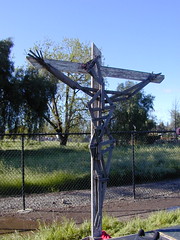
jesusof the fence!
1. Good Friday service outside Livermore Lab where nukes are invented

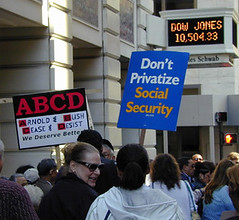
2SSdowscaled
2. Rallying against Social Security Privatization
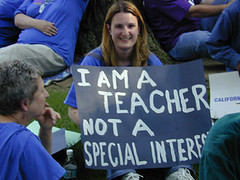
rallysignteacherforsmall
3. Labor takes it to Arnold's doorstep in Sacramento
4Aquinnahcliffs
4. Hiroshima remembered.

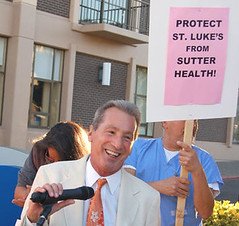
5Tom-St. Lukes
5. Sutter Health threatens to close St. Luke's Hospital; community speaks out.

6. frontdoor
6. The law, in its majestic equality, forbids the rich as well as the poor to sleep under bridges…

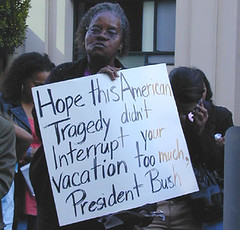
7Oaktownnterrupt
7. Oakland rallies for New Orleans

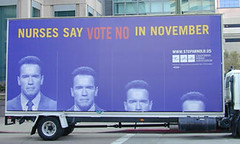
8incredibleshrinkingarnoldsm
8. Nurses rally against Governor Arnold

9robinsoncloseup
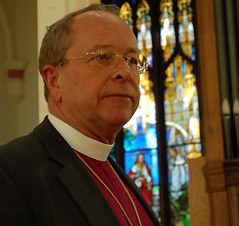
9. "Gay bishop" comes to town

10precinctwalk
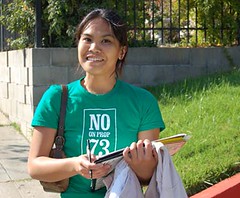
10. Precinct walk, Oakland, October 2005

11vigilingveteran
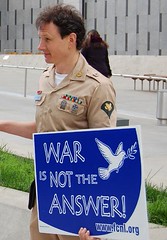
11. Federal building peace vigil

12Berkeleyagainsttorture
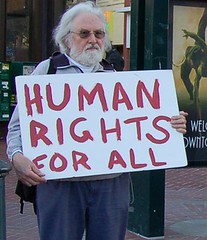
12. Standing up against torture

Hopefully 2006 will be a better year than 2005. With hard work, we can still make a difference to what "it" means.

Friday, December 30, 2005

Progress?

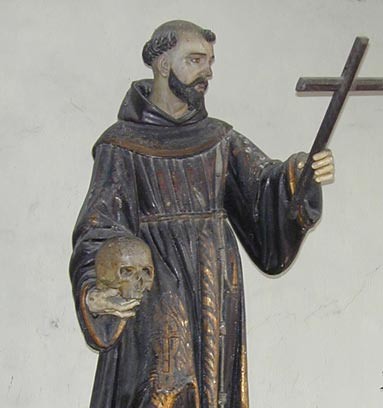
monkwskill
Apparently the Roman Catholic Church is backing away from the concept of limbo. Limbo is a medieval workaround for the theological problem created by the doctrine that all humans are born into a sinful condition. Left to ourselves, without baptism into the community of the Church, we sinful creatures are naturally condemned to hell. But infants frequently die without the opportunity for active sin -- or baptism. So progressives such as Thomas Aquinas proposed that that there must be a sort of boundary state, limbo, where deceased innocents would live in "natural happiness."

This sort of effort to parse eternity is out of fashion in contemporary thinking and theologians have been convened to discuss doing away with the notion. Rev. James O'Donnell, provost of Georgetown University and a professor of classics, describes their efforts as essentially saying:

"Let's progress back to ignorance rather than remain mired in assertion that brings with it perhaps more complication and more trouble than it is worth."

This seems like a good principle that might be applied to some other forms of thinking.

We could progress back to ignorance and admit we don't know what combination of hydrocarbon emissions and industrial by-products will so damage our environment as to change our ecosystem irreparably -- so perhaps we should be very cautious about introducing any more of these pollutants.

We could progress back to ignorance and admit we don't know when life begins -- and people of good intention may differ. We could then work to make the lives of those who are unequivocally alive as conducive to both justice and kindness possible.

We could progress back to ignorance and admit we also don't quite know when life ends -- and so people of good intention may differ. RIP Terry Schaivo and all those others whom some would condemn to a "living" limbo.

Hat tip to The Revealer.

Thursday, December 29, 2005

My mother's spam


My mother never took up computing, but she sure gets spam's predecessor, junk mail. That wouldn't be surprising or disturbing, except that she never lived at my address, where the mail arrives -- and she has been dead for nearly six years.

She was a charitable person who gave small sums to numerous nonprofits in response to what she called "begging letters." After she died, I put in a change of address so as to catch any important mail -- and dutifully marked "deceased" and returned every piece of first class mail. But some outfits never give up (and have lousy list management.)

For the last month, I've kept all the items that came to Mother. Here's the tally of the unsolicited and irrelevant:

America's Second Harvest, national office -- two pieces. They sent her address stickers and implored that she "help stop hunger at the holidays."

Meals on Wheels, Western New York affiliate -- also two pieces. One of them is a brown paper bag that reminds me the ones we put used tampax into in high school. The outside reads "the contents of this little bag can save an elderly person's life."

Martin de Porres House -- one letter. This free food program in San Francisco is a list I put Mother on. I know they know better -- they sent a condolence card when she died, but their database is primitive.

United Negro College Fund -- one appeal. "Emergency Hurricane Katrina Update." It is nice to know that Mother would almost certainly have given to that one.

Buffalo Zoo -- one brochure. "Get your tail to the zoo!"

Planned Parenthood, national office -- one appeal. "Survey and petition to Congress enclosed." Yeah sure, but she would have been there for PP.

The true spam gem yielded the illustration above. An outfit called "Help Hospitalized Veterans -- Saluting America's Heroes" sent a cover letter by General Tommy Franks, a check for one dollar and a request that she tear up the check and send them money. The five piece fundraising package must have cost nearly two dollars each, even if they sent out several million, which they probably did.

All these solicitors are mere beginners in persistent irrelevance though, compared to the National Wildlife Federation. They sent my father two pieces of mail that included holiday cards, a note pad and address labels in his name. He has been dead 14 years.

Wednesday, December 28, 2005

California anti-gay initiatives on hold

okaytobegay
Detail from mural painted outside a high school in San Francisco. Somewhat to my amazement, it has survived without being defaced for several months.
Good news for California gays today -- forces aiming to qualify initiatives to ban gay marriage have backed off for the moment. The "ProtectMarriage.com" set, a Focus on the Family front group, collected only half the signatures it would have needed to get its measure on the June 2006 primary ballot. Another lot, "VoteYesMarriage.com," this one a front for Lou Sheldon's "Traditional Values Coalition," didn't even get to the signature gathering stage. Both vow to come back and maybe they will, but for the moment, things are going well for the forces of tolerance.

On gay marriage, the longer it takes opponents to get organized, the weaker they will get. The San Francisco marriages celebrated in 2004; the passage of a gay marriage bill by the legislature in 2005 (vetoed by Schwarzenegger); the decision by a state court saying the California constitution forbids discrimination against gay marriage (now on appeal); and the numerous legal gay marriages in Massachusetts and many parts of Europe -- all these developments have helped indifferent voters become used to the idea that the sky won't fall if the queers get married. Current polling is very encouraging:

Since the passage of [the anti-gay marriage statute] Proposition 22, [Mark] Baldassare, [research director of the Public Policy Institute of California] said, Californians appear to have gradually softened their views on same-sex marriage.

In 2000, polls showed that only 38% of likely voters in California supported same-sex marriage. But a poll this August showed 46% supporting it and 46% opposing. Among all California adults, 44% favored same-sex marriage and 48% opposed it, he said.

Time is on the side of gay marriage.

The leaders who have worked to organize Equality California, the gay campaign to defeat the marriage bans, warn that this setback for the reactionaries may be temporary. And the anti-gay folks do vow that they'll raise the money to get their initiative on the November ballot. But if they do, they'll be running into some complicating, countervailing California Republican politics.

Governor Arnold certainly does not want a gay marriage vote in November. He is struggling to win back centrist independents and conservative Democrats whose support he frittered away in the last year. At the same time he needs California's extremely conservative Neanderthal Republicans. Having to declare for or against gay marriage is the last thing he needs in a difficult re-election.

Crucially, Attorney General Bill Lockyer has determined (and his interpretation would be part of the ballot language) that both the proposed initiatives would roll back existing domestic partnership law. Proponents of the measure that is not yet out for signature collection say their law would have no such legal effect. But the AG's description will give opponents a strong handle against it.

As I've explored before, the AG's role in describing initiative measures makes it crucial that progressive Californians pay attention to who is running for this second tier statewide office. Lockyer is termed out in 2006. There are two declared Democratic candidates for the post: former Governor and Oakland mayor, Jerry Brown and Los Angeles City Attorney Rocky Delgadillo. Presumably Brown would be at least somewhat sympathetic to gay civil rights, though his Oakland tenure has not been exactly progressive. Delgadillo's campaign web site promotes his law enforcement credentials and makes no mention of his civil rights record. The candidate will be determined in a June primary. The Republican candidate is State Sen. Chuck Poochigian of Fresno, almost certainly no friend of inclusive gay rights.

Supporters of marriage rights for gays need to press all the AG candidates to express clear positions on their understanding of how such a reform might be accomplished and generally get them on record in anticipation of battles to come.

Tuesday, December 27, 2005

I'm a herd animal:
the meme of four

Four jobs you’ve had in your life:
Answering service operator; taper of particleboard edges in a furniture factory; magazine distribution manager; professional outside agitator (and four is only a small selection of the possible answers.)

Four movies you could watch over and over:
None. Don't do movies.

Four places you’ve lived:
Buffalo, NY; Cape Town, South Africa; Boston, MA; New York
City

Four TV shows you love:
College football; NFL football; Olympics (summer and winter); Tour de France

Four places you’ve been on vacation:
Mt. Kilimanjaro; Belize; Peruvian Andes; Martha's Vineyard

Four websites you visit daily
Gilliard
k/o
Just World News
Body and Soul

Four of your favorite foods:
Ahi Tuna; brown rice; Vietnamese sautéed eggplant and shrimp; macaroni & cheese

Four places you want to see:
Patagonia; Galapagos Islands; Nepal; Australia

Four books you could read over and over:
I, Claudius by Robert Graves; The Divine Comedy by Dante; Gaudy Night by Dorothy Sayers; The Lord of the Rings trilogy by JRR Tolkien. (These answers are a bit of a cop out, as I actually almost never read fiction.)

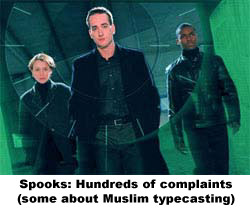
Of spying and being spied on


So now we're learning that federal spooks have been monitoring mosques, as well as businesses and homes of U.S. Muslims for suspicious radiation. I think John Emerson at Seeing the Forest understands this one rightly: the Bushies are leaking about this program because they know that most folks won't mind a little dubiously legal, warrantless, peeking into the secret doings of putatively brown people who practice a "foreign" religion.

Unfortunately, this kind of stuff has always been what police agencies do to the enemies of the moment. Been there; seen that.
  • There was the time in the 80s when my partner was speaking on the radio by phone about an upcoming, legal, public protest of government policies in Central America; as soon as she hung up the local police called on a number that she never announced asking for more details.
  • Later she told me she would call a student activist at a local college about demonstration plans; seconds later, she picked up the phone and found that woman already on the line. Neither had dialed; each had spoken aloud about calling the other.
  • Less humorously, soon after we arrived in South Africa to teach computer publishing to anti-apartheid newspapers, "roofers from the landlord" showed up to inspect our rented house from top to bottom. It later came out that a San Francisco leatherman acting out a spy fantasy had been selling Red Squad information he bought from a corrupt cop to the South African secret police.
Spying, both competent and inept, on potential opponents is what police agencies do.

The purpose of the spying is as much intimidation as information. White, middle-class people can laugh this stuff off. Muslim immigrants forced to do a turn as objects of our fears can't.

Alamdar S. Hamdani, a Texas lawyer describes how the spook work plays out among his clients:

For more than four years I have watched FBI agents pose inappropriate questions to my clients. In the name of the War on Terror, agents have questioned thousands of Muslims, often U.S. citizens, in violation of the First Amendment of the Constitution.

These agents have approached Muslims in their homes, businesses, and even places of worship, as part of intelligence gathering missions in reaction to 9/11. …For instance, because two Muslim men, both of them U.S. citizens speaking with Arab accents, complained to an apartment manager about the apartment complex's sales staff, the FBI approached the men. During the interview the agents asked about what occurred at the complex, but also attempted to ask the men which mosque they attended, who else attended that mosque, whether they prayed five times a day, what their political views were and whether they were Sunni or Shiite.

Asking such questions without a compelling reason places an impermissible "chilling effect" on First Amendment activities such as the rights to free speech or free association. In other words, agents often insinuate that because a person belongs to a particular religious group or holds a particular belief, that that person is somehow involved with terrorist groups.

Couple that suspicion with confused interviewees who speak English as a second language, and people can become afraid of attending a mosque or voicing political views. Worse yet, they are sometimes detained for simply misunderstanding a question.

Legal rights must seem a mirage to communities routinely subjected to this stuff.

Fortunately, some do find ways to laugh:

In other news, KABOBfest's team of investigative reporters have discovered that the federal government has also been surveilling the sewage pipes coming from Muslim houses. …

Read the rest here.

Monday, December 26, 2005

Christmas postmortem: spending snapshot


My partner and I celebrated the Great Amurrican Consumption Holiday in an intentionally modest style.

Between us, we spent $663 on gifts, including those to each other. The total was probably (though not certainly) lower because she knitted some of them; I have included the cost of the yarn. Oddly, it is not easy to find a figure for average adult per capita Christmas gift spending in the United States. However, a figure of CAN$736 is frequently cited for Canada in 2004. That converts to $630 in US dollars -- so two of us barely exceeded that norm for one.

We also spent $70 on food for a couple of Christmas gatherings, including the feast in our parish after 11 p.m. Mass on the 24th. And each of us thought we could use some new clothes for the occasion to a total of $229. (She probably won't purchase in this category again until next Christmas; I am not quite so careful.)

The grand total for the holiday was $962 for two middle-aged, economically comfortable adults.

That figure strikes me as astronomically excessive, but I realize that I am mostly reacting to the dollar figure, not necessarily the value of the money. In order to think about this more, I created the chart above so as to think about what this much spending would have meant in previous times. Click on the image for a larger version.

I started with 1908, my mother's date of birth. If her parents had been celebrating a similar Christmas, they would have spent $48.10! By the time my partner's parents were born, that figure would have been up to $60.61. When my parents married in 1933, at the depths of the Great Depression, that figure had only risen to $64.45. However, by the time I was born, in 1947, World War II had kicked off some serious inflation. The same Christmas costs would have been $110.63. By 1970, currently often used by economists as a benchmark year for the dollar, the cost would have been $193.36. The Vietnam war had caused a lot more inflation. And from there, it has been up, up and away.

Inflation really took off after 1970; but real prices did not necessarily rise. I doubt very much that we could have gotten the quantity or even quality of clothing items we bought in the last few weeks for $46.03 in 1970. Some items may cost more, but cheap imports made by grossly underpaid labor keep U.S. real prices low.

I'm not sure what any of this means, except that it is interesting to add a time dimension to a snapshot of our spending. You can find the formulas for comparing the value of the dollar in various years here. (Excel file.)

Saturday, December 24, 2005

A gift at Christmas

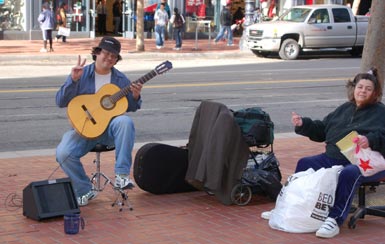
3streetpartnersweb

Among the other good folks I met on Market Street, this pair were some of the most cheerful.

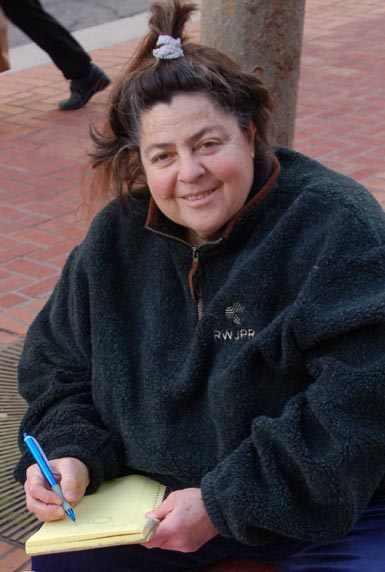
4letmesketchyouweb
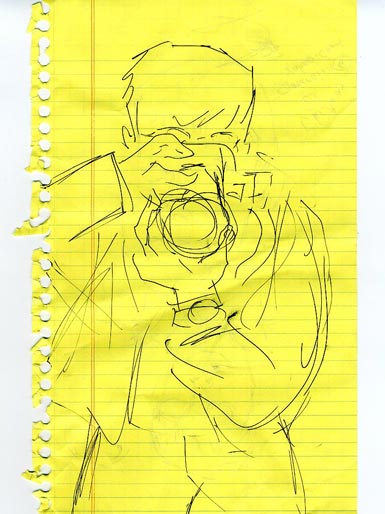
She asked, can I sketch you while you take those pictures?

Sketchweb
And this is her image of me. Merry Christmas, friend.

Christmas Eve on Market Street

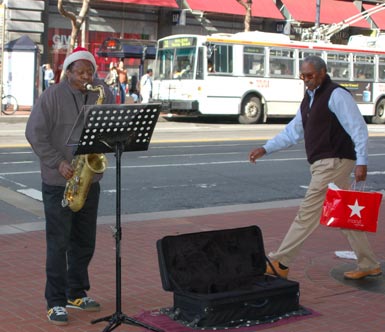
1playing-up-a-stormweb

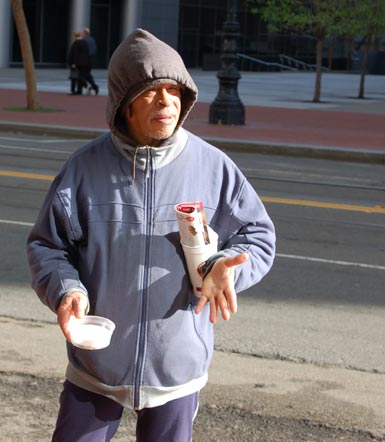
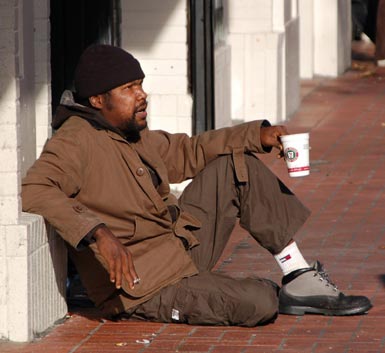
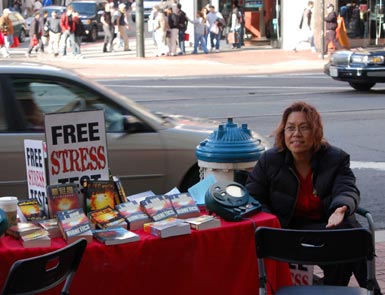
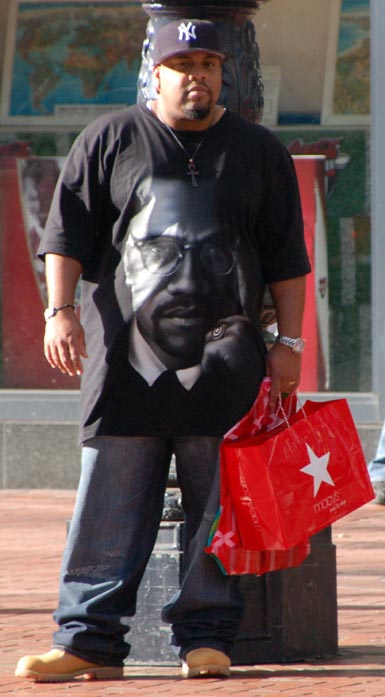
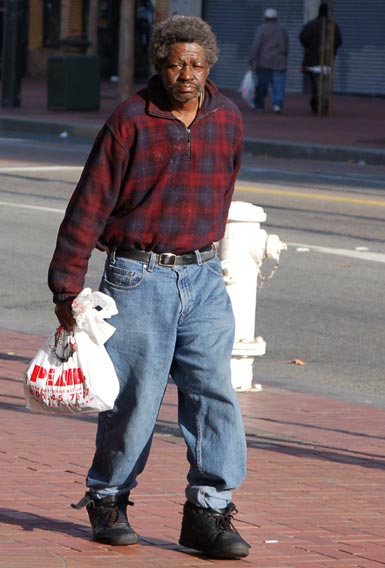
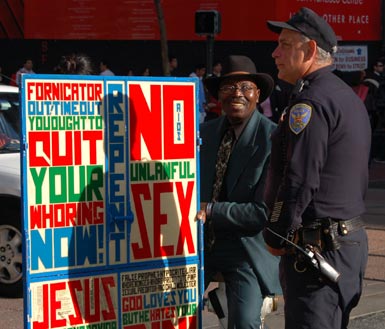
This afternoon I rode BART (the subway) to Powell Street (downtown San Francisco) and walked south on Market Street to the next BART stop at Civic Center. Here are some of the people I saw:

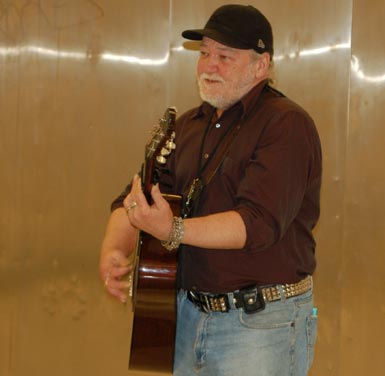
2singinginbart2web
This gentleman was inside the BART stop, not the most trafficked spot, but interestingly, one where you could actually hear his music.

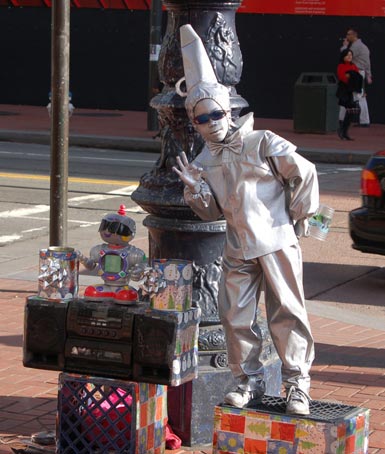
7tinmanwantstipsweb
Some folks were working really hard for their money. Several of those watching wondered whether this was child labor, but the little guy was clearly enjoying hamming it up.

13pleasehelpweb
Asking for money on the street is hard work. I mean that; I've done it.

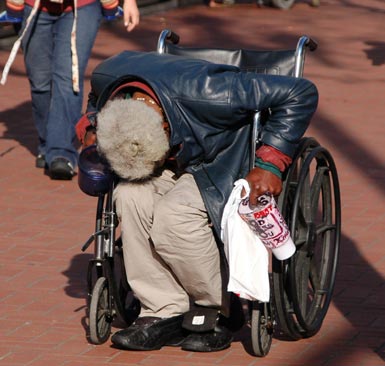
14sittingbeggarweb
Some weren't working quite so hard.

5outtogetyouweb
Some folks had their own dubious products to sell.

8shopperweb
Others had just been to Macy's.

9goingaboutmybusinessweb
And some were just going about their business.

10friendschattingweb
Some are regulars, on the street everyday.

6regularresidentsweb
More regulars.

11boweddownbyitweb
For some the street seems to have won.

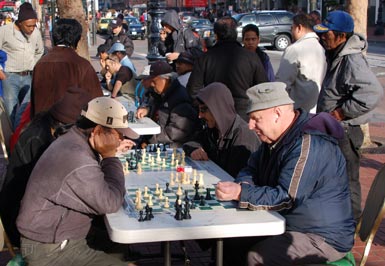
12chessplayersweb
Others gather for a good game of chess.

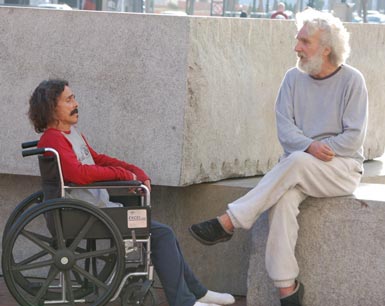
15friendsconversingweb
While others share a conversation.