Showing posts with label Germany. Show all posts

Thursday, October 09, 2025

Doing what could be done when the worst came

At a mass meeting in San Francisco working on responses to the Trump presidency last March, I was hanging about in the back of what felt like a repetitive session. A man who I recognized from many such gatherings and demonstrations, but had never spoken with, approached me to chat. He turned out to be Bruce Neuburger; he handed me a card about his recently released book Postcards to Hitler: A German Jew's Defiance in a Time of Terror, published by Monthly Review Press. This is a small press book very much worth searching out. 

A print copy can be found from Powells, an audiobook (that's what I read) from Audible. The San Francisco Public Library was also my source for a copy. 

Bruce Neuburger has created a vivid history of the life and fates of his grandparents. Benno and Anna were prosperous middle class Jews living in Munich. Benno had served honorably, if without enthusiasm, as an over-age draftee in the German army in World War I. After that war, he built a business and invested in land. The family lived through the terrible postwar inflation of the 1920s and the political instability of the Weimar Republic. Times were sometimes bad -- and sometimes better -- for Germany's Jews and for Germans at large. When Hitler's Nazi movement came to power in 1933, the family could hope this was just another turn in twenty years of both prosperity and sporadic insecurity. 

Nazi rule proved enduring and lethal for Jews. Jewish life -- both business and family -- was forced into smaller and smaller crevices of the society. Some of the younger generation quite rapidly decided to flee the looming catastrophe. Benno and Anna's children were among the very few who escaped to real security in America -- the U.S. in the 1930s was not a welcoming destination for Jewish refugees. 

Benno held out a long time before listening to the entreaties of his children to join them across the Atlantic. By the time he was ready to uproot himself in 1939, German Jews had been forced into ghettos. Germany then invaded Poland, western Europe, and eventually Russia. Benno expressed his secret confidence to his friend that Germany would lose the war -- but he had lost all chance of escape.

And so he performed the one solitary act of resistance he could imagine: he wrote postcards denouncing Hitler and the Nazis and dropped them in the postal stream. This wasn't effectual, or even meant to be -- there were no addressees. But Benno had found a tiny way to speak his necessary truth. The book offers an imagined account to the first time he dared to do this:

At the corner, a young woman appeared. Benno looked down. He had an urge to turn away but thought that would look suspicious. The woman looked at him as she passed the corner. 
Did she see the star? [the mandatory star of David sewn on his jacket] All he was sure of was that the mark was doing what it was meant to do -- rob him, rob Jews, of their last remnant of dignity. ... 
[Benno Neuburger] looked down at the words he'd written in large letters where an address would normally be: "THE ETERNAL MASS MURDERER, HITLER, I SPIT ON YOU!" He put the card in the mailbox, turned, and walked back to his apartment. 
It took nearly a year for the Nazi postal service to figure out who was carrying on this treacherous practice. But he was caught, imprisoned, tortured, and, perhaps because of his veteran status, brought to trial rather than being summarily shot. A full judicial record survived which formed some of the raw material for his grandson's book.

The Nazi judicial records from the Berlin People's Court concluded:

Benno Israel Neuburger has been executed on Sept. 18th, 1942. The convicted offender denigrated the Fuhrer, and the National Socialist government and committed high treason against the German Reich.
The Reich Ministry of Justice ordered fifty bright red posters announcing the execution of Benno Neuburger to be put up at visible locations in Munich. 
Anna was killed the next day at the death camp at Treblinka, Poland. Bruce Neuburger makes no suggestion that the date of her murder had anything to do with the date of Benno's. The machinery of extermination just ground on for them both.

• • •

The author/grandson, Bruce Neuburger, makes no pretense of writing a conventional academic history. He certainly consulted as many sources as he could find. The reunification of Germany after the 1990 collapse of the East German Soviet-aligned state led to release of the judicial and other records which enabled him to discover particulars about his grandparents' murders in 1942. Neuburger canvassed surviving family members. Recent German historians have also found many lost details of German Jewish resistance to Hitler. 

On this information, Bruce Neuburger wrote a novelistic account of life and tragedy that honors the experience of his family and so many like them. He explains his aim and defends telling his family story his way:

In my effort to bring to life the people whose stories are told here and the social environment in which they lived, I have necessarily imagined situations and relationships beyond the facts that I acquired directly [through historical sources.] I have sought to use the knowledge I gained through extensive historical research and travel to reconstruct the drama of those times. I can promise you, the reader, that I have taken care to reflect the historical moments recounted here as accurately and truthfully as I can.
Ever wonder what it was like to live under, stand against, and die under Nazi rule? This is a book to be read, experienced, and pondered.

Tuesday, July 01, 2025

When freedom seemed possible ...

Does history really have "turning points? The more deeply one looks into it, the less apt that metaphor seems. Human history is a long flow of events, accidents, and choices that could lead in different directions, but which are never entirely dictated by what came before and are uncertain in what future they may portend. 

But, oh, are there moments when something epic seems to have come along!

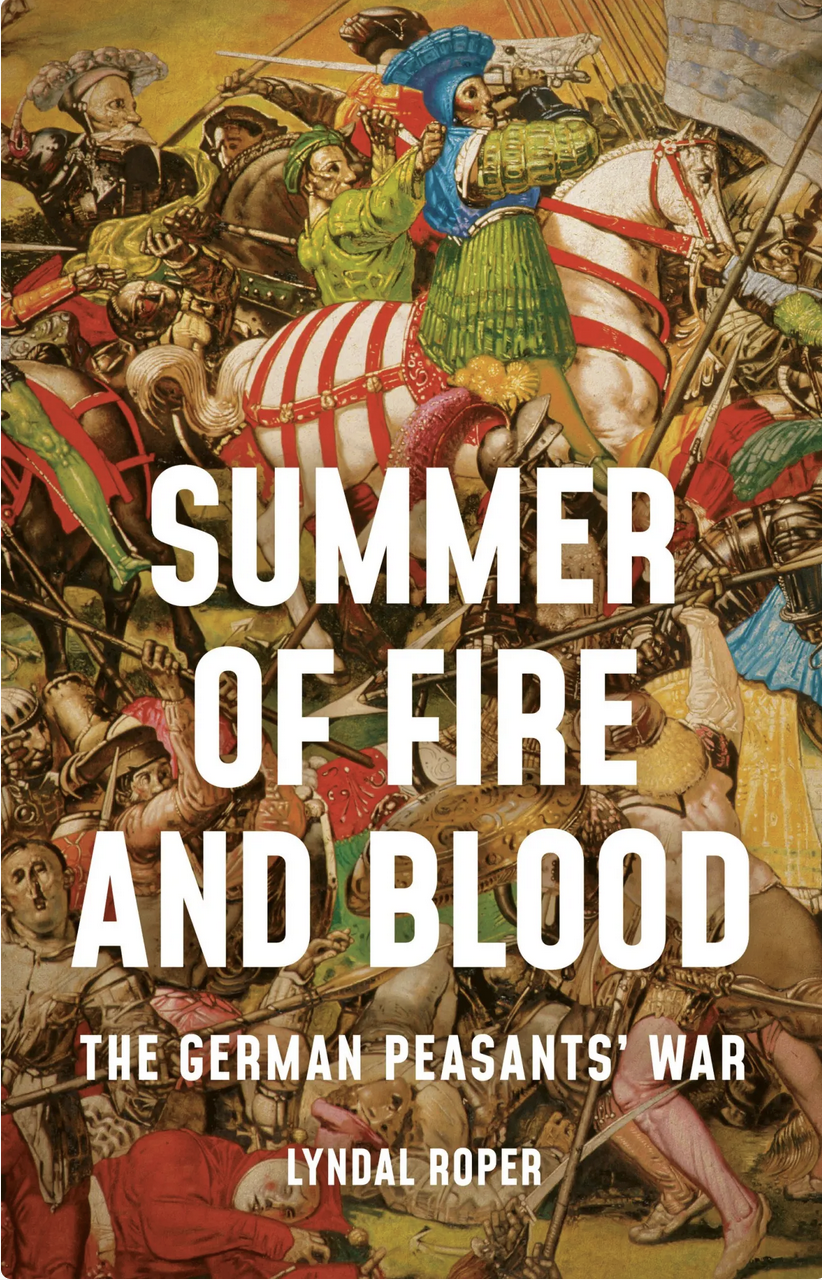
Summer of Fire and Blood: The German Peasants' War by Lyndal Roper, a senior Oxford historian revisits one such moment which, looking backward, we seem to periodically notice and then forget. In 1525, in the wake of Luther's destabilization of Western Christendom, in what is now modern Germany, peasants undertook to overturn feudal society and it looked for a moment as if their marching columns had succeeded. 

The German Peasants' War was the greatest popular uprising in western Europe before the French Revolution. ... Peasants massed in armed bands in one region, then another, and rebellions would break out even in areas far away. At its height it involved well over a hundred thousand people, perhaps many more, who joined with the rebels to bring about a new world of Christian brotherhood. And for several months they won. Authority and rulership collapsed ... People even began to dream of a new order. 

But this moment didn't last. ... The forces of the lords put down the revolt by slaying somewhere between seventy thousand and a hundred thousand peasants. ...

Insofar as the revolt can be said to have had an intellectual inspiration, Martin Luther's Freedom of a Christian published in 1520 served, despite Luther's quick repudiation of these ungoverned rebels. But the peasants, with input from other reforming clergy, created their own manifesto.

For them, freedom mean ending serfdom ... the peasants themselves ... formulated their complaints. The Twelve Articles then became a document that the movement everywhere acknowledged, even when the rebels didn't know exactly what the articles contained, and even though many areas revised them to suit local circumstances. Soon they were printed using the new technology made possible by the invention of moveable type, and they spread all over Germany. You could pick them up and hold them in your hand, point to each demand and the biblical passages that proved their godliness.

... The passions and dreams that drove the movement can seem inchoate, naive, and contradictory. ... this was not a movement driven by the literate few. It was a mass struggle by individuals who risked and lost their lives to try to bring about a new world. ...

The vision that drove them was about humans' relationship to creation. They were angry that lords claimed ownership of natural resources-- the water, the common land, the woods and forests -- when these were God's creation, given to all. They were enraged that the lords had stolen their freedom and claimed to own them when, as Luther showed, Christ had bought us all with his precious blood,"thus the Bible proves that we are free and want to be free." They were incensed by the growing inequality they saw around them ... They wanted men to live as brothers, in mutual obligation, not as lords and serfs. Theirs was an unabashedly male ideal, nourished by bonding amongst the peasant fighters, though that doesn't mean that women didn't support it too. They wanted decisions to be made collectively and to manage natural resources in a way that would respect the environment that God had created. ...

... for most of the war, the peasants were nonviolent; they humiliated but did not kill their lords. They questioned the established order at just the moment when capitalism was expanding and when Europeans were encountering new worlds, but they did not necessarily want to destroy authority of all kinds. Yet the authorities destroyed them, obliterated their movement, and built the structures of the current world on its ashes.

Roper's account of the peasants' brief but unprecedented revolt is detailed and granular. This is fascinating narrative history which for an American needs to be read alongside maps.

• • • 

The peasants' war is a huge historical event which 1) tends to be dropped from most accounts of early modern European history because its implications remain unclear, except that 2) Friedrich Engels brought a tendentious explanation of it to the fore in the context of articulating 19th century socialist thinking.

Roper's conclusion is her contribution to this historiography, to the academic theories and debates about what sort of frame in which to put the eruption. Here are some of those points, quotations from the book unless bracketed:

• ... [the peasants] were angry at how the lords treated them, but explaining the revolt in economic terms is not enough. Many richer peasants and even burghers joined the revolt ... if anything, conditions might have been improving as peasants engaged in markets and a long period of economic upswing continued after the Black Death. 

• ... the Reformation brought a religious transformation that did far more than legitimize or justify previous attacks on the abuses of feudalism; it brought a new vision of freedom, and of relations between human being as the environment. ... as some put it, all of us, rich and poor alike, are Christ's 'aigen,' his 'own', the same word as for serfs. 

• ... Marching together or taking over monasteries and convents allowed peasants to experience together a life of plenitude, where there was enough meat for all and more wine and beer than you could drink, a life of comradeship and brotherhood, not of dour monastic asceticism. These were ideals for which people were willing to fight. ... All could subscribe to the Twelve Articles, even those who did not know its specific contents. ... The rebels hatred of princes and 'top dogs' was now sealed in blood and gone was any reverence for rulers.

• ... the movement was held together by male bonding ... it is hard to know whether women would have felt included in their men's demands though the revolt could not have succeeded without women's support in running the farms and gardens their menfolk had left.

• ... the peasants' failure to bring the large towns in ... the cities were simply too populous, rich, powerful and well-armed to be seriously threatened by a peasant army.

• ... [yet] the peasants flattened the towers of lordship and wiped out the sacred geography of pilgrimage and monasticism. ... the war permanently undermined the power of the lesser nobility ...

• ... the ideas and dreams that had been formed in the war did not disappear but lived on in Anabaptism and in many varieties of radical thought. ... The war's legacy of blood desacralized lordship ... 

It's easy to think and feel that the present moment is another hinge point, a turning of some sort, what with climate change on top of the decay of Western capitalism and democracy. Maybe it is and maybe it isn't. But Roper's volume casts light on a time that felt and perhaps still appears to have been such a moment. I recommend it. 

Tuesday, May 06, 2025

We need boundaries and a new aspirational consensus

Once upon a time, it used to be possible to assume that most Americans had, if not a considerd opinion, still an instinctive revulsion against Nazis. Those were the bad guys ...

No more. Elon, his incel acolytes, and his fanbase get their jollies from playing at fascism. One has to assume that many of these guys (yes, they are mostly guys) know little of what they are aping, because there's no evidence they know much about anything. Elon may be a deeper case; the South African class and milieu from which he emerged was often authentically fascist as they struggled to hang on to their white European privileges over the nation's Black majority.

Thomas Zimmer is a German, a professor of contemporary history at Georgetown University. He knows a thing or two about fascism. He reports that many in German society are trying to hold the line against resurgent neo-Nazis:

News broke Friday morning that Germany’s domestic intelligence service is now officially classifying the AfD as a “confirmed rightwing extremist” group. The decision came after three years of investigating the party and was presented in a 1,100-page report. ...

Zimmer explains carefully that the Alternative for Germany (AfD) can be accurately called "neo-Nazi" by US readers. All the other German political parties, much as they oppose each other, agree not to work with the neo-Nazis which made electing a coalition Chancellor, the Conservative Friedrich Merz, a messy process. But German civil society got it done; for the time being, their neo-Nazis are excluded from power despite winning 20 percent of the vote in the last election.

No surprise -- JD Vance and the MAGAts love them some AfD and disdain Merz.

Zimmer then looks at what the rise of German neo-Nazis might imply about parallel developments in US politics: 

This is a remarkable moment in U.S. history. The fact that a movement that openly embraces the German Far Right, the party of German Neo-Nazis, was able to first take over the Republican Party and then the American government signals the complete dissolution of something we might call an anti-fascist consensus. 

The term is imperfect and perhaps even problematic. There was certainly never a universally shared consensus in America that the key elements of Nazi politics and ideology were bad. But there was nevertheless some agreement across the mainstream political spectrum that America had fought a righteous and noble war against Hitler. American society celebrated and revered its “Greatest Generation” and the soldiers who defeated the Nazis; American popular culture used the Nazis as a representation of ultimate evil. Anyone openly siding against this agreement would have had to expect to pay a price – politically, socially, and culturally. 

In post-1945 America, this was obviously never enough, in and of itself, to turn the nation from a racial caste system to a fully realized multiracial, pluralistic democracy. But it did provide those who desired egalitarian pluralism with a strong argument they could deploy in their struggle against rightwing extremism – it helped police the boundaries of what was considered acceptable within mainstream politics and “respectable” society.

That is evidently no longer the case. MAGA is now in power. This breakdown of boundaries did not happen overnight. It took decades for the most extreme factions to pull the entire “conservative” coalition further and further to the Right – and for the more moderate people, all those who might have objected to the idea of supporting German Neo-Nazis, to be ostracized. 

It will likely take decades to get the country out of this mess, which requires not just political change, but a fundamental reform of political and social culture. If a stable democracy that deserves the name is ever to emerge from this, America will have to restore some boundaries. We need to reimagine an anti-fascist consensus not in service of a purely restorative project, but as a reminder of the nation’s egalitarian aspirations, as a plea to finally defeat those anti-democratic forces in our midst and push America forward. 

You are siding with the German Neo-Nazis? That makes you the bad guys. In a society that cannot hold even that basic line, democracy stands little chance.

I'm up for giving democracy a chance. No more MAGAts and Nazis!

Sunday, November 28, 2021

A new German government, climate crisis, and migration

Economic historian Adam Tooze has passed along elements of the platform adopted by the "traffic-light coalition" composing the newly elected German government. Angela Merkel's Christian Democrats are out. The Social Democrats (the red element), the Greens, and the Free Democratic Party (the cautionary yellow right of center), are in. Olaf Scholz is the new Chancellor -- federal Prime Minister, roughly speaking. 

For anyone who retains an impression of Germany as a the homeland of European regressive nationalism and conservatism -- and after Nazism how could we not? -- this description of the German government's intentions is simply stunning:

“We are united by an understanding of Germany as a diverse society of immigration.” 
In the 1970s-1990s, when the current generation of German leaders were growing up, any such statement would have been politically explosive. 
They continue: “Migration has been and is today a part of the history of our country. Immigrants, their children and grand-children have helped to build our country and shape it. The 60th anniversary of the guest-worker treaty with Turkey is symbolic of that.” 
Like the last Red-Green government, this one promises to modernize Germany’s citizenship laws. This time it will permit multiple citizenship. Naturalization will normally occur after 5 years, or 3 years in the case of exceptional integration performances (sic) (Integrationsleistungen) ... 
Any mention of the concept of ‘race’ will be expunged from the German constitution.
Outgoing Chancellor Angela Merkel nearly capsized her government by responding generously to the refugee crisis created by war in Syria. The increasing strength of the proto-Nazi ADF party followed; Merkel was forced to backtrack. The new coalition appears ready to try again to incorporate migrants.

Tooze identifies the underlying and urgent emergency that this new German coalition understands:

This is a government that embraces the climate challenge and has the political backing to do something about it. It has no excuses. Germany is pivotal to Europe’s climate ambitions. And, more generally, the success or failure of this government will tell us a lot about the capacity of sophisticated democracies around the world to adapt to our 21st-century polycrisis.
Climate change prompts new challenges to states and to modern civilization itself from the natural world -- drought, fire, frost, flood, pestilence, and more. Climate change makes civil society and governments unstable. Climate change leads to forced human migration and increased flows of refugees at national borders. These are the great challenges of the 21st century.

• • •

This banner hung on Madrid's City Hall. Why in English?, I don't know. Spain serves as a major entry point for migrants to the European Union, often unwillingly.
British politician David Miliband heads the International Rescue Committee which provides aid to people affected by humanitarian crises all over the world, including people displaced by climate crisis. Founded by the refugee Albert Einstein, the organization got its start in Europe during World War II providing assistance to displaced people. Miliband told the Washington Post that people in the United States could use some simple education about the world's migration challenge.

What do you think people tend to misunderstand about refugee crises, about refugees? 
It’s really important that those of us in America or Europe remember that nearly 90 percent of the world’s refugees are in poor countries, not in rich countries. It’s a myth that Western Europe or the U.S. are bearing an unsustainable burden of refugees; the vast bulk of refugees are in low- or middle-income countries.  
Myth number two is that refugees are displaced for a short period of time, when in fact the averages are closer to 20 years than five.  
Myth number three — this not a short list — is that this is all about young men on the move, when it’s families, with about half of the world’s refugees under the age of 18.  
And myth number four is that refugees are in camps, whereas we know that 60 percent of refugees in the modern era are in urban areas — like Beirut, Istanbul, Islamabad. 
... So we need to change the way we do humanitarian aid. We need to provide education as much as we need to provide water and sanitation. And we’re very clear that a feminist approach is important, not just because two-thirds of our clients are women and girls, but because women and girls face double, triple, multiple vulnerabilities and inequalities, that the structures of power that face them are deeply unequal, and we need to take that into account.
There is nothing in the way the world is currently organized that suggests that the world will see fewer refugees in coming years. Local and international conflicts over power and resources will force people to flee. Climate change guarantees more people will be leaving their homes, both voluntarily and involuntarily. Those of us lucky enough not to be displaced, those of us in rich countries, need to face up to this prospect and figure out what we can do for the less lucky. Our own countries can become better for a well-managed, humane migration influx.