Showing posts with label refugees. Show all posts

Thursday, October 09, 2025

Doing what could be done when the worst came

At a mass meeting in San Francisco working on responses to the Trump presidency last March, I was hanging about in the back of what felt like a repetitive session. A man who I recognized from many such gatherings and demonstrations, but had never spoken with, approached me to chat. He turned out to be Bruce Neuburger; he handed me a card about his recently released book Postcards to Hitler: A German Jew's Defiance in a Time of Terror, published by Monthly Review Press. This is a small press book very much worth searching out. 

A print copy can be found from Powells, an audiobook (that's what I read) from Audible. The San Francisco Public Library was also my source for a copy. 

Bruce Neuburger has created a vivid history of the life and fates of his grandparents. Benno and Anna were prosperous middle class Jews living in Munich. Benno had served honorably, if without enthusiasm, as an over-age draftee in the German army in World War I. After that war, he built a business and invested in land. The family lived through the terrible postwar inflation of the 1920s and the political instability of the Weimar Republic. Times were sometimes bad -- and sometimes better -- for Germany's Jews and for Germans at large. When Hitler's Nazi movement came to power in 1933, the family could hope this was just another turn in twenty years of both prosperity and sporadic insecurity. 

Nazi rule proved enduring and lethal for Jews. Jewish life -- both business and family -- was forced into smaller and smaller crevices of the society. Some of the younger generation quite rapidly decided to flee the looming catastrophe. Benno and Anna's children were among the very few who escaped to real security in America -- the U.S. in the 1930s was not a welcoming destination for Jewish refugees. 

Benno held out a long time before listening to the entreaties of his children to join them across the Atlantic. By the time he was ready to uproot himself in 1939, German Jews had been forced into ghettos. Germany then invaded Poland, western Europe, and eventually Russia. Benno expressed his secret confidence to his friend that Germany would lose the war -- but he had lost all chance of escape.

And so he performed the one solitary act of resistance he could imagine: he wrote postcards denouncing Hitler and the Nazis and dropped them in the postal stream. This wasn't effectual, or even meant to be -- there were no addressees. But Benno had found a tiny way to speak his necessary truth. The book offers an imagined account to the first time he dared to do this:

At the corner, a young woman appeared. Benno looked down. He had an urge to turn away but thought that would look suspicious. The woman looked at him as she passed the corner. 
Did she see the star? [the mandatory star of David sewn on his jacket] All he was sure of was that the mark was doing what it was meant to do -- rob him, rob Jews, of their last remnant of dignity. ... 
[Benno Neuburger] looked down at the words he'd written in large letters where an address would normally be: "THE ETERNAL MASS MURDERER, HITLER, I SPIT ON YOU!" He put the card in the mailbox, turned, and walked back to his apartment. 
It took nearly a year for the Nazi postal service to figure out who was carrying on this treacherous practice. But he was caught, imprisoned, tortured, and, perhaps because of his veteran status, brought to trial rather than being summarily shot. A full judicial record survived which formed some of the raw material for his grandson's book.

The Nazi judicial records from the Berlin People's Court concluded:

Benno Israel Neuburger has been executed on Sept. 18th, 1942. The convicted offender denigrated the Fuhrer, and the National Socialist government and committed high treason against the German Reich.
The Reich Ministry of Justice ordered fifty bright red posters announcing the execution of Benno Neuburger to be put up at visible locations in Munich. 
Anna was killed the next day at the death camp at Treblinka, Poland. Bruce Neuburger makes no suggestion that the date of her murder had anything to do with the date of Benno's. The machinery of extermination just ground on for them both.

• • •

The author/grandson, Bruce Neuburger, makes no pretense of writing a conventional academic history. He certainly consulted as many sources as he could find. The reunification of Germany after the 1990 collapse of the East German Soviet-aligned state led to release of the judicial and other records which enabled him to discover particulars about his grandparents' murders in 1942. Neuburger canvassed surviving family members. Recent German historians have also found many lost details of German Jewish resistance to Hitler. 

On this information, Bruce Neuburger wrote a novelistic account of life and tragedy that honors the experience of his family and so many like them. He explains his aim and defends telling his family story his way:

In my effort to bring to life the people whose stories are told here and the social environment in which they lived, I have necessarily imagined situations and relationships beyond the facts that I acquired directly [through historical sources.] I have sought to use the knowledge I gained through extensive historical research and travel to reconstruct the drama of those times. I can promise you, the reader, that I have taken care to reflect the historical moments recounted here as accurately and truthfully as I can.
Ever wonder what it was like to live under, stand against, and die under Nazi rule? This is a book to be read, experienced, and pondered.

Tuesday, September 05, 2023

Women report from the wars

From Ukraine:

 
Kateryna Kibarova is a Ukrainian economist and resident of Bucha.
Recently, I read that the best warrior is the one who has lost everything. There was a story about a man in Odesa who went out for groceries at Easter. A rocket flew into the house and killed both his wife, his two-month-old baby, and, I think, the mother-in-law. He came back home to find his relatives—three generations—gone. And so he went to fight.

There are so many like him. It’s not only patriotism, but also boundless grief. It's like total courage—but it's different from when you are walking next to your mom as a child, and you're not afraid of anything. This is when you have so much pain inside, when you already know what pain—maximum pain—feels like, and you're not afraid of anything any more. This is a mix of anger, pain and aggression, all bubbling up in you.

I don't know of any punishment in the world that would be fitting for the people who are responsible for this. But I very much believe that the Russians will bear the consequences of their atrocities. They will be held accountable before God—and the Hague.

Africa encounters Saudi Arabia: 

Lydia Polgreen came up in journalism by way of years reporting from the civil conflicts of West Africa in the first decade of this century. Now from her perch at the New York Times editorial department, she insists that we not look away from reported Saudi massacres of refugee Ethiopians, desperately seeking to enter by way of war-torn Yemen:

We are living through a brutal new era of realpolitik, where might equals right amid a frenzy of global jockeying. This world has been very good to Saudi Arabia, a very rich and very important country by dint of its geography and natural resources. China brokered a deal between Saudi Arabia and its archenemy, Iran; and now the Biden administration seeks a grand bargain between the Saudis and the government of Israel. For the West, the dictates of our current moment are clear: Counter China. Contain Russia. Keep unwanted migrants out.
The Biden administration came to power with many promises and good intentions. Two years ago, speaking after the chaos of the necessary and long overdue withdrawal of American troops from Afghanistan, Biden declared: “I have been clear that human rights must be the center of our foreign policy, not the periphery.”
Biden made similar commitments about migrants. “If I’m elected president, we’re going to immediately end Trump’s assault on the dignity of immigrant communities,” he said in his acceptance speech at the 2020 Democratic National Convention. “We’re going to restore our moral standing in the world and our historic role as a safe haven for refugees and asylum seekers.”
I am certain that President Biden believed these words when he said them and believes them still. His administration is playing the hand it has been dealt. But as the events in the Saudi desert illustrate, this century is going to be nasty, brutish and long. ...

Photo via Human Rights Watch which made the story accessible in the US.

Saturday, September 17, 2022

This does my heart good

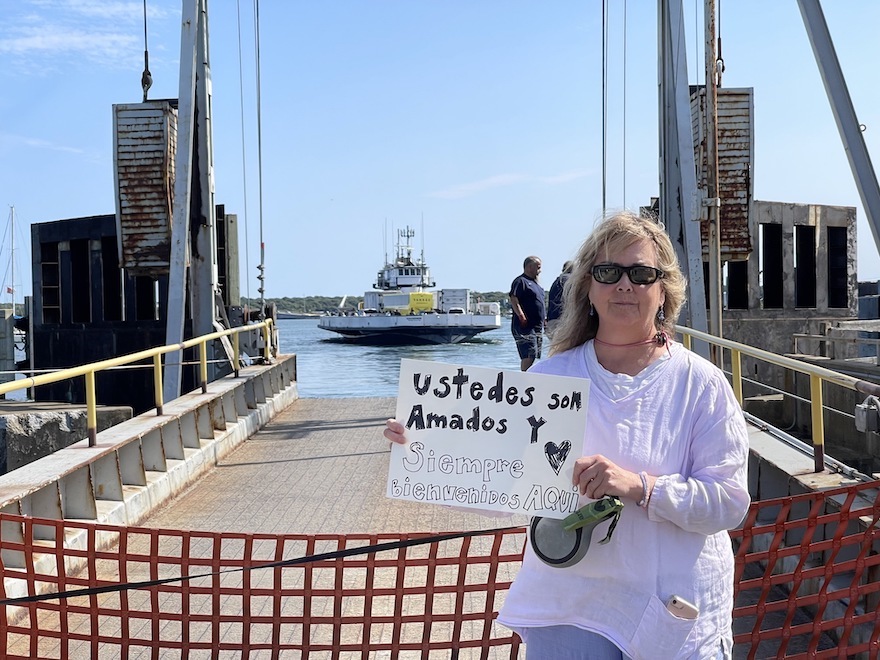
Martha's Vineyard can seem precious, just a little too pretty and bucolic to be true. But the people who choose to live on this New England outpost have heart. When bully boy Florida governor Ron DeSantis shipped to them a group of bewildered Venezuelan refugees, people knew what to do. In two days, new friends were made and clothed in the colors of the local high school. The state of Massachusetts then stepped up to do government's job, moving the people to a base on Cape Cod where they can be processed with access to immigration attorneys.

Photos by way of the Martha's Vineyard Times, all by Rich Saltzberg except as noted.

A young refugee embraces new found friend Sara Piazza.


Like most everyone else who leaves the island, the migrants departed on the ferry. Photo by Abigail Rosen

Nice to know that some people in these dis-United States still know how to behave when confronted with poverty and pain.

Michelle Norris gets the Island.

Yes, there are Land Rovers and yachts here, but the Vineyard is primarily an island of farms and fishermen, a year-round population that lives close to the land and in many cases works hard to make ends meet.

It’s an island that seesaws between overwork and underemployment. It’s a place where everything — gas, food, housing, toothpaste, you name it — costs more than it does on the mainland. It’s a place where 1 in 6 year-round residents is a registered user of the Island Food Pantry and one-third of schoolchildren receive free or reduced-price lunch.

It’s a place where organized groups go “gleaning” each week, picking produce left behind by farming machines so it can be used in the food pantry. ...

The Vineyard says to MAGA Republicans, cruelty to the weak is not who we are.

Friday, March 25, 2022

The Vindmans have a bit of an answer from President Joe

Lt. Col. Alexander Vindman came to public notice as the brave national security officer who testified to Donald Trump's plot to extort the Ukrainian president for dirt on the Biden family. He lost his career path for that one. His twin, Yevgeny Vindman, also a White House national security officer, was fired and marched out unceremoniously by the Trump regime.

The twins were born in Ukraine, but joined the Jewish exodus from the late Soviet Union and grew up in New York City, becoming patriotic citizens along the way.

Wednesday, Vevgeny posted a tweet imploring his country to welcome Ukrainian refugees from the Russian invasion. 

Weapons and humanitarian aid ✅. What about refugees? Are we accepting refugees entry into the US? Refugees and immigrants contribute enormously to our country.

Y. Vindman replied to the inevitable questions:

I’m the cuter one. @AVindman is the goofier one.

Thursday Joe Biden promised a small measure of welcome to Ukrainian refugees and aid to European countries bearing the main burden of this mass migration.

Bowing to domestic and international pressure, the United States announced on Thursday that it would accept up to 100,000 Ukrainian refugees into the country and would donate $1 billion to help European countries handle a surge of migrants fleeing Russia’s invasion.

The announcement comes as countries facing an exodus of some three million refugees have sought assistance from the United States, which has been engaged in its own struggle to absorb thousands of refugees from the war in Afghanistan.

... Earlier this week, in discussions in Washington, U.S. officials said they were considering bringing in Ukrainians with relatives in the United States under a streamlined family reunification process. Other Ukrainians deemed to be vulnerable, such as members of the L.G.B.T.Q. community, political activists and journalists, potentially would be considered for temporary protection, according to the sources.

The Vindmans and even the Times highlight HIAS and Razom for Ukraine as go-to places for charitable donations to help refugees.

• • •

The Times is kinder about our obligations to Afghans than I would be. Can we get Joe Biden to take seriously the plight of people who fled during and after our military belly flop at withdrawal? A good country is one that recognizes its debts.

Sunday, November 28, 2021

A new German government, climate crisis, and migration

Economic historian Adam Tooze has passed along elements of the platform adopted by the "traffic-light coalition" composing the newly elected German government. Angela Merkel's Christian Democrats are out. The Social Democrats (the red element), the Greens, and the Free Democratic Party (the cautionary yellow right of center), are in. Olaf Scholz is the new Chancellor -- federal Prime Minister, roughly speaking. 

For anyone who retains an impression of Germany as a the homeland of European regressive nationalism and conservatism -- and after Nazism how could we not? -- this description of the German government's intentions is simply stunning:

“We are united by an understanding of Germany as a diverse society of immigration.” 
In the 1970s-1990s, when the current generation of German leaders were growing up, any such statement would have been politically explosive. 
They continue: “Migration has been and is today a part of the history of our country. Immigrants, their children and grand-children have helped to build our country and shape it. The 60th anniversary of the guest-worker treaty with Turkey is symbolic of that.” 
Like the last Red-Green government, this one promises to modernize Germany’s citizenship laws. This time it will permit multiple citizenship. Naturalization will normally occur after 5 years, or 3 years in the case of exceptional integration performances (sic) (Integrationsleistungen) ... 
Any mention of the concept of ‘race’ will be expunged from the German constitution.
Outgoing Chancellor Angela Merkel nearly capsized her government by responding generously to the refugee crisis created by war in Syria. The increasing strength of the proto-Nazi ADF party followed; Merkel was forced to backtrack. The new coalition appears ready to try again to incorporate migrants.

Tooze identifies the underlying and urgent emergency that this new German coalition understands:

This is a government that embraces the climate challenge and has the political backing to do something about it. It has no excuses. Germany is pivotal to Europe’s climate ambitions. And, more generally, the success or failure of this government will tell us a lot about the capacity of sophisticated democracies around the world to adapt to our 21st-century polycrisis.
Climate change prompts new challenges to states and to modern civilization itself from the natural world -- drought, fire, frost, flood, pestilence, and more. Climate change makes civil society and governments unstable. Climate change leads to forced human migration and increased flows of refugees at national borders. These are the great challenges of the 21st century.

• • •

This banner hung on Madrid's City Hall. Why in English?, I don't know. Spain serves as a major entry point for migrants to the European Union, often unwillingly.
British politician David Miliband heads the International Rescue Committee which provides aid to people affected by humanitarian crises all over the world, including people displaced by climate crisis. Founded by the refugee Albert Einstein, the organization got its start in Europe during World War II providing assistance to displaced people. Miliband told the Washington Post that people in the United States could use some simple education about the world's migration challenge.

What do you think people tend to misunderstand about refugee crises, about refugees? 
It’s really important that those of us in America or Europe remember that nearly 90 percent of the world’s refugees are in poor countries, not in rich countries. It’s a myth that Western Europe or the U.S. are bearing an unsustainable burden of refugees; the vast bulk of refugees are in low- or middle-income countries.  
Myth number two is that refugees are displaced for a short period of time, when in fact the averages are closer to 20 years than five.  
Myth number three — this not a short list — is that this is all about young men on the move, when it’s families, with about half of the world’s refugees under the age of 18.  
And myth number four is that refugees are in camps, whereas we know that 60 percent of refugees in the modern era are in urban areas — like Beirut, Istanbul, Islamabad. 
... So we need to change the way we do humanitarian aid. We need to provide education as much as we need to provide water and sanitation. And we’re very clear that a feminist approach is important, not just because two-thirds of our clients are women and girls, but because women and girls face double, triple, multiple vulnerabilities and inequalities, that the structures of power that face them are deeply unequal, and we need to take that into account.
There is nothing in the way the world is currently organized that suggests that the world will see fewer refugees in coming years. Local and international conflicts over power and resources will force people to flee. Climate change guarantees more people will be leaving their homes, both voluntarily and involuntarily. Those of us lucky enough not to be displaced, those of us in rich countries, need to face up to this prospect and figure out what we can do for the less lucky. Our own countries can become better for a well-managed, humane migration influx.

Saturday, September 04, 2021

Simple courtesies

Most of us are not likely to encounter refugees from the shitshow the U.S. has stirred and left behind in Afghanistan. (San Francisco Bay Area residents may be slightly more likely than most to have the opportunity as there is a good-sized Afghan community in the South Bay.)

Sociologist Dr. Iman Ahmad-Sediqe has passed along a useful Twitter list of "micro aggressions" to avoid if you did meet newly arrived Afghans. It struck me that many of these suggestions would be appropriate to meeting anyone newly plopped in these disunited states regardless of their country of origin. The following are lightly edited for length. 

A list of micro aggressions to avoid with newly arrived Afghans: 
This is a delicate period of transition. As an Afghan American, & an academic who has studied the community, I urge you to avoid certain behaviors. These ... can be hurtful for our new neighbors.
1. Don't call them Afghanis. Afghani is the word for the currency in Afghanistan and is utilized as a slur by other communities against Afghans. The appropriate word for someone from Afghanistan is Afghan.

2. Don't ask an Afghan what their tribal background is. This is not showing interest in who they are, but rather displaying your interest in labeling them into a box.

3. Don't assume because they are refugees, that they are uneducated. Many are professionals whose degrees & accomplishments aren’t accepted in the American system, so they have to take up working class jobs in order to care for their families.

4. Just because they may speak with an accent, doesn’t mean they think with one— Some assume an accent means someone is intellectually inferior. On the contrary, these individuals are bilingual & can balance multiple languages. They simply communicate in a way you’re not used to.

5. Don’t ask them what their political views are on America. You don’t ask a neighbor who they’re voting for, it’s same courtesy. They’ve been through a more complex experience than you may be aware of and are focused on feeling a semblance of safety, not on trivial political ?s

6. Don’t ask if they’re Shia or Sunni. Assuming that the media portrayal of sectarian friction applies to them is false. Their personal experiences are much richer than that. Give them space to practice their religion however they feel comfortable. They just want to feel welcome

7. Don’t bring nationalism and racism into a discussion with them. They’re mourning the loss of their homes and social networks. They don’t want to hear about your political opinions. They’re not responsible for the refugee crisis.

8. Don’t assume one individual is representative of every Afghan & every Afghan’s experience. This is an unfair burden to carry, & would be akin to a foreigner meeting one American & assuming he represents the entire country.

9. Don’t expect them to immediately feel comfortable with you or trust you. The emotional toll they are experiencing is intense. Building relationships for them will take time....

12. Do NOT expect a personal thanks from them. Their homes were destroyed, their lives at risk, and their families torn apart. Providing humanitarian aid should not be done expecting a thanks. They don’t owe you anything.

13. Do NOT preach your religious perspectives to them (regardless of what religion you’re from). This is awkward & uncomfortable, even if you are from the same religion. If it’s a social taboo to discuss religion with guests, the same applies here…

13. (Continued)…They are preoccupied with feelings of loss, PTSD, & worries of resettlement. Give them the grace of space to not get into heavy topics or feel imposed upon.

15. Don’t feel a need to give them a personal crash course on America. Let them ask you questions. If there’s something you notice that would be helpful for them to know, approach someone who they are comfortable with to discuss it with them one on one in private…

15. (Continued)… Do not humiliate an adult by correcting their behaviors publicly. There are cultural norms they’re learning.
What other tips might readers have to offer for welcoming newcomers ... any newcomers?

Afghan refugees do need community support. Jewish Community and Family Services - East Bay has been on the job resettling displaced Afghans for years and offers a good window on their needs.